Berkeley, Grantley FitzhardingeBiblio.com

2 955 résultats
1164922378.Gpaperback. Good. Access codes and supplements are not guaranteed with used items. May be an ex-library book. paperback
1241390800.Gpaperback. Good. Access codes and supplements are not guaranteed with used items. May be an ex-library book. paperback
1241388873.Gpaperback. Good. Access codes and supplements are not guaranteed with used items. May be an ex-library book. paperback
1437123511.Gpaperback. Good. Access codes and supplements are not guaranteed with used items. May be an ex-library book. paperback
1145606938.Gpaperback. Good. Access codes and supplements are not guaranteed with used items. May be an ex-library book. paperback
0130085324.Gpaperback. Good. Access codes and supplements are not guaranteed with used items. May be an ex-library book. paperback
1778500889.Gpaperback. Good. Access codes and supplements are not guaranteed with used items. May be an ex-library book. paperback
1356959806.Ghardcover. Good. Access codes and supplements are not guaranteed with used items. May be an ex-library book. hardcover
3337309291.Gpaperback. Good. Access codes and supplements are not guaranteed with used items. May be an ex-library book. paperback
1023531801.Ghardcover. Good. Access codes and supplements are not guaranteed with used items. May be an ex-library book. hardcover
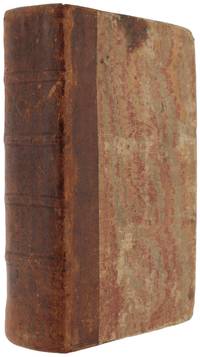
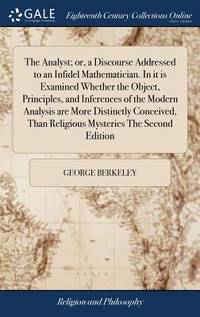
17346310London: printed for Jacob Tonson 1734. First edition. <p>Rare first edition first issue of Berkeley's renowned critique of Newton and Leibniz's calculus famously described by historian Florian Cajori as "the most spectacular event of the century in the history of British mathematics." Contemporaneously bound with Berkeley's influential Theory of Vision 1733 his Defence of Free-Thinking in Mathematics 1735 and five additional pamphlets.</p>. <p>BERKELEY'S FOUNDATIONAL CRITIQUE OF THE CALCULUS</p> . <p>First edition of Berkeley's famous attack on the calculus of Newton and Leibniz which the historian Florian Cajori described as "the most spectacular event of the century in the history of British mathematics" History of the Calculus p. 57 bound with Berkeley's important Theory of Vision 1733 and Defence of Free-Thinking in Mathematics 1735 and five further pamphlets. "The Analyst is a criticism of the calculus in both its Newtonian and Leibnizian formulations arguing that the foundations of the calculus are incoherent and the reasoning employed inconsistent. Berkeley's powerful objections provoked numerous responses and the task of replying to them set the agenda for much of British mathematics in the 1730s and 1740s" Jesseph p. 121. Perhaps the most famous passage in the book p. 59 and a vivid example of Berkeley's wit is his response to the idea that fluxions could be defined using ultimate ratios of vanishing quantities: 'It must indeed be acknowledged that Newton used Fluxions like the Scaffold of a building as things to be laid aside or got rid of as soon as finite Lines were found proportional to them. But then these finite Exponents are found by the help of Fluxions. Whatever therefore is got by such Exponents and Proportions is to be ascribed to Fluxions: which must therefore be previously understood. And what are these Fluxions The Velocities of evanescent Increments And what are these same evanescent Increments They are neither finite Quantities nor Quantities infinitely small nor yet nothing. May we not call them the Ghosts of departed Quantities' Modern historians have argued that the expression 'Ghosts of departed Quantities' was intended to address both Leibnizian infinitesimals and Newtonian fluxions. "Berkeley's attack on the calculus pointed out real deficiencies . his attack was also incisive witty and infuriating. Many mathematicians were moved to try to answer it. In fact several important eighteenth-century discussions of the foundations of the calculus can be traced back to Berkeley's attack. For instance Maclaurin's monumental two-volume A Treatise ofFluxions began as a reply to Berkeley. Berkeley's attack had a more lasting effect than simply stimulating an immediate set of replies; it served to keep the question of foundations alive and under discussion and it pointed to the questions which had to be answered if a successful foundation were to be given. D'Alembert and Lazare Carnot both used some of Berkeley's arguments in their own discussions of foundations and Lagrange took Berkeley's criticisms with the utmost seriousness" Grabiner p. 27. Despite these 18th century attempts calculus was not placed on a secure foundation until around 1820 with the work of Bolzano and Cauchy on the theory of limits. The 'Infidel Mathematician' in the title is thought to be Edmund Halley 1656-1742. "As a result of the publication of The Analyst there appeared within the next seven years some thirty pamphlets and articles which attempted to remedy the situation. The first appeared in 1734 a pamphlet by James Jurin Geometry No Friend to Infidelity . Berkeley answered Jurin in 1735 in A Defence of Freethinking in Mathematics bound in the offered volume and justly asserted that the latter was attempting to defend what he did not understand. In this work Berkeley again appealed to the divergence in Newton's views - as presented in De analysi the Principia and De quadratura - to show a lack of clarity in the ides of moments fluxions and limits . In the meantime however numerous attempts some noteworthy and others insignificant were made to find new and more satisfactory forms and arguments in which to present Newton's method. By far the ablest and most famous of these was made by Colin Maclaurin. In his Treatise of Fluxions in 1744 he aimed not to alter the conceptions invlolved in Newton's fluxions but to demonstrate the validity of his method by rigorous procedures of the ancients - to deduce the new analysis from a few 'unexceptional principles'. Maclaurin professed in the preface of this work that the Analyst controversy had given occasion to his treatise" Boyer. Berkeley's Theory of Vision 1733 also bound into this volume is a follow-up and defence of his earlier Essay towards a New Theory of Vision 1709 in which he had attacked Newton's cosmology. Keynes describes the 1733 as a work "of major importance". </p> <br /> <p>"Most mathematicians who dealt with calculus techniques in the early 18th century did not worry overmuch about foundational questions. Indeed it is significant that the first intensive discussion on the foundations of the calculus was not caused by difficulties encountered in working out or applying the new techniques but by the critique of an outsider on the pretence of mathematicians that their science is based on secure foundations and therefore attains truth. The outsider was Bishop George Berkeley 1685-1753 the famous philosopher and the target of his critique is made quite clear in the title of the present work. In sharp but captivating words he exposed the vagueness of infinitely small quantities evanescent increments and their ratios higher-order differentials and higher-order fluxions para. 4: 'Now as our Sense is strained and puzzled with the perception of Objects extremely minute even so the Imagination which Faculty derives from Sense is very much strained and puzzled to frame clear Ideas of the least Particles of time or the least Increments generated therein: and much more so to comprehend the Moments or those Increments of the flowing Quantities in statu nascenti in their very first origin or beginning to exist before they become finite Particles. And it seems still more difficult to conceive the abstracted Velocities of such nascent imperfect Entities. But the Velocities of the Velocities the second third fourth and fifth Velocities &c. exceed if I mistake not all Humane Understanding. The further the Mind analyseth and pursueth these fugitive Ideas the more it is lost and bewildered; the Objects at first fleeting and minute soon vanishing out of sight. Certainly in any Sense a second or third Fluxion seems an obscure Mystery. The incipient Celerity of an incipient Celerity the nascent Augment of a nascent Augment i.e. of a thing which hath no Magnitude: Take it in which light you please the clear Conception of it will if I mistake not be found impossible whether it be so or no I appeal to the trial of every thinking Reader. And if a second Fluxion be inconceivable what are we to think of third fourth fifth Fluxions and so onward without end'</p> <br /> <p>"Further on comes the most famous quote from The analyst: 'And what are these Fluxions The Velocities of evanescent Increments And what are these same evanescent IncrementsThey are neither finite Quantities nor Quantities infinitely small nor yet nothing. May we not call them the Ghosts of departed Quantities' para. 35. Berkeley also criticised the logical inconsistency of working with small increments which first are supposed unequal to zero in order to be able to divide by them and finally are considered to be equal to zero in order to get rid of them.</p> <br /> <p>"Of course Berkeley knew that the calculus notwithstanding the unclarities of its fundamental concepts led with great success to correct conclusions. He explained this success - which led mathematicians to believe in the certainty of their science - by a compensation of errors implicit in the application of the rules of the calculus. For instance if one determines a tangent one first supposes the characteristic triangle similar to the triangle of ordinate sub-tangent and tangent which involves an error because these triangles are only approximately similar. Subsequently one applies the rules of the calculus to find the ratio dy/dx which again involves an error as the rules are derived by discarding higher-order differentials. These two errors compensate each other and thus the mathematicians arrive 'though not at Science yet at Truth For Science it cannot be called when you proceed blind-fold and arrive at the Truth not knowing how or by what means' para. 22" Grattan-Guinness pp. 88-9.</p> <br /> <p>"Aside from calling the rigor and coherence of the Newtonian fluxional calculus into question Berkeley argued that there was no useful distinction between it and the Leibnizian calculus differentialis. This charge had a significant ad hominem effect in the context of Newtonians' claims for the superior rigor of their procedures in comparison with those of the Leibnizian school. After remarking that Newton's method is 'in effect the same with that used in the calculus differentialis' because it requires a 'marvellous sharpness of Discernment to be able to distinguish between evanescent Increments and infinitesimal Differences' Section 17 Berkeley echoes the Newtonian complaints against Leibnizian infinitesimal differences by arguing that the Leibnizians make 'no manner of scruple first to supposed and secondly to reject Quantities infinitely small: with what clearness in the Apprehension and justness in the reasoning any thinking man who is not prejudiced in favour of these things may easily discern' Section 18. The result is that Newtonian criticisms of the Leibnizian calculus are turned against the calculus of fluxions itself and the foundations of the calculus are rendered obscure and burdened with apparent self-contradiction" Jesseph p. 128.</p> <br /> <p>"Berkeley's publication of The analyst took up two themes that had long been of concern to him one mathematical and the other theological. Mathematically it continued the reservations about the foundations of the calculus that Berkeley had voiced in an early essay 'Of infinites' that he presented to the Dublin Philosophical Society in 1709 and reprised in arts. 130-132 of the Principles. Theologically The analyst was part of Berkeley's battle against freethinking and his principal argument intends to show that freethinkers who deride revealed religion for its mysteries cannot consistently accept the calculus since it contains suppositions at least as extravagant and incomprehensible as anything in revealed religion. This aspect of his criticism is indicated in the full title of The analyst which characterizes the work as A Discourse addressed to an infidel mathematician; wherein it is examined whether the object principles and inferences of the modern analysis are more distinctly conceived or more evidently deduced than religious mysteries and points of faith and attributes it to 'The Author of The minute philosopher'.</p> <br /> <p>"Whether the work was directed at a specific 'infidel mathematician' is somewhat uncertain although there is evidence that Berkeley intended it for Edmond Halley. According to Berkeley's 18th-century biographer Joseph Stock the London physician Samuel Garth had declined the last rites in his final illness on the grounds that 'my friend Dr. Halley who has dealt so much in demonstration has assured me that the doctrines of Christianity are incomprehensible and the religion itself an imposture'. According to Stock Berkeley 'therefore took arms against this redoubtable dealer in demonstration and addressed the Analyst to him with a view of shewing that Mysteries in Faith were unjustly objected to by mathematicians who admitted much greater Mysteries and even falsehoods in Science of which he endeavoured to prove that the doctrine of fluxions furnished an eminent example' Stock pp. 29-30. Whomever The analyst was intended to address immediately its broader audience was unmistakably those mathematicians who regarded the calculus as a rigorous and properly founded method that compared favorably with the mysterious tenets of revealed religion" Jesseph pp. 123-4.</p> <br /> <p>"As a result of the publication of The Analyst there appeared within the next seven years some thirty pamphlets and articles which attempted to remedy the situation. The first appeared in 1734 a pamphlet by James Jurin Geometry No Friend to Infidelity . Berkeley answered Jurin in 1735 in A Defence of Freethinking in Mathematics and justly asserted that the latter was attempting to defend what he did not understand. In this work Berkeley again appealed to the divergence in Newton's views - as presented in De analysi the Principia and De quadratura - to show a lack of clarity in the ides of moments fluxions and limits. Jurin's reply in the same year in The Minute Mathematician was again evasively tautological . Berkeley now dropped out of the controversy but the unsatisfactory nature of Jurin's arguments was pointed out by Benjamin Robins in A Discourse Concerning the Nature and certainty of Sir Isaac Newton's Methods of Fluxions and of Prime and Ultimate Ratios 1735 as well as in articles in current journals . numerous attempts some noteworthy and others insignificant were made to find new and more satisfactory forms and arguments in which to present Newton's method. By far the ablest and most famous of these was made by Colin Maclaurin. In his Treatise of Fluxions in 1742 he aimed not to alter the conceptions involved in Newton's fluxions but to demonstrate the validity of his method by rigorous procedures of the ancients - to deduce the new analysis from a few 'unexceptional principles'. Maclaurin professed in the preface of this work that the Analyst controversy had given occasion to his treatise" Boyer p. 228-33.</p> <br /> <p>According to Fraser The Works of George Berkeley III 1871 p. 257 the first edition of The Analyst was published in March 1734. Almost all copies including ours have the last two of the three instances of the word 'Science' in Query 36 p. 85 corrected by hand to 'Evidence'. That this is also the case in a presentation copy in the J. M. Keynes Collection King's College Cambridge leaves Keynes notes "no doubt as to Berkeley's intention"; this correction has been made in the version printed in the Works 1784. A second edition was published at Dublin later in the same year Keynes notes that Berkeley did not leave London for Ireland until April and that two of the three errata were corrected in the Dublin edition; it was advertised on 4 June in the Dublin Journal as "just published". The two texts are not identical; e.g. in para. 5 "of a plain an infinitely little plain" in the London text is corrected to "of a plane an infinitely little plane" in the Dublin text this is not noted in the errata to the first edition. Another edition was published at London in 1754.</p> <br /> <p>"A NewTheory of Vision 1709 reckoned by Brett's History of Psychology to have been 'the most significant contribution to psychology produced in the eighteenth century' being 'the first instance of clear isolation and purely relevant discussion of a psychological topic'. The main problem examined in this work is the factors that determine our ability to see things at a distance the assumption being that the sense of vision itself is incapable of doing so. Rather seeing distant objects requires the suggestions supplied by other senses especially that of touch as well as such other experiences as visual distortion caused by failure of eye accommodation. We do not 'judge' by means of quasi-optica1 calculation of the distance of objects the traditional account of Berkeley's predecessors; rather we let one group of sensations suggest another in virtue of experience and custom. Moreover from saying that all visual sensations 'seem to be in the eye' Berkeley moves to his basic contention later generalized in his Principles of Human Knowledge 1710 that visual ideas are in our minds. Given his general doctrine that the 'being' of things amounts to their being perceived i.e. being ideas in a mind the ultimate reference is to the divine mind he infers that external space is not basic but is 'only suggested' to us by visual ideas via tactile and other ideas" DSB.</p> <br /> <p>"Critics seized upon the inconsistency that Berkeley highlights by portraying objects of touch as outside the mind while objects of vision are within the mind. In at least nine sections of the New Theory Berkeley described tactile properties as if they correspond to real substance. Although these sections were written prior to Principles Berkeley likely understood later in life how these passages undermined the essence of immaterialism. Such incongruities came to haunt him in 1732 when he republished New Theory as an appendix to a theological work called Alciphron. Later that year an abrasive critique of the republished thesis appeared as an anonymous letter in a prominent newspaper the Daily Post-Boy. After reading the critique Berkeley decided to write a supplement to New Theory of Vision clarifying why it was consistent with the philosophy articulated in Principles and Three Dialogues. His rebuttal was published the following year and was titled An Essay Towards a New Theory of Vision Vindicated and Explained. This 71-paragraph essay skirts the thorny issues of immaterialism by conceding that materialists and immaterialists cannot have an honest conversation about vision to begin with. Berkeley reaffirms the consistency of ideas as reality in New Theory by rejecting matter exists outside the mind but did so without proposing any new metaphysical argument" Margo & Harman p. 230.</p> <br /> <p>The five other pamphlets bound in this volume are: </p> <br /> <p>BERKELEY George. Siris: a chain of philosophical reflexions and inquiries concerning the virtues of tar water and divers other subjects. . A new edition with additions and emendations. London printed for W. Innys C. Hitch C. Davis 1744. </p> <br /> <p>PRIOR Thomas and George BERKELEY. An authentic narrative of the success of tar- water: In curing a great number and variety of distempers with remarks. And occasional papers relative to the subject. To which are subjoined two Letters from the author of Siris. Dublin printed by Margt. Rhames for R. Gunne 1746. </p> <br /> <p>BERKELEY George. A discourse addressed to magistrates and men in authority: occasioned by the enormous license and irreligion of the times. London J. Roberts 1738. </p> <br /> <p>LYTTELTON George Baron. The court secret: a melancholy truth. Now first translated from the original Arabic. By an adept in the oriental tongues. London T. Brown 1742. </p> <br /> <p>CAREY Henry. A learned dissertation on dumpling: its dignity antiquity and excellence. With a word upon pudding. And many other useful discoveries of great benefit to the publick. . To which are added A poetical receipt to make an oatmeal pudding by the late Mr. John Dryden. The art of making hasty pudding by the late Dr. William King. Apple-pye. A poem by Mr. Welsted. And an essay on good eating by an eminent hand. The sixth edition. London T. Read 1744. </p> <br /> <p>Analyst: Barchas 167; ESTC T21863; Richard Green 31; Stanitz 52A; Honeyman 287; Keynes 32. Theory of Vision: Keynes 4. Defence of Free-Thinking in Mathematics: Keynes 36. Keynes Bibliography of George Berkeley 138a; Richard Green 31; Sotheran I 347; Stanitz 52A; Wallis 245.42. Boyer The History of the Calculus and its Conceptual Development 1949; Cajori A History of the Conceptions of Limits and Fluxions 1919; Grattan-Guinness From the Calculus to Set Theory 1630-1910 1980; Grabiner The Origins of Cauchy's Rigorous Calculus 1981; Jesseph 'George Berkeley The Analyst 1734' pp. 121-30 in Landmark Writings in Western Mathematics 1640-1940 Grattan-Guinness ed. 2005; Margo & Harman 'George Berkeley and the New Theory of Vision' Historia Ophthalmologica Internationbalis 2 2019 pp. 227-231. Stock An Account of the Life of George Berkeley 1776.</p> <br/> <br/> Eight works in one volume 200 x 125 mm. Theory of Vision: pp .64; Analyst: pp. x 3-94 2 errata; Defence of Freethinking: pp. 71 1 blank; Siris: pp. 174 2 table of contents; Authentic Narrative: pp. 4 248 2 corrigenda et addenda; A Discourse: pp. 32; Court Secret: pp. 24; Learned Dissertation: pp ii ii 3-33 1 blank. Eighteenth-century quarter calf marbled boards spine and sides lightly rubbed hinges cracked but holding firmly some wear at extremities. printed for Jacob Tonson unknown
1169191061.Ghardcover. Good. Access codes and supplements are not guaranteed with used items. May be an ex-library book. hardcover
1332937276.Gpaperback. Good. Access codes and supplements are not guaranteed with used items. May be an ex-library book. paperback
1385536772.Ghardcover. Good. Access codes and supplements are not guaranteed with used items. May be an ex-library book. hardcover
1017552495.Ghardcover. Good. Access codes and supplements are not guaranteed with used items. May be an ex-library book. hardcover
1017225400.Ghardcover. Good. Access codes and supplements are not guaranteed with used items. May be an ex-library book. hardcover
1161456449.Ghardcover. Good. Access codes and supplements are not guaranteed with used items. May be an ex-library book. hardcover
2004020714Norfolk VA U.S.A.: Crippen & Landru Publishers 2004. 1st edition. A fine unread copy fine in dust jacket. Number 11 in the Lost Classic Series. Low print run as the publisher states that "The first printing of each book will be small perhaps 400-500 copies divided between clothbound copies in dustjacket and trade softcover." In 1930 Anthony Berkeley Cox founded London's Detection Club. His novels and short stories are among the finest examples of the fair play challange-to-the-reader tradition of the Golden Age. Berkeley punctiliously presented all the clues to the reader but as Tony Medawar and Arthur Robinson point out in their introduction he loved showing that clues could be interpreted in multiple ways and Sheringham is often wrong in his conclusions. The title story in "The Avenging Chance" has long been considered one of the five or six greatest formal detective stories. This book also collects seven additional Sheringham and Moresby one of which "The Mystery of Horne's Copse" is a recently discovered novelette. Also included are Berkeley's own tongue-in-cheek satire of the Sheringham stories and a complete checklist of the Sheringham novels and tales. Introduction by Medwar and Robinson. . First Edition. Hard Cover. New/Fine. Illus. by Miller Deborah. Book. Crippen & Landru, Publishers Hardcover
1330333519.Gpaperback. Good. Access codes and supplements are not guaranteed with used items. May be an ex-library book. paperback
0656064919.Ghardcover. Good. Access codes and supplements are not guaranteed with used items. May be an ex-library book. hardcover
184574960X.Gpaperback. Good. Access codes and supplements are not guaranteed with used items. May be an ex-library book. paperback
1902009229Westminster: Archibald Constable & Co. Ltd. 1902 xiv 403pp 1 16pp printed on laid paper with deckled page edges bound in red cloth inner hinges starting but holding complete with all six maps being three full page maps one partial folding map and two folding maps in back slightly toned. This appears to be an working copy as there are occasional editorial marking and corrections in pencil. Covers are scuffed with a sunned spine and bumped corners. The interior shows foxing to the preliminary pages inscription on the front free endpaper "For N.O.J.H. Oct. 31 1902". From the personal collection of Dr. Brooks Ryder 1918-1995 graduate of Harvard College Harvard School of Public Health and Tufts Medical School. Known for his Public Health expertise overseas throughout East Africa and Indonesia. Archibald Constable & Co. Ltd. hardcover
1015686656.Gpaperback. Good. Access codes and supplements are not guaranteed with used items. May be an ex-library book. paperback
1015681891.Ghardcover. Good. Access codes and supplements are not guaranteed with used items. May be an ex-library book. hardcover
1935661H3528London: Constable and Co. Limited 1935. Book. Good. Hardcover. Second Edition. 8vo - over 7¾" - 9¾" tall. xl 403 pages. Six maps including two which fold out inside back board. New edition of the 1902 first edition. "In the first place the Battle of Adowa may rank as a peculiar phenomenon - for it amounts to nothing less - that a European army of about twenty thousand men should be annihilated by a native African race. To the best of my belief there is no parallel case in modern history." - Preface to first edition. Prior owner's details written atop front free endpaper. Small address ink stamp upon half-title. Armorial bookplate upon verso of half-title. Bit of writing atop recto of back free endpaper. Prior owner's name rubber stamped in several places through book. Prior owner has written a handy map list in calligraphic hand upon title page. Average wear to publisher's red cloth-covered boards which are sunned at fore-edges and backstrip. Binding intact. A sound copy. Constable and Co. Limited Hardcover