BERKELEY GEORGEABAA

191 résultats
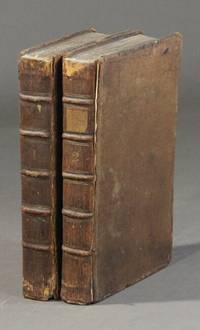
17342390London: Tonson 1734. first edition. contemporary calf. Very Good. VERY RARE FIRST EDITION OF ONE OF THE MOST INFLUENTIAL WORKS IN THE HISTORY OF CALCULUS. In 1731 Berkeley returned to England from the New World where he had spent years working to open a new college with the support of a royal charter. Despite having funds earmarked for the college no funds were ever released and he had grown tired of the whole affair - and of those who held the money he was meant to receive. Moreover "reports of growing infidelity in English society to which he was always liable to give credence were fueled by the continuing bad faith of the government in failing to lodge the funds he considered legally his." Stewart.<br /> <br /> Perhaps pushed by this diminishing opinion of the English gentry he revisited his earlier attacks on the secular 'freethinkers' and composed The Analyst "an acute and influential critique of the foundations of Newton's calculus." Downing. As Stewart explains "Berkeley considered the theory incoherent and a disservice to mathematics but one which if unchecked might reinforce prevailing views on the divisibility of matter and support infidelity."<br /> <br /> Within the criticism Berkeley raises careful arguments which often employ sophisticated philosophical distinctions. For example as Andersen explains "Berkeley acknowledged that mathematicians who applied Newton's method of fluxions or Leibniz's calculus ended up with valid results. However . he considered their calculations to be based on incorrect assumptions and to violate the rules of logic." As such he wished "to explain why this may come to pass and show how Error may bring forth Truth though it cannot bring forth Science." Berkeley.<br /> <br /> However between these arguments we find marvelously snide often comedic complaints about the whole approach. For example: "Now to conceive a Quantity infinitely small that is infinitely less than any sensible or imaginable Quantity or than any the least finite Magnitude is I confess above my Capacity. But to conceive a Part of such infinitely small Quantity that shall be still infinitely less than it and consequently though multiply'd infinitely shall never equal the minutest finite Quantity is I suspect an infinite Difficulty to any Man whatsoever". Berkeley.<br /> <br /> The concepts of the infinitesimal quantities of calculus haunted Berkeley and he returned to it repeatedly in his criticism most notably in his famous passage near the end of the book where he memorably referred to such infinitesimals as "ghosts of departed quantities". <br /> <br /> Note: This is the true first edition printed in London in 1734. A Dublin edition was also published in 1734 but appears to be a reprinting with some changes of the London first see Wilkins 2002. These were the only editions published in Berkeley's lifetime.<br /> <br /> References: Andersen K. 2011 "One of Berkeley's arguments on compensating errors in the calculus." Historica Mathematica 38. Cajori F. 1919 A History of Mathematics. 2nd ed. revised and enlarged. Macmillan 1919; Downing Lisa 2020 "George Berkeley" The Stanford Encyclopedia of Philosophy Spring 2020 Edition Edward N. Zalta ed.; Stewart M. 2005. Berkeley George 1685-1753 Church of Ireland bishop of Cloyne and philosopher. Oxford Dictionary of National Biography.; Wilkins D. 2002 edited version of The Analyst.<br /> <br /> London: J. Tonson 1734. Octavo contemporary full calf; custom box. Without errata leaf and final blank but with fragment of interesting binder's scrap showing ghost of part of the title page and partial blank bound in rear. With two manuscript corrections as usual on p. 85. Repairs to joints and spine; some spots of scattered foxing but text generally very clean. RARE. Tonson unknown books
1949111716New York: John Wiley & Sons 1949. First edition second printing of this important work which popularized cognitive images of early computers. Octavo original cloth. Association copy inscribed by the author on the front free endpaper "To Erwin Tomash with warmest greetings for more than 20 years together in the computer field from Ed Berkeley October 11 1975." The recipient Erwin Tomash was an engineer who co-founded Dataproducts Corporation which specialized in computer technology specifically printers and core memory units. He is recognized for his early pioneering work with computer equipment peripherals. Tomash led the creation of the Charles Babbage Institute and is responsible for The Adelle and Erwin Tomash Fellowship in the History of Information Technology and The Erwin Tomash Library. With Erwin Tomash's bookplate to the pastedown near fine in a very good dust jacket. An exceptional association linking these two pioneers in the field. Edmund C. Berkeley became famous in 1949 with the publication of his book Giant Brains or Machines That Think in which he described the principles behind computing machines called then "mechanical brains" "sequence-controlled calculators" or various other terms and then gave a technical but accessible survey of the most prominent examples of the time including machines from MIT Harvard the Moore School Bell Laboratories and elsewhere. In Giant Brains Berkeley also outlined a device which some have described as the first "personal computer" Simon. Plans on how to build this computer were published in the journal Radio Electronics in 1950 and 1951. Simon used relay logic and cost about $600 to construct. The first working model was built at Columbia University with the help of two graduate students. Berkeley founded published and edited Computers and Automation the first computer magazine. He also created the Geniac and Brainiac toy computers. John Wiley & Sons hardcover books
1949170923007New York: John Wiley and Sons 1949. First Edition. Hardcover. Very Good. First edition. Flat-signed by Berkeley on front free endpaper in black ink. xvi 270pp. Original gray cloth with blue lettering. Offsetting to ffep else Fine in About Very Good price-clipped dust jacket with edge-wear creased tear to bottom of back panel tiny chip near head. A very uncommon signature from the computer science pioneer journalist and mathematician who observed the UNIVAC Simon the first personal computer designed by Berkeley himself and the Harvard Mark I among other early computers in action. This book brought the concept of the computer to the lay public for the first time. John Wiley and Sons hardcover books
173235809London: J. Tonson 1732. First Edition. 8vo pp. xiv 350; viii 358. Tipped to the front blank is an engraved portrait of the author by Aveline. There is an ownership signature of "Twells" in the right margin of each title-page and the note: "Given by the author" in a contemporary although unknown hand along the top margin of the title-page in volume 1. Engraved scene on each title-page. Ex-Library copy with stamps on the bottom margin of the first two pages of text. Bound in modern calf backed boards. A very good clean set. Rothschild 374. Printing and the Mind of Man 176n. First edition of Berkeley"s attempt at the refutation of the current forms of free-thinking composed while he was resident in America and including some important observations relevant to that part of the world. The second volume also includes what is functionally the third edition of his ESSAY TOWARDS A NEW THEORY OF VISION first published in 1709. Praised by Adam Smith as "one of the finest examples of philosophical analysis that is to be found either in our ownor in any other language" the New theory of vision was accepted in France by Voltaire Condillac and Diderot Keynes pp. 7-8<br/> Bishop Berkeley was an influential Irish philosopher whose primary philosophical achievement is the advancement of what has come to be called subjective idealism summed up in his dictum "Esse est percipi" "To be is to be perceived". The theory states that individuals can only directly know sensations and ideas of objects not abstractions such as "matter J. Tonson unknown books
1947432481947. <p>Berkeley Edmund C. 1909-88. Electronic machinery for handling information and its uses in insurance. Offprint from Transactions of the Actuarial Society of America 48 1947. 36-52pp. 228 x 153 mm. Original printed wrappers a few tiny spots almost invisible staple-holes in front wrapper. Very good copy. Former owner's name-stamp Clifford J. Maloney on wrappers. </p> <p>First Edition Offprint Issue. The first published paper on the commercial application of electronic / electromechanical computing in private industry outside of the telephone company. Drawing on material that he would later publish in his famous Giant Brains or Machines that Think 1949 Berkeley described the four large-scale computing machines then in operation—MIT's Differential Analyzer; Harvard's Automatic Sequence Controlled Calculator; the Moore School's ENIAC; and Bell Laboratories' Relay Calculator—and discussed the machines' information-processing capabilities and their potential uses in the insurance industry. "It is natural to call these machines mechanical or electronic brains and to speak of them as machinery that thinks. This new machinery is certain to have far-reaching effects in all fields where the handling of information is the bulk of the work. . . . Much of the material in this paper is taken from a forthcoming book on the subject by the present writer and is used by special permission of the publisher" p. 36. </p> <p>Berkeley a seminal figure in the history of modern computing was introduced to computing using punched-card machine methods while working as an actuary at Prudential Insurance. In 1942 he joined the Navy and was assigned to the Harvard Computation Laboratory where he worked with Howard Aiken on the Harvard Mark II. In 1946 Berkeley returned to Prudential where he helped create a prototype premium billing trial for the Harvard Mark I and participated in studies that led to Prudential's purchase of one of the first UNIVAC I computers. He also began working on Giant Brains and in 1947 founded the Association for Computing Machinery. In 1948 he left Prudential to found his own company and in 1951 he began editing and publishing Computers and Automation later renamed Computers and People the first periodical specifically devoted to computing. He also headed his own publishing firm consulted for industry and invented and sold several build-it-yourself electronic computers and small robots Simon Squee Tyniac Brainiac etc. as educational tools. In his later years he became known as the conscience of the computer industry through his often-expressed belief that computers should be used not for military or destructive purposes but only for the benefit of society. </p> . unknown books
1752284380London: J. & R. Tonson 1752. First. hardcover. very good. 8vo contemporary calf with leather spine label. London: J. &. R. Tonson and S. Draper 1752. First Edition<br/><br/> The book contains 11 tracts each with a separate title page & date but only one continuous pagination. The subjects include Thoughts on Tar-water Proposal for converting the Savage Americans to Christianity by a College to be erected.in Bermuda Exhortation to the Roman Catholic Clergy of Ireland Discourse to Magistrates etc.<br/><br/> J. & R. Tonson unknown books
1871425006Clarendon Press - Oxford 1871. Hardcover. Near Fine. First edition. Four volume set. 8vo. Rebound by Zaehnsdorf in half tan calf over marbled paper-covered boards four raised bands black calf spine labels in second and fourth compartments top edges gilt marbled endpapers. 2198 pp. in toto individually paginated. Light rubbing to head heel edges and corners. Internally clean with a touch of toning to the page edges. Near fine. Clarendon Press - Oxford hardcover books
1750JC14358London: Printed for J. Whiston. R. Dodsley. and W. Russel. / W. Innys and C. Hitch. and C. Davis. / W. Innys C. Davis C. Hitch W. Bowyer. / M. Cooper 1750 et al see below. First Edition. Hardcover. Very Good. Contemporary calf handsomely rebacked with gilt-stamped lettering in red leather spine label in second compartment 5 raised bands; four works bound together in one volume 8vo; TIME 1750 First Edition pp. xxvii 1 130 2 ads; SIRIS 1747 London reprint of the Dublin edition pp. 174 1 contents; QUERIST 1750 First Edition pp. 4 83 1; MORALS 1751 First Edition pp. 30. Boards scratched and scuffed. Contemporary handwritten notes on FFEP listing the volume's contents; contermporary ownership signature on title-page of TIME and QUERIST; contemporary marginalia in QUERIST. Otherwise an excellent clean copy nice and tight text block just a bit tanned and brittle along the edges more pronounced on first and last few leaves. <br/><br/> Printed for J. Whiston... R. Dodsley... and W. Russel... / W. Innys, and C. Hitch... and C. Davis... / W. Innys, C. Davis, C. Hi hardcover books
24371Written between December 1980 and October 1981 these letters discuss the chronology of several of the composer's compositions for a catalogue that Poulton is compiling.<br/><br/>1 1-1/4 pp. Small octavo. Dated Spetchley Park Worcester December 25 1980. On white stationery with Berkeley's address and telephone number printed at head. "I feel sure that I would benefit greatly from a survey of my work to date such as you are doing for the composers you mention. I would like one of the possible contributors to be Peter Dickinson who has written the article on me in the New Grove. It might be as well to consult my publishers. J & W Chester. I should be glad to hear from you again." Creased at fold.<br/><br/>2 1-1/3 pp. Quarto. Dated London September 24 1981. On blue stationery with Berkeley's address and telephone number printed at head. Berkeley apologizes for his belated response. He discusses his Aubade for Organ. He will meet with his publisher Chester to discuss the order of his compositions after op. 96 and other queries. "I expect that most of your queries have been answered by now but some I will now try to answer. Aubade for Organ. This is the first of three pieces Op 72 number 1. The other movements being Aria and the last Toccata. 'There was neither grass nor corn' would as you suppose have been written in 1949." Creased at fold.<br/><br/>3 1-1/2pp. Quarto. Dated London October 15 1981. On blue stationery with Berkeley's address and telephone number printed at head. Once again Berkeley apologizes for his belated response and answers several more of Poulton's queries. He will contact Chester for answers to others. He would be happy to meet Poulton in London or Worcester. He mentions the following compositions: Judica me the first and second sonatas for Violin and Piano and the Suite for Orchestra. "I know this sounds nonsensical but I was dissatisfied with my first Violin & Piano Sonata and withdrew it. I then wrote another one - it was a considerable improvement so I decided to make it my Opus 1 forgetting that it was called No. 2 when published. I regard it as my first published work so I think its best just to call it Op 1." Creased at folds. "From the same generation as Walton and Tippett Berkeley has little connection with national traditions represented by them or by Elgar and Vaughan Williams earlier. This is partly because of his French ancestry and temperament which made him closer to Fauré and to Ravel and Poulenc who were both personal friends. Berkeley admired Mozart above all then Chopin Ravel and the neo-classical Stravinsky. His own idiom is built from an overt melodic expression usually rooted in tonality and allied to a fastidious command of harmony and orchestral texture. Religious subjects in particular invariably gave rise to vocal music of unusual spiritual intensity a mood also reflected in his instrumental slow movements. Though he was at his most distinctive in the 1940s and 50s the achievement of his later extended language is considerable. His is an enduring cultivated and imaginative voice in 20th-century British music." Peter Dickinson and Joan Redding in Grove Music Online.<br/><br/>Alan Poulton is the compiler and editor of A Dictionary-Catalogue of Modern British Composers among other music reference works. unknown books
186532925London: Hurst and Blackett 1865. hardcover. near fine. Colored frontispiece portraits completely extra-illustrated with about 40 mezzotints lithographs steel engravings of landscapes portraits and sporting subjects a few in color. 2 vols. 8vo red 1/2 morocco. London 1865. Near Fine.<br/><br/> Memoirs of the eminent 19th century sportsman and gallant.<br/><br/> Hurst and Blackett unknown books
1938133673Burbank CA: Warner Brothers 1938. Final Draft script for the 1938 film. From the library of producer Mark Hellinger who wrote the film's screenplay bound in red three-quarter leather with gilt titles and designs marbled endpapers raised bands trimmed edges and Hellinger's name in gilt on the front board. Also included is a typescript on onionskin stock with the title and credits for Hellinger and story writer Faith Baldwin on the front wrapper in holograph ink. Finally laid in is a typed letter signed by Bette Davis dated March 31 1939 on Davis' stationery thanking Hellinger for kind words regarding her film "Dark Victory" 1939 and discussing her dismay with the script for "Comet Over Broadway" and her resulting decision to part ways with the film. <br/><br/>Mark Hellinger's first screenplay for Warner Brothers. His other credits include the noir antecedent "The Roaring Twenties" 1939 screenwriter "It All Came True" 1940 producer and his notable series of foundation noir films "High Sierra" 1941 associate producer "The Killers" 1946 producer and "The Naked City" 1948 producer. <br/><br/>Based on a story by Faith Baldwin published in "Cosmopolitan" in 1937 about Eve Appleton Francis wife of garage owner Bill Appleton Litel and aspiring actress. Bill gets into an argument with an actor over Eve and accidentally kills him. Eve takes her infant daughter and tries to make her way on Broadway while Bill is imprisoned. Set in New York. <br/><br/>Bound script:<br/><br/>Noted as FINAL on the distribution page dated 3/28/38 with credits for Hellinger Robert Buckner N. Brewster Morse Fritz Falkenstein and Frank Cavett on the following page flatsigned by Walter MacEwen. Distribution page present with receipt intact. 155 leaves mimeograph duplication dated August 19 1938 and August 22 1938 screenwriters' credit page. Pages and binding Near Fine. <br/><br/>Typescript:<br/><br/>Blue wrappers. "Comet Over Broadway by Mark Hellinger / after a story by Faith Baldwin" in holograph ink on the front wrapper. Title page present with credits for screenwriter Hellinger and story writer Baldwin. 78 leaves typed watermarked "MILLERS FALLS." Pages Near Fine wrapper Very Good plus bound with two gold brads. <br/><br/>Bette Davis letter and envelope: <br/><br/>Light soil and a closed tear to the envelope. Letter folded horizontally else Near Fine. Warner Brothers unknown books
180025312Philadelphia: Way & Groff 1800. First edition. 34pp. 1 vols. 8vo. Disbound and resewn. Apart from some staining a very good copy. First edition. 34pp. 1 vols. 8vo. The author argues that the class of medicines commonly known as 'sedatives' are actually stimulants.<br/>He considers the likes of digitalis opium nitre and saccharum.<br/><br/>Scarce: OCLC locates 5 copies. Evans 36942 Way & Groff unknown books
1966246050Portland Oregon: Touchstone Press 1966. First edition one of 100 copies. Illustrated with photographs. 111 pp. 1 vols. 8vo. Simulated tan calf. Fine copy. First edition one of 100 copies. Illustrated with photographs. 111 pp. 1 vols. 8vo. Fine Copy. Scarce and interesting history of this Oregon sporting club situated in the descutes River Canyon. Bruns S-216; Heller 1:752 "only about 100 copies printed" Touchstone Press unknown books
1746WRCLIT65696Dublin Printed London Re-printed: For W. Innys C. Hitch and M. Cooper . 1746. 1742; 45-88pp. Octavo. Modern half-calf and marbled boards. Faint blindstamp and ink shelf number the latter on verso of title of The Library of the Society for the Home Study of Holy Scripture and Church History first title leaf a trace foxed otherwise a very good copy. New i.e. Third London edition of the first title Keynes's variant A1b with "A Letter to T.P. ." on the verso of the title. This copy has p. 160 misnumbered '610'. The second title is also a "New Edition" i.e. the second London edition and exhibits Keynes's second corrected state of the title leaf: 'Holbourn'. Berkeley first noticed the use of tar-infused water during his residence in America and although cautious in his initial conclusions he soon became an advocate of its use as an economical aid for the betterment of the health of the Irish people. Although by no means wanting in exposition of Berkeley's larger philosophical considerations the practical aspects of SIRIS led to its being his most popular work and the investigation of tar-water generated a significant body of pamphlet literature in response well delineated by Keynes among which Prior's work is one of the most significant. ESTC cites Bowyer's ledger in reporting the edition of the first title consisted of 1000 copies and that of the second title 2000 copies. KEYNES BERKELEY 68 & 104. ESTC T45794 & T125698. For W. Innys, C. Hitch, and M. Cooper .. hardcover books
1732WRCLIT35680London: Printed for J. Tonson 1732. 101-350;6358pp. Two volumes. Octavo. Contemporary calf. Engraved title vignettes. Ownership signature "J. Payne Jan. 24 1732/3" in each volume on front pastedown with authorship ascription in same hand in first as well as careful correction of the errata. Hinges cracked one board detached occasional light foxing otherwise a crisp large very nice set. First edition of Berkeley's attempt at the refutation of the current forms of free- thinking composed while he was resident in America and including some important observations relevant to that part of the world. The second volume also includes what is functionally the third edition of his ESSAY TOWARDS A NEW THEORY OF VISION first published in 1709. ROTHSCHILD 374. PRINTING AND THE MIND OF MAN 176n. ESTC T86056. Printed for J. Tonson unknown books
19013264New York: Funk & Wagnalls 1901. First edition. First edition. Original color pictorial decorated cloth with superb and scarce original color illustrated dust wrapper. With illustrations by the author and a frontispiece by F. Hopkinson Smith. Interesting cooperation between father and son. A most scarce and early fine dust wrapper. Book very fine. Most scarce thus. <br/><br/> Funk & Wagnalls hardcover books
173226337London: J. Tonson 1732. 2 vols. 8vo pp. 14 356; 8 218; engraved vignette title-pp.; bound with as issued An Essay towards a New Theory of Vision pp. 12 215-351; several woodcuts in the text; full contemporary calf double gilt rules on covers unlettered spines in 6 compartments volume designations in 1; some moderate chipping and cracking of the spines but all in all a good and reasonably sound set. Rothschild 372 citing the first edition of the same year: "Alciphron was written in America where Berkeley had gone to await funds which never came for his projected College in the Bermudas." <br/><br/> J. Tonson unknown books
196522540Newtonville MA: International Data Corporation 1965. Near fine in printed vinyl binder. First Edition. Quarto sheets in three-ring binder. Advertisement for Honda laid in. Proceedings of an early commercially oriented computer conference held on November 19th 1964 in Newtonville Massachusetts. The notebooks describe a wide range of computer equipment and applications. Speakers included computer science pioneer and antinuclear activist Edmund C. Berkeley known for having designed "Simon" the first "personal computer" in 1950. In January 1963 Berkeley was also the first person in print to describe an image as "computer art" upon publishing an image created by Israeli computer scientist Efraim Arazi in the magazine "Computers and Automation". Co-speaker Patrick J. McGovern had begun the EDP Industry & Market Report a year prior in 1964; that publication would eventually morph into both Computer World and PC World as well as spawning the "For Dummies" book series. McGovern achieved massive financial success; at time of death in 2014 his net worth was estimated by Forbes at in excess of five billion dollars. Overall a fascinating document from just before the dawn of the microprocessor revolution. Newtonville, MA: International Data Corporation unknown books
1732WRCLIT65559London: Printed for J. Tonson 1732. 141-356;821812215-351pp. Two volumes. Octavo. Contemporary calf. Engraved title vignettes. Three bookplates in each volume along with a faint old seminary stamp on each title scattered foxing joints a bit worn and cracked but cords sound; a good set. Second London edition of Berkeley's attempt at the refutation of the current forms of free-thinking composed while he was resident in America and including some important observations relevant to that part of the world. The second volume also includes what is functionally the fourth edition of his ESSAY TOWARDS A NEW THEORY OF VISION first published in 1709. KEYNES 17. PRINTING AND THE MIND OF MAN 176n. ESTC T86055. Printed for J. Tonson unknown books
180365195New Haven: From Signey's Press for Increase Cooke & Co 1803. First American from the fourth London edition. First published in March 1732. xiii i 15-388 pp. 8vo. Contemporary sheep red morocco label. Some rubbing 2 pages advertisements at back of books available at Increase Cooke and Co. some browning and offsetting of text generally light upper corner of free endpaper removed. In a leather tipped brown cloth open end case. First American from the fourth London edition. First published in March 1732. xiii i 15-388 pp. 8vo. With a leaf concerning the "Character of the Work" by Timothy Dwight Yale College Dec. 23 1802. In 1728 Berkeley went to America to look into founding a college in Rhode Island. He lived on a farm outside Newport Rhode Island until 1731 when he returned to England. It was during his residence in America that most of "Alciphron" was written and many of the descriptions of scenery are of the Newport area. Berkeley was close friends with the American Samuel Johnson. Johnson's "Elementa Philosophica" "the first text book in philosophy to appear in English-speaking America" Cremin "American Education" p. 296 owed much to the influence of Berkeley. In 1733 Berkeley sent a large contribution of books to Yale for its library. "A finely written work in the form of dialogue critically examining the various forms of free-thinking in the age and bringing forward in antithesis to them his own theory which shows all nature to be the language of God" Ency. Brit. Colby Library Quarterly p. 233; Shaw and Shoemaker 3784 From Signey's Press for Increase Cooke & Co unknown books
19035696Berkeley California: The Church; Printed by thePress of Standard Publishing Company 1903. Octavo 23.25 x 14 cm. iv 171 i pages. Advertisements. Index. Evident first edition but subsequent to an 1884 publication with different subtitle author statement and publisher. A generous church cookbook with seven hundred recipes; noteworthy among them: Squash Muffins Celery Root and Hearts of Artichoke Mussel Bordelaise Clam Patties Spanish Meat Pie Coffee Fruit Cake Lemon Cocoanut Cake Cookies with Sherry Monterey Pudding Gooseberry Pudding Pineapple Blanc-Mange Strawberry Mousse. ~ Congregationalists answered the call from President Daniel Coit Gilman 1831-1908 of the University of California to build a hall and organize a fellowship of moral vision within reach of the campus community. The "local church" emphasis of Congregationalist governance had already attracted the largest Protestant presence in San Francisco. After ten years of planning members of Berkeley First Congregational were called to new quarters by a recently cast bell on 30 September 1884 at the corner of Durant Avenue and Dana Street. Thus the early version of The Berkeley Cook Book subtitled A Collection of Choice and Tested Recipes celebrated the dedication of the 1884 church while its younger sibling of 1903 would have appeared in time to honor the building's twentieth anniversary. ~ In another twenty years they would move again to a grander brick complex on Channing Way still only a few city blocks from campus designed by the Bay Area architect Horace Gardner Simpson. It served successive generations for ninety years but in September 2016 was gutted by fire and the building's fate is undetermined as of this writing. ~ Clean and bright. Lightly wear at fore-corners and spine. Stapled in olive wrappers titled in brown. Very good. OCLC locates three copies also four copies of The Berkeley Cook Book: A Collection of Choice and Tested Recipes by the Ladies of Berkeley Oakland: Pacific Press 1884; Cook page 27; Brown 57 with different pagination; not in Cagle. [The Church; Printed by the]Press of Standard Publishing Company unknown books
1931126489London: Mundanus Ltd/Victor Gollancz Publisher 1931. Octavo printed wrappers. First edition. Berkeley's masterpiece which takes the reader into the mind of the murderer. "Iles was the innovator the father of those techniques so evident in much of today's crime fiction." - Pederson ed. St. James Guide to Crime & Mystery Writers 4th edition. Light tanning to edges of text block slight lean some soiling to covers crease to front cover some light rubs a good to very good copy. #126489 Mundanus Ltd/Victor Gollancz Publisher unknown books
1947140197Los Angeles: Twentieth Century-Fox 1947. Revised Final script for the 1948 film here under the working title "Mary O'Hara's Green Grass of Wyoming." Copy belonging to Robert Arthur who play Ken McLaughlin with his name on the front wrapper in holograph pencil and holograph pencil annotations to his scenes throughout. Laid in are three additional pages and two film negatives. <br/><br/>A mare has been lured away by a wild stallion angering the mare's owner Beaver Greenway a horse owner with a drinking problem. Meanwhile Ken McLaughlin Arthur returns home with a new horse who has developed altitude sickness. Based on the third book in Mary O'Hara's "My Friend Flicka" trilogy. Nominated for one Academy Award. <br/><br/>Set in Wyoming shot on location in Wyoming Utah and Ohio USA. <br/><br/>Red titled wrappers noted as Revised Final on the front wrapper rubber-stamped copy No. 166 and production No. 133 dated May 16 1947. Distribution page present with receipt removed. Title page present dated May 16 1947 noted as Revised Final with credits for screenwriter Martin Berkeley. 123 leaves with last page of text numbered 117. Mimeograph duplication with blue revision pages throughout dated variously between June 25 1947 and July 18 1947. Pages Very Good with dampstaining wrapper Fair to Good complete with dampstaining pages not affected and fray at the extremities bound with three gold brads. Twentieth Century-Fox unknown books
1970141060San Francisco: University of California Berkley Museum 1970. Original poster for one of the most important events in the Bay Area of California in 1970 a performance by Steve Reich to celebrate the opening of the UC Berkeley Art Museum. With a striking triangular design mounted as issued with a label on the verso crediting the Richell Gallery of Houston Texas for the archival framing. <br/><br/>The museum was founded in 1963 after a donation was made to the university from artist and teacher Hans Hofmann of forty-five paintings plus $250000. A competition to design the building was announced in 1964 and the museum opened in 1970. In 1966 the Pacific Film Archive was founded and began screenings in 1966. Today the museum continues to be a great success and operates under the name of the Berkeley Art Museum and Pacific Film Archive or BAM/PFA. <br/><br/>The performance for the opening included four early works by Reich: "Four Organs" "My Name Is" "Piano Phase" and "Phase Patterns." The event marked an important moment in San Francisco Bay Area new music history with the triumphant return to the East Bay by Reich who studied at Mills College with Luciano Berio and who performed the 1964 world premiere of Terry Riley's now-legendary work "In C" at the San Francisco Tape Music Center. <br/><br/>Three sided poster each side measuring 26.3 inches mounted as issued. Unexamined out of frame no glass. Some fading and minor spotting to the recto Very Good overall. University of California Berkley Museum unknown books
1744401896London: W. Innys and C. Hitch 1744. Second first London edition. Repairs to binding; title slightly soiled ink inscriptions in Greek on rear flyleaves a handsome copy/From the Collection of Allan B. Kirsner M.D. 8vo. 174 2 pp. Near-contemporary vellum-backed marbled boards. Berkeley's most popular work espousing the myriad uses of tar water to treat everything from fevers to cancers from infant to elderly and from human to animal. "The work begins as an investigation of the medicinal virtues of tar-water and ends with a disquisition on Platonic philosophy - a blend of science and metaphysics. While in America Berkeley experimented with tar-water for many ailments including dysentery rheumatism and asthma. The treatment proved so successful that he set up an apparatus for manufacturing it" Rootenberg. Blake 43; ESTC N12567; Keynes 64; Kress 4685; Wellcome II:149. <br/><br/> W. Innys and C. Hitch hardcover books