Locke, JohnBiblio.com
4 251 résultats
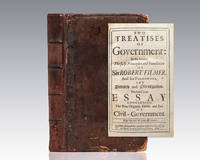
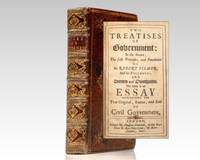
1690151350London: Printed for Awnsham Churchill 1690. Exceptionally rare first edition published at the end of 1689 in an edition of likely only 1000 copies with quire Q in second of two settings. Octavo bound in full calf morocco spine label gilt tooling to the spine blind stamped to the front and rear panels. Title-page within double rule. In very good condition. Rare and desirable. “In Two Treatises on Government… John Locke developed what he considered the ‘true original extent and end of civil government.’ The First Treatise was devoted to a refutation of the theory of divine right monarchy expounded by Sir Robert Filmer in his Patriarcha published in 1680. In his Second Treatise Locke presented his positive views on the origins of the social order. Civil society and government Locke argued were founded on an original social compact entered into by autonomous individuals in a state of nature. The powers of government Locke contended were limited by the authority granted by the free consent of the individuals subscribing to the social compact. Locke’s Second Treatise has been credited with great influence on American constitutionalism… Locke had a profound impact…. on the theoretical basis for forming new governments… Locke had a formative influence on the principles of the Declaration of Independence and on the early state constitutions†A Covenanted People 37. “The Second Treatise contains a plain statement of the principles of democracy. In an age and country in which the practice of democracy had just been triumphantly vindicated Locke’s theories… had all the freshness of novelty… civil rulers hold their power not absolutely but conditionally; government being essentially a moral trust which lapses if the trustees fail to maintain their side of the contract… The Treatises of Government provide a classic example of the empirical approach to social and political economy which has remained ever since the basis of the principles of democracy†PMM 163. Printed for Awnsham Churchill unknown
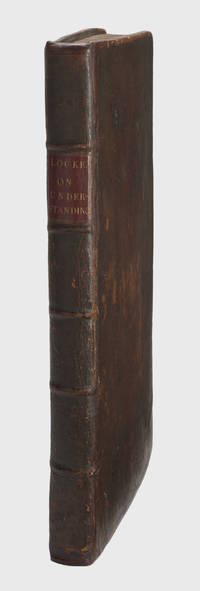
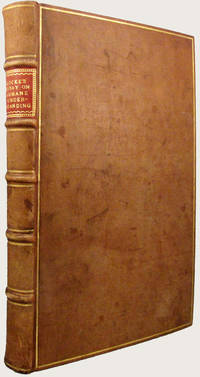
169032820531<p>FIRST EDITION FIRST ISSUE with the integral Eliz. Holt title-page. An excellent fresh copy of this classic of philosophy the first modern attempt to analyze knowledge. "Few books in the literature of philosophy have so widely represented the spirit of the age and country in which they have appeared or have so influenced opinion afterwards" Fraser.</p><p>"<b>The Essay has long been recognized as one of the great works of English literature of the 17th century and one of the epoch-making works in the history of philosophy. It has been one of the most repeatedly reprinted widely disseminated and read and profoundly influential books of the past three centuries</b>" Nidditch.</p><p>"Locke is often classified as the first of the great English empiricists ignoring the claims of Bacon and Hobbes. This reputation rests on Locke's greatest work the monumental An <i>Essay Concerning Human Understanding</i>" Stanford Encyclopedia of Philosophy.</p><p>Locke sold the copyright to the publisher Thomas Basset for thirty pounds plus six bound copies of every later edition and ten shillings for every sheet of additions to later printings. By 1800 twenty editions had appeared indicating work's great influence. Locke's intellectual heirs include Berkeley Hume and Bentham and the Radicals.</p><p>"Locke was the first to take up the challenge of Bacon and to attempt to estimate critically the certainty and the adequacy of human knowledge when confronted with God and the universe. In the past similar enquiries had been vitiated by the human propensity to extend them beyond the range of human understanding and to invent causes for what it cannot explain. Therefore Locke's first task was to ascertain 'the original certainty and extent of human knowledge' and excluding 'the physical consideration of the mind to show how far it can comprehend the universe.' His conclusion is that though knowledge must necessarily fall short of complete comprehension it can at least be 'sufficient'; enough to convince us that we are not at the mercy of pure chance and can to some extent control our own destiny" Printing and the Mind of Man 164.</p>Folio. Contemporary paneled calf red leather label. Rebacked preserving spine old endpapers. Manuscript correction on A3v. A very good fresh copy. Liz Holt
1690168757London: by Eliz. Holt for Thomas Basset 1690. One of the principal sources of empiricism in modern philosophy First edition first issue with the Holt imprint. Locke worked for nearly two decades on his investigation of "the certainty and the adequacy of human knowledge" PMM and the resulting landmark work influenced many Enlightenment philosophers. Locke argued that all our knowledge comes from experience and through our senses rather than innate ideas. The mind is at birth a clean sheet a tabula rasa; since only material things can affect our sense we can know nothing but matter and must accept a materialistic philosophy. Locke concluded that "though knowledge must necessarily fall short of complete comprehension it can at least be 'sufficient'; enough to convince us that we are not at the mercy of pure chance and can to some extent control our own destiny" ODNB. Locke's Essay quickly ran to several editions and was popularized on the continent through French translations. "Few books in the literature of philosophy have so widely represented the spirit of the age and country in which they appeared or have so influenced opinion afterwards. The art of education political thought theology and philosophy especially in Britain France and America long bore the stamp of the Essay or of reaction against it" Grolier. Voltaire and Diderot accepted Locke with little question Hume and Kant continued the investigation and Bishop Berkeley rejected it with his own immaterialism. The edition was reissued with a cancel title bearing an Edward Mory imprint. Provenance: inscription to front free endpaper "Robert Kirktowne London: 1698" a Robert Kirktowne is recorded as a naval surgeon in the period 18th-century inscription to the front pastedown "Ex libris Gulielmi Byrd MTS". This is possibly William Byrd II 1674-1744 a large landowner in Virginia who studied at Middle Temple in London explaining the MTS Middle Temple School initials. Folio 318 x 192 mm pp. xii 362 22. Contemporary speckled calf red morocco label covers bordered in blind edges speckled red. Housed in a dark blue quarter morocco solander box by the Chelsea Bindery. Ninteenth-century shelf label at head of spine. Skilful restoration at extremities leaf D2 with defective inner margin resulting in a number of missing words supplied in manuscript in early hand. A few splashes and scratches to covers else well-preserved contents a little toned else clean: a very good copy. Attig 228; ESTC R22993; Garrison-Morton 4967; Grolier English 100 72; Pforzheimer 599; Printing and the Mind of Man 164; Hook & Norman 1380; Wing L-2738; Yolton 61A. unknown
169031842London: by Eliz. Holt for Thomas Basset 1690. First edition first issue with the Undated Dedication with the title-page listing Eliz. Holt the Properly Positioned “SS†the first imprint and all points called for typographical ornaments line 3 has them upside down in columns 2 through 6 while in line 4 all ornaments are upside down with five of the six possible misnumbered pages for this issue: "85" as "83" "287" as "269" "296" as "294" "303" as "230" and "319" as "327" page 55 with "Underwandings" as called for with the incorrect Roman numerals to pp. 57 and 263 and the deleted 24 paragraph indicator at page 90. With contemporaneous signature “J Locke†on the title page and three handwritten corrections "in" “extremely†and the insert “some†which may be in Locke's hand in the preliminaries. Folio 320 x 195 mm. full polished calf to style handsomely and discreetly double lined in gilt on the covers and the spine with raised bands ruled in gilt with red morocco lettering label gilt in best style on the spine. In beautiful condition. title 10 1-362 22 Contents pp. A handsome and pleasing and crisp copy in lovely condition some quite unobtrusive evidence of age mellowing or toning to the lower edges of the leaves probably from old damp. FIRST EDITION FIRST ISSUE OF THIS SINGULARLY IMPORTANT WORK IN THE HISTORY OF PHILOSOPHY AND EPISTEMOLOGY. Locke's ESSAY was the "first attempt on a great scale and in the Baconian spirit to estimate critically the certainty and the adequacy of human knowledge when confronted with God and the universe" EB. It served as the most concrete manifestation of a new empiricist spirit in contrast to the metaphysical philosophies of Descartes Spinoza and Leibniz. Locke was inspired to write the ESSAY in 1671 after a philosophical discussion with friends in which he realized that no progress could be made before they had examined the mind's capacities and seen "what objects our understandings were or were not fitted to deal with" from the "Epistle to the Reader".<br> "Other philosophers had reflected on and written about human knowledge.But Locke was the first philosopher to devote his main work to an inquiry into human understanding its scope and its limits. And we can say that the prominent place occupied in modern philosophy by the theory of knowledge is in large measure due to him." Copleston A HISTORY OF PHILOSOPHY.<br> Locke's influence was widespread and was not strictly limited to pure philosophical enquiry. In America his emphasis on rational thought versus "enthusiasm" provided ammunition and philosophical grounding to opponents of the revivalist and itinerant preachers of the Great Awakening and in the nineteenth century the "nature versus nurture" thesis was employed by Unitarians and other anti-Calvinist factions to argue that human nature was improvable through nurture and self-culture rather than corrupt beyond hope without conversion through a special act of divine grace. In England Locke had a strong influence on the literature of the Augustan Age Sterne Addison and the members of the Scriblerus Club all acknowledging the currency of his ideas. "The art of education political thought theology and philosophy especially in Britain France and America long bore the stamp of the ESSAY or of reaction against it" Fraser quoted in Grolier. Locke's ESSAY has passed through more editions than any classic in modern philosophical literature and remains a cornerstone in the history of human thought. by Eliz. Holt for Thomas Basset hardcover
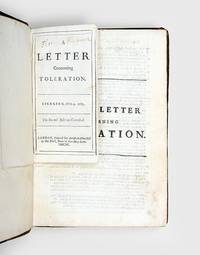
1690187184London: first: Printed for Awnsham Churchill 1690; second & third: Printed for Awnsham and John Churchill 1690 & 1692. Locke's three letters on toleration in a single volume with a probable connection to Locke's Somerset friends First editions of the Second and Third Letters second edition in English of the First collecting in a single volume all the works on toleration published by Locke in his lifetime. Following Louis XIV's revocation of the Edict of Nantes in 1685 Locke was moved to publish views he had previously circulated only in manuscript. Although intended primarily for Christians and particularly for dissenting Protestants the three Letters outline a hugely influential conception of the proper relationship between government and religion. For Locke the state cannot and should not compel individuals to adopt particular faiths. Churches are re-conceived as voluntary societies which can be joined or left without incurring civil penalties - subject to the concerns of civil society and foreign influence. Locke's original Epistola de tolerantia 1689 was swiftly translated into English by his friend William Popple who was responsible for the phrase often attributed to Locke himself "Absolute Liberty Just and True Liberty Equal and Impartial Liberty is the thing that we stand in need of" p. iv. In April 1690 an Oxford clergyman disputed the Letter's rejection of force which prompted Locke to reply that summer under an assumed identity with the Second Letter and then under his own identity with the much longer Third Letter of 1692. A fourth was left in manuscript at Locke's death in 1702; it was first published in the Posthumous Works 1706. The first and second Letters bear the contemporary ink signature of Thomas Musgrave on their title pages. This is probably a member of the Musgrave family of Nettlecombe Somerset whom Locke knew well. William Musgrave 1655-1721 was a fellow member of the Royal Society while Dr George Musgrave d. 1721 a country physician married the daughter of Edward Clarke one of Locke's closest friends. Locke himself a trained physician knew George Musgrave well enough to write letters praising his medical skills: the latter returned the compliment by providing some of the first admiring reviews of Locke's Essay Concerning Human Understanding 1694. The Somerset archives contain the 1723 will of one Thomas Musgrave of Nettlecombe. A similar hand possibly that of Musgrave has made a further annotation on the rear free endpaper verso. 3 works bound in 1 vol. the first duodecimo 139 x 70 mm the others quarto 205 x 142 mm; pp. iv 87 5; pp. iv 68; pp. iv 350 2. Contemporary panelled calf edges sprinkled red. Joints and extremities restored spot of wear to corners light bumping faint offsetting to several leaves Third Letter with minor loss to upper outer corner of half-title and short closed tears to outer margins of Gg4 & Yy1 each just touching text: still a very good volume indeed. ESTC R21477; R5484; R5673; Printing and the Mind of Man 163; Wing L2748 L2755 L2765; Yolton 4; 25; 27. See Sowerby 1338. unknown
169064538London: Printed for Tho. Basset and sold by Edw. Mory 1690. The First Modern Attempt to Analyze Human Knowledge<br> <br> LOCKE John. An Essay Concerning Humane Human Understanding. In Four Books. London: Printed by Elizabeth Holt for Tho. Basset and sold by Edw. Mory 1690.<br> <br> First edition title-page containing the inverted "SS" of "Essay" the type ornament composed of twenty-three pieces and without Elizabeth Holt's name in the imprint. With the dedication undated and with the errata uncorrected. It was once thought that the Holt imprint was the priority but recent studies have noted that the priority cannot be established. In his introduction to the Clarendon Press edition of the"Essay" Peter Nidditch changes his former opinion that the Holt imprint is the first issue and John Attig's bibliography records it as a varient. Folio 12 5/8 x 7 7/8 inches; 320 x 200 mm. 12 362 22 Contents pp. Pages 287 296 and 303 misnumbered 269 294 and 230 respectively.<br> <br> Contemporary brown mottled calf. Boards ruled in blind. Spine in six compartments lettered in gilt on brown calf spine label. Edges speckled red. Expertly rebacked to style with corners repaired. Title page is short at the fore-edge by half an inch due to the stub being turned behind A4. Marginal paper flaws on D1 P 3 and Dd3 not affecting text. Very small marginal hole on Hh not affecting text. The errata are corrected by a contemporary hand with ink and there are two contemporary ink notes on the back free endpaper. Locke's name is written in a contemporary hand on the title page as "IOHN LOCK: Gent:" Previous owner's name Brockett on the back pastedown. Previous owner's name Samuel Gaskell on the top margin of title page and previous owner's name Roger Gaskell dated 1813 on front free endpaper. A very clean and crisp copy in an excellent contemporary binding.<br> <br> Locke 1632-1704 considered the father of English empiricism "was the first to take up the challenge of Bacon and to attempt to estimate critically the certainty and the adequacy of human knowledge when confronted with God and the universe. In the past similar enquiries had been vitiated by the human propensity to extend them beyond the range of human understanding and to invent causes for what it cannot explain. Therefore Locke's first task was to ascertain 'the original certainty and extent of human knowledge' and excluding 'the physical consideration of the mind to show how far it can comprehend the universe'. His conclusion is that though knowledge must necessarily fall short of complete comprehension it can at least be 'sufficient'; enough to convince us that we are not at the mercy of pure chance and can to some extent control our own destiny" Printing and the Mind of Man.<br> <br> Locke's investigation was continued by Hume and Kant. John Stuart Mill considered him to be the founder of the analytic philosophy of mind.<br> <br> Attig 228. Grolier 100 English 36. Grolier Wither to Prior 527. Pforzheimer 600. Printing and the Mind of Man 164. Wing L2739.<br> <br> HBS 64538.<br> <br> $32500. Printed for Tho. Basset, and sold by Edw. Mory unknown
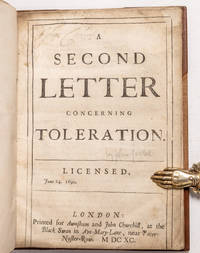
1690151201London: Printed for Awnsham and John Churchill at the Black Swan in Ave-Mary Lane 1690. First edition of John Locke's landmark second Letter of Toleration a profound influence on Jefferson Madison and the architecture of the American Constitution on freedom of religion. Octavo bound in three quarter calf with gilt titles to the spine marbled endpapers. In very good condition paper repair to lower corner D1 faint early ink ownership inscription to title page. Rare. John Locke’s Letters on Toleration 1689–1692 articulate one of the most influential defenses of religious toleration in Western political thought. Written in the aftermath of the religious conflicts that followed the Reformation and England’s own civil strife Locke’s argument became foundational for modern liberal constitutionalism—especially principles later reflected in First Amendment doctrines such as free exercise of religion and the separation of church and state. Locke's idea of toleration has been described as "one of the defining topics of political philosophy… a way of thinking about First Amendment rights such as the free exercise of religion and the wall of separation between church and state" Williams and Waldron Toleration 1. Jefferson and Madison in particular "grounded their commitment to freedom of conscience on the foundation laid by Locke in his Letter Concerning Toleration" which Locke wrote in Latin Epistola de Tolerantia in 1685 while in exile in Holland Ravitch & Witeritti Making Good Citizens 245. Soon after publication of Locke's first Letter in the virtually unobtainable 1689 English edition he was anonymously caught up in a heated debate with Jonas Proast whose 1690 Argument of the Letter Concerning Toleration quickly prompted Locke to reply the same year with A Second Letter Concerning Toleration. Locke continued developing his philosophy with "the largest work in the exchange A Third Letter for Toleration almost ten times the lengthy of his original Letter… In recent years… the Locke-Proast controversy has attracted more attention than ever before"—marking a seminal "divide between two conceptions of politics" Vernon Career of Toleration 3-6. Printed for Awnsham and John Churchill, at the Black Swan in Ave-Mary Lane unknown
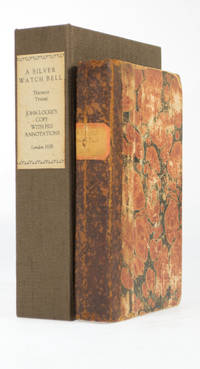
163866431London: Printed by John Haviland for Thomas Alchorn 1638. LOCKE John; TYMME Thomas. From the Library of John Locke<br> <br> LOCKE John association. TYMME Thomas. A Silver Watch Bell The Sound whereof is able by the Grace of God to win the most prophane Worldling and careless Liver if there be but the least spark of Grace remaining in him to become a true Christian indeed that in the end he may obtain everlasting Salvation; Whereunto is adjoyned A Treatise of the Holy Sacrament of The Lord's Supper in part augmented. By Thomas Tymme. XVIIIth Impression. London: Printed by John Haviland for Thomas Alchorn 1638.<br> <br> Small octavo. A1 tipped-in leaf with title supplied in ink on recto A3-A8 B-H8 I1 I3-I8 K-T8. 2 blank 2 title in ink verso blank 6 Dedication 4 To the Reader 2 Contents 12-114 117-188 pp. Lacking A2 title-page and I2 pp. 115-116. Text within double-ruled border with headline page numbers and marginal glosses inside outer border. Sixteen head-pieces fourteen ornamental initials and two tail-pieces.<br> <br> Contemporary marbled boards rebacked possibly in 1915 according to pencil note on front pastedown with speckled calf modern red and white paper spine label lettered in ink. Plain endpapers all edges speckled red some trimmed close to headlines and in a few cases to marginal inscriptions. Boards worn hinges cracked. Tiny rust or ink hole to top of front free endpaper tiny wormhole to outer margin of beginning leaves affecting a letter or two of marginal glosses. Over-opened at a few places. Still a very good copy.<br> <br> A popular much-reprinted work Tymme's little religious book was first published in 1605. This copy contains ink inscriptions signatures and marginal notations in at least five different hands: John Locke dated 1669 on p. v Ri. Yolland undated Emmanual Bayhind undated William Yoo dated December 21 1782 on p. 244 and Rietteel dated N. York 1819 on front free endpaper and title-page. We have been unable to locate any information on the later owners of the book.<br> <br> While many of the annotations in the volume are by its later owners pp. iv and v contain Locke's signatures and inscriptions including a quotation in Greek. Numerous other pages pp. 4 6 9 66 78 80 101 118 134 139 144 146 165 228 229 232 234 and 238 contain marginal notes often in Greek in what appears to be the same handwriting. Locke may have noted in the margin of p. 96 the date he purchased the book its cost and a selected list of page numbers; though partially obliterated by a later owner the note seems to read "166.his book of Mr. florins." On p. 176 there appears in the margin a figure which may perhaps be an early crude version of Locke's paraph-the distinctive mark he used to authenticate his signature on legal documents and occasionally to mark his books for an unknown purpose see Harrison and Laslett pp. 41-2. Locke may have marked the spine with a label or press-mark but if so this has been lost when the volume was rebacked.<br> <br> During the period that Locke 1632-1704 acquired and annotated this volume he was a tutor at Christ Church Oxford. A book collector as well as physician writer and scholar Locke amassed his library primarily for his own research purposes. In 1669 however he did not have the bulk of the volumes which would comprise his library at Otes in the 1680s and '90s. In those later years Locke was faced with a rapidly expanding library which confounded attempts to find any particular volume in it. Locke therefore developed a complicated cataloguing procedure to allow him easily to locate the volumes he needed. Though he generally made notations for his own reference on the title-page spine and last page of a work-and often also made a list of page numbers for future reference on a fly-leaf-he typically did not underline words or phrases in his books. "On the whole he left his margins well alone and made his notes in his notebooks" always showing "much admirable respect for the whiteness of his pages and the general appearance of the volumes standing in his boxes" Harrison and Laslett p. 39.<br> <br> It is important to remember though that Locke's cataloguing procedures were developed and perfected in the 1680s and 1690s-this was the first period in his life when his books were physically all in the same place: "Books which went out of Locke's possession in earlier years would have far less and less regular markings-some of them perhaps not marked in any way. But the over-lining and underlining would probably be present with sometimes the author's name. A spine label giving author and a digit indicating size might also be present.These signs are not unusually found in Otes books which had been with Locke before 1683 and occasionally the two figure press-marks there can be seen to have been converted from the one-figure marks which we believe characterized the books in Christ Church in 1681" Harrison and Laslett p. 43. Tymme's volume then is probably one which Locke sold or gave away possibly to a current or former pupil before he perfected his cataloguing method.<br> <br> See Harrison and Laslett The Library of John Locke1965.<br> <br> HBS 66431.<br> <br> $25000. Printed by John Haviland, for Thomas Alchorn unknown
1694148834London: Printed for Awnsham and John Churchill at the Black-Swan in Pater-noster Row 1694. Rare second edition of Locke’s famed treatises on government. Duodecimo elaborately bound in full contemporary calf with ruling and tooling stamped in blind to the front and rear panels all edges speckled. In good condition with rubbing losses to the corners and the spine rebacked. Lacking pages 337-352 which are supplied in facsimile and loosely inserted in a pocket adhered to the rear pastedown. Locke's Two Treatises of Government were first published anonymously in December 1689. Locke was unhappy with this edition complaining to the publisher about its many errors. For the rest of his life he was intent on republishing the Two Treatises in a form that better reflected his meaning. The First Treatise of the volume attacks patriarchalism in the form of sentence-by-sentence refutation of Robert Filmer's Patriarcha while the Second Treatise outlines Locke's ideas for a more civilized society based on natural rights and contract theory. Printed for Awnsham and John Churchill, at the Black-Swan in Pater-noster Row unknown
1693122924London: Printed for A. and J. Churchill. As New. 1693. Hardcover. FREE UPGRADE to Courier/Priority Shipping Upon Request - In stock and immediately available for shipment - text pristine & unmarked tight to the spine. 8vo. Pp. 4 p. L. 262 2. with a bonus offer-- . Printed for A. and J. Churchill hardcover
169019072London: Awnsham and John Churchill 1690 1692. First editions of both volumes of Locke's Second and Third Letter Concerning Toleration. Two volumes bound in one. Octavo contemporary calf rebacked. In excellent condition with the text clean contents clean except for light browning rebacked. From the library of James Stonhouse with his signatures and armorial bookplate. Exceptionally rare. The Second Letter Concerning Toleration is a response to the attack on A Letter concerning Toleration Locke's The Argument of the 'Letter concerning Toleration' Briefly Consider'd and Answer'd. In the first letter Locke had claimed 'Toleration to be the chief Characteristical Mark of the True Church'. His views on religious toleration continued to be the subject of controversy and he penned two more letters the fourth of which was published posthumously. Awnsham and John Churchill unknown
200491671Thoemmes Continuum. New. 2004. Hardcover. 1843710927 . FREE UPGRADE to Courier/Priority Shipping Upon Request - IN STOCK AND IMMEDIATELY AVAILABLE FOR SHIPMENT - Flawless copy brand new pristine never opened -- 3168 pages. EIGHT 8 VOLUME SET. Description: "John Locke 1632-1704 the father of British empiricism is also famous for his writings on politics education and religion. During his lifetime he had a great influence on the major thinkers in Britain and mainland Europe. In Germany his works on tolerance and on the limits of human knowledge were especially important. They supplied central arguments against the prevailing scholasticism of German school metaphysics. Since most German authors of the 18th century lacked a good command of the English language there was a great need for translations. Through these translations Wolff Endelssohn and the Neologians around Reimarus and Lessing were just as much influenced by Locke as by Immanuel Kant. Indeed the German Enlightenment is not intelligible without taking note of the early translations of Locke reprinted here. This eight-volume collection contains the most significant and widely disseminated 18th-century German translations of Locke's main works: his 'Epistola de Tolerantia' 'Of the Conduct of the Understanding' 'An Essay Concerning Human Understanding' 'Two Treatises of Government' 'Some Thoughts Concerning Education' and 'The Reasonableness of Christianity'. Also included is the first Latin translation of Locke's Essay 'Concerning Human Understanding' the edition very likely read and used by Kant. Most of these books include informative and prefaces or commentaries by the translators. This set introduced in German by Konstantin Pollok should be a useful resource for scholars of the German Enlightenment and those interested in the development and influence of British empiricism." -- with a bonus offer-- . Thoemmes Continuum hardcover
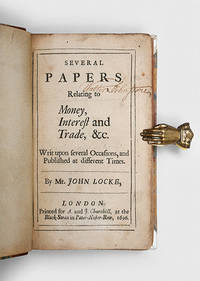
1696166327London: A. and J. Churchill 1696. Locke's gospel of sound money First edition thus. Several Papers comprises an issue under a collective title page of the second editions of three of John Locke's economic tracts all relating to the recoinage controversy of the 1690s in which the government attempted to replace the country's clipped worn and widely forged coinage with a new devalued currency. Though Locke was writing in response to a specific crisis his works had a lasting impact on monetary theory. He soon gained and retained well into the 19th century the reputation as a defender of an honest commercial society free from currency manipulation by governments. "Locke's writings on money and his arguments against devaluation have almost been regarded as gospels for 'sound money' men" Ming-Hsun Li pp. 104. The tracts included are Some Considerations of the Consequences of the Lowering of Interest and Raising the Value of Money first edition 1692 Short Observations. on Coining Silver Money first edition 1695 and Further Considerations Concerning Raising the Value of Money first edition 1695. The book is bibliographically complicated composed from existing sheets of the three works with a collective title page in two states. This copy has Yolton's second issue of the collective title page cancelled to read "By Mr. John Locke" rather than the original "By John Locke Esq;". The third work can be present in sheets of either its second or third edition here the second edition and retaining the distinguishing errata slip. Octavo 162 x 94 mm. Recent quarter calf marbled sides vellum tips. Housed in custom black cloth solander box. Contemporary ownership signature of one "Walter John Stone" to title page. Light browning and a few stains. A very good copy. ESTC R19558; Goldsmiths' 3315; Kress 1980; Wing L2757; Yolton 163B. Ming-Hsun Li The Great Recoinage of 1696-9 1963. hardcover
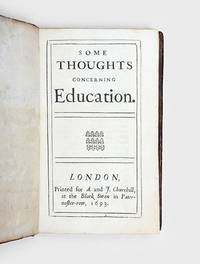
1693185824London: for A. and J. Churchill 1693. Enlightened education First edition of Locke's major contribution to pedagogical theory the seminal Enlightenment treatise on the subject: "His influence on educational thought and practice was enormous and is still very much with us in its fundamental outlook and method" Edwards p. 501. Locke judged his own impeccably orthodox education to be both unpleasant and unhelpful: he therefore welcomed the opportunity to advise a close friend Edward Clarke on the impending education of his son. He argues that pupils are essentially malleable a tabula rasa: receptive to a good education but easily corruptible by a bad one. The ultimate purpose of a Lockean education is to develop rational self-control and so temper one's selfish passions. To do so the teacher should aim first at physical health as a sound body leads to a sound mind while integrating sports and even trade skills. By contrast with his own upbringing the scholastic focus on ancient languages and theology is considerably reduced. These ideas made a deep impression on Enlightenment thought not least on Rousseau and his Emile. The tabula rasa in particular appealed to reformers who saw social progress as possible through education. There are two virtually identical editions the second a line-for-line resetting of the first; this copy has all the points delineated by Yolton as distinguishing the first edition. Octavo 173 x 104 mm pp. 8 262 2. Woodcut device on title page. Contemporary panelled calf rebacked to style edges sprinkled red. With 1716 ownership initials of one Joshua Harrison possibly the Harrison who studied at Queen's College Oxford from 1718 to 1722 to front free endpaper. With 1718 inscription recording Harrison's gift of this copy to one Thomas Horton possibly the Horton 1705-1791 who studied at St John's College Cambridge in 1729. Light scuffing extremities restored and initial 50 leaves washed otherwise crisp: a very good copy indeed. Attig 523; ESTC R7482; Pforzheimer 612; Wing L2762; Yolton 166. Paul Edwards ed. The Encyclopedia of Philosophy vol. III 1967. unknown
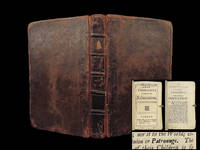
1693POCme[LO61London: Printed for A. and J.Churchill 1693. 1693. 8vo. pp. 4 p.l. 262 2. contemporary mottled calf front joint cracked short split in upper rear joint spine ends bit chipped lacking front flyleaf discolouration to outer margin in some gatherings outer margin of last few leaves with slight fraying. a few old manuscript marginal notes. First Edition First Issue with with slightly skewed woodcut ornament on title catchword I my on A2v and misprint Patronnge on A3v Yolton reversing priority given in Wing. Lockes treatise grew out of a correspondence dating from 1684 between himself and his friend Edward Clarke whom he was advising on the education of his son. Locke was in Holland at the time. "His thought was marked by a ready understanding of and sympathy with children. Three main thoughts dominate the work. First the individual aptitudes capacities and idiosyncrasies of the child should govern learning not arbitrary curricular or rote learning taught by the rod. Second Locke placed the health of the body and the development of a sound character ahead of intellectual learning. In the third place he saw that play high spirits and the "gamesome humor" natural to children should govern the business of learning wherever possible. Compulsory learning is irksome; where there is play in learning there is also joy in it. Throughout he placed emphasis on good example practice and use rather than on precepts rules and punishment. The work was an implicit criticism of his own education at Westminster and Oxford which he found unpleasant and largely useless." James Gordon Clapp Encyc. of Philosophy p. 500 Wing 2762A. Yolton 165. Christophersen p. 57. Pforzheimer 612. 1st Edition. London: Printed for A. and J.Churchill, 1693. unknown
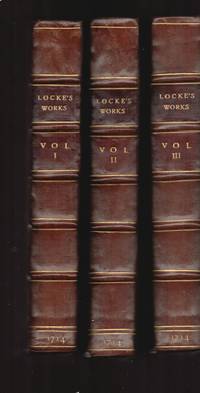
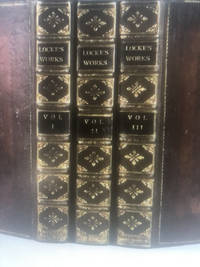
17149032182London: John Churchill/Sam. Manship 1714. 1st. Hardcover. Very Good. First edition of the Collected Works. "Printed for John Churchill at the Black Swan in Pater-noster-Row and Sam. Manship at the Ship in Cornhil." Beautifully rebacked to style with original calf covers spines stamped in gilt. Engraved frontispieces in volumes I and II. Text blocks are near fine clean and bright with sharp edges. Calf covers are rich and glossy. Some wear to extremities through cloth at some points of outer edges on all volumes. 7 3/4 x 12 1/2 inches. Images available upon request. <br/><br/> John Churchill/Sam. Manship hardcover
1714Bv1205<p>FIRST EDITION of Locke's collected works including his canonical Essay Concerning Human Understanding. This First printing further includes works by Locke acknowledged only in his will and the earliest to put his name to: Two Treatises on Government as well as the letters on Toleration and The Reasonableness of Christianity.</p><p>"Locke was the first to take up the challenge of Bacon and to attempt to estimate critically the certainty and the adequacy of human knowledge when confronted with God and the universe" PMM 164. A landmark in Enlightenment thought encapsulated in "the first modern attempt" to analyze human knowledge PMM 193 194 Locke's Essay Concerning Human Understanding: "To love truth for truth's sake is the principal part of human perfection in this world and the seed-plot of all other virtues."</p><p>The influence Locke exerted upon Jefferson and other Founding Fathers cannot be overestimated. Indeed some of Jefferson's contemporaries claimed that he borrowed central ideas in the Declaration of Independence directly from the writings of John Locke. Doubtless the political philosophy Locke bequeathed to America's Founding Fathers gave rise to the spread of freedom across the civilized world and the birth of the freest country in history the United States of America.</p><p>London: for John Churchill and Sam. Manshhip 1714. Folio contemporary full calf rebacked in period style by Bernard Middleton. Complete with and exquisite copper-engraved frontispiece portrait by George Vertue in Volume I and full-page memorial plate engraved plate of Locke's funeral monument. General light wear to bindings; text extremely clean with large margins. A very handsome set. Book #Bv1205. $10000.</p><p>We specialize in rare Ayn Rand and other legends and landmarks.</p> John Churchill and Sam Manship hardcover
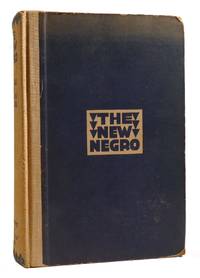
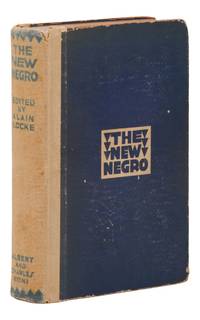
1925202261New York: Albert & Charles Boni 1925. First Edition; First Printing. Hardcover. Very Good bound in publisher's original blue paper-covered boards over buckram spine cloth lettered in blue. Rubbing along panel edges. Book decoration and illustrations by Winold Reiss. Albert & Charles Boni hardcover
169666981London: Printed for A. and J. Churchill 1696. First collected edition of Locke's important writings on the fundamentals of economics. Small octavo 6 5/16 x 3 3/4 inches; 159 x 95 mm. 4 4 192; 24; 16 111 1 advertisement 1 eratta 1 blank pp. With general title-page and separate title-pages for Some Considerations and Further Considerations.<br> <br> Contemporary full speckled calf rebacked to style. Boards stamped in blind. Red morocco spine label lettered in gilt. Boards a bit chipped and bumped. Overall a very good copy.<br> <br> Comprised of:<br> <br> The Second edition Corrected of:<br> <br> Some Considerations of the Consequences of the Lowering of Interest and Raising the Value of Money. In a Letter to a Member of Parliament 1691. London: for Awnsham and John Churchill 1696.<br> <br> and<br> <br> Short Observations on a Printed Paper Intituled For encouraging the Coining Silver Money in England and after for keeping it here. 1695<br> <br> and<br> <br> Further Considerations Concerning Raising the Value of Money. Wherein Mr. Lowndes's Arguments for it in his late Report concerning An Essay for the Amendment of the Silver Coins are particularly Examined. London: Printed for A. and J. Churchil 1695.<br> <br> ESTC lists two variants: one has "By John Locke Esq;" on the title-page 'Further Considerations' dated 1695 and 111 pages. The other issue has "By Mr. John Locke" on the title-page "Further Considerations" dated 1696 and 112 pages. This copy is a combination of the two with 'Further Considerations' dated 1695 and "By Mr. John Locke" on the title-page.<br> <br> "'The Great Recoinage' controversy of the 1690s was the impetus for Locke's writings on mercantile and monetary theory. In the 1660s Sir Josiah Child had argued that the legal rate of interest should be lowered. It was still a topic for political discussion in the early 1690s: Child was still pressing the argument and was supported by London merchants. Locke however defended a legal rate of interest but refused to fix it below the current rates. This was the occasion for his publishing Some Considerations of the Consequences of the Lowering of Interest and Raising the Value of Money in 1692. When William Lowndes Secretary of the Treasury proposed in 1695 to raise the nominal value of coins Locke slightly revised Some Considerations and also published two further pamphlets Short Considerations and Further Considerations. At that time gold and silver coins had a value equivalent to their metal content representing nothing but their silver or gold quantity. Locke rejected devaluation basing his argument on this 'commodity theory' of money. He considered 'raising of the denomination or the increase of alloy' to be debasement and fraud" Yolton.<br> <br> "Locke's second major essay Further Considerations Concerning Raising the Value of Money 1695 while it reiterated many of his earlier arguments was mostly concerned with the issue of recoinage. Locke took issue with a proposal to devalue the official coinage by 20 per cent and argued strongly for recoining at the old standard the currently circulating coins debased by clipping and normal wear and tear. Money Locke argued was equivalent to gold and silver. People contracted for gold and silver and a government stamp was simply an assurance of the specie content of official coins. Hence a devaluation would only confuse trade and cause an increase in prices denominated in terms of pounds and shillings" The New Palgrave.<br> <br> Einaudi. Goldsmiths'. Kress.<br> <br> HBS 66981.<br> <br> $9500. Printed for A. and J. Churchill unknown
17287141London: A. Bettesworth; J. Pemberton; E. Symon 1728. Fifth Edition. Fifth Edition - as stated on the title page. Rare 1700s imprint of Locke's landmark work on government. Originally published in 1689. Measuring approximately 8" x 5" with 308 numbered pages.<br /> <br /> The book is in good condition. Moderate to heavy wear and staining to the original full leather boards. Spine leather has partially perished. Hinges are cracked but the binding is holding strong. Small half-inch chip missing from the bottom of the front endpaper. Top corner of title page has been clipped. Minor scattered soiling and some dog-eared corners found within the textblock<br /> <br /> Please view the many other rare titles available for purchase at our store. We are always interested in purchasing individual or collections of fine books.<br /> <br /> Inventory # P7-2. A. Bettesworth; J. Pemberton; E. Symon unknown
1925140945556New York: Albert and Charles Boni 1925. First Edition. Very Good. First edition. Bound in publisher's original blue paper-covered boards over buckram spine cloth lettered in blue. Very Good with with rubbing to boards especially at edges two indentations to rear cover at spine and a light crease the rear board at the top corner. Former owner bookplate to front free endpaper. Pages tanned with occasional soiling several preliminary hinges slightly over-opened. <p>The leading African American poets and writers of the early 20th century are featured in this important anthology which came to define the Harlem Renaissance movement: Langston Hughes Zora Neale Hurston James Weldon Johnson Countee Cullen Claude McKay Jean Toomer Georgia Douglas Johnson Jessie Fauset and more. Albert and Charles Boni unknown
169326181<p><strong>1693 TRUE 1ed John LOCKE Concerning Education GOBLINS Boogeyman Bloody Bones</strong></p><p><em>"I have always thought the actions of men the best interpreters of their thoughts." </em></p><p>– John Locke</p><p>After studying medicine under the teaching of Thomas Sydenham John Locke began his journey of philosophical thinking that would develop into some of his most famous works. In 1693 Locke published a treatise on education entitled '<em>Thoughts Concerning Education'</em>. Throughout the 18th-century it was <strong><u>the most important work on the philosophy of education in England</u></strong>. This work was an extension from 'Concerning Human Understanding' in which he describes how to educate the 'blank slate' mind described in<em> 'Human Understanding'.</em></p><p>Perhaps the most intriguing sections found in this work is Locke's perspectives on <u>goblins sprites and the Boogeyman</u>! Locke describes recorded instances of <strong>Bloody-Bones</strong> being used to scare children into behaving! From this 17th-century printing:</p><p>"It being the usual method of servants to awe children and keep them in subjection by telling them of Raw-Head and Bloody-Bones as carry with them the ideas of some hurtful terrible things in habiting darkness." p. 159</p><p>This incredibly rare printing is notable for being one of the earliest printed editions of Locke and includes the desirable text misprint in the dedication. <u>An absolutely incredible printing of Locke's "<em>Education</em>"!</u></p><p>Item number: #26181</p><p>Price: $7500</p><p>LOCKE John</p><p><strong><em>Some thoughts concerning education</em></strong></p><p>Printed for A. and J. Churchill at the Black Swan in Pater-Noster-Row London 1693. <strong><u>True first edition!</u></strong></p><p><u>Details</u>: </p><p><!-- if !supportLists-->· <!--endif-->Collation: Complete with all pages</p><p><!-- if !supportLists-->o <!--endif-->8 262 2</p><p><!-- if !supportLists-->o <!--endif-->Title page i.e. A1 provided in professional facsimile</p><p><!-- if !supportLists-->· <!--endif-->References: Wing L 2762;</p><p><!-- if !supportLists-->· <!--endif-->Edition point:</p><p><!-- if !supportLists-->o <!--endif-->Verso of A3 line 19: "Patronnge" instead of "Patronage"</p><p><!-- if !supportLists-->· <!--endif-->Provenance: </p><p><!-- if !supportLists-->o <!--endif-->Armorial bookplate – J. Gibson A.M.</p><p><!-- if !supportLists-->· <!--endif-->Language: English</p><p><!-- if !supportLists-->· <!--endif-->Binding: Leather; tight and secure</p><p><!-- if !supportLists-->· <!--endif-->Size: ~7in X 4.5in 18cm x 11cm</p><p><!-- if !supportLists-->· <!--endif-->Exceedingly rare valuable and desirable with auction records and price comparisons between $11000-$15000</p><p>Our Guarantee:</p><p>Very Fast. Very Safe. Free Shipping Worldwide.</p><p>Customer satisfaction is our priority! Notify us with 7 days of receiving and we will offer a full refund without reservation!</p><p>26181</p><p>Photos available upon request. </p> Printed for A. and J. Churchill, at the Black Swan in Pater-Noster-Row hardcover
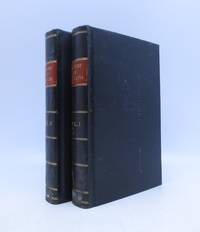
1799068560London: Printed for Alexander Donaldson 1799. First Edition. Hardcover. Very Good. 8vo. respectively. FIRST EDITION 1779. TWO VOLUME COMPLETE SET. The First History of South Carolina. Howes H452. Printed for Alexander Donaldson London 1779. Matching hardcover set. Rebound in black cloth covers are plain. Spines bear orange leather labels stamped in gilt along with the volume numbers. Top edges gilt. Endpapers are gray. Leaves are printed on laid paper. Includes "The first set of the fundamental constitutions of South Carolina / as compiled by Mr. John Locke"/ pages 321-347. Vol. I: xiv 347 pp; Vol II: ix 309 pp. On a shelf this set spans 2.5 inches. <br><br>ABOUT THIS SET: The "earliest history of the region" Howes H452. "Justin Winsor calls this work the 'earliest account of South Carolina cast in a sustained retrospective spirit'. Hewatt an Englishman who at one time lived at Charleston was a keen collector of historical documents". Streeter II 1133. "In Volume I Hewatt gives a sympathetic and balanced account of Indian life and customs based in part on his own observations. He describes the climate soil natural resources fauna snakes and insects; how to make turpentine tar and pitch; and how to cultivate silk cotton and especially rice. In Volume II he describes and criticizes slavery in the colonies and the treatment of slaves; he maintains that slaves should be given some instruction in morals and religion. He discusses diseases in Carolina and describes the cultivation of indigo in some detail. His factual account of the 'present state and condition of the colony' probably refers to the latter 1760s or early 1770s; he quotes some statistics of 1776." Clark I 225. De Renne 217. Turnbull I 223. <br><br>ABOUT THE AUTHOR: Alexander Hewatt came to Charleston in 1763 as minister of the Scots First Presbyterian Church there. Fascinated with the history of South Carolina he soon became a keen collector of historical documents. When the British fleet arrived at Charleston in 1776 Hewatt and other ministers were required to renounce their loyalty to the king. When he refused Hewatt was given sixty days to leave the colony. He sailed for Great Britain where he devoted the next two years to completing his history. In 1780 he was awarded the Doctor of Divinity form the University of Edinburgh an indication of the esteem in which he and his work were held. "Hewatt's account reflects the influence of William Robertson and the Scottish school of historiography. less concerned with a strict chronology of events Hewatt instead focused on the interrelatedness of those events and their various causes and effects. His goal in doing so was to provide moral political and practical instruction to the colonists and to those in England" both of whom he hoped would see the importance of continuing South Carolina's close ties to the Crown" ANB. The work includes detailed descriptions of the climate topography and fauna of South Carolina as well as discussions of slavery there. He warned that the mistreatment of slaves was likely to "fire them with desires of liberty and vengeance." Chapter 5 in the first volume includes a full account of the Yamasee War while chapter 10 is devoted to the war with the Cherokee. <br><br>CONDITION: This set is overall VG with general shelf wear. Removal of bookplate on the front pastedown on both volumes and clipped rectangular front endpaper removed in both volumes. Leaves are in remarkable condition with extremely minimal foxing. Completely free from marginalia or annotation. Bindings are tight. An incredible set. <br><br>Additional photographs available upon request. This set will be delivered with "adult signature required". Full refund if not satisfied. Printed for Alexander Donaldson hardcover
169166937Amsterdam: Chez Abraham Wolfgang 1691. A Founding Document of Democracy The First of John Locke's Works to be Translated from His Native English<br> <br> LOCKE John. Du gouvernement civil ou l'on traitte de l'origine des fondemens de la nature du pouvoir et des fins des societe politiques. Traduit de l'Anglois. Amsterdam: Chez Abraham Wolfgang 1691.<br> <br> First edition in French of Locke's groundbeaking work and the first of his works to be translated from his native English. Twelvemo 5 7/16 x 3 inches; 138 x 75 mm. 12 321 1 blank pp. Title page with printer's woodcut device. Short marginal tears to M7 & 8 repaired and with no loss.<br> <br> Contemporary light salmon paper over boards rebacked at a very early date in similar paper manuscript spine lettering red speckled edges. Small number of upper blank of title and front endpaper. Housed in a quarter morocco clamshell case. Overall an excellent copy; very clean and in a contemporary binding.<br> <br> Originally published in 1690 as 'Two Treatises of Government'. "Locke's anonymous text is here an anonymous translation traditionally attributed to David Mazel. 'One of the Huguenot pastors living in Holland' of the second treatise in its 1R version with the first chapter omitted" Yolton. "The second treatise contains a plain statement of the principles of democracy. In an age and country in which the practice of democracy had just been triumphantly vindicated Locke's theories although anticipated to some degree by the 'Whig' tradition of political thought-Aristotle Aquinas Hooker Grotius-had all the freshness of novelty. Like Hooker Locke presupposes an original and necessary law of reason and bases the constitution of society on it rather than on the de facto existence of a government based on the actual submission of the governed to the rulers. This consent is thus a prior condition of the 'social contract' not a result of it so that the civil rulers hold their power not absolutely but conditionally; government being essentially a moral trust which lapses if the trustees fail to maintain their side of the contract. Locke was to reinforce these liberal opinions by his Letters on Tolerance and they combine with the Treatises on Government to provide a classic example of the empirical approach to the social and political economy which has remained ever since the basis of the principles of democracy" PMM. Its influence on the development of French and American political though cannot be overstated.<br> <br> Graesse IV 243. Printing and the Mind of Man 163. Yolton Locke 46. No copies of this edition have come up at auction in the last thirty years and OCLC only located twelve copies.<br> <br> HBS 66937.<br> <br> $6000. Chez Abraham Wolfgang unknown
1925140947068New York: Albert and Charles Boni 1925. First Edition. Very Good. First edition first printing of this Harlem Renaissance cornerstone. Bound in publisher's original blue paper-covered boards over buckram spine cloth lettered in blue. Very Good with rubbing through to edges with heavier wear to corners and spine ends covers worn. Contents tanned with several leaves roughly opened. <p>The leading African American poets and writers of the early 20th century are featured in this important anthology which came to define the Harlem Renaissance movement: Langston Hughes Zora Neale Hurston James Weldon Johnson Countee Cullen Claude McKay Jean Toomer Georgia Douglas Johnson Jessie Fauset and more. Albert and Charles Boni unknown