Locke, JohnBiblio.com
4 251 résultats
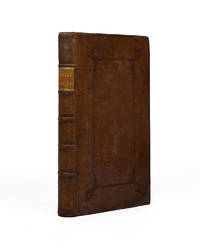
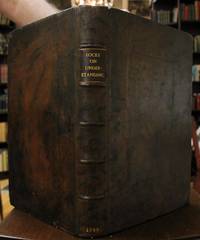
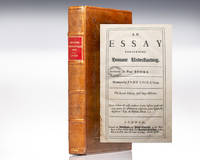
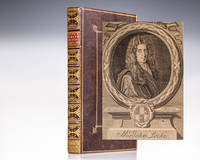
1700150333London: Printed for Awnsham and John Churchil at the Black-Swan in Pater-Noster Row and Samuel Manship at the Ship in Cornhill near the Royal-Exchange 1700. Rare fourth edition of this fundamental work in the history of Western thought the first to name Locke as the author and include the frontispiece portrait of him. Folio bound in in full speckled calf with gilt titles and tooling to the spine in six compartments within raised gilt bands gilt turn-ins engraved frontispiece portrait of Locke. An exceptional example. The second edition of Locke's essay contains a number of important changes and additions to the text. It was the first to name Locke as the author and include the frontispiece portrait of him. "It is Locke's second edition of the 'Essay on Human Understanding' that is the masterpiece we remember; the first 1690 edition did not bear Locke's name nor did it include a number of emendations that finished the work as Locke wanted it" Matthews Collecting Rare Books 97. "Locke was the first to take up the challenge of Bacon and to attempt to estimate critically the certainty and the adequacy of human knowledge when confronted with God and the universe" PMM 164. Printed for Awnsham and John Churchil, at the Black-Swan in Pater-Noster Row, and Samuel Manship, at the Ship in Cornhill, near unknown
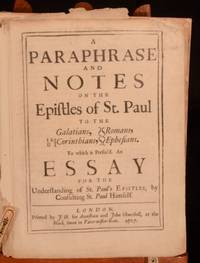
1707007735London: Printed by J.H. for Awnsham and John Churchill at the Black Swan in Pater-noster-Row 1707. This volume is compose of five parts each with its own title page and pagination the whole is proceeded by two volume title pages both dated 1707 and a preface. i-ii iii-xviv Galatians 1706 second edition title page2 publisher's message to the reader and publisher's adverts2pages 43 pages. I Corinthians 1706 advertisment2 title page1-2107 pages 208blank. II Corinthians 1706 : title page123-58 2adverts. Romans 1707 : title page1-23-142 pages. 2adverts. Ephesians 1707 : title page1-23-60 pages. 8 X 9.7 inches. Bound in contemporary full calf with tooled ruled borders and decorations title label to spine with only fragments remaining. externally very rubbed with wear to corners spine ends and edges cracking along outer and inner hinges both boards attached. Inside all complete as described here Initial "P" in ink on corner of front free endpaper and a name and date 1734 at the top of the title page. Browning and offsetting to endpapers Some browning and foxing to the pages of the preface and a water stain on the margin of several pages of the preface. Therafter all quite clean throughout with no further foxing or marking. No annotations. First Edition. Hard Cover. Good/No Jacket. Printed by J.H. for Awnsham and John Churchill, at the Black Swan in Pater-noster-Row Hardcover
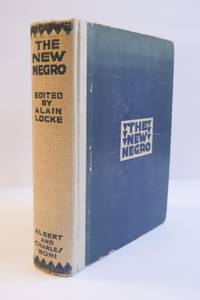
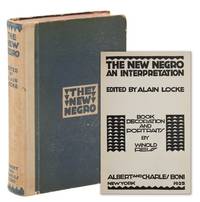
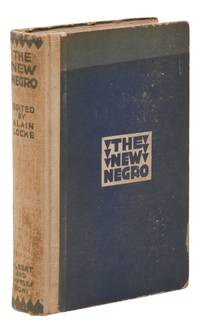
19251405855New York: Albert and Charles Boni 1925. First Edition. Hardcover. Octavo xviii 446 pages. In Very Good condition. Bound in publisher's quarter tan cloth and navy blue paper boards with blue lettering to spine. General shelf wear with moderate to heavy rubbing along extremities. Some sunning and scratching to boards. Fading to red dye on top edge of textblock. With pink pictorial endpapers. Previous bookseller's sticker adhered to rear pastedown. Mild tearing to fore edges of pages xv-xviii. Light age toning with minor penciling scattered throughout. Shelved in Case 1. "The New Negro: An Interpretation" is an anthology of fiction poetry and essays on African-American and African art and literature. The title lent itself to The New Negro Movement a contemporary name for what is now commonly known as the Harlem Renaissance. Editor Alain LeRoy Locke was a leading figure in the Harlem Renaissance and a professor at HBCU Howard University in Washington DC. 1405855. Shelved Dupont Bookstore. Albert and Charles Boni hardcover
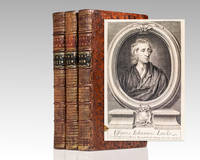
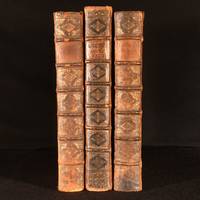
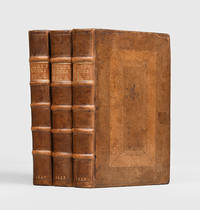
1722149219London: Printed for A. Churchill and A. Manship 1722. Rare second edition of the collected works of John Locke “the most worthy… of the indisputably great philosophers.†Folio three volumes bound in full speckled brown calf with gilt titles and tooling to the spine with morocco spine labels in seven compartments within raised gilt bands gilt turn-ins all edges stained red. Frontispiece of John Locke to volume one. In very good condition bookplate to the front pastedown and ownership signature to the front free endpaper of volume one. An exceptional example. John Locke is regarded as one of the most influential of Enlightenment thinkers and the Father of Classical Liberalism. "Locke was the first to take up the challenge of Bacon and to attempt to estimate critically the certainty and the adequacy of human knowledge when confronted with God and the universe" PMM 164. This is the first edition of the first collected edition of his work and the earliest to put his name to "Two Treatises on Government" as well as the letters on "Toleration"and "The Reasonableness of Christianity". Contents include: Volume 1: An Essay concerning Human Understanding. In Four Books; A Letter to the Right Reverend Edward Lord Bishop of Worcester concerning some Passages relating to Mr. Locke's Essay of Human Understanding in a late Discourse of his Lordship's in Vindication of the Trinity; Mr. Locke's Reply to the Right Reverend the Bishop of Worcester's Answer to the Letter; Mr. Locke's Reply to the Bishop of Worcester's Answer to his Second Letter. Volume 2: Some Considerations of the Consequences of the lowering of Interest and raising the Value of Money. In a Letter send to a Member of Parliament. 1691; Short Observations on a printed Paper entitled For encouraging the coining SilverMoney in England and after for keeping it here; Further Observations concerning raising the Value of Money. Wherein Mr. Lowndes's Arguments for it in his late Report concerning An Essay for the Amendment of the Silver Coin are particularly examind'd; Two Treatises of Government. In the Former the false Principles and Foundation of Sir Robert Filmer and his Followers are detected and overthrown. The Latter is an Essay concerning the true Original Extent and End of Civil Government; A Letter concerning Toleration; A Second Letter concerning Toleration; A Third Letter for Toleration: To the Author of the Third Letter concerning Toleration; The Reasonableness of Christianity as deliver'd in the Scriptures; A Vindication of The Reasonableness of Christianity From Mr. Edwards's Reflections; A Second Vindication of the Reasonableness of Christianity. Volume 3: Some Thoughts concerning Education; A Paraphrase and Notes on the Epistles of St. Paul to the Galatians I and II. Corinthians Romans and Ephesians. To which is prefix'd An Essay for the Understanding of St. Paul's Epistles by consulting St. Paul himself; Posthumous Works viz. I. Of the Conduct of the Understanding. II. An Examination of P. Malebranche's Opinion of Seeing all things in God. III. A Discourse of Miracles. IV. Par of a Fourth Letter for Toleration. V. Memoirs relating to the Life of Anthony first Earl of Shaftesbury. VI. A new Method of the Common-Place-Book written originally in French and translated into English; Some familiar Letters between Mr. Locke and Several of his Friends.The work was published ten years after his death and is the first time his works were published as a collection. Printed for A. Churchill and A. Manship unknown
121874London Printed for Awnsham and John Churchil at the Black Swan in Pater-Noster-Row and Samuel Manship at the Ship in Cornhill near the Royal Exchange 1695. . Third edition; folio 33 x 21 cm; engraved portrait frontispiece of Locke after Sylvester Brounower ads to verso of final f. of text ownership inscription in pen to title upper margin obscured inscription in pen to front pastedown contemporary corrections annotations and notes in pen to pp17 18 33 93 131 and 190 slight dampstaining to title and prelims and occasionally thereafter; blind-panelled calf later contrasting brown morocco lettering-piece to spine spine head cap and bottom corner of upper cover expertly repaired a little rubbed very good; 40 407 13pp.<br /> The third edition of John Locke's 1632-1704 major philosophical work an excellent lifetime example with contemporary annotations and notes in pen for the fourth edition published in 1700.<br /><br />The Essay Concerning Human Understanding seeks to explain how it is that we as humans acquire our ideas and knowledge. In it Locke refutes the suggestion of rationalist philosophers like Descartes that man is born with some form of innate understanding instead famously describing the mind as a 'white paper' i.e. blank slate 'void of all Characters without any Ideas' which is then filled through sensory experience p.41. As such the text is considered one of the primary sources of empiricism in early modern philosophy.<br /><br />With contemporary manuscript annotations to the margins inserting the additions which were incorporated into the fourth edition of the text published in 1700 and correcting errors. These include in italics: p.17 Book I Chap. III 5 '.the highest perfection of humane Nature to do otherwise'; p.18 Book I Chap. III 8 '.nothing else but our own Opinion or judgement of the moral rectitude or pravity of our own actions'; p.33 Book I Chap. IV 16 'angles' for 'Angels'; p.93 Book II Chap. XIV 5 'Durtaion' for 'Duration'; and p.190 Book II Chap. XXVII 29 inserting the extensive anecdote of Prince Maurice and his Brazilian parrot.<br /> ESTC R20221; Yolton 63. London, Printed for Awnsham and John Churchil, at the Black Swan in Pater-Noster-Row, and Samuel Manship, at the Ship in Cornhil unknown
1707EXP2-E-7London: J H Awnsham and John Churchill 1707. First edition. Leather. Fair. 9.5" by 7.5". None. A scarce collection of works by John Locke. The first collected edition compiled of various editions of earlier shorter works. Each work with a separate title page and pagination. Collated: Complete. With publisher's advertisements bound out of order to BL copy. Contains: An Essay for the Understanding of St Paul's Epistles by Consulting St. Paul himself 1707 First Edition A Paraphrase and Notes on the Episdtle of St. Paul to the Galatians 1706 Second Edition A Paraphrase and Notes on the First Epistle of St Paul to the Corinthians 1706 First Edition A Paraphrase and Notes on the Second Epistle of St Paul to the Corinthians 1706 First Edition A Paraphrase and Notes on the Epistle of St Paul to the Romans 1707 First Edition A Paraphrase and Notes on the Epistle of St Paul to the Ephesians 1707 First Edition John Locke was an influential English philosopher and physician of the Enlightenment. His work greatly influenced the development of political philosophy and the works of figures such as Voltaire and Rousseau. His religious beliefs varied over his lifetime and were rarely displayed in his writings. These works published posthumously provide important insight into his theology and the final years of his life. In a calf binding. Externally worn both boards detached but present. Loss to head at tail of spine and to leather at extremities. Light rubbing and worming to boards. Lacking front free-endpaper. Internally generally firmly bound although binding strained to Romans about half way through the volume. Title page and front blank detached but present. Title page with slight loss not affecting text. Pages bright with handling marks and dusting throughout occasional spotting. Marginal age toning and offsetting to first and last few pages. Pink ink annotations roman numerals indicating chapter numbers throughout. Light marginal worming to final work Ephesians not affecting text. Closed tear to page 29 of Ephesians. Overall: FAIR binding GOOD internally Fair J H Awnsham and John Churchill hardcover
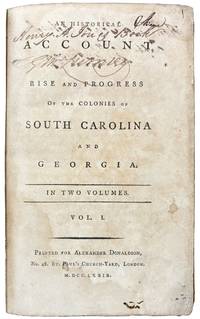
177940925London: Printed for Alexander Donaldson No. 48. St. Paul's Church-Yard London 1779. 8vo. 8 1/4 x 5 inches. First edition. Volume I: a-b4 A-Uu4 Xx2. i-xiv 2 1-347 1. 364 pp. Title Preface Contents Chapters I-VI The First Set of the Fundamental Constitutions of South Carolina as Compiled by Mr. John Locke. Volume II: a4 b1 A-Ss4 x1. i-ix 1 1-329 1. 340 pp. Last page misnumbered 309. Title Contents Chapters VII-XI With inscriptions of "Henry A. Jones" on both volumes unclear if it is the playwright of the same name. Bound to style in 18th-century calf spines with raised bands forming compartments gilt lettered red morocco lettering pieces in second compartments. Restoration to the the last text leaf in volume one<br/> <br/> First edition of the fundamental historical account of South Carolina and Georgia which Howes calls "the earliest history of this region" and Winsor states is the "earliest account of South Carolina cast in a sustained retrospective spirit." Streeter<br/> <br/> Hewatt or Hewat was a Scottish-born Presbyterian minister educated at Edinburgh who presided over the Scots First Presbyterian Church in Charleston when it was Charlestown South Carolina from 1763 to 1777. When the British fleet arrived at Charlestown in 1776 Hewatt and other ministers were forced by Patriots to renounce their loyalty to the king. When he refused Hewatt was given sixty days to leave the colony. His property was seized and he returned to the British Isles and wrote this historical account in London. Considered by Howe to be the earliest and best account of Colonial South Carolina and Georgia the book is bolstered by as Streeter states Hewatt being a "keen collector of historical documents." However his work remains important today because it is also based on his personal observations as a first-hand source from over a decade of lived experience in the region. Hewatt discusses the immigration of British French and other European migrants to the Carolinas due to religious persecution at home. He examines the lives they then created in the New World and the economies they built while doing so. But Hewatt also pays especial detail to the customs and cultures of those people these settlers displaced: the indigenous Native Americans of the region. "Hewatt gives a sympathetic and balanced account of Indian life and customs. He describes the climate soil natural resources fauna snakes and insects; how to make turpentine tar and pitch; and how to cultivate silk cotton and especially rice." De Renne An opponent of slavery as many Presbyterians were he chronicles the introduction of enslaved people from Africa and the ensuing social and economic problems it caused. He criticizes slavery in the colonies and the treatment of enslaved people while maintaining that they should be given instruction in morals and religion. He also warns that to mistreat enslaved people was to "fire them with desires of liberty and vengeance." Also covered in Volume I is the Yamasee War and in Volume II the War with the Cherokee. In 1780 after the publication of this work Hewatt was awarded the Doctor of Divinity from the University of Edinburgh an indication of the success of the present book. "Hewatt's account reflects the influence of William Robertson and the Scottish school of historiography. Less concerned with a chronology of events Hewatt instead focused on the interrelatedness of those events and their various causes and effects. His goal in doing so was to provide moral political and practical instruction to the colonists and to those in England." ANB His work especially his comments on Native Americans and enslaved people were used as the basis for David Ramsay's history though it went uncredited. The first volume includes the "first set of the fundamental constitutions of South Carolina" which have been attributed to the English political philosopher John Locke because he at the time was working as a paid secretary for one of the Province of Carolina's proprietors Anthony Ashley Cooper. The historian David Armitage and the political scientist Vicki Hsueh argue he was a co-author along with Cooper the 1st Earl of Shaftesbury. The constitutions reflect Locke's classical liberalism safeguarding religious freedom while also setting up a reactionary neo-feudal form of government.<br/> <br/> Clark I 255. De Renne 217. Howes H452 b. Sabin 31630. Servies 522. Streeter Sale 1133. Turnbull I 223. Printed for Alexander Donaldson, No. 48. St. Paul's Church-Yard, London unknown
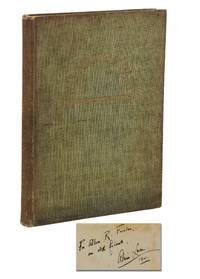
1940140946343Washington D.C.: Associates in Negro Folk Education 1940. First Edition. Very Good. First edition first printing. Signed by Alain Locke and inscribed to "an old friend" Allan R. Freelon on the front free endpaper. Freelon 1895-1960 was a prominent Harlem Renaissance artist pioneering educator and civil rights activist. 224 pp. with color frontispiece "Mother and Child" by Sargeant Johnson and 4 pp. color insert "The Amistad Murals" tipped in facing p 124. Bound in publisher's green cloth lettered in gilt. Very Good with darkened spine and edges with light soiling overall. Extremities lightly worn with minor foxing to endsheets. Faint toning to edges of textblock. No jacket likely as issued. <p>An important association between Locke "Dean" of the Harlem Renaissance and popularizer of African American art and Freelon on the first serious book-length study of Black artists. Two of Freelon's Impressionist-style paintings are featured in this work alongside work by Edmonia Lewis Henry Ossawa Tanner Hughie Lee-Smith and Jacob Lawrence. Associates in Negro Folk Education unknown
1925140949243New York: Albert and Charles Boni 1925. First Edition. Very Good. First edition first printing. xviii 446 pp. Bound in publisher's blue paper-covered boards over buckram spine cloth lettered in blue; lacking the dust jacket. Very Good with moderate rubbing and toning to covers boards exposed at edges. Dust-soiling and light staining to upper edge of textblock contemporary bookplate and several small abrasions to front endsheet. Contents slightly overopened at several places.<br /> <br /> <p>A landmark African American anthology featuring stories essays and poetry by the leaders of the Harlem Renaissance movement: Langston Hughes Zora Neale Hurston James Weldon Johnson Countee Cullen Claude McKay Jean Toomer and more. Albert and Charles Boni unknown
1727PCKeLOCK34London: Printed For Arthur Bettesworth. 1727. 1727. 3 Volumes. folio. pp. 2 p.l. xxviii 2 575 16index; 1 p.l. 671 13index; 3 p.l. 668 15. 2 engraved plates incl. frontis. portrait by Vertue after Kneller & memorial plate. woodcut ornaments & initials. contemporary mottled calf neatly rebacked preserving endpapers some scarring to covers but an attractive set. Third Edition including An Essay concerning Human Understanding Some Considerations of the Consequences of lowering the Interest and raising the Value of Money Two Treatises of Government Letter concerning Toleration Some Thoughts concerning Education Some Familiar Letters &c. but not the Remains or Le Clerc's account of Locke's life which was first added in the 1751 fifth edition. Christophersen 88. Rand I 341. NCBEL II 1836. cfPrinting and the Mind of Man 164. Palgrave p. 633. London: Printed For Arthur Bettesworth., 1727. unknown
1955mon0000001555Published jointly by Technology 1955. Unknown Binding. Good. in x in x in. Published jointly by Technology unknown
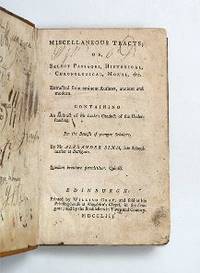
1753149022Edinburgh: Printed by William Gray 1753. Locke abridged for the younger reader First edition of this rare miscellany including an abridgement of John Locke's Of the Conduct of the Understanding 1706 a significant instance of the popularisation of Locke's philosophy in Scotland. Compiled by the retired schoolmaster Alexander Simm of the Scottish town of Bathgate the miscellany presents to "younger scholars" the "actions and sayings of the great good and wise men of antiquity as well as of the modern; which might instead of useless Trish Trash afford them an agreeable and profitable entertainment when otherwise unemployed" preface. Also included are remarks on the Copernican system Confucius the delusions of witchcraft and the raising of new islands by volcanos. A section on the Union of 1707 is present strongly in favour of the advantages which have accrued from it. Printed on poor-quality paper copies have not survived and the work is consequently rare - ESTC records only 3 copies British Library National Library of Scotland Bodleian. Octavo 170 x 102 mm. Contemporary unlettered sheep blind border to covers. Contemporary pen-trials and ownership signatures to endpapers. Light rubbing to sheep joints intact front free endpaper neatly excised a few minor nicks and peripheral chips to contents not affecting text. A very good copy. ESTC T119426; Yolton 311. unknown
1714022572London: John Churchill. Volume 1 and Volume II only. Full leather. First Edition of the collected works. Previous owners names in ink Thomas Eyre and Js Paine and small bookplates with the name of another owner. One name crossed out. Locke was a highly influential British philosopher and empiricist. Loss from head and foot of spines separations along spine edges Good. . Good. Hardcover. 1st Edition. 1714. John Churchill hardcover
1417956F16London: John Churchill and Sam. Manship; Awnsham Chirchill 1714-1722 . First edition. Leather. Good. 13.5" by 9". Not Stated. The complete collected works of Enlightenment philosopher John Locke with the first and third volume present in the first edition and with volume II present in the second edition. The 1714 first edition of volumes I and III and the 1722 second edition of volume II.Complete in three volumes.Volume I illustrated with an engraved frontispiece and engraved funerary epitaph. Collated complete.The collected works of English philosopher physician and Enlightenment thinker John Locke frequently referred to as the 'Father of Liberalism' and recognised as one of the first of the British empiricists.Essays and writings on numerous subjects - including a discussion of interest letters concerning toleration and the reasonableness of Christianity - are included in these volumes alongside his posthumous works and a number of personal letters. With a lengthy index to the rear of each volume. Volumes I and III present in the 1714 first edition ESTC T128627.Volume I with the collation: A2 a2 A-H2 I2 A-F2 a-g2 B-4G4 4H2. Collated complete.Volume III with the collation: A2 1 B-R2 S-5A4 5B-5E2. Collated complete.Volume I includes 'An account of the life and writings of John Locke Esq; The third edition enlarged' London: printed for J. Clarke and E. Curll 1714 and 'The remains of John Locke Esq; . Publish'd from his original manuscripts' London: printed for E. Curll 1714 as called for.Volume II present in the 1722 second edition. ESTC T128551With the collation: A4 B-4P4 4Q-4S2. Collated complete.Former owner's inscriptions to volume II and III title pages.Present here are first edition volumes of the works of one of the most important and enduring figures of Western philosophy.Locke's philosophy of mind is viewed as the origin of modern conceptions of personal identity and the psychology of the self influencing the work of later philosophers such as Rousseau Hume and Kant. In full panelled calf bindings with gilt detailing to back strips. Volumes I and III lacking spine labels. Small losses of calf to back strip heads and tails with rubbing to back strips joints and board perimeters. Volume I joints starting with front board a touch tender and rear board firmly held. Front board of volume III starting with board firmly held. Joint heads of volume II starting with boards firmly held. Volume II lacking endpapers. Internally firmly bound but with title page and following leaf of volume II detached and loosely inserted. Former owner's inscriptions to volume II and III title pages. Pages bright with instances of light handling marks to each volume. Faint tide marks to heads of leaves of 'An account of the life and writings of John Locke' and 'The remains of John Locke' in volume I and light tide marks to heads of ten leaves to the rear. Very light tide marks to tail of each leaf of volume III and to fore edges and heads of pages 173 onwards. Marginal ink annotations and instances of underlining to pages 13-21 of volume III. Good John Churchill, and Sam. Manship; Awnsham Chirchill hardcover
1751126250Florence: Andrea Bonducci 1751. Rare first edition in Italian of Some Considerations of the Consequences of the Lowering of Interest and Raising the Value of Money 1692 and Further Considerations concerning Raising the Value of Money 1695. It is the only early translation of Locke's papers on money based on the folio Works of 1740 and is furnished with extensive footnotes by the translators Giovanni Pagnini and Angelo Tavanti. It is issued here with a treatise by Pagnini appended at the end of the second volume. Locke's writings had a major influence on the then-ongoing Italian monetary debate. Economic unrest in Italy in the middle of the 18th century led to several publications on monetary theory. In the aftermath of the Succession Wars the possibility of devaluing currency to boost economic growth was considered a proposal which raised questions about Italy's move towards a commercial society and out of feudal systems. Most of the Italian writers opposed devaluation of the currency who cited Locke's similar arguments in the English recoinage crisis of the 1690s; the only major detractor was Galiani. Pagnini and Tavanti published the work in translation in the belief that Locke's ideas of sound money were relevant to the situation. "By publishing Locke's works on money in Italian Pagnini and Tavanti made available to an Italian audience a structured version of what had originally been a few long letters written to give advice on a specific issue that belonged to late seventeenth-century English politics. Yet in the following decades Locke's letters had risen to fame abroad where a myth had been formed of Locke as the defender of an honest commercial order of humankind. If Locke's letters contained a general message about commercial politics the work by Pagnini and Tavanti was supposed to bring it out" Stapelbroek p. 13. The appended treatise by Pagnini describes commercial society as one based on trust and peace; by devaluing the currency a government is undermining this society. 2 vols bound in 1 quarto 245 x 179 mm. Titles printed in red and black engraved vignette to first title large folding table at end of vol. Modern half vellum and plain paper boards new spine labels. Boards lightly marked small ownership stamp to first title and one or two minor stains; a crisp clean copy. Attig 507; Kress Italian 275; Yolton 164. Koen Stapelbroek "The Devaluation Controversy in Eighteenth-Century Italy" in History of Economic Ideas vol. 13 no. 2 2005. hardcover
1727189612London: printed for Arthur Bettesworth; Edmund Parker; John Pemberton; and Edward Symon 1727. The most influential philosopher of modern times Third edition of Locke's collected works following those of 1714 and 1722. "John Locke is the most influential philosopher of modern times. His influence in the history of thought on the way we think about ourselves and our relations to the world we live in to God nature and society has been immense. His great message was to set us free from the burden of tradition and authority both in theology and knowledge by showing that the entire grounds of our right conduct in the world can be secured by the experience we may gain by the innate faculties and powers we are born with" Chappell p. 252. 3 vols folio 318 x 202 mm. Engraved portrait frontispiece by Vertue after Kneller and engraved memorial plate. Contemporary panelled calf rebacked and recornered to style orange morocco labels. Ownership inscription to front pastedown dated 1832 of James Ford curate of St Lawrence in Exeter 1779-1850. Slight rubbing minor marking to covers tear to front free endpaper contents clean crisp and fresh. A very good copy. ESTC T115711; Yolton 365A another issue only says Parker's name in the imprint. Vere Chappell The Cambridge companion to Locke 1994. unknown
1925140947630New York: Albert and Charles Boni 1925. First Edition. Good. First edition first printing. xviii 446 pp. Bound in publisher's blue paper-covered boards over buckram spine cloth lettered in blue. Good with moderate rubbing and toning to covers mottling to front cover boards exposed at edges. Dust-soiling and light staining to upper edge of textblock dampstaining to endpapers pencil inscriptions to front endpapers and half-title. First two leaves clipped at the lower corner contents toned with occasional foxing binding exposed at multiple places. Lacking jacket. A serviceable copy. <p>A landmark African American anthology featuring stories essays and poetry by the leaders of the Harlem Renaissance movement: Langston Hughes Zora Neale Hurston James Weldon Johnson Countee Cullen Claude McKay Jean Toomer and more. Albert and Charles Boni unknown
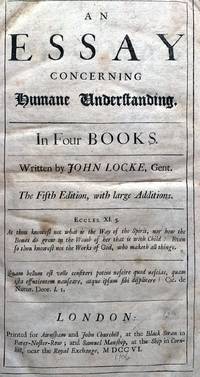
170617416London: Printed for Awnsham and John Churchill 1706. FIFTH EDITION. Index bound after Contents and before text. Contemporary full-paneled calf panels blind-stamped on front and rear boards edges partially rubbed with corners reinforced rebacked; interior excellent. Fifth edition containing expansions of all four books. This edition includes the final textual changes by Locke though it was published posthumously. It was also the last edition printed in folio format. Locke’s 1632-1704 famous work of empirical philosophy deals with the fundamental issues of how we think perceive and express ourselves through language logic and religion. All later editions were based upon this 1706 printing. Printed for Awnsham and John Churchill unknown
1700B5207London: Awnsham and John Churchil c. 1700. A fine example of this desirable work. Edition: 4th edition with large additions. Binding: Contemporary brown speckled calf boards with blind tooled decorative borders on top and bottom cover rebacked skillfully. Spine in six compartments with gilt text on 2 and 6. Tooled decorations on 1 3 4 5 and 6. <br> Notes: The essay is divided into 4 books within the one volume. John Locke FRS 1632 –v1704 was an English philosopher and physician regarded as one of the most influential of Enlightenment thinkers and known as the "Father of Classical Liberalism". Considered one of the first of the British empiricists following the tradition of Sir Francis Bacon he is equally important to social contract theory. His work greatly affected the development of epistemology and political philosophy. His writings influenced Voltaire and Rousseau many Scottish Enlightenment thinkers as well as the American revolutionaries. His contributions to classical republicanism and liberal theory are reflected in the United States Declaration of Independence. Locke was the first to take up the challenge of Bacon and to attempt to estimate critically the certainty and the adequacy of human knowledge when confronted with God and the universe. In the past similar enquiries had been vitiated by the human propensity to extend them beyond the range of human understanding and to invent causes for what it cannot explain. Therefore Locke’s first task was to ascertain ‘the original certainty and extent of human knowledge’ and excluding ‘the physical consideration of the mind to show how far it can comprehend the universe’. His conclusion is that though knowledge must necessarily fall short of complete comprehension it can at least be ‘sufficient’; enough to convince us that we are not at the mercy of pure chance and can to some extent control our own destiny" Printing and the Mind of Man Size: Small Folio 317x205mm. Illustration: Illustrated with a frontispiece engraving of John Locke. Volume: 4 books in 1 volume Provenance: of William Bell from Ulcombe Kent. References: Attig 228. Grolier 100 English 36. Grolier Wither to Prior 527. Pforzheimer 600. Printing and the Mind of Man 164. Wing L2739. HBS 64538. Pages: P. Blank. Frontis. Title. Dedication 1-4. Epistle to the Reader 1-10. Contents 1-23. 1-438. Index 1-11. Errata. Blank. 91-94 mispag as 93-96 226 jumps to 233 371 mispag as 317 380-381 mispag as 390-391. This is an augmented edition with two new chapters that were not in the previous editions. Category: Book Philosophy; Book Social Sciences; Book Europe United Kingdom; Awnsham and John Churchil hardcover
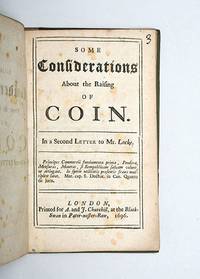
1696151077London: A. and J. Churchill 1696. Responding to Locke on coinage First edition of an anonymous reply to John Locke's Further Considerations Concerning Raising the Value of Money both part of the considerable output of publications surrounding the Great Recoinage of 1696 where the shortage and drawbacks of metal currency was engendering much debate. The terminal page is known in two settings this dated 3 October 1696 with advertisements the other dated 23 September 1696 and without advertisements. Octavo 173 x 106 mm. Nineteenth century white quarter cloth spine lettered in gilt green paper-covered sides. Early notation to title page stamp of Assay Office Library Birmingham to front free endpaper. Spine and extremities darkened contents foxed half-title lightly soiled. A very good copy. ESTC R16348; Pforzheimer 615; Wing S4481; Yolton C1696-5. hardcover
1773119924Amsterdam: no printer 1773. First edition in Italian of one of the most famous and influential works in the history of liberalism the second of Locke's Two Treatises on Government 1690. "'An anonymous translation from the French text of David Mazel probably the 1755 ed." Yolton. The work did not appear again in Italian until 1925. Octavo 183 x 119 mm. Contemporary quarter calf and marbled boards spine ruled and lettered gilt. Ownership stamp "G.G." to title ownership mark "Peyrot" to front pastedown. Spine ends neatly restored; occasional light spotting; a very good copy. Rare: Attig 188; Yolton 59; First Search locates 2 copies only York University Ontario and University of Texas at Austin to which we can add the copy at Yale. hardcover
1925035876NY: Albert and Charles Boni 1925. 1st Edition . Hardcover. Good/No Jacket. Bound in publisher's original blue paper-covered boards over buckram spine cloth lettered in blue. The boards are heavily rubbed with a2 2/3 inch split at the edge of the spine base. The binding is sound. Ex-library with the usual markings. <br/> <br/> Albert and Charles Boni hardcover
1694149739London: Printed for Awnsham and John Churchil at the Black-Swan in Pater-Noster Row and Samuel Manship at the Ship in Cornhill near the Royal-Exchange 1694. Rare second edition of this fundamental work in the history of Western thought the first to name Locke as the author and to include the frontispiece portrait of him. Folio bound full paneled calf morocco spine label lettered in gilt elaborated diced stamping to the spine in five compartments within raised bands engraved frontispiece portrait of Locke by P. Vanderbanck after Sylvester Brounower. In very good condition. From the library of the Isle of Wight Institution with stamps to the title page page 175 and verso of final leaf; ownership signature of British missionary Daniel Tyerman 1773-1828 of Newport Isle of Wight dated 1804 to the title page. The second edition of Locke's essay contains a number of important changes and additions to the text. It was the first to name Locke as the author and include the frontispiece portrait of him indicative of the celebrity Locke acquired with the publication of the first edition in 1690. "When Thomas Basset was running out of copies of the first edition in February 1693 he signed a contract with Locke to pay him ten shillings per sheet for additional materials for a new printing. These additions included an expansion of Book I Chap. IV; the chapter on power was almost entirely new; a new chapter 'Of Identity and Diversity' was inserted as 2.27 making chapters 27-31 to be renumbered as 2.28-32; and a discussion was added to 2.9.8. Other numerous additions were made throughout sectional summaries added in the margins and an analytical index supplied" Yolton. "It is Locke's second edition of the 'Essay on Human Understanding' that is the masterpiece we remember; the first 1690 edition did not bear Locke's name nor did it include a number of emendations that finished the work as Locke wanted it" Matthews Collecting Rare Books 97. "Locke was the first to take up the challenge of Bacon and to attempt to estimate critically the certainty and the adequacy of human knowledge when confronted with God and the universe" PMM 164. It is in this work that Locke 1632-1704 lays the foundations of British empiricism and the concept of the mind as a tabula rasa. "Locke summed up the Enlightenment in his belief in the middle class and its right to freedom of conscience and right to property in his faith in science and in his confidence in the goodness of humanity. His influence upon philosophy and political theory has been incalculable" Columbia Encyclopedia. Printed for Awnsham and John Churchil, at the Black-Swan in Pater-Noster Row, and Samuel Manship, at the Ship in Cornhill, near hardcover
1801884404London:: J. Johnson C.G. & J. Robinson Etc. 1801. Engraved frontis portrait folding table. Locke's influence on philosophy and government especially those principles espoused by America's founding fathers is immeasurable. This is a beautiful set of Locke's philosophical works in original boards and spine elaborately tooled in gold with red labels and gold lettering. Professionally rebacked. Contents very lightly toned. Ref. Printing and the Mind of Man 164. The Tenth Edition. Very Good. 8vo. 10 Volumes. J. Johnson, C.G. & J. Robinson Etc. hardcover
1936140944642Washington D.C.: Associates in Negro Folk Education 1936. First edition. First edition. Signed by Alain Locke on the foreword dated 1937. vi 122 pp. Bound in publisher's stapled wrappers. Very Good wraps a little stained and toned light foxing along edges wear at foot.<p>Called the "philosophical architect" and "ideological genius" of the Harlem Renaissance in this booklet Howard University professor Alain Locke traces the history of art by and about African Americans. Associates in Negro Folk Education unknown