47 résultats
1702460061702 Amsterdam, Gregorium Gallet., 1702 - In-8 - Edition Originale - 2 tomes en 1 volume - Reliure plein velin aux Armes de la ville d'Amsterdan aux 1 er & 4 ème plats, entourées de guirlandes dorées - Dos lisse orné - Frontispice dans chaque volume de J. Goeree and R. de Hooghe - 78 gravures représentant des portraits & pièces - (XXII)-533 pages & 242 pages + 102 pages d'index ET Lucius Ampelius, 46 pages - Ex-libris cachet "bibliothèque de Mr louis Lebond - Brunet II, 1312 ; Graesse II, 605 - Très bel exemplaire - Envoi rapide et soigné.- Réf. 46006
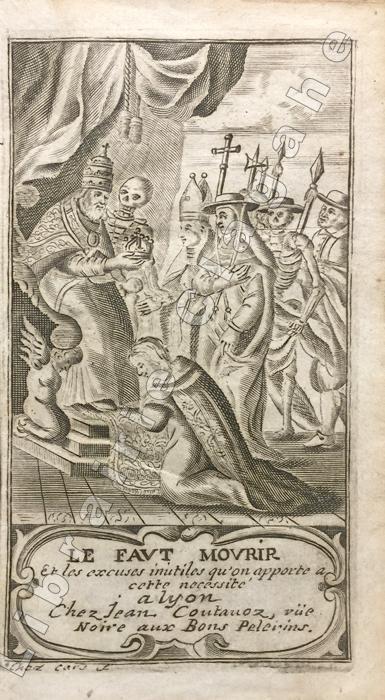
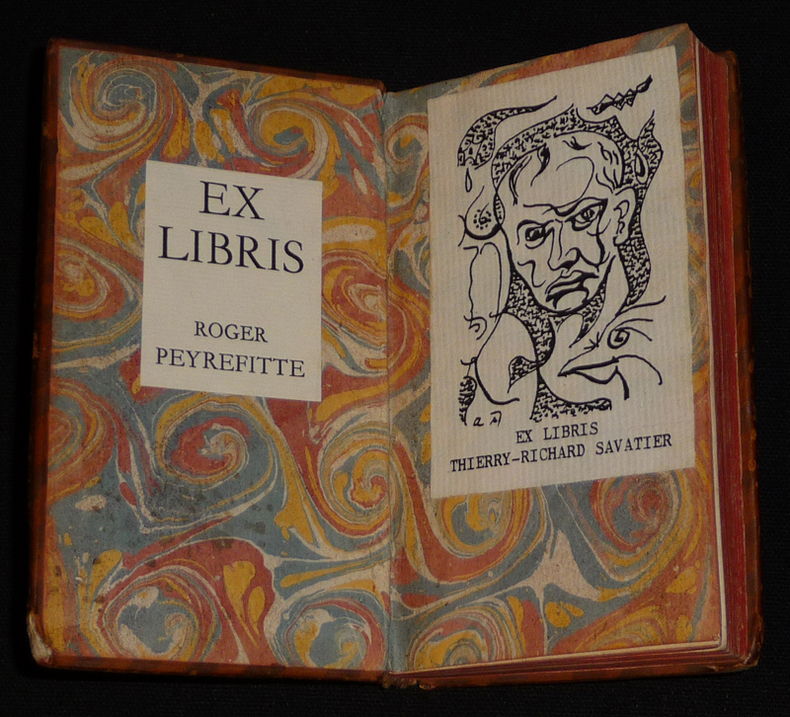
1755ga2547A Rochefort, chez Jaques Le Noir Relié 1755 In-12 (8 x 13,5 cm), reliure plein veau, dos à 5 nerfs orné de caissons dorés, tranches rouges, double ex-libris en première garde (Thierry-Richard Savatier et Roger Peyrefitte), XXIV-202 pages. Cet ouvrage, qui tourne en dérision la mort et fait l'apologie du suicide, sera mis à l'index en 1758 ; quelques frottements aux coiffes, mors et coins, par ailleurs bon état. Livraison a domicile (La Poste) ou en Mondial Relay sur simple demande.
17071204Lyon, Pierre Thenet, 1707 ; in-12 de [6] ff., 504 pp., [1] f., reliure de l’époque basane brune frottée, dos à nerfs.
17308906A Lyon, de l'imprimerie d'André Degoin, [1730?]. In-4 de [8]-6-[2]-27 pages, plein veau moucheté, dos à 6 nerfs orné de fleurons et encadrements dorés. Coins, dos et plats frottés, petit manque en queue.
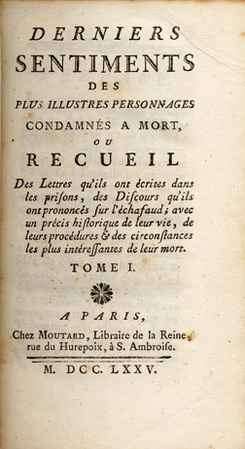
177528141775 1775 Moutard, Paris, 1775, première édition.2 volumes in-12 plein veau blond d'époque, dos à nerfs ornés de fleurons, pièces de titre et tomaison maroquin rouge, traces rouges, filets sur les coupes, gardes marbrées, faux-titre, page de titre, XVI pages de préface et errata, et 501 pages puis faux-titre, page de titre, 515 pages et [3pp.] de permission.Filets de coupes presque effacés, coiffes légèrement frottées sans manque, coins légèrement émoussés, l'ensemble est malgré tout très frais.
1732002982A Amsterdam, Chez les Frères Westeing, 1732
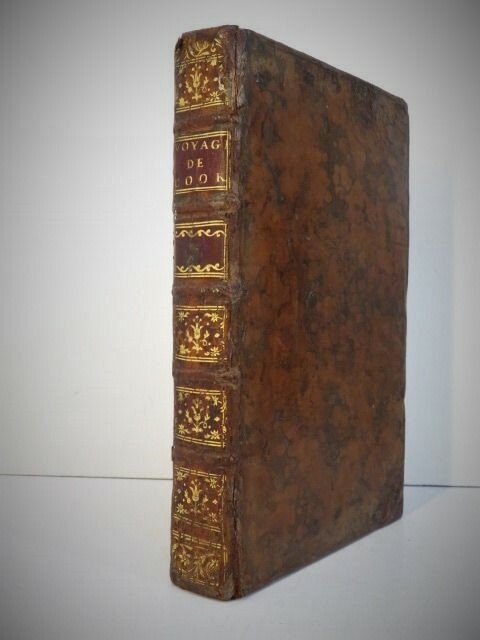
1782PHO-1331Paris ,Chez Pissot père et fils, Chez Laporte, (1782) 1 volume in-octavo (20 x 12,7 cm) de X-508 pp. ,Reliure plein veau marbré d'époque, dos lisse orné avec pièce de titre et tomaison, tranches rouges ,la carte et le frontispice sont manquants , défauts à la reliure .
17849413Londres, sans nom, 1784. 2 parties en un volume in-12 de [4]-277-[4]-206 pages, pleine basane brune, dos à 5 nerfs orné de fleurons, roulettes et encadrements dorés, roulette dorée sur les coupes, tranches rouges. Petite épidermure au premier plat, légère et discrète trace de pli au coin supérieur des feuillets, courant sur presque tout le volume.
1782PHO-717Paris ,Chez Pissot père et fils, Chez Laporte, (1782) 1 volume in-octavo (20 x 13 cm) de X-508 pp. Reliure plein veau marbré d'époque, dos à nerfs orné avec pièce de titre,la carte et le frontispice sont manquants.
1782PHO-1839Paris, Chez Pissot père et fils, Chez Laporte, (1782) 1 volume in-octavo (20 x 12,7 cm) de X-508 pp., Reliure plein veau marbré d'époque, dos lisse orné avec pièce de titre, tranches rouges, illustré de la gravure de la mort de Cook, la carte est manquante, défauts à la reliure, mouillure en fin d’ouvrage.
17758715Paris, Moutard, 1775 ; deux tomes, in-12 ; plein veau fauve marbré, dos à nerfs décoré et doré, pièce de titre grenat, tranches rouges (reliure de l'époque) ; (4), XV, (1) (errata), 501 pp. ; (4), 515, (3) pp. ; imprimé par Louis Jorry, rue de la Huchette.
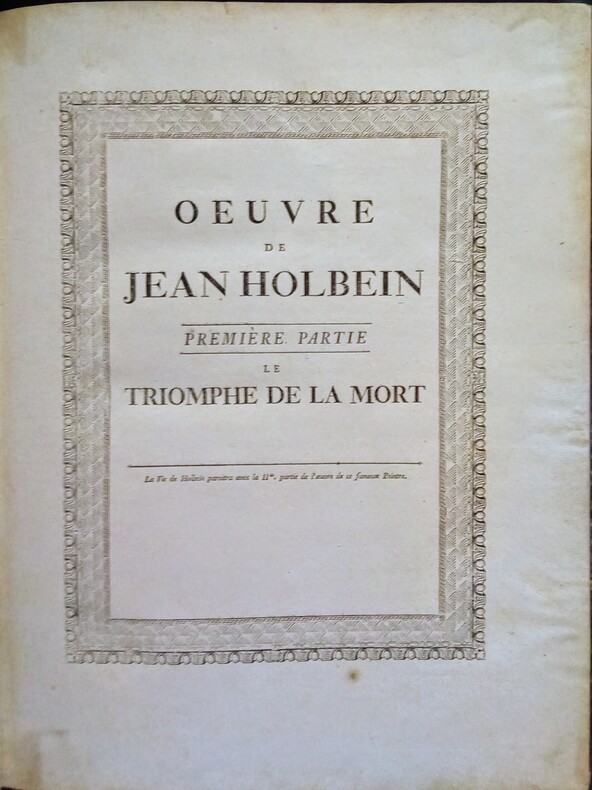
1780WOC-2072Oeuvre de Jean HOLBEIN ou Recueil de gravures d'après ses plus beaux ouvrages. Accompagnés d'Explications Historiques et Critiques et de la Vie de ce Fameux Peintre, par Chrétien De Mechel, Graveur de S. A. S. Monseigneur l'Électeur Palatin, et Membre de Diverses Académies. Première Partie: Le Triomphe de la Mort. 12 planches (contenant chacune 4 vues, sauf la dernière qui contient 3, et 1 planche à pleine page et 2 culs-de-lampes en eaux-fortes. A Basle, Chez l'Auteur, 1780. In-folio (38x28cl) relié demi veau d'époque, dos orné de petits nerfs, de fleurons dorés, titre et nom sur maroquin rouge et vert, coiffes et charnières faibles. 2 ff, (Dédicace à sa Majesté GEORGE III Roi de la Grande Bretagne, &c. &c. &c. + 14 pages (Explications des Sujets du Triomphe de la Mort de JEAN HOLBEIN + 1 planche hors-texte: Triumphus Paupertatis.
1796ZNC-576Paris, 1796, 2 volumes in8°, LXXXVIII-496 et 516 pages, demi-veau de l'époque.
17022146Lyon, Pierre Thened, 1702, in-12, plein veau moucheté de l’époque, dos orné à cinq nerfs ; (6) ff. (Frontispice gravé par Cars, titre, Au lecteur docile, table, Au lecteur critique), 503 pp. et 1 p. de permission. Le frontispice est le même que celui de l’édition précédente avec le nom de Jean Coutanoz, imprimeur à Lyon.
1732484721732 Amsterdam, Chez Zacharie Chatelain , 1732 - Complet en 7 volumes In-8 - Reliure plein veau de l'époque (frottée)- Dos à nerfs, à caissons fleuronnés - Pièce de titre & de tomaison havane - Titre & tomaison dorés - Roulette sur les coupes - Toutes tranches rouges - Trous de vers au T. VI, sans incidence sur le texte - Correct intérieurementT. I - Frontispice, Page de titre bi-colore rouge & noire avec vignette - Epitre dédicatoire armorié à Son excellence Mylor Comte de Chesterfield & Préface de l'Editeur, Portrait de Pufendorff & son éloge, Table Générale, LXXXIV-492 pages, Cartes dépliantes H.T. de l'Europe, de l'Espagne, de la Grande-Bretagne & de la France.T. II - Frontispice, Page de titre bi-colore rouge & noire avec vignette - Sommaire (20)-456 pages, Carte dépliante H.T. de l'Italie,T. III - Frontispice, Page de titre bi-colore rouge & noire avec vignette - Sommaire (14)-508 pages, Carte dépliante H.T. de l'Allemagne - Tableaux dépliants de la diete Générale de l'Empire, Généalogie de la Branche Ernestine de Saxe T. IV - Frontispice, Page de titre bi-colore rouge & noire avec vignette - Sommaire (32)-500 pages +1 Avertissement, Cartes dépliantes H.T. de la Scandinavie, Danemark, de Suède, etc., de la Turquie Européenne.T. V - Frontispice, Page de titre bi-colore rouge & noire avec vignette - Sommaire XXXVI-404 pages.. T. VI - Frontispice, Page de titre bi-colore rouge & noire avec vignette - Sommaire XXII-453 pages.T. VII - Frontispice, Page de titre bi-colore rouge & noire avec vignette - Sommaire XXIV-400 pages + Table Générale des Matières contenue dans les 7 Volumes - Envoi rapide et soigné - Réf. 48472
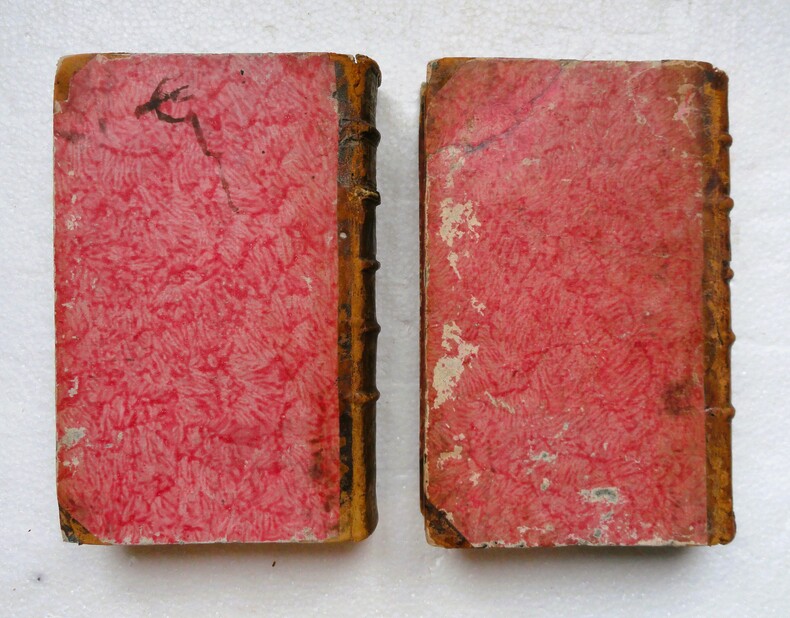
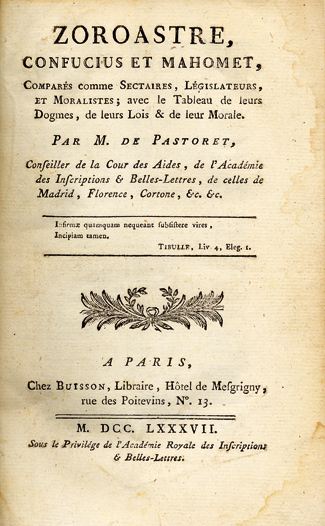
178715507Paris, Buisson, 1787 ; in-8 ; demi-veau havane, dos à faux-nerfs décoratifs dorés, fleurons dorés, pièce de titre vert foncé décorée et dorée, plats de papier peint rose (reliure de l'époque) ; (8), 477, (1) pp.
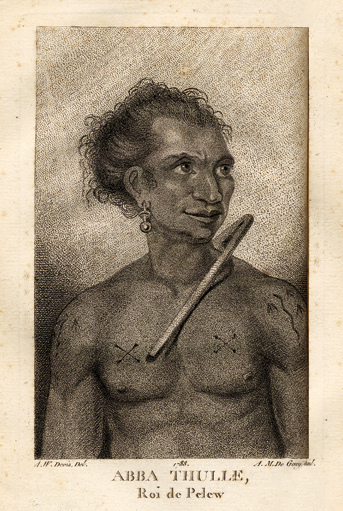
178814520Paris, Le Jay et Maradan, 1788 ; 2 tomes in-8 ; demi-chagrin noisette (reliure moderne) ; (4), 282 pp., portrait du capitaine Henri Wilson en frontispice, gravé par Mme Massard d'après I. Russell, grande carte géographique dépliante, 7 planches gravées dont 6 dépliantes ; (4), 274 pp., (3) ff. Errata et Approbation, 8 planches gravées dont 6 dépliantes, soit 17 planches au total ; vocabulaire de la langue Pelew pp. 251-267 du tome II.
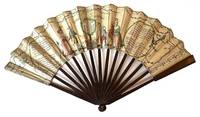
17864439France 1786. Hand-colored etched folding paper fan printed on the recto of two joined sheets backed in plain paper mounted on 15 later plain wooden sticks the open leaf measuring approx. 112 x 460 mm. total fan height 260 mm. The etching shows two couples and a small dog and table with wine carafe and glass flanking a female figure in white Grecian robes and a green wreath holding in one hand a heart at her breast and with the other hand ceremoniously setting alight a bundle of wood a fagot on a small pedestal or altar above which is the wreathed inscription Institution des fagotiers a auteuil le 2 avril 1786 / On prete serment sur un fagot de pratiquer toute sa vie cinq vertus : cordial franchise amitié générosité obeisance sic et tendresse; at top a star with the initials T L A and a banner lettered Vertus des fagotiers surmounted by the caption Ronde joyeuse des fagotiers/ Air: c’est la petite Theresse sic; on either side of this scene are four verses within two green-outlined oval cartouches within stenciled blue and yellow decorative border. Some wear and slight splitting along a few folds a couple of small tears at mounts.<br /> <br /> A mildly licentious pre-Revolutionary printed fan possibly commemorating a real event a “festival of the wood-gatherers†fagotiers held in Auteuil on April 2 1786 but of which there appears to be no historical record. Rather than a guild the fagotiers may have been a local association or club. <br /> <br /> The symbolism of the image and verses seems to be along the lines of Carpe diem carnally for death is around the corner — heavy sentiments for a feather-light fan. One of the men is gesturing toward his partner’s crotch and the verses on either side of the central scene are dotted with sexual innuendo. The first stanza “Let us sing of the burning fagot a bundle of small wood lit by friendship / he who backs away from it knows her i.e. friendship only half-way / without her life is nothing / with her one is deified†could be understood as innocuous but the second stanza celebrates the joys of Déduit an archaic term for the pleasures of love or coïtus. Stanza three brings in Death in the form of Charon: “amiable fellow let us sing his good humor his boat may lead to the devil but his spirit leads to happiness / with his worthy ardor the fire burns in our hearts.†The last stanza declares that the “august fagotine law†allows us to include women we need not hide everyone kiss your partner etc. <br /> <br /> I locate one other example of this fan held by the Musée Carnavelet in Paris. It is digitized on their website with the description “The Genie of Friendship lights the pyre on which the couples will take the oath of friendship.†The stenciled border of our copy differs from that of the Carnavelet example which is in pink; here it is in two colors and includes two birds perched on branches. unknown
1724000220Paris Imprimerie d'Antoine Urbain Coustelier 1724
1783002461Paris, Bastien, 1783
17843603426London: Sold in Spur Street Leicester Square 1784. Small crease in lower corner in good condition. Oval engraving 350 x 265 mm. image size; mounted. <p><p>Rare variant of the famous engraving of Cook's death showing as the caption notes "Part of the Original Plate after Webber" and presumably quite literally printed from an oval cut from the fuller engraved copper. This is only very rarely seen: the single example noted by Joppien and Smith was in the British Museum. </p> <p>The full-size engraving was first issued early in 1784. Based on the oil painting executed by Webber soon after he returned to London in 1780 the figures were engraved by Francesco Bartolozzi and the landscape by William Byrne. Quickly becoming the most famous of all eighteenth-century depictions of the massacre the view appeared at about the same time as the official third voyage account was published. This was no coincidence: although lavishly illustrated by Webber the official account did not include any depiction of the most famous scene of the entire voyage the death of Captain Cook. As a result the iconic engraving is often seen bound into extra-illustrated editions of the third voyage account.</p> <p>Reflecting the general opinion prevailing in published accounts of the voyage the original image as Joppien and Smith argue appeared to show Cook as 'an innocent victim killed in the act of pleading for peace'. This is here heightened by the changed composition as the oval shape dictates a radically different impact to that of the original engraving omitting the dramatic conflict between the British sailors and the Hawaiians and thus implying a scene in which Cook his arm raised in supplication to his men offstage stands alone and is overwhelmed by a seething crowd.</p> <p>The only copy noted among Australian holdings appears to be the heavily clipped copy in the National Library of Australia part of the Nan Kivell collection.</p> </p> . Sold in Spur Street, Leicester Square unknown
17503115<p>1750. DBI s.v. Albani; G. Cucco ed. Papa Albani e le arti a Urbino e a Roma 1700-1721 2001. Highly finished preparatory design for a fresco or tapestry connected to the Albani family whose coat of arms appears under the left-hand arch crowned with a cardinal’s hat. Under the central arch of the drawing preceded by a palafreniero four servants in blue and white livery carry a red baldacchino that covers two figures processing on horseback. One is clearly a secular prince with his garland crown and red cape while the other figure is a cardinal wearing a black hat and a red robe. It is possible that the cardinal depicted is either Annibale 1682-1751 or Alessandro 1692-1779 Albani or their nephew Cardinal Giovan Francesco Albani II 1720-1803. Under the right arch of the fictive architecture two buildings appear. While three commedia dell’arte figures who are commonly associated with the Venetian carnevale appear the carriage in the background contradicts the possibility that the setting for this event is Venice. Below these three arches a series of nine crests appear. The personification of death reclines with his scythe behind the coat of arms of the Corsini family blue and yellow diagonal stripes with a white band through the center. The crown which signified the rank of the family has been wrenched off. The Corsini were made dukes by Urban VIII in the seventeenth century and princes by Clement XII in 1730 This act of vandalism fits well within the long history of enmity between the Corsini and Albani families in the papal court. We have been unable to connect the sheet to a specific project at any Albani residence but future research should consider the Villa Castelbarco Albani in Vaprio d’Adda northeast of Milan whose documentation has proved difficult to obtain.</p> unknown books