876 résultats
190364533Mercure de France | Paris 1903 | 13 x 18.50 cm | 2 volumes brochés
188960004Leipzig, C.G. Naumann, 1889. 8vo. Bound with the original printed wrappers in a nice near contemporary brown half cloth with gilt lettering to spine. Lovely marbled end-papers. A bit of light soiling and brownspotting to wrappers, which are otherwise very well preserved. A few leaves with some very light brownspotting and a couple of leaves with small closed tears to blank inner margin, far from affecting text. Overall very nice. With the engraved book plate of Adolf Fischer to inside of front board. (8), 144 pp.
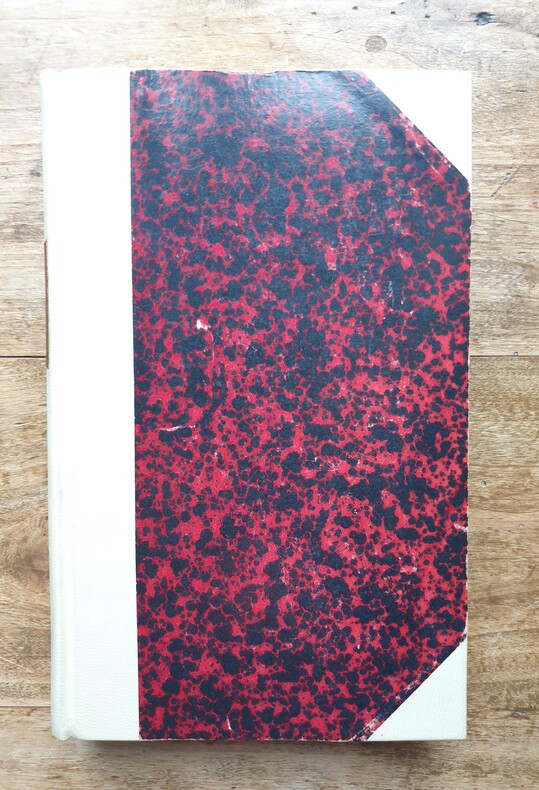
188961353Leipzig, C.G. Naumann, 1889. 8vo. Bound in a contemporary red half cloth binding with red marbled paper over boards and single gilt lines. Gilt lettering and a single gilt ornamentation to spine. Lovely patterned irdiscent end-papers in blue with white flowers. Boards slightly faded at top. Front hinge a bit soiled. Spine a bit discoloured and a bit worn at capitals. A few leaves with light, scattered brownspotting, but overall very clean and fresh. A few minor pencil marks on several pages and some faint brown spots on the final page. (8), 144 pp.
25790Leipzig, Verlag von C.G. Naumann, (1888.) Two works in one volume. (8), 144 pp.; (8), 57, (1) pp. 8vo. Contemporary half cloth, spine lettered gilt, marbled boards, corners. First work: Schaberg 56. First edition of the "Twilight of the Gods" and written during an incredibly productive six month period before Nietzsche's collapse in Turin. It was also the last book published during his lifetime. The title refers to an image in the preface: idols "are touched with a hammer and a tuning fork to determine whether they are hollow", which is of course a sarcastic allusion to Wagner, both personally and as a symbol of the German spirit. Nietzsche had 1,000 copies of this work privately printed. Originally to be called "A Psychologist at Leisure," Nietzsche changed the title at the suggestion of his friend, Gast and the book was released a few weeks after Nietzsche collapsed in Turin. The "Idols" that Nietzsche singles out here are those of the philosophers and the moralists. The Preface clearly states that the work at hand is to be "the revaluation of all values". Socrates and Christianity are particular targets although modern Germany and other contemporary ideas are also taken to task in the normally acerbic style of the author. (This book also contains some of Nietzsche's most frequently quoted phrases beginning with Aphorism #8: "What does not kill me only makes me stronger".)Second work: Schaberg 54.First edition, second issue. The book was published on 22 September 1888. Five hundred copies were printed, but 500 additional copies were printed at this time and falsely marked as second edition by the addition of "Zweite Auflage" in the middle of the ornamental rule and the deletion of the publication date. The true second edition of a 1000 copies was printed in October of 1891.The book is a critique of Richard Wagner and the announcement of Nietzsche's rupture with the German artist, who had involved himself too much, in Nietzsche's eyes, in the Völkisch movement and antisemitism. His music is no longer represented as a possible "philosophical affect," and Wagner is ironically compared to Georges Bizet. However, Wagner is presented by Nietzsche as only a particular symptom of a broader "disease" which is affecting Europe, that is nihilism. The book shows Nietzsche as a capable music-critic, and provides the setting for some of his further reflections on the nature of art and on its relationship to the future health of humanity.This work is in sharp contrast with the second part of Nietzsche's The Birth of Tragedy, wherein he praised Wagner as fulfilling a need in music to go beyond the analytic and dispassionate understanding of music. Nietzsche also praised Wagner effusively in his essay 'Wagner at Bayreuth' (part of the Untimely Meditations), but his disillusion with Wagner the composer and the man was first seen in his 1878 work Human, All Too Human. One of the last works that Nietzsche wrote returned to the critical theme of The Case of Wagner. In Nietzsche contra Wagner, Nietzsche pulled together excerpts from his works to show that he consistently had the same thoughts about music, only that he had misapplied them to Wagner in the earliest works. - First and last leaves a bit foxed, some scattered annotations in blue pencil and lead pencil.Provenance: from the library of A. Diepenbrock, with his signature on the first free endpaper (and date Jan. 1889) and second title-page (with the date Sept. 1888.) Alphons Diepenbrock was a Dutch composer, essayist and classicist. Although he showed musical ability he studied classics at the University of Amsterdam, gaining his doctorate cum laude in 1888 with a dissertation in Latin on the life of Seneca. The same year he became a teacher, a job which he held until 1894, when he retired from that position and decided to devote himself to music. As a composer, he had been completely self-taught from an early age. He created a musical idiom which, in a highly personal manner, combined 16th-century polyphony with Wagnerian chromaticism, to which in later years was added the impressionistic refinement that he encountered in Debussy's music. His predominantly vocal output is distinguished by the high quality of the texts used. Apart from the Ancient Greek dramatists and Latin liturgy, he was inspired by, among others, Goethe, Novalis, Vondel, Brentano, Hölderlin, Heine, Nietzsche, Baudelaire and Verlaine. As a conductor, he performed many contemporary works, including Gustav Mahler's Fourth Symphony (at the Concertgebouw) as well as works by Fauré and Debussy. Throughout his life, Diepenbrock continued his interests in the wider cultural sphere, remaining a classics tutor and publishing works on literature, painting, politics, philosophy and religion. Indeed during his lifetime his musical skills were often overlooked. Nonetheless, Diepenbrock was very much a respected figure within musical circles. He counted amongst his friends Mahler, Richard Strauss and Arnold Schoenberg.
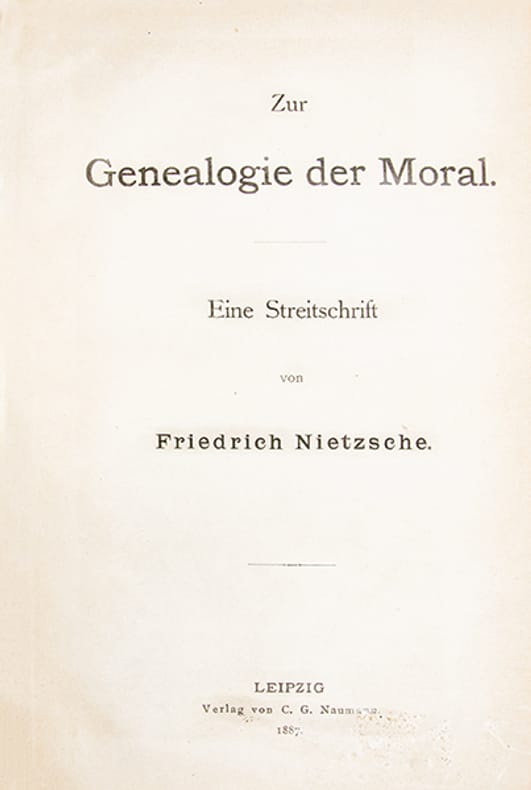
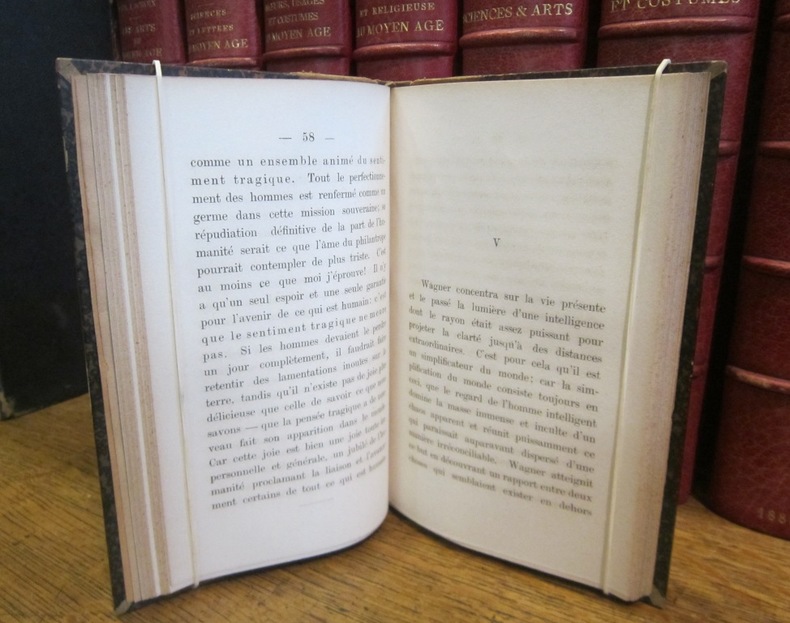
39286In-8 (198 x 132 mm), plein cartonnage ivoire à la Bradel, pièce de titre de veau orange, tranches rouges (reliure légèrement postérieure), xiv, (2), 182, (2) pages. Leipzig, C. G. Naumann 1887.
1945YQV-52In-12 (186 × 118 mm) de 284-[4] pp. ; broché, couverture imprimée.
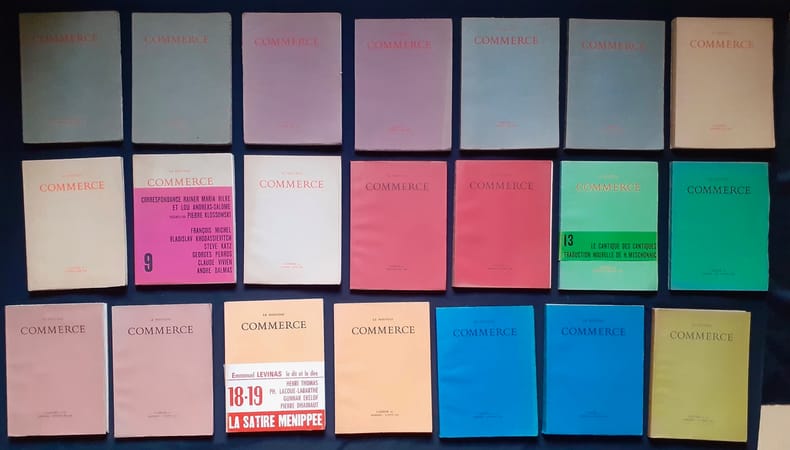
10833Collection complète, du n° 1 (été 1924) au n° 29 (printemps 1932). Nous joignons l'Index des années 1924-1928, paru sous forme de tiré-à-part joint au n° 22 (Hiver 1929). TOUS LES NUMEROS FONT PARTIE DU TIRAGE SUR VELIN PUR FIL LAFUMA (2e papier dont le nombre d'exemplaires est compris entre 150 et 300) et sont tous en bon ou très bon état. // Le n° 1 porte la mention manuscrite " Exemplaire sur Lafuma ", apposée par Auguste Morel qui a également signé cet exemplaire de ses initiales ; ce détail fait de cet exemplaire une belle pièce joycienne puisque dans ce premier numéro de " Commerce " paraît la première traduction en français d'un extrait d'ULYSSE de Joyce - traduction justement due au même Auguste Morel et à Valery Larbaud. // Rare et belle collection sur grand papier.
189549025Pan Couverture souple Berlin 1895
189843879Leipzig, Naumann, 1898. Small 8vo. Uncut in the original green printed wrappers. Spine with a bit of wear and minor wear to extremities. A very fine and clean copy in the scarce original wrappers. A 4-line presentation-inscription by Friedrich Jodl to front free end-paper, dated ""23.8.98"".
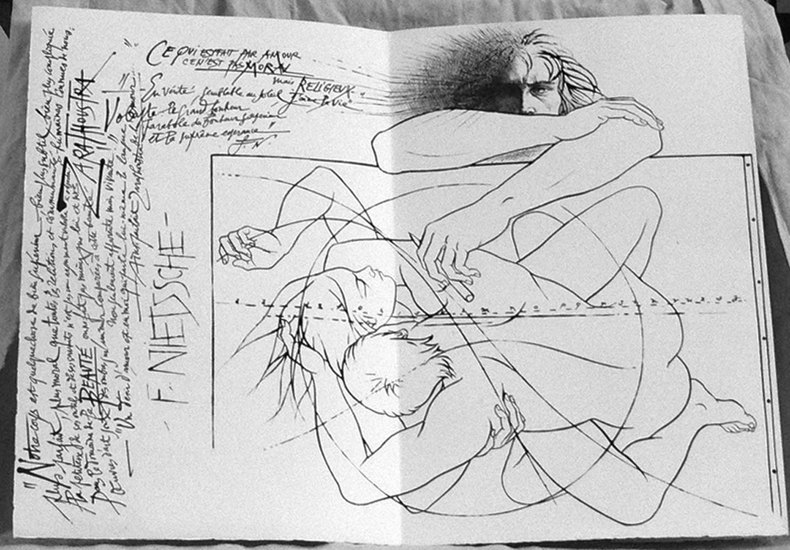
197751912Paris La Diane Franaise 1977 In-folio, en feuilles, couverture imprime. Chemise de veau noir orne sur le premier plat d'un important dcor typographique dor, tui ajour (embotage de l'diteur).12 gravures originales au burin et l'eau-forte de Pierre-Yves Trmois, dont une sur double page et 11 se dpliant en triptyque. Tirage limit 190 exemplaires numrots. Un des 25 exemplaires sur vlin de Rives, accompagns d'une suite des 12 gravures.
1977LIQ-1234P. La Diane Française 1977. Grand in-f° en ff, sous chemise decorée et étui de l'éditeur.
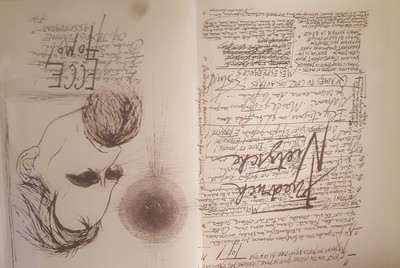
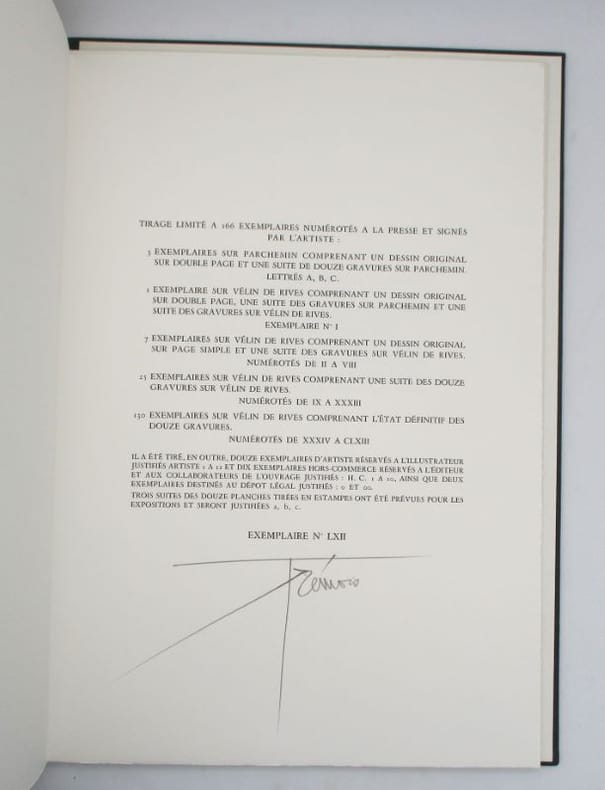
1977131735La Diane Française Paris, La Diane Française 1977. Grand In-folio en feuillet, sous chemise rempliée et double étui décoré, le premier au plat d'un semis de lettres dorées, nom de l'auteur dans un oval doré. Le second, au plat de plexiglas laissant apparaitre le plat au semis de lettres dorées. Douze gravures originales en noir dont 1 frontispice à double page et 11 triptyques de Pierre-Yves TREMOIS, tirées sur la presse à bras de Lacourière et Frélaut. Chaque gravure sous serpente rhodoïd. XCI pages pour le texte. Tirage limité numéroté à 166 exemplaires signés par l'artiste. Celui-ci, 1 des 25 exemplaires sur Vélin de Rives comprenant une suite des 12 gravures sur Vélin de Rives, numérotés de IX à XXXII et portant le n°XXXIII. Exemplaire bien complet et en parfait état.
12575Paris, Mercure de France, 1898 ; in-8. VII - 263 pp. - 1 f. (table). Demi-toile verte à coins, dos lisse, pièce de titre dorée, tête dorée, couvertures conservées. Légère décoloration du dos, si non très bel exemplaire.
1977689271977 Paris , La Diane Française , 1977, In Folio , xii planches xci pp, en feuilles sous chemise rempliée et double étui, très bon état comme neuf,
1877003244Paris, Turin, St. Pétersbourg, Londres, Schloss-Chemnitz (Carl Jahncke impr,Berlin), 1877
187788235Ernest Schmeitzner | Schloss-Chemnitz 1877 | 12.50 x 18.50 cm | relié
18983014# AUTEUR: Nietzsche Frédéric # ÉDITEUR: Mercure de France Paris # ANNÉE ÉDITION: 1898 # COUVERTURE: sans le 1er plat # DÉTAILS: In 8° broché 1ff.(page de titre)+ portrait en frontispice + 473pp.+ 2ff. (errata). Etat d'usage, le 1er plat est absent, léger manque au dos, coins inférieurs du 2eme plat déchirés. Ouvrage à relier. # PHOTOS visibles sur www.latourinfernal.com
21391Paris, La Diane française, 1977. In-folio, XCI pp. 12 pl., en feuilles, couverture originale imprimée, chemise de toile grise dorée et étui de l'éditeur (minuscules frottements à l'étui).
12412Paris, Société du Mercure de France, 1898 (achevé d'imprimer le 1er septembre 1897 par C.G. Naumann à Leipzig) in 8 reliure demi-velin à coins, dos lisse, pièce de titre, tête dorée, 473 pages plus achevé d'imprimer et feuillet d'errata conservé, couvertures et dos conservés
45555Paris, directeurs: André Dalmas et Marcelle Fonfreide. 25 numéros en 21 livraisons (4 numéros doubles). 21 volumes (18,2x24,3cm), brochés, la plupart avec cahiers non coupés. Exemplaire sur bouffant Edita. Ensemble en bon état. Collection complète des dix premières années de cette grande revue littéraire.
197715629Gallimard 1977 14 volumes reliés et 2 volumes brochés des oeuvres complètes de Nietzsche, manque le tome 9 et 13.
194753926Paris Gallimard 1947 In-8, cartonnage de l'diteur orn sur les plats et le dos de compositions en couleurs et en or dessines par Paul Bonet.Nouvelle dition, la seule sous cartonnage NRF, tire uniquement 1.040 exemplaires numrots sur chtaignier et relis d'aprs une maquette de Paul Bonet.
alb6846209825c3a303Nietzsche F. Collection of Works. Volume 2: Beyond Good and Evil. In Russian (as. Translation from it by A. Nikolaev and E. Vorontsova. M. Klyukin Publishing House 1903. 401 (1) p. The most important philosophical work of the German thinker in which his doctrine of morality is most consistently set out. SKUalb6846209825c3a303.
524London, Fanfrolico Press, s.d. Petit in-folio, cartonnage de l'édition. 7 gravures de Norman Lindsay. Tiré à 550 exemplaires, tous sur Arnold fait à la main.