NIETZSCHE, FriedrichBiblio.com
5 107 résultats
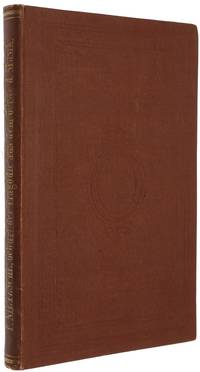
18724535Leipzig: E.W. Fritzsch 1872. First edition. <p>First edition in exceptionally rare original publisher's cloth binding. This copy previously handled by Bill Schaberg: "When I wrote The Nietzsche Canon: A Publication History and Bibliography 1995 I had never even heard of these cloth copies of Nietzsche's first book put out by his publisher Fritzsch. So it was quite a shock when someone offered this copy to me. It turns out that Fritzsch's contemporary advertisements for the book mention a cloth binding so this is not just a figment of some bookseller's imagination." This Nietzsche's first book is a compelling argument for the necessity for art in life. It is fueled by his enthusiasms for Greek tragedy for the philosophy of Schopenhauer and for the music of Wagner to whom this work was dedicated.</p>. Hardcover. IN THE EXCEPTIONALY RARE PUBLISHER'S BINDING. <p>First edition in exceptionally rare original publisher's cloth binding. This copy previously handled by Bill Schaberg: "When I wrote The Nietzsche Canon: A Publication History and Bibliography The University of Chicago Press 1995 I had never even heard of these cloth copies of Nietzsche's first book put out by his publisher Fritzsch. So it was quite a shock when someone offered this copy to me. It turns out that Fritzsch's contemporary advertisements for the book mention a cloth binding so this is not just a figment of some bookseller's imagination."</p> <br /> <p>This Nietzsche's first book is a compelling argument for the necessity for art in life. It is fueled by his enthusiasms for Greek tragedy for the philosophy of Schopenhauer and for the music of Wagner to whom this work was dedicated.</p> <br /> <p>Nietzsche argues that the tragedy of Ancient Greece was the highest form of art due to its mixture of both Apollonian and Dionysian elements into one seamless whole allowing the spectator to experience the full spectrum of the human condition. The Dionysian element was to be found in the music of the chorus while the Apollonian element was found in the dialogue which gave a concrete symbolism that balanced the Dionysiac revelry. Basically the Apollonian spirit was able to give form to the abstract Dionysian.</p> <br /> <p>In contrast to the typical Enlightenment view of ancient Greek culture as noble simple elegant and grandiose Nietzsche believed the Greeks were grappling with pessimism. The universe in which we live is the product of great interacting forces; but we neither observe nor know these as such. What we put together as our conceptions of the world Nietzsche thought never actually addresses the underlying realities. It is human destiny to be controlled by the darkest universal realities and at the same time to live life in a human-dreamt world of illusions.</p> <br /> <p>The issue then or so Nietzsche thought is how to experience and understand the Dionysian side of life without destroying the obvious values of the Apollonian side. It is not healthy for an individual or for a whole society to become entirely absorbed in the rule of one or the other. The soundest healthiest foothold is in both. Nietzsche's theory of Athenian tragic drama suggests exactly how before Euripides and Socrates the Dionysian and Apollonian elements of life were artistically woven together. The Greek spectator became healthy through direct experience of the Dionysian within the protective spirit-of-tragedy on the Apollonian stage.</p> <br /> <p>The Birth of Tragedy was the best selling book that Nietzsche ever published; still it did not sell quickly. The Wagners had feared that there might not be an audience for the work and their apprehensions proved to be well-founded. A prediction that Nietzsche had once made to Rohde proved true: "The philologists won't read it on account of the music the musicians won't read it on account of the philology and the philosophers won't read it on account of the music and the philology." False hopes for brisk sales plagued the first half-year. In mid-April Nietzsche was writing home that "a new edition of my book will be needed soon"34 but the necessity of printing a second edition did not materialize quickly. By 20 July Fritzsch complained that there had been "no results" even though he had "sent out a fair number of copies." Schaberg The Nietzsche Canon p. 27</p> <br/> <br/> 8vo 216 x 138 mm pp. i-iii iv 1 2-143 144. Original publisher's dark-rust binding with an ornate blind-stamped design on the front and rear covers and the spine lettered and filleted in gilt. There is some light browning to the edges of the page margins and light foxing throughout. Rear hinge with a 10 cm split. Entirely unrestored copy in its original state. An extremely well preserved copy of this unusual and all-but-unobtainable original publisher's cloth binding. / Hardcover. E.W. Fritzsch unknown
1873165812Leipzig: E. W. Fritzsch Schopenhauer: Schloss-Chemnitz: Ernst Schmeitzner 1873; 1874; 1874. Nietzsche in the culture war First editions of the first three of Nietzsche's four individually published Untimely Meditations bound together in a contemporary binding and unusual thus. Nietzsche originally conceived a series of 13 essays on the condition of contemporary European culture and its leading figures specifically German. The first published was an attack on David Strauss. The composer Richard Wagner who had taken an immediate dislike to Strauss's latest book Der alte und der neue Glaube The Old and the New Faith suggested Nietzsche publish the work with his own publisher E. W. Fritzsch. Nietzsche remained with Fritzsch for the publication of the second essay the only one not centred on a specific person but instead on the proper understanding and use of history. Finding payment slow Nietzsche switched publishers to Ernst Schmeitzner for the third essay which describes how Schopenhauer's genius despite his admitted pessimism might bring about a renaissance in German culture. The fourth work in the series Richard Wagner in Bayreuth was published in 1876 and is not present here - the collection was likely bound before its publication. The planning and publication of the Unzeitgemässe Betrachtungen series was quite haphazard and affected by Fritzsch's financial difficulties slow sales and Nietzsche's loss of enthusiasm for the project. No more of the planned thirteen works appeared after the Wagner essay though an uncompleted fifth essay was published posthumously. Schmeitzner negotiated to buy the remainders of the first two works from Fritzsch but was disappointed to find them in poor condition so that complete sets of all four essays which were all originally issued in wrappers are very rarely found bound together. Three works bound in a single vol. octavo 225 x 139 mm. Contemporary red morocco spine lettered in gilt red mottled sides black speckled edges. Errata of first work bound following p. 6 leaves in sig. 5 of same bound out of sequence. Spine a little darkened and trivial wear to tips contents with light foxing more pronounced towards rear some pencilled underlining and pencilled annotations to terminal endpapers a few leaves opened a little roughly in third work. In very good condition. Schaberg Nietzsche Canon 23 25 & 26. unknown
190364533Paris: Mercure de France 1903. Fine. Mercure de France Paris 1903 13 x 18.50 cm 2 volumes brochés La volonté de puissance. Essai d'une transmutation de toutes les valeurs Will to power Mercure de France Paris 1903 13x185cm 2 volume in original wrappers. First edition of the French translation one of 12 numbered copies on Hollande paper the only grand papier deluxe copies. One small trace of folding not serious to lower cover of the second volume endpapers very slightly and partially shaded. Nice and rare copy with untrimmed edges. Mercure de France unknown
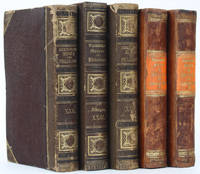
18671001<p>1867-73 First Edition of Seven of Nietzsche's Philological Articles Accepted as his Dissertation Requirement – Qualifying Him to Become a Professor at Age 24</p><p>Rheinisches Museum für Philologie Edited by F.G. Welcker & F. Ritschl 1867-68 F.G. Welcker F. Ritschl A. Klette 1869 Friedrich Ritschl & Anton Klette 1870 & 1873 Johann David Sauerländer Frankfurt am Main 1867-1870 1873. 1867 Volume: Facing TP TP V-XVI 1-648; 1868 Volume: Facing TP TP V-XVI 1-704; 1869 Volume: Facing TP TP V-XVI 1-640; 1870 Volume: Facing TP TP V-XV 1-640; 1873 Volume: Facing TP TP V-XV 1-640; First Edition of seven of the eight philological articles written by Nietzsche Schaberg 9-14 & 16.</p><p>Friedrich Nietzsche began his publication career at the age of twenty-two while he was a student of philology at the University of Leipzig. In Nietzsche's day to be a philologist meant that one studied ancient languages texts history philosophy art and even archeology in an attempt to recapture and understand the meaning of Greece and Rome. Nietzsche was a prize student first at the University of Bonn and then in Leipzig and as such he published several papers in scholarly journals… All but one of these essays appeared in the Rheinisches Museum für Philologie which was—and remains today—a respected journal in the field of classical studies. The single exception was The So-Called Contest of Homer and Hesiod which appeared in Volume I of the Acta Societatis Philologae a compendium organized in 1870 by Ritschl that published just four volumes before its demise in 1875.</p><p>Four of the philological articles were written in German and four in Latin. At least one of the articles On the Sources of Diogenes Laertius was originally composed in German and then translated into the required Latin. The German articles were signed at the end either as 'Friedrich Nietzsche.' or 'F. Nietzsche.' In the Latin articles the author was credited on the first page of each as 'Fridericus Nietzsche'. .</p><p>In later years Nietzsche was understandably dismissive of his philological works. He once wrote to Georg Brandes that "there are of course also Philologica by me but that need not concern either of us anymore." Certainly this was true in 1888 but twenty years earlier when these articles were published they were of major personal importance. Nietzsche's mentor Ritschl used the first four articles as justification for the recommendation that resulted in Nietzsche's spectacularly early appointment to Basel as professor at the age of twenty-four. Ritschl then went further and allowed the articles to be accepted as the dissertation requirement for Nietzsche's doctorate which was conferred without oral examination on 23 March 1869…</p><p>All of his philological works were published prior to the appearance of The Birth of Tragedy January 1872 except for the last article the second half of The Florentine Manuscript concerning Homer and Hesiod dated August of 1872 which appeared in February of 1873. It was the last piece of traditional classical scholarship that Nietzsche published.</p><p>Schaberg The Nietzsche Canon pp. 8-14</p><p>CONDITION: Very good or better in contemporary boards leather spines with gilt lettering. Two different styles of binding. Light edgewear. Three volumes in quarter leather with black boards and marbled endpapers; two volumes in quarter leather with marbled boards. See photos.</p> Johann David Sauerländer hardcover
190364533Mercure de France | Paris 1903 | 13 x 18.50 cm | 2 volumes brochés
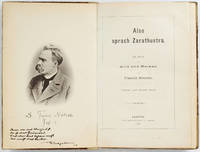
18911004<p>NIETZSCHE Friedrich. Also sprach Zarathustra Vierter und letzter Theil C. G. Naumann Leipzig 1891. Frontispiece portrait of Nietzsche TP Quote page 5-135 half title 3-21 23 = Inhalt Octavo. First Edition. Schaberg 58.</p><p>The famous first public printing of Nietzsche's notorious conclusion to Zarathustra. Although printed in 1890 and dated 1891 this book did not see public release until March of 1892 due to legal arguments between Nietzsche's sister Elisabeth and the publisher. Elisabeth was worried that the books would all be confiscated as "obscene" –and therefore negotiated until she received a contract from Naumann that protected her against this possibility. This edition –which is cited in Printing and the Mind of Man as the first edition ignoring the private printing of 1885 –is rare in any condition. When copies do make their rare appearances on the market they almost always come bound with the original three books 1883-1884 or more commonly bound with copies of the three books as re-issued in 1886. Containing the first edition printing of Nietzsche's poems: Dionysian Dithyrambs.</p><p>CONDITION: Contemporary quarter vellum with marbled boards little rubbed minor bumping to extremities. Slight browning little foxing and small marginal tears to few leaves at the end short tear to bottom gutter of title. - From the collection of archeologist and art-historian Botho Graef 1857-1917 known for his friendship with artists like Emil Nolde and Ernst Ludwig Kirchner in addition to his facilitation of the Jena art-collection. His handwritten dedication is addressed to German playwright and poet 'Ernst' Hardt 1876-1947.</p> C. G. Naumann hardcover
1880923Chemnitz: Schmeitzner 1880. First Edition. Wraps. Near fine. The Third and Final Part of Human all too Human <br /> <br />NIETZSCHE Friedrich. Der Wanderer und Sein Schatten The Wanderer and His Shadow. Schmeitzner Chemnitz 1880. 1 blank leaf TP 3-185 186 = Berichtigungen Octavo. First Edition First Issue in original wrappers. Schaberg 32. <br /> <br />Written as a second sequel to Human All Too Human The Wanderer and his Shadow was first published in the year following Nietzsches departure from academia. Perhaps the title here is somewhat autobiographical reflecting Nietzsche and his shadow heading off into the wilderness of the unknown. Wanderer contains a series of aphorisms and was published on December 20 1890. It was received enthusiastically by Nietzsches friends though failed to sell more than 200 copies. Yet it was viewed by Nietzsche himself as a triumph. In a letter to Schmeitzner written on December 18 Nietzsche remarks: "Der vollendete 'Wanderer' ist mir fast etwas Unglaubliches. Die ganze 'Menschlichkeit' mit den 2 Anhängen ist aus der Zeit der bittersten und anhaltendsten Schmerzen - und scheint mir doch ein Ding voller Gesundheit. Dies ist mein Triumph." The completed 'Wanderer' is to me something almost unbelievable. The entire 'humanity' with the 2 supplements is from a time of the most bitter and continual pains - and yet seems to me to be a thing full of health. This is my triumphThe Nietzsche Chronicle. <br /> <br />CONDITION: Very good to near fine in original front and rear wrappers. Spine restored with graphics to match the original. Interior crisp and bright. Housed in cloth-backed clamshell box. A gorgeous copy of this final installment of the Menschlisches three-book series. <br/><br/> Schmeitzner paperback
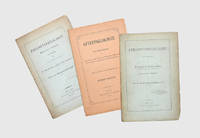
1872174288Berlin & Leipzig: Gebrüder Borntraeger & E. W. Fritsch 1872-73. Wagner Nietzsche and the battle for antiquity First editions of three key entries in the controversy over Nietzsche's first book a dispute which damaged his academic reputation confirmed his early Wagnerian allegiance and made his name in the German cultural scene. Both authors had known Nietzsche in his youth yet each offered a completely different analysis of his capacities methods and intentions. Die Geburt der Tragodie The Birth of Tragedy Nietzsche's first book outlined an analysis of ancient tragedy that "fell outside of every known convention in classical studies" Porter p. 74. For Nietzsche Socratic philosophy had killed Greek tragedy and Wagner was the man to revive it in modern Germany. For many this exposed a dangerous rift between Western tradition and the subversive followers of Schopenhauer and Wagner. Objections were first expressed by Ulrich von Wilamowitz-Moellendorff 1848-1931 in the Zukunftsphilologie Future Philology. Although Wilamowitz had been a fellow student with Nietzsche his response was a vitriolic demolition of Nietzsche's style logic and research. Wagner defended Nietzsche but his argument unwittingly bolstered Wilamowitz's claim that the Geburt was not intended for the academic establishment. Nietzsche persuaded Erwin Rohde 1845-1898 - another old schoolmate - to conduct his defence. The Afterphilologie False Philology which was shaped by suggestions from Nietzsche answers Wilamowitz in kind: exposing his own lack of academic rigour and painting him as an immature arriviste. Wilamowitz responded in the Zweites Stück Part II reiterating his disgust with Nietzsche's abandonment of Western philosophy. The Zukunftsphilologie captured the zeitgeist and recent academics "have remained broadly behind him" Silk & Stern p. 156. Wilamowitz became the most celebrated Greek scholar of his age while Rohde wrote a study of the Greek Pysche 1890-4 which remains prominent in modern classical studies. The three papers are: 1 WILAMOWITZ-MOELLENDORFF Ulrich von. Zukunftsphilologie! Eine erwidrung. Berlin: Gebrüder Borntraeger 1872. Pp. 32. 2 ROHDE Erwin. Afterphilologie. Zur Beleuchtung des von dem Dr. phil Ulrich von Wilamowitz-Möllendorff herausgegeben Pamphlets: "Zukunftsphilologie!" Sendschreiben eines Philologen an Richard Wagner. Leipzig: E. W. Fritsch 1872. Pp. 48. 3 WILAMOWITZ-MOELLENDORFF Ulrich von. Zukunftsphilologie! Zweites Stück. Eine erwidrung au die rettungsversuche für Fr. Nietzsches "geburt der tragödie". Berlin: Gebrüder Borntraeger 1873. Pp. 24. 3 works octavo. Original orange or green printed wrappers. Spines repaired. Light toning chipping and creasing to wrappers minor browning and foxing to contents: very good copies in the fragile original wrappers. James L. Porter "'Don't Quote Me on That!': Wilamowitz Contra Nietzsche in 1872 and 1873" The Journal of Nietzsche Studies no. 42 2011; M. S. Silk & J. P. Stern Nietzsche on Tragedy 2016. unknown
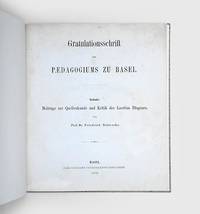
1870170977Basel: Carl Schultze's Universitaetsbuchdruckerei 1870. Nietzsche's early work on Diogenes Laertius First edition of this scarce early article privately printed in a run of 100 copies. The Gratulationsschrift was written shortly after Nietzsche had gained tenure at the University of Basel at the age of 24. He began his academic career as a philologist and the Gratulationsschrift outlines a philological study of Diogenes Laertius the shadowy author of the Lives and Opinions of the Eminent Philosophers. Nietzsche dedicates the work to F. D. Gerlach a colleague at Basel and copies were distributed at the ceremony marking Gerlach's retirement despite the fact Gerlach had opposed Nietzsche's appointment. Some copies were issued with a half-page cancel either bound between pages 2 and 3 or pasted to the lower half of page 3 that is not present here. No priority has been identified. Provenance: Hermann Türck 1856-1933 a philosopher and Nietzsche scholar who wrote Fr. Nietzsche und seine philosophischen Irrwege in 1891 a psychological study of the man and his later works. Türck's large printed bookplate is on the front pastedown. Quarto 218 x 193 mm pp. iv 36 8. Recent sprinkled grey boards printed paper label to spine. Minor browning and foxing to outer leaves: a very good copy indeed. Schaberg 18. hardcover
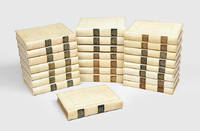
1920192049Munich: Musarion 1920-29. Nietzsche's complete works in the deluxe vellum First complete collected edition of Nietzsche's works number 138 of 185 sets in vellum from a total edition of 1600. Arranged chronologically with notes indexes and an introduction by Richardo Oehler this was the first edition to claim completeness. 23 vols large octavo 238 x 165 mm. With 4 photographic portraits and 7 facsimiles in vol. 21. Original vellum twin green leather labels to spines covers with two double-rule gilt borders top edges gilt. Light soiling to vellum a few covers a little bowed contents with some toning: an excellent set. Ziegenfuss 2 216. hardcover
188960004Leipzig, C.G. Naumann, 1889. 8vo. Bound with the original printed wrappers in a nice near contemporary brown half cloth with gilt lettering to spine. Lovely marbled end-papers. A bit of light soiling and brownspotting to wrappers, which are otherwise very well preserved. A few leaves with some very light brownspotting and a couple of leaves with small closed tears to blank inner margin, far from affecting text. Overall very nice. With the engraved book plate of Adolf Fischer to inside of front board. (8), 144 pp.
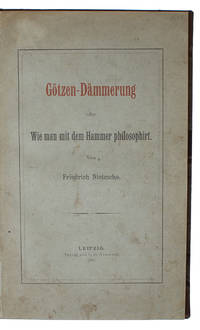
188960004Leipzig C.G. Naumann 1889. 8vo. Bound with the original printed wrappers in a nice near contemporary brown half cloth with gilt lettering to spine. Lovely marbled end-papers. A bit of light soiling and brownspotting to wrappers which are otherwise very well preserved. A few leaves with some very light brownspotting and a couple of leaves with small closed tears to blank inner margin far from affecting text. Overall very nice. With the engraved book plate of Adolf Fischer to inside of front board. 8 144 pp. <br/><br/><em>First edition - with the scarce original wrappers - of the epitome of Nietzsche's final project -a re-valuation of all values "Eine Umwerthung aller Werthe" -his hugely interesting "declaration of war" preface p. 4: "Diese Schrift ist eine grosse Kriegserklärung" which was written during his last productive year just before his big breakdown in Turin. "Götzen-Dämmerung" "The Twilight of the Idols" arguably constitutes the culmination of the production of this giant of philosophy who turned mad after having finished it.Early in 1889 Nietzsche began to exhibit signs of serious mental illness; in Turin he finally broke down and was brought back to Basel by his friends. "The Twilight of the Idols" was released merely a few weeks after this collapse and Nietzsche never wrote again.Nietzsche had 1.000 copies of the work privately printed. The work is considered one of his most popular and it is here that we find some of the most frequently quoted passages from the works of Nietzsche e.g. "What does not kill me only makes me stronger" p.2.: "Was mich nicht umbringt macht mich stärker".The Twilight was meant as an introduction to or summary of Nietzshe's philosophy and as such it is one of his most interesting works. It is written almost as in a rage of fever - it took him no more than a week to write it - and he regarded it a world-changing magnum opus. As he states at the end of the preface: "Turin am 30. September 1888 am Tage da das erste Buch der Umwerthung aller Werthe zu ende kam." i.e. "Turin on September 30. 1888 on the day that the first book on the re-valuation of all value came to an end.". This highly polemical work makes clear reference to Wagner's opera "Götterdämmerung" and it presents us with a sharp critique of the most influential philosophers in history e.g. Kant and Plato and of Christianity in general but also the likes of Rousseau Hugo Renan Mill Darwin Dante etc. are attacked as the causes of cultural decadence in Europe. Giants like Caesar Napoleon Dostojevski Goethe and Thukydides are considered representatives of the opposite.The mental collapse of the author may not come as a surprise to anyone reading the work.Of the 1.000 copies 659 still remained unsold by October 1893.Twilight of the Idols: Schaberg: 56a </em> hardcover
188232173Chemnitz: Schmeitzner 1882. First edition first issue. 8vo 2 leaves 5-255 pp. Bound to period style in marbled boards with red morocco spine and black leather labels. Fine condition. From the library of Viennese bibliographer Dr Moriz Grolig with his circular stamp on the title page verso. Of 1000 copies originally printed 788 remainders were sold to E.W. Fritsch in 1886 and reissued with a new title page and additional material. Schaberg 35. <br/><br/> Schmeitzner hardcover books
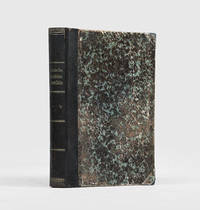
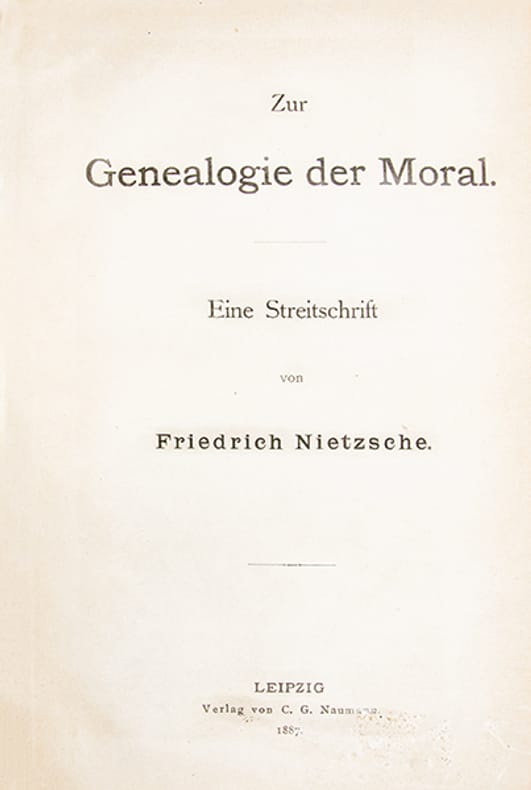
188717423Leipzig, Naumann, 1887. XIV S., 1 Bl., 182 S., 1 Bl. 8°. HLwd. der Zeit (kl. restaurierte Läsuren). [5 Warenabbildungen]
188961353Leipzig, C.G. Naumann, 1889. 8vo. Bound in a contemporary red half cloth binding with red marbled paper over boards and single gilt lines. Gilt lettering and a single gilt ornamentation to spine. Lovely patterned irdiscent end-papers in blue with white flowers. Boards slightly faded at top. Front hinge a bit soiled. Spine a bit discoloured and a bit worn at capitals. A few leaves with light, scattered brownspotting, but overall very clean and fresh. A few minor pencil marks on several pages and some faint brown spots on the final page. (8), 144 pp.
188961353Leipzig C.G. Naumann 1889. 8vo. Bound in a contemporary red half cloth binding with red marbled paper over boards and single gilt lines. Gilt lettering and a single gilt ornamentation to spine. Lovely patterned irdiscent end-papers in blue with white flowers. Boards slightly faded at top. Front hinge a bit soiled. Spine a bit discoloured and a bit worn at capitals. A few leaves with light scattered brownspotting but overall very clean and fresh. A few minor pencil marks on several pages and some faint brown spots on the final page. 8 144 pp. <br/><br/><em>First edition published in 1889 from Nietzsche's private press of the epitome of Nietzsche's final project -a re-valuation of all values "Eine Umwerthung aller Werthe" -his hugely interesting "declaration of war" preface p. 4: "Diese Schrift ist eine grosse Kriegserklärung" which was written during his last productive year just before his big breakdown in Turin. "Götzen-Dämmerung" "The Twilight of the Idols" arguably constitutes the culmination of the production of this giant of philosophy who turned mad after having finished it.Early in 1889 Nietzsche began to exhibit signs of serious mental illness; in Turin he finally broke down and was brought back to Basel by his friends. "The Twilight of the Idols" was released merely a few weeks after this collapse and Nietzsche never wrote again.Nietzsche had 1.000 copies of the work privately printed. The work is considered one of his most popular and it is here that we find some of the most frequently quoted passages from the works of Nietzsche e.g. "What does not kill me only makes me stronger" p.2.: "Was mich nicht umbringt macht mich stärker".The Twilight was meant as an introduction to or summary of Nietzshe's philosophy and as such it is one of his most interesting works. It is written almost as in a rage of fever - it took him no more than a week to write it - and he regarded it a world-changing magnum opus. As he states at the end of the preface: "Turin am 30. September 1888 am Tage da das erste Buch der Umwerthung aller Werthe zu ende kam." i.e. "Turin on September 30. 1888 on the day that the first book on the re-valuation of all value came to an end.". This highly polemical work makes clear reference to Wagner's opera "Götterdämmerung" and it presents us with a sharp critique of the most influential philosophers in history e.g. Kant and Plato and of Christianity in general but also the likes of Rousseau Hugo Renan Mill Darwin Dante etc. are attacked as the causes of cultural decadence in Europe. Giants like Caesar Napoleon Dostojevski Goethe and Thukydides are considered representatives of the opposite.The mental collapse of the author may not come as a surprise to anyone reading the work.Of the 1.000 copies 659 still remained unsold by October 1893.Twilight of the Idols: Schaberg: 56a </em> hardcover
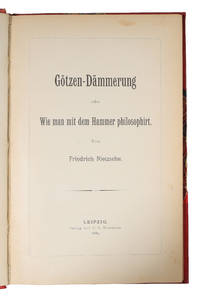
25790Leipzig, Verlag von C.G. Naumann, (1888.) Two works in one volume. (8), 144 pp.; (8), 57, (1) pp. 8vo. Contemporary half cloth, spine lettered gilt, marbled boards, corners. First work: Schaberg 56. First edition of the "Twilight of the Gods" and written during an incredibly productive six month period before Nietzsche's collapse in Turin. It was also the last book published during his lifetime. The title refers to an image in the preface: idols "are touched with a hammer and a tuning fork to determine whether they are hollow", which is of course a sarcastic allusion to Wagner, both personally and as a symbol of the German spirit. Nietzsche had 1,000 copies of this work privately printed. Originally to be called "A Psychologist at Leisure," Nietzsche changed the title at the suggestion of his friend, Gast and the book was released a few weeks after Nietzsche collapsed in Turin. The "Idols" that Nietzsche singles out here are those of the philosophers and the moralists. The Preface clearly states that the work at hand is to be "the revaluation of all values". Socrates and Christianity are particular targets although modern Germany and other contemporary ideas are also taken to task in the normally acerbic style of the author. (This book also contains some of Nietzsche's most frequently quoted phrases beginning with Aphorism #8: "What does not kill me only makes me stronger".)Second work: Schaberg 54.First edition, second issue. The book was published on 22 September 1888. Five hundred copies were printed, but 500 additional copies were printed at this time and falsely marked as second edition by the addition of "Zweite Auflage" in the middle of the ornamental rule and the deletion of the publication date. The true second edition of a 1000 copies was printed in October of 1891.The book is a critique of Richard Wagner and the announcement of Nietzsche's rupture with the German artist, who had involved himself too much, in Nietzsche's eyes, in the Völkisch movement and antisemitism. His music is no longer represented as a possible "philosophical affect," and Wagner is ironically compared to Georges Bizet. However, Wagner is presented by Nietzsche as only a particular symptom of a broader "disease" which is affecting Europe, that is nihilism. The book shows Nietzsche as a capable music-critic, and provides the setting for some of his further reflections on the nature of art and on its relationship to the future health of humanity.This work is in sharp contrast with the second part of Nietzsche's The Birth of Tragedy, wherein he praised Wagner as fulfilling a need in music to go beyond the analytic and dispassionate understanding of music. Nietzsche also praised Wagner effusively in his essay 'Wagner at Bayreuth' (part of the Untimely Meditations), but his disillusion with Wagner the composer and the man was first seen in his 1878 work Human, All Too Human. One of the last works that Nietzsche wrote returned to the critical theme of The Case of Wagner. In Nietzsche contra Wagner, Nietzsche pulled together excerpts from his works to show that he consistently had the same thoughts about music, only that he had misapplied them to Wagner in the earliest works. - First and last leaves a bit foxed, some scattered annotations in blue pencil and lead pencil.Provenance: from the library of A. Diepenbrock, with his signature on the first free endpaper (and date Jan. 1889) and second title-page (with the date Sept. 1888.) Alphons Diepenbrock was a Dutch composer, essayist and classicist. Although he showed musical ability he studied classics at the University of Amsterdam, gaining his doctorate cum laude in 1888 with a dissertation in Latin on the life of Seneca. The same year he became a teacher, a job which he held until 1894, when he retired from that position and decided to devote himself to music. As a composer, he had been completely self-taught from an early age. He created a musical idiom which, in a highly personal manner, combined 16th-century polyphony with Wagnerian chromaticism, to which in later years was added the impressionistic refinement that he encountered in Debussy's music. His predominantly vocal output is distinguished by the high quality of the texts used. Apart from the Ancient Greek dramatists and Latin liturgy, he was inspired by, among others, Goethe, Novalis, Vondel, Brentano, Hölderlin, Heine, Nietzsche, Baudelaire and Verlaine. As a conductor, he performed many contemporary works, including Gustav Mahler's Fourth Symphony (at the Concertgebouw) as well as works by Fauré and Debussy. Throughout his life, Diepenbrock continued his interests in the wider cultural sphere, remaining a classics tutor and publishing works on literature, painting, politics, philosophy and religion. Indeed during his lifetime his musical skills were often overlooked. Nonetheless, Diepenbrock was very much a respected figure within musical circles. He counted amongst his friends Mahler, Richard Strauss and Arnold Schoenberg.
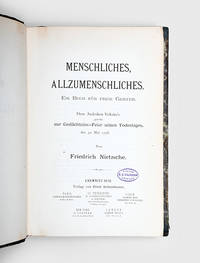
1878170976Chemnitz: Ernst Schmeitzner 1878. The defining work of Nietzsche's positivist period First edition of Nietzsche's first major polemical and aphoristic work marking his transition "from the philologist and cultural critic he had been into the kind of philosopher and writer he came to be" Schacht p. vii. The work which is translated as Human All Too Human embraces positivist reason in opposition to the metaphysical idealism of Schopenhauer and Wagner. For Nietzsche a naturally grounded reason was the only viable option to secure the ultimate enhancement of human life. The Menschliches reflects on religion art and morality and its incisive attacks on conventional pieties foreshadowed the thought of Nietzsche's mature period. It includes early expressions of many major Nietzschian concepts including the "will to power" and the rejection of Christian morality. Menschliches expresses Nietzsche's final direct disillusionment with Wagner of whom he had been a devoted admirer. He even claimed to have begun writing the work in response to the first Bayreuth production of the Ring cycle. On receiving his copy Wagner remarked that "he would be doing the author a favor for which the latter would one day thank him if he did not read it" quoted in Schaberg p. 64. Octavo 216 x 143 mm pp. viii 377 3. Contemporary half roan spine lettered and ruled in gilt marbled sides yellow coated endpapers edges marbled. Without the small cancel slip to p. 290. Late 19th-century bookplate of the author Gerhard Ouckama Knoop 1861-1913 to front free endpaper and his ink signature to head of half-title. Twentieth-century armorial bookplate of one Dr Roman Wolf to front pastedown. Contemporary purple ink bookseller's stamp to title page. Extremities restored. Light bumping and rubbing minor browning foxing and chipping to otherwise clean contents: a very good copy. Schaberg 29. Richard Schacht "Introduction" in Human All Too Human. A Book for Free Spirits 1996. unknown
1878182922Chemnitz: Ernst Schmeitzner 1878. The defining work of Nietzsche's positivist period First edition of Nietzsche's first major polemical and aphoristic work marking his transition "from the philologist and cultural critic he had been into the kind of philosopher and writer he came to be" Schacht p. vii. The work which is translated as Human All Too Human embraces positivist reason in opposition to the metaphysical idealism of Schopenhauer and Wagner. For Nietzsche a naturally grounded reason was the only viable option to secure the ultimate enhancement of human life. The Menschliches reflects on religion art and morality and its incisive attacks on conventional pieties foreshadowed the thought of Nietzsche's mature period. It includes early expressions of many major Nietzschian concepts including the "will to power" and the rejection of Christian morality. Menschliches expresses Nietzsche's final direct disillusionment with Wagner of whom he had been a devoted admirer. He even claimed to have begun writing the work in response to the first Bayreuth production of the Ring cycle. On receiving his copy Wagner remarked that "he would be doing the author a favor for which the latter would one day thank him if he did not read it" quoted in Schaberg p. 64. Octavo 215 x 143 mm pp. viii 377 3. Contemporary half roan rebacked with original spine laid down spine lettered ruled and decorated in gilt marbled sides yellow coated endpapers edges marbled yellow silk bookmarker. With the small cancel slip to p. 290. Light bumping and rubbing minor browning and foxing to contents damp stain to foot of endpapers and preliminary leaves: a very good copy. Schaberg 29. Richard Schacht "Introduction" in Human All Too Human. A Book for Free Spirits 1996. unknown
albae6451e62bca46c9Nietzsche F. A collection of works in ten volumes. In Russian (ask us if in doubt)/Nitsshe F. Sobranie sochineniy v desyati tomakh. Short description: In Russian (ask us if in doubt).M. Publication of the bookseller M.V. Klyukin 1901-1903. Zaratustra used to say. Symbolic poem. 1902. 359 p. We have thousands of titles and often several copies of each title may be available. Please feel free to contact us for a detailed description of the copies available. SKUalbae6451e62bca46c9
39286In-8 (198 x 132 mm), plein cartonnage ivoire à la Bradel, pièce de titre de veau orange, tranches rouges (reliure légèrement postérieure), xiv, (2), 182, (2) pages. Leipzig, C. G. Naumann 1887.
alb5a3081f22af19b06Nietzsche F. Collection of Works. In Ten Volumes In Russian (ask us if in doubt)/Nitsshe F. Sobranie sochineniy. V desyati tomakh Short description: In Russian (ask us if in doubt).Moscow: The Edition of the Bookseller M.V. Klyukin 1900-1903 Vol. 1. This is what Zaratustra said. A symbolic poem. 1902. 360 p. We have thousands of titles and often several copies of each title may be available. Please feel free to contact us for a detailed description of the copies available. SKUalb5a3081f22af19b06
18962002024London: H. Henry and Co. Ltd 1896. 1st. fine. First English edition 1896. Rebound in leather covers. Fine condition. Housed in a custom-made slipcase. H. Henry and Co. Ltd unknown books
alb8f25e6044c267e6dNietzsche Fr. Complete collection of works. In four volumes: Vol. 1 2 3 9 Complete set In Russian (ask us if in doubt)/Nitsshe Fr. Polnoe sobranie sochineniy. V chetyrekh tomakh: Tt. 1 2 3 9 Polnyy komplekt Short description: In Russian (ask us if in doubt).Translation under the general editorship of Prof. F. Zielinsky S. Frank G. Rachinsky and J. Berman: Moscow Book Publishing House A.A. Levenson Press Association 1909-1912 LVI 412 p. We have thousands of titles and often several copies of each title may be available. Please feel free to contact us for a detailed description of the copies available. SKUalb8f25e6044c267e6d
alb9573b40146646682Nietzsche Fr. Collection of Works. (Vol. 1-9-Sekt) In Russian (ask us if in doubt)/Nitsshe Fr. Sobranie sochineniy. (T. 1-9-Komplekt) Short description: In Russian (ask us if in doubt).Moscow Warehouse at D. P. Efimov's bookstore. Type: Chicherin Blvd. 1900-1903. So Zaratustra used to say. Vol. 2. Beyond Good and Evil. Vol. 3. The Darkness of Idols. Vol. 4. The Origin of Tragedy. Vol. 5. Human Too Human. Vol. 6. Man as He Is. Vol. 7. The Wanderer and His Shadow. Vol. 8. Morning Dawn. Vol. 9. Merry Science. Rare the Complete Collection. We have thousands of titles and often several copies of each title may be available. Please feel free to contact us for a detailed description of the copies available. SKUalb9573b40146646682