CAZENAVE AlphéeLivre Rare Book

41 résultats
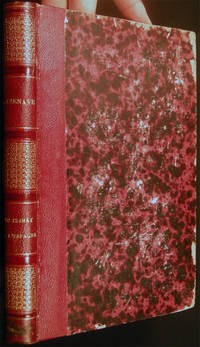
185094462Paris, Baillière 1850 In-8 demi-chagrin brun ép., dos à nerfs, filets et dentelles, VIII- 400 pp. Avec 8 planches dessinées d'après nature, gravées et coloriées. Quelques frottements, rousseurs marquées éparses, planches piquées. Rare.
185043035Paris, J.B. Baillière, 1850, in-8, (4), VIII, 400 pp, 8 pl, Demi-veau fauve de l'époque, dos plat orné de motifs à froid, Première édition. 8 planches gravées sur métal et coloriées à la main. Important ouvrage de Pierre Louis Alphée Cazenave (1802-1877) sur le sujet. Il est divisé en trois grandes parties : considérations anatomiques et physiologiques des cheveux ; pathologie du cuir chevelu ; hygiène. L'auteur fut l'un des premiers dermatologues à donner une bonne classification des maladies de la peau d'après leurs caractères anatomiques. On lui attribua la chaire de l'enseignement des maladies de la peau à la faculté de médecine de Paris, de 1841 à 1844). Quelques rousseurs, plus fortes sur les planches. Waller n° 1834. Hirsch I, 859 ; Wellcome II, 317. Couverture rigide
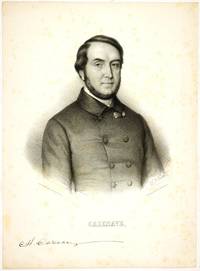
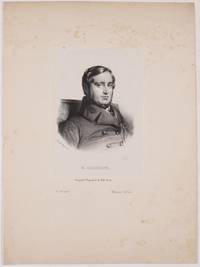
1835221951835. Paris Rosselin Editeur 21 Quai Voltaire. - Paris ca.1835 Z.Belliard 30 x 25 cm Pierre Louis Alphée Cazenave 1802-77 Dermatolgist at Paris. Not in Portr. Wellcome Inst. Hist. Med. R.Burgess; Not in Ehring. unknown
1843555661843. Encyclop. Biogr. XIX. Siècle 8. Cat. Médicins Célèbres. - Paris Rosselin Editeur 21 Quai Voltaire. - Paris 1843 332 x 242 mm; etwas fleckig. Pierre Louis Alphée Cazenave 1802-1877 Dermatolgist at Paris. Portr. Wellcome Inst. Hist. Med. R.Burgess. No.565.1. unknown
186812568AB1868. Paris P. Daffis 1868. 4 Bl. 386 S. Halblederband der Zeit Rücken etwas berieben Ecken restauriert. Erste Ausgabe. - Löser/Plewig Pantheon der Dermatologie 151; Hirsch/H. I 859; dieses Werk nicht bei Garrison/Morton vgl. Pusey 78/79. - Cazenave 1795-1877 Schüler des bedeutenden Dermatologen L. T. Biett hat das Verdienst die Hautkrankheiten nach einem streng wissenschaftlichen System das sich von dem Aliberts wesentlich unterschied betrachtet zu haben. Er beschrieb 1850 ertmals 'lupus erythematosus'. - Durchgehend leicht gebräunt bis S. 10 stockfleckig. - Vortitel und Titel mit Bibliotheksstempel und Abgabevermerk. unknown
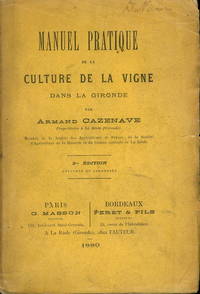
18892804Paris and Bordeaux: G. Masson and Feret & Fils 1889. Octavo 304 pages. 112 black and white figures in the text. A thorough well-illustrated manual of vine work from the owner of La Réole in the Gironde Bordeaux. The author apologizes for having spent more time in the fields than in school but this book is valuable for precisely that reason. Original printed paper wrappers. Yellow printed wrappers show a little wear and creasing at the spine. Internally very good. Worldcat locates only five copies of this edition two in the US; Simon Bibliotheca Vinaria page 96. G. Masson and Feret & Fils unknown books
1889RO20010551Masson. 1889. In-12. Broché. Etat d'usage, Couv. défraîchie, Manque en coiffe de pied, Quelques rousseurs. 304p, illustré de figures dans le texte, manque sur les coiffes et plat abimé.. . . . Classification Dewey : 634.8-Viticulture, vin
188917748Paris et Bordeaux Masson et Féret 1889 broché 304 pp.
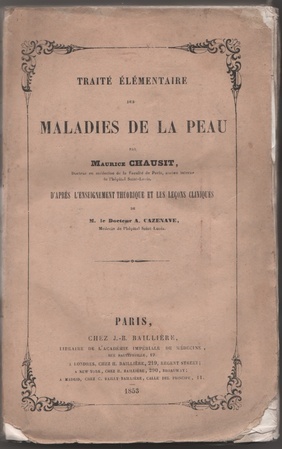
1853T934Edité par Baillière en 1853 Au sommaire : Inflammations – Lésions de sécrétions – Hypertrophies – Dégénérescences – Maladies hémorrhagiques – Lésions de la sensibilité de la peau – Corps étrangers de la peau – Maladies des annexes.
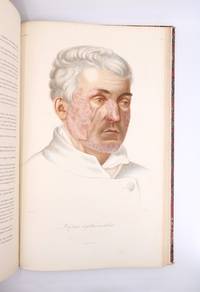
184689400Paris: Labé 1846. Fine. A fine illustrated medical work in color Labé Paris 1846 32.5 x 53 cm Relié First edition in book form; the rare original edition was issued in parts between 1845 and 1856 Brunet I 1707. Garrison and Morton reference three works by Cazenave on skin diseases. Illustrated with 60 large and striking hand-colored plates. Contemporary half red shagreen binding spine with five raised bands adorned with double gilt and black fillets sides covered in marbled cats eye paper some rubbing to the upper portion of the front board endpapers and pastedowns in combed marbled paper corners a bit worn; later binding. Minor foxing a pleasing copy overall. Pierre-Louis Alphée Cazenave born in Paris around 1795 died in Garches in 1877 was a student of Biett at the Hôpital Saint-Louis; appointed in 1838 to substitute for Alibert in his course on therapeutics he later held the chair of dermatology at the École de médecine from 1841 to 1844. He was among the first to study syphilis in a methodical manner. Labé hardcover
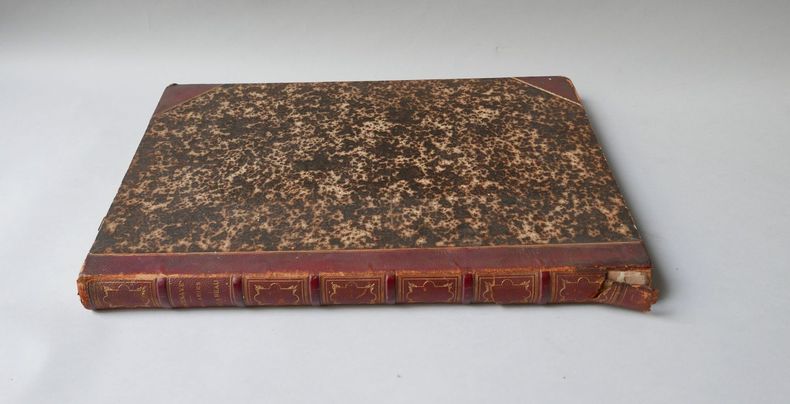
185685139Paris, Labé, 1856, in-folio, [4]-233-[3] pp, 60 pl. (1 à 59 + 25bis), Demi-chagrin rouge à coins de l'époque, filets dorés sur les plats, dos à nerfs, 60 planches gravées par Choubard, Annedouche, Oudet, Visto, Coupé et Viscot d'après E. Bocourt, Jadin, et coloriées par Gérard. Première édition collective de cet ouvrage paru d'abord en livraison de 1845 à 1856. Alphée Cazenave (1795-1877), médecin de l'hôpital Saint Louis et professeur agrégé de la Faculté de médecine de Paris, étudia les maladies de la peau d'après leurs caractères anatomiques. Il succède à Alibert, fondateur de l'École de Dermatologie Française et à son disciple Biett, qui proposèrent les premières classifications de maladies cutanées. Dans cet ouvrage, Cazenave choisit de répertorier les pathologies selon huit groupes. Pour suppléer à la présence des malades, que les auditeurs pouvaient examiner lors des leçons, Cazenave décide d'accompagner son texte de planches dont les dessins ont tous été pris d'après nature. Dos partiellement décollé, frottements. Exemplaire superbement illustré de planches anatomiques très réalistes. Hirsch I-859. Couverture rigide
184689400Labé | Paris 1846 | 32.5 x 53 cm | Relié
187827372Quimper Kerangal 1878. Plaquette Quimper Kerangal 1878. Plaquette in-8 brochée de 31 pages.
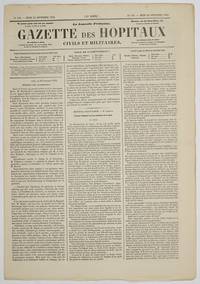
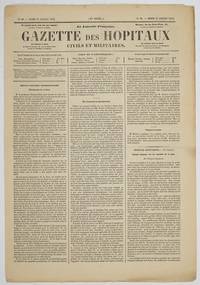
1852295721852. Gazette des Hopitaux 25/113. - Paris Septembre 1852 Folio pp.459-463 orig. broschur. Erstdruck! Pierre Louis Alphée Cazenave 1795-1877 war ein führender französischer Dermatologe am Hôpital Saint-Louis in Paris und Schüler Bietts der Willans/Batemans Hautkrankheiten-System in Frankreich weiterentwickelte. Die "Leçons cliniques sur les maladies de la peau. Du favus" markieren einen wichtigen Schritt in der exakten klinischen Charakterisierung parasitärer Kopfmykosen Tinea favosa bei Kindern und Armen wie sie in der Mitte des 19. Jahrhunderts am Hôpital Saint-Louis massenhaft beobachtet wurden. Sie stehen exemplarisch für die Integration parasitärer Hautkrankheiten in die dermatologische Systematik und zeigen wie sich aus den klinischen Beobachtungen in Saint-Louis ein eigener Problemkomplex "ringworm children" tinea capitis/Favus entwickelte der sowohl therapeutisch Epilation lokale Mittel als auch sozial-hygienisch Schul- und Armenkinder hohe Relevanz gewann. unknown
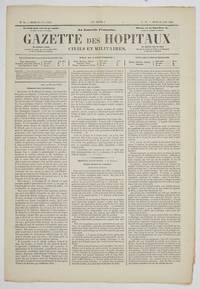
1852295741852. Gazette des Hopitaux 25/ 74. - Paris Juin 1852 Folio pp.293-296 orig. Broschur. Erstdruck! Pierre Louis Alphée Cazenave 1795-1877 war ein führender französischer Dermatologe am Hôpital Saint-Louis in Paris und Schüler Bietts der Willans/Batemans Hautkrankheiten-System in Frankreich weiterentwickelte. Die "Leçons cliniques sur le pellagre" gehören zu den frühen Versuchen Pellagra als klar umrissene klinische Einheit im Rahmen der Haut- und Systemerkrankungen zu beschreiben. Cazenave trägt damit zur Standardisierung des Pellagra-Krankheitsbildes bei lange bevor die Niacinmangel-Ätiologie geklärt ist. Zugleich zeigt der Abdruck in einer großen Pariser Klinikzeitschrift wie ein ursprünglich regionales Ernährungs- und Armutsleiden in den Kanon der gelehrten klinischen Dermatologie und der hospitalen Lehre aufgenommen wird. unknown
1852295731852. Gazette des Hopitaux 25/ 88. - Paris Juillet 1852 Folio pp.349-352 orig. Broschur. Erstdruck! Pierre Louis Alphée Cazenave 1795-1877 war ein führender französischer Dermatologe am Hôpital Saint-Louis in Paris und Schüler Bietts der Willans/Batemans Hautkrankheiten-System in Frankreich weiterentwickelte. Die "Leçons cliniques sur les maladies de la peau. De l'herpès tonsurant" gehören zu den früh präzisen klinischen Beschreibungen des herpès tonsurant d. h. der Tinea tonsurans / Tinea capitis wie sie bei Kindern und Jugendlichen mit kopfmykotischen Infektionen am Hôpital Saint-Louis massenhaft beobachtet wurden. Sie zeigen exemplarisch wie parasitäre Kopfmykosen in die dermatologische Systematik integriert und als spezifische übertragbare Krankheitsentitäten herausgearbeitet werden was später zur "Problemgruppe" der ringworm-Kinder und zu intensiven Debatten über Therapie Epilation topische Mittel und soziale Hygienemaßnahmen führte. unknown
187527425Paris: J.-B. Baillière & fils 1875. Fine. J.-B. Baillière & fils Paris 1875 13.50 x 22 cm relié First edition. Binding in flexible red cardboard smooth spine blind-ruled frame on covers mouse-colored endpapers and pastedowns. Copy complete with its lithographed folding plate illustrated with figures at the end two pale dampstains at foot of the plate with slight damage without consequence to one figure. Private library stamps serving as bookplates. Rare. J.-B. Baillière & fils unknown
187527425J.-B. Baillière & fils | Paris 1875 | 13.50 x 22 cm | relié
18412972Paris, Baillière, 1841, in-8, 12pp, broché, Quelques défauts mineurs sinon bel exemplaire 12pp
180527922Amsterdam J. ALLART 1805 Une gravure Originale à l'eau-forte et au burin en noir : Format : 26,5 de haut par 21,5 centimètres de large, sur papier crème, Inscriptions / marques - Lettre dans la cuvette au centre : "Heldenmoed van eene vrouw, te St. Mithier, tegen de oproerige Vendeeers in 1794 [Une femme se défend courageusement contre les soldats à Saint-Mithier pendant la guerre de Vendée.]" et à droite : R. Vinkeles & D. Vrydag sculp., en bas à gauche Cazenave, J.-Frédéric, 1805 Amsterdam J. ALLART Editeur,
186327168Paris France.: Henri Plon Imprimeur-Editeur 1863. 2 278 pages. French text; historical information on the climatology of Spain and of various regions cities coastal areas and a chapter on the mineral waters of the country. Title page with the small previous owner name-stamp of collector George R. Brush M.D. U.S. Navy; in service as a surgeon & medical inspector from 1861-1894. Volume approx. 5 1/2" x 8 5/8" size; bound in marbled paper covered boards red leather spine gilt spine titles ornamental decorations & simple line rules marbled endpapers. Some edge tips wear & rubbing to the binding bottom of spine scraped; text generally very clean and fresh; in very good condition. First Edition. Leather. Very Good. Henri Plon, Imprimeur-Editeur books
1847251601847. Frei nach dem Französischen deutsch bearbeitet von W. Walther & C. Streubel. - Leipzig Verlag von Gebhardt & Reisland 1847 8° XII 348 pp. Halbledereinband der Zeit; Papier fleckig. Titelauflage der zuerst 1844 mit Atlas erschienen Übersetzung. Textband zu dem bekannten Atlas von P.L.A. Cazenave 1795-1877. Proksch I 63 unknown
187025945Paris Imprimerie Nationale 1870 -in-4- demi-basane un volume, reliure demi-basane marron (half binding sheepskin) in-quarto (22,7 x 27,7 cm), dos long (spine without raised band) décoré "or" (gilt decoration), Auteur et Titre frappés "or" avec 3 filets "or" de part et d'autre, trois filets "or" en place des nerfs et en tête et en pied, papier marbré noir et gris aux plats, toutes tranches lisses, BON A TIRER AVEC LES CORRECTIONS MANUSCRITES EN MARGE DE L'AUTEUR AU CRAYON ET A L'ENCRE BRUNE : EXEMPLAIRE DE L'AUTEUR, sans illustration (no illustration) excepté une vignette marque de l'Editeur en bas de la page de titre gravée en noir, Rousseurs claires éparses et traces de mouillure claire en marge du coin droit des 40 premières pages, XLVIII + 317 pages, 1870 Paris Imprimerie Nationale Editeur,
180926239Paris: Imprimerie Impériale 1809. Fine. Imprimerie Impériale Paris 1809-1829 53.50 x 71 cm une feuille Original unshaved full-page etching from the Imperial edition of the Description de l'Égypte or Recueil des observations et recherches faites en Égypte pendant l'expédition française publié par les ordres de Sa Majesté l'Empereur Napoléon le Grand A Collection of the observations and research carried out in Egypt during the French expedition published on the orders of his Majesty the Emperor Napoleon the Great'.Produced between February 1802 and 1830 on the orders of Naopleon Bonaparte and published between 1809 and 1828 1000 copies were printed and distributed to institutions on vergé paper with an 'Égypte ancienne et moderne' watermark visible when held up to the light. Light marginal spotting not touching image otherwise in very fresh fine condition. An engraving from the Description de l'Egypte one of the masterpieces of French printing and the birth of a new field: Egyptology. A gigantic survey of Egypt at the time of Bonaparte's conquests in 1798 and 1799 the work is divided into 13 volumes of engravings making up 892 plates of which 72 colored as well as presenting the splendors of the Egypt of the Pharaohs in 9 volumes. The other volumes discuss natural history and present a fascinating portrait of Coptic and Islamic Egypt as it was seen by Bonaparte's Eastern Armies. The Egyptian campaign' militarily a disaster demonstrates through the engravings of the Description d'Egypte the scientific success it nonetheless became thanks to the 167 expert members of the Commission of the Sciences and Arts of the Institut d'Egypte Egyptian Institute who followed Napoleon's army. The Institut gathered together in Egypt the mathematician Monge the chemist Berthollet the naturalist Geoffroy Saint-Hilaire as well as numerous artists engineers architects and doctors. They were tasked with re-discovering modern and ancient Egypt and displaying its natural treasures as well as the know-how of its inhabitants.This edition the so-called Imperial edition of the plates for the Description de l'Egypte was printed in four large formats two of which were specially created for it and christened Moyen-Egypte and Grand-Egypte. A special press was built to print it the process extending over 20 years from 1809 to 1829. The Imperial edition proved so popular that a second edition this time in black and white and without the Egypte ancienne et moderne watermark known as the Royal Edition was published during the Restoration by the printing house of C.-L.-F. Panckoucke Paris.The engravings of the Description d'Egypte owe a great deal to Baron Dominique-Vivant Denon illustrator diplomat collector and later Director of the Musée Napoléon the Louvre. His exploration of the South of Egypt gave Bonaparte the idea of sending the experts of the Institut there thus creating a faithful and complete portrait of the area. This was the research gathered together from 1802 in the mammoth Description de L'Egypte.Denon embarked on this story of archeological exploration at the age of 51 reaching first Alexandria and then Cairo before exploring Upper Egypt. Along with the members of the Institut d'Egypte the Natural History Museum's painter H.J. Redouté brother of Pierre-Joseph Redouté author of Roses the mineralogist Dolomiue and the draughtsman Joly Denon then explored the Nile Delta and Lower Egypt. When however he joined the 21st Light Infantry Regiment as it marched across Upper Egypt in pursuit of the retreating Mameluks in November 1798 he found himself the only civilian. In the very midst of the battle itself he reeled off sketches of the works of art that peppered his path right up to the threshold of the Sudan. He said that he had crossed a country that is apart from its name entirely unknown to Europeans and therefore everything was worth describing Voyages dans la Basse et la Haute Egypte pendant les campagnes Imprimerie Impériale unknown
180926381Paris: Imprimerie Impériale 1809. Fine. Imprimerie Impériale Paris 1809-1829 71 x 53.50 cm une feuille Original unshaved full-page etching from the Imperial edition of the Description de l'Égypte or Recueil des observations et recherches faites en Égypte pendant l'expédition française publié par les ordres de Sa Majesté l'Empereur Napoléon le Grand A Collection of the observations and research carried out in Egypt during the French expedition published on the orders of his Majesty the Emperor Napoleon the Great'.Produced between February 1802 and 1830 on the orders of Naopleon Bonaparte and published between 1809 and 1828 1000 copies were printed and distributed to institutions on vergé paper with an 'Égypte ancienne et moderne' watermark visible when held up to the light. Light marginal spotting not touching image otherwise in very fresh fine condition. An engraving from the Description de l'Egypte one of the masterpieces of French printing and the birth of a new field: Egyptology. A gigantic survey of Egypt at the time of Bonaparte's conquests in 1798 and 1799 the work is divided into 13 volumes of engravings making up 892 plates of which 72 colored as well as presenting the splendors of the Egypt of the Pharaohs in 9 volumes. The other volumes discuss natural history and present a fascinating portrait of Coptic and Islamic Egypt as it was seen by Bonaparte's Eastern Armies. The Egyptian campaign' militarily a disaster demonstrates through the engravings of the Description d'Egypte the scientific success it nonetheless became thanks to the 167 expert members of the Commission of the Sciences and Arts of the Institut d'Egypte Egyptian Institute who followed Napoleon's army. The Institut gathered together in Egypt the mathematician Monge the chemist Berthollet the naturalist Geoffroy Saint-Hilaire as well as numerous artists engineers architects and doctors. They were tasked with re-discovering modern and ancient Egypt and displaying its natural treasures as well as the know-how of its inhabitants.This edition the so-called Imperial edition of the plates for the Description de l'Egypte was printed in four large formats two of which were specially created for it and christened Moyen-Egypte and Grand-Egypte. A special press was built to print it the process extending over 20 years from 1809 to 1829. The Imperial edition proved so popular that a second edition this time in black and white and without the Egypte ancienne et moderne watermark known as the Royal Edition was published during the Restoration by the printing house of C.-L.-F. Panckoucke Paris.The engravings of the Description d'Egypte owe a great deal to Baron Dominique-Vivant Denon illustrator diplomat collector and later Director of the Musée Napoléon the Louvre. His exploration of the South of Egypt gave Bonaparte the idea of sending the experts of the Institut there thus creating a faithful and complete portrait of the area. This was the research gathered together from 1802 in the mammoth Description de L'Egypte.Denon embarked on this story of archeological exploration at the age of 51 reaching first Alexandria and then Cairo before exploring Upper Egypt. Along with the members of the Institut d'Egypte the Natural History Museum's painter H.J. Redouté brother of Pierre-Joseph Redouté author of Roses the mineralogist Dolomiue and the draughtsman Joly Denon then explored the Nile Delta and Lower Egypt. When however he joined the 21st Light Infantry Regiment as it marched across Upper Egypt in pursuit of the retreating Mameluks in November 1798 he found himself the only civilian. In the very midst of the battle itself he reeled off sketches of the works of art that peppered his path right up to the threshold of the Sudan. He said that he had crossed a country that is apart from its name entirely unknown to Europeans and therefore everything was worth describing Voyages dans la Basse et la Haute Egypte pendant les campagnes Imprimerie Impériale unknown