509 résultats
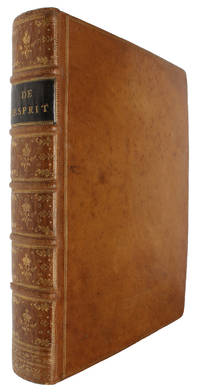
18102A La Haye, Chez Pierre Moetjens, (Provins, Michelin), 1759. With title-vignettes, titles printed in red and black. 3 volumes. (4), viii, x, 244 pp.; (4), xi, 209 pp.; (4), 166, iv, 34 pp. 12mo. Contemporary polished calf, spines gilt in compartments, gilt fillets on sides, gilt lettering to spine, a very good copy. Smith, E.10; Keim p. 714; Thomas, Checklist, p. 72; not in Tchemerzine-Scheler. Rare clandestine edition, made 'à la Hollandaise' by Michelins in Provins, of this epoch-making work which brought together the 'philosophes' in a common front against their ennemies (see: Belin, Commerce des livres prohibés, p. 102). Claude Adrien Helvétius (1715-1771) obtained the lucrative post of fermier-général in which he soon grew rich. He became known, however, for the philantropic and enlightened uses he made of his great wealth, particularly as a patron of the philosophers and men of letters. He resigned in 1751 from tax-farming, married and retired to his country estate, thenceforth devoting himself primarily to philosophical and literary persuits. The publication in 1758 of his principal work, De l'Esprit, proved to be one of the ideological causes célébres of the eighteenth century. Appearing at a moment of political reaction, De l'Esprit was noisily condemned by the authorities, both ecclesiastical and ministerial, for its dangerously heretical and subversive opinions. No book during the eighteenth century, except perhaps Rousseau's Emile, evoked such an outcry from the religious and civil authorities or such universal public interest. Condemned as atheistic, materialistic, sacrilegious, immoral and subversive, it enjoyed a remarkable succès de scandale. It lost its privilège within a fortnight of its publication. It was attacked in Church periodicals and in polemical pamphlets, in the literary salons and in popular songs, from bishops' pulpits and from the stage of the Théâtre français. When the work appeared it was censured by the Sorbonne, the pope and the Parlement of Paris and in 1759 it was burnt by the public executioner. Even Diderot found himself unable to subscribe to it. But in spite of Diderot's systematic refutation of the work and in spite of the fact that Helvétius never collaborated in the Encyclopédie the authorities held the sensationalistic philosophy expounded by the encyclopédistes responsible for Helvétius dangerous principles. The appearance of De l'Esprit was thus an important factor in the second suppression of the Encyclopédie. The thought of Helvétius sprang mainly from the predominant current of sensualism in the Enlightenment, which he fashioned with marked originality into what may be described as a thoroughgoing doctrine of 'environmental behaviorism'. - In this copy the 'Tables sommaires' are bound before the 'discourses.'
1758453611758 Paris. Durand. 1758. 1 volume in-4, plein veau marbré, dos à nerfs orné, pièce de titre rouge. (2) ff. ; XXII pp. ; 643 pp. ; (1) p. De privilèges.
175852026Paris Durand 1758. Large 4to. Large-paper copy bound in a beautiful contemporary full calf binding with five raised bands to richly gilt spine. Triple gilt line-borders to boards all edges of boards gilt and inner gilt dentelles. All edges gilt. A stunning bright clean and fresh copy with minimal wear and no restorations of any kind. Presentation-inscriptions to front free end-paper and to verso of title-page see description in note below. Large woodcut title-vignette and many smaller vignettes throughout. 4 XXII 643 1 pp. 40 ff. i.e. the original uncorrected leaves: pp. 1-16; 35-38; 59-62; 67-70; 75-78; 139-142; 145-154; 169-176; 187-190; 233-34; 227-230; 459-462; 547-550; 603-606 2 extra leaves that were printed incorrectly namely p. 160 - reset & p. 239 - different vignette. <br/><br/><em>Extremely rare first edition first issue with manuscript dedication-inscription from the author of this monumental work of the French Enlightenment. This magnum opus of modern thought is considered the founding work of modern Utilitarianism as it is here that Helvétius articulates the greatest happiness principle "the greatest happiness for the greatest number" for the first time and becomes the first to define social welfare upon this utilitarian maxim directly influencing Bentham and Mill.The materialistic philosophy of Helvétius' "De l'Esprit" also directly influenced Karl Marx who had studied the work while in Paris and called the ideas presented in it "the social basis of communism"."De l'Esprit" arguably constitutes the greatest "succès de scandale" of Western thought and one of the most influential works of Western philosophy.This magnificent copy is stunning in all ways. It contains all the extremely rare condemned and repressed leaves of the first issue bound in the back it is printed on large paper contemporarily bound presumably under instruction by Helvétius himself in a stunning full calf gift binding and with two manuscript ex-dono- presentation- inscriptions by Helvétius himself. One of them on the verso of the title-page is crossed out but is still legible reading "donum auctoris 17 avril 1760 Cl. Helvetius" the second on the front free end-paper reads "ex dono auctoris 1761" - thus indicating that Helvétius who had the copy in his possession to give away when he felt it appropriate had first intended to give it away - perhaps late in the year - in 1760 and then ended up giving it away in 1761. The work lost its privilege almost immediately and even though Hélvetius wrote three retractions it was still condemned and publicly burnt. In spite of this Helvétius still kept a few copies of the very first issue with all the original leaves. According to Smith 15 copies existed and as Jacques Guérin also notes these copies were all intended for his close friends and family we know for instance that Rousseau received one of the copies. These copies of which the present is one are thus of the utmost scarcity. Only one other has been on the market within the last 25 years namely that of Jacques Guérin which however did not have a dedication-inscription from Helvétius.As Tchermerzine describes the extremely rare copies of the first issue which are either without the newly formulated leaves or with the original leaves preserved our copy has them all! are between 10 and 60 times as valuable as the later issues depending on condition - these between 4 and 15 copies are the only ones to contain the 80 revolutionary pages that caused the work to be condemned and burnt and sent Helvétius into exile. Tchermerzine does not however account for copies with a presentation-inscription like the present. The work caused an immense uproar when it appeared. It was considered so heretical atheistic and immoral that it lost its privilege within a fortnight; it was heavily condemned by the Church and the State and was burnt by the Hangman the plan being to destroy all copies of it. Few books in the entire history of printing have been met with such opposition - it was condemned by both the son of Louis XV and the Sorbonne and the priests succeeded in convincing the court that the doctrines were so dangerous that even though Helvetius wrote three retractions the book was still publically burned; and when the Encyclopédie of Diderot and d'Alembert was suppressed for the second time this had much to do with Helvétius' De l'Esprit and the scandal it had caused.This scandalous work however gained so much attention that it was almost immediately translated into all European languages contributing to the immense influence it came to have on all European thought. "The history of Helvetius's De l'esprit 1758 his first major work is eventful complicated and paradoxical. No book during the eighteenth century except perhaps Rousseau's Emile evoked such an outcry from the religious and civil authorities or such universal public interest. Condemned as atheistic materialistic sacrilegious immoral and subversive it enjoyed a remarkable succes de scandale. The work lost its privilege within a fortnight of its publication. It was attacked in Church periodicals and in polemical pamphlets in the literary salons and in popular songs from bishops' pulpits and from the stage of the Théâtre francais. Though Helvetius retracted his book three times he was condemned by the Archbishop of Paris Nov. 1758 the Pope Jan. 1759 the Parlement of Paris Feb. 1759 the Sorbonne Apr. 1759 and by various bishops." Smith p. 332."In "De l'ésprit" 1758 Helvétius follows the Lockean sensationalism of Condillac and pairs it with the claim that human beings are motivated in their actions only by the natural desire to maximize their own pleasure and minimize their pain. "De l'ésprit" though widely read gives rise to strong negative reactions in the time both by political and religious authorities the Sorbonne the Pope and the Parlement of Paris all condemn the book and by prominent fellow philosophes in great part because Helvétius's psychology seems to critics to render moral imperatives and values without basis despite his best attempts to derive them. Helvétius attempts to ground the moral equality of all human beings by portraying all human beings whatever their standing in the social hierarchy whatever their special talents and gifts as equally products of the nature we share plus the variable influences of education and social environment." SEP.D. W. Smith The Publication of Helvetius's De l'esprit in French Studies 1968 p. 105.Tschermerzine III:672. </em> hardcover
175938286A La Haye: Chez Pierre Moetjens. Good with no dust jacket. 1759. Leather. Bound in full morocco leather. Three red and black title pages. Front cover attached by binding cords. Inside front cover scraped by removal of bookplate. An ideological work with heretical and subversive opinions. Possibly a pirate edition. . Chez Pierre Moetjens hardcover
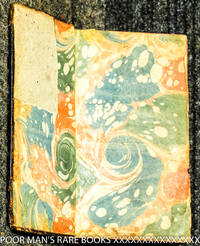
1753009248Berlin Londres 17531773. Due opere in un volume 9x157 cm di 158 pp e LXXII-83 pp. Una brunitura diffusa alla prima opera con erosione marginale all'angolo alto della pagina di titolo senza toccare lo stampato con firmetta antica di possesso. Macchioline al titolo della seconda opera. Legatura coeva in papier dominoté dorso spaccato senza pagine bianche. 1-Luzac LE BONHEUR OU. Prima edizione. L'opera è stata a volte erroneamente anche attribuita a La Mettrie di cui Luzac era editore in Olanda. Ma in realtà era stato lo stesso Luzac a confutare l'opera di La Mettrie con L'Homme plus que machine. La raison la tolérance la modération et l'harmonie sont des valeurs centrales pour Luzac. Il fait partie du monde des Lumières modérées et à ce titre croit en la liberté intellectuelle et s'oppose à l'intolérance du clergé et à la répression gouvernementale. Raro. 2- Helvetius: LE BONHEUR. Edizione dell'anno seguente all'originale. Probabile contraffazione: nel 1773 le edizioni vere o pirata si susseguirono almeno cinque. « Les pages préliminaires sont occupées par un Essai sur la vie et les ouvrages d'Helvetius attribué à Duclos sans raison sérieuse et dont Saint-Lambert s'est déclaré par la suite être l'auteur. On le retrouve dans ses Oeuvres Philosophiques. Grimm en fait le plus grand éloge. » unknown
M11035Couverture rigide Amsterdam & Leipsick, Arkstée & Merkus, 1758 , in12 plein veau , 409pp Note manuscrite sur la page de garde : " Cet ouvrage a été brûlé en place de grève par la main du Bourreau en fevrier 1759, par arret du p ( illisible) de Paris" .Edition peu courante parue en mêm temps que l' originale parisienne .Fortes épidermures sur le dos et les plats , intérieur très propre pour cet émouvant témoignage . Langue: Français
M12076Couverture rigide La Haye , Moetjens , 1770 , in12 plein veau , dos lisse orné , filet sur les plats , VIII - 244 - VII -219 -IX -166 - 34 - IV pp Dos légèrement frotté, un mors inférieur faible. Langue: Français
1758CLL-624Paris, Durand, 1758 In-4 de (2)ff., XXII pp., 643 pp., (1) p., veau marbré, triple filet à froid d'encadrement sur les plats, dos à nerfs orné de roulettes et caissons avec motifs floraux, macles et d'étoiles dorés, pièce de titre de maroquin rouge, double filet doré sur les coupes, tranches rouges (reliure de l'époque).
177442324London, 1774. 8vo. Very nice, contemporary full mottled calf with richly gilt spine. Gilt line to edges of boards. Marbled edges. A bit of minor scattered brownspotting and some smaller dampstaining towards end. All in all a very nice copy. (4), III, (1), 151 pp. Beautiful woodcut vignettes.