Helvetius, Maximilian RudolphBiblio.com
509 résultats
1247719294.Gpaperback. Good. Access codes and supplements are not guaranteed with used items. May be an ex-library book. paperback
17810Londres: 1775. The second work 1776. 4 volumes 8vo 8 x 5 1/4 inches. L'Homme pages xvi:495 & 615; L'Esprit pages: viii:634 & 226:civ:106-201 with an engraved portrait of the author. Contemporary full tan calf wide decorative gilt border to sides all edges gilt. The bindings very rubbed and dry all backstrips defective corners rubbed through. An ideal cadidate for rebinding as internally very good and bound with the half titles; priced to allow for such. Londres: 1775. unknown
1781294242London: Societe Typographique 1781. hardcover. very good. 5 volumes. 282; 448; 384; 398; 407 pages. Small 8vo full contemporary tree calf gilt-lettered and decorated spines; books are a bit rubbed top of spine on volume 3 is chipped; speckled edges. Londres: 1781. Internally tight and bright a very good set.<br/> <br/> Societe Typographique unknown
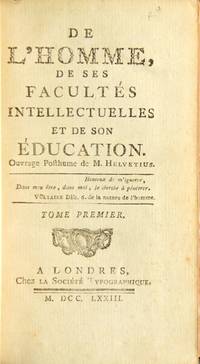
177317694London = France: La Société Typographique 1773. Contemporary mottled calf gold-tooled spine. 8vo. 2 volumes bound as 1. Third or second edition of one of the key works of the Radical Enlightenment published in the same year as the first edition. The author had evoked huge outcry with the publication of De L'esprit 1758 a carefully argued essay on the mind in which he roundly rejected metaphysics and the idea of Truth replacing Christian morals by purely utilitarian ethics and stressing the importance of education as the key to moral behaviour. In De l'homme Helvétius expanded and clarified his views provoking even Diderot to write a Réfutation. The present edition was most likely printed in France and as Smith argues it was probably this edition that the Paris Parliament condemned on 10 January 1774.Binding slightly rubbed; top of spine slightly worn. Fine copy.l Smith Bibliography H.3; cf. Cioranescu 33651 other edition; for Helvétius's philosophy: Blom A Wicked Company pp. 126-129. La Société Typographique, unknown
1774264014London: Societe Typographique 1774. hardcover. very good. 2 volumes. xl 231pp. 123pp and 462pp. 12mo full mottled calf gilt-lettered and decorated spine; both books lightly rubbed and with bumped corners stain to front cover of volume II as well as a small tear to upper front edge. Londres: Chez La Societe Typographique 1774. Internally tight and bright a very good set<br/> <br/> Societe Typographique unknown
177325123Londres i.e. The Hague: Chez la Société typographique 1773. 2 vols 12mo pp. 2 lxiv 639; 2 760 2 errata; brown morocco-backed brown cloth boards gilt lettering direct on spine; a good solid copy. Edited by Alexander Gallitzin. Posthumously published. There are at least two separate editions each with different title page ornaments. In this edition there is no comma after "intellectuelles" line 6 of title reads "et de son" and the title-page ornament looks somewhat like a stylized scallop shell. I can find no copies in ESTC that are duodecimo in format and with the stylized scallop-shell ornament. See Wellcome III p. 242 for the octavo edition. Chez la Société typographique unknown
1781294242London: Societe Typographique 1781. hardcover. very good. 5 volumes. 282; 448; 384; 398; 407 pages. Small 8vo full contemporary tree calf gilt-lettered and decorated spines; books are a bit rubbed top of spine on volume 3 is chipped; speckled edges. Londres: 1781. Internally tight and bright a very good set.<br/><br/> Societe Typographique unknown books
1774264014London: Societe Typographique 1774. hardcover. very good. 2 volumes. xl 231pp. 123pp and 462pp. 12mo full mottled calf gilt-lettered and decorated spine; both books lightly rubbed and with bumped corners stain to front cover of volume II as well as a small tear to upper front edge. Londres: Chez La Societe Typographique 1774. Internally tight and bright a very good set<br/><br/> Societe Typographique unknown books
177325123Londres i.e. The Hague: Chez la Société typographique 1773. 2 vols 12mo pp. 2 lxiv 639; 2 760 2 errata; brown morocco-backed brown cloth boards gilt lettering direct on spine; a good solid copy. Edited by Alexander Gallitzin. Posthumously published. There are at least two separate editions each with different title page ornaments. In this edition there is no comma after "intellectuelles" line 6 of title reads "et de son" and the title-page ornament looks somewhat like a stylized scallop shell. I can find no copies in ESTC that are duodecimo in format and with the stylized scallop-shell ornament. See Wellcome III p. 242 for the octavo edition. <br/><br/> Chez la Société typographique hardcover books
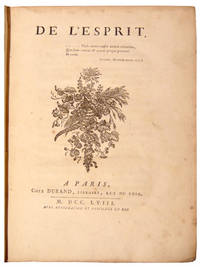
1758873<p>Paris: Durand 1758. First Edition. Hardcover. Very good. An Important Document for Understanding 18th Century French Censorship and Printing Practices and the Philosophical-Political Climate in 1758 <br /><br />HELVÉTIUS Claude-Adrien. De lesprit On the Mind Durand Paris 1758. 1 blank leaf half- title TP i-xxii 1-643 644 = Approbation and Privilege du Roi 1 blank leaf. Quarto. The B Tirage of De lesprit see below.Smith E.1b. <br /><br />The history of Helvétiuss De lesprit his first major work is eventful complicated and paradoxical. No book during the eighteenth century except perhaps Rousseaus Émile evoked such an outcry from the religious and civil authorities or such universal public interest. Condemned as atheistic materialistic sacrilegious immoral and subversive it enjoyed a remarkable success de scandale. The work lost its privilege within a fortnight of its publication. <br /><br />The publication history is no less eventful and complicated. There are three distinct first editions of the book: called the A B and C tirages. After carefully orchestrating efforts to mislead and bully the censor into a hasty approval of the text the A tirage the first impressions of the original edition which had begun to leave the presses by the end of June were kept by Helvétius for his personal friends. But before the work could be put on sale to the general public Malesherbes directeur de la librarie ordered that publication of the work be suspended indefinitely. The subversiveness of the book had been discovered and a new censor was introduced into the controversy and changes were made to the text. <br /><br />At this point the cunning of Helvétiuss publisher Durand came into play. He set up a completely new type modeling it upon the original edition. This type it can easily be recognized by its different type-setting and by its several new printing errors was adapted to suit the second censors requirements and was used to produce the second edition the B tirage. Thus when De lesprit was officially published in Paris on July 27th 1758 nobody suspected that it was in fact a completely new edition. However Durand had secretly saved and hidden the original typeset forms. <br /><br />The publication in 1758 of his principal work De lesprit was noisily condemned by the authorities both ecclesiastical and ministerial for its dangerously heretical and subversive opinions. Suppression of the book signaled a grave but fortunately temporary setback for the party of philosophes and Encyclopedists. Despite the recantations that Helvetius was forced to make regarding De lesprit he reaffirmed his ideas even more strongly in De LHomme de ses facultes intellectuelles et se son education published posthumously in 1772. EP Vol. 3 p. 472 Helvètius continued the work of Condillac by reducing all human understanding to sensation or sense- <br />perception. He then took this reductionist psychology and erected a utilitarian theory of morality based upon it making him one of the chief pioneers and promoters of utilitarian moral theory Copelston VI 1 p. 51. Helvètius was a strong defender of the benefits of education and also extremely political attacking all forms of despotism and in particular French despotism. <br /><br />CONDITION: Very good or better in a contemporary full calf binding with boards that are just a bit scuffed. The spine with five raised bands and beautiful gilt lettering and devices. Bookplate to front paste down. Stamp to upper corner of title page. Seemingly rehanged but expertly done. With lovely marbled endpapers. Overall a very beautiful copy of this book. <br /><br /></p> Durand hardcover
BB25<p>A Paris chez Durand Libraire Rue Du Foin 1758. Avec Approbation et Privilège du Roi. </p><p>Large 4to 253 x 193 mm of 2 ll. xxii pp. 643 pp. 1 p. Full bronze green morocco triple gilt fillet around the covers spine ribbed and decorated inner roll-stamp gilt edges. <i>Contemporary binding in morocco.</i></p><p><b>First edition seized and condemned to be burned immediately upon publication.</b></p><p><b>Copy from the issue C.</b></p><p>"<i>De l'esprit</i> had a huge scandal success. It is considered today as one of the most systematic and absolute forms of French materialism of the 18th century." Jacques Guérin.</p><p>Diderot considered that this book was "<i>a furious</i> <i>sledgehammer blow worn on prejudices".</i></p><p>"This famous work was censored by La Sorbonne as containing <i>all the scattered poisons distilled in the different modern books</i> that is contemporary ones" Tchemerzine.</p><p>The work dedicated to the royal family was rejected by the latter and on August 10 a few days after that of the publication the privilege given on May 12 was revoked. Despite the <i>Letter to the Reverend Father</i>. Berthier or Pleix which constitutes an apology and a retraction followed by a another more explicit retraction the book was blamed by the clergy.</p><p>Helvetius made these retractions out of friendship for his censor <i>Texier</i> who had had a lot of trouble because of him. These copies present <i>Petitions</i> on pages 1-16 35-38 59-62 67-70 75-78 139-142 145-154 159-160 169-176 187-190 227-230 233-234 239-240 459-462 545-550 603-606. </p><p>In the issue A the first word of page 5 is "dans"; "de" in the issue B and "mon" in the common issue C.</p><p>"The social and religious ideas developed in "<i>De l'Esprit</i>" are often borrowed from Hobbes Diderot Voltaire or Montesquieu; some of his theories on self-love the interest and fecundity of passions the identity between moral and social question are not unlike Vauvenargues La Rochefoucauld or Machiavel. However how to explain the huge "scandal success" that greeted the publication of this book We know that the reaction of the Church and the State was not long in coming and that a cascade of condemnations were launched against the author who had uselessly published his book anonymously. The author had to take refuge in England then in Germany where he was the guest of Frederick II. The Archbishop of Paris Mgr Christophe de Beaumont issued on November 22 1758 a special order against the book; La Sorbonne and the Parliament interfered so much that <i>De l'esprit</i> was burnt by the executioner himself. This condemnation was to entail the following year that of the <i>Encyclopedia</i>.</p><p>This "scandal success" undoubtedly holds to the fact that with Helvetius fall the last theological barriers in which the sensualism of Locke and also that of Condillac was still locked up. With Helvetius the French materialism of the 18th century took one of its most systematic and absolute forms and resolutely replaced the idealist myth which states that it is the ideas that govern the world and men the materialist principle which considers that it is by transforming the environment that has formed him that man kind will be transformed. It is understandable that such a principle could only arouse passion and interest at a time where great changes in society appeared to be more probable and desirable." Guy Schoeller.</p><p><b>Beautiful copy bound in contemporary green morocco coming from the famous library of Madame de La Borde with ex-libris. </b><br /></p><p><br /></p><p><u>French</u></p><p>A Paris chez Durand Libraire Rue Du Foin 1758. Avec Approbation et Privilège du Roi. </p><p>Grand in-4 de 2 ff. xxii pp. 643 pp. 1 p. Plein maroquin vert bronze triple filet doré autour des plats dos à nerfs orné filets or sur les coupes roulette intérieure tranches dorées. <i>Reliure en maroquin de l'époque</i>. </p><p>253 x 193 mm.</p><p><b>Edition originale saisie et condamnée à être brûlée dès sa parution.</b></p><p><b>Exemplaire du tirage C.</b></p><p>" <i>De l'esprit</i> eut un énorme succès de scandale. Il est considéré aujourd'hui comme l'une des formes les plus systématiques et les plus absolues du matérialisme français du XVIIIe siècle. " Jacques Guérin.</p><p>Diderot considérait que ce livre était " <i>un furieux coup de massue porté sur les préjugés</i> ".</p><p>" Cet ouvrage célèbre fut censuré par la Sorbonne comme contenant <i>tous les poisons épars distillés dans les différents livres modernes</i> c'est-à-dire contemporains " Tchemerzine.</p><p>L'ouvrage dédié à la famille royale fut repoussé par cette dernière et le 10 août peu de jours après celui de la parution le privilège donné le 12 mai fut révoqué. Malgré la <i>Lettre au</i> <i>révérend père</i>.Berthier ou Pleix qui constitue une apologie et une rétractation suivie d'une autre rétractation plus explicite le livre fut blâmé par le clergé.</p><p>Helvétius en remit alors une troisième à <i>Joly de Fleury</i> avocat général le 22 janvier 1759 ; le 31 parut la lettre du pape le 9 avril la censure de la Faculté de Théologie. Dès le 23 janvier Fleury avait prononcé ses réquisitions tout en ménageant l'auteur lui-même et le Parlement le 6 février 1759 rendit son jugement ; le livre fut brûlé le 10. Helvétius se défit de sa charge de maître d'hôtel de la reine ; le censeur démissionna. </p><p>Helvétius fit ces rétractations par amitié pour son censeur <i>Texier</i> qui avait eu beaucoup d'ennuis à son sujet. Ces exemplaires présentent des <i>Cartons</i> aux pages 1-16 35-38 59-62 67-70 75-78 139-142 145-154 159-160 169-176 187-190 227-230 233-234 239-240 459-462 545-550 603-606. </p><p>Dans le tirage A le premier mot de la page 5 est " dans " ; " de " dans le tirage B et " mon " dans le tirage commun C.</p><p>" Les idées sociales et religieuses développées dans " <i>De l'Esprit</i> " sont souvent empruntées à Hobbes Diderot Voltaire ou Montesquieu ; certaines de ses théories sur l'amour- propre l'intérêt et la fécondité des passions l'identité entre question morale et question sociale ne sont pas sans rappeler Vauvenargues La Rochefoucauld ou Machiavel. Cependant comment expliquer alors l'énorme " succès de scandale " qui salua la parution de cet ouvrage On sait que la réaction de l'Église et de l'État ne se fit point attendre et qu'une cascade de condamnations furent lancées contre l'auteur qui avait bien inutilement publié son livre sous l'anonymat. L'auteur dut se réfugier en Angleterre puis en Allemagne où il fut l'hôte de Frédéric II. L'archevêque de Paris Mgr Christophe de Beaumont lança le 22 novembre 1758 un mandement spécial contre le livre ; la Sorbonne et le Parlement s'en mêlèrent si bien que <i>De l'esprit</i> fut brûlé de la main même du bourreau. Cette condamnation devait d'ailleurs entraîner l'année suivante celle de l'<i>Encyclopédie</i>.</p><p>Ce " succès de scandale " tient sans aucun doute à ce fait qu'avec Helvétius tombent les dernières barrières théologiques dans lesquelles le sensualisme de Locke et aussi celui de Condillac était encore enfermé. Avec Helvétius le matérialisme français du XVIIIe siècle prenait une de ses formes les plus systématiques et les plus absolues et substituait résolument au mythe idéaliste qui veut que ce soient les idées qui gouvernent le monde et les hommes le principe matérialiste qui estime que c'est en transformant le milieu qui l'a formé que l'on transformera l'homme. On comprend qu'un tel principe ne pouvait que susciter les passions et l'intérêt en un moment où de grands changements dans la société apparaissaient comme de plus en plus probables et désirables. " Guy Schoeller.</p><p><i>Karl Marx</i> devait ajouter : " <i>la doctrine matérialiste suivant laquelle les hommes sont des produits des circonstances et de l'éducation que par conséquent des hommes modifiés sont des produits d'autres circonstances et d'une éducation modifiée oublie que ce sont précisément les hommes qui modifient les circonstances et que l'éducateur a besoin lui-même d'être éduqué</i>".</p><p><b>Bel exemplaire relié en maroquin vert de l'époque provenant de la célèbre bibliothèque de Madame de La Borde avec ex-libris. </b></p> hardcover
120531Douai Duaci = Zürich Typis Petri Columbii 1734. 8vo. XVI;XXXVI404 p. Vellum 17 cm Ref: Brunet 4602; Graesse 5263; E. Weller 'Die falschen und fingirten Druckorte' Leipzig 1858 p. 190 Details: 5 thongs laced through the joints. Short title & year on the back. All 3 edges marbled. Good quality paper Condition: Vellum soiled. Old inscription on the front flyleaf: 'Bel exemplaire de ce livre curieux et recherché'; old references written on the verso of this flyleaf Note: 'Johannes Jakob Zimmermann Professor der Theologie an der Karlsschule in Zürich war der erste namhafte Vertreter der religiösen Aufklärung dieser Stadt'. Zimmermann was born in 1695 in Zürich and died there in 1756. During his studies he came under the influence of freethinkers like Clericus and Grotius and began to dislike orthodoxy and grew interested in heretics. In 1737 he was appointed professor of natural law and of church history in his hometown and later succeeded against all expectations in gaining a professorship of theology. Hauptprofessur 'In dieser Stellung entfaltete er eine bedeutende Thätigkeit als Lehrer und Freund der studirenden Jugend und veröffentlichte daneben eine Reihe von theils gelehrten theils mehr populären Abhandlungen philosophischen und theologischen Inhaltes'. Zimmermann wanted to discuss fruchtbringende Fragen instead of the traditionellen Subtilitäten and made a stand against Verketzerungssucht. He warned against too exaggerated views on the holiness of the first christians and the visions and wonders that occurred in the first centuries of christianity. To prove his point he wrote this De miraculis quae Pythagorae Apollonio Tyanensi Francisco Assisio Dominico & Ignatio Lojolae tribuuntur libellus. Their stories were merely inventions of naive followers he argues. His scepticism brought him ennemies among the clergy who opposed his arminian heresy. 'Zimmermann's Bekämpfung der Orthodoxie stützt sich auf die Überzeugung das die Religion eine praktische Angelegenheit des Menschen sei. Das oberste Ziel der Religion ist die Besserung des Menschen. . Die zürcherischen Theologen der zweiten Hälfte des Jahrhunderts kamen aus seine Schule'. ADB 45271-273 Zimmermann's book against wonderworking and supernatural tales remained on the Index of forbidden books of the Catholic Church till 1948. It was published pseudonymously in Zürich. The name of the Swiss author was already revealed to the public in a review of the book in the Bibliothèque germanique ou Histoire littéraire de l'Allemagne de la Suisse et des Pays du Nord Année 1735 Tome 31 p. 148/152. We quote part of the review: 'Après quelques Reflexions générales sur les Miracles il parle d'abord de ceux de Pythagore & d'Apollonius & puis de ceux de St. François de St. Dominique & de St. Ignace de Loyola. Ensuite il entre dans l'Examen de la doctrine des moers; & du but de chacun des ces faiseurs de Miracles en particulier. Il prétend que les Miracles des uns & des autres ne sauroient venir de Dieu; mais il ne veut pas non plus qu'ils ayent été l'Ouvrage de Demon desorte qu'il ne lui reste d'autre partie à prendre que de les taxer comme il fait de Chimeres & d'impostures de faux Miracles ménagés par l'adresse des Charlatans Thaumaturges. On se sera pas faché de lire ce que Notre Auteur dit pour appuyer son sentiment surtout par rapport aux prétendus Miracles d'Apollonius de Tyane. Monsieur Zimmermann ameroit mieux qu'on canonisât Socrate que les trois Saints qu'il met en parallele avec Pythagore & avec Apollonius'. Zimmermann's pseudonym Phileleutherus Helvetius means a Swiss loving freedom or a Swiss liberal. This pen name echoes the pseudonym used by the famous English philologist and theologian Richard Bentley 1662-1742 the greatest name among classical scholars of the first half of the 18th century. In 1710 he published a book with his emendations of the fragments of Menander and Philemon under this assumed name. Zimmermann by choosing this name seems to connect his endeavour to wipe out idolatry superstition and the belief in wonders in pre-elightenment faith with the battle fought by Bentley against orthodox classical philologists who thought that old was best. He proved in his Dissertation upon the Epistles of Phalaris 1697 that some ancient texts which were believed to be old authorative and great literature were in fact late antique forgeries without any literary or historical merit. Zimmermann tries to do the same. He argues that wondrous tales concerning Franciscus of Assisi the founder of the Franciscan order and Dominicus Guzman the founder of the Dominican order and Ignatius de Loyola the founder of the Jesuit order which were considered to be true and which were promoted by the Catholic Church were in fact mendacious fabrications. mendacia & figmenta Monachorum p. a2 recto He also battles against the veneration of saints and the canonization of numerous saints by the Catholic Church. The transsubstantion of the body of Christ is in his eyes ridiculous. As a consequence the Vatican placed this book on the Index of forbidden books. And allthough Zimmermann admits in his preface in caeteris satis ostendi me natura ad jocos risusque proclivem non esse p. b4 verso one reads on the title that this book was published in 'Duaci' i.e. in Duacum the Latin form of the name of the city of Douai in North of France near Arras. It was in this city in the Spanish Netherlands now French Flanders that the Spanish king Philip II founded in 1559 with the support of pope Paulus IV a university which was to be a catholic bulwark of the Contrareformation against the spreading of the protestantism in the Low Countries. The contemporary reader would immediately have realized that this was an impossible and funny combination an antipapist book on the title of which pagan charlatans were on equal level with great saints being published in the lion's den of Douai. The book was in fact published in Zürich. The name of the printer/publisher deserves some attention too. The non existing name 'Petrus Columbius' Peter Dove in the imprint seems to be programmatic. Contemporary readers might recognize Acts 4:8-11 where the apostle Petrus speaks up filled with the Holy Spirit and explains that Christ is the only one a christian should worship. This passage forbids to believe in wonders other than those of Christ and forbids to worship other deities/saints. The dove symbolises the Holy Spirit since early christianity. It is told John 1:32 that the Holy Spirit descended on Jesus's head like a dove quasi columbam when he was baptized by John the Baptist in the Jordan. By way of conclusion we cite the titles of some chapters. Chapter 10: Miracula Pythagorae Apollonii Francisci Dominici Lojolae non sunt a Deo quia doctrina eorum omnibus Dei virtutibus contraria 11: '. quia Relig. Christianae veritatem & divinitatem subvertunt; 13: Disquiritur utrum Miracula illa Diabolo sint tribuenda'. There is also a chapter 15 in which Zimmermann proves that Pontifices illos homines fuisse cum rerum divinarum ignarissimos tum impudentissimos nequissimosque Collation: 8 a-b8 A-2B8 2C2 Photographs on request hardcover
197574424Editora Nacional 1975. Tapa blanda. 2ª Mano. Clasicos Para Una Biblioteca Contemporánea 24. . . . . Tapa blanda con solapas 584 p. ; 21x13 cm Editora Nacional unknown
2012185203Editorial Laetoli S.L. 2012. tapa blanda. 2ª Mano - Bueno/2ª Mano. Editorial Laetoli S.L. 2012. Los ilustrados 6. Publicado originalmente en París en 1758 este tratado defiende un materialismo radical y un enfoque sensualista todo conocimiento y facultad humana provienen exclusivamente de las sensaciones físicas. En su época provocó un enorme escándalo social y religioso: fue prohibido por el Consejo de Estado francés condenado por el Papa Clemente XIII y quemado públicamente junto a la célebre Enciclopedia. Su objetivo principal en palabras de filósofos contemporáneos como Michel Onfray era buscar la verdad de forma rigurosa basándose en las leyes de la naturaleza y no mediante dogmas impuestos Tapa blanda con solapas 576 p. 23x15 cm Editorial Laetoli, S.L. unknown
feb61319Used. For more details please contact me unknown
feb61670Used. For more details please contact me unknown
17872075165Liegnitz und Leipzig: David Siegert 1787. XXIV, 16, 646 Seiten. Frakturdruck. 8° (21 x 13,5 cm). Dekorativer Halblederband der Zeit auf 5 Bünden mit goldgeprägtem Titelschild und goldgeprägten Harfen auf dem Rücken, Buntpapierbezug, rotgefärbtem Schnitt und Buntpapiervorsätzen. [Hardcover / fest gebunden].
1728303321728 In-4, broché, couverture de papier marbré de l'époque, (1) f., 69, (3) p. Paris, Barois, 1728.
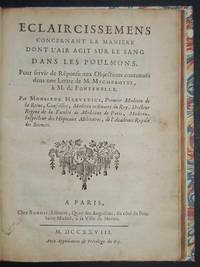
34272Paris: Barois 1728. 4to 2 69 3pp. recent quarter calf marbled paper boards red morocco title label on upper cover. Jean Claude Adrien Helvétius 1685-1755 was a celebrated physician in Paris and father of the philosopher Claude Adrien Velvétius 1715-1771. Wellcome III p. 243. Paris: Barois, 1728 hardcover
SLIVCN-9782012709195Hachette supérieur pédagogique (9/2015)
2011124572Hachette, 2011, in-8°, 304 pp, cartes, glossaire, biblio, broché, couv. illustrée, bon état (Coll. Carré Histoire)
192716422Hannover, 1927. 8°. VII, 248 S., Halbleinenband der Zeit. Titel gestempelt und mit einem Bibliotheksetikett. Kleiner Stempel auf Titelrückseite und letzter Seite.
8200P., Muguet, 1708, un volume in 4 relié en cartonnage bradel (reliure moderne), 8pp.
1968204082Berlin/Weimar: Aufbau, 1968. 349 S., 19 cm. kart., broschiert.
R200087112LOUIS-MICHAUD. NON DATE. In-12. Broché. Bon état, Couv. convenable, Manque en coiffe de pied, Quelques rousseurs. 222 pages. Quelques gravures et portraits en noir et blanc, hors texte. Quelques annotations au crayon dans le texte.. . . . Classification Dewey : 100-PHILOSOPHIE ET DISCIPLINES CONNEXES