"CONDORCET, (MARIE JEAN ANTOINE NICOLAS CARITAT MARQUIS de).Livre Rare Book

75 résultats
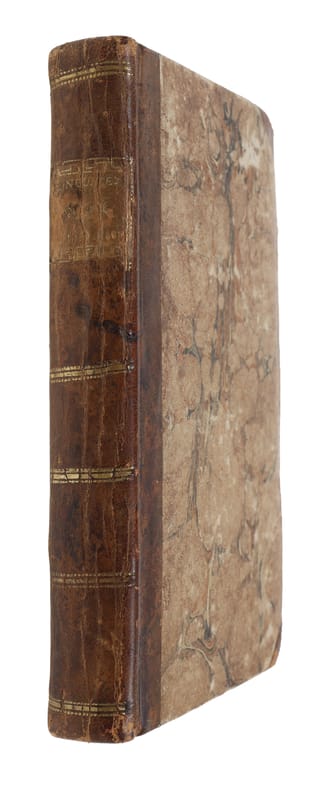
179542119Paris, Agasse, l'an III de la République, une et indivisible (1795). 8vo. Bound in a very nice newer pastiche-binding in full mottled calf. Five raised bands and gilt title-label to spine. A very nice, clean, fresh, and attractive copy. VIII, 389 pp.
179761971København, Tikiøbs Forlag, 1797. 8vo. Bound in a contemporary half calf binding with gilt spine and gilt title label. Minor cracks to spine. Insignificant wear to capitals. Edges of boards worn. Corners bumped. Bibliographical notes to front free endpaper. Small ownership stamp to verso of title page. Evenly browned. XII,(2),368,(1: errata) pp.
178629371No publisher London Paris 1786. First Edition. Softcover. Very Good Condition/No Dust Jacket. Gerits Edition C listing four editions published in 1786 in "Londres" but more likely Paris. "Contrary to what is suggested by the title this book was not a biography but rather an expose of Turgot's educational political and economic ideas. In fact Stanley Jevons has called it one of the earliest works on 'economie pure' He also included it in his famous list of 'mathematico-economic' works for Condorcet expressed his ideas on fiscal reform and on freedom of commerce and trade in mathematical terms" from Anton Gerits' 'Condorcet's Vie de Monsieur Turgot'. An 'unsophisticated' copy bound in original publisher's wrappers the wrappers rather worn particularly on the spine and some staining to rear wrapper the contents clean with printed pastedown leaf from an earlier work; engraved portrait frontispiece iv 5-287 pages untrimmed a very small single wormhole to last two leaves of text. Approx. 8.5" x 5.4". Quantity Available: 1. Category: Economics; Pictures of this item not already displayed here available upon request. Inventory No: 29371. . No publisher paperback
1786EONe[CON89London ie. Paris: 1786. 1786. 8vo. pp. 3 p.l. 246. old half calf rebacked. One of several issues with identical imprint this one being Gerits' issue 'B'. The present work and Dupont de Nemours' earlier memoir 1782 are the two major contemporary biographies of the great French statesman economist and financial reformer. The Life is also important for containing an early contribution to mathematical economics in a passage where Condorcet discusses the various mathematical ways "in which indirect taxation could be replaced by direct taxation and the effects of such a change". Theocharis Early Development in Maathematical Economics p. 65 A.Gerits in Harvard Library Bulletin 1992-93 Vol. III No. 4. cfCioranescu 20417. cfEinaudi 1217. cfGoldsmiths' 13128. cfKress B.1031-33. Palgrave III p. 594. London [ie. Paris]: 1786. unknown
1786383061786 In-8 (219 x 144 mm), demi-veau blond, dos lisse orné de doubles filets dorés en place des nerfs, titre doré, (reliure Laurenchet), (4), 299 p. et (1) p. d'errata (exemplaire imprimé sur grand papier). Londres, 1786.
178615811786 Sans nom d'éditeur, Londres, 1786. In-8, plein veau marbré d'époque, IV et 322 pages.
1788264649Paris: Chez Froullé libraire quai des Augustins 1788. First edition. 4 xvi 383 1; 4 259 1; 4 292; 4 366 pp. 4 vols. 8vo. Contemporary quarter leather pastepaper boards french tips flat spines with red leather title and volume labels. Spines rubbed some minor starting of joints to two volumes small loss to head of vol. I a very good contemporary set. First edition. 4 xvi 383 1; 4 259 1; 4 292; 4 366 pp. 4 vols. 8vo. Mazzei emigrated to America from Italy in 1773 and introduced the cultivation of grapes and olives to the United States. He became a neighbor of Jefferson in Virginia settling near Monticello at Jefferson's request and this association led to their long friendship and the author's acquaintance with Franklin and Adams. A staunch Republican Mazzei took an active role in the Independence movement. In this work he outlines the history of the American colonies the causes of the Revolution and the economy and government of the United States. Also discussed are Indians slavery emigration and the Society of the Cincinnati. The book was a contemporary success and remains an important work which Malone characterizes as "probably the most reliable of all the works of the period on the United States" Thomas Jefferson 2:109-110. Jefferson aided Mazzei in the compilation of the work while acting as American minister in Paris. Sabin 47206; Leclerc 957; Howes M456; Monaghan 1052; Muller 1612; Fay 24; Einaudi 3807; Reese Revolutionary 87 Chez Froullé, libraire, quai des Augustins unknown
178416473Londres, sn, 1779 1784 In-8 plein veau brun, dos lisse, caissons ornés, 231- 120 pp. & 115- 105 pp. Dos passé, anotations manuscrites en pages de garde. Bon exemplaire.
178851530No place: no publisher 1788. The abolition of taxes First edition the first four numbers of Le Moniteur a political journal edited by Brissot de Warville Clavière and Condorcet all published. Issues two and four consider taxation proposing the abolition of all existing taxes and their replacement by equally distributed voluntary subsidies. In this volume the fourth number is the 50-page edition. Garrett notes: "The Bibliothèque nationale has the only complete collection of Le Moniteur. The British Museum has a 38-page edition of the fourth number and Cornell University has versions of the same pamphlet in 48- and 50-page editions. Among the other major collections of French revolutionary pamphlets in this country i.e. USA Le Moniteur is to be found only at Harvard University 48-page edition of the fourth number Princeton University 50-page edition of the fourth number and the New York Public Library an edition of the third number differing slightly from that in the Bibliothèque nationale" Garrett. 4 parts in one vol. octavo 188 x 119 mm pp. 14 2 bl.; 20; 32; 50. Ownership stamp of Thomas Valletau de Chabresy to title verso of the fourth part. Modern dark red quarter morocco spine lettered in gilt patterned paper boards old red edges to first 3 parts. Boards rubbed at lower outer edges some dampstaining to part 4 very good copies. Hatin 92; INED 815. Clarke W. Garrett "The Moniteur of 1788" in French Historical Studies vol. 5 no. 3 Spring 1968 pp. 263-73. hardcover
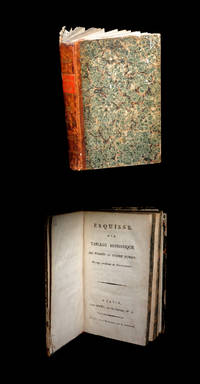
1794245971794. A Paris chez Agasse l'an III de la RÂŽpublique 1794 / 1795. Un vol. au format in-8 198 x 128 mm de viii - 389 pp. Reliure lÂŽgÂrement postÂŽrieure de demi-basane brune dos lisse ornÂŽ de doubles filets dorÂŽs fleurons dorÂŽs piÂce de titre de maroquin cerise titre dorÂŽ tranches marbrÂŽes. Edition originale. ''Texte capital emblÂŽmatique du projet des LumiÂre de son idÂŽologie du progrÂs comme de sa conception de la perfectibilitÂŽ continue de l'esprit humain''. Alde. ''Aussit™t ÂŽlevÂŽe lors de sa publication en l'an III par Mme de Condorcet et Daunou au rang des Ãuvres nationales l'Esquisse est souvent considÂŽrÂŽe pour le contexte tragique qui a entourÂŽ sa composition comme une Ãuvre de circonstance ÂŽcrite quelques mois avant le dÂŽcÂs de son auteur. S'appuyant sur le rationalisme cartÂŽsien l'empirisme de Locke et le sensualisme de Condillac qui fournissent une caution philosophique ˆ la thÂse de la perfectibilitÂŽ humaine l'Esquisse synthÂŽtise la philosophie des LumiÂres et tÂŽmoigne de l'influence exercÂŽe sur Condorcet par le Tableau philosophique des progrÂs successifs de l'esprit humain et le Plan des deux discours sur l'histoire universelle de son ma”tre et ami Turgot.'' Eric Letonturier. ''Les conclusions de Condorcet ressemblent beaucoup ˆ celles des anciens alchimistes ; en ce qu'il admet comme une certitude que l'homme parviendra t™t ou tard ˆ prolonger son existence ˆ des limites invraisemblables''. in Caillet. Brunet II Manuel du libraire et de l'amateur de livres 3650 - Varet II Manuel de bibliographie philosophique p. 502 - Cioranescu I Bibliographie de la littÂŽrature franÂaise du XVIIIÂme 20528 - QuÂŽrard II La France littÂŽraire p. 269 - Caillet I manuel bibliographique des sciences psychiques et occultes 2545 - Dorbon-A”nÂŽ Bibliotheca esoterica 56 pour une ÂŽdition de 1822 - En FranÂais dans le texte 196 - Martin & Walter n¡8083. Coiffes et coupes ÂŽlimÂŽs. Petit manque angulaire au second plat. Dos prÂŽsentant des frottements. Petit dÂŽfaut angulaire affectant le faux-titre. InÂŽgales mais claires rousseurs dans le texte. PrÂŽsence de passages surlignÂŽs accolÂŽs ou annotÂŽs. b42961 unknown
179525074Paris: Agasse ans III 1795. First edition 8vo pp. viii 389; contemporary full calf black morocco label on gilt-decorated spine; front joint cracked binding rubbed and scuffed; a good copy. See PMM 246: "It was the gospel of the nineteenth century that mankind is destined for indefinite future progress. Condorcet 1743-1794 looking back and then forward saw proof of this in the growing equality between classes and nations the intellectual physical and moral improvement of man; and he prophesied that popular education on correct principles would strengthen and assure this progress. In the Esquisse An Historical Outline of the Progress of the Human Mind published after his death Condorcet traces the history of man through epochs the first three covering his progress from savagery to pastoral community and thence to the agricultural state. The next five span the growth of civilizations and knowledge down to Descartes and the ninth describes the revolution of Condorcet's own lifetime from Newton to Rousseau. The prophetic view of the tenth epoch shows Condorcet at his most original. He forecasts the destruction of inequality between nations and classes and the improvement intellectual moral and physical of human nature it is as the most fully developed exposition of the progress of man that Condorcet's work is now remembered and it is this which has given its lasting appeal." <br/><br/> Agasse, ans III unknown books
1796262913Philadelphia: Lang and Ustick 1796. hardcover. good. Frontis. 293pp. 16mo contemporary calf covers detached spine worn edges of corners worn light foxing throughout many pages dampstained on top half many pages slightly wavy back cover dampstained. Philadelphia: Printed by Lang and Ustick for M. Carey. 1796. First American Edition<br/><br/> Printing and the Mind of Man 246 "Considered to be Condorcet's most original and most important work. In it he divided history into ten epochs the first nine dealing with history up to the time in which he himself lived whereas the tenth is his prophetic view of the future. It is the most original part of the book in which Condorcet forecasts among others the future moral intellectual and physical improvement of man." Evans 30257<br/><br/> Lang and Ustick unknown books
1795168984Paris: Chez Agasse 1795. Second. hardcover. very good. 389pp. 4pp. of advertisments 8vo untrimmed rebound in cloth-backed marbled boards spine neatly repaired. Paris: Chez Agasse L'An III 1795. Second Edition. Very good .<br/><br/> Printing and the Mind of Man 246; Robinet 382. Considered to be Condorcet's most original and most important work. Considered to be Condorcet's most original and most important work. In it he divided history into ten epochs the first nine dealing with history upto the time in which he himself lived whereas the tenth is his prophetic view of the future. It is the most original part of the book in which Condorcet forecasts among others the future moral intellectual and physical improvement of man. '. PMM<br/><br/> Chez Agasse unknown books
179565358ìCan Man Become Perfectî CONDORCET Marie Jean Antoine Nicolas Caritat Marquis de. Esquisse dÃun tableau historique des progrËs de lÃesprit humain. Ouvrage posthume de Condorcet. Paris: Chez Agasse LÃan III. de la RÈpublique 1795. First edition of CondorcetÃs philosophical masterpiece. Octavo 7 7/8 x 4 13/16 inches; 201 x 123 mm. viii 389 1 blank pp. Contemporary quarter calf over dark blue paste-paper boards spine gilt with dotted bands and ornaments gilt red morocco lettering piece. Old owner's signature on half-title. A quarter-inch marginal tear at the bottom of leaf M42 that does not affect the text. Light foxing throughout. A blue ink stain on top edge from signature Z to the end. Overall a clean and attractive copy. ìIt was the gospel of the nineteenth century that mankind is destined for indefinite future progress. Condorcet 1743-1794 looking back and then forward saw proof of this in the growing equality between classes and nations the intellectual physical and moral improvement of man; and he prophesied that popular education on correct principles would strengthen and assure this progress.In the Esquisse ëAn Historical Outline of the Progress of the Human Mindà published after his death Condorcet traces the history of man through epochs the first three covering his progress from savagery to pastoral community and thence to the agricultural state. The next five span the growth of civilizations and knowledge down to Descartes and the ninth describes the revolution of CondorcetÃs own lifetime from Newton to Rousseau. The prophetic view of the tenth epoch shows Condorcet at his most original. He forecasts the destruction of inequality between nations and classes and the improvement intellectual moral and physical of human nature.it is as the most fully developed exposition of the progress of man that CondorcetÃs work is now remembered and it is this which has given its lasting appealî Printing and the Mind of Man. Printing and the Mind of Man 246. HBS 65358. $2000 Chez Agasse hardcover books
178566958ìThe First Large-Scale Attempt to Apply Mathematics to Knowledge of Human Phenomenaî CONDORCET Marie Jean Antoine Nicolas Caritat Marquis de. Essai sur lÃapplication de lÃanalyse ‡ la probabilitÈ des dÈcisions rendues ‡ la pluralitÈ des voix. Paris: De lÃImprimerie Royale 1785. First edition.†Quarto. 2 cxci 1 blank 304 pp. Decorative woodcut head- and tail-pieces. Contemporary French mottled calf spine decorated in gilt with five raised bands. Marbled endpapers all edges red. First and last few pages browned at edges . gathering K is browned a Q and 2G is toned. Otherwise very good and very scarce. ìCondorcetÃs most significant and fruitful endeavor was in a field entirely new at the time. The subject was one that departed from the natural sciences and mathematics but nevertheless showed the way toward a scientific comprehension of human phenomena taking the empirical approach of natural science as its inspiration and employing mathematics as its tool. Condorcet called this new science ësocial mathematics.à It was apparently intended to comprise.a statistical description of society a theory of political economy inspired by the Physiocrats and a combinatorial theory of intellectual processes. The great work on the voting process published in 1785 is related to the latter. Condorcet there sought to construct a scheme for an electoral body the purpose of which would be to determine the truth about a given subject by the process of voting and in which each elector would have the same chance of voicing the truth.No doubt the results obtained in the Essai dÃapplication de lÃanalyse were modest ones. ëIn almost all casesà Condorcet said ëthe results are in conformity with what simple reason would have dictated; but it is so easy to obscure reason by sophistry and vain subtleties that I should feel rewarded if I had only founded a single useful truth on a mathematical demonstrationà Essai p. ii. One must nevertheless recognize in this work.the first large-scale attempt to apply mathematics to knowledge of human phenomenaî D.S.B. Brunet VI col. 472. HBS 66958. $7500 De k'Imprimerie Royale hardcover books
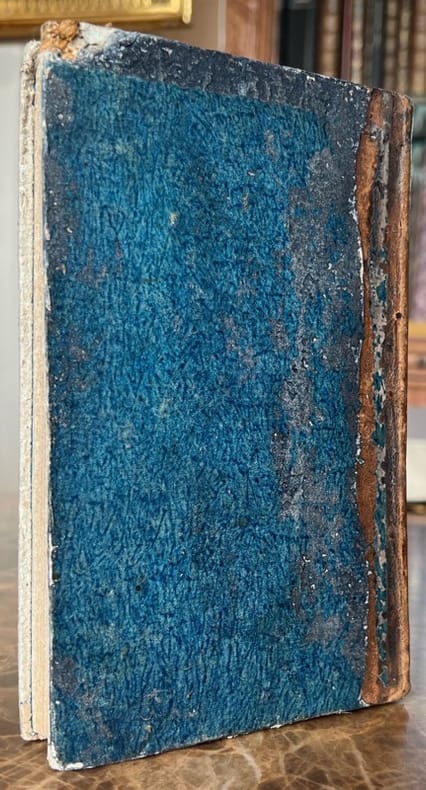
179546405122Paris, Agasse, An III (1795) ; in-8, broché, entièrement non rogné, couverture bleue muette de parution. VIII pp., 389 pp. avec l’étiquette imprimée (dessinée au dos du brochage).Malgré la mention “deuxième édition”, ce tirage est en tous points conforme à l’édition originale. Ce livre posthume est l’ouvrage le plus important de Condorcet. Souvent considéré comme l’apogée de la Philosophie des Lumières, ce texte est un hymne à la gloire du progès. La notion de progrès existait avant dans le domaine scientifique ou culturel. Mais l’idéologie de progrès de Condorcet, à la suite des Philosophes et surtout de Turgot, s’entendait dans l’ordre de l’esprit et de la morale. L’Esquisse ne veut pas seulement éclairer le présent, mais également maîtriser l’avenir. On retrouvera son influence dans la pensée du XIXe, en particulier chez Saint-Simon et Aug. Comte. Printing and the Mind of Man, n° 246. - En français dans le texte, n°196. État de parution, mouillure dans un angle au début du volume, brochage et quelques feuillets de la fin un peu abîmés dans les marges, un plat détaché, derniers ff. débrochés.
1798195361798 Gènes, chez Yves Gravier libraire, 1798, An I de la République Ligurienne, in-8 de 361-(1) pp., rel. postérieure fin XIXe , demipercaline bordeaux, dos lisse avec date en pied, angle supérieur de la page de faux-titre anciennement réparé, bon ex.
179512965A Paris, chez Agasse, 1795. In-8 de VIII-389 pp., demi-basane brune, dos frotté (reliure de l'époque).
179239936Paris, Fiévée, 1792. In-8 broché de 16 pp.
179139899Paris, de l'Imprimerie nationale, [1791]. In-8 broché de 7 pp.
179339945A Paris, de l'Imprimerie nationale , 1793. In-8 de (2)-48-48 pp., cartonnage Bradel, pièce de titre sur le plat supérieur (reliure moderne).
179139904Londres, , 1791. 2 tomes en 1 vol. in-16 de (2)-303 pp. et (2)-279 pp., demi-basane racinée, dos lisse orné (reliure de l'époque).
1786207281786 Londres (Paris), 1786, in-8 de (2) ff- 299 pp.-(1)p. (errata), reliure de l'époque de plein veau havane raciné, dos lisse orné de fers dorés, pièce de titre de maroquin rouge, charnières fendues, 1er plat détaché, reliure à restaurer, sinon bel état intérieur.
179559131BBParis, Chez Agasse. L'an III. (i.e. 1795). 8°. VIII S., 389 S. Halblederband der Zeit mit rotem goldgeprägtem Rückenschild und wenig Rückenvergoldung.
179424597A Paris, chez Agasse, l'an III de la République [1794 / 1795]. Un vol. au format in-8 (198 x 128 mm) de viii - 389 pp. Reliure légèrement postérieure de demi-basane brune, dos lisse orné de doubles filets dorés, fleurons dorés, pièce de titre de maroquin cerise, titre doré, tranches marbrées.