_2.jpg)
78 résultats
1777(LCPCRELI-0010)(Un rare ouvrage de Condorcet sur Michel de l'Hôpital, en édition originale, relié pour la Marquise du Deffand, la célèbre salonnière du XVIIIe siècle) REMY (Abbé) - MONTYOUD - CONDORCET M.J.A.N. CARITAT (M.is de). (Ribemont, 1743 - Bourg-la-Reine, 1794) "ELOGE DE MICHEL DE L'HOPITAL, CHANCELIER DE FRANCE, DISCOURS QUI A REMPORTE LE PRIX DE L'ACADEMIE FRANCOISE, EN 1777". (Avec :) "ELOGE DE MICHEL DE L'HOPITAL, CHANCELIER DE FRANCE. DISCOURS QUI A OBTENU LE SECOND ACCESSIT DU PRIX DE L'ACADEMIE FRANCOISE, EN 1777". (Avec :) "ELOGE DE MICHEL DE L'HOPITAL, CHANCELIER DE FRANCE. DISCOURS PRESENTE A L'ACADEMIE FRANCOISE, EN 1777". 1777, Paris, Demonville. 3 ouvrages en 1 volume in-8° (223x148 mm) (dimensions pages 217x138 mm) I : 68 pp. (y compris le titre) ; II : 59, (1) pp. (y compris le titre) ; III : 124 pp. (y compris le titre, l'avertissement et l'approbation). (I : A-D8, E2 ; II : A-C8, D6 ; III : A-G8, H6) Reliure de l'époque en veau marbré. Encadrement d'un simple filet à froid sur les plats. Dos à cinq nerfs avec le célèbre fer doré du "Chat assis" et petites décorations dorées dans les compartiments et pièce de titre en maroquin rouge. Filet doré sur les coupes. Tranches marbrées à couleurs. Gardes de papier décoré. Trois rares Editions Originales reliées ensemble. Deux petites et habiles restaurations à deux coins. Anciennes petites taches sur le premier plat, mais très bel exemplaire, très frais. Provenance : Rare exemplaire de Marie-Anne de Vichy-Chamrond, Marquise du Deffand (1696-1780), avec son célèbre fer doré du "Chat assis" frappé dans les compartiments du dos. Des écrits sur Michel de l'Hôpital consacrés au concours de l'Académie Française, la Marquise du Deffand à choisi les trois compositions qui lui ont paru les plus remarquables. L'ouvrage du célèbre philosophe et mathématicien était le meilleur. La personnalité de Michel de l'Hôpital, prônant la tolérance à l'époque si intolérante des guerres de religion, l'a évidemment inspiré. Mais son texte suscita l'hostilité des prêtres, des nobles et des amis de Necker. Prétextant que l'ouvrage excédait du double les bornes prescrites, l'académie ne lui donna pas le prix. "... Tel fut le Chancelier de l'Hôpital. Au milieu du plus violent fanatisme, il fit entendre la voix de la raison & de l'humanité ; au sein de l'anarchie & de la révolte, il défendit avec un courage égal & l'autorité du Roi & les droits de la Nation ; la corruption de son siècle, les intrigues de la Cour, n'altèrent ni son intégrité ni sa franchise ; & lorsque tous ne songeoient qu'à établir leur fortune sur les malheurs publics, seul il veillait pour la Patrie". (...) "On me reprochera peut-être de montrer les hommes sous des couleurs trop odieuses ; mais qu'on daigne se souvenir que j'ai à peindre, & le siècle le plus coupable peut-être dont les Annales du Monde aient transmis la mémoire, & dans ce siècle les classes plus élevées, c'est à dire, les plus corrompues de la Société...". L'union de Condorcet et de la Marquise du Defend est particulièrement piquante. On sait que Madame du Deffand tint un des plus importants salons du XVIIIe siècle où se côtoyaient hommes politiques, philosophes et écrivains célèbres : le Duc de Choiseul, Horace Walpole, Voltaire, d'Alembert, Montesquieu, Diderot, Condorcet, Mirabeau et bien d'autres le fréquentèrent et ce salon eut une grande influence sur la société du temps. Madame du Deffand était considérée comme une des femmes les plus spirituelles de son époque, comme en témoignent les lettres qu'elle a laissées, remarquables par la pureté de leur style. (LCPCRELI-0010) (4.500,00 €)
1775CLL-840"In-8 de 12 pp. ; 63 pp. ; 70 pp., vélin vert, tranches rouges (reliure de l'époque)."
1792259931792 [Paris] : Imprimerie nationale, 1792."Signé Hérault, président; Marant, G. Romme, secrétaires"--Page 4.- "Imprimée par ordre de l'Assemblée nationale."- 4 pages ; 22 cm- complet
17913304771Paris.: Buisson. 1791. Hardcover. Cubierta deslucida. Good. 19 cm. 280 p. Encuadernación en tapa dura artesanal lomo en piel. Idioma francés . Cubierta deslucida. Buisson. hardcover
17913304768Paris.: Buisson. 1791. Hardcover. Cubierta deslucida. Good. 19 cm. 260 p. Encuadernación en tapa dura artesanal lomo en piel. Idioma francés . Cubierta deslucida. Buisson. hardcover
17913304766Paris.: Buisson. 1791. Hardcover. Cubierta deslucida. Good. 19 cm. 262 p. Encuadernación en tapa dura artesanal lomo en piel. Idioma francés . Cubierta deslucida. Buisson. hardcover
17913304769Paris.: Buisson. 1791. Hardcover. Cubierta deslucida. Good. 19 cm. 268 p. Encuadernación en tapa dura artesanal lomo en piel. Idioma francés . Cubierta deslucida. Buisson. hardcover
17913304767Paris.: Buisson. 1791. Hardcover. Cubierta deslucida. Good. 19 cm. 264 p. Encuadernación en tapa dura artesanal lomo en piel. Idioma francés . Cubierta deslucida. Buisson. hardcover
17913304770Paris.: Buisson. 1791. Hardcover. Cubierta deslucida. Good. 19 cm. 270 p. Encuadernación en tapa dura artesanal lomo en piel. Idioma francés . Cubierta deslucida. Buisson. hardcover
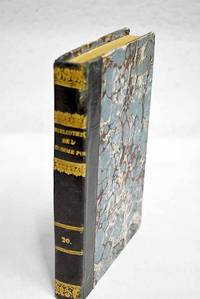
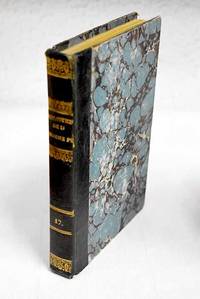
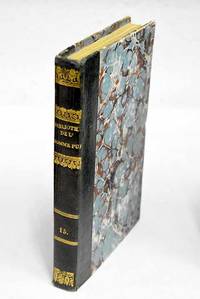
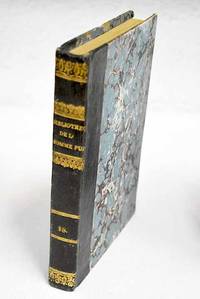
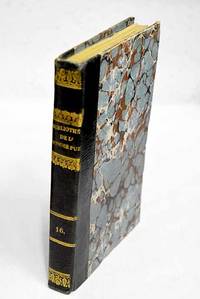
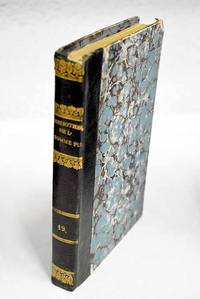
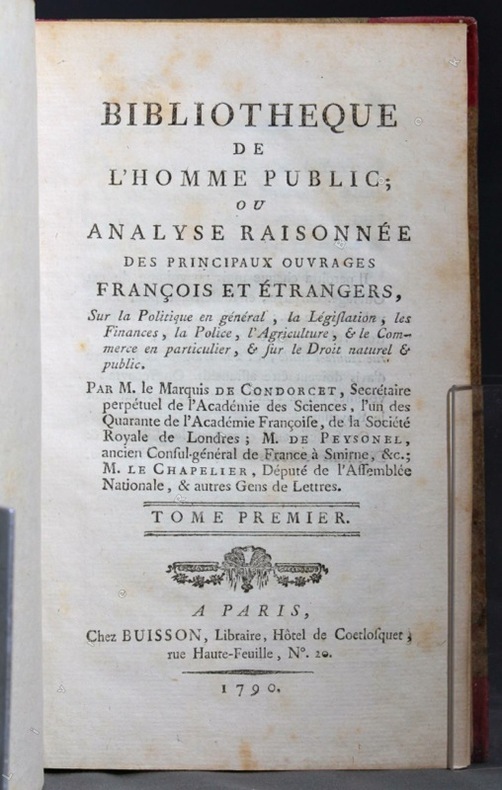
17909307A Paris, chez Buisson, 1790-1791. 24 tomes en 18 volumes petit in-8, demi-vélin teinté rouge à coins, dos lisses ornés de roulettes et filets dorés, étiquettes de titre et tomaison vertes. Reliures un peu frottées, dos légèrement passés, minimes manques à quelques étiquettes, quelques taches au papier des plats, très rares rousseurs, quelques auréoles. A noter que les étiquettes de titre orthographient "public" avec la terminaison -que. Les 12 numéros de la première années sont reliés indépendamment, les 12 de la seconde sont reliés à raison de 2 numéros par volume, sous la même reliure toutefois.
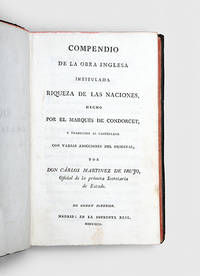
1792164946Madrid: en la Imprenta Real 1792. THE FIRST APPEARANCE OF ADAM SMITH IN SPANISH First Spanish translation of Condorcet's summary of Smith's Wealth of Nations the first appearance of any of his work in Spanish prior to the complete translation by J. A. Ortiz in 1794. The translator of the present summary is the young marqués de Casa Carlos Martinez de Yrujo y Tacón 1763-1824. "This is a translation of the Roucher/Blavet condensation of Wealth of Nations in the Bibliothèque de l'homme publique. to which Condorcet lent his name. The translator restores to the text a summary of Smith's Digression on the Bank of Amsterdam WN IV iii. b 479-88 a five-line qualification of the argument for free trade. The criticism of Catholic clergy is omitted." Tribe. Octavo 174 x 108 mm. Contemporary tree sheep flat spine ruled and decorated in gilt red morocco label marbled endpapers red edges. 19th-century ownership inscription to front free blank leaf extremities lightly rubbed one corner slightly worn; a crisp clean copy in fine condition. Palau 59126; Tribe 47. This edition not listed in Goldsmiths' Kress or Vanderblue. unknown
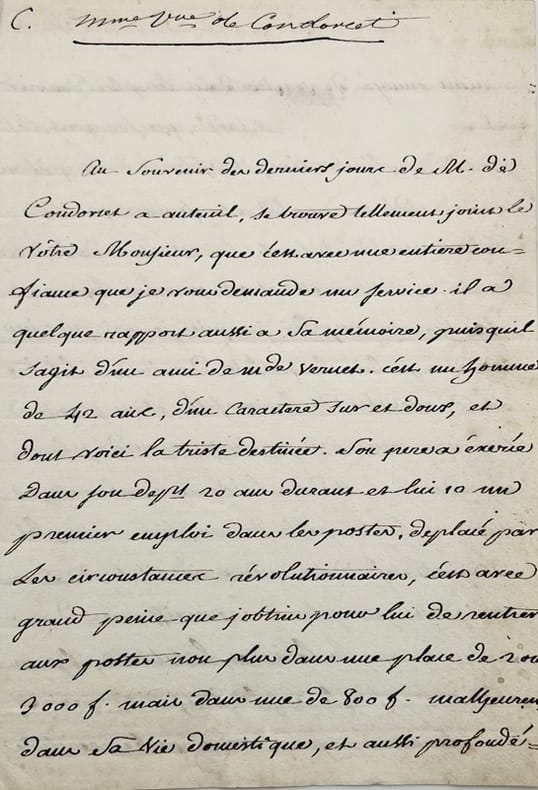
179844332, , 1798-1811. Ensemble 4 lettres autographes signées.
1778263011Paris: Not Identified 1778. hardcover. near fine. Title with ornamental borders; title vignette and ornamental head/tail pieces throughout. Illustrated with a portrait of Pascal engraved by L. Demeuse. XII 316 pages. 8vo handsomely bound in full contemporary mottled calf with gilt decorated spine and marbled page edges. Paris i.e. Geneva: Publisher Not Identified Grasset 1778. Nouvelle edition. Scarce.<br/> <br/> According to BN the imprint is false; this edition was printed in Geneva by Grasset. A reprint of Condorcet's selection from the Pensees. he added to his own notes a selection from the "Remarques sur les Pensees de Pascal" by Voltaire who's notes are signed "Note du present editeur." -- Bengescu 1910; BN 5391. Page 163 is misnumbered 139; page 193 is misnumbered 391.<br/> <br/> Not Identified unknown
1778263011Paris: Not Identified 1778. hardcover. near fine. Title with ornamental borders; title vignette and ornamental head/tail pieces throughout. Illustrated with a portrait of Pascal engraved by L. Demeuse. XII 316 pages. 8vo handsomely bound in full contemporary mottled calf with gilt decorated spine and marbled page edges. Paris i.e. Geneva: Publisher Not Identified Grasset 1778. Nouvelle edition. Scarce.<br/><br/> According to BN the imprint is false; this edition was printed in Geneva by Grasset. A reprint of Condorcet's selection from the Pensees. he added to his own notes a selection from the "Remarques sur les Pensees de Pascal" by Voltaire who's notes are signed "Note du present editeur." -- Bengescu 1910; BN 5391. Page 163 is misnumbered 139; page 193 is misnumbered 391.<br/><br/> Not Identified unknown books
1787x08156<p>A. Padoue 1787. Three volumes. Two volumes of text with plates in the third. 4to. lxxvi 728: 4 979: Complete with 108 plates numbered from 1 to 118 with 10 folding plates receiving a number for each side. Publication dates 1787 1789 1790 respectively. Good. Spines chipped and cracked although hinges still sound. Some dealer prices inked to front endpapers. Hardcover. Good.</p> A. Padoue hardcover
1789R300114703"CHEZ PANCKOUCKE / CHEZ PLOMTEUX. 1789. In-4. Cartonné. Bon état, Couv. convenable, Dos satisfaisant, Intérieur frais. XXVIII + 184 pages - textes sur deux colonnes - reliure d'attente - une étiquette collée sur le dos - une étiquette collée sur le 1er plat ""table des objets"" - 3 photos disponibles.. . . . Classification Dewey : 840.05-XVIII ème siècle"
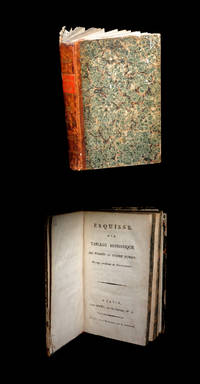
1794245971794. A Paris chez Agasse l'an III de la RÂŽpublique 1794 / 1795. Un vol. au format in-8 198 x 128 mm de viii - 389 pp. Reliure lÂŽgÂrement postÂŽrieure de demi-basane brune dos lisse ornÂŽ de doubles filets dorÂŽs fleurons dorÂŽs piÂce de titre de maroquin cerise titre dorÂŽ tranches marbrÂŽes. Edition originale. ''Texte capital emblÂŽmatique du projet des LumiÂre de son idÂŽologie du progrÂs comme de sa conception de la perfectibilitÂŽ continue de l'esprit humain''. Alde. ''Aussit™t ÂŽlevÂŽe lors de sa publication en l'an III par Mme de Condorcet et Daunou au rang des Ãuvres nationales l'Esquisse est souvent considÂŽrÂŽe pour le contexte tragique qui a entourÂŽ sa composition comme une Ãuvre de circonstance ÂŽcrite quelques mois avant le dÂŽcÂs de son auteur. S'appuyant sur le rationalisme cartÂŽsien l'empirisme de Locke et le sensualisme de Condillac qui fournissent une caution philosophique ˆ la thÂse de la perfectibilitÂŽ humaine l'Esquisse synthÂŽtise la philosophie des LumiÂres et tÂŽmoigne de l'influence exercÂŽe sur Condorcet par le Tableau philosophique des progrÂs successifs de l'esprit humain et le Plan des deux discours sur l'histoire universelle de son ma”tre et ami Turgot.'' Eric Letonturier. ''Les conclusions de Condorcet ressemblent beaucoup ˆ celles des anciens alchimistes ; en ce qu'il admet comme une certitude que l'homme parviendra t™t ou tard ˆ prolonger son existence ˆ des limites invraisemblables''. in Caillet. Brunet II Manuel du libraire et de l'amateur de livres 3650 - Varet II Manuel de bibliographie philosophique p. 502 - Cioranescu I Bibliographie de la littÂŽrature franÂaise du XVIIIÂme 20528 - QuÂŽrard II La France littÂŽraire p. 269 - Caillet I manuel bibliographique des sciences psychiques et occultes 2545 - Dorbon-A”nÂŽ Bibliotheca esoterica 56 pour une ÂŽdition de 1822 - En FranÂais dans le texte 196 - Martin & Walter n¡8083. Coiffes et coupes ÂŽlimÂŽs. Petit manque angulaire au second plat. Dos prÂŽsentant des frottements. Petit dÂŽfaut angulaire affectant le faux-titre. InÂŽgales mais claires rousseurs dans le texte. PrÂŽsence de passages surlignÂŽs accolÂŽs ou annotÂŽs. b42961 unknown
17982060<p>8vo pp. viii 389 1 blank; occasional spotting and marking but never heavy; the odd tear to foot with slight paper loss but never affecting text; final leaf stuck to wrapper but verso blank so with no loss of text; uncut in interim wrappers; wrappers worn but sound spine chipped at head and foot with light dampstain to head and old manuscript paper label.</p><p>First Milan printing uncommon of Condorcet's monumental survey of the history of human endeavour first published posthumously in 1795.</p><p>An 'ouvrage d'un utilité générale et durable' the <em>Esquisse</em> represents a summation of Concordet's thoughts on the notion of human progress and thus can in some ways be seen as a definitive encapsulation of the enlightenment project or at least of one view of it. Condorcet divides his work into ten <em>époques</em> tracing human history from the initial formation of societies through the development of agriculture the invention of writing the intellectual and scientific achievements of classical Greece the progress not uninterrupted of the sciences the invention of printing and the tense relationship between scientific progress and 'the yoke of authority'. Closing with two chapters on the period from Descartes until the French Revolution and on his expectations for future human progress Condorcet demonstrates his optimism: 'Our hopes for the future state of the human species can be reduced to these three important points: the destruction of inequality between nations; the progress of equality within nations; and finally the real perfection of humanity. Are not all nations bound one day to approach the state of civilisation reached by the most enlightened freest least prejudiced of peoples such as the French and the Anglo-Americans' p.328</p><p>Concorcet's work was instantly popular with 1795 printings in Paris and Zürich; it was swiftly translated into English printed in both London and Philadephia and German Tübingen before Zatta in Venice published an Italian translation by Luigi Bossi in 1797. The present edition is the first to be printed in French in Italy.</p><p>Outside Continental Europe OCLC records copies at Connecticut the College of the Holy Cross in Massachusetts and Durham.</p> De l’Imprimerie Italienne et Française à S. Zeno
1795161166Paris: chez Agasse l'an III de la République 1795. History as progress First edition of the finest and most durable expression of the ultimate perfectibility of man perhaps the clearest and boldest statement of the enlightenment belief in progress demonstrating "man's progressive emancipation first from the arbitrary domination of his physical environment and then from the historical bondage of his own making" Encyclopedia of Philosophy II 184. Condorcet wrote the work in 1794 while in hiding from Robespierre's agents having voted against the execution of the king. Captured by the state he was found dead the next day presumed to have taken his own life to escape the guillotine. His manuscript was published the next year. "In the Esquisse. Condorcet traces the history of man through epochs the first three covering his progress from savagery to pastoral community and thence to the agricultural state. The next five span the growth of civilizations and knowledge down to Descartes and the ninth describes the revolution of Condorcet's own lifetime from Newton to Rousseau. The prophetic view of the tenth epoch shows Condorcet at his most original. He forecasts the destruction of inequality between nations and classes and the improvement intellectual moral and physical of human nature" PMM. Octavo 193 x 119 mm. Early 19th-century blue quarter roan smooth spine lettered and tooled in gilt blue mottled sides brown speckled edges. Front pastedown with early 20th-century bookseller's label of Emile Nourry of Paris and bookplate of Caroli Michel. Light rubbing to binding corners worn spotting to contents marginal loss to foot of G2 not affecting text a few peripheral nicks very good. Printing and the Mind of Man 246; En français dans le texte 196; Martin & Walter 1 8083; Quérard II p. 269. unknown
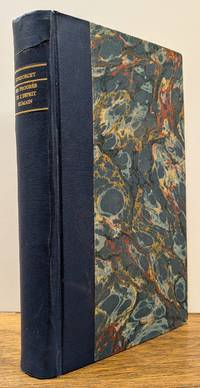
179542119Paris Agasse l'an III de la République une et indivisible 1795. 8vo. Bound in a very nice newer pastiche-binding in full mottled calf. Five raised bands and gilt title-label to spine. A very nice clean fresh and attractive copy. VIII 389 pp. <br/><br/><em>The rare first edition of Condorcet's main work "the most fully developed exposition of the progress of man" Printing and the Mind of Man p. 149 and a main work of the Enlightenment as well as of historical thought in general. The author was the creator of what came to found the basis for the modern French system. The great French philosopher political thinker and mathematician M.J.A. Condorcet 1743 - 1794 played a seminal role in 18th century France. He was friends with the likes of d'Alembert Voltaire Turgot etc. and he greatly contributed to the social and political debates of politically turbulent France. As one of the few he advocated a liberal economy equality in public education as well as in gender and race etc. He preached constitutionalism and his thoughts that are still influential today embody those of the Enlightenment and rationalism."A belief in the ultimate perfectibility of man lies at the root of all progressive thinking about the human condition. The "philosophes" and Godwin had familiarized the reading public with this notion; it was left to Condorcet to give it its finest and most durable expression. It was the gospel of nineteenth century that mankind is destined for indefinite future progress. Condorcet looking back and then forward saw proof of this in the growing equality between classes and nations the intellectual physical and moral improvement of man; and he prophesied that popular education on correct principles would strengthen and assure this progress." PMM 246.During the French Revolution Condorcet came to play a dominating role advocating a rationalist reconstruction of society and he championed many liberal causes. In 1791 he became secretary of the Legislation Assembly and the institution adopted his scheme for comprehensive state education which later became the basis of the modern French system. In the struggle between the two political parties the Girondists and the Montagnards Condorcet occupied an independent role but when he opposed the death penalty under the trial of King Louis XVI still supporting the actual trial and the radical Montagnards gained more power Condorcet was branded a traitor and in October 1793 a warrant was issued for his arrest. He now went into hiding for several months almost a year and it is during these months that he writes the work that was to become his most important the main work "Esquisse." "Sketch for a Historical Picture of the Progress of the Human Mind" which was published posthumously the year after his death. In 1794 Condorcet was arrested and two days later he was found dead in his cell -it is unknown whether he committed suicide or was murdered because of fear of fierce reactions that would definitely have occurred had the beloved man been officially sentenced to the death penalty."In the Esquisse" published after his death Condorcet traces the history of man through epochs the first three covering his progress from savagery to pastoral community and thence to the agricultural state. The next five span the growth of civilizations and knowledge down to Descartes and the ninth describes the revolution of Condorcet's own lifetime from Newton to Rousseau. The prophetic view of the tenth epoch shows Condorcet at his most original. He forecasts the destruction of inequality between nation and classes and the improvement intellectual moral and physical of human nature. it exercised considerable influence on Comte. But it is as the most fully developed exposition of the progress of man that Condorcet's work is now remembered and it is this which has given it its lasting appeal." PMM 246. </em> hardcover
1795Biblio239THE PERFECTIBILITY OF MAN. 8vo. Early half red morocco. Near fine. FIRST EDITION. A distinguished mathematician and friend of Voltaire d'Alembert and Turgot Condorcet played a major role in promoting the Revolution's democratic principles. In the Esquisse An Historical Outline of the Progress of the Human Mind he traces the history of man through ten epochs moving from savagery through the development of civilization and knowledge up to Descartes in the eighth epoch. The ninth epoch spans the Enlightenment from Descartes to the Revolution. For the tenth epoch Condorcet predicts that equality of opportunity will prevail among all classes and nations and that man will improve intellectually morally and physically. "A belief in the ultimate perfectibility of man lies at the root of all progressive thinking about the human condition. The philosophes and Godwin had familiarized the reading public with this notion but it was left to Condorcet to give it its finest and most durable expression. . . . Unlike Godwin he does not preach absolute equality but equality of opportunity" Printing and the Mind of Man 246. A'gasse, L'An III hardcover
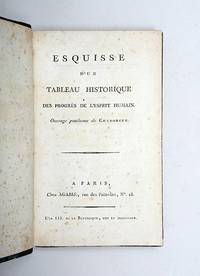
179565358Paris: Chez Agasse 1795. Can Man Become Perfect"<br> <br> CONDORCET Marie Jean Antoine Nicolas Caritat Marquis de. Esquisse d'un tableau historique des progrès de l'esprit humain. Ouvrage posthume de Condorcet. Paris: Chez Agasse L'an III. de la République 1795.<br> <br> First edition of Condorcet's philosophical masterpiece. Octavo 7 7/8 x 4 13/16 inches; 201 x 123 mm. viii 389 1 blank pp.<br> <br> Contemporary quarter calf over dark blue paste-paper boards spine gilt with dotted bands and ornaments gilt red morocco lettering piece. Old owner's signature on half-title. A quarter-inch marginal tear at the bottom of leaf M42 that does not affect the text. Light foxing throughout. A blue ink stain on top edge from signature Z to the end. Overall a clean and attractive copy.<br> <br> "It was the gospel of the nineteenth century that mankind is destined for indefinite future progress. Condorcet 1743-1794 looking back and then forward saw proof of this in the growing equality between classes and nations the intellectual physical and moral improvement of man; and he prophesied that popular education on correct principles would strengthen and assure this progress.In the Esquisse 'An Historical Outline of the Progress of the Human Mind' published after his death Condorcet traces the history of man through epochs the first three covering his progress from savagery to pastoral community and thence to the agricultural state. The next five span the growth of civilizations and knowledge down to Descartes and the ninth describes the revolution of Condorcet's own lifetime from Newton to Rousseau. The prophetic view of the tenth epoch shows Condorcet at his most original. He forecasts the destruction of inequality between nations and classes and the improvement intellectual moral and physical of human nature.it is as the most fully developed exposition of the progress of man that Condorcet's work is now remembered and it is this which has given its lasting appeal" Printing and the Mind of Man.<br> <br> Printing and the Mind of Man 246.<br> <br> HBS 65358.<br> <br> $2000. Chez Agasse unknown
1795168984Paris: Chez Agasse 1795. Second. hardcover. very good. 389pp. 4pp. of advertisments 8vo untrimmed rebound in cloth-backed marbled boards spine neatly repaired. Paris: Chez Agasse L'An III 1795. Second Edition. Very good .<br/> <br/> Printing and the Mind of Man 246; Robinet 382. Considered to be Condorcet's most original and most important work. Considered to be Condorcet's most original and most important work. In it he divided history into ten epochs the first nine dealing with history upto the time in which he himself lived whereas the tenth is his prophetic view of the future. It is the most original part of the book in which Condorcet forecasts among others the future moral intellectual and physical improvement of man. '. PMM<br/> <br/> Chez Agasse unknown
179565358ìCan Man Become Perfectî CONDORCET Marie Jean Antoine Nicolas Caritat Marquis de. Esquisse dÃun tableau historique des progrËs de lÃesprit humain. Ouvrage posthume de Condorcet. Paris: Chez Agasse LÃan III. de la RÈpublique 1795. First edition of CondorcetÃs philosophical masterpiece. Octavo 7 7/8 x 4 13/16 inches; 201 x 123 mm. viii 389 1 blank pp. Contemporary quarter calf over dark blue paste-paper boards spine gilt with dotted bands and ornaments gilt red morocco lettering piece. Old owner's signature on half-title. A quarter-inch marginal tear at the bottom of leaf M42 that does not affect the text. Light foxing throughout. A blue ink stain on top edge from signature Z to the end. Overall a clean and attractive copy. ìIt was the gospel of the nineteenth century that mankind is destined for indefinite future progress. Condorcet 1743-1794 looking back and then forward saw proof of this in the growing equality between classes and nations the intellectual physical and moral improvement of man; and he prophesied that popular education on correct principles would strengthen and assure this progress.In the Esquisse ëAn Historical Outline of the Progress of the Human Mindà published after his death Condorcet traces the history of man through epochs the first three covering his progress from savagery to pastoral community and thence to the agricultural state. The next five span the growth of civilizations and knowledge down to Descartes and the ninth describes the revolution of CondorcetÃs own lifetime from Newton to Rousseau. The prophetic view of the tenth epoch shows Condorcet at his most original. He forecasts the destruction of inequality between nations and classes and the improvement intellectual moral and physical of human nature.it is as the most fully developed exposition of the progress of man that CondorcetÃs work is now remembered and it is this which has given its lasting appealî Printing and the Mind of Man. Printing and the Mind of Man 246. HBS 65358. $2000 Chez Agasse hardcover books
1795168984Paris: Chez Agasse 1795. Second. hardcover. very good. 389pp. 4pp. of advertisments 8vo untrimmed rebound in cloth-backed marbled boards spine neatly repaired. Paris: Chez Agasse L'An III 1795. Second Edition. Very good .<br/><br/> Printing and the Mind of Man 246; Robinet 382. Considered to be Condorcet's most original and most important work. Considered to be Condorcet's most original and most important work. In it he divided history into ten epochs the first nine dealing with history upto the time in which he himself lived whereas the tenth is his prophetic view of the future. It is the most original part of the book in which Condorcet forecasts among others the future moral intellectual and physical improvement of man. '. PMM<br/><br/> Chez Agasse unknown books