526 résultats
20041733217338833Légères piqûres sur jaquette ; GLN-544, Institut National d'Etudes Démographiques, Paris 2004
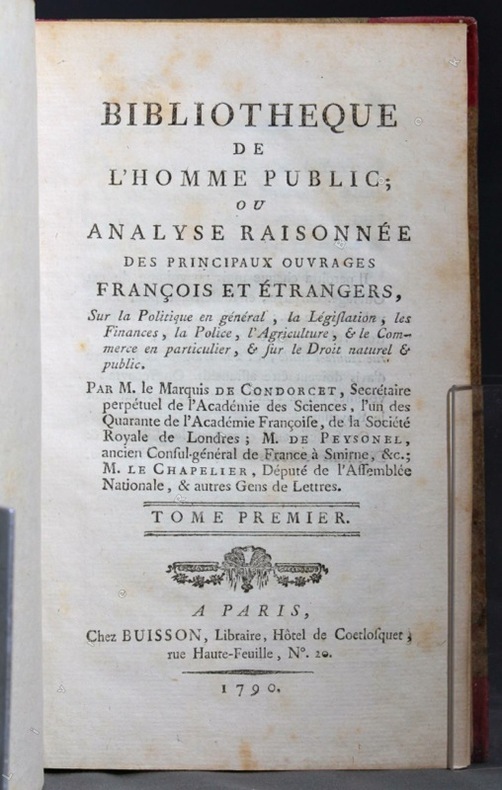
17909307A Paris, chez Buisson, 1790-1791. 24 tomes en 18 volumes petit in-8, demi-vélin teinté rouge à coins, dos lisses ornés de roulettes et filets dorés, étiquettes de titre et tomaison vertes. Reliures un peu frottées, dos légèrement passés, minimes manques à quelques étiquettes, quelques taches au papier des plats, très rares rousseurs, quelques auréoles. A noter que les étiquettes de titre orthographient "public" avec la terminaison -que. Les 12 numéros de la première années sont reliés indépendamment, les 12 de la seconde sont reliés à raison de 2 numéros par volume, sous la même reliure toutefois.
19317107paris Honoré Champion 1931 in8 cartonnage bradel imprimé façon "papier de relieur", pièce de titre cuir vert, titre doré, frontispice, 354 pp, 5 illustrations édition originale, envoi de l'auteur, (80 pp de bibliographie)
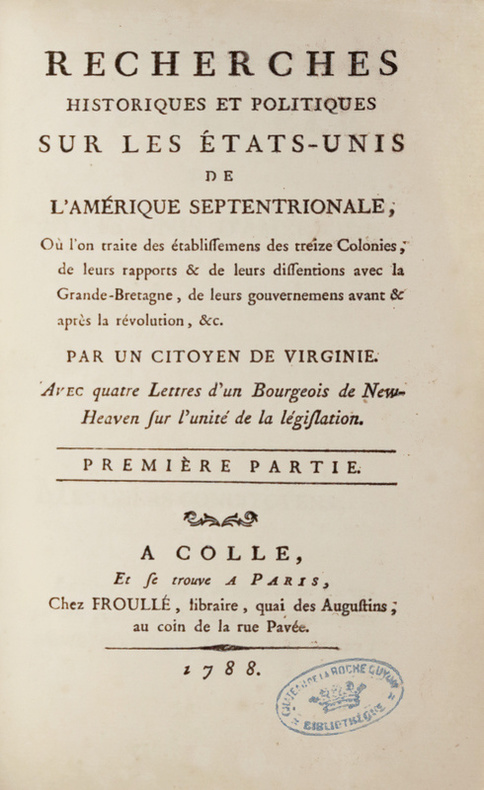
LCS-17450Bel exemplaire provenant du château de la Roche-Guyon, aux armes de Louis-Armand, duc de la Rochefoucauld (1732-1792),traducteur des Constitutions des treize Etats-Unis de l’Amérique. A Colle, et se trouve à Paris, chez Froullé, 1788. 4 tomes en 4 volumes in-8 de : I/ (2) ff., xvi pp., 383 pp., (1) p. d’errata ; II/ (2) ff., 259 pp. ; III/ (2) ff., 292 pp. ; IV/ (2) ff., 366 pp. Cachets de bibliothèque sur les titres. Basane marbrée, encadrement de filet à froid autour des plats, dos lisses ornés de fleurons dorés avec armoiries en tête, étiquettes de bibliothèque en pied des dos, pièces de tomaison en maroquin rouge, coupes décorées, tranches rouges. Quelques usures sans gravité. Reliure de l’époque. 193 x 123 mm.
1978R100066040Imp. l'avenir graphique. 1978. In-8. Broché. Etat d'usage, Couv. légèrement passée, Agrafes rouillées, Intérieur frais. 63 pages agrafées - rousseurs sur les plats.. . . . Classification Dewey : 320-Science politique
2362recueil politique et d’économie sociales qui paraissait sous les auspices et avec le concours de 14 écrivains Patriotes,dont chacun était chargé d’une partie distincte, Clavière avait les finances,Condorcet la législation,et l‘instruction publique,Kersaint la marine et les colonies, Garran de Coulon la jurisprudence etc… à Paris de l’imprimerie du Cercle Social rue du Théâtre n°4 parution de novembre 1791 à juillet 1793 la collection forme 21 recueils.Premier recueil Novembre 1791 an 3 de la liberté 46 pages et titre,deuxième recueil Décembre 1791,troisième recueil janvier 1792 titre et 136 pages,quatrième recueil février 1792 an 4 de la Liberté titre,124 pages,cinquième recueil mars 1792 titre,88 pages Sixièmerecueil Avril 1792 titre, 116 pages,(pâle mouillure en marge extérieure pages 34 à 64),septième recueil Mai 1792 titre et 104 pages (mouillure en marge extérieure pages 89 à 104 sans gravité) huitième recueil juin 1792 titre,100 pages.Dixième recueil août 1792 titre,80 pages,+ intéressant catalogue,onzième recueil septembre 1792 titre et 80 pages plus supplément de 52 pages."du nouvel ordre social"par Henry BANCAL député du Puy de Dôme à la Convention Nationale(avec cette remarque:le supplément de ce cahier ayant été imprimé la nuit,on y a employé par erreur du papier destiné à un autre ouvrage)douzième recueil Octobre 1792 An Premier de la République,treizième recueil Novembre 1792 titre, 106 pages plus 80 pages par Guy KERSAINT député à la Convention "de la Constitution et du Gouvernement qui pourroie convenir à la République Françoise" quatorzième recueil Novembre décembre 1792 titre,72 page.Rarissime réunion de 13 recueils sur 21 devenue très difficile à rencontrer même en recueil isolé. L’ensemble en 4 volumes reliure cartonnée modeste, mais d’époque avec étiquette manuscrite et avec grandes marges "ces recueils contiennent des travaux solides d’un haut intérêt"
1786182171786 un volume, reliure demi-basane havane in-octavo (half binding sheepskin in-8), (23 x 15 cm), reliure tardive (19ème), dos à nerfs (spine with raised bands), décoration or (gilt decoration) à filets or (gilt lines) et mates, filet mate de chaque côté des nerfs, pièce de titre sur fond rouge avec filet or (label of title with gilt line), titre frappé or, papier peigné aux plats (cover with painting paper), toutes tranches non rognées, sans illustrations (no illustration), dos légèrement frotté, [IV]-299-[1] pages, 1786 Londres (sans nom d'Editeur),
179520272A Paris, chez Agasse, l'an III de la République, [1795]. In-8 de [8]-385 pages, demi-basane brune, dos lisse orné de filets et fleurons dorés.
1800ROD0115294PARIS. 1800. In-12. Broché. Etat passable, Plats abîmés, Dos abîmé, Déchirures. 132 pages. Manque en tête sur les 10 premières pages ayant des conséquences sur la lecture. Manque dos.. . . . Classification Dewey : 372.7-Livre scolaire : mathématiques
2009ROD0132686LE MONDE/FLAMMARION. 2009. In-8. Broché. Bon état, Couv. convenable, Dos satisfaisant, Intérieur frais. 247 pages - annotations à l'encre sur la page de titre.. . . . Classification Dewey : 300-SCIENCES SOCIALES
19885186Flammarion 1988 352 pages poche. 1988. broché. 352 pages.
QWA-2887Paris, Ponthieu, 1824, XII-363 p., in-8 rel. 1/2 peau, tome 1 seul, dos frotté et épidermé, coiffe inférieure endommagée, rousseurs éparses, état moyen
17913304771Paris.: Buisson. 1791. Hardcover. Cubierta deslucida. Good. 19 cm. 280 p. Encuadernación en tapa dura artesanal lomo en piel. Idioma francés . Cubierta deslucida. Buisson. hardcover
17913304768Paris.: Buisson. 1791. Hardcover. Cubierta deslucida. Good. 19 cm. 260 p. Encuadernación en tapa dura artesanal lomo en piel. Idioma francés . Cubierta deslucida. Buisson. hardcover
17913304766Paris.: Buisson. 1791. Hardcover. Cubierta deslucida. Good. 19 cm. 262 p. Encuadernación en tapa dura artesanal lomo en piel. Idioma francés . Cubierta deslucida. Buisson. hardcover
17913304769Paris.: Buisson. 1791. Hardcover. Cubierta deslucida. Good. 19 cm. 268 p. Encuadernación en tapa dura artesanal lomo en piel. Idioma francés . Cubierta deslucida. Buisson. hardcover
17913304767Paris.: Buisson. 1791. Hardcover. Cubierta deslucida. Good. 19 cm. 264 p. Encuadernación en tapa dura artesanal lomo en piel. Idioma francés . Cubierta deslucida. Buisson. hardcover
17913304770Paris.: Buisson. 1791. Hardcover. Cubierta deslucida. Good. 19 cm. 270 p. Encuadernación en tapa dura artesanal lomo en piel. Idioma francés . Cubierta deslucida. Buisson. hardcover
8471124432.Gpaperback. Good. Access codes and supplements are not guaranteed with used items. May be an ex-library book. paperback
0274861364.Gpaperback. Good. Access codes and supplements are not guaranteed with used items. May be an ex-library book. paperback
0274861372.Ghardcover. Good. Access codes and supplements are not guaranteed with used items. May be an ex-library book. hardcover
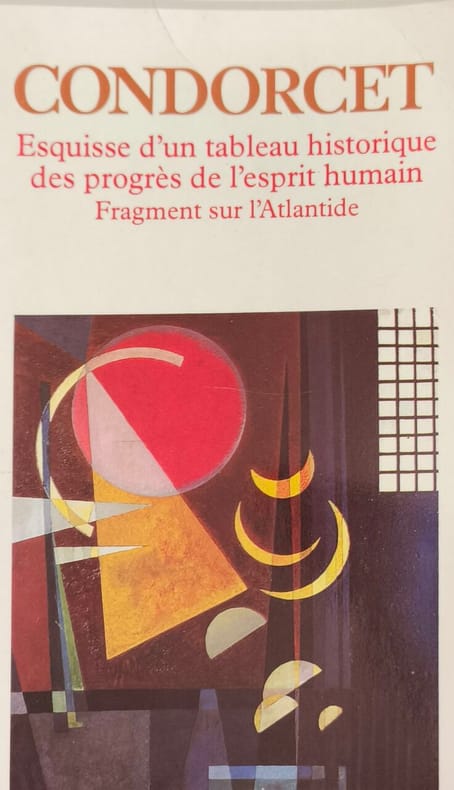
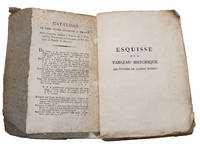
17982060<p>8vo pp. viii 389 1 blank; occasional spotting and marking but never heavy; the odd tear to foot with slight paper loss but never affecting text; final leaf stuck to wrapper but verso blank so with no loss of text; uncut in interim wrappers; wrappers worn but sound spine chipped at head and foot with light dampstain to head and old manuscript paper label.</p><p>First Milan printing uncommon of Condorcet's monumental survey of the history of human endeavour first published posthumously in 1795.</p><p>An 'ouvrage d'un utilité générale et durable' the <em>Esquisse</em> represents a summation of Concordet's thoughts on the notion of human progress and thus can in some ways be seen as a definitive encapsulation of the enlightenment project or at least of one view of it. Condorcet divides his work into ten <em>époques</em> tracing human history from the initial formation of societies through the development of agriculture the invention of writing the intellectual and scientific achievements of classical Greece the progress not uninterrupted of the sciences the invention of printing and the tense relationship between scientific progress and 'the yoke of authority'. Closing with two chapters on the period from Descartes until the French Revolution and on his expectations for future human progress Condorcet demonstrates his optimism: 'Our hopes for the future state of the human species can be reduced to these three important points: the destruction of inequality between nations; the progress of equality within nations; and finally the real perfection of humanity. Are not all nations bound one day to approach the state of civilisation reached by the most enlightened freest least prejudiced of peoples such as the French and the Anglo-Americans' p.328</p><p>Concorcet's work was instantly popular with 1795 printings in Paris and Zürich; it was swiftly translated into English printed in both London and Philadephia and German Tübingen before Zatta in Venice published an Italian translation by Luigi Bossi in 1797. The present edition is the first to be printed in French in Italy.</p><p>Outside Continental Europe OCLC records copies at Connecticut the College of the Holy Cross in Massachusetts and Durham.</p> De l’Imprimerie Italienne et Française à S. Zeno
2322543829.Gpaperback. Good. Access codes and supplements are not guaranteed with used items. May be an ex-library book. paperback
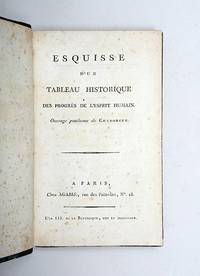
1795161166Paris: chez Agasse l'an III de la République 1795. History as progress First edition of the finest and most durable expression of the ultimate perfectibility of man perhaps the clearest and boldest statement of the enlightenment belief in progress demonstrating "man's progressive emancipation first from the arbitrary domination of his physical environment and then from the historical bondage of his own making" Encyclopedia of Philosophy II 184. Condorcet wrote the work in 1794 while in hiding from Robespierre's agents having voted against the execution of the king. Captured by the state he was found dead the next day presumed to have taken his own life to escape the guillotine. His manuscript was published the next year. "In the Esquisse. Condorcet traces the history of man through epochs the first three covering his progress from savagery to pastoral community and thence to the agricultural state. The next five span the growth of civilizations and knowledge down to Descartes and the ninth describes the revolution of Condorcet's own lifetime from Newton to Rousseau. The prophetic view of the tenth epoch shows Condorcet at his most original. He forecasts the destruction of inequality between nations and classes and the improvement intellectual moral and physical of human nature" PMM. Octavo 193 x 119 mm. Early 19th-century blue quarter roan smooth spine lettered and tooled in gilt blue mottled sides brown speckled edges. Front pastedown with early 20th-century bookseller's label of Emile Nourry of Paris and bookplate of Caroli Michel. Light rubbing to binding corners worn spotting to contents marginal loss to foot of G2 not affecting text a few peripheral nicks very good. Printing and the Mind of Man 246; En français dans le texte 196; Martin & Walter 1 8083; Quérard II p. 269. unknown