Condorcet, Jean-Antoine NicolasBiblio.com

526 résultats
2019698447.Gpaperback. Good. Access codes and supplements are not guaranteed with used items. May be an ex-library book. paperback
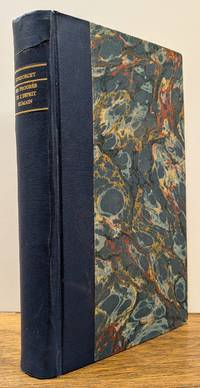
179542119Paris Agasse l'an III de la République une et indivisible 1795. 8vo. Bound in a very nice newer pastiche-binding in full mottled calf. Five raised bands and gilt title-label to spine. A very nice clean fresh and attractive copy. VIII 389 pp. <br/><br/><em>The rare first edition of Condorcet's main work "the most fully developed exposition of the progress of man" Printing and the Mind of Man p. 149 and a main work of the Enlightenment as well as of historical thought in general. The author was the creator of what came to found the basis for the modern French system. The great French philosopher political thinker and mathematician M.J.A. Condorcet 1743 - 1794 played a seminal role in 18th century France. He was friends with the likes of d'Alembert Voltaire Turgot etc. and he greatly contributed to the social and political debates of politically turbulent France. As one of the few he advocated a liberal economy equality in public education as well as in gender and race etc. He preached constitutionalism and his thoughts that are still influential today embody those of the Enlightenment and rationalism."A belief in the ultimate perfectibility of man lies at the root of all progressive thinking about the human condition. The "philosophes" and Godwin had familiarized the reading public with this notion; it was left to Condorcet to give it its finest and most durable expression. It was the gospel of nineteenth century that mankind is destined for indefinite future progress. Condorcet looking back and then forward saw proof of this in the growing equality between classes and nations the intellectual physical and moral improvement of man; and he prophesied that popular education on correct principles would strengthen and assure this progress." PMM 246.During the French Revolution Condorcet came to play a dominating role advocating a rationalist reconstruction of society and he championed many liberal causes. In 1791 he became secretary of the Legislation Assembly and the institution adopted his scheme for comprehensive state education which later became the basis of the modern French system. In the struggle between the two political parties the Girondists and the Montagnards Condorcet occupied an independent role but when he opposed the death penalty under the trial of King Louis XVI still supporting the actual trial and the radical Montagnards gained more power Condorcet was branded a traitor and in October 1793 a warrant was issued for his arrest. He now went into hiding for several months almost a year and it is during these months that he writes the work that was to become his most important the main work "Esquisse." "Sketch for a Historical Picture of the Progress of the Human Mind" which was published posthumously the year after his death. In 1794 Condorcet was arrested and two days later he was found dead in his cell -it is unknown whether he committed suicide or was murdered because of fear of fierce reactions that would definitely have occurred had the beloved man been officially sentenced to the death penalty."In the Esquisse" published after his death Condorcet traces the history of man through epochs the first three covering his progress from savagery to pastoral community and thence to the agricultural state. The next five span the growth of civilizations and knowledge down to Descartes and the ninth describes the revolution of Condorcet's own lifetime from Newton to Rousseau. The prophetic view of the tenth epoch shows Condorcet at his most original. He forecasts the destruction of inequality between nation and classes and the improvement intellectual moral and physical of human nature. it exercised considerable influence on Comte. But it is as the most fully developed exposition of the progress of man that Condorcet's work is now remembered and it is this which has given it its lasting appeal." PMM 246. </em> hardcover
1795Biblio239THE PERFECTIBILITY OF MAN. 8vo. Early half red morocco. Near fine. FIRST EDITION. A distinguished mathematician and friend of Voltaire d'Alembert and Turgot Condorcet played a major role in promoting the Revolution's democratic principles. In the Esquisse An Historical Outline of the Progress of the Human Mind he traces the history of man through ten epochs moving from savagery through the development of civilization and knowledge up to Descartes in the eighth epoch. The ninth epoch spans the Enlightenment from Descartes to the Revolution. For the tenth epoch Condorcet predicts that equality of opportunity will prevail among all classes and nations and that man will improve intellectually morally and physically. "A belief in the ultimate perfectibility of man lies at the root of all progressive thinking about the human condition. The philosophes and Godwin had familiarized the reading public with this notion but it was left to Condorcet to give it its finest and most durable expression. . . . Unlike Godwin he does not preach absolute equality but equality of opportunity" Printing and the Mind of Man 246. A'gasse, L'An III hardcover
179565358Paris: Chez Agasse 1795. Can Man Become Perfect"<br> <br> CONDORCET Marie Jean Antoine Nicolas Caritat Marquis de. Esquisse d'un tableau historique des progrès de l'esprit humain. Ouvrage posthume de Condorcet. Paris: Chez Agasse L'an III. de la République 1795.<br> <br> First edition of Condorcet's philosophical masterpiece. Octavo 7 7/8 x 4 13/16 inches; 201 x 123 mm. viii 389 1 blank pp.<br> <br> Contemporary quarter calf over dark blue paste-paper boards spine gilt with dotted bands and ornaments gilt red morocco lettering piece. Old owner's signature on half-title. A quarter-inch marginal tear at the bottom of leaf M42 that does not affect the text. Light foxing throughout. A blue ink stain on top edge from signature Z to the end. Overall a clean and attractive copy.<br> <br> "It was the gospel of the nineteenth century that mankind is destined for indefinite future progress. Condorcet 1743-1794 looking back and then forward saw proof of this in the growing equality between classes and nations the intellectual physical and moral improvement of man; and he prophesied that popular education on correct principles would strengthen and assure this progress.In the Esquisse 'An Historical Outline of the Progress of the Human Mind' published after his death Condorcet traces the history of man through epochs the first three covering his progress from savagery to pastoral community and thence to the agricultural state. The next five span the growth of civilizations and knowledge down to Descartes and the ninth describes the revolution of Condorcet's own lifetime from Newton to Rousseau. The prophetic view of the tenth epoch shows Condorcet at his most original. He forecasts the destruction of inequality between nations and classes and the improvement intellectual moral and physical of human nature.it is as the most fully developed exposition of the progress of man that Condorcet's work is now remembered and it is this which has given its lasting appeal" Printing and the Mind of Man.<br> <br> Printing and the Mind of Man 246.<br> <br> HBS 65358.<br> <br> $2000. Chez Agasse unknown
1248A Paris: Chez Agasse An V 1797. Hardcover. Good. Octavo. viii 392pp. 4 A8-Z8 Aa8 Bb4. Half-title present. Third edition published by Sophie Condorcet and Daunou. Later quarter calf over boards by GKB Pynaker Bookbinders at the Hague with their small bookplate. A. Martin & G. Walter Catalogue de l'histoire de la Révolution Française 8083. <br/> <br/> A Paris: Chez Agasse, An V (1797). hardcover
1795168984Paris: Chez Agasse 1795. Second. hardcover. very good. 389pp. 4pp. of advertisments 8vo untrimmed rebound in cloth-backed marbled boards spine neatly repaired. Paris: Chez Agasse L'An III 1795. Second Edition. Very good .<br/> <br/> Printing and the Mind of Man 246; Robinet 382. Considered to be Condorcet's most original and most important work. Considered to be Condorcet's most original and most important work. In it he divided history into ten epochs the first nine dealing with history upto the time in which he himself lived whereas the tenth is his prophetic view of the future. It is the most original part of the book in which Condorcet forecasts among others the future moral intellectual and physical improvement of man. '. PMM<br/> <br/> Chez Agasse unknown
1108077994.Gpaperback. Good. Access codes and supplements are not guaranteed with used items. May be an ex-library book. paperback
178566958Paris: De k'Imprimerie Royale 1785. The First Large-Scale Attempt to Apply Mathematics to Knowledge of Human Phenomena"<br> <br> CONDORCET Marie Jean Antoine Nicolas Caritat Marquis de. Essai sur l'application de l'analyse à la probabilité des décisions rendues à la pluralité des voix. Paris: De l'Imprimerie Royale 1785.<br> <br> First edition. Quarto. 2 cxci 1 blank 304 pp. Decorative woodcut head- and tail-pieces.<br> <br> Contemporary French mottled calf spine decorated in gilt with five raised bands. Marbled endpapers all edges red. First and last few pages browned at edges . gathering K is browned a Q and 2G is toned. Otherwise very good and very scarce.<br> <br> "Condorcet's most significant and fruitful endeavor was in a field entirely new at the time. The subject was one that departed from the natural sciences and mathematics but nevertheless showed the way toward a scientific comprehension of human phenomena taking the empirical approach of natural science as its inspiration and employing mathematics as its tool. Condorcet called this new science 'social mathematics.' It was apparently intended to comprise.a statistical description of society a theory of political economy inspired by the Physiocrats and a combinatorial theory of intellectual processes. The great work on the voting process published in 1785 is related to the latter. Condorcet there sought to construct a scheme for an electoral body the purpose of which would be to determine the truth about a given subject by the process of voting and in which each elector would have the same chance of voicing the truth.No doubt the results obtained in the Essai d'application de l'analyse were modest ones. 'In almost all cases' Condorcet said 'the results are in conformity with what simple reason would have dictated; but it is so easy to obscure reason by sophistry and vain subtleties that I should feel rewarded if I had only founded a single useful truth on a mathematical demonstration' Essai p. ii. One must nevertheless recognize in this work.the first large-scale attempt to apply mathematics to knowledge of human phenomena" D.S.B.<br> <br> Brunet VI col. 472.<br> <br> HBS 66958.<br> <br> $7500. De k'Imprimerie Royale unknown
3050044616.Ghardcover. Good. Access codes and supplements are not guaranteed with used items. May be an ex-library book. hardcover
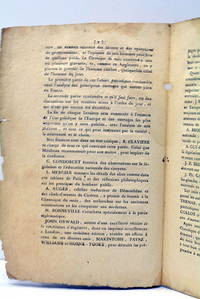
67764A la fin: Paris Imprimerie du Cercle Social 1791. 4 pages. 23x145 Cm. Broché. Rarissime prospectus de parution de ce célèbre périodique paru entre 1791 et 1793. On y trouve la philosophie de la publication la rubrique assurée par chaque auteur les conditions d'abonnement etc. Petits manques. Taches et rousseurs. (A la fin:) Paris, Imprimerie du Cercle Social (1791). unknown
1024118274.Ghardcover. Good. Access codes and supplements are not guaranteed with used items. May be an ex-library book. hardcover
027486133X.Ghardcover. Good. Access codes and supplements are not guaranteed with used items. May be an ex-library book. hardcover
0274861321.Gpaperback. Good. Access codes and supplements are not guaranteed with used items. May be an ex-library book. paperback
1774127684Paris: Chez Couturier père 1774 but 1775. First edition of Condorcet's defence of the free trade of grain. Turgot's liberalisation of the grain trade in 1774 coinciding with bad harvests and rocketing prices led to a fierce pamphlet war between proponents of the mercantilist and free trade schools of thought. Condorcet had written the present tract prior to Turgot's enactment of the policy perhaps to anticipate it but the work was not published until April 1775 in the midst of the troubles and the month before the outbreak of bread riots in Paris. Condorcet would elaborate his ideas further in his 1776 treatise Réflexions sur le commerce des bleds the year in which Turgot was dismissed and liberalisation of the grain trade scaled back. Octavo 181 x 118 mm. Recent marbled boards black calf label. Half-title present. Some offsetting from type a few minor creases discreet repair to tear on p. 8 else a very good copy. INED 1171 bis; Kress 7003. Williams Condorcet and Modernity p. 19. hardcover
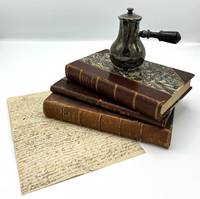
17801756c.1780-1800. French silver coffee pot with turned ebony side-handle 12.5cm in height with engraved inscription to the front: "Cafetière de la Marquise de Condorcet / donnée à Claude Fauriel / léguée à Madame Mary de Mohl / 120 Rue du Bac Paris" "Coffee pot belonging to the Marquise de Condorcet / given to Claude Fauriel / bequeathed to Madame Mary de Mohl / 120 rue du Bac Paris". Stamped maker's mark and hallmarks to the base and lid. The coffee pot's ebony handle has an old somewhat crude glue repair where it joins the silver pot there are possible old repairs to the silver base of the handle and to the base of the spout as well as a few minor dents to the body otherwise it is in good condition and presents well. </p><p>With: A closely-written 2pp. manuscript letter in French from Mary Clarke to Claude Furiel dated August 1829 with a later typed English translation. The letter with a 1cm tear to the foot some splitting along the folds and scattered foxing.</p><p>And three books comprising: </p><p>1 Mohl Ottmar de: Correspondance de Fauriel et Mary Clarke. Paris: Plon-Nourrit et Cie. 1911. Author's own copy with his armorial bookplate to the front pastedown. First edition. Octavo. Contemporary binding by Victor Wächter of Cairo Egypt of half brown sheep over marbled boards ruled in gilt the spine ruled and with titles in gilt. Marbled endpapers. Original blue paper upper wrapper with printed titles bound-in. Illustrated with a photogravure frontispiece of Clarke with tissue guard and two further portraits of Fauriel and Julius Mohl. pp. 6 iii 1 403. A very good copy the binding firm with a little rubbing to the joints. The contents with some minor spots of worming to the front hinge and occasional light foxing are otherwise in good order. The book is accompanied by a group of contemporary press cuttings reviewing the work.</p><p>2 Galley J. B.: Claude Fauriel Membre de l'Institut 1772-1843. Saint-Étienne: Loire Républicaine. 1909. Ottmar von Mohl's copy with his armorial bookplate to the front pastedown. First edition. Octavo. Contemporary binding by Victor Wächter of Cairo Egypt of half brown sheep over green cloth boards the spine with five raised bands ruled and titled in gilt. Marbled endpapers. pp. xxiv 512. A good copy the binding firm with heavy rubbing to the joints and fading and a few scuffs to the spine. The contents with the occasional spot minor mark or spot of foxing are otherwise in good order.</p><p>3 ROD. Ed.: Le Roman de Claude Fauriel et de Mary Clarke. Lettres d'Amour de 1822 a 1844. Three instalments excerpted from an unidentified journal "La Revue". 1909. Ottmar von Mohl's copy with his armorial bookplate to the front pastedown. Octavo. Contemporary binding by Victor Wächter of Cairo Egypt of half brown sheep over marbled boards ruled in gilt the spine with titles in gilt. Marbled endpapers. pp. 551-587; 832-862; 131-161. A very good copy the binding firm with rubbing to the joints and few scuffs to the spine. The contents with toning light scattered foxing and the occasional finger-mark are otherwise in good order. An evocative artefact in the form of a silver coffee pot connecting two of most significant female-intellectual salon hostesses of the late eighteenth and early nineteenth centuries. Originally owned by the philosopher author and influential public figure Sophie Madame de Condorcet 1764-1822 the coffee pot was subsequently bequeathed to her lover the historian philologist and critic Claude Charles Fauriel 1772-1844 who then gifted it to his intimate friend the feminist intellectual Mary Clarke 1793-1883.</p><p>Following her marriage to the French Enlightenment philosopher political economist politician and mathematician the Marquis de Condorcet 1743-1794 in 1786 Sophie de Grouchy now Madame de Condorcet began hosting what would become one of the most significant salons of the revolutionary period. Commencing in 1789 the salon ran until 1793 when it was halted by the reign of terror and the proscription and death of the Marquis resuming again uninterrupted from 1799 to 1822. More egalitarian than her fellow-Girondist hostess Madame Roland Condorcet did not discriminate on the basis of class or social origins and always welcomed other women into her salon along with a host of notable visitors including Thomas Jefferson Adam Smith and Germaine de Staël. The salon also played a particularly notable role in the promotion of women's rights with Condorcet allowing the Cercle Social - an association with the goal of equal political and legal rights for women - to meet in her home; Olympe de Gouges author of the "Declaration of the Rights of Woman and of the Female Citizen" 1791 being prominent amongst its members. Scholars have also argued that Sophie de Condorcet's own concern with female emancipation was responsible for her husband's arguments for greater rights for women most famously expressed in his essay "Sur l'admission des femmes au droit de cité" 1790. Beyond her role as a salon hostess Condorcet also penned the philosophical work "Lettres sur la Sympathie" which she appended to her 1798 translation of Adam Smith's "Theory of Moral Sentiments".</p><p>Claude Charles Fauriel a dedicated republican was a regular attendee at Condorcet's salon having been introduced to such intellectual circles by Madame de Staël particularly the group centred around Antoine Destutt de Tracy and the "idéologues". He began a relationship with Condorcet in 1801 living openly with her until her death in 1822. Fauriel met Mary Clarke that same year with the pair quickly developing a romantic attachment although this ultimately developed instead into an intimate friendship.</p><p>Born into a family of progressive intellectual women Mary Clarke moved from Westminster to Paris with her mother and grandmother at the age of eight. By her twenties initially via her friend the French socialite Juliette Récamier she had become a well-known figure at the heart of Parisian intellectual and literary life and was acquainted with writers including Stendhal Victor Hugo Prosper Merimee Chateaubriand and Alessandro Manzoni. In 1838 she established her salon in rooms that she rented above the home of Chateaubriand in a third floor apartment at 120 Rue du Bac in the Saint-Germain district. Here for more than forty years her home became an intellectual centre in Paris where she hosted all manner of writers thinkers aristocrats diplomats and politicians additionally offering a home-from-home for Anglophone foreigners such as William Thackeray the Brownings and the Trollopes. It was here that Clarke also cultivated a number of friendships with other distinguished female authors thinkers and activists including George Eliot Lady Augusta Stanley Elizabeth Gaskell and most intensely Florence Nightingale with whom she shared a close lifelong friendship. In her mid-fifties she married the German orientalist Julius von Mohl 1800-1876 whose nephew Ottmar von Mohl 1846-1922 a German diplomat and government adviser in Meiji period Japan ultimately published Clarke and Fauriel's correspondence and via whom the present collection descended. Between 1897 and 1917 von Mohl served as a German delegate to the Egyptian National Debt Commission in Cairo hence the Egyptian binder's labels in the three books.</p><p>In the present typically full letter by Clarke - which she notes with pleasing detail was written whilst her beloved cat sits upon her lap - she makes reference to her travels between Paris Brussels and England as well as politics religion her current reading and the pair's own intellectual and literary endeavours as well as mentioning the activities of various friends and associates including the physicist and mathematician André-Marie Ampère 1775-1836 statesman and later Prime Minister of France François Guizot 1787-1874 and historian Augustin Thierry 1795-1856. Writing in a forthright style she is unafraid to commence the letter with a rebuke to Fauriel for apparently requiring encouragement from another friend to reply promptly to her letters: "Madam Arconati is very kind and has more capacity for affection in her little finger than the entire male race has in their whole bodies".</p><p>The present coffee pot was left by Sophie de Condorcet to Fauriel in her will as part of a larger generous inheritance which is reproduced in one of the accompanying books noted in a more intimate line: "I bequeath and give to Mr. Claude Fauriel named above my small silver coffee pot the few pieces of furniture and books that will be found at the time of my death mixed with his in Paris and Meulan". Galley p.275. It was likely engraved with its present inscription later in Clarke's own lifetime following her marriage bearing her final address of 120 Rue du Bac.</p><p>Coffee of course formed part of the life-blood of convivial salon culture as it similarly did in the English coffeehouse; the present coffee pot which passed through the hands of two prominent public female intellectuals who served as leading salon hostesses of the period thus carries a strong symbolism which as the proud inscription attests was likely not lost on Mary Clarke. Considering the varied and illustrious nature of those who passed through Condorcet's and Clarke's salons it is tempting to imagine who may have poured their coffee from this distinguished little pot.</p><p>Provenance: Sophie Marquise de Condorcet; bequeathed to Claude Charles Fauriel 1822; bequeathed to Mary Elizabeth Clarke 1844; the collection of Clarke's nephew and the editor of her correspondence Ottmar von Mohl 1846-1922. hardcover
1780136971No place no publisher 1780. First edition of Condorcet's attack on the corps of engineers responsible for France's major canal building projects. Turgot looking to finish the large and ambitious Picardy and Burgundy canal systems placed Condorcet in charge of experimental research on canals. "Condorcet's research was instrumental in demonstrating the flaws in existing proposals for the tunnels for the new canals whose design would have made it impossible for boats to pass through. In the course of the demonstration a whole new branch of physics was invented. Apart from technical issues Condorcet also soon found himself immersed in research of a more sociological nature in Flanders and Picardy on the impact of the new canals on local communities. This resulted in an angry report to Turgot published in 1780 as the Mémoire sur le canal de Picardie in which the corps of engineers and the inadequacies of their professional training were strongly criticised" Williams p. 21. Octavo 194 x 120 mm. Disbound. Contemporary note of Condorcet's authorship to title page. Slight loss at bottom fore corner of pp. 11-14 not near text contents clean; very good. David Williams Condorcet and Modernity 2004. unknown
1334803226.Gpaperback. Good. Access codes and supplements are not guaranteed with used items. May be an ex-library book. paperback
DADAX0274483637Wentworth Press 2018-08-01. hardcover. New. 6.14x1.44x9.21. Buy with confidence. Excellent Customer Service & Return policy. Wentworth Press hardcover
2019301334.Gpaperback. Good. Access codes and supplements are not guaranteed with used items. May be an ex-library book. paperback
2019324326.Gpaperback. Good. Access codes and supplements are not guaranteed with used items. May be an ex-library book. paperback
1796054673Philadelphia: Lang and Ustick 1796. No Statement of Printing. . Hardcover. Good/No Dust Jacket. A Good copy in rubbed/scuffed full brown leather with red leather spine label. Lacks the blank front endpaper. Some listings show a frontispiece but this copy does not have one. The first sheet is a half title page with title only followed by the title page and Contents pages.There are two blank endpapers at the rear. The binding is sound and the text is clean/unmarked. Not ex-library. <br/> <br/> Lang and Ustick hardcover
0578016664.Gpaperback. Good. Access codes and supplements are not guaranteed with used items. May be an ex-library book. paperback
1015591310.Ghardcover. Good. Access codes and supplements are not guaranteed with used items. May be an ex-library book. hardcover
1385746270.Ghardcover. Good. Access codes and supplements are not guaranteed with used items. May be an ex-library book. hardcover