Fourier, CharlesBiblio.com

951 résultats
2013098383.Gpaperback. Good. Access codes and supplements are not guaranteed with used items. May be an ex-library book. paperback
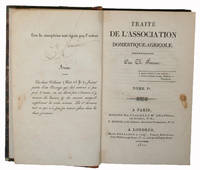
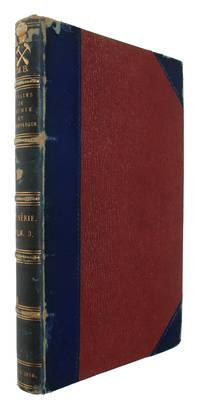
182248285Paris Bossange père; Londres Martin Bossange et Comp. 1822 & 1823. 8vo. Traité: Two lovely contemporary uniform half calf bindings with gilding and blindstamped ornamentations to spines. "E. C." in gilt lettering to top of spine on both volumes Sommaire: a bit later red half cloth with marbled paper over boards. Gilt title to spine. Traité: signed by the author on verso of half-title in vol. 1: "Ch Fourier". Title-page of vol. 1 with a small light brown stain probably candle-starin far from affecting lettering. Both volumes in lovely condition with only very light occassional brownspoting. LXXX 592 pp.; VIII 648 pp. Sommaire: Title-page slightly browned evenly. Otherwise very nice clean and fresh. 16 pp pp. 1329 -1448 4 ff. = A8 unnumbered - on two leaves first recto and second verso blank B8 C8 D8 E8.A lovely set. <br/><br/><em>Scarce first edition of Fourier's milestone work of political theory which is considered a founding work of Utopian Socialism and a main inspiration for Marx. The work which contains "the essence of Fourier's doctrine" David Owen Evans Social Romanticism in France 1830-1848 p. 129. is here presented together with the exceedingly rare complete supplement which was published the following year.It is in the "Traité." that Fourier presents the revolutionary ideas that Marx were to adopt and use in his "Kapital" namely the theory of poverty and exploitation and its relation to the means of production. These same ideas are those that made Marx speak of Fourier's "Gargantuan view of man".It is due to the "Traité de l'association" that Fourier is considered one of the founding fathers of Utopian Socialism being by far the most utopian of them; in his quest for a more equal society he became one of the very first to defend things such as same-sex sexuality and the rights of women - in fact it is Fourier that later coins the word "Feministe" while stating that the position of women in society was equal to that of slaves. Many of his publications preceded those of de Saint-Simon Owens and Marx but his ideas seemed to find greater influence when interpreted by others. Due to the lack of success of the "Traité" Fourier decided the following year to publish the "Sommaire" in an attempt to draw attention to his revolutionary ideas in the "Traité". The "Sommaire" constitutes a short more easily understood summary though also containing some additional new work. The "Sommaire" is often referred to as "The Appendix" to the "Traité" and is considered as belonging to that work. One of the central themes of the work is the thought of "harmony": "The word harmonisme - here fully explained and described for the first time - was first applied to the highest of the passions or motives of humankind; then as a synonym for Harmonie to the ultimate stage of social evolution. The fortunate inhabitants of the perfected world he called harmoniens a word coined in the present work. These words were duly translated by the Fourierites of other lands. Harmony the Harmonic state Harmonization or integral contrasted association were the terms used in the earliest English translations in 1841 to describe Fourier's proposed social system; and Harmonism was employed in the 1850's. The inhabitants were spoken of as Harmonians; and Fourier's philosophy as a whole was sometimes described as the Harmonian Doctrine. Even the word harmonious was called into service as a technical term one English disciple writing of a Harmonious Phalanx." Bestor The Evolution of the Socialist Vocabulary p. 264.Charles Fourier claimed to find inspiration in the exorbitant price of an apple in a Parisian restaurant and he convinced himself that he could design a more efficient way to produce and deliver goods. Unlike other socialists of his day Fourier believed that the pursuit of self interest served as an effective incentive to productive work. He simply did not believe that the market economy of his day successfully mobilized the pursuit of self interest for the common good and he was offended by the low productivity of labor. He argued that most people were employed in deadening jobs that failed to fully utilize their energies and that nearly two thirds of all workers were performing virtually useless tasks. A more efficient economic organization promised enormous benefits to all if only a benefactor capitalist would advance the money necessary to set up the first community or ''phalanstery''.Phalanxes structures called Phalanstères or "grand hotels" were four level apartment complexes where the richest had the uppermost apartments and the poorest occupied the ground floor residence. Wealth was determined by one's job jobs were assigned based on the interests and desires of the individual. There were incentives: jobs people might not enjoy doing would receive higher pay. Fourier considered trade which he associated with Jews to be the "source of all evil" and advocated that Jews be forced to perform farm work in the phalansteries. Furthermore he believed that there were twelve common passions which resulted in 810 types of character it is not clear why exactly this number so the ideal phalanx would have exactly 1620 people. One day there would be six million of these loosely ruled by a world "omniarch" or a World Congress of Phalanxes.Fourier and his contemporaries such as Owen and Saint-Simon were named utopian socialist because of their visions of imaginary ideal societies. Many saw them as not being grounded in the material conditions of society and as reactionary. Despite Fourier's lacking sense of practicality his ideas profoundly influenced all later socialist political and economic though; Not only was he immortalized by Marx "John Stuart Mill shared the same enthusiasm for Fourier as did the German Marx and Engels and the American George Ripley. Fourier's was "the most skillfully combined and with the greatest foresight of objections of all the forms of Socialism." Feuer The Influence of the American Communist Colonies on Engels and Marx P. 466. Fourier's views inspired in the mid 19. century the founding of the communities in Utopia Ohio La Reunion near present-day Dallas Texas and several other communities within the United States of America including the North American Phalanx in Red Bank New Jersey; Brook Farm in West Roxbury Massachusetts and the Community Place and Sodus Bay Phalanx in New York State.In the mid 20th Century Fourier's influence began to rise again among writers appraising socialist ideas outside the Marxist doctrines. After the Surrealists had broken with the French Communist Party André Breton turned to Fourier writing Ode à Charles Fourier in 1947."Traité de l'association domestique-agricole ":Kress C864 Goldsmiths 23694 Einaudi 1960 including both works. "Sommaire du traité":Kress C1060Goldsmiths 23997. </em> hardcover
1103435639.Gpaperback. Good. Access codes and supplements are not guaranteed with used items. May be an ex-library book. paperback
0282120548.Gpaperback. Good. Access codes and supplements are not guaranteed with used items. May be an ex-library book. paperback
1980__3112746023De Gruyter 1980. Hardcover. New. reprint edition. 310 pages. German language. 6.14x0.81x9.21 inches. De Gruyter hardcover
49882137-nnew. unknown
49882137like new. unknown
3050049146.Ghardcover. Good. Access codes and supplements are not guaranteed with used items. May be an ex-library book. hardcover
2012__3050049146Akademie Verlag Gmbh 2012. Hardcover. New. 216 pages. German language. 9.45x6.69x0.71 inches. Akademie Verlag Gmbh hardcover
1021015407.Ghardcover. Good. Access codes and supplements are not guaranteed with used items. May be an ex-library book. hardcover
1017496250.Gpaperback. Good. Access codes and supplements are not guaranteed with used items. May be an ex-library book. paperback
1017491712.Ghardcover. Good. Access codes and supplements are not guaranteed with used items. May be an ex-library book. hardcover
182844899(Paris, Crochard, 1828). 8vo. Without wrappers. Extract from 'Annales de Chimie et de Physique', Series 2 - Volume 37. With halftitle to vol. 37. Pp. 291-315 and 1 folded engraved plate, depicting experimental apparatus and the new contact thermometer.
15411Paris, Dentu, 1874. 2 parts in 1 volume, 105 pp., continuously paginated. 8vo. Sewn, original printed covers, some small loss of paper to spine, nice uncut copy. Del Bo, Fourier, pp. 9 & 76. The first work is an unedited letter, dated December 26, 1803 and published for the first time by Charles Pellarin with a commentary. The letter of Fourier is signed 'Fourrier'.
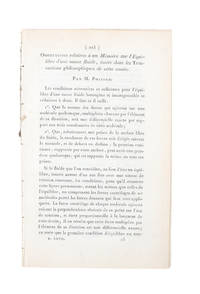
181641346Paris Crochard 1816 181718171820 1824 1824 1825. Without wrappers as issued in: "Annales de Chimie et de Physique Par MM. Gay-Lussac et Arago.". Vol. 3 pp. 350-375. - Vol. 4 pp. 128-145. - Vol. 6 pp. 259-303. - Vol. 13 pp. 418-38. - Vol. 27 pp. 136-167. - Vol. 27 pp. 236-281. - Vol. 28 pp. 337-365. <br/><br/><em>All first edition and first appearances of papers forecasting the more elaborated theories which he published in his famous work "La Therorie analytique de la chaleur. 1822". His analytical mathematical method that any continous function can be represented as a sum of sine and cosine curves is here applied to physical problems f.i. his treatment of the warming and cooling of the earth and terrestrial temperatures f.i. the papers offred here no.1 2 4 5 a. 6. The theory of terrestrial temperatures played a central role in Fourier's mathematical physics.An. 1. Description of the 4to volume which was afterwards published in 1822 without the chapters on radiant heat the solar heat as it effects the earth the comparison of analysis with the experiment and the history of rise and progress of the theory of heat. As such the paper contains importent applications and results not described in "Theorie analytique.1822."An. 2. This is a mathematiccal sketch on the sine law of emission of heat from a surface. The authors paradox on the hypothesis of equal intensity of emission in all directions is here proved.An. 3. An elegant physical treatise on the discoveries of Newton Pictet Wells Wollaston Leslie and Prevost.An. 4. A Sketch of a memoir mathematical and descriptive on the waste of the earth's initial heat.An. 5. A descriptive memoir read before the Academy 20. a. 29. Sept 1824 and later published in "Memoires de l'Academy." Tome VII 1827.An. 6. An elementary analytical account of surface-emissions and absorption based on the principle of equilibrium of temperature. This paper comes with Poisson's "Observations relatives à un Mémoire sur l'Equilibre d'une masse fluide inséré dans la Transactions philosophique de cette année." Pp. 225-236.An. 7. An elementary analysis of emissionn absorption and reflexion by walls of enclosure uniformly heated. At p. 364 Fopurier promises a "Theorie physique de la chaleur" to contain the applications of the "Theorie analytique" omitted in teis work published 1822. </em> unknown
183051179Paris Firmin Didot Frères 1830 1831. 4to. Contemp. hcalf. Richly gilt spine. A paperlabel pasted on top of spine. 4XXIV258 pp. and 1 folded engraved plate. A few minor brownspots. A fine wide-margined copy. <br/><br/><em>Scarce first edition with the reprinted titlepage 1831 instead of 1830.Fourier's "Analyse des equations determines" constitutes a highly important work on the theory of equations a work which occupied Fourier throughout his life and the last thing that he wrote. The work contains numerous theories that had not previously been published e.g. his method of solution and applications of linear qualities due to which he actually anticipated linear programming.The work was of great importance to Fourier himself who had attempted to publish some of his important results on the subject as early as 1789 and who later ended up in a priority-dispute due to the much delayed publication of one of these results the Fourier-Budan theorem. His final opus constitutes his final preparation of the Fourier-theorem as well as many other important theories and results connected to his theory of equations and it thus presents us with his final views on this important science. "He had almost finished only the first two of its seven "livres". His friend Navier edited it for publication in 1831 inserting an introduction to establish from attested documents including the delayed 1789 paper Fourier's priority on results which had by then become famous. Perhaps Fourier was aware that he would not live to finish the work for he wrote a synopsis of the complete book which also appeared in this edition. The synopsis indicated his wide interests in the subject of which the most important not yet mentioned were various means of distinguishing between real and imaginary roots refinements of the Newton-Raphson method of approximating to the root of an equation extensions to Daniel Bernoulli's rule for the limiting value of the ratio of successive terms of a recurrent series and the method of solution and applications of linear inequalities. Fourier's remarkable understanding of the last subject makes him the great anticipator of linear programming." D.S.B. V:98. - Honeyman IV:1361. </em> unknown
183042087Paris Firmin Didot Frères 1830 1831. 4to. Orig. clothbacked boards. Red titlelabel in paper with gilt lettering on spine. Spine faded and with small nicks to titlelabel and spine. Light wear to spine ends. 4XXIV258 pp. and 1 folded engraved plate. Htitle a bit browned. A few scattred brownspots. A wide-margined copy. <br/><br/><em>Scarce first edition with the reprinted titlepage 1831 instead of 1830.Fourier's "Analyse des equations determines" constitutes a highly important work on the theory of equations a work which occupied Fourier throughout his life and the last thing that he wrote. The work contains numerous theories that had not previously been published e.g. his method of solution and applications of linear qualities due to which he actually anticipated linear programming.The work was of great importance to Fourier himself who had attempted to publish some of his important results on the subject as early as 1789 and who later ended up in a priority-dispute due to the much delayed publication of one of these results the Fourier-Budan theorem. His final opus constitutes his final preparation of the Fourier-theorem as well as many other important theories and results connected to his theory of equations and it thus presents us with his final views on this important science. "He had almost finished only the first two of its seven "livres". His friend Navier edited it for publication in 1831 inserting an introduction to establish from attested documents including the delayed 1789 paper Fourier's priority on results which had by then become famous. Perhaps Fourier was aware that he would not live to finish the work for he wrote a synopsis of the complete book which also appeared in this edition. The synopsis indicated his wide interests in the subject of which the most important not yet mentioned were various means of distinguishing between real and imaginary roots refinements of the Newton-Raphson method of approximating to the root of an equation extensions to Daniel Bernoulli's rule for the limiting value of the ratio of successive terms of a recurrent series and the method of solution and applications of linear inequalities. Fourier's remarkable understanding of the last subject makes him the great anticipator of linear programming." D.S.B. V:98. - Honeyman IV:1361. </em> hardcover
181748917Paris Crochard 1817. Contemp. hcloth. Spine with gilt lettering. In: "Annales de Chimie ou Recueil de Mémoires concernant la Chemie" 2e Series Tome 6. - 4484 pp. a. 2 engraved plates. The entire volume offered. Fourier's paper: pp. 259-303. A few scattered brownspots. <br/><br/><em>First apperance of this importent memoir in which Fourier gives an account of the Physical theory of heat conduction and radiation."Fourier made observations on the heating power of the Sun and on night-time refrigeration. He conducted experiments on the heating and cooling of objects of different composition and shape and on the transmissionabsorption and reflection of radiant heat. He employed basic physical principles and formulated mathematical laws to explain and predict universal phenomena such as ‘the progressive extinction of heat rays in the atmosphere." James R. Fleming </em> hardcover
181749605Paris Crochard 1817. Contemp. hcalf. Spine with gilt lettering. Light scratching to spine In: "Annales de Chimie ou Recueil de Mémoires concernant la Chemie" 2e Series Tome 6. - 4484 pp. a. 2 engraved plates. The entire volume offered. Fourier's paper: pp. 259-303. Internally clean and fine. Stamps on verso of title-page. <br/><br/><em>First apperance of this importent memoir in which Fourier gives an account of the Physical theory of heat conduction and radiation."Fourier made observations on the heating power of the Sun and on night-time refrigeration. He conducted experiments on the heating and cooling of objects of different composition and shape and on the transmissionabsorption and reflection of radiant heat. He employed basic physical principles and formulated mathematical laws to explain and predict universal phenomena such as ‘the progressive extinction of heat rays in the atmosphere." James R. Fleming.The volume contains other notable papers JOHN MURRAY "Analyse de l'Eau de meret Observations sur l'analyse des sources salées" first edition in French MAGENDIE "Mémoire sur Emploi de l'Acide prussique dans le traitement de plusieurs maladies de poitrine et particulierement dans la phthisie pulmonaire" by Leopol de Buch Gay-Lussac etc. etc. </em> unknown
182844899Paris Crochard 1828. 8vo. Without wrappers. Extract from 'Annales de Chimie et de Physique' Series 2 - Volume 37. With halftitle to vol. 37. Pp. 291-315 and 1 folded engraved plate depicting experimental apparatus and the new contact thermometer. <br/><br/><em>First appearance of an importent paper investigating the heat flow in different substances by using his new contact thermometer. </em> unknown
182443911Paris Crochard 1824. Without wrappers. In: "Annales de Chimie et de Physique Par MM. Gay-Lussac et Arago." tome 27 Cahier 3. Pp. 225-336. Entire issue offered. Fourier's paper: pp. 236-281. <br/><br/><em>First printing of this importent paper dealing with the "Green-House-Effect". It is the second paper from 1824 in which Fourier investigates the connection between the temperature of the earth and radiation. Fourier's analysis in these two papers is widely recognized as the first proposal of what is now known as the greenhouse effect theory.In the 1820s Fourier calculated that an object the size of the Earth and at its distance from the Sun should be considerably colder than the planet actually is if warmed only by the effects of incoming solar radiation. He examined various possible sources of the additional observed heat in articles published in 1824 the paper offered is the second of the papers published 1824 and 1827. While he ultimately suggested that interstellar radiation might be responsible for a large portion of the additional warmth Fourier's consideration of the possibility that the Earth's atmosphere might act as an insulator of some kind is widely recognized as the first proposal of what is now known as the greenhouse effect theory. </em> unknown
182251212Paris Firmin-Didot 1822. 4to. Contemporary half calf with gilt spine. Old paper label to top of spine. Two old stamps to foot of title-page and old inscription to top of title-page. Half-title browned otherwise just a bit of mild scattered brownspotting. A mild damp stain to lower blank margin of ab. 20 leaves far from affecting text. A nice copy. Plates with light brownspotting. 4 XII 639 pp. 2 plates. <br/><br/><em>First edition of Fourier's seminal main work an epochal achievement in the history of science being "the first outstanding publication on the conduction of heat" Milestones of Science and the "source of all modern methods in mathematical physics involving the integration of partial differential equations in problems where boundary values are fixed." Cajori. "Fourier demonstrated that problems in mathematical physics can be solved for any complex condition when one knows how to solve the simple periodic initial condition." Milestones of Science. The great achievements that Fourier presents us with in the present work can be seen as twofold treating first the formulation of the physical problem as boundary-value problems in linear partial differential equations which extended rational mechanics to fields outside those Newton had defined in his "Principia" and second "the powerful mathematical toold he invented for the solution of the equations which yielded a long series of descendants and raised problems in mathematical analysis that motivated much of the leading work in that field for the rest of the century and beyond." D.S.B.Dibner: 154.Sparrow: p. 31. Barchas: 740.Norman: 824. </em> unknown
181659819Paris Crochard 1816. 8vo. In contemporary half calf. Spine with gilt lettering. In: "Annales de Chimie et de Physique Par MM. Gay-Lussac et Arago." Sweries 2 tome 3. Entire volume offered. 448 pp. and 3 engraved plates. Library stamps to verso of title-page and verso of plates. Fourier's paper: pp. 350-375. A few scattered brownspots. <br/><br/><em>First appearance in print of any part of Fourier's landmark work "Théorie Analytique de la Chaleur" which was published in 1822. The 2 large memoirs of 1811 out of which - together with the offered memoir - grew his landmark work were only published in 1824 and 1826. The volume contains also original papers by LAPLACE GAY-LUSSAC MAGENDIE PRONY HUMBOLDT BIOT etc.etc. "In 1816 Fourier published a paper the paper offered announcing the imminent appearance of a book on both the mathematical and the physical aspects of heat Fourie 1816; but six years were to pass before a book was published and it covered only the mathematical sides. In the 'preliminary discourse' he stated that its writing and printing had taken a long time p. xvii." Grattan-Guiness "Landmark Writings in Western Mathematics 1640-1940" p.356. </em> unknown
181649626Paris Crochard 1816. Contemp. hcloth. Spine with gilt lettering. In: "Annales de Chimie et de Physique Par MM. Gay-Lussac et Arago." Sweries 2 tome 3. Entire volume offered. 448 pp. a. 3 engraved plates. A library stamp to some upper corners. Fourier's paper: pp. 350-375. A few scattered brownspots. <br/><br/><em>First appearance in print of any part of Fourier's landmark work "Théorie Analytique de la Chaleur" which was published in 1822. The 2 large memoirs of 1811 out of which - together with the offered memoir - grew his landmark work were only published in 1824 and 1826.The volume contains also original papers by LAPLACE GAY-LUSSAC MAGENDIE PRONY HUMBOLDT BIOT etc.etc."In 1816 Fourier published a paper the paper offered announcing the imminent appearance of a book on both the mathematical and the physical aspects of heat Fourie 1816; but six years were to pass before a book was published and it covered only the mathematical sides. In the 'preliminary discourse' he stated that its writing and printing had taken a long time p. xvii." Grattan-Guiness "Landmark Writings in Western Mathematics 1640-1940" p.356. </em> hardcover
182444820Leipzig Johann Ambrosius Barth 1824. Without wrappers as issued in "Annalen der Physik und Chemie. Hrsg.von Poggendorff" Bd. 2 Jahrgang 1824 Zwölftes Stück. Pp. 345-448 entire issue offered. Fourier's paper: pp. 359-402. <br/><br/><em>First German edition in the same year as the French " Résumé théorique des Propriétés de la chaleur rayonnante" of this importent paper which gives an analytical account of surface-emissions and absorption based on the principle of equilibrium of temperature forecasting the more elaborated theories which he published in his famous work "La Therorie analytique de la chaleur. 1822". His analytical mathematical method that any continous function can be represented as a sum of sine and cosine curves is here applied to physical problems f.i. his treatment of the warming and cooling of the earth and terrestrial temperatures. The theory of terrestrial temperatures played a central role in Fourier's mathematical physics. </em> unknown