BACON, Sir FrancisBiblio.com
6 931 résultats
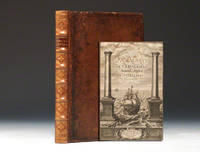
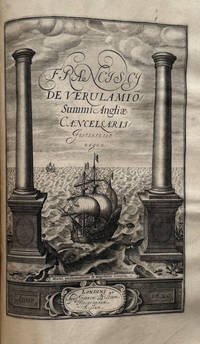
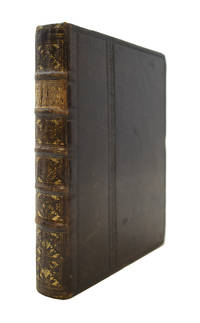
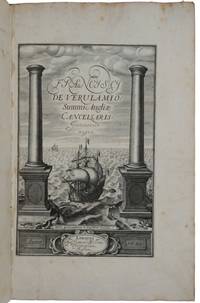
16205962London: Joannem Billium 1620. First edition. <p>First edition first issue the Devonshire-Horblit-Garden copy and one of approximately fifteen copies printed on large paper with the crown watermark - on present evidence one of only two first-issue large paper copies to have appeared in commerce. The Instauratio magna was Bacon's plan for the total reconstruction of human knowledge on experimental and inductive foundations projected in six parts of which only the first two were ever completed: the De Augmentis Scientiarum of 1623 and the Novum Organum offered here in which the method of the whole is set down. Against Aristotle's Organon Bacon opposed a new instrument: the purging of the four idola - of Tribe Cave Market-Place and Theatre - followed by the inductive ascent from designed experiment through Tables of Presence Absence and Comparison to the forms of simple natures and the ladder of axioms above them. The frontispiece a ship passing outward through the Pillars of Hercules is the book in miniature: Bacon's programme institutionalised in 1662 as the Royal Society.</p>. A Total Reconstruction of Sciences Arts and all Human Knowledge. <p>First edition first issue the Devonshire-Horblit-Garden copy and one of approximately fifteen copies printed on large paper with the crown watermark. Published in October 1620 with Norton's name in the colophon the first issue is of considerable rarity in any paper; the large-paper state in the first issue is of an altogether different order of scarcity. ESTC locates ten copies of the first issue in the United Kingdom and twelve in the United States without distinguishing paper stock; ABPC/RBH records since 1975 only two other copies of the first issue a large-paper copy in a presentation vellum binding at auction in 1996 and the Honeyman copy not stated to be large paper together with two large-paper copies of the second issue. On the evidence presently available this is one of only two first-issue large-paper copies to have appeared in commerce in living memory. The book is dedicated to King James I to whom Bacon had presented a manuscript draft in October 1620 with a letter explaining that he had laboured at the work for almost thirty years and that the king's acceptance was the only reward he sought; James on receiving the volume is said to have remarked that it was 'like the peace of God which passeth all understanding'. The presentation copy to the king has not survived; the present copy is thus among the very small number of large-paper copies that did and the only one to have descended through Devonshire Horblit and Garden.</p> <br /> <br /> <p>Bacon's Instauratio magna - the Great Instauration or renewal - was conceived as the total reconstruction of human knowledge on experimental and inductive foundations in six parts of which only the first two were ever brought to completion. Part I a survey of existing knowledge and its gaps appeared in 1623 as the De Augmentis Scientiarum a greatly expanded Latin recasting of his English Advancement of Learning of 1605. Part II the book offered here under the running title Novum Organum - the New Instrument set deliberately against Aristotle's Organon - presented the new logical method by which true knowledge was to be acquired. Part III intended to collect the natural and experimental histories that would supply the raw material for inductive inference appears in the 1620 volume only as the prefatory Parasceve ad Historiam Naturalem et Experimentalem. Parts IV V and VI - worked examples preliminary speculations and the new philosophy itself - were never written. Bacon understood the Novum Organum as the working core of the entire programme: the part of the Instauratio in which the method of all the rest is laid down and without which the other parts cannot be attempted. The frontispiece engraved by Simon van de Passe places a ship in full sail passing outward through the Pillars of Hercules - the classical boundary of the known world - into open ocean. The device is the book in miniature: the old philosophy is the inland sea the new is the Atlantic.</p> <br /> <br /> <p>The Novum Organum proper is divided into two books of aphorisms. Book I opens with a diagnosis of the obstacles to true knowledge - the four classes of idola or illusions to which the unreformed intellect is natively prone. The idols of the Tribe arise from common features of human nature itself - the tendency to anthropomorphise to impose pattern on disorder to read purpose into process. The idols of the Cave arise from the peculiar history education and temperament of the individual. The idols of the Market-Place arise from the ambiguity and inadequacy of the words through which thought is transacted. The idols of the Theatre arise from received philosophical systems - Aristotelian Platonic Galenic - which impose a fictional dramaturgy on the world. Until the mind has been purged of the four Bacon argues it cannot receive truth from nature; the effort of the Instauratio is therefore at once logical psychological and religious a tabula abrasa on which nature itself may write. The theological motif is sustained: the reformation of the intellect reverses the effects of the Fall restoring the human capacity for dominion over creation that was forfeited in Eden.</p> <br /> <br /> <p>Book II of the Novum Organum presents Bacon's inductive method as applied by way of worked example to the investigation of heat. The aim of the method is to discover the form of a simple nature - by which Bacon means not an Aristotelian essence but what later philosophy would call an explanation or a reduction: the arrangement of primary qualities from which the secondary quality in question is generated. The form of heat Bacon concludes is a motion - expansive restrained and acting in its striving upon the smaller parts of bodies. The route to this conclusion runs through three tables. The Table of Presence collects instances in which heat is manifestly present - the rays of the sun flame boiling liquids - chosen to be as unlike one another as possible so that the nature they share may stand out against irrelevant commonalities. The Table of Absence collects matched instances in which heat is absent - the rays of the moon phosphorescence cool liquids - to eliminate candidate forms that fail the negative test. The Table of Comparison collects instances in which heat varies in degree requiring that the true form vary with it. Between them the three tables function as an analytic sieve: a putative form survives only if it is present when heat is present absent when heat is absent and co-variant with heat where heat is graded. The structure anticipates by two centuries John Stuart Mill's Joint Method of Agreement and Difference and is radically more discriminating than the induction by simple enumeration with which Bacon's method has sometimes been mistakenly identified. Construction of the tables demands not passive observation but the active interrogation of nature through designed experiment - nature in Bacon's phrase must be put to the question.</p> <br /> <br /> <p>Inference of the form from the tables is however only the first stage. Bacon envisages a progressive ascent from individual forms to what he calls the ladder of axioms - successive levels of generalisation that together compose the unified system of natural philosophy. The conception has something of Aristotelian classification genus species differentia about it and something of the later idea of a theoretical structure from which observations follow by deduction; but Bacon's ascent is emphatically not the hypothetico-deductive method. His axioms are the guaranteed products of properly conducted induction over properly contrived tables and the whole programme depends on his conviction that the simple natures of things are finite in number and exhaustively enumerable - that the primary qualities of bodies constitute a closed alphabet from which the variety of the world is assembled as a literature is assembled from letters. Where the senses cannot reach the relevant qualities directly Bacon commends what he calls aids to sense: instruments such as the telescope and what he terms fit and apposite experiments designed to bring hidden processes within observational range. Nor is the ascent to axioms the end of the labour. Bacon insists that the programme is sterile unless the axioms are returned to practice in what he calls the descent to works - the application of inductively secured knowledge to the amelioration of the human condition. Science is understanding but it is useless understanding unless it issues in dominion.</p> <br /> <br /> <p>The significance of the Novum Organum in the history of scientific method lies in its explicit commitment to observation and experiment as logically prior to theoretical construction rather than as downstream confirmation of conclusions already reached by deduction. The standard pre-Baconian practice widespread in Bacon's own time was to treat experiment as illustrative of a result antecedently established - Robert Boyle an admirer of Bacon would later note of Pascal's hydrostatical demonstrations that they are physically impossible to perform and were plainly conceived as thought experiments in service of an already-decided theory. Bacon inverts the sequence: the experiments come first the tables come next the axioms come only at the end. Not all the experiments reported in the Novum Organum are Bacon's own but a substantial number are carried out in the fields of chemistry and mechanics very likely after the manner of Boyle and other gentleman-philosophers through the physical labour of laboratory assistants under his direction. Bacon distinguishes carefully between experiments he has performed and accounts he has received at second hand and he engages directly with contemporary technology - the instance of experiments on compression and expansion in bells is linked openly in the text to the diving-bell technology then being deployed for salvage operations. This intimate engagement with applied science and craft practice is the practical counterpart to the theoretical methodology and was until recent scholarship recovered it among the most frequently overlooked features of Bacon's work.</p> <br /> <br /> <p>Francis Bacon 1561-1626 statesman essayist and philosopher was the younger son of Sir Nicholas Bacon Lord Keeper of the Great Seal under Elizabeth I. He entered Trinity College Cambridge at the age of twelve and was admitted to Gray's Inn in 1576. A legal and parliamentary career under Elizabeth brought only modest advancement but under James I he rose through the offices of Solicitor-General and Attorney-General to become Lord Chancellor in 1618 with the titles Baron Verulam and Viscount St Albans in successive years. In 1621 he was impeached by the House of Commons for accepting gratuities from litigants stripped of his offices and confined briefly in the Tower; the last five years of his life spent in enforced retirement at Gorhambury were among the most productive of his career and saw the publication of the Historia Naturalis et Experimentalis 1622 the De Augmentis Scientiarum 1623 and the posthumous Sylva Sylvarum and New Atlantis both 1627. The Essays first published in 1597 and enlarged in 1612 and 1625 remain the aspect of his literary output most familiar to general readers. Bacon's direct scientific contributions are slight - he made no observation and proposed no result of enduring importance - and he was notably indifferent to the major discoveries of his contemporaries mentioning Gilbert Copernicus Galileo Kepler Napier and his own physician Harvey only glancingly or not at all. What he contributed was a programme and the programme proved decisive. His insistence on the priority of experiment over authority passed through his English admirers to Locke through Locke to the whole subsequent tradition of British empiricism and through the translation projects of the Encyclopédistes and the polemical essays of Voltaire into the intellectual armoury of the French Enlightenment. In 1660 one generation after his death his programme would be institutionalised in the founding of the Royal Society whose early fellows - Boyle above all - adopted him as their patron and methodological sponsor.</p> <br /> <br /> <p>The 1620 Instauratio magna appeared in two issues. The first issue of which the present copy is an example carries Bonham Norton's name in the colophon beside that of John Bill and retains an uncorrected pagination and a number of errors that the second issue would set right. Gibson records the existence of large-paper copies of both issues; ESTC specifies that roughly fifteen copies of the first issue were printed on large paper with a large crown watermark measuring about thirteen inches in height the remainder of the edition being printed on a smaller paper bearing a jug watermark and measuring about twelve inches. The large-paper copies were printed last in the sequence of the first issue so that all but one of the pagination errors were corrected in them together with two of the errors subsequently listed in the second-issue errata. In some large-paper first-issue copies - the present among them - leaf e3r beginning Non abs re fuerit admonere. is numbered 37; in others the numbering is suppressed. In the second issue leaf e3 is cancelled and the text reset on e4r an errata leaf is added and Norton's name is removed from the colophon. The present copy thus belongs to the latest-printed and best-corrected state of the first issue on the distinguishing paper stock with the full Norton imprint preserved.</p> <br /> <br /> <p>Provenance: William Cavendish 2nd Duke of Devonshire 1672-1729 bookplate on the verso of the title; the Cavendish library at Chatsworth was among the foremost English collections of the eighteenth century and the volume is very probably the copy entered in the 1879 Chatsworth catalogue at 1:103. From Devonshire the book passed to Harrison D. Horblit 1912-1988 whose science collection - formed in the 1950s and 1960s and dispersed at Sotheby's London over 1974-1978 in five parts - was with the Honeyman the Norman and Streeter collections among the major twentieth-century American libraries of early science; the book appeared in his first sale 10-11 June 1974 as lot 68 with Horblit's book label. It was purchased there by Lew David Feldman 1906-1976 proprietor of the House of El Dieff named for his initials L. D. F. and the pre-eminent American rare-book dealer of the mid-century known for his agent work for Harry Ransom in building the core of the Humanities Research Center at Austin. Feldman's successors sold the book in March 1977 to Haven O'More and Michael Davis who assembled over the following decade The Garden Ltd. - a library distinguished for the exceptional condition of its holdings described in the foreword to the Sotheby's catalogue as one of the finest of its kind to come to market in the twentieth century. The collapse of O'More's business arrangements forced the Garden sale at Sotheby's New York on 9-10 November 1989 at which the present Bacon was offered as lot 84. The Garden sale remains one of the high-water marks of science-book collecting: the two Copernican volumes in that sale the Rheticus Narratio Prima of 1540 and Copernicus's own De Revolutionibus of 1543 jointly set a new record price for printed books in the history of science.</p> <br /> <br /> <p>Beyond its contribution to scientific method the Novum Organum opened a political and institutional horizon for natural philosophy that its contemporaries read clearly. The New Atlantis of 1627 would extrapolate the Instauratio into fiction imagining Salomon's House as a state-supported research institution devoted to the enlargement of the boundaries of human empire; the Hartlib Circle and the group around Boyle and Wilkins that gathered in Oxford and London through the 1640s and 1650s drew directly on both texts in their own institutional plans; and the Royal Society chartered in 1662 took up Bacon as its presiding intellectual figure. Thomas Sprat's History of the Royal Society 1667 placed him at the head of its lineage. The Instauratio magna is thus at once a work of philosophy a work of scientific method and a foundational document of the institutional history of modern science - a book whose programme shaped in ways few other single works of the seventeenth century did the actual organisation of research in the three hundred years that followed.</p> <br /> <br /> <p>References: Dibner Heralds of Science 80 - ESTC S120789 - Gibson Francis Bacon: A Bibliography 1950 103a - Grolier/Horblit 8b - Pforzheimer App. 1 - PMM 119 - STC 1162 - Norman 98 large paper second issue - Jardine and Silverthorne eds. The New Organon Cambridge 2000 - Rees and Wakely eds. The Oxford Francis Bacon vol. XI The Instauratio Magna Part II: Novum organum and Associated Texts 2004 - Rossi Francis Bacon: From Magic to Science 1968 - Peltonen ed. The Cambridge Companion to Bacon 1996.</p> <br /> <br/> <br/> <br /> <p>Folio 334 × 208 mm xii 172 181-360 37 3 pp. including engraved title by Simon van de Passe woodcut headpieces and historiated initials; small cancel slip correcting a preposition de for de de in the last line of T1r; in the second set of numbered pages the misnumbering of pages 27 and 30 has been corrected; with blank c4 but without the first and last blanks some marginal soiling and spotting. Contemporary calf gilt neatly rebacked. Housed in a red cloth box with ties. An excellent copy in a contemporary binding.</p> . Joannem Billium unknown
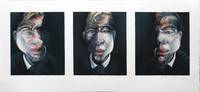
1981150382Paris: Editions de la Différence 1981. Edition of 150 signed by Bacon in pencil lower right numbered lower left. This lithograph is after a triptych oil painting on canvas 1979-80 currently held by the Metropolitan Museum of Art New York. Lithograph in colours on Arches wove paper right top and bottom deckle edged. Each image size: 32.5 x 28 cm. Sheet size: 47.3 x 103.5 cm. Framed size: 57.5 x 116.5 cm. Excellent condition. Presented in a dark brown stained wooden frame with conservation acrylic glazing. Sabatier 15. unknown
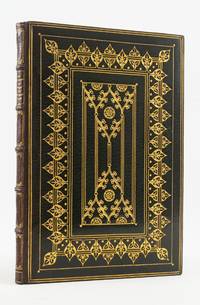
1915ST20770London: Especially written out and illuminated by Alberto Sangorski ca. 1915. 249 x 165 mm. 9 3/4 x 6 1/2". 18 2 pp. 2 leaves blank colophon. <br/> Attractive dark green crushed morocco gilt by Riviere & Son stamp-signed on front turn-in covers with wide frame and central panel tooled in gothic architectural motifs raised bands spine compartments with double gilt rules gilt lettering turn-ins framed by gilt fillets and dots scarlet watered silk pastedowns and endleaves all edges gilt old repair to head of spine. With one burnished gold initial "A" with intricate penwork embellishment in red and blue THE WORD "FOR" WRITTEN IN LARGE BURNISHED GOLD LETTERS SIX TIMES all with delicate penwork embellishment in blue or green TWO WITH A FAIRY-WINGED PUTTO perched on the crossbar of the "F" another "FOR" written in blue THE "F" IN BURNISHED GOLD ON A BACKGROUND OF BRUSHED GOLD WITH A PINK ROSE SPRIG a tailpiece of white jasmine blossoms entwined with a spray of lilac blooms FOUR ESPECIALLY FINE BRIGHT OVAL VIGNETTES approximately 90 mm. across SHOWING LOVELY GARDENS one of these accompanied by A HALF BORDER OF HUCKLEBERRY VINE another at the front as part of A SUPERB DOUBLE-PAGE OPENING FEATURING A PROFUSION OF PINK ROSES forming a frame around a gilt-edged cartouche bearing the title in blue surrounded by delicately blue and brown tendrils on the left AND A FRAME OF GRAPEVINES BEARING SUCCULENT PURPLE FRUIT ON A BRUSHED GOLD BACKGROUND on the right an oval view of a lake and mountains at its foot this frame enclosing text beginning with the words "GOD ALMIGHTY" in thickly burnished gold accented with curling blue and brown acanthus leaves and blue penwork. One page with trivial thumb smudge faint variations in shade of the vellum but A SUPERB SPECIMEN the vellum smooth and creamy the paint and gold bright and the virtually unworn binding with shining gilt.<br/> <br/> Featuring several gorgeous moments this is a luxurious and appropriately luxuriant illuminated manuscript of Bacon's prescription for the ideal princely garden. The most prominent modern creator of illuminated manuscripts our artist Alberto Sangorski 1862-1932 started his professional life as secretary to a goldsmith's firm before being attracted to the book arts at the age of 43. He began doing illuminated manuscripts that were then bound by his brother Francis' firm Sangorski & Sutcliffe with the colophon crediting the manuscript to the firm rather than acknowledging Alberto's contribution. Partly because of this failure to recognize his work Alberto had a falling out with Francis sometime around 1910 at which time he took his talents to Riviere the chief competitor to his brother's bindery. Robert Riviere began as a bookseller and binder in Bath in 1829 then set up shop as a binder in London in 1840; in 1881 he took his grandson Percival Calkin into partnership at which time the firm became known as Riviere & Son and the bindery continued to do business until 1939. Riviere was happy to allow Albert to add a colophon proclaiming as here that "This manuscript . . . was designed written out and illuminated by Alberto Sangorski." The decoration in the present work has an airy light-hearted aura with the bright gold lettering the delicate intricate penwork and the whimsical fairies conveying considerable joy and playfulness. And the beauty of the manuscript is heightened by the extremely fine condition here. Especially written out and illuminated by Alberto Sangorski unknown
162348295London Joannis Haviland 1623 later altered in manuscript to 1624. Small folio. Bound in a lovely early 19th century full vellum binding with gilt borders to boards and gilt ornamentations and gilt title-label to spine.Lower front hinge cracked but bindning still tight. A bit of edge wear but overall very nice. Woodcut title-vignettes burning heart and woodcut initials in beginning. Text within single woodcut borders. 18 493 1 - errata pp. Complete with both title-pages no final blank. Old owner's name to title page along with the dates 1624 and 1648 unlegible scribbles to second title-page and "collated e perfect" in old hand to last leaf. A very nice and clean copy with good margins. <br/><br/><em>The extremely rare first edition of what is arguably Bacon's main work "De Augmentis Scientiarum" in which he sets out to lay the foundations of science entirely anew and reform the process of knowledge for the advancement of learning. Bacon believes that the advancement of learning will ultimately relieve mankind from its miseries and needs and as such he not only reformed the foundations of science he also laid the philosophical foundations for the dawning of the Industrial age. His proposed change of the collective thought of mankind completely reshaped the entire course of science in history. The aim of the present work - to investigate and re-classify philosophy and the sciences - marks a turning point in the rhetorical and theoretical framework for science which is still essential for our conceptions of proper methodology today.The "De Augmentis Scientarum" constitutes a greatly expanded and completely re-written version of the "Advancement of Learning" 1605. The Latin is by William Rawley in close collaboration with Bacon himself who oversaw the entire process. When speaking of "De Augmentis Scientiarum" one never refers the incomparable English forerunner of the work which was only in 2 books as opposed to the 9 of the "De Augmentis Scientiarum". The first English translation of the "De Augmentis Scientiarum" appeared in 1640 and is translated by Gilbert Wats as "Of the Advancement and Proficiencie of Learning".The "De Augmentis Scientiarum" was intended as Part 1 of Bacon's proposed but never completed "Instauratio magna" PMM 119. "Bacon conceived a massive plan for the reorganization of scientific method and gave purposeful thought to the relation of science to public and social life. His pronouncement "I have taken all knowledge to be my province" is the motto of his work. His proposal was "a total reconstruction of sciences arts and all human knowledge. to extend the power and dominion of the human race. over the universe". The plan for this was to be set out in six parts: 1 a complete survey of human knowledge and learning; this was expounded in the "De Augmentis Scientiarum" 1623 a greatly extended version of "The Advancement of Learning" 1605. Of parts 3 to 5 only fragments were ever published; part 6 remained unwritten." PMM 119 - the header being "The Advancement of Learning". Francis Bacon's Great Instauration for learning and the sciences was thus to be introduced by his most important work the "De Augmentis Scientiarum" which he himself considered the most fundamental for the project that caused him to be considered one of the fathers of modern science. "In "De augmentis scientiarum" which is concerned primarily with the classification of philosophy and the sciences Bacon develops his influential view of the relation between science and theology. He distinguishes in traditional fashion between knowledge by divine revelation and knowledge by the senses and divides the latter into natural theology natural philosophy and the sciences of man. Having placed his project within the complete framework of knowledge in true Aristotelian fashion Bacon proceeds to demolish all previous pretentions to natural philosophy. His aim is to lay the foundations of science entirely anew neither leaping to unproved general principles in the manner of the ancient philosophers nor heaping up unrelated facts in the manner of the "empirics" among whom he counts contemporary alchemists and natural magicians. "Histories" or collections of data are to be drawn up systematically and used to raise an ordered system of axioms that will eventually embrace all the phenomena of nature.". D.S.B. I:374-75. For Bacon this proposed reformation would lead to a great advancement in science and a progeny of new inventions that would relieve mankind of its miseries. His demand for a planned procedure of investigating all things natural marked a turning point in the rhetorical and theoretical framework for science much of which still surrounds conceptions of proper methodology today.It is due to his "De Augmentis Scientiarum" that Bacon is referred to as the creator of empiricism. With this work and the work intended as the second of the Great Restauration project the "Novum Organum Bacon established and popularized inductive methodologies for scientific inquiry that which we now call the Baconian method or quite simply "the scientific method". With his belief in the possibility of the advancement of learning of relieving mankind from its miseries and needs Bacon is furthermore considered the philosophical influence behind the dawning of the Industrial age. He continually proposes that all scientific work should be done for charitable purposes as matter of alleviating mankind's misery and that therefore science should be practical and have the purpose of inventing useful things that will improve the conditions of mankind. This proposed change of our collective mind changed the entire course of science in history. The state was no longer merely contemplative; it became a practical and inventive state - one that would have eventually led to the inventions that made possible the Industrial Revolutions of the following centuries.It is furthermore to be noted that it is in the present work that Bacon presents his cipher method for the first time. He had first mentioned the Biliteral Cypher in a brief paragraph of his "Advancement of Learning" in 1605 but it is in the present work that he details with illustrations how to write and use the Biliteral Cypher. As most will know Bacon's Cypher has had the greatest of impact on modern Bacon-Shakespeare scholarship. Almost all theories of Bacon as the true author of the Shakespearian corpus can be traced back to the cipher that is presented in 1624 in the "De Augmentis Scientiarum"."The system has been recognized and used since the day that "De Augmentis" was published and has had its place in every translation and publication of that work since but the ages have waited to learn that it was embedded in the original books themselves from the date of his earliest writings 1579 as now known and infolded his secret personal history." Elizabeth Wells Gallup The Bi-Literal Cypher of Sir Francis Bacon Discovered in His Works and Deciphered p. 48.As is known since the 19th century many people have suggested that the plays attributed to William Shakespeare were in fact written by Francis Bacon and that the published plays contain enciphered messages to that effect. Both Ignatius L. Donnelly and Elizabeth Wells Gallup attempted to find such messages by looking for the use of Bacon's cipher in early printed editions of the plays.For roughly a century from 1850 Bacon's Cypher set the world of literature on fire. A passion for puzzles codes and conspiracies fuelled a widespread suspicion that Shakespeare was not the author of his plays. Professional and amateur scholars from all places all over the world have spent extraordinary amounts of time energy and money combing Renaissance texts in search of signatures and other messages that would reveal the true identity of their author. Also great authors and thinkers have been convinced that Shakespeare's works contained a secret message. These include Mark Twain Walt Whitman Sigmund Freud Henry James Henry Miller etc. Francis Bacon with his biliteral cipher -Renaissance England's first and clearest statement about how to hide texts within texts - became the leading candidate for the holder of the key to the puzzle.The cipher which consists in an alphabet was first printed in the present first edition in 1623. It is to be found in Book 6 Chapter 1. It was reprinted in all the later editions of the work 2nd ed. Paris 1624; London 1638; English translation Oxford 1640 and the alphabet in all are substantially the same. Bacon devised this ingenious code in the late 1570s when he spent three years in the entourage of the English ambassador in France but he did not describe its workings until 1623. "Bacon gives both mathematics and analogy which he considers a science and calls "grammatical philosophy" a high place in his Great Instauration; which when used together help to unlock the doors to that which Bacon has deliberately concealed-- including certain mysteries hidden in the Shakespeare plays. For instance the two great books published in 1623 were the Shakespeare's Folio "Comedies Histories & Tragedies" and Bacon's "De Augmentis Scientiarum" the philosophical background and purpose of the Shakespeare plays two masterpieces published together since they are as twins each being a key to unlock hidden treasures in the other-- two relating to the twin faculties of the mind--imagination and reason--and both drawing upon the third faculty memory." Peter Dawkins "Francis Bacon Herald of the New Age". Bacon's Cypher however has not only been used as the key to the Shakespearian puzzle. It was in fact a highly important cryptographical invention which constitutes on the the very first English works on the subject predating Both Wilkins' "Mercury" And Falconer's "Cryptomenysis". This is one of the earliest illustrations of a cipher intended to hide a text within a text.Not only is this the first edition of "de Augmentis Scientiarum" it is also the most correct and in addition the most beautiful. "First edition exceedingly scarce and according to Archbishop Tenison the "fairest and most correct edition." A copy is in the British Museum." Lowndes I:95. Gibson 129a. With the date on both title-pages altered in manuscript adding a "I" as in some copies as also noted in the description of e.g. the copy in the Huntington. This was presumably done by either the printer or publisher to those copies that remained unsold at the end of 1623. A second edition of the "De Augmentis Scientiarum" appeared in Paris in 1624. The first English translations of "De Augmentis Scientiarum" appeared in 1640.We have not been able to locate a single copy of this first edition in auctions within the last 40 years. </em> hardcover
1517I3AM4J9JIN0FLyon: publishers device of Barthélemy Trot colophon: Lyon printed by Jacques Myt 1517. 17th-century calf sewn on 5 double supports gold-tooled spine with titles in the 2nd 3rd and 4th of 6 compartments and a fleur-de-lis in each of the others blind fillets on sides. Rebacked with the original backstrip laid down. Small 4to 19 x 14 cm. With the title page printed in red and black with Trots woodcut publishers device lion holding arms bearing a globus cruciger with a parochial cross and initials BT 12 decorated woodcut initials white-on-black Lombardic capitals with leaf and flower decorations 3 series plus 3 repeats. Set in rotunda gothic types 2 sizes with 3-line Lombardic capitals and a couple 2-line and 2 spaces with guide letters left to be filled in by hand. Rare fourth edition of a collection of ten Mediaeval works by seven authors concerning medicine health food and wine including notes taken from Ibn Sina Avicenna. They include Maynus de Maynis ca. 1295- 1368 Regimen sanitatis on health; a work on phlebotomy attributed to Arnaldus de Villanova ca. 1295- 1368; Astronomia on astrological influences on health attributed to Hippocrates 460-377 BC; Johannes de Zantvliete active 1343-1350 De dieta on food; Nicolaus Salernitanus 12th century Quid pro quo a list of medicines for numerous ailments; Averroès 1126-1311 on poisons and on theriac a poisonous concoction used as an antidote to other poisons especially poisoned wounds; Secreta a short piece attributed to Hippocrates; Villanova Tractatus de vinis an extensive and important work on wine; and Roger Bacon ca. 1220-ca. 1292 De regimine senum et seniorum a treatise on geriatrics here erroneously attributed to Villanova. With occasional underlining and marginal marks by an early hand. With leaves 4 and 5 mounted on stubs: otherwise in very good condition with only very slight browning. Rebacked as noted and with the surface of the leather refurbished but now structurally sound. One of the rare earliest editions of several Mediaeval treatises on health medicine food and wine.l Baudrier VIII p. 431; Durling 3044; USTC 144805 8 copies; Vicaire cols. 549-550. publishers device of B[arthélemy] T[rot] (colophon: Lyon, printed by Jacques Myt, unknown
1620Bv2426<p>The Birth of the Scientific Method: FIRST EDITION OF ONE OF THE MOST IMPORTANT BOOKS IN THE HISTORY OF SCIENCE: FRANCIS BACON'S DEFENCE AND DEVELOPMENT OF THE SCIENTIFIC METHOD laying the foundation of the inductive model. A MOST DESIREABLE COPY. Bacon's Novum Organon his manifesto for a new philosophy of scientific method relies on laws derived from observation and investigation "the evidence of the senses" Ayn Rand. "Nature to be commanded must be obeyed." Bacon originally conceived his revolutionary work in six parts of which only the first and second parts the De augmentiis scientiarum 1623 a greatly expanded version of the Advancement of learning and the Novum organum were completed. Bacon's aim was to lay an entirely new foundation for science "neither leaping to unproved general principles in the manner of the ancient philosophers nor heaping up unrelated facts in the manner of the 'empirics.'" DSBI. "The writings of Lord Bacon and especially the Novum Organum possess a fourfold interest: They have a direct bearing upon the history of philosophy literature logic and physical science; and whatever estimate we may form of their influence upon each of these branches of knowledge we think that few will fail to admit that Bacon threw a bridge over that vast and deep gulf which separates the ancient from the modern modes of thought and directly opened a way to our present philosophy and science" G.F. Rodwell Bacon's Novum Organum. Bacon "insisted on experiment in determining truth in nature and the Novum is a proposed method for the assessment of all knowledge. The accumulation of observation and fact must be the basis of a new philosophy and not the authority of Aristotle or anyone else. Bacon's inspiration led directly to the formation of the Royal Society" Dibner 80 the oldest continuously existing scientific academy in the world. The Novum's famous allegorical title page with its evocative engraving of a ship in full sail passing through the Pillars of Hercules refers to the work as the Instauratio Magna. The Philosophical Transactions of the Royal Society were soon to be filled with exactly the kind of "Histories" careful collections of experimental data that Bacon here recommends. As usual this copy is the second state with leaf e3 canceled and reprinted on e4 errata added and printer John Bill present. Ownership inscription at head of title; 18th-century manuscript notes on both sides of initial blank; scarce underlining and marginal marks in the preface. From the library of the Irish classical scholar John Walker 1769-1833 with his ownership inscription at the head of the engraved title "John Walker T.C.D." retrospectively dated 1815 and with his manuscript notes in Latin about the book on both sides of the initial blank leaf. Walker entered Trinity College Dublin in January 1786 ascending by stages to Bachelor of Divinity in 1800. Inspired by practices of the apostles and rejecting later developments in church authority Walker founded a group called the Church of God known pejoratively as Separatists or Walkerites and Walker was expelled from his fellowship at Trinity. He supported himself by lecturing and writing until the last year of his life when Trinity College Dublin granted him a pension in amends for its earlier treatment of him. Very infrequent scattered light foxing with occasional marginal pinpoint wormholing not affecting readability. Age-wear to contemporary calf boards with a few cuts wormholes on rear board. A desirable copy in extremely good condition of this landmark. Book #Bv2426. $28500. We specialize in rare Ayn Rand history and science.</p> John Bill hardcover
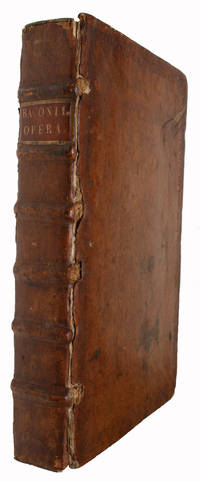
1620008198London. Londini: NORTON Bill and BILL John. GRIFFINI Edwardi. PAULI D. WHITAKERUM Richardum. 1620. 1st Edition 2nd Printing. Hardcover. Very Good. 4to - over 9¾ - 12" tall. PASSE Simon van de 1595-1647. A 'landmark in the advancement of human learning' Pforzheimer. First edition 1620 second issue. Bound within the first part of Summi Angliae Cancellarii 1638 In contemporary full calf gilt double fillet border to covers spine with 6 raised bands & ornamental tool within double fillet gilt borders in the compartments except second compartment with direct gilt titling rubbed some wear to extremities with tailcap showing some splitting along upper joint folio 292 x 190 mm. Internally initial blank Pi1 bound before A1 woodcut headpieces and historiated initials a few leaves with small blank paper loss to outer top and bottom corners bound with an incomplete copy of Bacon's Baronis de Verulamio 1638 bound before and after the Instauratio Magna late 17th-century/early 18th-century engraved armorial bookplate of 'R. L. B. D. F.' to front paste down with contemporary ink ownership inscription of 'Juliani le Tac Rothomagensis' at head with the same owner's neat ink ownership name at head of title of the second work Baronis de Verulamio 1638 and with a small circular library stamp of Petit Seminaire de Caen lower down on the same title engraved title after Simon van de Passe second issue with e3 canceled as usual and e4r adding errata and omitting the name of Bill Norton from the colophon. Baronis de Verulamio commences 1638 title 10 4 176 179-386 16.299 1. Instauratio commences engraved title 10 2 172 181-360. Parasceve commences 1620 7 9-22 25-36 1 1. Verulamio recommences 1638 2 303-475 pp. Housed in a modern cloth slipcase printed title labels. Signature in 6s&4s: Vervlamio A-4C6. Instauratio commences 1 q-q4 1 A-D4 E-2T6 a-c3. Verulamio recommences 1 4D2-4S4. Occasional missnumbering but complete. Provenance: 1. ownership inscriptions Julien Le Tac or Letac c.1640-1720 lawyer at Pont-l'Eveque employed in the Court of Accounts Aid and Finance for Normandy and sometime resident of St Godard de Rouen; 2. bookplate Jean-Baptiste Remi Le Bas de Fresne 1723-1773 archdeacon of Gace clerical advisor to the parliament of Rouen dean of the chapter in Lisieux and builder of the deanery of Lisieux. His coat of arms depicts a spitting winged dragon. 3. library stamp Petit Seminaire de Caen. Gibson 103b; Grolier / Horblit 8B; Pforzheimer pp. XIX-XXI; PMM 119; STC 1163. First edition of one the most important works of the 17th century an unsophisticated copy in an unrestored contemporary binding. 'Bacon conceived a massive plan for the reorganisation of scientific method and gave purposeful thought to the relation of science to public and social life' and 'his insistence on making science experimental and factual rather than speculative and philosophical had powerful consequences' PMM. <br/> <br/> [NORTON Bill and] BILL John. GRIFFINI Edwardi. PAULI D. WHITAKERUM Richardum. hardcover
1551London: Printed by Thomas Purfoot and Thomas Creede for Henrie Tomes and are to be sold at his shop at Graies Inne Gate in Holborne 1605. Hardcover. Very Good. Quarto. In two parts. 1 45 118 i.e. 121ff. A4-L4; M2; Aa4-Ggg4; Hhh2. First edition. Blank leaf present but two errata leaves absent. C4r with the first state reading 'maniable.' Contemporary vellum repaired by Bernard Middleton. From the library of C.R. Lowell with his bookplate and his rubber stamp on each title-page. Also on first title-page an ownership inscription: "bibca Williams Scptio 1813." Pforzheimer 36; Gibson 81; Grolier Langland to Wither 12; Grolier/Horblit 8a; Norman 97; STC 1164. Bound with: Sandys Edwin. A relation of the state of religion . <br/> <br/> London: Printed [by Thomas Purfoot and Thomas Creede] for Henrie Tomes, and are to be sold at his shop at Graies Inne Gate in Ho hardcover
1791London: Printed by Val. Sims for Simon Waterson dwelling in Paules Churchyard at the signe of the Crowne 1605. Hardcover. Very Good. Small quarto. 91ff. A4-Z4 AA4-ZZ4. First edition. Ornament beneath title. Contemporary vellum repaired by Bernard Middleton. From the library of C.R. Lowell with his bookplate and his rubber stamp on each title-page. Also on first title-page an ownership inscription: "bibca Williams Scptio 1813." STC 21716. In this edition H3r line 1 ends: practi- Birmingham copy. Bound with: Bacon Francis. The Twoo Bookes of Francis Bacon. <br/> <br/> London: Printed by Val. Sims for Simon Waterson dwelling in Paules Churchyard at the signe of the Crowne, 1605. hardcover
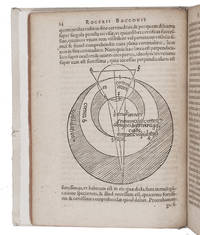
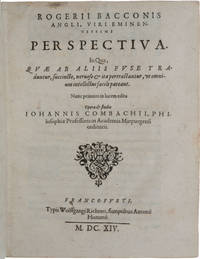
16146937Frankfurt 1614. 4to. Wolffgang Richter for Antonius Hummius Modern plain paper boards red edges. With 8 full-page woodcuts printed on both sides of four leaves inserted as plates and numerous woodcut figures and illustrations in text several full-page. 8 189=205 1 blank pp. First edition of a famous work on optics by the English natural philosopher and mathematician Roger Bacon ca. 1220-ca. 1292. Bacon was well read in Arabic and ancient Greek sources on optics and perspective a subject hardly studied in Europe during the earlier Middle Ages. The main sources for his theories were the writings of Euclid Ptolemy and Alhazen Ibn al-Haytham and he followed Robert Grosseteste concerning the importance of light and in his emphasis on the use of lenses not only for burning but also for magnification to aid natural vision. Bacon advised magnifying glasses for old people as well as for people with weak eyes. The Perspectiva belonged to Bacon's Opus maius compiled in manuscript in 1266-1267. The present edition was based on a medieval manuscript and was edited by Johann Combach 1585-1651 professor of philosophy at Marburg in GermanyWith a stain on the title-page and two on the last blank probably from removing old stamps browned throughout with a few small spots but overall in good condition. Binding with some water stains but otherwise good.l DSB I pp. 377-384; Poggendorff I 468; STC German 17th Century B 53; VD17 23:236968W; cf. Kemp The science of art pp. 26 211 and 269; Vagnetti DB5. hardcover
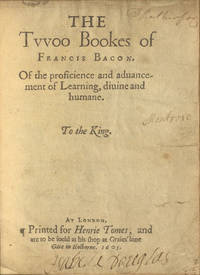
160568825London: Printed for Henrie Tomes 1605. Full description:<br> <br> BACON Sir Francis. The Twoo Bookes of Francis Bacon. Of the proficience and advancement of Learning divine and humane. London: Printed for Henrie Tomes 1605.<br> <br> First edition. Two parts in one small quarto volume 7 5/8 x 5 3/4 inches; 195 x 145 mm. 1 title 45; 118 i.e. 121 leaves. Bound without initial and final blank leaves or the two extra leaves of errata found only in "a very few copies.probably of the latest sold" Pforzheimer. C4r line 5 with variant "maniable" instead of "amiable" and page 118 with page number. No priority in these variants according to ESTC. Signature G is misbound after signature I. Decorative woodcut initials.<br> <br> 18th-century calf boards stamped and ruled in blind. Spine stamped in gilt. Tan leather spine label lettered in gilt. All edges gilt. A one-inch closed tear to margin of leaf C not affecting text. Leaves Bb2 and Aaa with blank corners torn. A tiny rust hole to leaf E4 only touching one letter. Some mild toning mainly to final leaf. Previous owner's small bookplate on front pastedown. Overall a very good copy.<br> <br> "Bacon's major contribution to the development of science lies in his natural philosophy his philosophy of scientific method and in his projects for the practical organization of science. During the last years of his life he expounded these ideas in a series of works of which the Twoo bookes was the first. The only work Bacon ever published in English it was later expanded and latinized into De augmentis scientiarum 1623. In the Twoo bookes Bacon concerned himself primarily with the classification of philosophy and the sciences and with developing his influential view of the relation between science and theology. While preserving the traditional distinction between knowledge obtained by divine revelation and knowledge acquired through the senses Bacon saw both theoretical and applied science as religious duties the first for a greater knowledge of God through his creation and the second for the practice of charity to one's fellows by improving their condition. This view of science as a religious function maintained its authority throughout the seventeenth and early eighteenth centuries and was an important factor in the public success of the scientific movement" Norman Library.<br> <br> Gibson 81. Grolier/Horblit 8a. Norman Library 97. Pforzheimer 36. STC 1164.<br> <br> HBS 68825.<br> <br> $11000. Printed for Henrie Tomes unknown
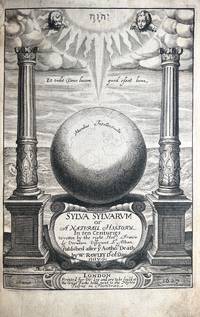
163846277London Edward Griffin John Haviland Bernard Norton and John Bill Richard Whitaker & John Norton 1638. Folio. Binding: 32x22 cm leaves: 311x208 cm. Contemporary full speckled calf binding with six raised bands and gilt red leather title-label to spine. Boards with blindstamped ornamental border. Scuff marks to boards and hinges worn so bands showing. Large woodcut head- and tail-pieces initials printer's devices and typographical ornaments that have been of great significance to the Baconians in their attempts to establish Bacon as the author of the works attributed to Shakespeare. Roman and Italic lettering and some Greek. Several neat inscriptions to front free end-papers and verso of frontispiece in Latin Greek English and German dated 1704 1740 and 1926 the last being a presentation-inscription for the renowned German Bacon-scholar and noted Baconian George J. Pfeiffer. Neat early 18th century inscription to top of title-page. Old description of the copy 1946 neatly pasted on to inside of front board. Vague minor damp-staining to lower margin throughout far from affecting text and mostly barely visible. A vague minor dampstain to margins of a few leaves at the beginning also far from affecting text. All in all a lovely clean and crisp copy on large paper. Full page engraved frontispiece-portrait 14 386 pp. 177-78 omitted in pagination; 16 475 1 pp. Fully complete with separate half-titles for the different works. <br/><br/><em>Scarce first edition first issue on large paper - THE GREAT BOOK COLLECTOR VOLLBEHR'S COPY GIVEN TO THE IMPORTANT BACONIAN G.J. PFEIFFER - of the monumental first collected edition of the works of Francis Bacon containing the seminal first printing in Latin of not only his greatly influential "Nova Atlantis" "The New Atlantis" - often referred to as "the blueprint for the founding of America" but also his groundbreaking Essays "Sermones Fideli" as well as his history of Henry VII "Historiam Regni Henrici Septimi" and his Dialogue on the Holy War "Dialogum de Bello Sacro" published by Bacon's literary executor his close friend William Ramsey to whom Bacon bequeathed most of his manuscripts. This first edition of his works in Latin is of the utmost importance to Bacon-scholarship and has played a seminal role in the spreading of his works as well as the understanding of two of his greatest achievements The Essays and The Nova Atlantis which is usually referred to with its Latin title instead of the English.This magnificent copy with its wide margins contains several interesting inscriptions in different languages. One of them 19th century in German states that "This book is to remind you of the "15th Century Plot". When in 1926 you showed to scholars his collection of 2000 incunables. He is also known as "Otto H.F. Vollbehr. ." - " Dated "N. York City 29/11 26" And in the same hand the presentation inscription is continued: "This "little book" is being handed over in friendship to Mr. George J. Pfeiffer the famous "Bacon-scholar" in order for him to continue his fruitful studies ." -THE PRESENT COPY THUS EVIDENTLY BEING THE GREAT BOOK COLLECTOR VOLLBEHR'S COPY GIVEN TO THE IMPORTANT BACONIAN PFEIFFER. "Vollbehr was a German industrial chemist turned book collector who at the close of World War I found himself with more assets than most. Either in his own collection or through consignment Vollbehr had control of thousands of incunabula. In 1926 Vollbehr came to the United States bringing with him a collection of 3000 incunabula to be exhibited at the Eucharistic Congress in Chicago. After the exhibition in Chicago Vollbehr traveled with the collection by train to several other cities. His last stop was in Washington and over 100 of the books were exhibited in the Great Hall of the Library of Congress. Vollbehr proposed that if a benefactor would step forward to buy the collection for an American institution for half the asking price of $1.5 million he would donate the other half. In addition he would include a complete copy of the Gutenberg Bible printed on vellum as one of the 3000 incunabula.The Gutenberg Bible which crowned Vollbehr's collection had had only three owners. The first owner was said to have been Johann Fust who took it to Paris and sold it as a manuscript to a representative of the monks of Saint Blasius. It resided with the monks in the Black Forest until they had to move to St. Paul in Carinthia in the face of the Napoleonic army. Finally in 1926 Otto Vollbehr purchased the three volumes from the monks for $250000.In December 1929 a bill was presented to Congress proposing that public funds be used to acquire the Vollbehr collection for the Library of Congress. In June 1930 Congress passed the bill and President Hoover signed it into law. Between July 15 and September 3 the Vollbehr books arrived at the Library of Congress. The Bible one of three known perfect copies printed on vellum is one of only a few items that are permanently on display in the Library." from the Library of Congress web-site. George J. Pfeiffer Ph. D. of New York graduate of Harvard University and Vice-president of the Bacon Society of America is considered one of the most important Bacon-scholars of his time. His thorough scientific studies convinced himself and many others that Bacon was in fact the author of the works attributed to Shakespeare. With THE FIRST PRINTING IN LATIN OF "NOVA ATLANTIS" Bacon's famous theories of his masterly utopian work became widespread and hugely influential. It had originally been printed posthumously in English and appeared at the very end of his "Sylva Sylvarum" of 1626 where it was more or less hidden away and quite humbly presented by Rawley who was responsible for his leftover papers. Rawley's introduction to the Latin edition of the work is quite different from that of the English edition and has had quite an impact upon the reception of the work a work which came to inspire a totally new philosophical and political genre and which fundamentally changed the way that we view the world. The "Nova Atlantis" occupies a unique place within the works of Bacon; among many other things it is the only overtly fictional product of his career if one does not like Pheiffer believe that he is actually the true author of the Shakespearean works. The printing of this major work in the history of man's thought is quite interesting and fairly complicated. As mentioned it appeared at the back of the larger and much more conform work "Sylva Sylvarum" which was published by his secretary and friend William Rawley shortly after Bacon's death. It does not however seem to have much in common with the "Sylva Sylvarum" and the "New Atlantis" was not even mentioned when that work entered the Stationers' Register on July 4th 1626.The "Sylva Sylvarum" was being compiled during the last couple of years of Bacon's life and there is evidence to conclude that "Nova Atlantis" was being translated into Latin at the same time whereas it seems that the English version of it was written about a year or two earlier. Although the Latin translation was thus left lying around for quite some years before it was finally printed perhaps due to the fact that it was an unfinished text Bacon himself seems to have concerned himself a great deal with the Latin translation of the work as well as the other works. The appearance of them in the "universal language" were in the words of Bacon himself to be carried out 'for the benefit of other nations' a phrase which is paralleled in the text of "Nova Atlantis" as the father of Salomon's House remarks of his relation of the institution's working that 'I giue thee leave to Publish it; for the Good of other Nations'. And finally does this great work appear to the benefit of all men and all nations in the universal Latin language when in 1638 Rawley publishes the "Operum moralium" in which his "Essays" also appear in Latin for the first time as does the History of Henry VII and the Dialogue on the Holy War two other greatly important works. The printed title of the "Operum Moralium" not only informs the reader which texts are included within the volume; Rawley also provides information on the texts themselves dividing them into two distinct sections with two separate title-pages. The first section consists of five translations which apart from De sapientia had never appeared in Latin translation before; the second section consists in the first part of the "Instauratio" originally published in 1620. The second issue of the "Operum Moralium" furthermore has the reissued sheets of the last part of the "Novum organum".Rawley's prefatory letter tells us quite a bit about the way that he and Bacon himself would like the "Nova Atlantis" to be viewed and for the first time the work is addressed in a direct and assertive manner bringing it forth as an important philosophical work now for the first time properly introduced. Rawley informs the reader that Bacon began the process of translating the Essays and the Nova Atlantis because he wished his moral and political works not to perish. He goes on to explain the importance of the moral and political works being published in the "universal" Latin and groups the texts in a new way. He now makes a new category of text for the final two works "De bello sacro" and "Nova Atlantis" calling them 'fragmentary' as opposed to the "Worke Unfinished" that he used for the English "Now Atlantis" of 1626/7 stating that this is at the request of Bacon himself: "And finally he ordered that two fragments be added the Dialogue of the Holy War and the New Atlantis: but he said that these were the three kinds of fragments." giving to them a certain status of their own and a deliberate character that they had not possessed before. For the first time the "Nova Atlantis" the hitherto hidden-away work that was never properly introduced is now included in the general preface which it was not in 1626/27 and the "Nova Atlantis" is given the central position within Bacon's works that it deserved - and that it has possessed ever since. This also explains the great impact of the first Latin version of the "Nova Atlantis" as opposed to the English version which was far less influential. Not only is "Nova Atlantis" no longer just an unfinished work worthy of no more than being hidden away at the back of a larger work it is now the central part of a seminal collection of works appearing for the first time in Latin "for the Good of other Nations"."Francis Bacon 1561-1626 was one of the leading figures in natural philosophy and in the field of scientific methodology in the period of transition from the Renaissance to the early modern era. As a lawyer member of Parliament and Queen's Counsel Bacon wrote on questions of law state and religion as well as on contemporary politics; but he also published texts in which he speculated on possible conceptions of society and he pondered questions of ethics Essays even in his works on natural philosophy The Advancement of Learning.After his studies at Trinity College Cambridge and Gray's Inn London Bacon did not take up a post at a university but instead tried to start a political career. Although his efforts were not crowned with success during the era of Queen Elizabeth under James I he rose to the highest political office Lord Chancellor. Bacon's international fame and influence spread during his last years when he was able to focus his energies exclusively on his philosophical work and even more so after his death when English scientists of the Boyle circle Invisible College took up his idea of a cooperative research institution in their plans and preparations for establishing the Royal Society.To the present day Bacon is well known for his treatises on empiricist natural philosophy The Advancement of Learning Novum Organum Scientiarum and for his doctrine of the idols which he put forward in his early writings as well as for the idea of a modern research institute which he described in Nova Atlantis." SEP. Gibson: 196; Lowndes I:96. </em> hardcover
1683711991. Edition unknown. Signed by Bacon below the image and Giacobetti on the verso. Giacobetti had long admired the work of Bacon and when they eventually met in 1991 the artist was most co-operative with the photographer's requests and they met each other another 11 times over the next few months. This led to a substantial and revelatory filmed interview and the collaborative participation of an extended photographic portrait session taken in two London hotels 11 Cadagon Gardens and Browns. Gelatin silver print laid on board as issued. Image size: 38 x 56.5 cm. Sheet size: 60 x 56.5 cm. Framed size: 70 x 66.7 cm. Excellent condition. Presented in a black wooden frame with conservation acrylic glazing. unknown
1683671991. Edition unknown. Signed by Bacon below the image and Giacobetti on the verso. Giacobetti had long admired the work of Bacon and when they eventually met in 1991 the artist was most co-operative with the photographer's requests and they met each other another 11 times over the next few months. This led to a substantial and revelatory filmed interview and the collaborative participation of an extended photographic portrait session taken in two London hotels 11 Cadagon Gardens and Browns. Gelatin silver print laid on board as issued. Image size: 38 x 56.5 cm. Sheet size: 60 x 56.5 cm. Framed size: 70 x 66.7 cm. Excellent condition. Presented in a black wooden frame with conservation acrylic glazing. unknown
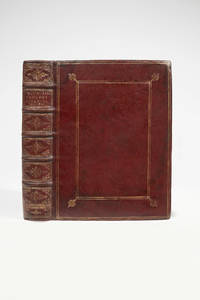
163273<p><b>The rare first French edition of <i>De Dignitate et augmentis scientarum</i> " <i>Francis Bacon's first important published text</i>" J. P. Cavaillé.</b></p><p>Gibson 137.</p><p>The book was published in English in 1605 in only two books. The Magna Instituatio was published in 1620. At the end of his life 1623 Bacon gave a new edition in nine books and in Latin.<br /><br />A translation was given by André Maugars in Paris in 1624 under the title Le Progrez et avancement aux sciences divines & humaines. This one different is a new book much more complete.<br /></p><p>Bacon's work of great significance in the development of modern Western thought called "intrinsically important" by Pforzheimer.</p><p>Bacon's masterpiece that will deeply influence the thinking of Descartes Locke Leibniz Huygens and Voltaire. </p><p>In this work Bacon reveals his new scientific method.<br /><br />Francis Bacon 1551-1626 " was the prophet of the truths that Newton later came to reveal to men" Horace Walpole.<br /></p><p>" This work is the most complete of Bacon's writings: it is also one of those in which the author's qualities shine most brightly and where the truly encyclopedic qualities of his vast intelligence are developed at their ease. Bacon in this treatise begins by defending letters and the arts against the contempt of their detractors and celebrates in magnificent terms their greatness and usefulness. He then examines what has been done up to his century for their progress and what remains to be done… it ends with a treatise on the sources of law which is a masterpiece of its kind and places Bacon next to Montesquieu… One of the most beautiful monuments raised to the glory of the human spirit" Francis Riaux.<br /></p><p>"It is not to possible to think that Descartes did not know of this revolution in English philosophy and it is impossible to deny the reality of the influence of Bacon's writings on Descartes" <i>Notice sur Descartes Œuvres de Descartes</i>1864.</p><p>" <i>His proposal was: "A total reconstruction of sciences arts and all human knowledge… to extend the power and dominion of the human race… over the universe</i>".<i> His notions for a planned development of science and social organization based on scientifically ascertained facts are still relevant to what has become one of the crucial problems of the twentieth century </i>"PMM.</p><p>" <i>In terms of conscious power and statesmanlike eloquence he expressed ideas far in advance of his time</i> " W. C. Dampier.</p><p><b>A beautiful copy preserved in its contemporary red morocco.</b></p><p>Provenance : J<i>acques Lacour Gayet.</i></p> Jacques Dugast hardcover
1605008068London Graies Inne Gate in Holborne: Henrie Tomes 1605. 1st Edition . Hardcover. Very Good. 12mo - over 6¾ - 7¾" tall. A Very Good example of Bacon's First published works. Better known under title: Advancement of learning. In attractive full calf c1818 decorative gilt tooling edges rubbed. Spine raised bands gilt tooling & titles. Internally 2 45 ff 70 70-71 1 70 21 89-97 8 106-118 ff 2 blanks signatures A-M2 Aa-3H1 small burn hole Pp3-Qq2 slightly affecting text occasional light spotting & soiling the fep & the last 2 blanks have been substituted with blanks watermarked 1817 although ESTC states that most copies were issued without these this was probably when the book was rebound in its attractive calf a.e.g. ink names to tp Isabella Douglas; Montrose; & P Rutherford. The variant copy with C4r line 5 reading maniable rather than amiable. Erratic pagination but complete. 181131 mm. ESTC 1164; Gibson 81; Pforzheimer 36 Thomas Purfoot the elder printed book 1 and 2K-2R of book 2; Thomas Creede printed 2A-2I 3E-3H; another unidentified printer or compositor set the rest. Cf. STC <br/> <br/> Henrie Tomes hardcover
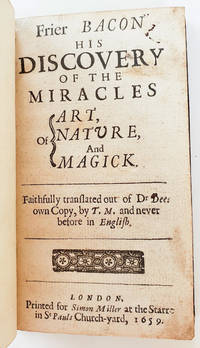
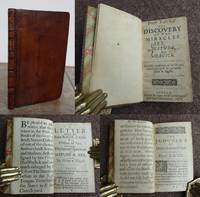
1659021560London: Simon Miller 1659. First Edition. Hardcover. Minor foxing pencil notes on endpapers; small chip to head of spine. Near Fine and very scarce. Small duodecimo 3-1/8" x 5-1/2" bound in early calf with gilt-ruled covers and gilt decoration and lettering on the spine; xii 51 7 - ads pages. First separate printing and First English Edition of Roger Bacon's letter to William of Paris that first appeared in Dee's BACON'S EPISTOLAE published in Hamburg in 1618. Bacon begins this long essay denying the existence of magic but concludes showing how to create a "Philosophers Egg." He writes about optics gunpowder Bacon is believed to have introduced gunpowder--a Chinese invention--to the West and petroleum in warfare. Bacon makes some bold futurist statements such as admirable Artificial Instruments of locomotion It's possible to make a Chariot move with an inestimable swiftnesse and this motion to be without the help of any living creature of flight It's possible to make Engines for flying a man sitting in the midst whereof by turning onely about an Instrument which moves artificiall Wings made to beat the Aire and diving A man may make an Engine whereby without any corporal danger he may walk in the bottome of the Sea or other water. Bookplate of Lord Northwick on front pastedown. <br/><br/> Simon Miller hardcover
1639141492London: Henrie Tomes and Printed by Iohn Beale 1639. full 19th-century calf border stamped in gilt on boards gilt ornamentation on spine red leather spine label in second compartment five raised bands all edges stained red. square 8vo. full 19th-century calf border stamped in gilt on boards gilt ornamentation on spine red leather spine label in second compartment five raised bands all edges stained red. 2 blanks 45 121 leaves; 1 blank iv 340 pages. First edition of the "preparative or key for the opening of the instauration" Grolier/Horblit.<BR> <br /> <BR> <br /> First edition Pforzheimer 36; Gibson 81; Grolier Langland to Wither 12; Grolier/Horblit 8a; Norman 97; Norman Library 261; STC 1164 with the newly enlarged edition ESTC S100372; Gibson 17. Perez Zagorin Francis Bacon 1999. Early 20th-century ownership inscription in ink on front free endpaper. Lacking the errata Pforzheimer however Gibson states that they are "not often found". Scuffing to the leather binding rubbing to hinges and extremities minor loss to the first two blanks two pin-point worm holes on the title page near the publisher small dampstain to top corner of leaf 10 minor margin loss to the bottom gutter of leaf 107 of Twoo Bookesthe bottom fore-edge of page 207/208 of Essayes and small worm holes on the final leaf and subsequent free endsheet. Else a near fine copy and internally very clean and free of blemishes. The variant copy with page 11 line 5 reading 'maniable' rather than 'amiable'. Many of the pages of Twoo Bookes are inconsistently paginated with hand notations in ink but the book is complete. <BR> <br /> <BR> <br /> An excellent copy of the first published work of Francis Bacon with decorative woodcut initials. Exceptionally rare. Bound in full calf circa 1818.<BR> <br /> <BR> <br /> From the Haskell F. Norman Library Christie's sale Part II June 15 & 16 1998: "The Advancement of learning was the first of two works in which Bacon expounded his philosophy of scientific method. It was expanded and latinized as De augmentis scientiarum in 1623. "In the Twoo bookes Bacon concerned himself primarily with the classification of philosophy and the sciences and with developing his influential view of the relation between science and theology" Norman. It was the only work Bacon ever published in English."<BR> <br /> <BR> <br /> The second volume bound-in The Essayes or Covnsels Civill and Morall. 1639 has the title in a woodcut border. First published in 1597 this work is the enlarged edition and perhaps the most widely read work of Bacon. "Some of the essays deal with policy for princes and men in high position. A number however are written from the viewpoint of those seeking advancement in life. Bacon proffers concise advice and judgements on civil business situations conduct and the weighing of character and motives. The work's appeal is due to the pragmatic intelligence and knowledge informing its observations which are expressed in a style employing striking images apt examples and quotations and pithy aphorisms" Zagorin p. 141. Henrie Tomes (and) Printed by Iohn Beale unknown
189500025591895. On offer is a wonderful copy of 'Etretat: Hamlet of the Setting Sun - a Norman Village and its Surroundings' by Henry Bacon 1839-1912 the American Impressionist artist. This smallish utterly charming book published by Brentano's in 1895 uniquely contains eleven original watercolor illustrations by Bacon as evidenced by his initials on a number of the drawings. This is a very unusual relic of Bacon's work beautifully executed. Overall VG. Good. 12mo - over 6¾" - 7¾" tall. Manuscript. unknown
1614703L19London: Robert Wilson 1614. Disbound. Very Good. 7" by 5.5". None. A very scarce first edition of this important treatise by Francis Bacon. Here Bacon highlights his stance against duels which he deemed to be against the will of God. This work was published as a part of James I's anti-dueling campaign. Bacon's work was one of two major treatises published on this subject at the time. The campaign was prompted by a series of high profile combats between leading courtiers in late 1613. In October of 1613 James I issued a proclamation banning the publishing or writing of works on duels. He also made the offence punishable in Star Chamber to publicise any proceedings of duels. Henry Howard the Earl of Northampton lead the campaign initially and this then fell to Sir Francis Bacon the attorney general upon Northampton's death. This work is one of the major contributions to the Jacobean anti-dueling campaign. ESTC reference No: S121055. A disbound copy of this work which is closely trimmed to the head of the title. Collated lacking the initial and final blanks. Illustrated with woodcut head pieces and initials. Sir Francis Bacon was a leading intellectual figure of sixteenth and seventeenth century Britain. He served as both the Attorney General and Lord Chancellor and was of great influence in the scientific revolution. The father of empiricism Bacon's work in the fields of science history poetry and philosophy have shaped modern life. A very scarce and important work of this topic. Disbound. Externally very smart. Inscription to the top of title obscured from close-cropping. A few light spots to the externals. Internally firmly bound. Pages are bright with occasional scattered spots to pages. Very Good Robert Wilson unknown
16145811Frankfurt: Wolfgang Richter for Anton Humm 1614. First edition. <p>First editions of these two rare works on optics by the 'Doctor Mirabilis' Roger Bacon. The Perspectiva deals with the physiology of the eye and the geometrical optics of mirrors and lenses while the Specula mathematica presents Bacon's theory of the propagation of light. "In the Specula Bacon "outlined a quantitative theory of any propagation along straight lines and so arrived at the inverse square law at least implicitly since he attributed the weakening of the action with distance to the decrease in the cone solid angle under which the acted-on body is seen by the agent" Russo.</p>. anticipated the inverse square law four centuries before Newton. <p>First editions of these two rare works on optics by the 'Doctor Mirabilis' Roger Bacon 1214/1220-1292 - 'perspectiva' for Bacon had a different meaning from today's 'perspective'. Bacon's "skill in mathematics experimental science and mechanical inventions was so remarkable for his time that . he acquired the reputation . of being a magician" Ferguson Bibliotheca Chemica I p. 65. It is appropriate that the Perspectiva and Specula mathematica are here bound together not only because they have the same publisher and date but because the subjects treated in the two works are complementary. The Perspectiva deals with the physiology of the eye and the geometrical optics of reflection and refraction while the Specula mathematica presents Bacon's theory of the propagation of light. Remarkably the latter work anticipates the inverse square law normally ascribed to Newton four centuries after Bacon. "Bacon's major claim to fame in science is that he is the first Latin Western thinker to comprehend and write on most of the ancient sources of optics. In brief he initiates the tradition of Optics/Perspectiva in the Latin world. This tradition would be formulated as teaching texts by his contemporaries Pecham and Witelo. Bacon's optics was also read and commented on in 14th century Italy especially by Lorenzo Ghiberti. It was known to and used by Leonardo Da Vinci. And it was part of the tradition of learning that led to Kepler and Descartes. In his Perspectiva and De scientia experimentali Bacon outlines a sketch for a scientific method one that takes optics as the model for an experimental science. In fact he succeeded in his endeavor in that perspectiva was added to the four traditional university subjects of the quadrivium: arithmetic geometry astronomy music" Stanford Encyclopedia of Philosophy. Part I 'Distinctio I' of the Perspectiva deals with the anatomy of the eye and the optic nerve. Bacon realised that seeing involved not just the eye but the brain and following Avicenna he divides the brain into 'cells'. In Part II Bacon recounts a whole range of optical phenomena - long sight near sight errors of vision clarity of vision on the moon on our perceptions of magnitude and so on all drawing on a wide variety of earlier sources and on experimentation. Part III deals with reflection and refraction discussing the geometry of the former in various sorts of mirrors showing a good understanding of focal point and focal plane. The Perspectiva concludes with Bacon's treatise De speculis comburentibus a commentary on the last proposition of Euclid's De speculis by means of an analysis of burning mirrors and the passage of light through small apertures. The Specula mathematica contains a long discussion of the usefulness of mathematics "the door and key to all knowledge" p. 2 but most importantly includes his treatise De specierum multiplicatione which "is acknowledged by him as the key to his Optics" ibid. It is in this work that Bacon discusses radiation. As Lindberg puts it "This is a complete physical and mathematical analysis of the radiation of force - and thus of natural causation." The Perspectiva and Specula mathematica formed parts V and IV respectively of Bacon's six-part Opus majus composed in 1266-67 but not published in its entirety until 1733. But both were soon disseminated as separate works and they served as important textbooks throughout the 14th to 16th centuries. The reason for their late publication is unknown.</p> <br /> <p>"Nobody contributed more to the development of the science of perspectiva in the West than Roger Bacon. On the methodological issues that separated Robert Grosseteste c. 1158-1253 and Albert the Great c. 1200-1280 Bacon dismissed Albert's opinion nearly as enthusiastically as he praised Grosseteste's. Although Bacon did not study under Grosseteste and may never even have met him he did have access to Grosseteste's library left to the Franciscan convent in Oxford and was clearly inspired by his example. However Bacon was also powerfully moved by sources that had been unavailable to Grosseteste principally the optical works of Ptolemy and Alhacen where the promise of geometrical optics had been much more completely fulfilled.</p> <br /> <p>"Thus Bacon even more than Grosseteste became an apostle of the application of mathematical method as the gate and key to all subjects claiming for example that 'no science can be grasped without this science mathematics and . nobody can perceive his ignorance in other sciences unless he is excellently informed in this one. Nor can things of this world be known nor can man grasp the uses of body and things unless he is imbued with the mighty works of this science' . Following Alhacen's lead Bacon applied geometrical analysis to optical phenomena wherever promising and possible given the conceptual framework and the mathematical techniques available to him thereby pushing the mathematization of light and vision as far as it would go before the seventeenth century .</p> <br /> <p>"Several examples will serve as illustrations. First the magnitude of Bacon's commitment to a mathematical analysis is superficially apparent from a glance at his Perspectiva which contains fifty-one geometrical diagrams or his On the Multiplication of Species which contains thirty-nine all fully integrated into the argument of their respective treatises. Second Bacon's works reveal a complete mastery of the geometry of reflection and image-formation in plane convex and concave mirrors" Lindberg & Tachau pp. 501-502.</p> <br /> <p>"Bacon fully understood and successfully communicated the basic geometrical principles governing reflection in plane concave and convex mirrors; the equality of the angles of incidence and reflection; location of the images of objects seen by reflection at the intersection of the rectilinear extension of the visual ray issuing from the eye or the reflected luminous ray entering the eye since Bacon could conceptualize the problem either way and the perpendicular drawn from the visible point to the reflecting surface the cathetus. He also dealt successfully with questions of the magnification and diminution and the inversion and reversal of images; and his analysis of image formation in convex spherical mirrors implicitly embodied the concepts of focal point and focal plane . Bacon's geometrical analysis of the phenomena of refraction was equally successful. He revealed no interest in the quantitative problem of discovering an algebraic or trigonometrical law of refraction. Ptolemy had already made a serious attempt in that direction and Bacon was undoubtedly familiar with it. Bacon aimed only to establish the geometrical and thus qualitative principles governing refraction at interfaces of various shapes separating media of different densities. He understood that radiation is refracted when passing from one medium to another in such a way as to fall closer to the perpendicular in the denser medium; he knew also that the image of an object seen by refracted rays is situated at the intersection of the rectilinear extension of the visual ray emerging from the eye or the luminous ray entering the eye and the perpendicular drawn from the visible point to the refracting interface; and he understood that the degree of refraction depended on the relative transparencies we would say 'optical densities' of the two media. To display these principles he offered a successful geometrical analysis of ten cases of refraction at plane and spherical interfaces each illustrated with a geometrical diagram.</p> <br /> <p>"There is a temptation for those of us who have received a modern education in the physical sciences to regard the successful geometrical analysis of reflection and refraction as obvious and inevitable. We must remind ourselves therefore that taking a geometrical approach to problems of the propagation of light seems self-evidently efficacious to us only because of our membership in or encounter with the tradition of geometrical optics on which Bacon was in the Latin world one of the founding fathers. There was nothing obviously efficacious about the geometrical mode of analysis until he and others made it obvious" Lindberg 1996 pp. xlv-xlvi. </p> <br /> <p>"We can see the depth of Bacon's commitment to the mathematization of optical phenomena in a third example - Bacon's remarkable supposition following Alhacen that the visual apparatus and the very act of vision will submit to geometrical analysis. According to Bacon all of the tunics and humors of the eye cornea crystalline lens aqueous and vitreous humors and retina are defined or enclosed by spherical surfaces the centers of which are situated on a straight line running from the center of the pupil at the front to the opening into the optic nerve at the back. He believed as Alhacen had taught that only rays incident on the eye perpendicularly which enter it without refraction are capable of stimulating the eye's visual capabilities. These perpendicular rays form a cone or pyramid extending from the visual object as base toward an apex which the rays never actually achieve at the center of the observer's eye. The rays that make up this visual cone pass without refraction through the cornea and front surface of the crystalline lens which are concentric so that a ray perpendicular to the one will be perpendicular to the other. At the rear surface of the crystalline lens they are refracted in such a way as to be projected through the opening of the optic nerve which conducts them to its point of union with the other optic nerve our optic chiasma. There the completion of vision occurs as the species from the two eyes join to form a single image. That image in turn continues to multiply itself into the three chambers of the brain that house the five inner senses defined in Avicenna's On the Soul. Although Bacon's theory contains much more detail a striking feature of his quest to understand the act of vision is his willingness following Al-kindi Grosseteste and especially Alhacen to extend mathematical analysis to something so apparently unmathematical as human anatomy" Lindberg & Tachau pp. 502-503.</p> <br /> <p>The Perspectiva also contains Bacon's treatise De speculis comburentibus p. 168 et seq. "The problem was the classic one of explaining how radiation from a spherical body such as the sun passing through a small triangular or rectangular aperture can produce a circular image . In the long run his analysis does not succeed as Kepler was to make clear but it was thorough intelligent influential and above all geometrical; it taught Bacon's successors that the solution to the problem was to be sought in a geometrical analysis of the modes of radiation" Lindberg 1996 pp. xlix-l.</p> <br /> <p>"Bacon's treatise De multiplicatione specierumcontained in the Specula mathematica his major later work on physics written before 1267 is closely related to the study of light vision and perception in the Perspectiva. Bacon takes Grosseteste's physics of light a development of Al-Kindi's universal radiation of force out of its metaphysical background and develops a universal doctrine of physical causation . What Bacon achieves is a comprehensive theory of physical force divorced from psychological moral and religious interpretation . The use of 'species' in this account . is 'the force or power by which any object acts on its surroundings' . As Bacon himself notes 'species force power is the first effect of an agent . the agent sends forth a species into the matter of the recipient so that through the species first produced it can bring forth out of the potentiality of matter of the recipient the complete effect that it intends. This is a universal theory of natural causation as the background for his philosophy of vision and perception. Most importantly species is a univocal product of the agent. The first immediate effect of any natural action is definite specific and uniform. This production is not the imparting or imposition of an external form. The effect of the species is to bring forth the form out of the active potency of the recipient matter' Lindberg 1983 pp. 6-7.</p> <br /> <p>Bacon "outlined a quantitative theory of any propagation along straight lines and so arrived at the inverse square law at least implicitly since he attributed the weakening of the action with distance to the decrease in the cone solid angle under which the acted-on body is seen by the agent Specula Distinctio III Caput II. Bacon calls multiplicatio secundum figuras the law of dependence on distance of an action that radiates in all directions along straight lines and he adds that the lines along which it radiates terminate in the concave surface of a sphere ibid. II III" Russo p. 377. Bacon applied his general theory of the propagation of species to optics: species - in this case light and colour - emanate in every direction from every point of the surface of a visible object and do this continuously; the path is represented by straight lines or rays.</p> <br /> <p>The Specula mathematica also deals as its title suggests "with mathematics and the applications of mathematics. Bacon presents reasons for a reduction of logic to mathematics a kind of reversal of modern logicism and sees mathematics as the key to an understanding of nature. Clearly he is proclaiming the 'usefulness' of mathematics for knowledge; he is not doing mathematical theory. And the branch of mathematics that is important here is geometry. Following his abbreviation of the De multiplicatione specierum in part four of the Great Work which shows how mathematics might be applied to physics he deals with the application of astronomy/astrology to human affairs the uses of mathematics in religious rites as in chronology music symbolism calendar reform and geographical knowledge and a resume of astrology . Bacon was very interested in the applications of astronomy/astrology to human events . Although committed to freedom of the will Bacon held to a deterministic notion of causation in nature based on the Introductorium Maius in Astronomiam of the Islamic authority on Astrology Albumassar on the De radiis of al-Kindi and on the Centiloquium by Pseudo-Ptolemy Ahmed Ibn Yusuf. And since he held to a doctrine of universal radiation in nature he had to account for the influence of the heavens on the human body and hence indirectly on the human mind. Much of the polemic in his later works consists of a justification of this interest in an astrologically necessitated universe in the face of traditional theological objections. These works play a big role as background for his natural philosophy in De multiplicatione specierum" Stanford Encyclopedia of Philosophy.</p> <br /> <p>"Bacon was a transitional figure of great importance who played a critical role in the transmission of Greek and Islamic learning to medieval Europe. It was he more than any other who introduced Latin Christendom to the mathematical optics of Euclid Ptolemy Alkindi and Alhacen; who synthesized their works clarifying and exhibiting their methodological achievement; and who consequently stood at the head of the European tradition in geometrical optics" Lindberg 1997 p. 273.</p> <br/> <br/> Two works bound in one volume 4to 200 x 155mm pp. viii 207 with four leaves of plates of woodcut diagrams printed on recto and verso between pp. 160 & 161 numerous woodcut diagrams in text last two pages misnumbered 204 & 189 as usual gathering c misbound but complete; pp. viii 83 woodcut diagrams in text light browning and foxing in both works. Contemporary blind-ruled vellum with later black lettering-piece on spine a bit soiled. Wolfgang Richter for Anton Humm unknown
2124917London: John Haviland for Hanna Barret and Richard Whitaker. 1625. 4to. Twentieth-century crushed red morocco by Sangorski & Sutcliffe front turn-in signed in gilt ruled in gilt spine lettered directly in gilt and gilt-ruled in compartments raised bands edges gilt turn-ins richly gilt; pp. 9 1 blank 340; bound without blank leaf A1; A2-A4 a2 B-Z4 2A-2V4 2X2; hinges cracked but holding firm slight offsetting to endpapers; sporadic light spotting heavier to quires and 2K-2L uniform light toning small rust-mark to ff. O4-P2 with resultant hole to P2 touching two characters; else a handsome copy.Handsome first issue of the first complete edition of Bacon's Essayes enlarged 'both in Number and Weight . So that they are indeed a New Worke' the last edition of the work to appear in his lifetime.First published in 1597 as a modest octavo collection of ten texts Bacon's Essayes was successively enlarged and revised over nearly three decades. The present 1625 edition the twelfth overall is the first to contain the full complement of fifty-eight essays and represents the definitive form of one of the great monuments of English prose. This is the first issue with 'newly enlarged' on the title-page and Whitaker's name in the imprint. In addition to nineteen new essays this edition presents a completely revised version of the whole collection. Earlier essays were carefully reworked: phrasing was refined illustrative material drawn from his reading introduced and arguments expanded by the addition of sentences or whole sections. Several pieces were entirely recast in a more formal and structured manner while others retain or deliberately recover the spare and aphoristic character of the earliest essays. The work thus displays a deliberate variety of form reflecting both the evolution of Bacon's thought and his sustained experimentation with the genre.Across its successive versions the Essayes reveal an increasing preoccupation with civil life and public affairs shaped by changing political circumstances as well as by Bacon's own career as lawyer courtier statesman philosopher and moralist. Several of the new essays address matters of immediate relevance to the reign of James I including economic policy in 'Of Usury' and colonial enterprise in 'Of Plantations' while 'Of Revenge' reflects contemporary concern with duelling. Elsewhere existing essays are enlarged in ways that sharpen their political application: 'Of the true Greatness of Kingdoms and Estates' expands its consideration of military strength; 'Of Nobility' develops its treatment of the relationship between aristocracy and crown; and 'Of Empire' gains a substantial new section examining the prince's dealings with the various estates of the realm and the dangers attendant upon a failure of prudent governance.Bacon himself took a close interest in the production of the volume intervening in the printing process to make stop-press corrections. The 1625 edition 'is the text most commonly reprinted today. For this reason it ranks in importance with the first of 1597' Pforzheimer.Hanna Barret was seemingly the widow of William Barret; she 'published several works - notably the productions of Montaigne Bishop Hall Sandys and Bacon - between the years 1608 and 1624. Hanna Barret either retired from business or died in 1625 for we do not after that date meet with any examples of her publications' Shakesperiana V 1888 p. 479.Provenance: Thomas Burdett Money-Coutts 7th Baron Latymer 1901-1987 his sale Sotheby's 15 December 1988 lot 1 with loosely inserted catalogue cutting.ESTC S124226; Gibson 13; for the second issue see Pforzheimer 30 and Gibson 14. hardcover
16269176<p>Gilt paneled full red morocco; five raised bands; gilt particulars to spine. Marbled endpapers and heavily gilt dentelles. First edition first issue with printed title dated 1626. Rebacked portrait frontispiece and additional engraved pictorial title dated 1627. The "New Atlantis" bound to rear with its own pagination and title page. Edward Micholls Henriques' armoreal bookplate to front pastedown; John Crooks signature above frontis; Richard Rockliffe signature to second Title. Frontis portrait rebacked see images 1 & 5 with restoration to borders see image5. Light moisture marks to occasional page edges. 14 266 14 47 3 pages. This copy trimmed to 7 x 10.25 inches and five blank leaves as well as blank fly leaves removed at time of rebinding.</p><p>Blank Engraved 1626 Title Engraved 1627 Title Blank 1626 Title Blank Two page Dedication; A1-I4; K1-L2; L4-T4; V1-V4; X1-Z4; Aa2-Dd2; Dd4-Ll4; Mm2-Nn-2; a1-g3</p> Printed by J. H. [John Haviland] for William Lee at the Turkes Head in Fleet-Street hardcover
16187294JUSTIFICATION FOR RALEIGH'S EXECUTION<br /><br /><b>BACON SIR FRANCIS and King James I. </b><i><b>A Declaration of the Demeanor and Cariage of Sir Walter Raleigh Knight as well in his Voyage as in and sithence his Returne; And of the true motives and inducements which occasioned His Maiestie to Proceed in doing Iustice upon him as hath bene done.</b></i><br /><br />Extra <b>illustrated </b>with full-page frontispiece portrait of Raleigh. 8vo. Bound in full modern calf gilt lettering on spine. London Printed by Bonham Norton and John Bill<b> 1618. First Edition. First Issue.</b> <br /><br /><b>With an early 17th-century inscription on the title page:</b> "<i>From his very much esteemed friend Raleigh</i>." It is thought that this might be an inscription by Raleigh's cousin George. The inscription is slightly faded from having been lightly washed. <br /><br />This is the official apologia for Raleigh's execution at the order of King James I. It was composed largely by Francis Bacon but also by the other commissioners who tried Raleigh and with additions by King James himself. It was published only a few months after the events it describes and as quickly as possible following Raleigh's beheading. <br /><br /><br />Starkey's article on the publication history of this book published in '<i>The Library'</i> in September of 1948 defined the first issue in conformity with this copy. His analysis is generally considered to supersede Pforzheimer's earlier analysis as well as that of the first edition of STC both of which identified a different first issue. Since Starkey's article STC has revised its entry assigning first issue priority to the issue offered here. <br /><br />Bacon began his prosecution by asserting that it was not ever a Sovereign's duty to justify himself to his people but that Raleigh's final speech had made it necessary to explain why his execution was deserved. Bacon then helpfully revised King James' assent to Raleigh's disastrous expedition to Guiana to conform to a magnanimous gesture. James had not it turned out believed in the existence as such of a 'City of Gold' but had humored and indulged Raleigh because of his influence and popularity. As it is written in this work probably by Bacon: "<i>Sir W. Rawleigh had so inchanted the world with his confident asseveration of that which every man was willing to beleeve as his maiesties honour was in a manner ingaged not to deny unto his people the adventure and hope of so great Riches to bee sought and atchieved at the charge of Voluntaries.</i>" <br /><br /><br />The work includes in full and for the first time in print the commission given to Raleigh for his Voyage and gives an account of how he betrayed this commission. Finally it gives a short account of Raleigh's voyage and supposed misdeeds as well as a detailed account of Raleigh's return and his purported attempts to escape. <br /><br />The volume is complete save the initial blank leaf which is absent from nearly all copies. The upper margin is trimmed a little closely touching some of the page numbers o/w a fine clean copy. <br /> Bonham Norton and John Bill hardcover
165952245<p>London printed for Simon Miller at the Starre in St Pauls Church-yard 1659. FIRST ENGLISH EDITION 1659 small book 12mo approximately 130 x 80 mm 5¼ x 3 inches pages: 12 1-51 plus 7 pages of publisher's adverts endpapers replaced at sometime collates as ESTC R10803. Bound in full calf rebacked using original spine gilt title marbled endpapers. Slight rubbing to hinges tips of corners worn with board just showing top margin slightly trimmed affecting running title on 9 pages pale browning to title page and following page tiny rust hole to second page of adverts affecting 1 word recto and 1 letter veso pages 17-19 have neat old ink name against the experiment otherwise a very good copy. A student of Aristotle Roger Bacon was one of the earliest European proponents of experimental research. His writings are also notable for including descriptions of vehicles flying machines diving bell etc. See: A Catalogue of Printed Books in the Wellcome Library Volume 2 page 83; George Thomason Catalogue of books relating to the English Civil War Volume 2 page 274 E. 1932 1. MORE IMAGES ATTACHED TO THIS LISTING ALL ZOOMABLE FURTHER IMAGES ON REQUEST. POSTAGE AT COST.</p> London, printed for Simon Miller at the Starre in St Pauls Church-yard, 1659. hardcover