Marshman, Joshua [Confucius]Biblio.com
429 résultats
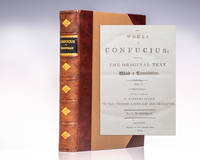
1809149588Serampore: Printed at the Mission Press 1809. First English translation of the Analects of Confucius printed at Serampore the first major center of English printing in Chinese. Quarto Vol. I all published bound in modern half calf gilt-lettered morocco spine label gilt stamping to the spine in six compartments within raised gilt bands half-title 4pp. errata Chinese and English text without the 'Dissertation on the Chinese Language and Character' and its four tables and the 17pp. postscript. In very good condition. A very nice example. The first English translation of the Analects Lunyu of Confucius Baptist missionary Marshman's translation contains the first five of twenty books and was printed at Serampore the first major center of English printing in Chinese. The first complete translation by James Legge was published decades later in 1861. A collection of sayings attributed to Confucius the Analects were likely compiled posthumously by his followers. The Analects' reputation grew to surpass that of the Five Classics and became one of the texts underpinning the Confucian system which held sway over China for two millennia. Joshua Marshman William Carey and William Ward established a Baptist mission and press at Danish-controlled Serampore in 1800 beyond the control of the East India Company. The Company discouraged missionary activity and maintained a policy of press censorship within its territories. Marshman and his fellow missionaries had ambitious plans for proselytizing across Asia and he had studied Arabic Greek Hebrew Latin and Syriac before he even reached India. In India he first learned Bangali and Sanskrit. Next he turned to Chinese which he studied intensively under the guidance of Johannes Lassar scion of a wealthy Armenian trading family in Macao and assisted by several Chinese tutors. This book dates from the first phase of Chinese language printing in Serampore with Chinese character printed using woodblock characters carved by Bengali textile workers whose carved woodblocks were employed to print patterns onto calico. The second phase would only being in 1813 when moveable metal type replaced woodblocks which enormously increased efficiently as it permitted many more impressions. The Chinese publications for the Mission Press were principally evangelical; Lassar and Marshman translated large sections of the Old and New Testaments into Chinese and saw Serampore as an ideal position from which to spread the Chinese gospel free from imperial Chinese censorship. The East India Company too was increasingly interested in the study of Chinese for political reasons. Their Indian territories abutted the Chinese forts in Tibet and the memory of Macartney's diplomatic failure in 1792 remained fresh. Another diplomatic mission would require translators and the Company had no competent Chinese interpreters in India at the turn of the century. Marshman dedicated this work toe the Governor-General of Bengal Lord Minto who subsidized the cost of printing in Chinese at Serampore despite his personal hostility to missionary activity with British India. Printed at the Mission Press unknown
16911091London: Randal Taylor 1691. First Edition. 8 vo. pp xvi 142. 1st edition in English of any of Confucius’ writings translated from the 1687 Latin edition of Prospero Intocetta Philippe Couplet et all and guided by an intervening French translation attributed to either/both Louis Cousin or/and Jean de la Brune. Contemporary speckled calf paper flaws to the margins of A4 and H4 without loss to text chips to the margins of L1 and L7 without loss ownership signature to the upper margin of the advertisement page endpapers not quite a match internally clean skillful repairs to the joins else a near fine copy and other copies aren’t. Wing C5806. This is the real 1st edition with the collation xvi 142pp A C–L and not to be confused with the 1780 reprint which duplicated the 1st edition exactly including the 1691 date a false imprint and varied only in its collation and often sold as the 1st edition. Most library holdings are either the 1780 reprint miscataloged or electronic copies of the 1691 1st edition held in The British Library. A scarce book in commerce with only one copy of the first edition an inferior one selling at auction in the last 40 years.<br /> <br /> The teachings of Confucious shaped Chinese civilization for over two millennia. His emphasis on moral cultivation proper social relationships and ethical governance formed the foundation of Confucianism which became the state ideology of imperial China. Randal Taylor unknown
46947Paris : Daniel Horthemels 1687. First edition. Folio contemporary speckled calf rebacked preserving the original spine in compartments with raised bands gilt ornamentation and lettering book labels for Levenside and H.P. Kraus to front pastedown front free endpaper detached pp. cxxiv; 108; 21; iii - blanks; 159; blank; xx; 108; 8; I - privilege blank copperplate map of China folding portrait of Confucius the first published in Europe engraved headpiece woodcut headpieces tail pieces and ornamental initials a fine copy. The first edition of Confucius published in Europe preceded only by fragmentary translations. Edited by Prospero Intorcetta 1626-1696 Chrétien Herdtrich 1625-1684 François de Rougemont 1624-1676 and Philippe Couplet 1623-1692 the translation was undertaken under special license from Louis XIV by members of the Jesuit Society. In addition to a translation of the three principal books of Confucius the work includes his biography valuable essays on Chinese history and culture and much other factual information on China. Brunet II 2221; Cordier Sinica I 1389-1393; Lust 724; Morrison 438-439; Pei-tang 1358; Pfister 326-327. hardcover
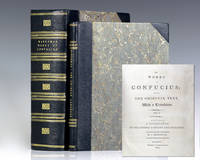
1809131224Serampore: Printed at the Mission Press 1809. First English translation of the Analects of Confucius complete with the rare Dissertation on the Chinese Language and Character here bound in a separate volume. Quarto two volumes bound in three quarter morocco over marbled boards with gilt titles and tooling to the spine in six compartments within raised gilt bands illustrated with 2 folding charts on Chinese characters 4 further tables on 2 folding leaves postscript at rear. In fine condition. Exceptionally rare particularly with Marshman's separately printed dissertation present including the tables and charts. The first English translation of the Analects Lunyu of Confucius Baptist missionary Joshua Marshman's translation contains the first five of a projected series of twenty books and was printed at Serampore the first major center of English printing in Chinese. The first complete translation by James Legge was published decades later in 1861. A collection of sayings attributed to Confucius the Analects was one of the primary texts underpinning the Confucian system which held sway over China for two millennia. Confucius believed that the welfare of a country depended on the moral cultivation of its people beginning from the nation's leadership and taught that a ruler's sense of virtue was his primary prerequisite for leadership. His primary goal in educating his students was to produce ethically well-cultivated men who would carry themselves with gravity speak correctly and demonstrate consummate integrity in all things. Joshua Marshman William Carey and William Ward established a Baptist mission and press at Danish-controlled Serampore in 1800 beyond the control of the East India Company. The Company discouraged missionary activity and maintained a policy of press censorship within its territories. Marshman and his fellow missionaries had ambitious plans for proselytizing across Asia and he had studied Arabic Greek Hebrew Latin and Syriac before he even reached India. In India he first learned Bangali and Sanskrit. Next he turned to Chinese which he studied intensively under the guidance of Johannes Lassar scion of a wealthy Armenian trading family in Macao and assisted by several Chinese tutors. This book dates from the first phase of Chinese language printing in Serampore with Chinese characters printed using woodblocks carved by Bengali textile workers employed to print patterns onto calico. The Chinese publications for the Mission Press were principally evangelical; Lassar and Marshman translated large sections of the Old and New Testaments into Chinese and saw Serampore as an ideal position from which to spread the Chinese gospel free from imperial Chinese censorship. The East India Company too was increasingly interested in the study of Chinese for political reasons. Their Indian territories abutted the Chinese forts in Tibet and the memory of Macartney's diplomatic failure in 1792 remained fresh. Another diplomatic mission would require translators and the Company had no competent Chinese interpreters in India at the turn of the century. Marshman dedicated this work to the Governor-General of Bengal Lord Minto who subsidized the cost of printing in Chinese at Serampore despite his personal hostility to missionary activity with British India. Printed at the Mission Press hardcover