1 170 résultats
1968Q-0691019606Princeton University Press 1968-11-21. Paperback. New. New. In shrink wrap. Looks like an interesting title! Princeton University Press paperback
0691622337.Gpaperback. Good. Access codes and supplements are not guaranteed with used items. May be an ex-library book. paperback
1992SKU0505611Princeton University Press 1992-04-15. Paperback. Good. Textbook May Have Highlights Notes and/or Underlining BOOK ONLYNO ACCESS CODE NO CD Ships with Emailed Tracking Princeton University Press paperback
1992SKU0509300Princeton University Press 1992-06-15. Paperback. Good. Textbook May Have Highlights Notes and/or Underlining BOOK ONLYNO ACCESS CODE NO CD Ships with Emailed Tracking Princeton University Press paperback
0691020825.Gpaperback. Good. Access codes and supplements are not guaranteed with used items. May be an ex-library book. paperback
2009x-0521709105Cambridge University Press 2009. Paperback. New. 1st edition. 600 pages. 8.80x5.90x1.10 inches. Cambridge University Press paperback
2019x-0691622337Princeton Univ Pr 2019. Paperback. New. 368 pages. 8.00x5.25x1.18 inches. Princeton Univ Pr paperback
1992126977Princeton: Princeton U. P. 1992. reprint. Nice copies. octavo. softbacks with stiff wrappers xi 630 xix 345pp. notes indexes ÔSoren Kierkegaard's Concluding Unscientific Postscript has provoked a lively variety of divergent interpretations for a century and a half. It has been both celebrated and condemned as the chief inspiration for twentieth-century existential thought as a subversive parody of philosophical argument as a critique of mass society as a forerunner of phenomenology and of postmodern relativism and as an appeal for a renewal of religious commitmentÕ Princeton U. P. unknown
1992036271Princeton University Press 1992. Soft Cover. Fine Like New. Fine Like New. Appears unread. Size: 8vo - over 7¾" - 9¾" tall Princeton University Press paperback
199290322Princeton NJ U.S.A.: Princeton University Press. New. 1992. Hardcover. 0691073953 . FREE UPGRADE to Courier/Priority Shipping Upon Request - IN STOCK AND IMMEDIATELY AVAILABLE FOR SHIPMENT - Flawless copy brand new pristine never opened - Corresponds to TWO 2 VOLUME SET that includes ISBN: 0691073953. VOLUMES I 630 pages and II 345 pages - Book description: " In 'Philosophical Fragments' the pseudonymous author Johannes Climacus explored the question: What is required in order to go beyond Socratic recollection of eternal ideas already possessed by the learner Written as an afterword to this work 'Concluding Unscientific Postscript' is on one level a philosophical jest yet on another it is Climacus's characterization of the subjective thinker's relation to the truth of Christianity. At once ironic humorous and polemical this work takes on the 'unscientific' form of a mimical-pathetical-dialectical compilation of ideas. Whereas the movement in the earlier pseudonymous writings is away from the aesthetic the movement in 'Postscript' is away from speculative thought. Kierkegaard intended 'Postscript' to be his concluding work as an author. The subsequent 'second authorship' after 'The Corsair Affair' made 'Postscript' the turning point in the entire authorship. Part One of the text volume examines the truth of Christianity as an objective issue Part Two the subjective issue of what is involved for the individual in becoming a Christian and the volume ends with an addendum in which Kierkegaard acknowledges and explains his relation to the pseudonymous authors and their writings. The second volume contains the scholarly apparatus including a key to references and selected entries from Kierkegaard's journals and papers. " -- with a bonus offer--; . Princeton University Press hardcover
199290323Princeton NJ U.S.A.: Princeton University Press. New. 1992. Hardcover. 069107402X . FREE UPGRADE to Courier/Priority Shipping Upon Request - IN STOCK AND IMMEDIATELY AVAILABLE FOR SHIPMENT - Flawless copy brand new pristine never opened - Corresponds to TWO 2 VOLUME SET that includes ISBN: 069107402X. VOLUMES I 630 pages and II 345 pages - Book description: " In 'Philosophical Fragments' the pseudonymous author Johannes Climacus explored the question: What is required in order to go beyond Socratic recollection of eternal ideas already possessed by the learner Written as an afterword to this work 'Concluding Unscientific Postscript' is on one level a philosophical jest yet on another it is Climacus's characterization of the subjective thinker's relation to the truth of Christianity. At once ironic humorous and polemical this work takes on the 'unscientific' form of a mimical-pathetical-dialectical compilation of ideas. Whereas the movement in the earlier pseudonymous writings is away from the aesthetic the movement in 'Postscript' is away from speculative thought. Kierkegaard intended 'Postscript' to be his concluding work as an author. The subsequent 'second authorship' after 'The Corsair Affair' made 'Postscript' the turning point in the entire authorship. Part One of the text volume examines the truth of Christianity as an objective issue Part Two the subjective issue of what is involved for the individual in becoming a Christian and the volume ends with an addendum in which Kierkegaard acknowledges and explains his relation to the pseudonymous authors and their writings. The second volume contains the scholarly apparatus including a key to references and selected entries from Kierkegaard's journals and papers. " -- with a bonus offer--; . Princeton University Press hardcover
199219960Princeton NJ U.S.A.: Princeton University Press. New. 1992. Paperback. 0691020825 . FREE UPGRADE to Courier/Priority Shipping Upon Request - IN STOCK AND IMMEDIATELY AVAILABLE FOR SHIPMENT - FLAWLESS COPY BRAND NEW PRISTINE NEVER OPENED 345 pages-- From the description on the back cover: " In 'Philosophical Fragments' the pseudonymous author Johannes Climacus explored the question: What is required in order to go beyond Socratic recollection of eternal ideas already possessed by the learner Written as an afterword to this work 'Concluding Unscientific Postscript' is on one level a philosophical jest yet on another it is Climacus's characterization of the subjective thinker's relation to the truth of Christianity. At once ironic humorous and polemical this work takes on the 'unscientific' form of a mimical-pathetical-dialectical compilation of ideas. Whereas the movement in the earlier pseudonymous writings is away from the aesthetic the movement in 'Postscript' is away from speculative thought. Kierkegaard intended 'Postscript' to be his concluding work as an author. The subsequent 'second authorship' after 'The Corsair Affair' made 'Postscript' the turning point in the entire authorship. Part One of the text volume examines the truth of Christianity as an objective issue Part Two the subjective issue of what is involved for the individual in becoming a Christian and the volume ends with an addendum in which Kierkegaard acknowledges and explains his relation to the pseudonymous authors and their writings. The second volume contains the scholarly apparatus including a key to references and selected entries from Kierkegaard's journals and papers." -- with a bonus offer--; . Princeton University Press paperback
196818450Princeton University Press. As New. 1968. Paperback. 0691019606 . FREE UPGRADE to Courier/Priority Shipping Upon Request - IN STOCK AND IMMEDIATELY AVAILABLE FOR SHIPMENT - Text block clean & unmarked - -- with a bonus offer-- . Princeton University Press paperback
35576128-nnew. unknown
35576128like new. unknown
THPU-63754Hardcover. NEW. US Standard Edition. We will ship same day or next day with trackable delivery method. Expedited Shipping Available. We don't entertain INTERNATIONAL orders ATM. 30-day money-back guarantee. hardcover
35576130-nnew. unknown
35576130like new. unknown
1944801Princeton University Press 1944. Near Fine/Very Good. 8vo navy blue cloth gilt titles blue topstain 577pp. Stated second printing 1944. Unclipped dust jacket 6.00 moderately rubbed to panels small chips to spine edges. Contents clean binding firm. ‘A Mimic-Pathetic-Dialectic Composition An Existential Contribution’ Originally published in 1846 as a postscript to the Philosophical Fragments under the pen name Johannes Cliamcus. Examines the objective and subjective truth of Christianity and Kierkegaard’s concept of truth as subjectivity. A nearly fine copy in a very good dust jacket preserved in mylar. Princeton University Press unknown
0691071063.Ghardcover. Good. Access codes and supplements are not guaranteed with used items. May be an ex-library book. hardcover
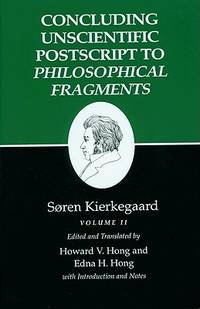
1992L3 box733 a1v1v2<p>Concluding Unscientific Postscript to Philosophical Fragments by Soren Kierkegaard. Two Volume Set; Volume 1: Text; Volume 2: Historical Introduction Supplement Notes and Index. Kierkegaard's Writings Volumes 12.1 and 12.2. Edited and Translated with Introduction and Notes by Howard V. Hong Edna H. Hong. 1992 by Princeton University Press. Hardcover two volumes total 1008 pages: 642 pp Volume 1 366 pp Volume 2.</p> Princeton University Press hardcover
A9780691622330Paperback / softback. New. Contents include: Foreword Editor's Preface Introduction by the Editor Preface Introduction BOOK ONE: The Objective Problem Concerning the Truth of Christianity Introductory Remarks Chapter I: The Historical Point of View 1. The Holy Scriptures 2. The Church 3. The Proof of the Centuries for the Truth of Christianity Chapter II: The Speculative Point of View BOOK TWO: The Subjective Problem The Relation of the Subject to the Truth of Christianity The Problem of Becoming a Christian PART ONE: Something About Lessing Chapter I: An Expression of Gratitude Chapter II: Theses Possibly or Actually Attributable to Lessing 1. The subjective existing thinker has regard to the dialectics of the process of communication 2. The existing subjective thinker is in his existential relation to the truth as negative as he is positive; he has a much humor as he has essential pathos; and he is constantly in process of becoming i.e. he is always striving 3. Lessing has said that accidental historical truths can never serve as proofs for eternal truths of the reason; and that the transition by which it is proposed to base an eternal truth upon historical testimony is a leap 4. Lessing has said that if God held all truth in His right hand and in His left the lifelong pursuit of it he would choose the left hand A. A logical system is possible B. An existential system is possible PART TWO: How the Subjectivity of the Individual Must be Qualified in Order that the Problem May Exist for Him Chapter I: The Task of Becoming Subjective. The conclusion that would be forced upon ethics if the attainment of subjectivity were not the highest task confronting a human being-Considerations left out of account in connection with the closer understanding of this-Examples of thinking directed towards becoming subjective Chapter II: The Subjective Truth Inwardness; Truth is Subjectivity Appendix. A Glance at the Contemporary Effort in Danish Literature Chapter III: Real or Ethical Subjectivity-The Subjective Thinker 1. Existence and Reality 2. Possibility as higher than Reality-Reality as higher than Possibility-Poetic and Intellectual Ideality-Ethical Ideality 3. The Simultaneity of the Individual Factors of Subjectivity in the Existing Subject-The Constrast between this Simultaneity and the Speculative Process 4. The Subjective Thinker-his Task his Form his Style Chapter IV: The Problem of the Fragments: How can an Eternal Happiness be based upon Historical Knowledge Section I. For Orientation in the Plan of the Fragments 1. That the point of departure was taken in the pagan consciousness and why 2. The importance of a preliminary agreement concerning what Christianity is before there can be any question of mediating between Christianity and speculative thought. The absence of such an agreement favors the proposal of medication while at the same time making any mediation illusory; the presence of such an agreement precludes mediation 3. The problem of the Fragments viewed as a problem introductory not to Christianity but to becoming a Christian Section II. The Problem Itself. The eternal happiness of the individual is decided in time through the relationship to something historical which is furthermore of such a character as to oinclude in its composition that which by virtue of its essence cannot become historical and must therefore become such by virtue of the absurd A. Existential Pathos 1. The Initial Expression for Existential Pathos: the absolute direction respect toward the absolute telos expressed in action through the transformation of the individual's existence Aesthetic Pathos-The deceptiveness of the principle of mediation-The medieval monastic movement-The simultaneous maintenance of an absolute relationship to the absolute telos and a relative relationship to the relative ends 2. The Essential Expression for Existential pathos: Suffering-Fortune and misforutne as the expression for an aesthetic view of life in constradistinction to suffering as the expression of a religious view illustrated by reference to the religious discourse-The Reality of suffering humor-The reality of suffering in the last instance as evidence for the possession by the existing individual of a relationship to an eternal happiness-The illusion of religiosity-The category of Anfechtung-The primary ground and significance of the religious suffering: The dying away from the life of immediacy while still remaining in the finite-An edifying divertisement-Humor as an incognito for religiosity 3. The Decisive Expression for existential pathos: Guilt-That the investigation goes backward instead of forward-The eternal recollection of guilt is the highest expression for the relation between the consciousness of guilt and an eternal happiness-Lower expressions for the consciousness of guilt and corresponding forms of satisfaction-Self-imposted penance-Humor-The religiosity of hidden inwardness Intermediate Clause between A and B B. The Dilectical 1. The dialectical contradiction which constitutes the breach: to expect an eternal happiness in time through a relationship to something else in time 2. The dialectical constradiction that an eternal happiness is based upon something historical 3. The dialectical contradiction that the historical fact here in question is not a simple historical fact but is constituted by that which only against its nature can become historical hence by virtue of the absurd Appendix to B. The retroactive effect of the dialectical upon the pathetic and the factor simultaneously present in the pathos a The consciousness of sin b The possibililty of offense c The smart of sympathy Chapter V. Conclusion. About Childish Christianity Appendix. For an Understanding with the Reader First and Last Declaration Notes Index Originally published in 1941. The Princeton Legacy Library uses the latest print-on-demand technology to again make available previously out-of-print books from the distinguished backlist of Princeton University Press. These editions preserve the original texts of these important books while presenting them in durable paperback and hardcover editions. The goal of the Princeton Legacy Library is to vastly increase access to the rich scholarly heritage found in the thousands of books published by Princeton University Press since its founding in 1905. paperback
2083002115901445Iwanamishoten N.A. Soft Cover. Fine. Number of pages: 221p Size: 15cm Iwanamishoten paperback
1840915Kjøbenhavn: Corsaren 1840. First Edition. Hardcover. Very good. KIERKEGAARD Soren & GOLDSCHMIDT Meir Aaron ed. Corsaren. DANISH SATIRE - CARICATURING KIERKEGAARD complete Corsaren Affair Kjøbenhavn Vol I: 1840 - 41 Vol II: 1843 Vol III: 1846. Octavo. First Edition. <br />$ 2500 <br /> <br />The complete Corsaren Affair all issues related to Soren Kierkegaards conflict with Aaron Goldschmidt editor of the famous Danish satirical journal Corsaren with the iconic caricatures of Kierkegaard that now stand as the most famous "portraits" of the founder of existentialism. <br /> <br />This satirical weekly typically was issued with 8 pages with numbered columns 2-per page. Filled with short polemics and dozens of caricatures of various public figures in Denmark. A wonderful snapshot of literary and political life in mid-19th century Denmark often the target of political and police censure due to its scathing depictions of powerful figures. <br /> <br />Mention and review of Kierkegaards Concept of Irony in issues 49 & 51; <br />Review of Either-Or in issue 129 <br />Polemics against Kierkegaard began in issues 276 & 277 <br />Continued polemical ridicule and caricatures in issues 278 279 & 280 <br />Review of Concluding Unscientific Postscript in issue 284 <br />Famous depiction of Kierkegaard as center of the world in issue 285 <br />Further devastating polemicizing in issues 297 299 300 & 304 <br /> <br />CONDITION: Good 3 matching volumes in contemporary quarter leather with marbled boards. Leather along front hinge slightly starting. Staining and moderate wear to leather with light to moderate foxing to pages. <br /> <br/><br/> Corsaren hardcover
0002421089.Ghardcover. Good. Access codes and supplements are not guaranteed with used items. May be an ex-library book. hardcover