3 673 résultats
200357676Berghahn Books. New. 2003. Hardcover. 157181812X . FREE UPGRADE to Courier/Priority Shipping Upon Request IN STOCK AND IMMEDIATELY AVAILABLE FOR SHIPMENT - FLAWLESS COPY BRAND NEW PRISTINE NEVER OPENED -- - 322 pages. -- with a bonus offer-- . Berghahn Books hardcover
2024__0323959814Academic Pr 2024. Paperback. New. 1st edition. 369 pages. 8.50x5.75x0.75 inches. Academic Pr paperback
46260917like new. unknown
46260917-nnew. unknown
1999178433Köln: Könemann 1999. 254 S. mit zahlr. teilw ganzs. u. farb. Fotos, Chronik, Quellen, Register. 4° Ln.mS. *neuwertig*
75-5225New York: The College Art Association of America 1985. 4to. Soft Cover. ca. 100 pp. B&W plates Very Good Age Toning Sunning Minor Creasing New York: The College Art Association of America, 1985 paperback
Moretti & Vitali 2002. LIEVI SEGNI DEL TEMPO Quale spazio può essere oggi allestito dall’etica? Quali sono le condizioni per ricostituire un luogo dove il soggetto possa dimorare al di fuori di ogni pretesa di fondazione ontologica? La filosofia viene convocata con la psicoanalisi per un ripensamento delle categorie fondative, a partire dall’assunto che la centralità del linguaggio non è segno individuante il genere umano e non lo esaurisce nella sua “fisionomia” di animal rationale, limitato in un’etica puramente valoriale oppure affondato nella solitudine di un’etica tragica. Al vettore del linguistico inteso come ciò che marca la discontinuità con “il resto dell’accadere universale” (Freud) non si tratta però di contrapporre 1′”altro dal linguistico”, come risulta, per certi versi, da alcune delle posizioni filosofiche discusse in questo libro. Occorre piuttosto riprendere a percorrere, sulla scorta del lavoro teorico di Sergio Finzi e di Virginia Finzi Ghisi, “la via lunga e discensionale delle forme”, attraverso cui il soggetto si costituisce coestensivamente al resto dell’accadere universale. Da quest’angolazione, il linguaggio non ha più la funzione di differenziare “l’uomo dall’animale” ma di esplicitare “i legami che intercorrono tra i due” (V. Finzi Ghisi), e diventa punto di arrivo “di un processo silenzioso di metamorfosi della luce e del colore” (S. Finzi). Attraverso questa via lunga e discensionale si dischiude, in virtù del fondamentale e inaugurale passo costitutivo di ogni soggettività che è l’invenzione del luogo della fobia, l’etica della verità del soggetto. Per la preminenza che in tale luogo ha la dimensione rappresentativa, quest’etica si configura come un’etica della rappresentazione. Riconosciuto ed elaborato con le sue “prime invenzioni” (teorie sessuali infantili e romanzo familiare) il proprio fondo psicotico (“l’espandersi disordinato del godimento paterno da cui si nasce”), il soggetto articola il proprio esserci in continuità con quel mondo delle forme da cui discende e ritrova, per questa via, il proprio posto nella grande politela della natura.
20051-8474329728Gedisa Editorial 2005. Paperback. New. 306 pages. Spanish language. 8.70x6.00x0.80 inches. Gedisa Editorial paperback
Il testo affronta la figura di una delle intellettuali più interessanti del Novecento, andando oltre la frammentarietà dei suoi scritti per ricostruire un quadro sistematico in grado di presentare in modo chiaro e preciso la metafisica mistica e religiosa di cui si fece portavoce. Il volume è diviso in due parti: nella prima vengono presentate le considerazioni della Weil sulla civiltà greca, riletta in chiave "pre-cristiana", nella seconda parte vengono ricostruite le linee fondamentali del suo pensiero teoretico. Autori: Filippo Bergonzoni.
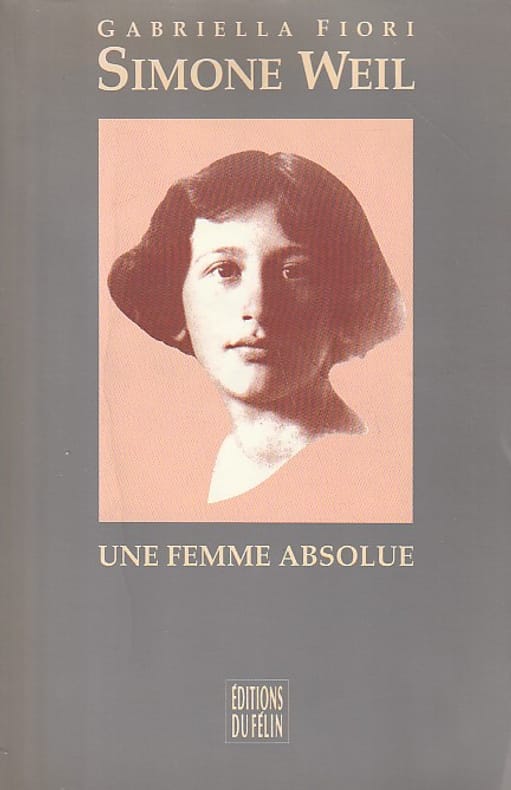
39754Félin, Le temps et les mots, 1993, 219 pp., broché, traces d'usage, tranches brunies, passages signalés et annotés au crayon, quelques pages cornées, état correct.
19979654New York: Vincent FitzGerald & Co 1997. One of 50 copies all on Fabriano Artistico paper each signed by the artist on the colophon. Page size: 4-7/8 inches x 4-7/8 inches; 31 individual leaves cards including "Joker" and 2 "Wild Cards" titlepage and colophon. Bound: housed in red cloth clamshell box by BookLab with title printed in silver gilt on front cover new. The calligraphy is by Jerry Kelly who has printed it letterpress at Kelly / Winterton Press. There are 59 etchings of body parts - some hand watercolored - by Susan Weil from her drawings that were blind-drawn on copper a technique that Weil has used for more than 50 years. The double-sided cards can be shuffled and dealt in any pattern which contributes to the humorous possibilities in the title pun. Further the cards can be re-arranged by simply turning them over creating a new figure. The simple line etchings become incredibly complicated upon closer inspection. Playful and sly touching and always imaginative Ms. Weil gives us her unique view of the human condition touching on varieties of emotions and stages of life with an artist's eye. Vincent FitzGerald & Co unknown books
19979655New York: Vincent FitzGerald & Co 1997. One of 20 copies all on Antique JB Green and Japanese Gampi paper signed and numbered by the artist in pencil on each of the 5 etchings. The names of the subject of each portrait is etched in the plate itself. The authors are: Gertrude Stein James Joyce Franz Kafka and Virginia Woolf. The artist is of course Matisse. Each etching measures 12-1/4 inches x 17 inches fine. The etchings were printed by Lothar Osterburg and Vincent FitzGerald. Susan Weil's aesthetic predecessors are portrayed in these blind-drawn etchings created around the same time as BLIND MAN'S BLUFF. She has captured the key element in the features of each. Vincent FitzGerald & Co unknown books
20029651New York: Vincent FitzGerald & Co. 2002. One of 20 copies all on special paper handmade by Paul Wong at Dieu Donne Papermill each signed and numbered on the colophon by Susan Weil. The artist has titled signed numbered and dated each print as well at the bottom in pencil. Page size: 16 x 16 inches; 6 images plus colophon. Housed in orange silk custom-made clamshell box with inset of blueprint image by the artist of broken glasses printed in white on blue fabric box made by Priscilla Spitler at Hands on Bookbinding new. The colophon was printed by Daniel Keleher at Wild Carrot Letterpress. Vincent FitzGerald & Company did the collage work. The prints are described by the publisher as follows: 1 blueprint image on cover; 2 "Umbrella" photograph which puts the umbrella structure directly on the paper; 3 "Secrets" A collaged blueprint. These private words are layered then cut in strips and woven. The back of the strips are water colored red reflecting slightly. 4 "Grace's Lace" The lace squares are treated with chemicals for a brown print and developed with ultraviolet light. This is mounted on handmade paper which has been water colored pale gray. 5 "Catenary" This is a blueprint collage. The two blueprint hands hold a copper string. The handmade paper is water colored pale green. 6 "Woven Wineglasses" This is a photograph collage. Several direct wineglass images are simply woven into a box form making this study of water and shadows into an abstraction. 7 "Haphazard" This is a formal blue print configuration of glass rectangles. The haphazard quality comes from the unpredictability of the beautiful breaks in the glass. <br/>Susan Weil returns to a medium she used in the late 1940's and early 1950's with her then husband Robert Rauschenberg at Black Mountain College where they had studied with Josef Albers. Carla Schulz-Hoffman notes in her article on Susan Weil in the exhibition catalogue MIND'S EYE 1989 the origins of this art form. In subsequent visits to Black Mountain they began experimenting with blueprint paper. Rauschenberg writes "Sue and I experimented with light-sensitive papers partly because of their low cost.". Schulz-Hoffman writes "In 1951 their son Christopher was born and in that same year 'Life' magazine published a three page article including reproductions of their spectacular 'Blueprints'. Similar to Man Ray's rayographs the blueprints used blueprint-paper and a sunray lamp to capture life-sized silhouettes." She notes "For this reason it is not always possible to credit one particular individual with the discovery of innovations which would prove decisive in precipitating the fall of Abstract Expressionism and in shaping the course which the entire New York School would eventually take. Although many of the results of Weil's productive collaborations with Rauschenberg and Jasper Johns cannot be attributed exclusively to one or another of these artists nevertheless a typically one-sided art historical scholarship tends to ignore Weil or consign her a marginal role.". As well as blueprint images Weil began to use collage in an especially creative way. Her complete mastery of these techniques can be seen in these images. Vincent FitzGerald & Co. unknown books
20019656New York: Vincent FitzGerald & Co 2001. Portfolio of five etchings by Susan Weil signed by Weil on the colophon in pencil and initialed by her with the print number in pencil on each print. Printed on Japanese Gampi paper chine colle on Hahnemuhle Copper paper by Peter Pettengill at Wingate Studio. The etchings are taken from re-strikes of the Rembrandt Self-Portrait etchings purchased by Susan Weil while studying art in Paris at the Academie Julien in the 1940's. For this suite she has cut up the etchings and collaged them to achieve the images herein. The images were made from photogravue plates made by Jon Goodman. Ms. Weil has been experimenting with the use of images made from blueprint paper since 1951 when she and her then husband Robert Rauschenberg were working at Black Mountain College. Her use of collage has dated from this time as well. She has obviously has made these mediums her own. Vincent FitzGerald & Co unknown books
20069813New York: Vincent FitzGerald & Company 2006. One of 10 copies only on J.B. Green paper each signed and numbered in pencil on the colophon by the artist Susan Weil. Page size: irregular but about 7 inches x 9 inches; 7 individual collages each hand water colored cut out and assembled by the artist Susan Weil and the publisher Vincent FitzGerald. On the reverse of each individual work of art is a "secret" hand written by the artist. Because they are secrets the reader / viewer can see words but there is no way to read the secret. Bound: loose in translucent plexi-glass box with sliding cover printed colophon in black with title in red visible through side of box new. The images created by Weil are so full of life - one is instantly drawn into the full world of this talented artist who has always included others in her life - children partners pets - all lovingly viewed through her aesthetic. The colors are vivid blues bright yellows gold and silver and the reader / viewer engages with them - knowing they will be unknowable and all the more intriguing. Vincent FitzGerald & Company unknown books
196548241Paris: Presses Universitaires de France 1965. 8vo pp. ci 489. Sources bibliography index. In French. Author's presentation on half-title. Paper wraps. Some ink marking in one chapter o/w a VG tight copy. Presses Universitaires de France unknown books
1997114586Paris Presses Universitaires de France - PUF 1997 1 vol. broché in-8, broché, 489 pp., index. Envoi autographe signé des trois auteurs. Bon exemplaire.
1997114586Paris Presses Universitaires de France - PUF 1997 1 vol. broché in-8, broché, 489 pp., index. Envoi autographe signé des trois auteurs. Bon exemplaire.
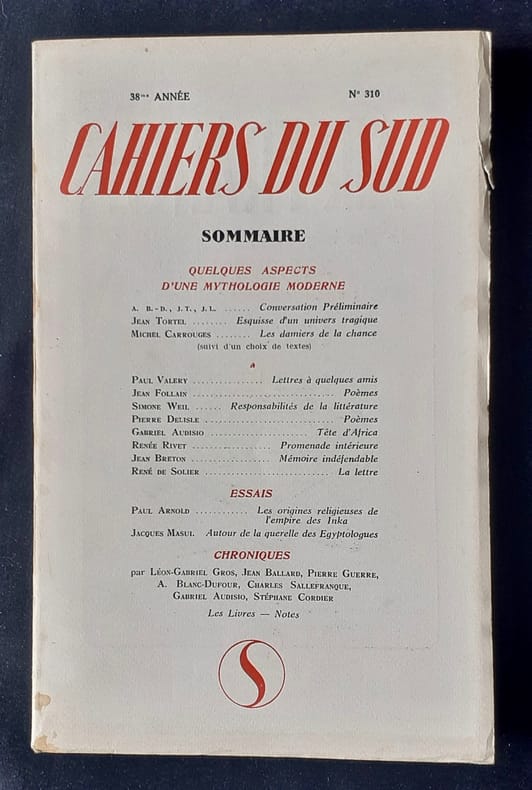
47010Marseille, directeur: Jean Ballard. Un volume de 170 pages. Exemplaire en bon état.
1974R200090192D'ORGANISATION. 1974. In-8. Broché. Bon état, Couv. convenable, Dos satisfaisant, Quelques rousseurs. 223 pages.. . . . Classification Dewey : 658-Gestion des entreprises privées et publiques
br. Una nuova interpretazione della scrittrice francese i cui scritti hanno avuto in Italia tanta fortuna. La riscoperta del legame essenziale tra religione e politica nel pensiero di Simone Weil. Indice: Rivolta e rivoluzione: il rousseauismo di Simone Weil; Il tradizionalismo rivoluzionario; Sulla nozione weiliana di divisione del lavoro; Ebraismo e cristianesimo: il tentativo di una nuova cristologia; Dizionario weiliano.
2011x-389971881XV&R unipress GmbH 2011. Paperback. New. 248 pages. German language. 9.45x6.14x0.79 inches. V&R unipress GmbH paperback
EDITORI RIUNITI 1998. Lievi segni del tempo, leggera ondulazione della quarta di copertina, VOLUME INTONSO, MAI SFOGLIATO.
1986777766PN. New. 1986. Soft Cover. Date is original print. This is a reprint edition. . PN paperback
A9780231129343Hardback. New. In telling the story of how New York has grown from Dutch colonial outpost to the global city 'the capital of the 21st century' Francois Weil also examines the social tensions that have arisen from this evolving role and how the New York experience has affected American notions of urban space. hardcover