165 résultats
19709780828898911-2025French & European Pubns 1970. Paperback. New. <p><strong>Author:</strong> Marcel Pagnol</p><p><strong>Publisher:</strong> French & European Pubns</p><p><strong>Binding:</strong> Paperback</p><p><strong>ISBN:</strong> 9780828898911</p><p><strong>Release Date:</strong> 1970</p><p><strong>Number Of Pages:</strong> 283</p><p><strong>Details:</strong> Depuis le départ de Marius César est de plus en plus coléreux et ses amis en font les frais. Lorsque Fanny apprend qu'elle attend un enfant de Marins le déshonneur la guette. Deux ans après Marins Pagnol reprend dans Fanny 1931 ses personnages où il les a laissés. Les spectateurs du Théâtre de Paris retrouvent avec enthousiasme Fanny César Panisse Escartefigue monsieur Brun Honorine Orane Demazis et Charpin sont au rendez-vous. mais pas Raimu fâché avec le directeur de la salle est remplacé par Harry Baur. En 1932. Marc Allégret tourne Fanny et Raimu reprend le rôle que Pagnol a écrit pour lui. Le succès du film Fanny est aussi grand que celui de Marins. Des années trente aux années soixante plusieurs remakes en sont réalisés. Wallace Beery Emil Janings Charles Boyer ont interprété César. Maurice Chevalier lui a été en 1961 un Paraisse hollywoodien. " Cet enfant quand il est né il pesait quatre kilos. Ceux-là c'est sa mère qui les a faits. Maintenant il arrive à sept. Ces trois kilos de plus c'est trois kilos d'amour. "</p> French & European Pubns paperback
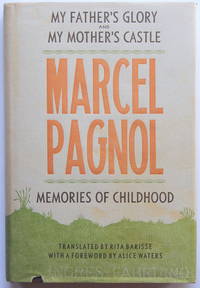
19864751st US edition of Pagnol's poignant 2-volume memoir published here as one volume translated from the French by Rita Baresse. The publication commemorates the fifteenth anniversary of Chez Panisse restaurant founded by Alice Waters who contributes a Foreword to the volume along with a recipe. Fine in brown cloth boards in a nearly fine dw with a small chip at the bottom of the front panel.  North Point Press hardcover
19603113585New York: Doubleday. Fine in Near Fine dust jacket. 1960. First Edition; First Printing. Hardcover. First American edition. Author Irving Stone's copy with his siganture on front end paper. Fine in near fine dust jacket. Spine on jacket midly age toned. A few short edge tears. Youthful memoirs by the writer of "Fanny." ; 5 3/4" x 8 1/2"; 335 pages . Doubleday. hardcover
33397Monte-Carlo Topaze: Lausanne Editions du Livre Henri Kaeser 1949 1952. 8° jew. 230 - 280 S. zahlr. farb. u. lithogr. Taf. Textabb. Brosch. Kapitale u. Kanten min. berieben Rücken broschurbedingt knickspurig «Topaze» min. unsauber innen tadellos; gesamthaft schöne Ex. Jew. Ex. Nr. 1528/1650 «Topaze» Nr. 847/1000. Die Lithogr. gedruck bei Mourlot Paris. Mit den entlarvenden Ill. von Albert Dubout des ehem. Mitarbeiters der Pariser Zeitschriften Pele-Mele Ric et Rac u. a. 010 Monte-Carlo (Topaze: Lausanne), Editions du Livre (Henri Kaeser), 1949 (1952) unknown
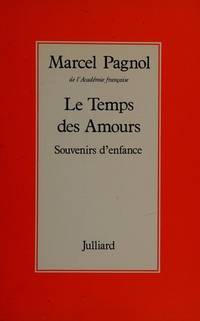
1977BN146004Julliard 1977. 1977. Softcover. Le Temps des Amours : Souvenirs d'enfance <br/><br/>Le Temps des Amours : Souvenirs d'enfance Marcel Pagnol Julliard paperback
19566044381956. "Marcel Pagnol" in black fountain pen ink on vintage album leaf laid down on a larger leaf. 6 1/4" x 4" on larger leaf 10 1/2" x 8". Very good. 1956. Signed and inscribed in French: To Cesa Vasquez Coelho 1956 ". . . a friend from far away . . . Marcel Pagnol 1956.". No Binding. Very Good/No Jacket. unknown
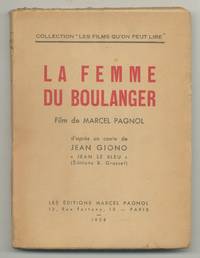
1938545911Paris: Les Éditions Marcel Pagnol 1938. Softcover. Near Fine. First photoplay edition. Small octavo. 148pp. Illustrated with several black and white plates of film stills. Text in French. Printed wrappers. Faint owner name of the translator Jacques Guicharnaud French bookstore label on first page modest age-toning and light wear near fine. Collection "Les Films Qu'on Peut Lire." Based on the 1932 novel Jean le Bleu by Jean Giono; the text of the film version is published here. Les Éditions Marcel Pagnol unknown
194870417Lausanne : Henri Kaeser 1948 1949. 220x160mm. 227 283Êpages lithographies couleurs broch. Exemplaires limits sur papier grand Vlin blanc numrots n.¡ 1543 / 1650. 2340 Henri Kaeser unknown
1973202241Pastorelly 1973. Bon Etat texte frais 300 à 400 p pour chaque ouvrage illustrations pleine page couleurs. in8. 1973. Relié. Pastorelly unknown
195851667Bruxelles:: Editions Terres Latines 1958. No. 457 of 700 sets. loose sheets in chemises and slipcases as issued. Fine in very slightly hand-soiled slipcases. . 8vo. Aquarelles de Gaston Barret with an extra suite of plates in black at rear of each volume. Editions Terres Latines, unknown
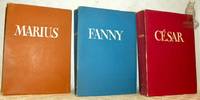
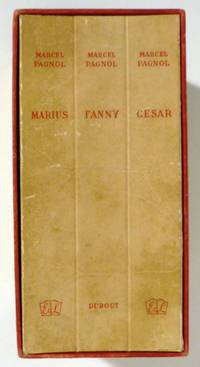
194948120Monte-Carlo:: Editions du Livre. Near Fine. 1949. Paperback. Complete in three volumes. Text is in French. Each volume is illustrated with color lithographs and black and white drawings throughout. Limited edition - this set is number 3308 of 2000 copies numbered from 3001 to 5000. Each volume is fine in printed wraps with glassine dust covers. Unopened pages. Housed in a near fine light shelf wear slipcase. . Editions du Livre, paperback
1949165806Monte-Carlo: Editions du Livre 1949. Softcover. Schmuckschuber ertwas angestaubt und berieben die Bücher tadellos. 8°. jeder Band mit zahlreichen lithographierten Illustrationen farbig auf Tafeln und schwarz/weiss im Text. französische Broschur in Schmuckschuber Nummerierte Ausgabe Exemplar 386 von 3000 auf velin blanc. Die farbigen Lithographien wurden bei Frères Mourlot abgezogen. Bücher mit mit braunem blauen und Himbeer-Umschlag in transparentem Pergamin-Umschlag. Saint-Martin Frankreich; 20. Jahrhundert; Editions du Livre, paperback
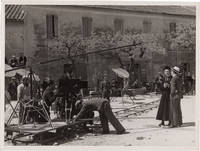
1937150439N.p.: N.p. 1937. Vintage double weight photograph from the 1938 film. A candid on-the-set photograph by the film's credited still photographer Roger Corbeau capturing a scene in the town square between the town priest Robert Vattier and schoolteacher Robert Bassac with the camera crew just to the left director Marcel Pagnol looking on in the center background and several members of the cast waiting just outside the frame to the far right. With Roger Corbeau's photo credit "PHOTO ROGER CORBEAU" at the bottom left of the frame. With a stamp for the Cinemonde Archives on the verso.<br /> <br /> An extraordinary "fourth wall" shot demonstrating at once the method and the magic of Pagnol's filmmaking as well as his relentless interest in provincial life in France. <br /> <br /> Loosely based on Jean Giono's 1932 novel "Blue Boy" the film follows a small-town baker's wife who runs away with a handsome younger shepherd leaving the baker heartbroken and unable to work. The villagers who initially laugh at his cuckoldry soon take the matter very seriously and organize a plan to find the wife and to bring her back to her husband. <br /> <br /> 9.25 x 7 inches. About Fine. N.p. unknown
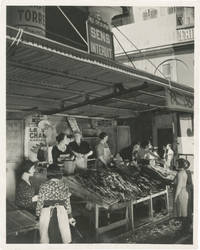
1932149934N.p.: N.p. 1932. Vintage oversize double weight reference photograph from the 1932 film showing the fish stand in the Marseille harbor. With a manuscript pencil annotation on the verso noting the number 8. <br /> <br /> A young fishmonger's daughter discovers she's pregnant with little chance of marriage to the father who has departed overseas for a sailor's life. The second film in director Marc Allegret's delicate lyrical Marseillaise trilogy preceded by "Marius" 1931 and followed by "Cesar" 1936. <br /> <br /> Set and shot on location in Marseille. <br /> <br /> 9 x 11.25 inches. Very Good plus slightly wavy at the bottom edge with some soil on the bottom half of the recto only.<br /> <br /> Criterion Collection 883. Godard Histoires du cinema. N.p. unknown
193239213Paris: Fasquelle 1932. A LARGE-PAPER COPY OF THE FIRST EDITION. 215 pp. ONE OF ONLY 100 COPIES PRINTED ON FINE DUTCH LAID PAPER WITH LARGE MARGINS. 8vo. Original printed wraps. Entirely uncut. FINE AND BRIGHT. <br/><br/> Fasquelle paperback
1990Q-2877061000Editions de Fallois 1990-08-01. Paperback. New. New. In shrink wrap. Looks like an interesting title! Editions de Fallois paperback
196855123DAS BESTE 1968. 1. hardcover. Reader's Digest Auswahlbücher Sirmkovrilo! DAS BESTE hardcover
157942Monte Carlo: Terres Latines. hardcover. fine. 3 volumes. Illustrated throughout with color aquarelles by Gaston Barret. 158 146 157pp. 8vo original color pictorial wrappers; uncut and unopened. Each volume is housed in a custom two-toned cloth clamshell box. Monte Carlo: Editions Terres Latines no date ca. 1948 1949. Text in French. Fine unused copies.<br/> <br/> Limited edition. Number 466 of 1800 copies. Pagnol's trilogy comprising the 28th 29th & 30th volumes in the collection "Leurs Chefs-D'Oeuvre".<br/> <br/> Terres Latines unknown
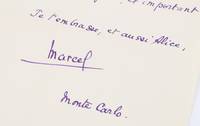
195983040Paris 1959. Fine. Paris 19 mai 1959 21 x 27 cm une feuille Touching autograph letter signed by Marcel Pagnol addressed from Monte Carlo to his great friend Carlo Rim 9 lines in blue ink : ""Petit Carlo Où es-tu Donne-moi ton adresse car il faut que je t'écrive sérieusement à propos du droit d'auteur au cinéma. C'est urgent et important pour tous. Je t'embrasse et aussi Alice Marcel. Monte Carlo"" ""Little Carlo Where are you Give me your address as I need to write to you seriously about film copyright. It's urgent and important for everyone. I embrace you and also Alice Marcel. Monte Carlo"" Central folds inherent to postal handling Carlo Rim having inscribed a date in pencil probably that of receiving the letter. He also indicated below still in pencil: 27 mai ass.ger. SACD à Pleyel. Carlo Rim was a Provençal writer author notably of ""Ma belle Marseille"" a caricaturist a filmmaker: ""Justin de Marseille"" ""L'armoire volante"" ""La maison Bonnadieu"" and was notably the friend of Fernandel Raimu and Marcel Pagnol but also of Max Jacob and André Salmon whom he met in Sanary. Tutor to the aspiring baccalaureate candidate Jean Marius future Carlo Rim the very young graduate Marcel Pagnol preferred to teach him cup-and-ball mocking the uselessness of the baccalaureate. This was the beginning of an unshakeable friendship between the two artists whose literature theater and films contributed to the fame of the land of cicadas. unknown
194441308Paris: Oeuvres Sociales du Cinéma 1944. First edition. Softcover. g- to vg. Octavo 8 1/2 x 7 1/4". Unpaginated. Original spiral bound illustrated wrappers by Gilberte Vigué. Laid in the first two pages of a four-page program for the 1944 edition of "La Nuit du Cinéma" a French event whose primary purpose was the raising of funds to help the unemployed of the movie industry. Bound in at rear is a tombola-ticket for the above mentioned event.<br /> <br /> This elegant brochure was published to comemorate the fourth year of the "Comité d'Organisation de l'Industrie Cinématographique" COIC: Committee for the Organization of the Cinema Industry an organization created by the Nazis in the first months of the occupation. The COIC was to oversee and manage film production in occupied France. <br /> <br /> "Cinéma 1944" is profusely illustrated throughout with 22 pages of b/w photographic reproductions five original lithographs by Jean Colin Grau Sala Touchagues Ray Bret Koch Jean Effel and features a series of delightful b/w and color sketched portraits of some of the most celebrated French actors of the period such as:<br /> <br /> - Raimu; Pierre-Richard Willm; actor and singer Tino Rossi; Claude Genia; actor and director Sacha Guitry; Noel Roquevert; Raymond Rouleau; Michèle Alfa; Jeanne Fusier-Gir; Fernandel; Michel Simon; Charles Vanel; Jean Tissier; Fernand Ledoux; Fernand Gravey; Mila Parely; Suzy Carrier and Jacques Dumesnil.<br /> <br /> The brochure contains also a preface and a photo-illustrated article on the fiftieth anniversary of the French movie industry as well as advertisement pages for the following movie companies: <br /> <br /> - Gaumont Pathé Cinéma France-Actualités Minerva Tobis ACE Consortium du Film Continental Films UFA Continental Films Francinex Films Roger Richebé Regina Scalera Film Sirius Eclair Les Films Raoul Ploquin and Les Productions Camille Tramichel.<br /> <br /> Includes advertisements for the following movies:<br /> <br /> - Les Visiteurs du Soir; L'Eternel Retour; Paméla; Le Merle Blanc; Le Ciel est à Vous La Nuit Fantastique Les Visiteurs du Soir Pontcarral Les Anges du Péché Goupi Mains Rouges Le Corbeau Paméla: l'Enigme du Temple etc.<br /> <br /> Also includes advertisements for the following magazines and newspapers:<br /> <br /> - "Sensations" "Actu" "Le Film Complet" "Vedettes" "Ciné-Mondial" "Le Petit Parisien" "Le Miroir des Sports" "Ciné-Miroir" Paris-Soir" and "Le Matin."<br /> <br /> The last section contains advertisements for high end Parisian fashion jewelry and fragrance companies Lucien Lelong Rolex Paquin Phebel Worth Marin Jeanne Lanvin Cherigan A la Ville du Puy Kriegck L. Larsen & Co. Renoir Chanel Robel Armand Gabriel La Samaritaine de Luxe Heyraud etc. as well as restaurants cabarets and French mineral water wines and spirits Chateau Bagatelle Bar François Ier Champagne de Saint-Marceaux Calvados Blanchard Perrier Cognac Rouyer Kressmann Chateau Cheval Blanc St. Emilion Cognac Larsen St. Emilion Jean-Jacques Galhaud Chateau d'Yquem St. Emilion Chateau Ausone St. Emilion Chateau Belair and Cognac Camus.<br /> <br /> Wrappers partly foxed and age-toned. Fore-edge of front cover partly and slightly water-stained. Text in French. Wrappers in overall good- interior in good to very good condition. Oeuvres Sociales du Cinéma unknown
1937133241N.p.: N.p. 1937. Vintage double weight photograph from the 1938 film. A candid on-the-set photograph by the film's credited still photographer Roger Corbeau of a cafe scene featuring the film's principal character actor Raimu with the camera crew just to the left in the shadows the borders of the studio set clearly visible. With Roger Corbeau's photo credit "PHOTO ROGER CORBEAU" at the bottom left of the frame. On the verso is a rubber stamp for the Cinemonde Archives. <br /> <br /> An extraordinary "fourth wall" shot demonstrating at once the method and the magic of Pagnol's filmmaking as well as his relentless interest in provincial life in France. In this film a new baker Aimable Raimu settles down in a small French village. His wife Aurelie is beautiful and much younger than he. She departs with a shepherd the night after Aimable produces his first breads. Aimable is so afflicted that he cannot work anymore. The villagers who initially laugh at his cuckoldry soon take the matter very seriously they want the bread and organize a plan to find Aurelie and to bring her back to the bakery and her husband. <br /> <br /> In a custom museum-quality frame archivally mounted with UV glass. 9.25 by 7 inches. Four tiny single pinholes at the corners within the white marginal border. Near Fine overall. N.p. unknown
193039324Paris: Fasquelle 1930. First edition. A SPECTACULAR LARGE-PAPER COPY ON JAPON IMPERIAL OF PAGNOL'S MASTERPIECE. 287 pp. From a total edition of 1000 numbered copies this is ONE OF ONLY 75 ON IMPERIAL JAPANESE PAPER. 4to. Beautifully bound in quarter morocco and decorated boards. Wrappers and backstrip preserved. Top edge gilt other edges uncut. FINE AND BRIGHT WITH NO DEFECTS. <br/><br/> Fasquelle hardcover
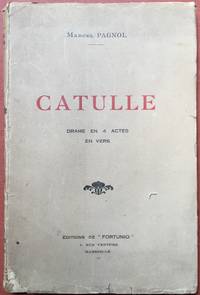
1922H2901Marseille: Editions de 1922. First printing. Wraps. Good. Inscribed by Pagnol to Eugene Silvain doyen of the Comédie Francaise and a very well known actor and author in 1923. Pagnol notes that this is the last copy he has of the original printing. Small quarto wraps good plus copy some shelfwear and soil to wraps and what looks like old streaks of glue to rear wrap contents tanning. Possibly Pagnol's first book he also published a novel “Pirouettes†in 1922 from his earliest time in Paris when he was still teaching English. Although he first started working on this play in 1913 completing it in 1920 it was not published until 1922. In 1928 Pagnol proposed staging it at the Theatre Silvain with Eugene Silvain playing the title role but although Silvain was friendly with the Pagnol he declared that Pagnol had "no sense of theater." Pagnol was at that time an overnight success because of his play Topaze so it might have been professional jealousy on Silvain's part as he came from an older generation and tradition. In any case a superb association copy between a young playwright and an older and established actor and author. Pagnol went on to become France’s first “auteur†filmmaker and the first filmmaker elected to the Academie Francaise. There was a brief revival of interest in Pagnol in the late 1980s when two of his books were made into critically and commercially successful films by director Claude Berri: “Jean de Florette†and “Manon des Sources.â€. Editions de unknown
1938539870Paris: Les Éditions Marcel Pagnol 1938. Hardcover. Very Good. First photoplay edition. Small octavo. 148pp. Illustrated with several black and white plates of film stills. Text in French. Bound with wrappers including the spine still connected to the lower wrap in cloth and papercovered boards. Binding with a lightly toned spine and modest edgewear a bit of interior toning very good. Inscribed by the director on the half-title: "To Howard Barnes Sincerely Marcel Pagnol. 1950." Collection "Les Films Qu'on Peut Lire." Based on the 1932 novel Jean le Bleu by Jean Giono; the text of the film version is published here. Les Éditions Marcel Pagnol hardcover
2469To Mr. E. Fasquelle editor Pagnol writes about film. "I had two parts in my film. One where I had my characters speak. The other where I left that to the cinematography and to Honnegger's sic music. The musical segments are very boring I am told. I am in the process of cutting out as many as I can but it is a delicate thing because of Honnegger sic who is a charming lad." He signs in full "Marcel Pagnol" then adds a note about having received payment. Pagnol most likely refers to his 1937 film "Regain" "Harvest" for which Swiss composer Arthur Honegger composed the music. The Marius trilogy Marius Fanny and Cesar filmed between 1931 and 1936 are viewed as Pagnol's most important cinematic contribution. unknown