Hemingway, ErnestBiblio.com
5 520 résultats
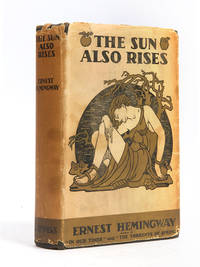
1926124010New York: Charles Scribner's Sons 1926. First edition first issue of the first printing with the misprint "stoppped" on page 181 line 26 in the first issue dust jacket with the misprint on the front panel "In Our Times" vs. "In Our Time". Octavo original black cloth. Association copy inscribed by the author on the half-title page in the year of publication “To Edward Titus with best regards Ernest Hemingway Paris 1926.â€Â The recipient Edward Titus was an expatriate publisher of the Black Manikin Press issuing among other publications Kiki’s Memoirs featuring an introduction by Hemingway. Fine in a near fine first issue dust jacket without any restoration. The Annette Campbell-White copy brought $120000 at Sotheby's in 2007 and that was not inscribed. Housed in a custom half morocco clamshell box. An exceptional example most rare and desirable inscribed especially in the year of publication. The Sun Also Rises was published by Scribner's in 1926 and a year later in the United Kingdom by Jonathan Cape under the title Fiesta. Though it initially received mixed reviews it is now "recognized as Hemingway's greatest work" Meyers 1985. The fictional plot depicts a love story between war-wounded and impotent Jake Barnes and the promiscuous divorcée Lady Brett Ashley but the novel is a roman à clef; the characters are based on real people and the action is based on real events. Hemingway proposes that the "Lost Generation" considered to have been decadent dissolute and irretrievably damaged by World War I was resilient and strong. Naturally themes of love death renewal in nature and the nature of masculinity are heavily investigated. For example the characters engage in bull-fighting which is presented as an idealized drama: The matador faces death and in so doing creates a moment of existential nothingness broken when he vanquishes the possibility of death by killing the bull Stoltzfus 2005. The Sun Also Rises is seen as an iconic modernist novel for future generations Mellow 1992 although it has been emphasized that Hemingway was not philosophically a modernist Reynolds 1990. "The Sun Also Rises is Hemingway's masterpiece - one of them anyway - and no matter how many times you've read it or how you feel about the manners and morals of the characters you won't be able to resist its spell. This is a classic that really does live up to its reputation" David Laskin. Charles Scribner's Sons hardcover
193279411New York:: Charles Scribner's Sons 1932. First edition. publisher's black cloth in dust jacket. Preserved in a custom quarter red morocco clamshell folding box. Slight tanning to endsheets; a few spots of foxing to fore-edge; and some insect damage to the cloth. The dust jacket has some minor darkening but is unchipped. . Large 8vo. Illustrated. Signed and inscribed by Ernest Hemingway to Ring Lardner: "To Ring Lardner from his early imitator and always admirer Ernest Hemingway Cooke Montana September 11 193--ran off the page" Charles Scribner's Sons, hardcover
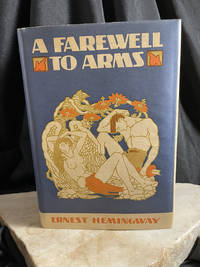
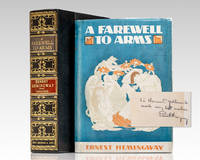
1929218<p>ERNEST HEMINGWAY. A FAREWELL TO ARMS. New York: Scribners 1929. First edition first printing in first state dust jacket. Inscribed by Ernest Hemingway to Gus Edwards. Book's cloth covers and gold labels are in fine condition. Internal pages are lightly toned; no foxing. Book's dust jacket is near fine plus to fine condition. Book dust jacket shows do wear or damage although it is lightly toned; "$2.50" original price still present on inner front flap. Hemingway inscription to Gus Edwards is bright and clean. It does not appear that Ernest Hemingway was a close friend of Gus Edwards simply because the inscription was written with his generic "all best wishes." It is presumed this Gus Edwards was the significant vaudeville music composer in the 1920s whose life served as the basis for the 1939 movie The Star Maker with Bing Crosby playing the lead role as Edwards. Edwards' career evolved from songwriter to theater owner Gus Edwards Music Hall in New York music publisher radio star and film director His "school days" reviews provided the career starts for Groucho Marx Eddie Cantor George Jessel Ray Bolger Phil Silvers Walter Winchell and many others. Some of Edwards' hit songs include: "By the Light of the Silvery Moon" "In My Merry Oldsmobile" "If I Were a Millionaire" "I'll Be With You When the Roses Bloom Again" and many more. He also began his Hollywood Revues in the late 1920s. According to Andre Hanneman's ERNEST HEMINGWAY: A Comprehensive Bibliography Princeton University Press 1967 the firsdt edition first printing of A FAREWELL TO ARMS was published September 27 1929. Thrity-one thousand and fifty copies were printed. Page 23 #8 It is not known if Hemingway inscribed this book for Edwards in person or an agent acquired it for Edwards. COLORADO ARTIFACTUAL</p> Scribners hardcover
195079409New York:: Charles Scribner's Sons 1950. First edition; Advance Issue; an association copy signed and inscribed by Ernest Hemingway: "To Adriana from her business partner with love - Hemingstein White Tower 1951" . publisher's blue-black buckram; a variant presentation binding taller than the trade issue. No paper dust jacket was made for the presentation bindings. Preserved in a custom quarter morocco slipcase and chemise. . Small area of erasure on the title page possibly by the recipient including a tiny area of replaced paper; some foxing to endsheets; lower corners a little bumped; otherwise bright and tight. . 8vo. "Renata" in the novel was based on the recipient of this book Adriana Ivancich whom Hemingway had met in 1949 at a shooting party on the lower Tagliamento. There was certainly an immediate attraction on the part of the author and he pursued the young girl and tolerated her mother and brother who accompanied her on several visits with Hemingway to the Finca. Adriana careful to protect her reputation always maintained that their relationship as portrayed in the novel was fiction while Hemingway tended to suggest the opposite. There seems to be no question that in Hemingway's mind the novel and reality became mixed and his attentions to the young girl were occasionally embarrassing to Adriana and the Hemingways' friends and eventually infuriating to Mary Hemingway. Charles Scribner's Sons, hardcover
192320196Paris: Contact Publishing Company 1923. Book. Very Good. Original Wraps. Inscribed by Authors. First Edition. 12mo. Black lettered blue jacket over beige wraps enclosed in green cloth slipcase. Hemingway's first book. Although Bill Bird's Three Mountains Press' In Our Time was contracted earlier Robert McAlmon's Contact Editions book was published and released first. Limited to 300 copies only. This copy inscribed by Hemingway on the front endpaper "This book is the property of James Cowan--he is not responsible for it--nor did he buy it. It was presented to him by the author--Ernest Hemingway" Cowan was a fellow reporter for the Toronto Star newspaper for which Hemingway also worked. Included also is a sheaf of correspondence between former owners and James Cowan attesting to it's history and authenticity. Also included a dealer's catalogue in which this book was listed for sale back in late thirties or forties. This copy wrapped in glassine which is contemporary but not original. Wear and a few tears to the extremities but a particularly fine example of a fragile book otherwise a very good copy. A great Toronto copy of an essential item in the Hemingway canon. Contact Publishing Company Paperback
192769764London:: Jonathan Cape 1927. First English edition. publisher's blue cloth in dust jacket. Preserved in a custom folding box. Bookplate to front pastedown; some staining from binder's adhesive of rear pastedown; else an unworn copy with some fading to the blue cloth to the spine and edges. The extremely rare dust jacket is slightly worn at the top of the backstrip which is somewhat tanned. 8vo. Jonathan Cape, hardcover
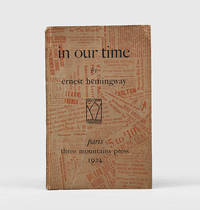
1924125303Printed at the Three Mountains Press and for sale at Shakespeare & Company: Paris 1924. First edition of Hemingway's second published work one of of 170 numbered copies printed on Rives hand-made paper this is number 90. Quarto original tan printed <span class="glossaryQtip qTip">boards</span> with black lettering and publisher's device printed over a collage of red-lettered facsimile newspaper items <span class="glossaryQtip qTip">woodcut</span> <span class="glossaryQtip qTip">frontispiece</span> portrait of Hemingway from a portrait by Henry Strater all edges uncut. In fine condition. Housed in a custom folding cloth chemise and half morocco slipcase with splitting to the chemise. One of Hemingway's rarest books second only to Three Stories and Ten Poems both because of the limited number of copies printed and its fragile nature. A superior example. Ezra Pound had arranged with William Bird the owner of The Three Mountains Press to publish a series of six volumes by contemporary writers under the collective title 'The Inquest into the State of Contemporary English Prose'. Contributors included Pound himself Ford Maddox Ford William Carlos Williams and Ernest Hemingway. For his contribution Hemingway selected the 6 sketches that had already been published in The Little Review in 1924 to which he added a further 12. The resulting publication was titled in our time an ironic reference to the twelfth line of the Episcopalian Evening Prayer: "Give peace in our time O Lord". In our time is certainly one of Hemingway's rarest both because of the limited number of copies printed and its fragile nature. A series of short vignettes the work is a powerful statement on war and includes chapters written during Hemingway's recent visits to Spain and the fictional account of the death of Maera a renowned matador. In his review in The Dial October 1924 Edmund Wilson asserted "I am inclined to think that this little book has more artistic dignity than any other book that has been written by an American about the period of the war" and called it "a harrowing record of the barbarities of the period in which we live". Ezra Pound edited in our time and it was later expanded into the American edition of 1925 in which these 18 chapters appeared interspersed among other classic Hemingway short stories. Paris hardcover books
19262003012New York: Scribners 1926. Near fine./Very good. A near fine first edition first issue three p's on stoppped in a very good first edition dust jacket with all first issue points In our Timesand no restoration. With a paper inscribed and signed by Hemingway laid in. Some tape on inside of dj. Two bookplates attached to front paste-down. Rear gutter of book cracked open. Housed in a custom-made collector's clamshell case. Scribners unknown
1924171400Paris: printed at the Three Mountains Press and for sale at Shakespeare & Company; London William Jackson 1924. His critically successful second book First edition sole printing review copy with the secretarial presentation inscription on the front free endpaper "Compliments of the author" and the limitation page stamped "Review Copy" in purple underneath the printed notice that 170 copies were printed on Rives handmade paper. The fragile nature of this production means that copies in such well-preserved condition are seldom encountered. Grissom states there were an additional 130 "damaged" copies with the watermark discernible on the frontispiece that were consequentially given away as gifts or review copies. This copy is among the 170 "perfect" copies without the watermarked frontispiece evidencing that the publishers took not only from damaged stock when sending copies out for review. Considered one of the most original short story collections in 20th-century literature in our time established Hemingway as a writer of great promise. F. Scott Fitzgerald wrote to Maxwell Perkins after reading the work "this is to tell you about a young man named Ernest Hemmingway sic. its remarkable & I'd look him up right away. He's the real thing" 10 October 1924. Edmund Wilson's review shows that the essence of Hemingway was already acknowledged at this early stage. "His prose is of the first distinction demonstrating a naiveté of language often passing into the colloquialism of the character dealt with which serves actually to convey profound emotions and complex states of mind. It is a distinctively American development in prose. Hemingway is rather strikingly original" The Dial October 1924. The book was the final instalment in Ezra Pound's "The Inquest into the state of contemporary English prose" series. An American edition published by Boni & Liveright as In Our Time appeared the following year. Tall octavo. Woodcut portrait frontispiece of the author by Henry Strater. Printed on handmade paper watermarked with the publisher's device. Original buff boards lettered in black and printed in red with decorative newspaper collage edges uncut. Housed in a custom red quarter morocco folding box. Red morocco book label of the American bibliophile John Stuart Groves 1921-1997. Chip to spine head bright boards with central vertical crease and a little wear usual browning to endpapers from binder's glue contents clean. A near-fine copy. Grissom A2.1.a; Hanneman 3a. Connolly The Modern Movement 49. hardcover
19262003012New York: Scribners 1926. Near fine./Very good. A near fine first edition first issue three p's on stoppped in a very good first edition dust jacket with all first issue points In our Timesand no restoration. With a paper inscribed and signed by Hemingway laid in. Some tape on inside of dj. Two bookplates attached to front paste-down. Rear gutter of book cracked open. Housed in a custom-made collector's clamshell case. Scribners unknown books
1924140941742Paris: Three Mountains Press 1924. First Edition. Near Fine. First edition copy number 23 of a limited 170 copies. 30 1 pp. Bound in publisher's paper-covered boards with news-clipping design. Near Fine with light edge wear light wear to spine ends with a closed tear roughly one-inch from the base though suggesting no restoration toning to spine and the usual browning to the endsheets. Housed in a custom cloth chemise case with morroco title label stamped in gilt. Hemingway's scarce second published book and his first of short fiction. Though intended to be published in an edition of 300 copies due to a printing error only 170 were released and originally sold through Sylvia Beach's literary juggernaut of a bookshop Shakespeare & Company. Three Mountains Press unknown
192669759London:: Jonathan Cape 1926. First UK edition first binding. publisher's green cloth in dust jacket and custom slipcase and chemise. Corners bumped; slightly cocked; some staining and darkening to cloth; else a very good copy in an attractive jacket with a few spots of foxing. . 8vo. Inscribed to Harry Sylvester and signed by Ernest Hemingway Key West 1936. With a number of corrections and annotations by Hemingway in pencil. He mostly restores the original language i.e. "bitching" for "crutting." Above the title of the story "Mr and Mrs Elliot" Hemingway notes "This all rewritten by Cape's bitches." Jonathan Cape, hardcover
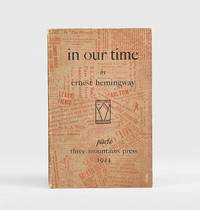
1924190782Paris: printed at the Three Mountains Press and for sale at Shakespeare & Company; London William Jackson 1924. The booze blood and brutality are all there" - Claude McKay's copy First edition the Harlem Renaissance poet and novelist Claude McKay's copy signed by him on the half-title. Hemingway's writing was a strong influence on McKay who was then living in Montparnasse in the same circle of Lost Generation literary expatriates. McKay lived the bohemian life in Paris supporting himself by posing nude in the city's art studios including for the Cubist painter Andre Lhote. He remembers in his 1937 memoir A Long Way from Home that he was given this copy of Hemingway's breakthrough collection by an American friend who read aloud from the book at the Dôme while McKay drank a double cognac. "My friend and host said 'They are talking in a big way about this Hemingway but I just can't get him. I like the young radical crowd and what they are aiming to do. But this thing here' - he pointed to in our time - 'I don't like it. It is too brutal and bloody. The only thing I admire about the book is the cover. That sure is in our time all right. If you like it you can have it.' My hand trembled to take it. The book was worth something between thirty and fifty francs which was more than I could afford. I have it still" pp. 249-50. The two writers met once on the Left Bank when they were briefly introduced by the publisher Max Eastman. In his memoir McKay confesses his "vast admiration" for Hemingway praising his clarity and honesty. "When Hemingway wrote The Sun Also Rises 1926 he shot a fist in the face of the false romantic-realists and said 'You can't fake about life like that'" p. 251. He read Hemingway devotedly. The Sun Also Rises looms large over McKay's Home to Harlem which likewise takes an existential war veteran named Jake as its protagonist and the title of his second memoir My Green Hills of Jamaica alludes to Green Hills of Africa. McKay traces the originality of Hemingway's writing back to this collection: "in our time contains the frame the background and the substance of all of Hemingway's later work. The hard-boilism - the booze blood and brutality are all there. Hemingway has taken this characteristic of American life from the streets the barrooms the ringsides and lifted it into the realm of literature. In accomplishing this he did revolutionary work with four-letter Anglo-Saxon words" p. 252. This is number 71 of 170 numbered copies offered for sale; another 130 imperfect copies were printed and sent as presentation and review copies. The American edition followed in 1925. Tall octavo. Woodcut portrait frontispiece of the author by Henry Strater. Printed on handmade paper watermarked with the publisher's device. Original buff boards lettered in black and printed in red with decorative newspaper collage edges uncut. Housed in a custom red cloth slipcase and chemise. Shakespeare and Co. ticket to rear pastedown. Spine ends just slightly worn minor rubbing endpapers browned as usual. A well-preserved near-fine copy of this fragile book. Grissom A2.1.a; Hanneman 2a. Connolly The Modern Movement 49. Gary Edward Holcomb & Charles Scruggs eds Hemingway and the Black Renaissance 2012. hardcover
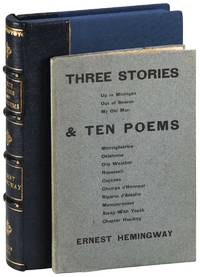
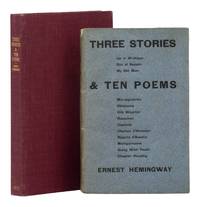
192352495Paris: Contact Publishing Co. 1923. First edition. Fine. Stunning copy of Hemingway's legendary first published book and among the rarest of his first editions. The typography and design of Hemingway's first book reflected the new Modernist style for which Hemingway would become known: spare balanced striking. In this as in his prose Hemingway was influenced by Gertrude Stein who advised a careful pick of typeface for the titles listed on the front wrapper "good and black but not squatty like the others" quoted in Grissom 26. <br /> <br /> 3STP was issued by Robert McAlmon's formative Modernist press Contact one of the original loci of the burgeoning movement. McAlmon also brought out numerous other classic expatriate texts including Stein's epic monument THE MAKING OF THE AMERICANS William Carlos Williams's SPRING AND ALL Gertrude Beasley's cult feminist memoir MY FIRST THIRTY YEARS Bryher's pioneering autobiographical lesbian novel TWO SELVES and H.D.'s PALIMPSEST - though it was this Hemingway book that would ultimately become the most famous of all its publications. <br /> <br /> Poorly constructed and issued in an edition of only 300 copies 3STP has become one of the most sought rarities of the 20th century and a cornerstone for any collection that documents the rise of Modernism. This copy is among the very best we've seen. 7'' x 4.75''. Original blue printed wrappers uncut and partially unopened. 8 58 2 pages. Housed in custom blue cloth slipcase and chemise. Slight lean with a couple small creases and minimal wear to spine. Else clean fresh and beautifully intact. (Contact Publishing Co.) unknown
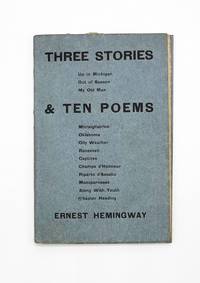
19237285Paris: Contact Publishing Company 1923. First Edition. The Nobel Prize-winning author's first book published in a tiny run by Robert McAlmon's Contact Publishing Co. in Paris. The three stories - "Up in Michigan" "Out of Season" and "My Old Man" - appear here for the first time along with four of the ten poems. The remaining six first appeared in the January 1923 issue of Poetry. One of the great literary debuts in 20th century literature and one that turns up frequently enough though usually worn torn soiled and foxed - seldom in anything approaching pristine condition. Grissom A.1.1.a; Hanneman A1.a. One of 300 copies. Slim octavo 18cm; original bluish-grey wrappers titled in black on front cover; x5859-64pp. The tiny contemporary rubber-stamped word "FRANCE" appears at lower margin of p.60. Some very subtle tanning to the text edges else a fresh Fine copy the blue-grey wrappers unfaded and retaining their original color. Lacking the rare glassine dustjacket. Housed in a custom half-morocco clamshell case and chemise. Contact Publishing Company unknown
1923140947224Paris: Contact Publishing Company 1923. First Edition. Near Fine. First edition first and only printing of Ernest Hemingway's legendary first published book. viii 58 2 pp. Bound in publisher's original gray wraps lettered in black lacking the scarce glassine wraps. Near Fine with light wear and toning to the spine faint soiling to wraps. A lovely copy housed in a custom cloth chemise case. <p>A momentous debut and a turning point in world literature. One of only 300 copies published by expat Robert McAlmon at Contact Publishing Co. in Paris in the summer of 1923. Four of the poems and all three of the stories made their print debut here. It was originally set to be Hemingway's sophomore effort but William Bird at Three Mountains Press dragged his heels in publishing the limited edition of In Our Time so this came out first. Few examples of Hemingway's early work remain as his suitcase with manuscripts was stolen from a Paris train station in December 1922. Hanneman A1. Contact Publishing Company unknown
19402004004Scribner's 1940. first galley proofs. very good. Pre-publication galley proofs first printing the earliest state the text terminating at galley page 141 concluding with a line of dashes between two Os to signify the end of the novel. Printed on rectos only on two different paper stocks. A little chipping and minor soiling overall very good. Housed in a custom-made fold-out slipcase. Scribner's books
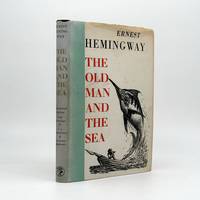
1955371200London: Jonathan Cape 1955. Second English edition first printing second issue; First illustrated edition. Illustrated by C.F. Tunnicliffe and Raymond Sheppard. 8vo. Half-cloth and illustrated paper boards. Some warping and foxing to boards and endpapers endemic to books from the Caribbean in dust jacket with some fading to spine bit of edgewear and some closed tears along top edge with a "With the Compliments of the Author" panel pasted to rear flap. Second English edition first printing second issue; First illustrated edition. Illustrated by C.F. Tunnicliffe and Raymond Sheppard. 8vo. A wonderful association copy of The Old Man and the Sea inscribed by Hemingway on the half title to film director and producer Fred Zinnemann: "Dear Freddy: Better luck if there is a place where we get better luck Papa" <br /> <br /> Laid in are two photographs of Ernest and Mary Hemingway at a table with Fred Zinnemann who had made an unofficial trip to Cuba in October 1955 to discuss the project with Hemingway before being brought on as director. Additionally laid in is a typed sheet with the heading: "December 20th 1955 / "Old Man of the Sea" / Lima - Peru" containing notes on prices accommodations restaurants etc. associated with filming on location in Peru." There is also a pictorial postcard from a group fishing expedition in Peru for capturing footage for the Old Man and the Sea film that includes Hemingway and Mary as well as cinematographer Hans Koenekamp. They spent April in Cabo Blanco Peru fishing every day and getting footage of Marlins for the film. The card's typed message is addressed to film producer Norman Cook and Fred Zinneman at the Hotel Rosita De Hornedo in Havana Cuba from Joe Barry who's name appears in minor film roles throughout the period as well as in the Leland Hayward archive at the NYPL and was likely working as a production assistant on this shoot. Sent on May 1 1956 he writes about the photo on the verso: "This is the one we got but he did not give us any action 730 lbs. 13 Ft 5 In. long. Too bad he might have been the one it is one foot longer then sic. the biggest one caught here but not as heavy. We are still trying and hope we get what we came here for. My best wishes to you both and hope to see you soon." <br /> <br /> Leland Hayward who had persuaded Life magazine to serialize the novel acquired the rights to The Old Man and the Sea in 1953 Hemingway was brought in to work on the script - eventually handled by Peter Viertel - and supervise the fishing scenes. Fred Zinneman's first film The Wave 1936 - shot on location in Mexico with non-professional actors - was one of the earliest examples of a social realist film. He had recent success with the films High Noon From Here to Eternity and Oklahoma! Zinneman was unhappy with the difficulty in capturing marlin and shark activity suitable for use in the film and after a mechanical marlin sank in the waters off of Cuba Zinneman walked away saying afterwards: "It made little sense to proceed with a robot pretending to be a fish in a studio tank pretending to be the Gulf Stream with an actor pretending to be a fisherman."<br /> <br /> His son Tim gives a more colorful version of his parting from the film: "My father had been directing the movie of 'Old Man and the Sea' but had a series of fights with Spencer Tracy and quit in the middle of shooting. Hemingway took my father's side and gave him the book with the 'better luck next time'" message. They remained good friends until Hemingway's death.HemingwayTracy and Leland Hayward were the producers of the film. Tracy would get drunk and habitually show up five or more hours late on the set at sea. My father was furious and quit. Hemingway backed up my father and went to see Hayward at his hotel in Havana - got into an argument with him and punched him out." A letter sent to Zinneman by Hemingway in August 1956 after the project has already wrapped reads "Will not write any atrocity stories about the picture. You must be as sick of them as I am" and congratulates Zinneman on passing up an offer to work on a film version of The Sun Also Rises Christies 2005.<br /> <br /> Finally laid into the book is a Christmas card to Zinnemann's family written by Mary Hemingway and sent during the Hemingways' Eurropean trip at the end of 1956: "Dear Z's - we really ought to be together in this fine town - best to have all three of you - Mary Hemingway Paris" Beneath Mary's inscription Hemingway writes: "Love Papa. Hope things go well."<br /> <br /> A lovely association between Hemingway and someone he saw as a close friend until the end of his life. Grissom A.24.1; Baker Carlos Ernest Hemingway: A Life pp. 533 Jonathan Cape unknown
1929151376New York: Charles Scribner's Sons 1929. First edition of this early Hemingway classic which established him among the American masters. Octavo original black cloth with gilt labels to the spine and front panel. First issue with Scribner's seal to title verso and without legal disclaimer. Presentation copy inscribed by the author on the front free endpaper. Near fine in a very good first state dust jacket with expert restoration and the misspelling "Katharine Barclay" in the blurb on the front flap. Housed in a custom half morocco clamshell box and folding chemise. Written when Ernest Hemingway was thirty years old and lauded as the best American novel to emerge from World War I A Farewell to Arms is the unforgettable story of an American ambulance driver on the Italian front and his passion for a beautiful English nurse. Set against the looming horrors of the battlefieldweary demoralized men marching in the rain during the German attack on Caporetto; the profound struggle between loyalty and desertion this gripping semiautobiographical work captures the harsh realities of war and the pain of lovers caught in its inexorable sweep. Ernest Hemingway famously said that he rewrote the ending to A Farewell to Arms thirty-nine times to get the words right. It is the basis for the 1932 film bearing the same name directed by Frank Borzage and starring Gary Cooper Helen Hayes and Adolphe Menjou. Charles Scribner's Sons hardcover
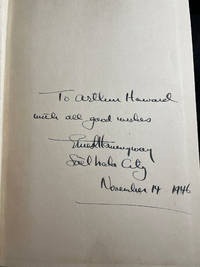
1940170<p><strong>FOR WHOM THE BELL TOLLS</strong> <strong>by</strong> <strong>ERNEST HEMINGWAY</strong> <strong>1940</strong> <strong>First edition first issue </strong><strong>in original first state dust jacket </strong><strong>INSCRIBED by </strong><strong>ERNEST HEMINGWAY </strong><strong>to </strong><strong>Arthur Howard </strong><strong>in Salt Lake City Utah. </strong><strong>Arthur Howard was a noted geologist for the </strong><strong>UNITED STATES GEOLOGICAL SURVEY.</strong> <strong>Inscribed on November 14 1946.</strong> <strong>"A" </strong><strong>on copyright page.</strong> <strong>Book in astoundingly fine condition -- </strong><strong>book dust jacket and internal pages almost </strong><strong>as if new.</strong> <strong>COLORADO ARTIFACTUAL</strong></p> Scribners hardcover
192369766Paris:: Contact Publishing Company 1923. First edition of Hemingway's first book. publisher's blue wrappers lettered in black preserved in a later quarter blue morocco slipcase and chemise. A fresh bright unworn copy with very slight browning to the top 1/8" of the front wrapper. Pages 25-28 are roughly opened resulting in the loss of a few letters of the text in the upper outside corners. Otherwise a spectacular copy. . 12mo. Contact Publishing Company, unknown
193275406Paris:: The Black Sun Press for Crosby Continental Editions 1932. publisher's wrappers lettered in red in supplied glassine wrapper and custom folding box. There is some insect damage to the right margin of the front wrapper; otherwise in very nice condition. 12mo. Inscribed and signed by Ernest Hemingway "With best wishes" for May Ray. Hemingway was photographed by Man Ray in 1923 as were many writers and artists in Paris at the time. They clearly were acquainted but we have never seen another book inscribed by Hemingway to Man Ray. Modern Masterpieces in English. [The Black Sun Press for] Crosby Continental Editions, unknown
117164New York Charles Scribner's Sons 1926. . First edition first printing first issue with 'stoppped' on p181; 8vo; publisher's black cloth gold paper title labels to upper board and spine printed in black. With the first issue Cleon dust jacket. Some minor toning to the page stock as usual few marks here and there a very good copy in the somewhat marked and frayed toned and little chipped first issue dust jacket with some internal repair at the folds but entirely unrestored.<br /> The correct first issue with the misprint of the true first printing of one of the greatest American novels ever published. In the correct first issue dust jacket incorrectly printing the title of his earlier book as 'In Our Times'.<br /><br />Set between the cafés of Paris and the streets of Pamplona Hemingway's finest novel focuses on the bittersweet exploits of a group of American expatriates in the aftermath of the First World War.<br /> New York, Charles Scribner's Sons, 1926. hardcover
19271510024Scribners 1927. 1st Edition. Hardcover. Very Good/Very Good. A very good first edition in a very good dust jacket inscribed by the author to a judge on the front free endpaper which has been reattached. Housed in a custom-made collector's clamshell case with a leather spine. Scribners hardcover books
19291510023Scribners 1929. 5th or later Edition. Hardcover. Very Good/Very Good. A very good early printing 1929 ninth printing inscribed by Ernest Hemingway on the front free endpaper. In a very good original dust jacket. Housed in a custom-made collector's clamshell case. Scribners hardcover books