Hemingway ErnestBiblio.com
5 520 résultats
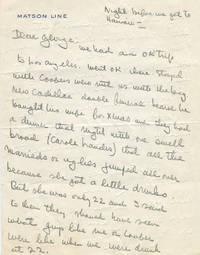
194133<p>Ernest Hemingway<br />Autograph letter signed "Ernesto" to George Brown.<br />Dated "The night before our arrival in Hawaii" February 1941.<br />7 pages 12mo in pencil on two bifolia with the letterhead of the Matson Line shipping company.<br /><br /><strong>A remarkable letter: pure Hemingway.</strong><br /><br /></p><p><em>"Dear George </em></p><p><em>We had an OK trip to Los Angeles. Went OK there. Stayed with Coopers who met us with the big new Cadillac double funeral hearse he bought his wife for Xmas and they had a dinner that night with one swell broad Carole Landis that all the married or uglies jumped all over because she got a little drunko. But she was only 22 and I said to them they should have seen what guys like me or Cooper were like when we were drunk at 22. Coopers wife Rocky and I beat Cooper and Marty 5 set of tennis to win 11 dollars in 2 days. But no money changes hands that way on acct of husband and wife. I think Marty and I could beat them but Mrs C. likes to win very much. More even than giggy. She has very extensive taught ground strokes but she has a high bouncing serve that I could set myself and murder so it is better for her happiness that we are partners. Marty was much prettier than the hollwood shes and looked like a human being instead of a kennel entry but I shudder to think what would pass with the Colonel faced by them blondes altho lots of them were 22-23 years old which is aged in the Colonels book. With a cold my ears gave me hell on the plane. Never had that before. San Francisco was fine. We ate very well and saw Mike Ward an old pal and his wife and shipped up Ingrid Bergman to look her over for Maria for the picture. She is perfect. Really swell. Not like those Hollywooders. On this boat it has been rough as a bastard all the time. The gym guy wouldn't box. He rubs too and he says he is afraid it would hurt his hands altho he says he teaches boxing. he comes from Hollywood too where I guess hands hurt easy. Probably his thumbs swell up. It was a shame because I was going to left hook him in the profile like Barney Gimbel ruining a bum. But I worked on the big bag instead but couldn't rouse no really dirty feeling against it on such short acquaintance and when you get close to it the fucking thing seems sort of dead and helpless and not like ones fellow man. I practiced hitting it in the balls a little. Tomorrow we get into Honolulu. It sounds more like a ½ jig Coney Island or Polynesian Miami Beach all the time. The food on this boat is swell tho. Marty sends her love. We got a bang out of the wire. I miss you and the reading Colonel and working out and all the fun we have but will be back soon with a lot of new lies and stories. Take care of yourself.</em></p><p><em>Best always from us both</em></p><p><em>Ernesto"</em></p><p><br /><br />This letter is addressed to George Brown a very close friend of Hemingway an Irishman who had given him boxing lessons in New York and who would still be by his side the day before his suicide.<br /><br />Hemingway had spent a few days in Los Angeles staying with Gary Cooper where preparations were underway for the film adaptation of For Whom the Bell Tolls starring Gary Cooper and Ingrid Bergman directed by Sam Wood and released in 1943.<br /><br />In his inimitable style—full of energy humor and coarseness—Hemingway recounts the various episodes that punctuated his stay.<br /><br />We encounter Gary Cooper his wife Sandra Shaw known as Rocky the actress Carole Landis Ingrid Bergman David O. Selznick amid tennis matches drinking boxing and social gatherings.<br /><br />Hemingway begins by gently mocking the actor and his "double Cadillac hearse" then introduces us to a Hollywood party where Carole Landis 1919–1948 has had a bit too much to drink prompting "the married men and the ugly ones" to crowd around her.<br /><br />Nurturing his own legend the author cannot resist adding: "they should have seen what guys like me or Cooper were like when we were drunk at 22." Hemingway formed a genuine friendship with the actor of whom he said: "Coop is a fine man; as honest upright kind and decent as he seems. If one invented a character like Coop no one would believe it. He is simply too good to be true."<br /><br />His admiration also extends to Ingrid Bergman: "She is perfect. Really wonderful. Not like those Hollywood women."<br /><br />Hemingway had just married his third wife Martha Gellhorn whom he praises here in his own way: "Marty was much prettier than the Hollywood women and looked like a human being instead of a kennel entry."<br /><br />The two couples exchanging partners engage in fierce tennis matches. Here again the writer's confidence comes through: "She has very extensive well-trained ground strokes but she has a high-bouncing serve that I could murder so it is better for her happiness that we are partners."<br /><br />But it is in his account of the boxing bouts he longs to fight that Hemingway appears most fully himself. He overwhelms with sarcasm the ship's gym instructor who refuses to spar with him for fear of hurting his hands.<br /><br />So Hemingway unleashes himself on the punching bag giving us a small anthology piece brimming with humor: "But I worked on the big bag instead… and when you get close to it the damn thing seems sort of dead and helpless and not like one's fellow man. I practiced hitting it in the balls a little."<br /><br />His description of Honolulu is equally striking: "It sounds more and more like some half-assed Coney Island or Polynesian Miami Beach."<br /><br />These lines give an exact sense of what the writer's conversation with his friends must have been like.<br /><br />The letter also mentions another of his close friends Taylor Williams his hunting guide known as "the Colonel" who seems to have had a taste for rather young women: "I shudder to think what would pass with the Colonel faced by them blondes… even if many were 22–23 years old which is aged in the Colonel's book."<br /><br />As he says at the end of the letter "we will be back soon with a lot of new lies and stories."<br /><br />This lively letter is a wonderful example of those stories that delighted his friends—and now delight us.</p>
195222661ENew York: Scribners 1952. Later printing. Signed presentation copy from Ernest Hemingway to actress Ann Sothern. Inscribed: “To Ann Sothern Wishing her all good things always. From her friend Ernest Hemingway Sun Valley 1958â€. With Ms. Sothern’s bookplate. Near fine copy with a hint of handling and very faint darkening to the cloth at the spine and outer edges in a near fine dust jacket with some minor dust soiling and a few tiny nicks. With the publisher’s original wraparound band indicating that the book was the winner of the Nobel Prize for Literature in 1954. After Ann Sothern retired from her acting career she moved to Ketchum Idaho which is a small town adjacent to Hemingway’s home in Sun Valley. Ms. Sothern is best known for her roles in A Letter to Three Wives 1949 with Jeanne Crain and Linda Darnell and The Whales of August 1987 with Bette Davis and Lillian Gish - her last film for which she was nominated for an Oscar for Best Supporting Actress and for her television work on Private Secretary 1953 - 1957 and The Ann Sothern Show 1958 - 1961 - both of which lead to Primetime Emmy Award nominations. Enclosed in a custom blue cloth clamshell box with gilt-stamping to the spine. Scribners hardcover books
19262004105Charles Scribner's Sons 1926. first. hardcover. very good/very good. First edition first issue book with "stoppped" on page 181. In a second state dust jacket "In Our Time" at bottom of front of dj. Title and copyright page have same publishing date 1926. Book very good stains on front and rear pastedowns and end papers. Dust jacket very good with some repair done to dust jacket visible on inside. Housed in a custom-made foldout case. Charles Scribner's Sons unknown books
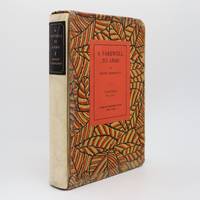
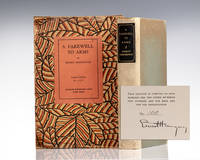
1929375418New York: Scribners 1929. First edition number 56 of 510 copies signed by the author on the limitation leaf. 10 355 pp. 1 vols. 8vo. Publisher's light bluish-green boards backed and cornered with vellum black morocco spine label lettered in gold. Near fine in original decorative-paper board slipcase repaired in custom half-morocco clamshell box. First edition number 56 of 510 copies signed by the author on the limitation leaf. 10 355 pp. 1 vols. 8vo. The only signed limited issue of Hemingway's work and one of the greatest war novels of all time. "His first full-length novel and probably his best . Its success was so enormous that it may be said to have ended Hemingway's influence as a writer. After it one could no more imitate that musical crystal-clear style; blown like glass from the white-heat of violence" Connolly. Hanneman 8b; Grissom A.8.1.a2; Connolly Modern Movement 60 Scribners unknown
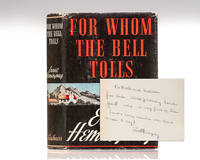
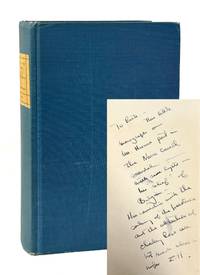
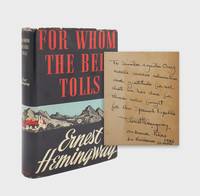
1940149834New York: Charles Scribner's Sons 1940. First edition early printing of Hemingway's third novel a tragic exploration of love duty and the futility of war. Octavo original publisher's cloth. Association copy lengthily inscribed by Ernest Hemingway to his cousin on the front free endpaper "For Ruth and Malcolm from their child producing house guest who is very fond of them what a lousy dedication when there is so much to say Ernest Hemingway." The recipients Ruth White Lowry 1884–1974 and her husband William Malcolm Lowry 1884–1953 were longtime residents of Kansas City Missouri and integral members of Ernest Hemingway’s extended Midwestern family. Ruth the daughter of William White and Mary Hall White was a first cousin of Grace Hall Hemingway the author’s mother. This made her Ernest’s first cousin once removed though their families were close enough that Hemingway referred to her simply as “Cousin Ruth.†The White and Hall families had deep Midwestern roots—Ruth was educated in Kansas City and was part of the city’s civic and cultural life throughout the early twentieth century. When Hemingway and his second wife Pauline Pfeiffer returned from Paris to the United States in 1928 they came to Kansas City for the birth of their first child Patrick Hemingway who was delivered at St. Mary’s Hospital on June 28 of that year. The Hemingways stayed with Ruth and Malcolm Lowry at their Kansas City home both before and after the delivery. Pauline returned to the same house three years later in November 1931 for the birth of their second son Gregory Hancock Hemingway while Ernest shuttled between Kansas City and Key West during the final stages of Death in the Afternoon. The Lowrys’ hospitality offered Hemingway a familial refuge far from the expatriate world of Europe and the growing celebrity that attended his literary success. The relationship between the two families endured for decades. Letters and family recollections describe Ruth as a warm maternal presence in Hemingway’s life—a relative he could trust with his young family during periods of upheaval. The Lowry household thus occupies a unique place in Hemingway’s biography: it was the setting for the births of both of his sons with Pauline and the site of rare domestic calm amid his restless movements between continents. Copies inscribed to members of the Lowry family remain among the most significant Hemingway association copies linking the author’s private life in the American Midwest to his public identity as one of the central figures of twentieth-century literature. Ernest Hemingway’s For Whom the Bell Tolls 1940 represents one of the author’s most complex meditations on war love and moral responsibility. Set during the Spanish Civil War the novel follows Robert Jordan an American volunteer in the International Brigades as he undertakes a mission to destroy a fascist-held bridge. Drawing on Hemingway’s own experiences as a journalist in Spain the novel fuses political engagement with psychological depth exploring the tension between individual conviction and collective duty. Stylistically it embodies Hemingway’s characteristic economy of language—his “iceberg theoryâ€â€”while broadening his earlier focus on personal heroism to encompass a larger ethical inquiry into the nature of sacrifice and solidarity. The novel’s title drawn from John Donne’s Devotions upon Emergent Occasions underscores its universalist theme: the interconnectedness of human suffering and mortality. Through its spare prose shifting perspectives and symbolic use of death and time For Whom the Bell Tolls transforms the brutality of civil conflict into a profound reflection on the cost of idealism and the enduring value of human compassion amid catastrophe. Charles Scribner's Sons hardcover
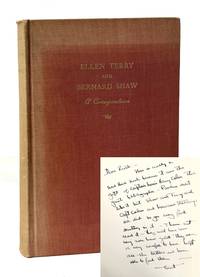
1931EH315New York: G. P. Putnam's Sons 1931 Preface by George Bernard Shaw. First edition first printing. Signed and inscribed by Hemingway to his cousin Ruth White Lowry on the front free endpaper with reference to the previous owner Hemingway bibliographer Captain Louis Henry Cohn: "Dear Ruth: - This is really a 2nd hand book because it was the gift of Captain Louis Henry Cohn the great bibliographer - Pauline didn't like it but Shaw and Terry and Capt. Cohn and Lawrence Stallings all did so you may find something in it - I have not read it - They must have been very sure how great they were or very careful to have kept all the letters and been able to find them - Ernest." Publisher's red cloth with front board and spine lettered in gilt red topstain; lacking dust jacket. Very good with toning to spine and board edges heavy dimming to spine gilt some very light scratches to rear board small House of Books ticket Captain Cohn's bookshop to rear pastedown. Overall a uniquely inscribed copy with exceptional provenance. From the personal library of Hemingway's cousin Ruth White Lowry. This book is a collection of correspondence between the great Irish playwright George Bernard Shaw 1856 - 1950 and leading English actress Ellen Terry 1847 - 1928. In 1892 Ellen reached out to Shaw then a 36-year-old music critic to get his opinion on the career prospects of a musical protégé of hers. This began a roughly 30-year correspondence between the two which was marked by flirtation genuine affection and Shaw's repeated attempts to lure Ellen away from Henry Irving's productions at Lyceum Theatre to star in theatrical productions of his own work. With praise from its New York Times review: "It represents the very flower of the minds and hearts-the select harvest of sentiment and wit-of two of the most remarkable personages of our generation." Captain Louis Henry Cohn 1889- 1953 born in Brooklyn New York earned his military rank by fighting in the French Army during World War I. In 1930 Cohn wrote a letter to Hemingway asking him for permission to compile a bibliography of his works. Hemingway begrudgingly agreed and in 1931 the book A Bibliography of the Works of Ernest Hemingway was published: in a note from Hemingway to Cohn which was later included as the frontispiece of the bibliography Hemingway wrote "I think it all balls to publish bibliographies of living writers". Later Cohn and his wife Marguerite opened House of Books a successful bookshop specializing in modern first editions. Under the House of Books imprint Cohn published an edition of Hemingway's short story "God Rest You Merry Gentlemen" 1933 limited to 300 numbered copies and a facsimile of Hemingway's "Bastard Note"-a legal disclaimer page included in the second printing of A Farewell to Arms with a humorous note to the printer in Hemingway's hand-limited to 93 numbered copies. Signed. First Edition. Hard Cover. Very Good. New York: G. P. Putnam's Sons hardcover
1929149688New York: Charles Scribner's Sons 1929. Signed limited edition of this early Hemingway classic which established him among the American masters. Tall octavo original publisher's white vellum over green boards with black morocco spine label lettered in gilt. One of 510 copies signed by Ernest Hemingway this is number 102. Very good with toning to the spine. Housed in the rare original slipcase which is in good condition with tape repairs. Written when Ernest Hemingway was thirty years old and lauded as the best American novel to emerge from World War I A Farewell to Arms is the unforgettable story of an American ambulance driver on the Italian front and his passion for a beautiful English nurse. Set against the looming horrors of the battlefieldweary demoralized men marching in the rain during the German attack on Caporetto; the profound struggle between loyalty and desertionthis gripping semiautobiographical work captures the harsh realities of war and the pain of lovers caught in its inexorable sweep. Ernest Hemingway famously said that he rewrote the ending to A Farewell to Arms thirty-nine times to get the words right. Farewell To Arms is the only signed limited edition of Ernest Hemingway's works. It is the basis for the 1932 film bearing the same name directed by Frank Borzage and starring Gary Cooper Helen Hayes and Adolphe Menjou. Charles Scribner's Sons hardcover
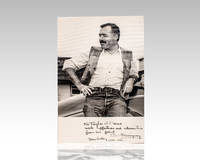
150070Rare original black and white photograph of legendary American writer Ernest Hemingway. Black and white matte photograph of Hemingway at his peak wearing Western garb and leaning on a car. Inscribed by Ernest Hemingway in black ballpoint at the bottom margin below the image "For Taylor Williams with affection and admiration from his friend Ernest Hemingway Sun Valley 1939 - 1940." The recipient was Hemingway's great friend Taylor “Beartracks†Williams the well-known Sun Valley hunting and fishing guide. Hemingway’s friendship with Williams dated back to their meeting in Idaho in the late 1930s after which Hemingway frequently returned to Ketchum before eventually settling there. The spring of 1953 also marked a peak moment in Hemingway’s career and personal life: he had recently written The Old Man and the Sea and received the Pulitzer Prize and this period preceded the airplane accidents of 1954 and his later forced departure from Cuba during the Castro regime—events that would profoundly affect his final years and contribute to his death in 1961. In fine condition. Triple matted and framed. The photograph measures 6.5 inches by 9.5 inches. The entire piece measures 16.75 inches by 13.5 inches. Ernest Hemingway 1899–1961 was one of the most influential American writers of the 20th century whose concise prose style and exploration of universal themes reshaped modern literature. Known for his works such as The Old Man and the Sea A Farewell to Arms and For Whom the Bell Tolls Hemingway developed a narrative voice that captured the complexities of human struggle and resilience with stark simplicity. His experiences as a journalist and participant in both World Wars deeply informed his writing lending authenticity to his depictions of courage loss and alienation. While his personal life marked by adventure and tragedy often overshadowed his literary contributions his stylistic innovations and engagement with existential themes solidified his status as a transformative figure in American letters. By pushing the boundaries of narrative form and emphasizing the power of understatement Hemingway left an enduring legacy on both literature and the cultural understanding of the human condition. unknown
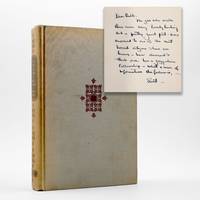
1930372878New York: Alfred A. Knopf 1930. First edition second printing. Illustrated xxi 378 vi 1 pp. 8vo. Grey linen stamped and printed. Spine and top edge sunned some light soiling from handling partially unopened very good with Bennett Schneider Book Seller ticket at rear. First edition second printing. Illustrated xxi 378 vi 1 pp. 8vo. Inscribed by Hemingway to his Kansas City Cousin Ruth Lowry: "Dear Ruth: The girl who wrote this was very lovely looking and a pretty good poet - was married to one of the most horrid citizens I have ever known now divorced. Think one has a Guggenheim fellowship - what a mine of information the fellow is- / Ernest-"<br /> <br /> The "lovely looking" "pretty good poet" who wrote this Genevieve Taggard 1894-1948 was an acquaintance of Hemingway's known to him from his travels in expatriate and leftist circles. Elsewhere he called her "a good poet" with a "very good heart" Maris Kathryn "Buried twice" TLS Sept. 27 2024. The "horrid citizen" Hemingway refers to is author Robert L. Wolf 1895-1970 a Jewish radical from a wealthy Cleveland family who was married to Taggard from 1921-1934 so the inscription must have been made after this date. Wolf lived in Paris from 1926-1928 where he was part of Hemingway's social circle and known for his amorous affairs and his struggles with mental illness. Wolf's letters to Taggard during this period mostly detail the agony of their failing relationship but Taggard has suggested that he also blamed his failure to produce novels to the responsibilities of marriage and fatherhood.<br /> <br /> The recipient of the inscription is Ruth White Lowry 1884-1974 Hemingway's Kansas City Cousin. Hemingway was familiar with the city having spent time there as a cub reporter for the Kansas City Star. After returning from Europe Ernest and his second wife Pauline spent time in Arkansas with Pauline's family; they needed somewhere with a good hospital where Pauline could give birth to their son so he went up to stay with Ruth and her husband Malcolm in their large house in Mission Hills where he worked on A Farewell to Arms writing pages 156-260 there in the mornings and swimming in their swimming pool in the afternoon and drinking bootleg Scotch at the country club. It was there that Pauline suffered a life-threatening cesarean section that informed the childbirth scene at the end of his novel. They returned in 1931 so that Pauline could give birth to their second child under the care of the same attending doctor and it was in the Lowry's house that Hemingway finished Death in the Afternoon. Alfred A. Knopf unknown
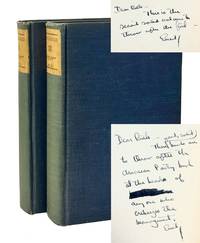
1923EH312New York: Alfred A. Knopf 1923 Two volumes. Foreword by Lady Gregory. Later American edition "Third and Popular Edition". Signed and inscribed by Hemingway to his cousin Ruth White Lowry on front free endpapers of both volumes. Volume I: "Dear Ruth: - These good solid books are to throw after the American Poetry book at the head of strikeout any one sic who criticizes the management -- Ernest."; Volume II: "Dear Ruth - This is the second solid volume to throw after the first - Ernest."; Ruth Lowry's ownership signature in pencil on front pastedown of Vol. I. Publisher's dark blue cloth with title labels to spines printed in black; lacking dust jackets. Very good set with some toning to spines and labels light wear to spine ends light rubbing to front board of Vol. I Bennett Schneider bookseller tickets to both rear pastedowns and Bennett Schneider bookmark laid in to Vol. II. Overall a lovely set inscribed twice by Hemingway. From the personal library of Hemingway's cousin Ruth White Lowry. Wilfrid Scawen Blunt 1840 - 1922 was an English poet diplomat and outspoken critic of colonialism. Blunt married Lady Anne Noel the granddaughter of Lord Byron in 1869 and together they ran the Crabbet Arabian Stud a prominent horse breeding farm in Sussex which imported exceptional Arabian horses from the Middle East. Blunt's marriage to Lord Byron's granddaughter was emblematic of his broader aspiration to emulate Byron: much like the renowned Romantic poet Blunt was a strikingly handsome womanizer a social outcast and a world traveler who fought for idealistic causes. Some of the chapter titles in My Diaries illustrate the sweeping range of Blunt's interests and adventures: "A Visit to Greece in 1888" "Egypt under Tewfik in 1889" "A Visit to Tunis and Tripoli" "Satan Absolved - The Boer War" "Literature and Politics" "The French Invade Morocco" and "The War with Germany Declared." Blunt published many works in his lifetime including The Love Sonnets of Proteus 1881 The Future of Islam 1882 and Satan Absolved: A Victorian Mystery 1899. Blunt and Hemingway were similar in personality and lifestyle in that they are both remembered not only for their literary contributions but also for embracing a comprehensive life and valuing the wisdom gained from experiences. . Signed. Later American Edition. Hard Cover. Very Good. New York: Alfred A. Knopf hardcover
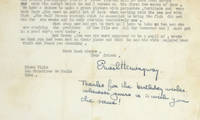
19552662629/07/1955. <blockquote><p>“You need an awful lot of luck when working with the sea and with fish.â€</p><p> </p><p>A fascinating unpublished letter obtained by us directly from the recipient’s family</p></blockquote><p><img class=""alignnone wp-image-26886 size-post-window"" src=""https://cdn.raabcollection.com/wp-content/uploads/20231204130941/Hemingway-July-29-1955-1-1-1-1600x411.jpg"" alt="""" width=""1600"" height=""411"" /></p><p><strong>On Hemingway</strong></p><p>After covering the Spanish Civil War in 1939 Hemingway purchased Finca VigÃa “Lookout Farm†an unpretentious estate outside Havana Cuba. In 1940 he published “For Whom the Bell Tolls†which many consider his best book. All of his life Hemingway was fascinated by war - in “A Farewell to Arms†he focused on its pointlessness and in “For Whom the Bell Tolls†on the comradeship it creates. During World War II he flew several missions with the Royal Air Force and landed with American troops on D-Day. He saw a good deal of action in Normandy and in the Battle of the Bulge. He also participated in the liberation of Paris. Following the war in Europe Hemingway returned to his home in Cuba and turned his attention to writing again. He also traveled widely and at the end of their 1953-1954 African safari the Hemingways survived a near-fatal plane crash only to have their rescue plane crash the very next day. Though they survived the second crash as well newspapers around the world carried brought the details to the reading public. Soon after he received the Pulitzer Prize in fiction for “The Old Man and the Sea†a short heroic novel about an old Cuban fisherman who after an extended struggle hooks and boats a giant marlin only to have it eaten by voracious sharks during the voyage home. That book also played a role in gaining for Hemingway the Nobel Prize for Literature in 1954. It ran in its entirety in five million copies of Life Magazine and the 50000 copies printed in book form sold out in ten days.</p><p>In 1955 back in Cuba Hemingway turned fifty-five and tried to follow his doctors’ advice by reducing his drinking. In October it is announced that he has been awarded the 1954 Nobel Prize in Literature. All of his wife’s’ efforts to protect his privacy were sabotaged by the crush of worldwide press and the fact that Hemingway invited any and all to the Finca Vigia to visit. In the summer of 1955 he was working on the filming of “The Old Man and the Sea†starring Spencer Tracy. The pace of people and press of lunches and drinking finally takes its toll and in the autumn of 1955 Hemingway took to his bed for two months suffering from hepatitis and nephritis.</p><p><img class=""alignnone wp-image-26887 size-post-window"" src=""https://cdn.raabcollection.com/wp-content/uploads/20231204130935/Hemingway-July-29-1955-1-2-1600x361.jpg"" alt="""" width=""1600"" height=""361"" /></p><p><strong>On his friend Mary Lou</strong></p><p>A young American naval officer named Morris was on a training mission with the military and a liberty stop was scheduled for Havana Cuba in late January 1955. Mary Lou Firle his girl friend at the time and later his wife was then a second year student at CCNY and she arranged a trip Cuba so they could meet in Havana. She went a week earlier and stayed at Veradero Beach outside Havana with some other students. Their place at the beach cost $1.00 per day. Before she left she bet a friend that she would have Ernest Hemingway sign the book she had “Farewell to Arms.†Mary Lou and boyfriend Morris met in Havana. They went to the famous El Floridita for daiquiris and had dinner. She wore pants slacks which were unusual for ladies at the time. The next day they went to Veradero Beach. His ship departed on Sunday.</p><p>A day or so Later Mary Lou telephoned Ernest Hemingway. When he answered she introduced herself and added “I have a friend at Fordham University.†Hemingway immediately assumed the friend was Prof. Bob Brown who had been in touch with Hemingway on several occasions. Brown was writing a book or articles about Hemingway. Hemingway told Mary Lou that his wife Mary was away and he had to entertain visitors from the French Embassy that afternoon. He asked her if she would come to his home and help him. Mary Lou agreed and Hemingway sent his driver to pick her up.</p><p>At the meeting a member of the group possibly the ambassador said she looked familiar and that he had seen her at the Floridita with a naval officer. She stood out because she wore pants. After the meeting the group drove her back to Havana. Hemingway invited her back the next day for lunch and sent his driver to pick her up. They spent the afternoon talking. When Hemingway asked her about Prof. Brown she replied “Who is Professor Brown†She said she knew one of his students. Hemingway laughed really hard about that and her “trick.†She had told him of her family background that her parents were born in Germany. Since she had been at Veradero Beach for a week she had a deep tan and Hemingway called her the “Black Kraut.†The reason for the nickname Hemingway said was that he called his good friend Marlene Dietrich the famous German actress “Krautâ€; so Mary Lou would be the “Black Kraut.†Later that day Hemingway’s driver drove her back to Havana.</p><p><img class=""alignnone wp-image-26888 size-post-window"" src=""https://cdn.raabcollection.com/wp-content/uploads/20231204130929/Hemingway-July-29-1955-1-3-1600x297.jpg"" alt="""" width=""1600"" height=""297"" /></p><p>In the Spring of 1955 Mary Lou a friend and Morris met Professor Brown at his home on Long Island. When Mary Lou wrote to Hemingway about a possible trip to Cuba in the Summer he wrote back to discourage the trip too hot in Cuba. He told about how busy he was with his film “The Old Man And The Sea†adding that “You need an awful lot of luck when working with the sea and with fish.â€</p><p><strong>Hemingway’s letter to his black kraut</strong></p><p><strong>Typed letter signed</strong> Finca Vigia San Francisco de Paula Cuba July 29 1955 to Mary Lou. <em>“I don't think August is a good time to take a vacation in Cuba . It is cooler here in the hills than any place except the sea but last night it was so hot I couldn't sleep. The trade winds are not blowing and the general weather plan for July has been very hot mornings in town and moderately cool here until lately; then rains starting at noon. For two weeks the first part of July it rained nearly all day day and night. This was good for the farm because we had had a seven months drought. But it is poor vacation weather. August promises to be very hot and probably with rains in the afternoons. You would be much better off to take a vacation somewhere in the north where it should be cool by then. That heat spell they have been having can't keep on forever.</em></p><p><img class=""alignnone wp-image-26889 size-post-window"" src=""https://cdn.raabcollection.com/wp-content/uploads/20231204130923/Hemingway-July-29-1955-1-4-1600x335.jpg"" alt="""" width=""1600"" height=""335"" /></p><p><em>“I am working terribly hard on my book and am on page 526. I have to concentrate on it all August heat or no heat as must start photography at sea of fishing for The Old Man and The Sea. Have had to interrupt several times to organize on this. It is a tough job with many problems; some very difficult. There will be people here that are working on that and the house unfortunately will be full in August and September when the actual photography starts. Peter Viertel will be back from Europe with the script which he and I worked on the first two weeks of June. We have a chance to make a great picture with patience fortitude and very much luck. You need an awful lot of luck when working with the sea and with fish. The Gulf Stream current which is essential to bring the fish did not run for six weeks and is only starting tentatively now.</em></p><p><em>“Must stop now and get to work as I have to take two men who are studying the problems of the film out all day tomorrow and I must get in a good day's work today. Bob Brown the man you were supposed to be a pupil of wrote me that you had been out at their place and that he and his wife enjoyed your visit and found you charming.â€</em> He adds in his hand <em>“Thanks for the birthday wishes. Whenever yours is I wish you the same.â€</em> With the envelope addressed in his hand.</p><p>The subjects and subtexts of the letter are all the essential Hemingway and rare to find together in one letter - script writing working on a book thoughts on the sea and fish photography the challenges of making a great film from one of his books his hospitality and his strong sexual impulse his wife was away. Hemingway famously rewrote the ending to ""A Farewell to Arms"" numerous times and that is possibly the writing he refers to.</p><p>The letter has been in the family’s possession since it was received and we acquired it direct from them. Mary Lou had promised Hemingway that she would not sell the letter during her lifetime and kept her promise. She told Morris it would be ok to sell it after she passed.</p><p><img class=""alignnone wp-image-25018 size-post-window"" src=""https://cdn.raabcollection.com/wp-content/uploads/20231204144051/Folder-site-11-1600x1327.jpg"" alt="""" width=""1600"" height=""1327"" /></p> unknown
195416066JNew York: Look Magazine 1954. First Edition and Only Printing. One of the rarest of all Ernest Hemingway A items which was unknown for many years until revealed in C. Edgar Grissom’s A Descriptive Bibliography of Ernest Hemingway published in 2011 and is listed as item A.26. This oversize booklet 10 1/2 wide by 13 inches tall separately prints the article and photography for the January 1954 issue of Look Magazine for which Hemingway wrote an original piece. The article is 3500 hundred words plus photographs for which Hemingway wrote the captions. This special printing was the brainchild of the magazine’s publisher Vernon C. Myers who presented it to a small select number of people calling it a literary first “you may want to add to your library.†A little light soiling and use to the printed wrappers. Enclosed in a custom cloth folding case. A Hemingway first edition lacking in almost all Hemingway collections. Look Magazine hardcover books
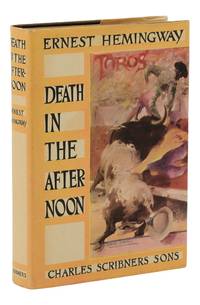
1932140949333New York: Charles Scribner's Sons 1932. First Edition. Near Fine/Near Fine. First edition first printing with an "A" and publisher's seal on copyright page. xi 517 pp. Illustrated with color frontispiece by Juan Gris and 81 black and white photographs. Bound in publisher's black cloth stamped in gilt dark topstain. Near Fine with light wear to extremities fraying at head and tail of spine bookseller ticket to back pastedown. In a Near Fine unclipped $3.50 dust jacket with light toning and edgewear and vertical crease to spine. A magnificent copy of Hemingway's novelistic nonfiction account of Spanish bullfighting scarce with a dust jacket in this condition. Hanneman 10A. Charles Scribner's Sons unknown
19292210410Charles Scribner's Sons 1929. signed limited. hardcover. near fine. SIGNED LIMITED edition. This being #12 of 510 copies of which 500 were for sale and 10 for presentation. Book near fine minor tanning on covers book very fine on inside pages still uncut at top. Housed in a custom-made elaborate fold-out case. Charles Scribner's Sons
19352210317Charles Scribner's Sons 1935. first. hardcover. near fine/fine. First edition first printing with date and "A" on copyright page. Book near fine fading to spine and to edges of covers former owner's name to top of front paste-down. Dust jacket fine. Housed in fold-out custom case. Charles Scribner's Sons unknown
192569758New York:: Boni & Liveright 1925. First edition. publisher's cloth in dust jacket. Preserved in a custom quarter morocco folding box. Good to very good with some oxidation of the gold decoration and lettering to cloth. The jacket has some chipping to the extremities of the spine and the upper edge of the front panel not affecting any lettering. There are some creases to the backstrip and front panel. Still a decent example of a very scarce dust jacket. 8vo. Boni & Liveright, hardcover
1931EH314New York: William Faro Inc. 1931 Illustrated with thirteen plates including a frontispiece. First edition first printing. Signed and inscribed by Ernest Hemingway to his cousin Ruth White Lowry on front free endpaper: "To Ruth. - This little monograph on Mr. Hoover's part in the Nurse Cavell scandal - with sidelights on his "relief" of Belgium - His connection with the sinking of the Lusitania and the abduction of Charley Ross are not made clear. - E. H." Publisher's blue cloth with paper label to spine lettered in black; lacking dust jacket. Very good or better with a few light scratches to front board very light toning to spine and label rubbing to spine label affecting "a" in "Strange" tiny chip to bottom of label text unaffected corners slightly bumped toning to endpapers and some smudging to Hemingway's inscription. Overall a unique inscription showing Hemingway's interest in politics. From the personal library of Hemingway's cousin Ruth White Lowry. The Strange Career of Mr. Hoover Under Two Flags is a survey of Herbert Hoover's pre-presidential career presented in a decidedly unflattering light and filled with accusations of corruption and other misdeeds. The book was one of a handful of smear books about Hoover published before the 1932 election geared toward undoing his reputation as "The Great Humanitarian" and "The Great Engineer." The project began when opportunistic ex-policeman James J. O'Brien approached John Hamill with the idea for the book. After Hamill completed it publisher Samuel Roth who had been jailed three times for dealing in obscene literature agreed to publish it under his William Faro imprint. In 1932 James J. O'Brien sued Hamill over profits from the book and Hamill subsequently repudiated the book and signed an affidavit stating that "while the material gathered for the book contained statements that were true in themselves they were used in such a way as to lead to false conclusions concerning the President" The New York Times January 5 1933. In Hemingway's inscription he mentions the "Nurse Cavell scandal." Edith Cavell was a British nurse who was executed by Germans in German-occupied Belgium for helping Allied soldiers escape. Her execution became a source of outrage for the Allies and was heavily propagandized. In The Strange Career of Mr. Hoover Hamill suggested that Hoover could have saved Nurse Cavell but failed to do so. This was one of the aspects of the book that Hamill later admitted was not true with the above-mentioned New York Times article stating "Hamill swore he learned nothing in Belgium to justify any inference that Miss Cavell's life might have been saved by Mr. Hoover and said he had caused similar false inferences to be drawn from other statements in the book ". The tenor of the inscription in this copy seems to indicate that Hemingway disliked Hoover. Further proof may lie in Hemingway's incendiary "Who Murdered the Vets" essay 1935 about the government's callousness toward the Bonus Army: while directed toward the Roosevelt administration the gross mistreatment of the Bonus Army began under Hoover's leadership. Signed. First Edition. Hard Cover. Very Good. New York: William Faro, Inc. hardcover
1933106729New York: Charles Scribner's Sons 1933. First edition of Hemingway's classic collection of short stories. Octavo original black cloth. Presentation copy inscribed by the author on the front free endpaper "To D. White best wishes always Ernest Hemingway." Near fine in an excellent dust jacket with light rubbing and wear. Housed in a custom clamshell box. One of the rarest Hemingway titles to find signed and inscribed. Written when Hemingway was at the height of his creative powers the stories in Winner Take Nothing glow with the mark of his unique talent. Hunters wives old men of wisdom waiters fighters women loved women lost: they are all here living on the raw edge making love facing the inevitable reality of death. The characters the dialogue the settings the remarkable insight could have come only from Hemingway's imagination. As an introduction to his work or as an overview of the themes he developed at greater length in his novels it is a stunningly successful collection. Charles Scribner's Sons hardcover
4330In this timely and substantial letter Hemingway responds to Abner Green's request to write press releases for The American Committee for the Protection of the Foreign Born. Hemingway's opinions are clear especially with the suggestion that he write about the "murder of sending people guilty of political offenses back to Fascist countries and advocating some provisions for the right of asylum for political refugees." Hemingway writes on the envelope flap "your press release." Specifically he describes the brutal murder of Otto Richter a 21-year old anti-Nazi German who had fled to the United States in 1933. Hemingway refers to his Esquire and Cosmopolitan magazine articles and Cuban politics. This a remarkable letter. Additional background information on the letter follows the text: "Dear Green.Was in Cuba 6 weeks working on something and did not see your Richter releases or other releases as P.O. not forward 2nd class mail. However you're so much better than my own conscience that sometimes wonder if you must not feel pretty happy at what a good man you are. Certainly you have a damned worthy job and presumably are being paid for doing it as well and you have the satisfaction of being morally superior to Guerillas or just call it bandits. O.K. pal. To please you and see what difference it would make haven't written an Esquire article for 4 months. Have given them 2 good stories I could have sold elsewhere.and have been working like a son of a bitch. Now I am a shit because I've sold my 3rd story in 4 years to Cosmopolitan. The other two were good stories and so is this one. You go to hell. Now what do you want me to do about your press releases By the time they catch up with me is too late to protest as now on Richter who you have sadly on 13th and today is 18th and you sent that one by airmail. Will you write a telegram to be addressed to Sec. Perkins which I can sign and you send and I pay for any such cases. Can have it on file in KW office of Western Union and you wire there collect giving name of deportee etc. and the girl there will send it and charge it to me. Or do you want me to write an Esquire piece on the murder of sending people guilty of political offenses back to Fascist countries and advocating some provisions for the right of asylum for political refugees. It is a subject I can write a good piece on. In that case please give me list of cases and their disposition. Also information as to what countries would accept Richter for instance if he were deported to another country than Germany. What do you think would be proper solution if a man is convicted of illegal entry Give him a choice of where to be deported What countries will accept him under that circumstance As I see it the principal difficulty is that a political refugee now cannot enter legally since he must make an escape from his own country therefore his is always liable for illegal entry and you've got to find a legal way to pass him on somewhere else or provide for asylum of political refugees. Otherwise you are simply going to publicize an endless series of deportations which is o.k. if anybody wants martyrs but god damned impractical as tactics. Will you please write me . to Box 406-Key West-Fla. Anyway out west with my wife and Bob The kids middle of July and will take your doll with me and write a piece or will send the telegrams. Arrange for them in advance or both. I didn't answer your letter before this one about my stuff because it was so bloody righteous. Maybe it wasn't. What the hell. Anyway if righteousness is your bread and cheeze sic and red wine for Christ sake eat and drink it well. People in the church die happiest. It doesn't matter what form the church takes and if feeling superior is all you've got for Christ sake feel superior. I get the same kick when I write a good story. Send me the dope. I'm sorry as hell about Richter. I'm also sorry they took a pal of mine out 4 weeks ago and broke both his ankles pounded his balls broke all his finger bones and then poured a gallon of gas over him and set him on .fire alongside the road to Gruajoy . As near as anyone can figure the couldn't make him talk either. Nobody's gotten it since. What are you doing about Batista and Jose Pedraza What do you know about what the last names has been getting away with or do the fish bit too good with money and Cosmopolitan stories have to be written in the afternoons You've a nice lead there for the next time you pan. Pan sic ahead pal. I'll be a son of a bitch if I'm to want any friends." ." Signed "So hay Good luck Ernest Hemingway.''. Abner Green a writer was in charge of educational materials for the American Committee for the Protection of the Foreign Born ACPFB and would become its Executive Secretary of from 1941 to 1959. As the person in charge of publicity and educational materials for the ACPFB it would have been Green who sent out press releases on various issues the committee was addressing. Hemingway is referring to the press releases that Green was sending out regarding Otto Richter a German immigrant who became a cause celebre. Fleeing Nazi Germany Richter got to the United States in 1936 but faced deportation back to Germany where he likely would have been killed. A protest movement supporting Richter and a letter writing campaign to Pres. Roosevelt failed. Richter went on a hunger strike wound up in the hospital and was finally granted permission to emigrate to Mexico. The US and Mexico had agreed to allow some refugees arriving in America to be relocated to Mexico. According to "The Mexican Right: The End of Revolutionary Reform 1929-1940" by John W. Sherman Praeger 1997 Richter was one of the "leftists whom New York communists routed to Mexico - spared from certain death in Germany." However our research makes it unclear whether Richter was actually a communist at the time or whether he was so labeled in the 1950s when the ACPFB was also deemed communist not just left leaning. Among the press releases that Abner Green must have sent out and to which Hemingway referred were the following each with further interesting bits of information on Richter and the American Committee for the Protection of Foreign. -In the July 11 1936 issue of the "Oakland Times" an article reads "The American Committee for the Protection of Foreign Born New York announced today that arrangements have been made to give Otto Richter. German awaiting deportation 30 days to leave the United States. Richter arrested here San Francisco during the 1934 longshoremen's strike expressed fear of Nazi retaliation if he was deported to his native country. He was active against the Nazis prior to 1933 he informed immigration officials. has been held at Ellis Island since June 12 but was freed yesterday under $1000 bail furnished by the committee." The article further states that Richter was hoping that he would be granted permission from "some foreign country" to go there with his 19-year old American wife. In the October 5 1936 issue of the Reading Pennsylvania Times an article notes that the ACPFB announced that Mexican authorities had consented to receive Richter as a "political exile." It further notes "Last June he marched down Broadway with a sign on his back saying ‘Shoot me'. He contended he would suffer that fate if sent back to Germany. And in the Indianapolis Star of October 6 1936 an article entitled "Nazi Foe Gets Refuge" it is stated that "Otto Richter 21 years old anti-Nazi German who fled his native land three years ago has obtained permission to enter Mexico as a political refugee the American Committee for the Protection of Foreign Born announced today. Richter and his American-born wife will leave for agencies caring for the sick."Seems this quote should read "leave with agencies.". A correspondence between Hemingway and Green began when Green using his pen name Paul Harris wrote an open letter to Hemingway entitled "Please Mr. Hemingway!" which appeared in "The American Criteria" December 1 1935. He implored Hemingway to stop writing the kind of stories he was writing for "Esquire Magazine" and instead to write of more important issues. The letter was distributed by The American Committee for the Protection of the Foreign Born. From this letter a correspondence developed between Green and Hemingway. As a result of Green's call to Hemingway to take on the issue of immigrants both men began a correspondence which would likely include this letter. Hemingway became the Co-Chairman of the Committee of Sponsors of the American Committee for the Protection of the Foreign Born. The other Co-Chairman was Dr. William Allan Neilson a Scottish-born American and President of Smith College who advocated for the acceptance of Jewish refugees from Nazi Germany into the United States. The open letter to Hemingway is referenced in "The Legacy of Abner Green: A Memorial Journal" edited by Harry Carlisle published by the ACPFB in 1959. This is referred to in "Ernest Hemingway. Supplement to Ernest Hemingway: A Comprehensive Bibliography" by Andre Hanneman p. 146. The open letter is reprinted in "Hemingway and the Mechanism of Fame" by Matthew Bruccoli University of South Carolina Press 2006. The American Committee for the Protection of the Foreign Born ACPFB was founded in 1933 on "the initiative of Roger Baldwin of the ACLU to defend constitutional rights of foreign-born persons in the United States. The new organization assisted individuals facing deportation aided persons seeking to become naturalized citizens attempted to combat harassment and official persecution of the foreign-born and opposed discriminatory legislation." See University of Michigan Special Collections summary of the Records of the Committee 1926-1980s The Joseph A. Labadie Collection; The ACPFB also supported the Veterans of the Abraham Lincoln Brigade - Americans who fought in the Spanish Civil War. While there is no mention of Hemingway in the papers at the University of Michigan the connection to Hemingway is clear. During the Spanish Civil War Hemingway reported for the North American Newspaper "Alliance" and was a proponent of the Republicans against the Fascists. The ACPFB was formally dissolved in 1982 when it was absorbed by the National Emergency Civil Liberties Committee. Hemingway's reference to "Sec. Perkins" in our letter suggests that Green might have been thinking of having him write a telegram to Perkins who served as President Roosevelt's Secretary of Labor at the time. Senator Frances Perkins became the first woman to serve as a cabinet secretary and she is considered the "principal architect of the New Deal. " She is known especially for the Social Security Act which she spearheaded in 1935. Perkins held a firm stand on the issue of Jewish refugees from Nazi Germany and worked diligently to force FDR and America to take in refugees. Until 1940 the Department of Labor was in charge of immigration and naturalization. According to the University of Michigan website "Throughout its history the Committee was run by a small staff with considerable assistance from those sponsors who served as honorary chairpersons. Abner Green was executive secretary from 1941 to 1959. unknown books
1950180323005New York: Charles Scribner's Sons 1950. First Edition. Hardcover. Like New. First edition first printing presentation issue. Error "Papadopohi" on p. 21 uncorrected as are two errors on pp. 24 and 80. One of only 25 "advance" copies printed from uncorrected sheets and specially bound for presentation as noted by David A. Randall head of Scribner's rare book department at the time on paste down before his signature. xii 308 pp. Publisher's dark blue buckram cloth stamped in gilt. Fine with bright gilt. Housed in a custom chemise slipcase. A rarity and perennial "stopper" for Hemingway collectors in excellent condition. Charles Scribner's Sons hardcover books
1950180323005New York: Charles Scribner's Sons 1950. First Edition. Hardcover. Like New. First edition first printing presentation issue. Error "Papadopohi" on p. 21 uncorrected as are two errors on pp. 24 and 80. One of only 25 "advance" copies printed from uncorrected sheets and specially bound for presentation as noted by David A. Randall head of Scribner's rare book department at the time on paste down before his signature. xii 308 pp. Publisher's dark blue buckram cloth stamped in gilt. Fine with bright gilt. Housed in a custom chemise slipcase. A rarity and perennial "stopper" for Hemingway collectors in excellent condition. Charles Scribner's Sons hardcover
1944377793Philadelphia: The Blakiston Company 1944. Third American edition second printing. 410 pp. 8vo. Black paper covered boards with signature blindstamped on cover and printed title on spine. Some wear and loss to paper of spine and along edge in near fine jacket from the same edition with offsetting to endpapers from dust jacket pages evenly toned and Havana bookseller's ticket "La Bohemia Bookstore" and censor's stamp to endpapers. Third American edition second printing. 410 pp. 8vo. Hemingway's tale of love amidst the Spanish Civil War inscribed on the ffep: "To Senator Agustin Cruz with sincere admiration and gratitude for all that he has done for those who fought for the Spanish Republic / Enest Hemingway / On Board "Pilar" / La Habana 21 Julio 1946"<br /> <br /> Senator Agustin Cruz Fernandez was a Cuban Republican and Oppositionist political party leader from Santa Cruz who was Secretary of Labor in the cabinet of Miguel Mariano Gomez Cuba's first constitutional President since the downfall of the Machado régime in 1933. White Secretary<br /> during the period 1936-1939 Cruz worked to expel Falangist political figures from Cuba on the grounds that they were spreading anti-Democratic messages eventually leading the push to in 1941 to banish all consular officials from the totalitarian regimes of Spain Germany and Italy.<br /> <br /> The Bohemia Bookstore in Havana was where Hemingway bought his books. Other inscribed copies of For Whom the Bell Tolls also were purchased there. The Blakiston Company unknown
192950681New York: Charles Scribner's Sons 1929. Signed Limited Edition. Hardcover missing slipcase. Very Good- vellum spine. Octavo. Missing slipcase signed on the limitation page this being number 444 of 510 signed/limited copies. Previous owner's name in ink on the ffep. The vellum spine has soiling and discoloration. Pale green boards and ffeps sunning to the edges of the boards. Deckled edges. Black label with gilt letters. 355pp. Binding is tight pages remain bright. 6.5 X 9 1/4". Charles Scribner's Sons hardcover
1930HEMINGWA013877Edward W. Titus at the Sign of the Black Manikin Press Paris. 1930. First edition. Translated by Samuel Putnam. Royal octavo. 186 pages. Wrappers. 1000 copies printed by Daranti�re Dijon. Publisher's note. "A Note on Kiki St. Theresa and the Vulgate" by the translator. 20 full-page black and white reproductions of paintings by the author; 4 black-and-white photographs of the author by Man Ray; 1 black-and-white photograph of her grannie by the author; other black-and-white photographs; full-page black-and-white portraits of the author by Foujita Kisling Per Krohg Hermine David Mayo and Tono Salazar. Contains chapters on Man Ray Kisling and Foujita.The original publisher's card slipcase is signed boldly in red crayon by both Hemingway and Kiki; in addition Kiki has drawn crosses kisses above her name and on the backstrip. Presumably the signatures date from the launch of the book. A later hand but probably not much later as the ink is fading and probably belonging to someone who was unaware of the significance of the signatures has written the publication details of the book below Hemingway's name.Spine darkened. Very good. The original card slipcase is tanned dusty rubbed at the edges and a bit marked. Edward W. Titus, at the Sign of the Black Manikin Press, Paris. unknown
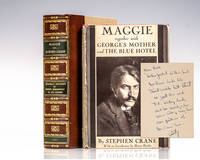
1931149856New York: Alfred A. Knopf 1931. First edition of this collection of classic psychological realism works. Octavo original publisher's cloth. Association copy lengthily inscribed by Ernest Hemingway to his cousin on the front free endpaper "Dear Ruth In the jacket on this book Mr. Crane looks like Ernest Wahl but that is just the old T. B. Watley look and Mr. Walsh who came later may have seen pictures of Mr. Crane too. Ernest." Hemingway admired Stephen Crane's work and considered him an important influence on his own writing. He specifically praised The Red Badge of Courage in the introduction to his 1942 anthology Men at War: The Best War Stories of All Time where he described it as "one of the finest books of our literature and I include it entire because it is all as much of a piece as a great poem is." The recipient Ruth White Lowry 1884–1974 and her husband William Malcolm Lowry 1884–1953 were longtime residents of Kansas City Missouri and integral members of Ernest Hemingway’s extended Midwestern family. Ruth the daughter of William White and Mary Hall White was a first cousin of Grace Hall Hemingway the author’s mother. This made her Ernest’s first cousin once removed though their families were close enough that Hemingway referred to her simply as “Cousin Ruth.†The White and Hall families had deep Midwestern roots—Ruth was educated in Kansas City and was part of the city’s civic and cultural life throughout the early twentieth century. When Hemingway and his second wife Pauline Pfeiffer returned from Paris to the United States in 1928 they came to Kansas City for the birth of their first child Patrick Hemingway who was delivered at St. Mary’s Hospital on June 28 of that year. The Hemingways stayed with Ruth and Malcolm Lowry at their Kansas City home both before and after the delivery. Pauline returned to the same house three years later in November 1931 for the birth of their second son Gregory Hancock Hemingway while Ernest shuttled between Kansas City and Key West during the final stages of Death in the Afternoon. The Lowrys’ hospitality offered Hemingway a familial refuge far from the expatriate world of Europe and the growing celebrity that attended his literary success. The relationship between the two families endured for decades. Letters and family recollections describe Ruth as a warm maternal presence in Hemingway’s life—a relative he could trust with his young family during periods of upheaval. The Lowry household thus occupies a unique place in Hemingway’s biography: it was the setting for the births of both of his sons with Pauline and the site of rare domestic calm amid his restless movements between continents. Copies inscribed to members of the Lowry family remain among the most significant Hemingway association copies linking the author’s private life in the American Midwest to his public identity as one of the central figures of twentieth-century literature. Near fine in a very good dust jacket. Housed in a custom folding chemise and half morocco clamshell box. Stephen Crane’s Maggie: A Girl of the Streets along with “George’s Mother†and “The Blue Hotel†gathers three key examples of his stark naturalistic storytelling. Maggie follows a young woman growing up amid poverty and violence in New York’s Bowery showing how harsh environment and limited choices drive her toward ruin. “George’s Mother†is a tightly focused domestic tragedy in which a mother’s hopes for her son collapse as he succumbs to drink and moral drift. “The Blue Hotel†set on the western frontier traces a chain of misunderstandings and rising tension among strangers that ends in senseless violence. Together the works present Crane’s bleak view of social forces human vulnerability and the fatal consequences of fear and illusion. Alfred A. Knopf hardcover