Sand GeorgeABAA

5 503 résultats
18432030Paris: Imprimerie de Schneider et Langrand 1843. First edition. Contemporary 19th century quarter calf binding with green boards; gentle wear to edges. Internally an excellent copy with original wraps bound in; occasional light foxing and small paper loss to margins of last two leaves neither affecting text. Octavo collates complete with 31 pages. An exceptionally rare copy of Sand's first work on social justice of which only 500 were printed. This copy is the only one known to have come onto the market with none in the modern auction records and the only other held at La Bibliotheque Nationale de France.<br/><br/>Having dedicated the first decade of her career toward writing novels about women's internal and social struggles George Sand made her first move into activism with Fanchette. Shocked by the story of a young girl with mental illness who had been refused refuge in a convent and was soon after discovered pregnant and arrested for begging Sand opted to expose the events in a set of letters printed in the Revue Independente. Following a wave of public outcry "Sand decided to have the letters printed in brochure form with the plan that half the copies would be distributed free to the workers of La Chatre the others sold for the benefit of Fanchette. Five hundred copies of this brochure of thirty-one pages were printed and circulated. The Fanchette case therefore revealing as it did an appalling lack of sympathy for the poor and misfortunate convinced George Sand that an effort should be made to awaken the citizens of La Chatre to their duties as members of a community" Bowes. This publication marked a new phase of Sand's writing career which more directly emphasized social justice particularly for vulnerable women. A rare and important work. [Imprimerie de Schneider et Langrand] unknown books
186471862Michel Lévy frères | Paris 1864 | 14.50 x 23 cm | relié
187578260Michel Lévy frères | Paris 1875 | 11.50 x 18.50 cm | relié
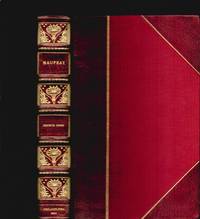
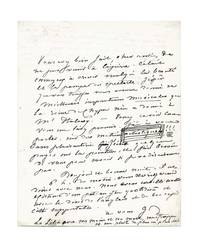
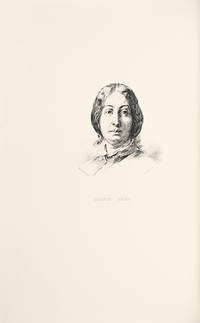
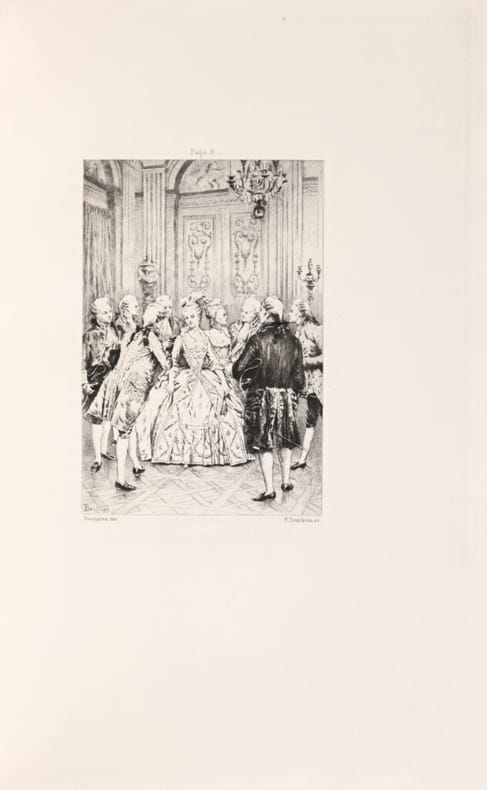
19029033028Philadelphia: George Barrie & Sons 1902. Hardcover. Fine condition. With ten etchings in two states by H. Toussaint after paintings by J. Le Blant. Hand colored etched frontispiece. 8vo top edge gilt fore edge uncut. Bound in half-red French levant morocco and red cloth boards red end-papers. Gilt rules on front and rear covers with spine elaborately tooled and lettered in gilt. With the 1 x 2 inch bookplate of Thomas D. Murphy who was also the binder in the upper right- hand corner of the back side of the front free end-paper. Also tipped in is a half -page letter of approximately fifteen lines and sixty words in blue ink in the author's hand and signed and dated December 20th 1860 by the author. Also included is another half page holograph translation in another hand. This volume is from a twenty volume set entitled The Masterpieces of George Sand printed on Japanese vellum with prints in two states with the frontispiece in color. The set is limited to one thousand sets. <br/><br/> George Barrie & Sons hardcover
1841Sand14<p><strong>DELACROIX SAND George 1804-1876</strong></p><p>Autograph letter signed " G.S. " to Eugène Delacroix<br />Paris Postal mark 23rd December 1841 1 p. 1/2 in-8°<br />Autograph address on fourth folio wax seal : " Monsieur Delacroix rue des Marais Saint Germain 17 "</p><p><strong>Superb letter to her friend Delacroix about her desire to write "a few pages on painting" the <em>Femmes d'Alger</em> her contempt for the <em>Ingresque</em> school and other artistic news</strong></p><p><em>" Vous avez bien fait cher ami de ne pas venir à l'Opéra. <strong>C'était ennuyeux à crever malgré la beauté et la pompe du spectacle.</strong> J'espère que vos truffes vous auront donné de meilleures inspirations musicales que la reine de Chypre n'en a donné à Mr Halevy.1</em><br /><strong><em>Venez ce soir comme vous me l'avez promis. J'ai à vous parler sur des matières artistiques !!!</em></strong> le mot est entouré par Sand d'un triple trait de plume.<strong><em> Sans plaisanterie j'écris quelques pages sur la peinture et j'ai besoin de vous pour savoir si je ne déraisonne pas. </em></strong><em>2</em><br /><em>Bonjour et bonne nuit. Il est 6h du matin. Vous devriez venir dîner avec nous. Nous avons embelli notre existence d'un pot-au-feu quotidien et avec le dîner de l'anglais3 et du bon café c'est supportable.</em><br /><em>G.S.</em><br /><strong><em>La Lélia</em></strong><em>4<strong>avec son moine et son mort me frappe et me plaît de plus en plus c'est ce qui m'a mise en veine d'écrire sur la couleur et ce qu'il faut entendre par la forme. Avec ça j'ai vu vos femmes d'Alger</strong>5 ce matin. Si vous m'encouragez je suis capable de faire le prochain salon dans notre revue</em> La Revue indépendante<em> et <strong>vous savez que je ne caponnerai pas</strong></em> ne se montrera pas lâche <strong><em>avec tout cette école silhouettiste</em></strong><em>6<strong> qui se dit en possession du dessin</strong> ".</em></p><p>1 <em>La Reine de Chypre</em> an opera in five acts by Halévy to a libretto by St. George took place the day before December 22 1841. Unlike George Sand Richard Wagner who was also present at the premiere considered the music "noble moved and even new and exhilarating" although he criticized Halévy's failings in simple orchestration.<br />2 In Horace which George Sand was then writing she staged a rapin a pupil of Delacroix but there were no "few pages on painting". Is this an article intended for the Independent Review – which it has just created – but which it has renounced The word written in postscript confirms that it is an aesthetic reflection that focuses on "color" and "form".<br />3 Possible reference to an English restaurateur or caterer frequented by George Sand.<br />4 <em>Lélia avec son moine et son mort</em> is the third work offered by Delacroix to George Sand for the gifts of 1842. It is a pastel depicting Lélia kneeling near Stenio's corpse while the monk Magnus "in the shadows leaning stiffly against the wall of the cave darted on her his sparkling eyes". The subject was treated several times by Delacroix.<br />5 This is the <em>Femmes d'Alger dans leur appartement</em> a painting presented at the Salon of 1834 where it caused a sensation. A synthesis of orientalism and romanticism this painting expresses a deep "melancholy" for the poet and art critic Baudelaire.<br />6 George Sand refers to the school of Ingres as a "Silhouettist school". We know the adversity between the two painters that animated the artistic scene of the nineteenth century. The writer had resolutely taken Delacroix's side that of "form" and "color".</p><p><u>Bibliography:</u><br /><em>George Sand</em> – Correspondance t. V Lubin Garnier p. 529-531 lettre n°2369<br /><em>Correspondance</em> éd. Françoise Alexandre Les éditions de l'Amateur p. 117-118 n°50</p><p><u>Provenance:</u><br />Achille Piron Delacroix's universal legatee<br />Bibliothèque Marc Loliée</p>
1842Sand29<p><strong>DELACROIX SAND George 1804-1876</strong></p><p><u>Two autograph letters</u> signed " GS " to Eugène Delacroix<br />Nohant 6 & 7 July 1842 3 p. in-8° in total in black ink<br />Autograph addresses on verso<br />Stamp marks previous trace of mounting</p><p><strong>Saddened by the departure of her "good little" Delacroix after the latter's stay in Nohant in the company of Chopin and the rest of the Sand family the writer found herself immersed in her reading of <em>Les Mystères de Paris</em></strong></p><p><strong><u>From the Marc Loliée library</u></strong></p><p><em>" <strong>Cher bon petit</strong> J'espère que vous êtes arrivé à bon port sans trop souffrir de la chaleur qui a été modérée le jour de votre départ. Vous avez oublié ici quelques effets dont Maurice a fait une caisse laquelle part aujourd'hui. Comme le port en est payé accusez-en réception afin qu'elle ne s'égare pas sans que nous la fassions réclamer. J'ai encore retrouvé dans mes mouchoirs un mouchoir à vous. Je vous le mets à part ainsi que ceux qui pourraient se retrouver au prochain blanchissage. <strong>Que Jenny</strong></em> la gouvernante de Delacroix <strong><em>ne nous accuse donc pas de vous avoir grinché vos zardes</em></strong>¹<em>. – <strong>Je lis le Chourineur et je vous assure que malgré l'horreur du sujet et des détails</strong></em>²<strong><em> c'est jusqu'à présent fort intéressant et fabriqué avec beaucoup de talent</em></strong><em>. – <strong>Nous sommes restés tout tristes et tout déconfits de votre départ</strong>. Nous tâchons de jouer au billard mais je crois que vous avez emporté le carambouillage</em>³<em> dans votre poche et que vous ne nous avez laissé que le manque de touche. J'attends avec impatience un petit mot de vous. <strong>Nous sommes encore trop chagrins pour vous en dire long aujourd'hui</strong>. Et puis l'heure me presse. À présent cher soyez bien portant. Si vous nous regrettez autant que nous vous regrettons faites un effort pour nous oublier jusqu'à notre retour </em>Sand et Chopin rentreront à Paris le 31 juillet<em> alors vous nous raimerez de nouveau. <strong>Adieu moi et tous vous embrassons et vous aimons</strong>.<br />GS. "</em></p><p><em>" Cher ami mon dadet </em>sic <em>de Thomas </em>peut-être Thomas Aucante autrefois vacher<em> a commencé le cours de bêtises auxquelles je dois m'attendre en ne payant pas le port de la caisse que je vous ai envoyée hier. Si bien qu'il faut que vous le sachiez afin de n'avoir pas de contestation avec l'administration. Accusez-moi réception car tout ceci a été fort mal fait malgré mes précautions.<br />Nous nous portons bien. <strong>Nous vous aimons. J'ai rêvé de vous toute la nuit</strong> ; j'espère que c'est bon signe et que vous êtes bien portant.<br />À vous<br />GS. "</em></p><p>In response to his friend's repeated invitations Delacroix spent nearly two weeks in Nohant in June 1842. He wanted above all to rest "vegetate" as he put it and enjoy the pleasures of the countryside. Back in Paris he replied on the 8th stating that he had received the crate and calling the person who had brought it to him a cheat and an imposter demanding postage. He asked his friend for a small purse left in Nohant a purse that Solange had given him and a small cord from Algiers. He concluded: "The weather is awful for the nerves. When you dreamed that you saw me did you dream that you were the Duchess of Berry I send you all my sincere embraces but I am very sad" Corr. gén. de Delacroix t. II p. 116.</p><p>Using the slang present in Eugène Sue's work we understand that Sand is here in the middle of reading The Mysteries of Paris. The serial novel published in the Journal des débats from June 19 1842 to October 15 1843 inaugurated mass literature in the 19th century and earned its author immense fame in all social classes.</p><p><u>Provenance:<br /></u>Bibliothèque Marc Loliée<br /><u><br />Bibliography:<br /></u><em>Correspondance</em> t. V éd. G. Lubin Garnier n°2477 & 2478</p>
TR18<p>Paris Calmann Lévy 1888.</p>Large 8vo 200 x 135 mm with 5 pref. ll. including the portrait of the author in triplicate 93 pp 1 p. 1 l. 7 full-page engravings in double state and 2 in triplicate. Full blue morocco triple gilt fillet framing the covers richly decorated spine ribbed double gilt fillet on the edges gilt edges on witnesses covers and spine preserved. Binding signed by<i> Chambolle-Duru.</i><p><b>Superb deluxe edition of this short novel by George Sand.</b></p><p>Limited edition of 225 numbered copies on Marais vellum paper this one bearing the number 10.</p><p>The story is about the Marquise de R. an attractive young woman who is wounded by an unhappy marriage but who soon discovers a devouring and platonic passion for Lélio a humble actor of unknown talent.</p><p>Alas we soon discover that the beautiful woman is only in love with a shadow since as soon as he is stripped of his finery and taken off the stage Lélio turns out to be a vile and ordinary man.</p><p><b>The abundant illustration comprises a portrait of the author engraved by François Courboin </b>1865-1926 after Thomas Couture 1815-1879as well as <b>3 chapter heads 3 lamps and 3 plates also engraved by Courboin after drawings by Baugnies.</b></p><p>Our copy presents each engraving in double or triple state.</p><p><b>A superb wide-margined copy bound in elegant contemporary blue morocco covers signed by Chambolle-Duru.</b></p><p>Provenance: from the <i>P. Villeboeuf</i> collection with ex libris.</p><p><br /></p><p><u>FRENCH</u><br /></p><p>Grand in-8 de 5 ff. prél. dont le portrait de l'auteur en triple état 93 pp. 1 p. 1 f. 7 gravures à pleine page en double état et 2 en triple état. Plein maroquin bleu triple filet doré encadrant les plats dos à nerfs richement orné double filet or sur les coupes tranches dorées sur témoins couvertures et dos conservés. Reliure signée de <i>Chambolle-Duru.</i></p><p>200 x 135 mm.</p><p><b>Superbe édition de luxe ce de court roman de George Sand.</b></p><p>Tirage limité à 225 exemplaires numérotés sur papier vélin du Marais celui-ci portant le numéro 10.</p><p>La nouvelle met en scène la marquisede R. une séduisante jeune femme blessée par un mariage malheureux mais qui se découvre bientôt une passion dévorante et platonique pour Lélio un humble comédien au talent méconnu.</p><p>Hélas nous découvrons vite que la belle n'aime qu'une ombre puisque aussitôt dépouillé de ses atours et descendu de la scène Lélio se révèle un homme vil et ordinaire.</p><p><b>L'abondante illustration se compose d'un portrait de l'autrice</b> gravé par <i>François Courboin</i> 1865-1926 d'après <i>Thomas Couture</i> 1815-1879 ainsi que de<b> 3 têtes de chapitre 3 culs-de-lampe et 3 planche</b>s gravés également par <i>Courboin</i> d'après les dessins de <i>Baugnies</i>.</p><p>Notre exemplaire présente chaque gravure en double ou en triple état.</p><p><b>Superbe exemplaire grand de marges relié avec les couvertures conservées en élégant maroquin bleu de l'époque signé de Chambolle-Duru.</b></p><p>Provenance : de la collection <i>P. Villeboeuf </i>avec ex libris.</p> hardcover
LCS-18580Superbe exemplaire grand de marges relié avec les couvertures conservées en élégant maroquin bleu de l’époque signé de Chambolle-Duru. Paris, Calmann Lévy, 1888. Grand in-8 de(5) ff. prél. dont le portrait de l’auteur en triple état, 93 pp., (1) p., (1) f., 7 gravures à pleine page en double état et 2 en triple état. Plein maroquin bleu, triple filet doré encadrant les plats, dos à nerfs richement orné, double filet or sur les coupes, tranches dorées sur témoins, couvertures et dos conservés. Reliure signée de Chambolle-Duru. 200 x 135 mm.
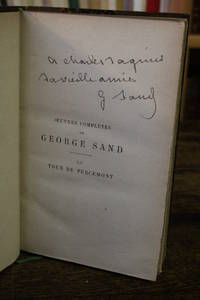
187648387Paris: Calmann Lévy 1876. Fine. Calmann Lévy Paris 1876 12.50 x 19.50 cm relié First edition published as part of the complete works Half light brown morocco by Petit successeur de Simier spine in six compartments marbled pastedowns and endpapers top edge gilt Handsome autograph inscription from George Sand to his friend Charles Sagnier a frequent visitor of the house at Nohant during the final years of Sand's life Provenance: from the library of Charles Sagnier with his ex libris. Calmann Lévy unknown
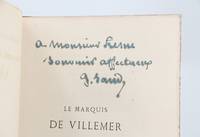
186487349Paris: Michel Lévy frères 1864. Fine. Michel Lévy frères Paris 1864 14.50 x 23 cm relié First edition of the theatrical adaptation.  Contemporary binding in red half morocco with corners spine with five raised bands framed by gilt fillets adorned with double gilt panels and decorative tooling gilt fillets framing the marbled paper boards combed paper endpapers and pastedowns combed edges. A few stains to the covers a crisp and clean copy free of foxing.  Signed autograph inscription by George Sand to the actor Fresne : « à monsieur Fresne souvenirs affectueux. G. Sand. » Fresne had performed in her play Molière at its premiere at the Théâtre de la Gaîté in 1851. « On 1st March 1864 the theatrical event of the year took place: the premiere of Le Marquis de Villemer. The Odéon Theatre cordoned off by police lines was stormed by students who had been camping out in the square since ten in the morning. Inside the actors were interrupted by stomping shouting and thunderous applause. The hired claque was overwhelmed. Between 3000 and 4000 people were turned away at the door. The imperial family applauded the emperor wept openly Flaubert was in tears Prince Napoléon shouted his enthusiasm. It was a triumph. Two hundred people surrounded George and embraced her in the theatre foyer. Students escorted her back to her home to the cries of « Vive George Sand! Vive Mademoiselle La Quintinie! à bas les cléricaux! » The police dispersed the crowd later that night. These anticlerical demonstrations were all the more surprising given that the play contained no such allusions. It was a melodrama—highly accomplished—in which love triumphs over social prejudice. The first act infused with the spirit of Dumas fils is dazzling. The play tells the story of two brothers: one deeply attached to his mother introverted and serious initially refuses to marry. but ends up wedding the virtuous and upright ladyÂ’s companion. The other a charming and witty libertine in his forties marries a wealthy heiress just out of the convent. The pace is brisk the characters well drawn. The play benefited from George SandÂ’s aura. Its success was repeated night after night. The box office receipts were extraordinary. The Latin Quarter was unrecognizable. The narrow streets around the Odéon far removed from the elegant grands boulevards were clogged with luxury carriages. Elegant ladies queued at the box office from early morning. The Odéon—once described as a theatre that was “dirty cold remote deserted wretched” Letter to Maurice and Lina Dudevant-Sand 5 March 1864—was lit up every evening. » Evelyne Bloch-Dano Le Dernier Amour de George Sand 2010  Michel Lévy frères hardcover
187648387Calmann Lévy | Paris 1876 | 12.50 x 19.50 cm | relié
186487349Michel Lévy frères | Paris 1864 | 14.50 x 23 cm | relié
18432030Paris: Imprimerie de Schneider et Langrand 1843. First edition. Contemporary 19th century quarter calf binding with green boards; gentle wear to edges. Internally an excellent copy with original wraps bound in; occasional light foxing and small paper loss to margins of last two leaves neither affecting text. Octavo collates complete with 31 pages. An exceptionally rare copy of Sand's first work on social justice of which only 500 were printed. This copy is the only one known to have come onto the market with none in the modern auction records and the only other held at La Bibliotheque Nationale de France.<br /> <br /> Having dedicated the first decade of her career toward writing novels about women's internal and social struggles George Sand made her first move into activism with Fanchette. Shocked by the story of a young girl with mental illness who had been refused refuge in a convent and was soon after discovered pregnant and arrested for begging Sand opted to expose the events in a set of letters printed in the Revue Independente. Following a wave of public outcry "Sand decided to have the letters printed in brochure form with the plan that half the copies would be distributed free to the workers of La Chatre the others sold for the benefit of Fanchette. Five hundred copies of this brochure of thirty-one pages were printed and circulated. The Fanchette case therefore revealing as it did an appalling lack of sympathy for the poor and misfortunate convinced George Sand that an effort should be made to awaken the citizens of La Chatre to their duties as members of a community" Bowes. This publication marked a new phase of Sand's writing career which more directly emphasized social justice particularly for vulnerable women. A rare and important work. [Imprimerie de Schneider et Langrand] unknown
00303Paris: Desessart 1847. Piracy Banditry and Disorder"<br/>Bewitching Beauty Inflames Desires<br/>Uncut in the Original Printed Wrappers<br/><br/>SAND George. Le Piccinino. Paris: Desessart Éditeur 1847.<br/><br/>First edition. Five octavo volumes 9 1/16 x 5 7/16 inches; 231 x 139 mm. 4 315 1 blank 1 "Table" 3 blank final blank leaf pasted to rear pastedown; 4 301 1 blank 1 "Table" 1 blank; 4 307 1 "Table"; 308 1 "Table" 3 blank final blank leaf pasted to rear pastedown; 4 advertisements 4 318 1 "Table 1 blank pp.<br/><br/>Uncut in the original yellow printed wrappers. Advertisements on rear wrappers. Minimal chipping to wrappers spines slightly darkened some light foxing and edge browning as usual. A wonderful set. Each volume housed in a marbled board slipcase and the five volumes housed together in two quarter blue morocco clamshell cases.<br/><br/>Le Piccinino is the tale of a bewitching Sicilian princess whose beauty inflames the desires of everyone she encounters whether artist noble commoner or bandit.<br/><br/>"The Piccinino is a novel of fantasy" writes George Sand in her preamble "which has no claim to paint a precise historical epoch nor to accurately describe a country. It is a study of color dreamed rather than felt and where only a few features have been found just as by chance. The scene of this novel could be placed everywhere else under the sky of the south of Europe .". A story full of fascinating family secrets from one end to the other.<br/><br/>Astonishingly only one the present copy in 1989 of this novel featuring "piracy banditry and disorder" has come to auction within the last fifty years.<br/><br/>"Nothing could be more charming than her tales of mystery intrigue and adventure.Le Piccinino et al - these things have all the spontaneous inventiveness of the romances of Alexander Dumas his open-air quality his pleasure in a story for a story's sake." Henry James Literary Criticism: French Writers p. 730.<br/><br/>On April 16 1847 Chopin wrote to his family: "her new romance entitled thus far Piccinino which means: little. The action takes place on Sicily. Many lovely things; I do not doubt that it will be more to Ludwika's liking than Sand's Lucretia which also aroused less enthusiasm among others here.A great deal of naturalness of poetry I remember what a pleasure it was to listen to her reading it" Fryderyk Chopin—Calendary.<br/><br/>George Sand pen name of Amandine Lucie Aurore Dupin Baronne Dudevant 1804-1876 "was as famous for her ‘unfeminine' independence her habit of wearing men's clothes and her love affairs with such prominent artistic figures as Alfred de Musset and Frédéric Chopin as for her writings. In 1831 she left her husband Baron Dudevant. Her work is usually divided into three distinct periods the first of which intensely romantic corresponds to her affair with Musset. The novels of this period plead the right of free love for both men and women and include such works as Indiana 1832 Lélia 1833 and Valentine 1832. During the next decade George Sand became interested in various humanitarian reform movements and published such works as Consuelo 1842 and Le Meunier d'Angibault 1845. Her last group of novels sentimental studies of nature and of rustic manners includes La Mare au diable 1846 Le Piccinino 1847 La Petite Fadette 1848 and François le Champi 1850" Benét's Reader's Encyclopedia.<br/><br/>Vicaire VII col. 231. Not in Carteret. Paris: Desessart, 1847 unknown books
00303Paris: Desessart 1847. Piracy Banditry and Disorder"<br /> Bewitching Beauty Inflames Desires<br /> Uncut in the Original Printed Wrappers<br /> <br /> SAND George. Le Piccinino. Paris: Desessart Éditeur 1847.<br /> <br /> First edition. Five octavo volumes 9 1/16 x 5 7/16 inches; 231 x 139 mm. 4 315 1 blank 1 "Table" 3 blank final blank leaf pasted to rear pastedown; 4 301 1 blank 1 "Table" 1 blank; 4 307 1 "Table"; 308 1 "Table" 3 blank final blank leaf pasted to rear pastedown; 4 advertisements 4 318 1 "Table 1 blank pp.<br /> <br /> Uncut in the original yellow printed wrappers protected by glassine wrappers. Advertisements on rear wrappers. Minimal chipping to wrappers spines slightly darkened some light foxing and edge browning as usual. A wonderful set. Each volume housed in a marbled board slipcase and the five volumes housed together in two quarter dark blue morocco over royal blue cloth clamshell cases spines with five raised bands ruled in gilt three morocco labels of differing blues lettered in gilt. A remarkable survival.<br /> <br /> A fantastical and romantic tale of mistaken identity erotic obsession and aristocratic intrigue Le Piccinino follows the fateful course of a beautiful Sicilian girl - raised among brigands and peasants - whose origins like her destiny are shrouded in mystery. She moves through a sun-drenched landscape of artists outlaws princes and adventurers inspiring adoration and chaos in equal measure.<br /> <br /> In this richly imagined and theatrical narrative Sand celebrates invention over realism placing the novel firmly within her later romantic oeuvre that privileged exoticism imagination and the internal landscape of female identity. Piracy banditry smoldering secrets and hidden bloodlines abound.<br /> <br /> "The Piccinino is a novel of fantasy" writes George Sand in her preamble "which has no claim to paint a precise historical epoch nor to accurately describe a country. It is a study of color dreamed rather than felt and where only a few features have been found just as by chance. The scene of this novel could be placed everywhere else under the sky of the south of Europe .". A story full of fascinating family secrets from one end to the other.<br /> <br /> Astonishingly only one the present copy in 1989 of this novel featuring "piracy banditry and disorder" has come to auction within the last fifty years.<br /> <br /> "Nothing could be more charming than her tales of mystery intrigue and adventure.Le Piccinino et al - these things have all the spontaneous inventiveness of the romances of Alexander Dumas his open-air quality his pleasure in a story for a story's sake." Henry James Literary Criticism: French Writers p. 730.<br /> <br /> On April 16 1847 Chopin wrote to his family: "her new romance entitled thus far Piccinino which means: little. The action takes place on Sicily. Many lovely things; I do not doubt that it will be more to Ludwika's liking than Sand's Lucretia which also aroused less enthusiasm among others here.A great deal of naturalness of poetry I remember what a pleasure it was to listen to her reading it" Fryderyk Chopin-Calendary.<br /> <br /> George Sand pen name of Amandine Lucie Aurore Dupin Baronne Dudevant 1804-1876 "was as famous for her 'unfeminine' independence her habit of wearing men's clothes and her love affairs with such prominent artistic figures as Alfred de Musset and Frédéric Chopin as for her writings. In 1831 she left her husband Baron Dudevant. Her work is usually divided into three distinct periods the first of which intensely romantic corresponds to her affair with Musset. The novels of this period plead the right of free love for both men and women and include such works as Indiana 1832 Lélia 1833 and Valentine 1832. During the next decade George Sand became interested in various humanitarian reform movements and published such works as Consuelo 1842 and Le Meunier d'Angibault 1845. Her last group of novels sentimental studies of nature and of rustic manners includes La Mare au diable 1846 Le Piccinino 1847 La Petite Fadette 1848 and François le Champi 1850" Benét's Reader's Encyclopedia.<br /> <br /> Vicaire VII col. 231. Not in Carteret. Paris: Desessart, 1847 unknown
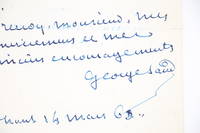
186376837Nohant Nohant-Vic 1863. Fine. Nohant Nohant-Vic 14 mars 1863 13.40 x 20.60 cm 3 pages sur un double feuillet Autograph letter signed by George Sand addressed to René Biémont. Three pages written in blue ink on a double sheet bearing at the head of the first page the blind stamp of Sand's initials. Envelope included. Folds inherent to mailing. This letter was published in the complete correspondence of George Sand established by Georges Lubin. Fine letter of congratulations addressed to René Biémont after sending his work Le Petit Fils d'Obermann: ""Your little book is very original and you show qualities of talent that will develop if you look ahead."" As an attentive reader much solicited by her young peers Sand develops her literary criticism: ""Obermann and his grandson the monk belong to the past. They are true and the timid Jean is well drawn. There is grandeur and truth in this exceptional type. But Constant d'Heurs is too passive to events. He should react against this powerless man and cure him or pity him more ."" Sententiously she thus concludes her letter: ""Do not complain of thankless work and accept it as a good thing three-quarters of life sacrificed to some duty makes the last quarter very strong and very alive. It is very good to be attached to poetry and thwarted in the possession of a beautiful dream. As soon as one can savor it without respite it fades or becomes troubled. I speak to you from experience. One is never happier and more inspired than when one believes one does not have time to be so."" Very fine testimony to the leading role that George Sand played on the literary scene of the Second Empire. unknown
1866L006.789FRANCE: Michel Levy Freres 1866. Original printed pink wrappers. Halftitle title page 1-26 blank. At rear os a 36 page catalogue of Michel Levy dated Juillet 1866. Book is in very good condition with minor signs of wear and/or age. . Paperback. VG. Michel Levy Freres Paperback
77107Paris E. Deyrolle published edition 1871-shortly before 1879. 4to 22.1 x 14.6 cm. 179 pp. followed by ca. 100 blanks. Original green half sheep over marbled boards. Printed label on front board. AND 12 pages of manuscript text pertaining to this work and in particular the preface. In a contemporary envelope AND. A signed letter draft 92 pp. folded by the author on paper with his blind-stamp directed to one of his correspondents. = This is the original manuscript of a very seldom-seen catalogue written by the French entomologist writer artist and son of the famous writer George Sand Jean-François-Maurice-Arnauld Dudevant known as Baron Dudevant and better known by his pseudonym Maurice Sand 1823-1889. Sand started collecting butterflies in 1852 and started writing this catalogue in 1871. Apparently it was completed in or just before 1879. Sand arranged the list following the numbering used by O. Staudinger and M. Wocke in their 1871 catalogue Catalog der Lepidopteren des Europäischen Faunengebietes. Catalogue ou enumération méthodique des Lépidopterès qui habitent le territoire de la faune européenne. I. Macrolepidoptera. II. Microlepidoptera. He recorded the localities and rarity of each species identified and added the months in which caterpillars and adults were observed as well as the presence of varieties and aberrant specimens. The region covered is in Central France which is quite diverse in landscape and climate reflected in a high number of moth species. Sand observed that 80 per cent of all European butterflies occurred in France and in turn the area covered by his work contained 80 per cent of all French butterflies. This manuscript gives an insight of how the printed edition became final. Many text corrections are included and for instance we see that species 2532 was first listed but subsequently erased perhaps because of a wrong determination. A few appear only in pencil and were subsequently left out. Even the title seems to have undergone a late change being pasted over a previous version. Included are two additional manuscript parts. One of four loose leaves heavily edited by Sand dealing with the geology and climate of the area covered and not included in the published work. The other 8 pp. similar with many modifications and corrections by Sand being the draft of the preface of the published work. This manuscript shows even more how carefully Sand arranged his facts and crafted his prose. Also added a draft of a letter or paper by Sand in reply to information provided by a Docteur Vallentini in the town of Angoulême dealing with some butterflies. Spine felted otherwise very good; the handwriting well-readable. Horn-Schenkling II4 p. 13 published edition. hardcover
1862006327Paris: A. Lévy Fils 1862. Half Morocco. Very Good. Sand Maurice. All the plates are here rendered in three states -- full hand-colored black and white and sepia and white! 2 volumes 4to. 28 by 20 cm. viii 356 2 384 pp. 50 hand-colored plates and 100 additional in the two other formats featuring the stock characters of the improvisational Theatre Italienne such as Harlequino Arlechino Pulcinella Colombine Pagliaccio Pierrot Pantalon L'Apothicaire Le Notaire Scaramuccia Pasquariello etc. Nowadays these characters are most familiar to opera-goers thanks to the comical works of Donizetti Mascagni Busoni Mozart etc. Most of these characters grew out of the roaming theatrical troupes that originated in Italy of the sixteenth and seventeenth centuries. The costume and basic personality of the character remained stable from one performance to the next but within those parameters the characters in a troupe usually following the broad contours of a story line would improvise bringing in buffonery perhaps relating to the events of the day the specific venue where they were appearing or whatever else might spring into their mind on the spur of the moment. In the eighteenth century the free form went into decline replaced by more scripted plays but its influence is very evident in the plays of Goldoni Moliere who worked well before the form vanished and besides the opera buffa early twentieth century Vaudeville ballet and more current comedy. Also the costume from the Theatre Italienne has never failed to excite enthusiasm and thus it is often celebrated in the decorative arts as perhaps most magnificently in porcelain beginning in the eighteenth century with Meissen Nymphenburg and many other makes. Today the style of Harlequin or Arlecchino continue to be emulated in clothes design with some regularity. This two volume celebration of the costume and characters of this theater was written by Maurice Sand who was the son of the novelist George Sand who wrote the preface. Maurice Sand 1823 -1889 was an accomplished illustrator and writer in his own right. Provenance: this copy comes from the heirs of John James Audobon. The initials "V.A." are stamped on both front boards; these initials probably refer to Victor Gifford Audubon Jr. 1847-1915 the artist's grandson. Condition: some minor scuffs and abrasions on the leather spine shelfwear on the edges. A few some light soil spots here and there but overall quite clean and bright. <br /><br /> A. Lévy Fils books
1862006327Paris: A. Lévy Fils 1862. Half Morocco. Very Good. Sand Maurice. All the plates are here rendered in three states -- full hand-colored black and white and sepia and white! 2 volumes 4to. 28 by 20 cm. viii 356 2 384 pp. 50 hand-colored plates and 100 additional in the two other formats featuring the stock characters of the improvisational Theatre Italienne such as Harlequino Arlechino Pulcinella Colombine Pagliaccio Pierrot Pantalon L'Apothicaire Le Notaire Scaramuccia Pasquariello etc. Nowadays these characters are most familiar to opera-goers thanks to the comical works of Donizetti Mascagni Busoni Mozart etc. Most of these characters grew out of the roaming theatrical troupes that originated in Italy of the sixteenth and seventeenth centuries. The costume and basic personality of the character remained stable from one performance to the next but within those parameters the characters in a troupe usually following the broad contours of a story line would improvise bringing in buffonery perhaps relating to the events of the day the specific venue where they were appearing or whatever else might spring into their mind on the spur of the moment. In the eighteenth century the free form went into decline replaced by more scripted plays but its influence is very evident in the plays of Goldoni Moliere who worked well before the form vanished and besides the opera buffa early twentieth century Vaudeville ballet and more current comedy. Also the costume from the Theatre Italienne has never failed to excite enthusiasm and thus it is often celebrated in the decorative arts as perhaps most magnificently in porcelain beginning in the eighteenth century with Meissen Nymphenburg and many other makes. Today the style of Harlequin or Arlecchino continue to be emulated in clothes design with some regularity. This two volume celebration of the costume and characters of this theater was written by Maurice Sand who was the son of the novelist George Sand who wrote the preface. Maurice Sand 1823 -1889 was an accomplished illustrator and writer in his own right. Provenance: this copy comes from the heirs of John James Audobon. The initials "V.A." are stamped on both front boards; these initials probably refer to Victor Gifford Audubon Jr. 1847-1915 the artist's grandson. Condition: some minor scuffs and abrasions on the leather spine shelfwear on the edges. A few some light soil spots here and there but overall quite clean and bright. A. Lévy Fils unknown
184075120Reliure plein maroquin janséniste rouge. Dos à nerfs. Tête dorée. Filets et fines roulettes fleuronnées dorés sur les coupes. Reliure signée Antoine JOLY.
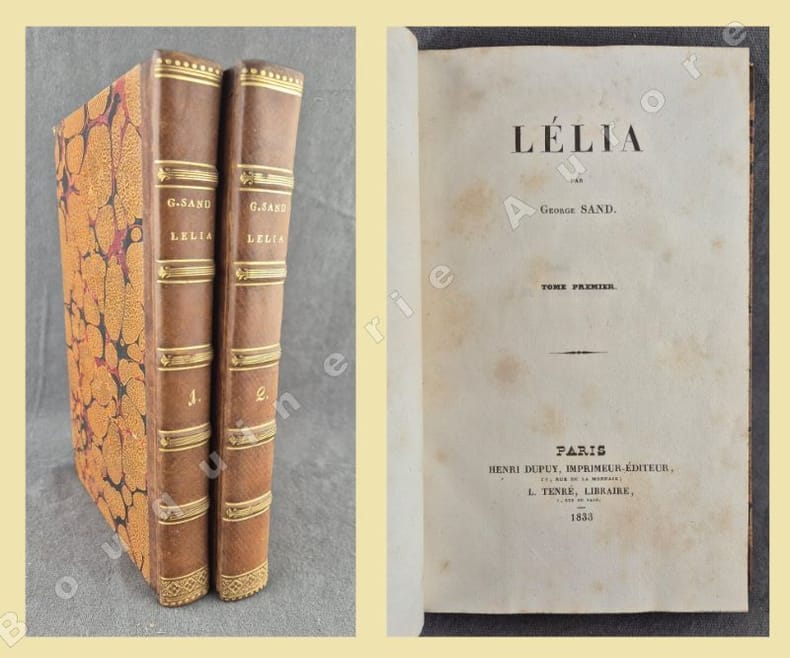
1833143311833 P., Dupuy et Tenré, 1833, 2 vol. in-8° (209 x 130 mm) reliés œ cuir de Russie fauve à petits coins, dos à 5 nerfs, auteur, titre, tomaison et jeux de filets et roulettes dorés, plats de papier marbré, tranches légèrement mouchetées, reliure de lépoque, de (4) pp. (faux-titre, titre, dédicace à M. H. Delatouche et pensées dun solitaire) 350 pp. (3) ff. (faux-titre, titre, poème dAlfred de Musset) 383 pp.Plats très légèrement frottés, rousseurs éparses (pâles et rares dans le 1e volumes, un peu plus importantes dans le 2e surtout concentrées à la fin de louvrage), très bel exemplaire.
1848293976Paris 1848. unbound. very good. Important A.L.S. as Sand had recently began writing for the soon-to-be-banned Le Vrai Republique with integral address page personal stationary with blind stamped monogrammed initials: "G.S." 8vo. 1 page Paris March 16th 1848 to radical journalist and fellow supporter of the French Revolution Theophile Thore in French with translation explaining that she has not yet met with Louis and Charles Blanc and apologizes for not having responded to his letters because all of her time has been consumed writing material for the Republique. In closing she signs herself "a vous de tout Coeur / George Sand". Evenly toned and set into a white matte gatefold whereby both the letter and the integral address page are both visible then placed into a simple gold-stained wooden frame to 13" x 11.5". Louis Blanc 1811-1882 was a staunch French Socialist and reformer who only three months after this letter was written was exiled to England where he would remain until 1870. Also two weeks prior to this letter being sent George Sand had agreed to provide the Republique with no less than 13 original articles for publication. An exceptional letter written during the heart of the French Revolution of 1848.<br/><br/> French novelist and socialist whose works were immensely popular in Europe during her lifetime and whose fame eclipsed both that of Victor Hugo and Honore de Balzac in the 1840's and 1850's.<br/><br/> unknown books
1862003597Paris: A. Levy Fils 1862. Quarter Morocco pebbled cloth boards. Very Good. Sand Maurice. 2 volumes 4to. 28 by 19 cm. viii 356 2 384 pp. 50 hand-colored plates featuring the stock characters of the improvisational Theatre Italienne such as Harlequino Arlechino Pulcinella Colombine Pagliaccio Pierrot Pantalon L'Apothicaire Le Notaire Scaramuccia Pasquariello etc. Nowadays these characters are most familiar to opera-goers thanks to the comical works of Donizetti Mascagni Busoni Mozart etc. Most of these characters grew out of the roaming theatrical troupes that originated in Italy of the sixteenth and seventeenth centuries. The costume and basic personality of the character remained stable from one performance to the next but within those parameters the characters in a troupe usually following the broad contours of a story line would improvise bringing in buffonery perhaps relating to the events of the day the specific venue where they were appearing or whatever else might spring into their mind on the spur of the moment. In the eighteenth century the free form went into decline replaced by more scripted plays but its influence is very evident in the plays of Goldoni Moliere who worked well before the form vanished and besides the opera buffa early twentieth century Vaudeville ballet and more current comedy. Also the costume from the Theatre Italienne has never failed to excite enthusiasm and thus it is often celebrated in the decorative arts as perhaps most magnificently in porcelain beginning in the eighteenth century with Meissen Nymphenburg and many other makes. Today the style of Harlequin or Arlecchino continue to be emulated in clothes design with some regularity. This two volume celebration of the costume and characters of this theater was written by Maurice Sand who was the son of the novelist George Sand who wrote the preface. Maurice Sand 1823 -1889 was an accomplished illustrator and writer in his own right. Occasional soiling sometimes toning around perimeter outside of tissue guards which have survived remarkably well. Rubbing along joints and moderate wear of boards. Very handsome marbled painting of edges. <br/><br/> A. Levy Fils hardcover books
1848293976Paris 1848. framed. very good. Important A.L.S. as Sand had recently began writing for the soon-to-be-banned Le Vrai Republique with integral address page personal stationary with blind stamped monogrammed initials: "G.S." 8vo. 1 page Paris March 16th 1848 to radical journalist and fellow supporter of the French Revolution Theophile Thore in French with translation explaining that she has not yet met with Louis and Charles Blanc and apologizes for not having responded to his letters because all of her time has been consumed writing material for the Republique. In closing she signs herself "a vous de tout Coeur / George Sand". Evenly toned and set into a white matte gatefold whereby both the letter and the integral address page are both visible then placed into a simple gold-stained wooden frame to 13" x 11.5". Louis Blanc 1811-1882 was a staunch French Socialist and reformer who only three months after this letter was written was exiled to England where he would remain until 1870. Also two weeks prior to this letter being sent George Sand had agreed to provide the Republique with no less than 13 original articles for publication. An exceptional letter written during the heart of the French Revolution of 1848.<br/> <br/> French novelist and socialist whose works were immensely popular in Europe during her lifetime and whose fame eclipsed both that of Victor Hugo and Honore de Balzac in the 1840's and 1850's.<br/> <br/> unknown