5 434 résultats
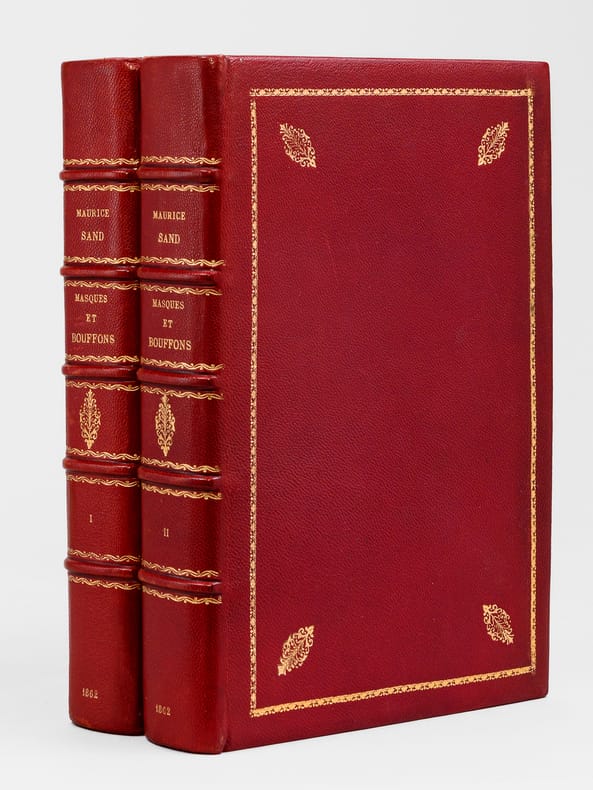
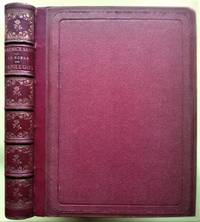
1862003597Paris: A. Levy Fils 1862. Quarter Morocco pebbled cloth boards. Very Good. Sand Maurice. 2 volumes 4to. 28 by 19 cm. viii 356 2 384 pp. 50 hand-colored plates featuring the stock characters of the improvisational Theatre Italienne such as Harlequino Arlechino Pulcinella Colombine Pagliaccio Pierrot Pantalon L'Apothicaire Le Notaire Scaramuccia Pasquariello etc. Nowadays these characters are most familiar to opera-goers thanks to the comical works of Donizetti Mascagni Busoni Mozart etc. Most of these characters grew out of the roaming theatrical troupes that originated in Italy of the sixteenth and seventeenth centuries. The costume and basic personality of the character remained stable from one performance to the next but within those parameters the characters in a troupe usually following the broad contours of a story line would improvise bringing in buffonery perhaps relating to the events of the day the specific venue where they were appearing or whatever else might spring into their mind on the spur of the moment. In the eighteenth century the free form went into decline replaced by more scripted plays but its influence is very evident in the plays of Goldoni Moliere who worked well before the form vanished and besides the opera buffa early twentieth century Vaudeville ballet and more current comedy. Also the costume from the Theatre Italienne has never failed to excite enthusiasm and thus it is often celebrated in the decorative arts as perhaps most magnificently in porcelain beginning in the eighteenth century with Meissen Nymphenburg and many other makes. Today the style of Harlequin or Arlecchino continue to be emulated in clothes design with some regularity. This two volume celebration of the costume and characters of this theater was written by Maurice Sand who was the son of the novelist George Sand who wrote the preface. Maurice Sand 1823 -1889 was an accomplished illustrator and writer in his own right. Occasional soiling sometimes toning around perimeter outside of tissue guards which have survived remarkably well. Rubbing along joints and moderate wear of boards. Very handsome marbled painting of edges. A. Levy Fils unknown
2010122361Stiftung. New. 2010. Hardcover. 8872833914 . FREE UPGRADE to Courier/Priority Shipping Upon Request - IN STOCK AND IMMEDIATELY AVAILABLE FOR SHIPMENT - Flawless copy brand new pristine never opened. Text in German and Italian. with a bonus offer-- . Stiftung hardcover
199518509San Francisco California U.S.A.: Mercury House. New. 1995. Paperback. 156279082X . FREE UPGRADE to Courier/Priority Shipping Upon Request - IN STOCK AND IMMEDIATELY AVAILABLE FOR SHIPMENT - Fine -- with a bonus offer-- . Mercury House paperback
199868853Prestel. New. 1998. Hardcover. 3791319485 . FREE UPGRADE to Courier/Priority Shipping Upon Request - IN STOCK AND IMMEDIATELY AVAILABLE FOR SHIPMENT - Flawless copy brand new pristine never opened -- Text in English. 160 pp. With 103 ills. 76 col. . 31 x 25 cm. -- with a bonus offer--; 0.73 x 12.1 x 9.64 Inches . Prestel hardcover
29857S.l.n.d. (ca 1900). 1 vol. in-8°, demi-basane outremer, titre doré en long au dos. Reliure postérieure. Bel exemplaire. (26) ff. calligraphiés et lithographiés.
5777BELLE LETTRE DANS LAQUELLE GEORGE SAND APPORTE SON SOUTIEN ERNEST FEYDEAUGeorge Sand rpond aux trois articles que Feydeau venait de faire paratre dans La Presse Lettres sur la crmation . La romancire avait elle-mme consacr, lanne prcdente, un article sur la question de lincinration des cadavres (article paru galement dans La Presse, le 25 octobre 1856) : & Je vous remercie beaucoup de mavoir cite avec sympathie et redresse dans mon erreur. Je vous remercie surtout davoir si bien plaid la question, et jespre que, malgr le peu despoir que vous avez dy intresser lternel ingrat quon appelle le public, vous laisserez en lui une plus forte trace de ceci que tous ceux qui lavaient essay avant vous& Elle regrette & quun travail dune autre nature qui me prend tout mon tems met empche de poursuivre cette croisade ; mais jen suis charme maintenant, puisque Mr Bonneau [Rdacteur La Presse, qui avait crit sur le mme sujet] est venu rompre encore des lances, et vous ensuite, de meilleures lances encore. En effet, vous avez tout dit sur ce sujet et le plaidoyer est complet. Vous avez dit le dernier mot et le plus frappant, cest la ncessit invitable, plus ou moins prochaine, dune translation profanatoire, hideuse. Je ne savais pas tout cela, moi, et me voil, grce vous, bien plus de mon avis que je nen tais dj& Aprs lui avoir prsent ses compliments, elle linvite lui adresser son plaidoyer & Si vous le publiez en brochure, comme je suis loin de Paris et que la plupart du tems, je ne sais pas quand mes propres ouvrages paraissent, je vous demande de penser moi et de men envoyer un exemplaire& Flatt par la lettre de George Sand, Ernest Feydeau lui rpondra le 2 fvrier, en des termes les plus amnes. Fils dun officier napolonien, ERNEST-AIM FEYDEAU [1821-1873], se fit remarquer en littrature en 1858, par la publication de Fanny, un roman populaire qui rencontra un trs large succs sur fond de scandale et permit son auteur de lui assurer quelque postrit. Mais ce qui rend Ernest Feydeau plus intressant nos yeux, cest son appartenance au groupe intime des amis de GUSTAVE FLAUBERT : THOPHILE GAUTIER, les FRRES GONCOURT qui le citent plusieurs reprises dans leur Journal, et GEORGE SAND avec laquelle il eut de nombreux changes pistolaires. Remari en seconde noce avec Locadie Bogaslawa Zelewska, nice du vicomte de Calonne, il est le pre du clbre vaudevilliste GEORGES FEYDEAU.
187036905Reliure demi-chagrin havane à coins. Tête dorée. Dos à nerfs très fins avec titre doré. Couverture et dos conservés. Reliure signée HONNELAITRE. Photo de l'auteur collée en page de garde. Intérieur très frais.
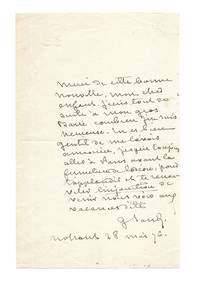
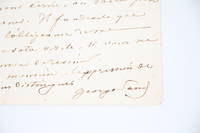
1876Sand2<p><strong>SAND George 1804-1876</strong></p><p>Autograph letter signed "GSand" to Paul Porel Dry monogrammed G S initial on letterhead Nohant May 28 1876 1 page in-8 in black ink</p><p><strong>A moving letter one of the very last less than 10 days before her death</strong></p><p><em>"Merci de cette bonne nouvelle mon cher enfant. J'écris tout de suite à mon gros</em> Léopold<em> Barré combien je suis heureuse. Tu es bien gentil de me l'avoir annoncée. J'espère toujours aller à Paris avant la fermeture de l'Odéon pour t'applaudir et te renouveler l'injonction de venir nous voir aux vacances d'été. </em> <em>GSand</em> <em>Nohant 28 mai 76″</em></p><p>This moving letter is one of George Sand's last. After the three letters written on 28 May one to Miss Marguerite Thuillier the other to her doctor Henri Favre and finally this one and a note in the Agenda on 29 May she will take up the pen one last time on the 30th to write to her nephew Oscar Cazamajou Corr. XXIV p. 638</p><p>George Sand who died on 8 June 1876 of an intestinal obstruction was already suffering of stomach pain on 28 May as evidenced by her letter to Dr. Henri Favre: "<em>I wonder where I am going and whether to expect a sudden departure one of these mornings. I'd rather know right away than by surprise.</em>" Her condition will deteriorate on May 30 before the symptoms worsen significantly on June 3. On June 7 in agony she whispers to her daughter Solange who is caring for her and to her daughter-in-law Lina Calamatta: "<em>Goodbye farewell I am dying.</em>" She died on June 8 at 10:00 a.m. in her 72nd year.</p><p>Paul Porel 1843-1917 is a French actor director and theater director. He was married to the actress Réjane and was close to literary and musical circles notably attending Alphonse Daudet Emile Zola Léon Hennique George Sand Gabriel Fauré etc.</p><p>This letter unpublished in the correspondence edited by Lubin will appear in the next volume of <em>Nouvelles lettres retrouvées</em>.</p><p>Provenance: René Vallet Archives</p>
186271056Texte et dessins par Maurice Sand, Gravures par A. Manceau, Préface par George Sand, 2 vol. grand in-8 reliure postérieure plein chagrin bordeaux, dos à 5 nerfs orné, tête dorée, filetd dorés d'encadrement en plats et fers dorés en écoinçons, couvertures conservées, A. Lévy Fils, Libraire-Éditeur, Paris, 1862, VIII-356 pp. ; 2 ff., 384 pp. avec 50 planches en couleurs hors texte
5776CHARMANTE LETTRE UN AMI DE LONGUE DATE, LE CAPITAINE D'ARPENTIGNY, RENCONTR DANS LES ANNES 1840, ET QUE GEORGE SAND ENCOURAGEA CRIRE : George Sand s'excuse du retard pris lui rpondre ...Je voulais m'informer si l'affaire dont vous me parlez avait quelque solidit, et elle n'en a pas... tranche-t-elle ...C'est un coup de d, or, on ne peut jouer que quand on a de quoi courir la chance et je ne suis pas dans cette position... Elle lui demande donc de rpondre ... bien poliment la personne qui vous a crit que je suis occupe, ne pouvoir rien entreprendre en dehors de ma tche, et c'est presque la vrit... Elle a eu grand plaisir recevoir de ses nouvelles ...Vous en avez dout puisque vous ne m'avez crit que trois lignes et vous avez eu tort. Je vous garde bon souvenir et bonne amiti, Maurice aussi, et nous avons souvent parl de vous. J'ai souvent demand de vos nouvelles Mme Marliani, elle a d vous le dire. Nous nous reverrons, et vous me rendrez la bonne causerie et la bonne amiti d'auparavant...N Yport en 1791, Casimir Stanislas d'Arpentigny, militaire de carrire, ayant franchi tous les grades, se trouva sous-lieutenant la chute de Napolon. Il termina sa carrire militaire avec le grade de capitaine en 1844. Son dossier militaire le reprsente comme frondeur, critique vis--vis de ses suprieurs, il incitait ses camardes l'indiscipline. Disciple de Lavater et de Spurzheim, il est l'auteur de deux livres qui eurent de nombreuses rditions : la Chirognomonie (1843) et la Science de la main (1865). Il aurait t prsent George Sand en 1841 par le comte d'Aure. George Sand le poussa vers l'criture. Il devint ainsi un collaborateur de la Revue indpendante et publia dans divers journaux. Il fut trs li Alfred de Musset.
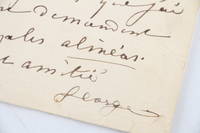
1838866321838. Fine. Sand publishes her response to Lerminier s. d. 23 février 1838 11 x 20.40 cm 1 page sur feuillet Autograph letter signed by George Sand addressed to François Buloz. One page in black ink on a single sheet. Fold marks sheet reinforced with paper on verso. Published in her correspondence ed. Georges Lubin vol. IV pp. 331-332. Exasperated by the attitude of the Revue des deux mondes of her friend Buloz George Sand decides to defend the progressive thinker Félicité Lammenais targeted by a scathing critique published in the review. She takes up her pen here and orders Buloz to publish her response article without changing a single line. Mon cher Buloz voici la lettre à M. Lerminier n'y changez rien. Relisez-en vous même et vous seul l'épreuve. Corrigez les fautes de typographie. Veuillez à la ponctuation et aux guillemets. Il va sans dire que les blancs de mon manuscrits sont le résultat de coupures et de transcriptions que j'ai faites et ne demandent que de simples alinéas. Bonjour et amitié George ""My dear Buloz here is the letter to M. Lerminier change nothing. Proofread it yourself and yourself alone. Correct the typographical errors. Mind the punctuation and quotation marks. It goes without saying that the blanks in my manuscript are the result of cuts and transcriptions I have made and require only simple paragraphs. Good day and friendship George"" This letter perfectly illustrates the stormy yet fruitful collaboration that united François Buloz and George Sand. The latter gave Sand for many years a platform and a means to live by her pen. She published in the Review a great number of masterpieces including Lettres d'un voyageur 1834-1836 Mauprat 1837 Spiridion 1839 Gabriel 1839 Mademoiselle La Quintinie 1863 Césanne Dietrich 1870. Through his mediation she also actively participated in the political debates of her time. In 1838 Buloz was the great orchestrator of an ideological duel when Sand ""decided to take on the critic Lerminier who had just made a very critical analysis of the Livre du peuple in the review. Buloz out of desire for publicity allowed his two collaborators to publicly exchange blows in the review. Through Lerminier and his superior tone the review then revealed its rather misogynistic vision of literature and philosophy: 'the time has come for you to give your philosophical opinions more consistency and scope because you are entering a new phase of life and talent. Inspiration and fantasy have raised you to a height where they would not suffice to maintain you. Draw now madam new strength from reflection and science'"" Marie-Eve Thérenty George Sand François Buloz et la Revue des Deux Mondes. Sand reacted immediately and sent her response article accompanied by this peremptory missive ordering Buloz to publish her text as it stood. Lamennais was very touched by her gesture: ""I shall always count among the happy circumstances of my life where I don't count many to have been defended by you. In publishing my last book I knew well that it would shock almost everyone legitimists juste-milieu Catholics even republicans those at least who want neither God nor liberty and their number is great and they have a terrible faith in themselves. I have hoped only in the people who do not make systems and who under the influence of primitive and imperishable human instincts judge by the heart and judge alone infallibly. Without them I don't know what would become of liberty on earth. M. Lerminier and many others imagine that I speak at random according to whatever idea of the moment occurs to me. They are mistaken"" Yves Chastagnaret George Sand Lerminier et le Livre du Peuple de Félicité Lamennais. Flying to the rescue of a defender of the people Sand writes this scathing missive at a key moment in her tumultuous relationship with Buloz. unknown
1868784821868. Fine. s. d. mai 1868 13.50 x 20.70 cm 2 pages sur un double feuillet Autograph letter signed by George Sand addressed to Alphonse Peyrat two pages written in black ink on a double sheet. Transverse folds inherent to mailing. Interesting letter evoking one of her faithful friends: Jean Patureau-Francoeur. George Sand had published a long obituary article in tribute to this close friend in L'Avenir national on May 2 1868. She described her late friend with great tenderness: ""C'était un simple paysan un vigneron des faubourgs de Châteauroux. Il avait appris tout seul à écrire et il écrivait très remarquablement avec ces naïves incorrections qui sont presque des grâces dans un style rustique et spontané. . Ce petit homme robuste à grosse tête ronde au teint coloré à l'il bleu étincelant et doux était doué d'une façon supérieure. Il voyait la nature il l'observait il l'aimait et il la savait. . Son existence parmi nous fut pénible agitée méritante. Naturellement un esprit aussi complet que le sien devait se passionner pour les idées de progrès et de civilisation. Il fut avant la Révolution le représentant populaire des aspirations de son milieu et il travailla à les diriger vers un idéal de justice et d'humanité. ."" ""He was a simple peasant a wine-grower from the suburbs of Châteauroux. He had taught himself to write and he wrote remarkably well with those naive incorrections that are almost graces in a rustic and spontaneous style. . This sturdy little man with his large round head his ruddy complexion his sparkling and gentle blue eyes was gifted in a superior way. He saw nature observed it loved it and understood it. . His existence among us was painful agitated meritorious. Naturally a mind as complete as his had to be passionate about ideas of progress and civilization. He was before the Revolution the popular representative of his milieu's aspirations and he worked to direct them toward an ideal of justice and humanity. ."" In 1848 Patureau was elected mayor of Châteauroux and became the spokesman for the workers of his commune. ""Au moment du coup d'État il fut poursuivi mais il se cacha dans des familles amies et échappa à la police. George Sand obtint difficilement sa grâce ce qui lui permit de regagner Châteauroux. Il fut arrêté en janvier 1858 à la suite de la loi de sûreté générale."" ""At the time of the coup d'état he was pursued but he hid with friendly families and escaped the police. George Sand obtained with difficulty his pardon which allowed him to return to Châteauroux. He was arrested in January 1858 following the general security law."" ""Il resta un mois au cachot sur la paille en plein hiver. Quand on le mit dans la voiture cellulaire qui le dirigeait vers l'Afrique il était presque aveugle et depuis il a toujours souffert cruellement des yeux"" ""He remained a month in the dungeon on straw in the middle of winter. When they put him in the prison van that was taking him to Africa he was almost blind and since then he has always suffered cruelly with his eyes"" George Sand. In September 1858 following an intervention by George Sand with her friend Jérôme-Napoléon Napoleon III's cousin he was released but remained under surveillance. He settled in Algeria after obtaining permission to come to Châteauroux to sell his house and vineyard and to fetch his family. In Algeria he lived by his trade as a wine-grower was part of the Agricultural Society of Philippeville and wrote a treatise on viticulture."" Maintron ""À présent je viens vous demander de me payer ce petit article le plus cher que vous pouvez et d'envoyer le prix directement à Joseph Patureau rue de cluis n°7 à Châteauroux. Indre. Et cela le plus tôt possible."" ""Now I come to ask you to pay me for this little article as dearly as you can and to send the payment directly to Joseph Patureau rue de cluis n°7 à Châteauroux. Indre. And this as soon as possible."" Jos unknown
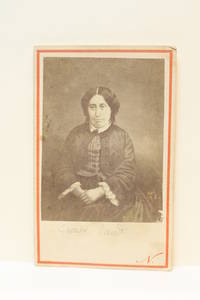
185273020Paris: Nadar 1852. Fine. Nadar Paris s. d. circa 1852 6.50 x 10.30 cm une photographie Original albumen photograph representing George Sand in carte-de-visite format mounted on studio cardboard from Nadar ""35 boulevart des Capucines"". This photograph taken in 1852 by Nadar after a daguerreotype by Richebourg was commercialized between 1862 and 1871 as evidenced by the photographer's address on the back of the cardboard. Pencil annotation in lower margin of the portrait as well as on the back. A period bookseller's label pasted on the back of the cardboard. One copy at the Musée d'Orsay. Nadar unknown
190040348Philadelphia: George Barrie & Son 1900. Hardcover. Complete 20-volume set. Translation by George Burnham Ives. 8vo. Half brown calf with compartments and gilt letterng and decorations and tan decorated paper over boards. Various paginations. Top edge gilt. Frontispiece with captioned tissue guards full-page illustrations with captioned tissue guards decorative tan endpapers. Very good overall. Bit of occasional edgewear only. A tight quite handsome custom bound full set of the "Edition de Nohant" with colophon noting the limitation to 1000 numbered sets this #83 and this set printed for Charles N. Mann likely the Philadelphia antiquarian and book collector1840-1912. Though not so marked this set hails from the library of Adlai E. Stevenson III Illinois senator and before him the library of his father Adlai E. Stevenson II 1900-65 Illinois governor and twice presidential candidate -- whose wife Ellen Borden 1907-72 likely acquired it she being the family member who read and collected fine literature and poetry. Uncommon set nice condition unusual provenance. George Barrie & Son hardcover books
184512486Hetzel 1845 2 volumes grand in-8, plein maroquin bleu nuit, dos à nerfs richement orné, plats encadrés de filets, roulette et d'une large dentelle, roulette sur les coupes et en contreplat, tranches dorées reliure anglaise de l'époque, 380- 364 pp.. Illustrations in & hors-texte en noir. Infimes rousseurs. Bel exemplaire.
183886632s. d. [23 février 1838] | 11 x 20.40 cm | 1 page sur feuillet
185273020Nadar | Paris s. d. [circa 1852] | 6.50 x 10.30 cm | une photographie
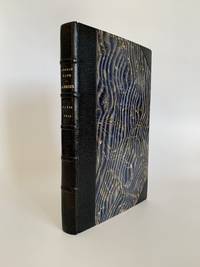
1905776Paris, Conquet, 1905 ; in-8 de [2] ff., xx-184 pp., maroquin janséniste chocolat, dos à nerfs, doublures de maroquin sépia ornées de branches de mûrier mosaïquées en châtain, orangé, vert, noir et rouge, gardes de soie quadrillée brochée de petites feuilles, doubles gardes, tranches dorées sur témoins, couverture et dos, étui bordé (G. L. R. -D.).
186721.0247Paris: J. Rothschild Éditeur 1867. 1st ed. Contemporary quarter morocco with gilt titles decorations and raised bands. 22.5x27.5. 50 lithographic plates of which 49 are hand coloured. . Bookdealer's blind sttamp on title page; corners slightly bumped; very occasional foxing the half title of the second part - see photo - is the most foxed; there are four others in a similar condition otherwise a very clean and attractive copy J. Rothschild, Éditeur hardcover
184077244Paris 1840. Fine. Paris jeudi 7 mai 1840 13.60 x 20.90 cm une page sur un double feuillet Autograph letter signed by George Sand addressed to publisher Léon Curmer. One page written in black ink on a double sheet. This letter was published in the complete correspondence compiled by Georges Lubin. ""Monsieur J'ai parcouru votre recueil avec beaucoup d'intérêt et j'accepte la collaboration que vous m'avez offerte mais je ne pourrais m'occuper de vous satisfaire que dans six semaines ou deux mois. Si cette époque vous convient veuillez bien me le faire savoir ainsi que les conditions de la rédaction."" ""Sir I have perused your collection with great interest and I accept the collaboration you have offered me but I could not undertake to satisfy you for six weeks or two months. If this timing suits you please let me know as well as the conditions of the writing."" The ""recueil"" ""collection"" in question here is none other than Les Français peints par eux-mêmes. Sand would not however collaborate on this monumental compendium of types preferring instead several years later Le Diable à Paris published under the direction of her close friend publisher Hetzel. unknown
183560346Paris: Félix BonnaireVictor Magen 1835. Fine. Félix Bonnaire Victor Magen Paris 1835 13 x 20.50 cm relié First edition. Half shagreen two corners slightly bumped contemporary binding. A little light spotting library label to pastedown. Félix BonnaireVictor Magen unknown
184072174Paris: Félix Bonnaire 1840. Fine. Félix Bonnaire Paris 1840 14 x 23 cm relié First edition rare published in the Complete Works of George Sand by Bonnaire. The half-title indicates volume XXIV. Modern half black straight-grained morocco binding with small corners signed René Aussourd at the top of the endpaper. Jansenist spine with raised bands. Title author and date gilt. Covers preserved. Upper right corner of the front cover lacking 0.5cm. Light rubbing to boards. Very handsome copy with perfectly fresh uncut paper. Ex libris Paola Sanjust. Dialogue novel featuring a young Italian noblewoman during the Renaissance raised as a man for succession reasons. Gabriel will be confronted with the hypocrisy of society and rebels against the abyssal difference between the rights granted to men and the oppression reserved for women. The author analyzes with irony the differences in education between girls and boys. Balzac enthusiastic upon reading the work did not hesitate to compare it to a Shakespeare play. Félix Bonnaire hardcover
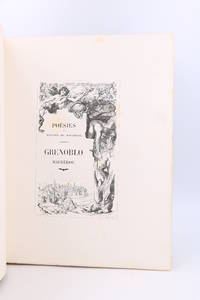
186490471Grenoble: Rahoult et Dardelet 1864. Fine. Rahoult et Dardelet Grenoble 1864-1874 24.6 x 33 cm 2 volumes reliés en 1 Illustrated edition with drawings by D. Rahoult and numerous wood engravings by E. Dardelet Vicaire I 812813; Carteret III 9596.Preface by George Sand. Grenoble Rahoult et Dardelet 18641874 issued in two parts bound in one volume large quarto.Half brown morocco over corners spine with five raised bands decorated with gilt fleurons and blind tooling minor rubbing to the spine covers of marbled paper framed with double gilt fillets surface wear to the boards comb-marbled endpapers and pastedowns gilt top edge.The first part issued in nine instalments between 1859 and 1864 consists of a poem in local patois on the flooding of Grenoble in 1733 first published in that year.The author François Blanc 16621742 known as La Goutte was a grocer in Grenoble described as impotent and consumed by gout.The second part published in 1874 and illustrated by the same artists contains a copy of the letter written by François Blanc to one of his friends concerning the flood that struck Grenoble on 20 December 1740; Jacquety de le Comare by the same author pp. 2353; and a glossary by Michal-Ladichère pp. 5578.These last two items appear to be lacking from the copies described by Vicaire and Carteret who record only 21 pages.Printed stamp used as an ex-libris of G. Magnin of Grenoble on an endpaper.Some foxing and a light waterstain in the right-hand margin of a few leaves. Rahoult et Dardelet hardcover
190524610Paris L. Conquet 1905 In-4, demi-maroquin marron coins, plats de papier marbr, dos quatre nerfs orn de fers romantiques pousss or; doublures et gardes de papier marbr, tte dore, non rogn, couverture imprime (Kauffmann).31 compositions par A. Robaudi, graves au burin et l'eau-forte par Henri Manesse, dont une sur la couverture, 26 hors-texte et 4 in-texte. Tirage limit 300 exemplaires numrots. Un des 200 exemplaires sur vlin du Marais, enrichi du prospectus illustr de l'diteur.
20029939Octon France: Verdigris Press 2002. One of 6 copies from a total issue of 50 8 with an original copper plate and additional mezzotint 6 with an additional mezzotint this copy 36 regular copies all on Hahnemuhle paper this special copy with an additional mezzotint not in the regular edition each signed and numbered by the artist Judith Rothchild. Page size: 8 x 10 inches; 16pp. Bound: reversible accordion-fold leporello covers of hand-marbled Venetian papers in red black and gold over boards; as issued in black slipcase with Venetian paper accents title in letterpress in black on marbled paper insert white label on cover boards a bit ink spotted else fine. Text in original French.<br/>This book which is completely reversible has on one side a text on Venice by George Sand and on the other by Emile Zola each with three Rothchild mezzotints of doorways bridges and canals. Sand's delightful description of Venice in springtime forms a sharp contrast to Zola's grim portrayal of a decadent city in decay. Like the illustrations themselves the texts provide a provocative study of contrasts. An extraordinarily beautiful book redolent with the eternal allure of Venice. Verdigris Press unknown books