2 361 résultats
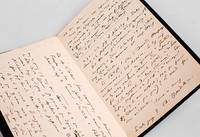
185965117Honfleur 1859. Fine. Honfleur 28 février 1859 13.10 x 20.50 cm 3 pages sur un feuillet remplié Remarkable autograph letter signed by Charles Baudelaire to Auguste Poulet-Malassis publisher of Les Fleurs du Mal dated 28 February 1859 and written in Honfleur. 64 lines in black ink some passages underlined housed in a modern black half-morocco folder. Baudelaire appears preoccupied with the Sainte-Beuve/Babou affair one of the many controversies following the Fleurs du Mal trial in which the writer Hippolyte Babou accused Sainte-Beuve of failing to defend Baudelaire during the proceedings. Excerpts from this letter were quoted by Marcel Proust in his celebrated Contre Sainte-Beuve where he lamented Sainte-Beuves cowardice during the trial of Les Fleurs du Mal and the undue esteem Baudelaire continued to show him. The poet writes from Honfleur where he had retired in January to live with his mother a revered figure who haunts her sons heart and mind. This letter was written eight days after a new development in the aftermath of the Fleurs du Mal trial. Torn by conflicting emotions Baudelaire confides in Malassis after his friend Hippolyte Babou had on 20 January published an article in La Revue française attacking Sainte-Beuve for failing to defend Baudelaire during the trial: He will glorify Fanny by Ernest Feydeau the honest man and remain silent about Les Fleurs du Mal he wrote. Despite Baudelaires pleas Sainte-Beuve had never published anything in support of the collection. In response to Babous attack Baudelaire received a horrible letter from Sainte-Beuve: It seems the blow . struck Sainte-Beuve deeply. I must do him the justice of saying he did not believe I had prompted Babou in any way. Although outraged by the accusations Sainte-Beuve did not hold Baudelaire personally responsible. Baudelaire is surprised by the critics vehemence writing to Poulet-Malassis: Truly here is a passionate old man with whom it is dangerous to fall out . You cannot imagine what that letter from Sainte-Beuve is like. It appears that for twelve years he had been noting every sign of malice from Babou. Baudelaire stands helpless amid the quarrel between two respected men while expressing a clear attachment to Sainte-Beuve now jeopardised by Babous article: Either Babou wanted to help me which would imply a certain degree of stupidity or he wanted to play a trick on me; or he simply pursued a mysterious grudge without any concern for my interests. Baudelaire indeed held Sainte-BeuveUncle Beuvein the highest regard. A senator an academician and the undisputed master of literary criticism Sainte-Beuves opinions carried great weight in Parisian literary circles. For years Baudelaire had awaited a formal sign of approval from Sainte-Beuve which might have bolstered his fragile career still tarnished by the scandal of Les Fleurs du Mal. The poet thus finds himself torn between his admiration for Sainte-Beuve and his long-standing friendship with Hippolyte Babouwho according to legend suggested the title Les Fleurs du Mal. To Poulet-Malassis he confides: What made this situation dangerous for me was that Babou appeared to be defending me against someone who had done me a great many favours. It remains unclear what Baudelaire meant by favours given that Sainte-Beuve had done relatively little to advance his career. This letter was later quoted in Marcel Prousts posthumously published Contre Sainte-Beuve 1954 a fierce and famous indictment in which Proust reproaches Sainte-Beuve for failing to recognise Baudelaires poetic genius and highlights his cowardice during the Fleurs du Mal trial. To preserve his position in the Senate Sainte-Beuve refrained from public support and provided only a defence strategy which the lawyer was authorised to use provided Sainte-Beuves name was not mentioned. Nearly two years after the verdict the disastrous trial of Les Fleurs du Mal still haunted B unknown
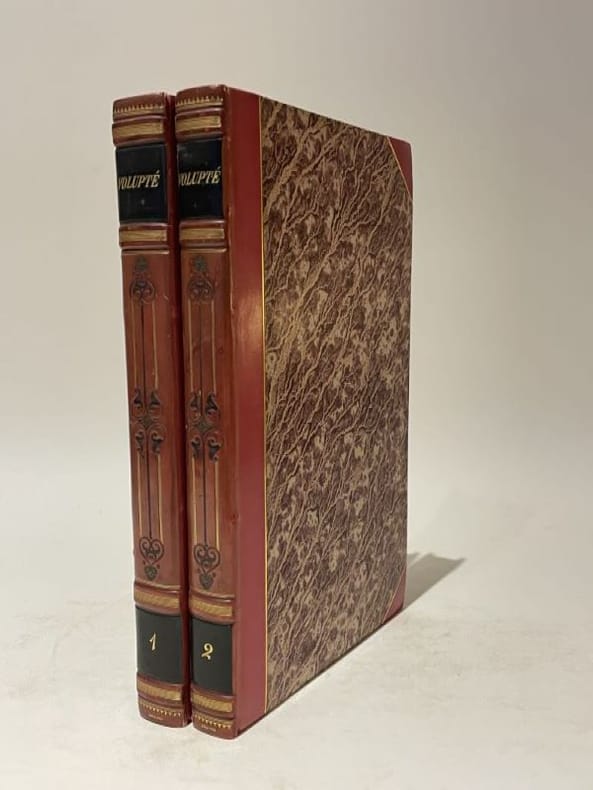
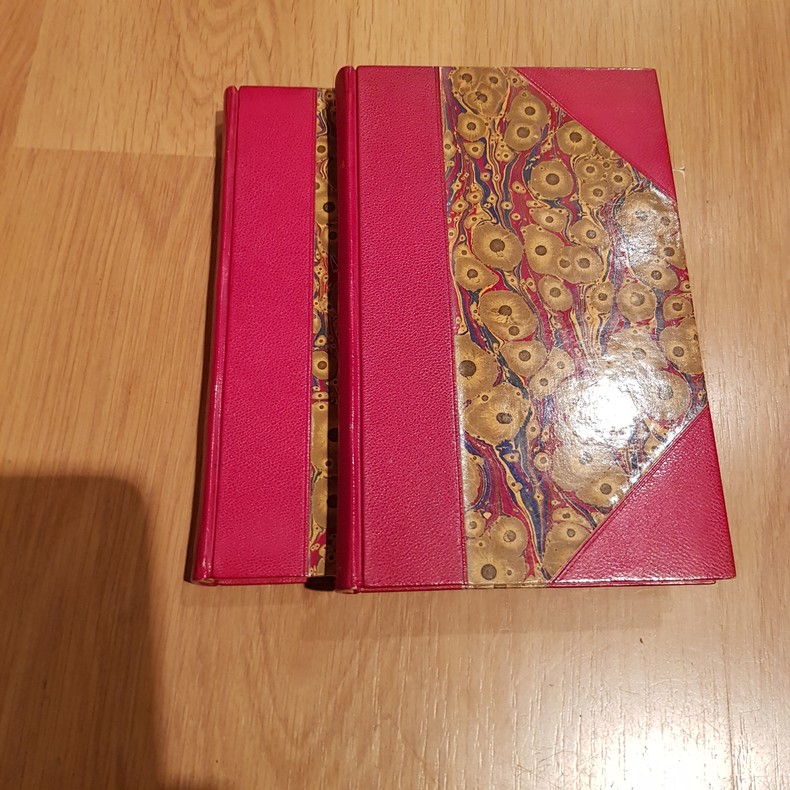
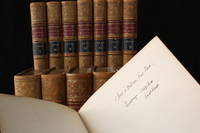
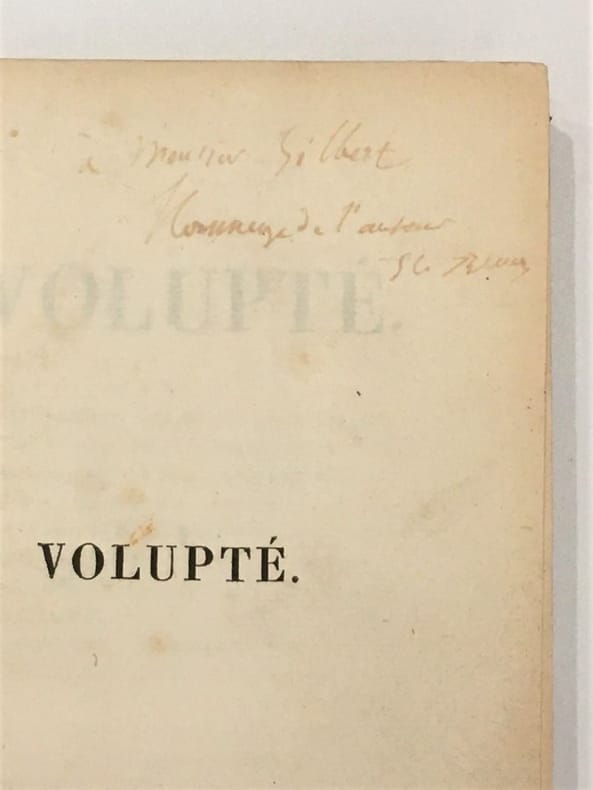
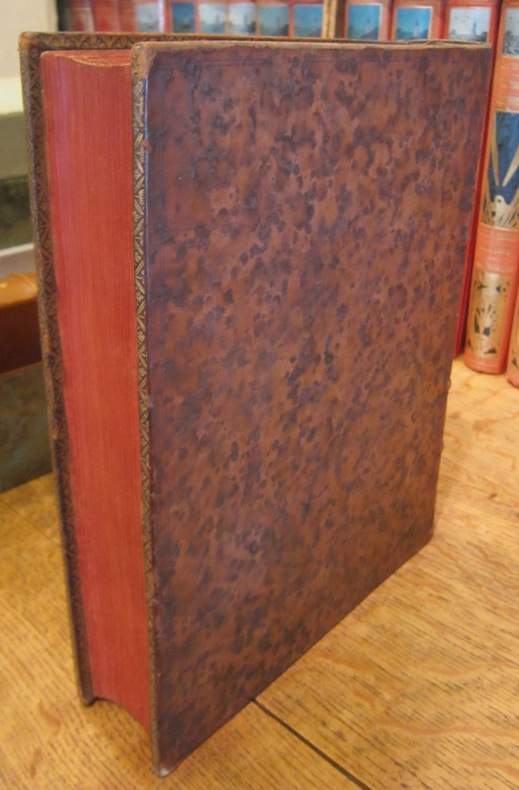
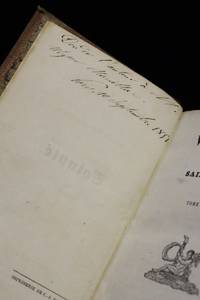
183470707Paris Renduel 1834 2 vol. relié 2 vol. in-8, demi-veau glacé framboise à coins, dos à nerfs, pièces de titre et de tomaison de veau noir, filets dorés, décor central de fleurons et arabesques à froid, couvertures et dos conservés, non rognés, étui bordé (Noulhac), 335 et 291 pp. Édition originale de l'unique roman publié par Sainte-Beuve qui, pour s'inspirer largement de sa liaison avec Adèle Foucher, lui valut la disgrâce de Victor Hugo, le surnommant "Sainte-Bave". Salué néanmoins par beaucoup de ses contemporains et notamment George Sand et Michelet, Volupté reste un classique du roman d'apprentissage en pleine période romantique. Ainsi, deux ans plus tard, Balzac n'eut aucun scrupule à s'emparer de ce matériau littéraire pour le refondre sous forme de roman épistolaire dans Le Lys dans la vallée. Notre exemplaire est enrichi d'un rare envoi de l'auteur à son ami Jean-Jacques Ampère, son collègue à la Revue des Deux Mondes, à l'Académie française et à la Bibliothèque Mazarine dont ils furent tous deux conservateurs. Très bel exemplaire à toutes marges et finement relié, avec ses fragiles couvertures et dos conservés, sans lesquels on pourrait croire l'oeuvre parue anonymement.
183470707Paris Renduel 1834 2 vol. relié 2 vol. in-8, demi-veau glacé framboise à coins, dos à nerfs, pièces de titre et de tomaison de veau noir, filets dorés, décor central de fleurons et arabesques à froid, couvertures et dos conservés, non rognés, étui bordé (Noulhac), 335 et 291 pp. Édition originale de l'unique roman publié par Sainte-Beuve qui, pour s'inspirer largement de sa liaison avec Adèle Foucher, lui valut la disgrâce de Victor Hugo, le surnommant "Sainte-Bave". Salué néanmoins par beaucoup de ses contemporains et notamment George Sand et Michelet, Volupté reste un classique du roman d'apprentissage en pleine période romantique. Ainsi, deux ans plus tard, Balzac n'eut aucun scrupule à s'emparer de ce matériau littéraire pour le refondre sous forme de roman épistolaire dans Le Lys dans la vallée. Notre exemplaire est enrichi d'un rare envoi de l'auteur à son ami Jean-Jacques Ampère, son collègue à la Revue des Deux Mondes, à l'Académie française et à la Bibliothèque Mazarine dont ils furent tous deux conservateurs. Très bel exemplaire à toutes marges et finement relié, avec ses fragiles couvertures et dos conservés, sans lesquels on pourrait croire l'oeuvre parue anonymement.
183258440Paris: Eugène Renduel 1832. Fine. Eugène Renduel Paris 1832-1839 14 x 22.50 cm 5 volumes reliés First edition the first volume being at the right date of 1832 which is very rare according to Clouzot. Binders in half navy blue morocco navy corners smooth back decorated with cartridges decorated with golden floral friezes golden dates in tails gilt fillets on the plates of marbled paper guards and contreplats of handmade paper blankets and back preserved elegant bindings in the romantic style signed by Champs. Rare and pleasant copy set in a perfect romantic binding of Champs. Eugène Renduel unknown
183258440Eugène Renduel | Paris 1832-1839 | 14 x 22.50 cm | 5 volumes reliés
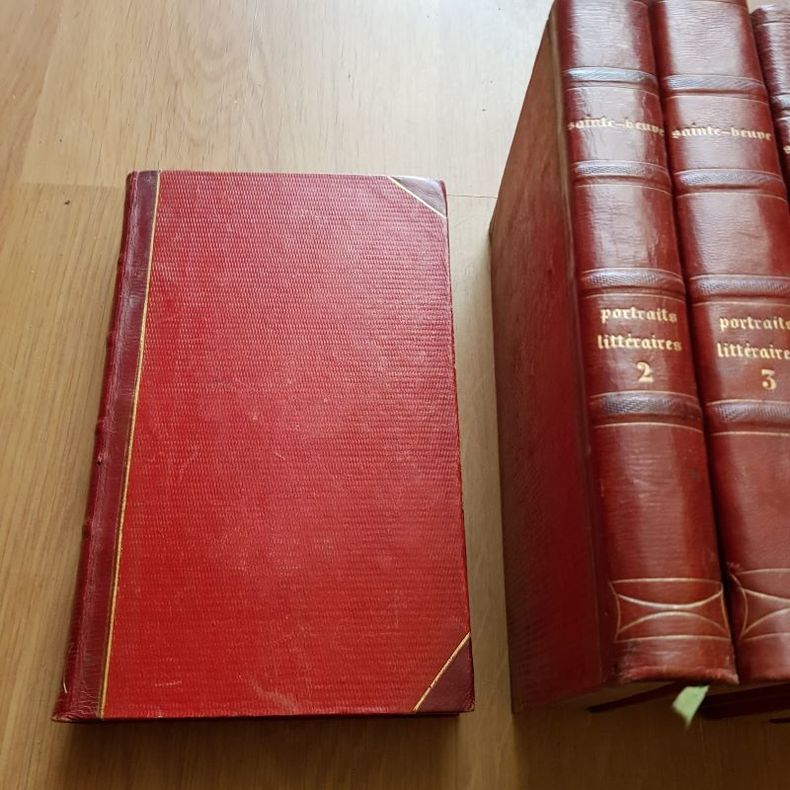
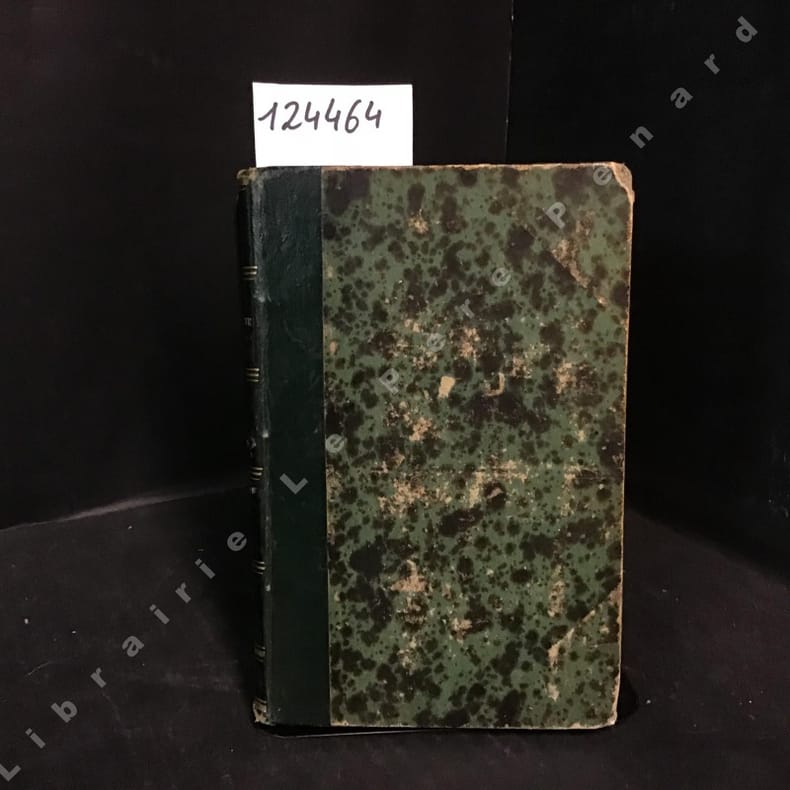
22283Paris, Eugène Renduel, Editeur-Libraire, rue des Grands-Augustins, 1834. 2 volumes in-8, demi-chagrin rouge à coins, à la Bradel, non rogné, dos lisse, titre, tomaison et date en lettres dorées (Reliure signée L. Pouillet). (sans les couvertures et les dos). Tome 1 : 335 pp. y compris le faux-titre et le titre (au V° errata). Tome 2 : 291 pp y compris le faux-titre et le titre (au V° errata).
1850927T12Paris: Garnier Freres c1850-1880. Vellum. Very Good. 7" by 4.5". None. A fifteen volume set of the Causeries du Lundi or "Monday Chats" of French literary critic Charles Augustin Sainte-Beuve in the original French. French. Complete in fifteen volumes. Mixed edition with volume fifteen being a first edition volume thirteen being a second edition and all other volumes being third editions. A series of informal essays and topical columns originally published as the author's "Monday chats" in the newspaper Le Constitutionnel. This set contains critical and biographical essays on literary topics regarding French and European authors. Sainte-Beuve provided details on an author's character background appearance education religion and friendships creating a well-rounded view of the subject before beginning his critique of their work. These factors developed his style of criticism over a wide range of genres in ancient and contemporary literature. Published weekly from 1849 to 1869 the essays proved to be very popular and were collected in two sets the fifteen-volume Causeries du Lundi originally released from 1851 to 1862 and the thirteen-volume Nouveaux Lundis originally released from 1863 to 1870. Written by Charles Augustin Sainte-Beuve a French literary critic. In the original quarter paper vellum binding with marbled boards. Externally smart with rubbing and light bumping to the extremities. Fading and discolouration to the spine as is typical with ageing. The odd small mark to the boards with spine labels detached. Small cracks to the spine of volume fifteen. Internally firmly bound. Pages are very bright with the odd small spot and age toning to the endpapers. Very Good Garnier Freres hardcover
185745017Paris: Garnier frères 1857. Fine. Garnier frères Paris 1857 11.50 x 18.50 cm 15 volumes reliés Third edition first in parts. Contemporary half caramel-colored calf over marbled paper boards spine in six compartments with gilt dots and double gilt compartments richly gilt with decorative motifs dark red morocco title pieces and dark green volume labels some headpieces slightly rubbed headpiece of volume four repaired some joints cracked and repaired gilt fillet frame to covers marbled endpapers and pastedowns some corners bumped top edge gilt. Handsome autograph inscription signed by Charles Augustin Saint-Beuve to Madame Paul Huet the wife of the noted Romantic painter and friend of Victor Hugo. Manuscript ex donos of Pierre Jean David d'Angers' grandson to start of each volume. A little spotting sometimes heavy to some leaves. Garnier frères hardcover
185745017Garnier frères | Paris 1857 | 11.50 x 18.50 cm | 15 volumes reliés
17185Paris, Eugène-Renduel, 1836-1839. 5 vol. in-8°. t. I (1836) : (2) ff.-IV-559 pp (texte et appendice).-[1] p. de table ; t. II (1836) : (2) ff.-VIII-493 pp.-(1) f. ; t. III (1836) : (2) ff.-573 pp.-(1) f. ; t. IV (1839) : (2) ff.-II-489 pp.-(1) f. ; t. V (1839) : (2) ff.-553 pp.-(1) f. Demi cuir de Russie rouge à coins, dos à faux nerfs orné de filets dorés (rel. ép.).
1834724Paris, Renduel, 1834 ; 2 tomes en un vol. in-8 de 335 pp. ; 291 pp., demi-maroquin à long grain bordeaux à petits coins, dos à 4 nerfs orné de filets dorés, tête dorée (Bernasconi).
184290713Paris: Imprimerie de H. Fournier et Cie 1842. From the library of Victorien Sardou: a rare surviving example of Sainte-Beuve's repudiated title First collected edition in a presentation binding. Charles Augustin Sainte-Beuve published his biographical portraits anonymously and for private circulation among his circle of friends. For obscure reasons he had second thoughts and destroyed most copies. It is said that he did not keep a copy for himself and that his bibliographer Paul Chéron a librarian the Bibliothèque Nationale only became aware of its existence through a bookseller who had brought a copy back from England. From the library of French playwright Victorien Sardou 1831-1908 with the bookplate from his library at Château de Marly on the front pastedown. Sardou is the author of many popular 19th-century plays including La Tosca on which Puccini based his opera. Laid in are four early 20th-century bibliographical documents and press cuttings. Octodecimo 174 x 114 mm. Fine presentation binding by S. David in black full levant morocco spine in compartments with gilt titles direct top edge gilt turn-ins gilt with foliate tools and stars at corners marbled endpapers green silk bookmark. Early 20th-century press cutting and bookplate on one initial blank. Extremities lightly rubbed binder's blanks faintly dampstained foxing throughout. An excellent copy. unknown
15532Paris, Eugène Renduel, 1834. Deux tomes en deux volumes, 335 pp. et 291 pp., demi chagrin vert sapin à coin, dos à nerfs janséniste, tête dorée, reliure signée Dupré (infimes frottements, papier bien frais).
19617Paris, Urbain Canel et Levavasseur, 1830. In-12, XXXII-237 pp., demi-chagrin écrasé à coins vert, filets dorés sur les plats, dos à nerfs orné de caissons dorés, tranches dorées, couverture conservée (insolation, petites épidermures, petites rousseurs éparses).
183721208Paris Eugne Renduel 1837 In-12, demi-maroquin prune coins, plats de papier mouchet orns de filets dors, dos nerfs; doublures et gardes de papier peigne, tte dore, non rogn.Edition originale. Exemplaire enrichi d'une lettre autographe date et signe de l'auteur.
1832CLL-367Paris, Renduel, 1832 In-8 de (2) ff., III, 574pp., (1)f., demi-veau bleu marine, dos à quatre nerfs orné de filets, roulettes et fleurons dorés et à froid, tranches marbrées (reliure de l'époque).
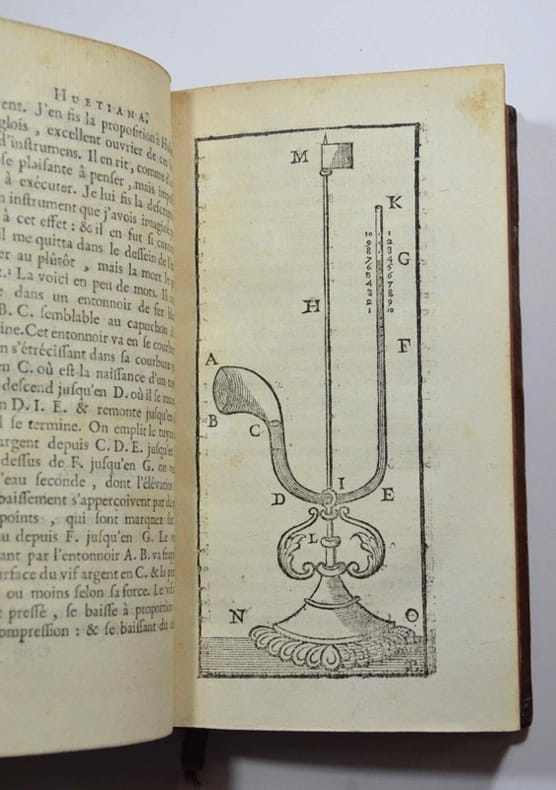
2048À Paris, chez Jacques Estienne, dcccxxii, xxiv-436-(16) pp In-12, veau brun granité glacé, dos à nerfs cloisonné et fleuronné, pièce de titre brune, tranches mouchetées, coiffe inférieure et mors restaurés (reliure de l'époque).ÉDITION ORIGINALE, établie et préfacée par l'abbé Pierre-Joseph Thoulier d'Olivet, académicien comme Huet, de ce recueil de critiques littéraires sur Virgile, Montaigne, La Rochefoucauld et d'autres, mais comprenant aussi des essais philologiques, historiques, religieux, scientifiques.Ami de ménage et de Madame de Lafayette, l'érudit prélat Pierre Daniel Huet (1630-1721) fut sous-précepteur du Dauphin.Précieux exemplaire annoté par Sainte-Beuve: il a marqué le chapitre xxxii, «Du prétendu sublime de quelques expressions de l'Écriture» et plus particulièrement le passage relatif à un commentaire de Longin sur la Genèse. Il a inscrit, sur la première garde volante, un renvoi à ce passage.Provenance: Charles-Augustin Sainte-Beuve (signature). - Le bibliophile et bibliographe Jules Le Petit (note autographe signée). - Jacques Millot
18381409290001Paris : L. Curmer 49 rue Richelieu 1838-01-01. Hardcover. Very Good. 4to. lvi 458p. 1 hand-coloured engraved map 7 ports 28 engravings all on mounted papier de Chine ca 450 vignettes throughout text. French. Bound in contemporary full red Moroccan leather. Gilt lettering and tooling on spine. Gilt tooling on spine. Inlaid gilt tooling on inside board extremities. 4 raised bands. AEG. Good binding and cover. Wear to extremities. Clean unmarked pages. Scattered foxing. Vicaire VII 42ff.; Carteret III 532-547; cf. Negley 1551; Fortunati/Trousson 489f. <br><br>Paul et Virginie or Paul and Virginia is a novel by Jacques-Henri Bernardin de Saint-Pierre first published in 1788. The novel's title characters are very good friends since birth who fall in love. The story is set in the island of Mauritius under French rule then named Ile de France which the author had visited. Written on the eve of the French Revolution the novel is hailed as Bernardin's finest work. It records the fate of a child of nature corrupted by the false artificial sentimentality that prevailed at the time among the upper classes of France. <br><br> Saint-Pierre attacked the issues of divided social classes present in eighteenth century French society. In Paul et Virginie Saint-Pierre describes perfect equality occurring on Mauritius where inhabitants share the same possessions have equal amounts of land and all work to cultivate it. They live in harmony without violence or unrest. These beliefs of Saint-Pierre's echo those of Enlightenment philosophers such as Jean-Jacques Rousseau. <br> The book also presents an Enlightenment view of religion: that God or "Providence" had perfectly designed the world to be harmonious and pleasing. Paris : L. Curmer, 49, rue Richelieu hardcover
183917181Paris, Hachette, 1839 ; 2 tomes in-8, demi veau blond à coins, dos à nerfs, soulignés de filets dorés, pièce de titre rouge et de tomaison vert empire, tête dorée (Bruyère) ; (4), CXXII, (2), 434 ; (4), 416 pp.
1863366118Paris: Lévy 1863. 1st Edition. Hardcover. 28 Volumes. Finely bound copies in gilt-blocked quarter leather over marble boards. Raised spine bands. Internally bright and clean. Remains particularly well preserved over all. Physical description: 28 volumes. Contents: Nouveux Lundis Tome 1-13. Causerues Du Lundi Tome 1-15. Notes: Text is in French. Subjects: Informal essays. Literary history and criticism. French literature History and criticism Addresses essays lectures. Paris: Lévy hardcover
18421FislDe0028Paris France: Librairie Hachette 1842. Book. Very Good. Hardcover. Tome 2/ Vol. 2. 8vo or 8° Medium Octavo: 7¾" x 9¾" tall. 584 pp. Tome 2/ Vol. 2 only! Solidly bound copy with moderate external wear crisp pages and clean text. Text in French. No dj. Moderate foxing on page edges. Ex-Libris copy. Librairie Hachette Hardcover
183552475Bruxelles Brussels: Louis Hauman & Cie 1835. Fine. Louis Hauman & Cie Bruxelles Brussels 1835 10 x 15.50 cm 2 volumes reliés en 1 First Belgian edition one year after the first edition. Binding half shagreen red back with four nerves set with golden dots adorned with double gilded boxes and gilded typographic florets small traces of friction on the upper cap chestnut cardboard plates guards and contreplats of handmade paper corners very slightly blunted. Signed autograph from Sainte-Beuve to Ulysse Marcillac next to the title page of the first volume. Nice copy. Louis Hauman & Cie unknown
18421244641842 Imprimerie de H. Fournier et Cie, Paris - 1842 - Un volume in-8 (12x18cm), reliure demi cuir, dos lisse avec auteur et filets horizontaux en doré - 282 pages + Table - Edition originale avec envoi (autographe) de Sainte-Beuve sur la troisième page de garde
194339063Paris: Compagnie Française des Arts Graphiques 1943. A wonderful livre d'artiste featuring sonnets by Ronsard Du Bellay Louise Labé Jodelle Agrippa d'Aubigné Malherbe Cyrano de Bergerac Sainte-Beuve Nerval Musset Leconte de Lisle Baudelaire and others illustrated with ORIGINAL HORS-TEXTE ETCHINGS BY Camille Berg Jean Bersier Jacques Boullaire Yves Brayer Michel Ciry Daragnès Hermine David Dignimont Dunoyer de Segonzac Jean Frélaut Galanis Edouard Goerg André Jacquemin Marie Laurencin Luc-Albert Moreau Maurice Savin Vergé Sarrat Henri de Waroquier and Roger Wild and two small in-texte etchings by Bonfils. From a total edition of 326 numbered copies this is ONE OF 26 COPIES ON FINE ARCHES WOVE PAPER WITH A SECOND SUITE OF THE ETCHINGS ON FINE BERZELIUS PAPER. Large 4to. Loose as issued in original wraps. With the suite in a separate envelope. Wraps lightly worn else FINE AND BRIGHT. <br/><br/> Compagnie Française des Arts Graphiques paperback