17 673 résultats
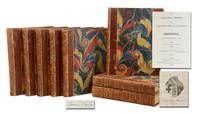
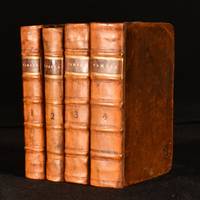
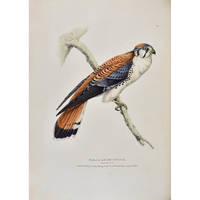
1829B568<p>London: John Murray Richard Bentley and Josiah Fisher 1829- 1837 4 vols 4to 275 x 200mm Contemporary red half morocco gilt with 110 engraved plates of which 72 are hand-coloured a very nice large uncut copy.</p><p>Scarce Complete Copy of the First Edition of this Rare Work on the Natural History of the Arctic.</p><p>Sir John Richardson 1787–1865 surgeon naturalist and Arctic explorer went on Sir John Franklin's first two Arctic expeditions as ship's doctor and naturalist and made observations and collected a large number of plant and animal specimens from the Canadian Arctic. </p><p>On his return to England after the second expedition he began to write this four-volume work of natural history first published between 1829 and 1837. A volume is dedicated to each of the classes of mammal bird fish and insect which are found in the Canadian Arctic. This work is an interesting example of pre-Darwinian natural history full of detailed descriptions of the appearance anatomy and behaviour of the different species. Volume 2 was first published in 1831 and focuses on the species of birds found in the Canadian Arctic. It was co-authored with naturalist and illustrator William Swainson 1789–1855 and contains many illustrations.</p>Please go to www.marshallrarebooks.com for many more books on this subject.<br /> John Murray
193417197JLondon: London Films 1934-1936. Present in the archive is the extremely rare privately printed original screenplay written by H.G. Wells for the film Things To Come entitled at this working stage - Whither Mankind Most films scripts of the period are simple mimeographed pieces. Wells went and had his script typeset by a printer and printed like a book in a tiny quantity: “This is the property of Mr. H.G. Wells.PRIVATE AND CONFIDENTIAL.FOR PRIVATE CIRCULATION ONLY.†Bound in plain green wrappers. Laid in is an Autograph Letter Signed from H.G. Wells to the film director of Things To Come William Cameron Menzies in which he tries to take Menzies to account and assert his control over the film: “Private and Confidential. Oct. 9. 34. Dear Menzies. This is all wrong. Get it in full perspective. This is an HG WELLS film!!!! And your highest and best is needed for the complete realization of MY treatment. Bless you. The very casting of ‘machines to the design of Mr. Menzies’ will be a casting out. Again bless you H.G.†Accompanied by a remarkable detailed pencil quarto size Autograph Letter Signed H.G. Wells written to actor Raymond Massey the lead star of Things To Come. Wells's obsession with exerting his desires are well shown in the letter where Wells takes Massey to task on aspects of his performance in a key scene with Ralph Richardson telling him that it should be re-shot and Wells has drawn 4 pencil sketches showing how he thinks the scene should be filmed. This letter was then given by Massey to director Menzies. Additionally present is a typed carbon copy of a letter to H.G. Wells from actor Ralph Richardson who played the role of The Boss in the film. Apparently Wells was unhappy with Richardson's performance as well and Richardson in the letter suggests it can be improved by reshooting and that Wells should speak to Menzies as director. This carbon was sent on to Menzies to give him a heads up. And there are four original black and white still photographs from the film including a terrific image of H.G. Wells on the set with actors Raymond Massey and Ann Pearl Argyle in their futurist costumes. All the material is in very good to fine condition enclosed in a custom morocco and cloth clamshell box. Things To Come was the first great science fiction picture in the sound film era and its treatment approach and stunning design has influenced generations of motion pictures. London Films hardcover
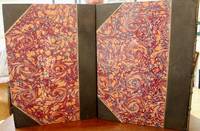
1812140947913London: Printed for the Translator by Robert Wilks 1812. First Edition in English. Very Good. First edition in English of the works of Aristotle one of 50 sets printed and boldly signed by the translator Thomas Taylor in ink at the end of the first volume. All volumes bear the armorial bookplates of noted bibliophile and Bronte family benefactor Frances Mary Richardson Currer 1785-1861. <p>Incomplete set with eight of ten volumes present of the complete translation. Uniformly bound by "J. Mackenzie Binder to the King" in contemporary half morocco over French Curl marbled boards with spines lettered and tooled in gilt; all edges gilt 4to. Very Good with wear extremities rubbed sporadic foxing hinges slightly tender. <p>Volumes include: 1. The Organon 1807. 2. The Treatises on the Soul 1808. 3.The History of Animals 1809. 4.The Treatises on the Parts and Progressive Motion on Animals etc. 1810. 5. The Rhetoric 1811. 6. The Great Edemian Ethics 1811. 7. A Dissertation on the Philosophy of Aristotle 1812.8. The Metaphysics first edition of 1801. <p>The first collected English translations of Aristotle's works from Orphic fragments by Neoplatonist scholar Thomas Tyler 1758-1835. Provenance of famed bibliophile and collector Frances Mary Richardson Currer whose well-curated and respected library expanded to nearly 20000 volumes. Bibliographer Thomas Frognall Dibdin remarked that she was "the head of all female book collectors in Europe." Known for her philanthropic endeavors she donated a sum of 50 pounds to Patrick Bronte father of Charlotte Bronte when he was widowed in 1821. Currer also contributed an unknown amount to the Clergy Daughter's School that the Bronte sisters attended. Scholars postulate that Charlotte chose the non de plume of "Currer Bell" for her first published 1847 novel Jane Eyre in honor of Currer's philanthropy. A desirable set even without Currer's bookplate that seldom comes up for sale. Printed for the Translator by Robert Wilks unknown
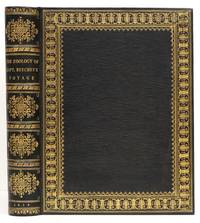
1839144944London: Henry G. Bohn 1839. xii180 pp. Quarto 28 X 22.5 cm. Bound in an attractive modern full dark blue straight grain morocco. Gilt decoration on spine and gilt decoration on boards. All edges speckled red. Marble endpapers to match. Modern bookplate on the front pastedown. Half title. 50 hand-colored engraved plates by Sowerby on the title page but there are actually only 44 plates 3 engraved geological plans with hand-colored details and 1 folding hand-colored engraved plate of geological sections. One extra uncoloured plate not called for after Plate 44. Overall a very attractive and fresh copy with very bright colouring. A very rare item. An IMPORTANT WORK NOTED for ITS STRIKING COLORED PLATES of BIRDS REPTILES MAMMALS and MARINE LIFE. The collections and notes were done during the four-year voyage of the Blossom a voyage to assist the expeditions of W.E. Parry and John Franklin. The notes are by John Richardson mammalia Nicholas A. Vigors birds George T. Lay and Edward T. Bennett fishes Richard Owen crustacea William Buckland geology and John Edward Gray reptiles and shells. As Beechey explains in the introduction the appearance of this work was long frustrated and it was only after a full eight years that it saw publication. In no uncertain terms he states "that it the delay has been occasioned entirely by Mr. Gray's failing to furnish his part in spite of every intercession from myself and others." As also noted by Beechey although the nature of the Blossom's mission prevented long stays in any one locality the crew did collect an astounding number of rare and exotic species from a good variety of locations. Hill 96; Sabin 71032. Lada Mocarski 105. 1839 Henry G. Bohn hardcover
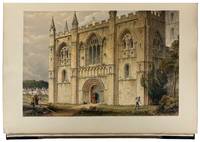
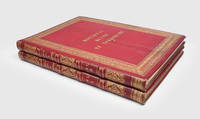
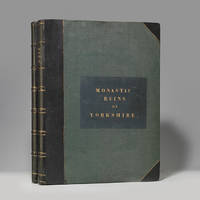
184342171York: Robert Sunter 1843. 2 volumes. Folio. 23 5/8 x 16 7/8 inches. Lithographed Dedication Contents leaf explanatory text accompanying each section of plates. Illustrated with 84 plates of which 34 are full-page hand-coloured plates 27 are hand-coloured and affixed to text pages and 23 are with tinted details or uncoloured and 1 coloured map showing localities of abbeys etc. Half brown morocco and cloths spine with raised bands forming six compartments marbled endpapers all edges gilt<br/> <br/> A rare beautifully illustrated work with magnificent hand coloured lithographs celebrating Yorkshire’s storied architectural heritage.<br/> <br/> A monumental visual and historical survey The Monastic Ruins of Yorkshire is among the most ambitious 19th-century publications devoted to Britain's early architectural heritage. Comprising 84 lithographic plates 61 hand coloured after on-site drawings by architect William Richardson and lithographed with remarkable sensitivity by George Hawkins the work offers sweeping detailed views of the region's most storied monastic sites: Fountains Abbey Rievaulx Whitby Bolton Kirkstall and many others. The accompanying texts by the Revd. Edward Churton M.A. supply rich historical commentary detailing each abbey's foundation its monastic order phases of architectural development notable benefactors and the devastation wrought by the Dissolution of the Monasteries under Henry VIII. Yorkshire's landscape rugged expansive and historically wealthy in natural resources was ideally suited for the growth of monastic communities. From the 12th century onward the region became a stronghold for the Cistercians Benedictines Augustinians and Premonstratensians whose abbeys often flourished under aristocratic and royal patronage. Yorkshire's remoteness from court life its vast agricultural estates and its political significance as a northern frontier made it a vital religious and economic center in medieval England. These monasteries were not only spiritual havens but also hubs of learning manuscript production and agrarian innovation. The prominence of Yorkshire in England's monastic landscape also made it disproportionately affected by the Dissolution 1536-1541 which stripped religious houses of their lands and wealth and left their architectural shells to decay. By the 19th century these ruins overgrown sublime and emblematic of a vanished order became focal points of Romantic imagination and national identity. The present work reflects this cultural turn merging antiquarian interest with a Victorian appreciation for the picturesque. This copy is notable for its original hand colouring. While some examples were issued with colour tinting or were embellished with modern hand colouring this copy preserves the original hand-colouring.<br/> <br/> Abbey Scenery 381. Robert Sunter unknown
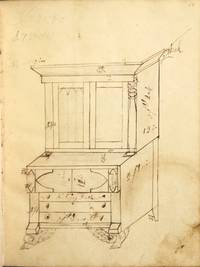
183548691Holley NY 1835. Small 4to notebook approx. 8" x 6¼" bound in original half calf over marbled boards containing approximately 80 leaves with manuscript entries and designs composed and drawn in ink and pencil; some blank pages scattered throughout. Approximately 50 designs including fully realized furniture styles with measurements some sketches or details of design elements table legs column styles acanthus leaf patterns etc. some more abbreviated images of design features. Dates on some of the drawings indicate the notebook was used between 1830 and 1833. One manuscript entry includes a grid-style list of prices for joints in various woods; another describes the construction of a portable desk giving the cost of various additions to the basic design such as a hollow for pens a square drawer and a book rest. Another 10 pp. offer approximately 18 recipes for stains and varnishes. Three loose scraps containing designs laid in. Moderate wear dampstaining to endpapers otherwise very good. The letterpress broadside advertises Richardson's business and reads in part: "Holley / Cabinet / Ware House. / C. Richardson / would inform the people of Holley and vicinity / that he still continues the cabinet making business 3 doors south of Perry's Tavern." Brockport: A. Edwards Printer 1835. The broadside measures 14" x 11" printed in various sizes and styles of type with a central composite image of period furniture including a dresser chairs settee and wash stand the text within a thick ornamental border. Old fold lines some foxing else a nice example. This broadside appears to be unrecorded. A very faint contemporary pencil notation on the front endpaper of the notebook reads "Chase Richardson 1832." This is most likely the same Richardson who had the broadside printed given that some of the illustrations on the broadside appear to be taken from drawings in the accompanying manuscript. Records from Hillside Cemetery Clarendon Orleans County NY just 3 miles from Holley NY mention a Chase Richardson 1810-1839. Both items are housed in recent cloth clamshell boxes with gilt stamped leather labels. At the beginning of the 19th century the furniture industry in America saw a sudden shift of its epicenter from Philadelphia to New York. Dubbed the "London of America" it was thought at the time that New York would in fact be the leader in business in the United States. To facilitate the cabinetmaking industry a new directory for cabinetmakers in New York was published in 1805 and various guides were issued helping craftsmen to price their furniture. Styles were elegant and influenced highly by the European furniture which was also being imported into New York. Phyfe Allison and Ash produced some of the finest examples of furniture from that period. However although the high styles of the time may have been determined by these well known cabinetmakers others imitated and added their own interpretations. John L. Scherer in his exhibition catalog "New York Furniture: The Federal Period 1788-1825" Albany: 1988 states: "Eventually cabinetmakers in upstate towns and villages who picked up New York City styles rendered their own versions. Using local woods this furniture evokes a spirit of the time with a dash of country charm. As trends in New York State furniture moved upstate they also spread across the country. New York remained in the forefront of furniture design and production until the end of the century." This fine group of material illustrates an 1830's provincial craftsman working in the newly fashionable Empire-style designs. Among the more fully executed designs in this notebook are a washstand stool dressing tables and secretaries each with detailed measurements. Some are titled such as "French Bureau" "Grecian Card Table" and "Portable Secretary." Others may have been sketched during a trip to York Ontario now Toronto including "York Bureau No. 1 and 2." Richardson was aware of the developments in furniture design in other parts of the state. One of the notes beside a drawing of a "Dress Beauro sic Plain" mentions what the same item sold for at Meads & Alvords. John Meads & William Alvord operated a successful cabinet-maker's shop in Albany NY until Alvord's death in 1847 according to a "Bi-centennial History of Albany" published by W.W. Munsell in 1886. The notebook also includes details of carving designs such as foliage scrolls turning profiles and volutes. In the back of the volume are several recipes for varnishes and stains some intended to imitate more expensive materials such as mahogany curly maple and marble. For example to imitate birds eye maple one had only to mix "cuprite two shades darker than white lead & chrome yellow & V. Red plus Raw Terra de Sena" using a quill and fingers as tools. Many of these recipes are credited to other cabinet-makers residing in Ontario and northern New England. A recipe for white varnish came from John Bradshaw of Waterson sp a stain for Rose Wood Chairs from Silas Alden of Boston a German Polish recipe from Clark H. Ober of New Ipswich etc. While information and documentation for furniture makers in the larger cities is often obtainable information on smaller local artisans is much more scarce. Both items were inherited by Gertrude Cole Simmons 1895-1985 of an old Holley-area family. Her grandmother was Ellen Maria Richardson Cowles 1838-1873 who may have been the daughter or niece of the cabinet maker C. Richardson. See also: Finkelman Encyclopedia of the New American Nation: The Emergence of the United States 1754-1829. Detroit 2006; Scherer New York Furniture: The Federal Period 1788-1825. Albany 1988; and Scherer New York Furniture at the New York State Museum Alexandria VA 1984. <br/><br/> hardcover books
183561406Holley NY 1835. Small 4to notebook approx. 8 x 6 1/4 in. bound in original half calf over marbled boards containing approximately 80 leaves with manuscript entries and designs composed and drawn in ink and pencil; some blank pages scattered throughout. Approximately 50 designs including fully realized furniture styles with measurements some sketches or details of design elements table legs column styles acanthus leaf patterns etc. some more abbreviated images of design features. Dates on some of the drawings indicate the notebook was used between 1830 and 1833. One manuscript entry includes a grid-style list of prices for joints in various woods; another describes the construction of a portable desk giving the cost of various additions to the basic design such as a hollow for pens a square drawer and a book rest. Another 10 pp. offer approximately 18 recipes for stains and varnishes. Three loose scraps containing designs laid in. Moderate wear dampstaining to endpapers otherwise very good. The letterpress broadside advertises Richardson's business and reads in part: "Holley / Cabinet / Ware House. / C. Richardson / would inform the people of Holley and vicinity / that he still continues the cabinet making business 3 doors south of Perry's Tavern." Brockport: A. Edwards Printer 1835. The broadside measures 14 x 11 in. printed in various sizes and styles of type with a central composite image of period furniture including a dresser chairs settee and wash stand the text within a thick ornamental border. Old fold lines some foxing else a nice example. This broadside appears to be unrecorded. A very faint contemporary pencil notation on the front endpaper of the notebook reads "Chase Richardson 1832." This is most likely the same Richardson who had the broadside printed given that some of the illustrations on the broadside appear to be taken from drawings in the accompanying manuscript. Records from Hillside Cemetery Clarendon Orleans County NY just 3 miles from Holley NY mention a Chase Richardson 1810-1839. Both items are housed in recent cloth clamshell boxes with gilt stamped leather labels. At the beginning of the 19th century the furniture industry in America saw a sudden shift of its epicenter from Philadelphia to New York. Dubbed the "London of America" it was thought at the time that New York would in fact be the leader in business in the United States. To facilitate the cabinetmaking industry a new directory for cabinetmakers in New York was published in 1805 and various guides were issued helping craftsmen to price their furniture. Styles were elegant and influenced highly by the European furniture which was also being imported into New York. Phyfe Allison and Ash produced some of the finest examples of furniture from that period. However although the high styles of the time may have been determined by these well known cabinetmakers others imitated and added their own interpretations.<br/>John L. Scherer in his exhibition catalog "New York Furniture: The Federal Period 1788-1825" Albany: 1988 states: "Eventually cabinetmakers in upstate towns and villages who picked up New York City styles rendered their own versions. Using local woods this furniture evokes a spirit of the time with a dash of country charm. As trends in New York State furniture moved upstate they also spread across the country. New York remained in the forefront of furniture design and production until the end of the century." This fine group of material illustrates an 1830's provincial craftsman working in the newly fashionable Empire-style designs. Among the more fully executed designs in this notebook are a washstand stool dressing tables and secretaries each with detailed measurements. Some are titled such as "French Bureau" "Grecian Card Table" and "Portable Secretary." Others may have been sketched during a trip to York Ontario now Toronto including "York Bureau No. 1 and 2." Richardson was aware of the developments in furniture design in other parts of the state. One of the notes beside a drawing of a "Dress Beauro sic Plain" mentions what the same item sold for at Meads & Alvords. John Meads & William Alvord operated a successful cabinet-maker's shop in Albany NY until Alvord's death in 1847 according to a "Bi-centennial History of Albany" published by W.W. Munsell in 1886. The notebook also includes details of carving designs such as foliage scrolls turning profiles and volutes. In the back of the volume are several recipes for varnishes and stains some intended to imitate more expensive materials such as mahogany curly maple and marble. For example to imitate birds eye maple one had only to mix "cuprite two shades darker than white lead & chrome yellow & V. Red plus Raw Terra de Sena" using a quill and fingers as tools. Many of these recipes are credited to other cabinet-makers residing in Ontario and northern New England. A recipe for white varnish came from John Bradshaw of Waterson sp a stain for Rose Wood Chairs from Silas Alden of Boston a German Polish recipe from Clark H. Ober of New Ipswich etc. While information and documentation for furniture makers in the larger cities is often obtainable information on smaller local artisans is much more scarce. <br/>Both items were inherited by Gertrude Cole Simmons 1895-1985 of an old Holley-area family. Her grandmother was Ellen Maria Richardson Cowles 1838-1873 who may have been the daughter or niece of the cabinet maker C. Richardson. <br/><br/> hardcover books
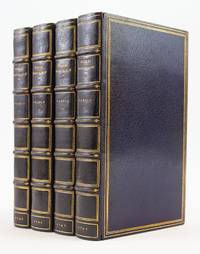
1421ST19567-114London: Printed for C. Rivington and J. Osborn vols. III-IV printed for S. Richardson and sold by C. Rivington and J. Osborn 1741-42 i.e. 1740-41. FIRST EDITIONS FIRST STATES vol. I with Letter XXVII p. 81 misnumbered "XXVI"; p. 16 mis-paged "61"; p. 295 with the "5" left off. 169 x 102 mm. 6 5/8 x 4". Four volumes. <br/> Elegantly simple dark blue morocco by Zaehnsdorf stamp-signed and dated 1912 on front turn-in with oval exhibition stamp on rear pastedown covers with French fillet border raised bands spine compartments with double gilt fillet gilt lettering densely gilt turn-ins marbled endpapers all edges gilt. Front pastedowns with ex-libris featuring two interlocking "A"s forming an X. Sale 5 15; Rothschild 1745; Day "History of English Literature 1660-1837" pp. 225-26. Spines just slightly and uniformly darkened text lightly washed and pressed no doubt at the time of binding half a dozen expert marginal paper repairs leaves a shade less than bright isolated light foxing or trivial stain but still quite a fine set--clean and pleasing internally in lustrous virtually unworn bindings.<br/> <br/> This is an attractively bound copy of a work widely considered the first English novel with all four volumes in their first state. The story of a virtuous servant girl who resists the unwanted attention of her employer's son until marriage is offered "Pamela" was first issued in November 1740 as a complete novel in two volumes. The tale was a runaway success going to five editions in 1741 and spawning so many imitations parodies and unauthorized continuations that Richardson was compelled to wrest the narrative back under his own control by writing two additional volumes. The second part of the work features "Pamela" as the exemplary wife of a country gentleman winning over snobs and winning back her straying spouse. Day describes the plucky maid-turned-lady as "the first great character creation of English prose fiction" wryly observing "as much as we may dislike her prudential morality we must recognize here a complete human being." And even the book's moralizing is far more than just palatable: as Day notes Alexander Pope after staying up all night to read the novel declared "it will do more good than a great many of the new sermons." Sets with all four volumes in the first state are rarely seen in the marketplace and are frequently in unpleasant condition when they are found. A well-preserved set of firsts in uniform bindings by a premier workshop is especially agreeable. Printed for C. Rivington and J. Osborn [vols. III-IV printed for S. Richardson and sold by C. Rivington and J. Osborn] unknown
1843B4090York: Robert Sunter c.1843. Edges gilt all plates are clean and crisp and beautifully hand colored A very handsome and fine set in original dark green half morocco. Frontispiece with a small library stamp on the lower right corner of the margin not affecting the plate. . Binding: Original green half morocco with matching marbled boards. 6 raised bands in 7 compartments tooled gilt rules tooled gilt lettering and elaborate design on the spine marbled free and pasted end papers Notes: An architectural and landscape engraver George Hawkins 1809-1852 turned his attention to lithography in which he was very successful. He was frequently employed by architects in colouring their designs for various edifices many of which were exhitibted in the architectural room of the Royal Academy. One of his most important undertakings was a series of lithographs of the “Monastic Ruins of Yorkshire†from sketches made by W. Richardson. For the above projects he worked closely with prominent printers Day and Hague which were also the printers for the celebrated works of David Roberts of Holyland and Egypt.<br>Abbey 248 DNB.<br> Size: Large Folio: 450mm x 606m Illustration: Illustrated with 55 hand colored full page plates 25 half page plates and one map 2 frontispieces. Volume: Two Volumes References: Abbey 248 381 DNB. Pages: P. Vol1: Blank Frontis Title Contents 1 Intro v-ix 11-56 blank; Vol 2: Blank Frontis Blank 57-88 blank. Category: Book Plate Books Colour; Book Europe United Kingdom; Robert Sunter hardcover
1843185001York: Robert Sunter 1843. Richardson's really fine plates will always make this a desirable book First and only edition; a very handsome copy bound in York of one of the most resplendent English colour plate topographical books. Richardson's beautifully composed picturesque scenes superbly lithographed by George Hawkins were printed by the firm of Day & Haghe - responsible for the celebrated David Roberts folios - which "raised lithography to perhaps the highest point it ever attained" Abbey. Boyne remarks that "Richardson's really fine plates will always make this a desirable book" and notes that it was issued originally in nine parts available at nine guineas plain or eighteen guineas coloured; this copy has a mixture of both which is often the case. All the major abbeys of Yorkshire are portrayed among them Whitby Kirkstall Rievaulx Byland and Fountains as well as a number of priories and smaller religious houses. Richardson's finely rendered placid scenes populated attractively by local people and admiring visitors illustrate the exceptional richness of Yorkshire's survivals from Henry VIII's dissolution of the monasteries. In fact Yorkshire did not "go quietly" during that period of state-sanctioned vandalism: "The dissolution violently destroyed centuries-old communities and wiped out ancient landmarks But in the midst of the dissolution a sudden storm of opposition took the government by surprise; for a time it looked likely to threaten not only Cromwell's policy but even perhaps Henry's throne. This was the northern rising also known as the Pilgrimage of Grace which convulsed Lincolnshire Yorkshire and finally all the north in the last three months of 1536" Elton p. 145. Monastic Ruins pairs two men with deep roots in the county. York-born William Richardson 1814-1899 the son of a cabinet maker specialized in architectural and landscape subjects and exhibited at the Royal Academy between 1842 and 1869. Edward Churton 1800-1874 theologian and Spanish scholar held the living of Crayke in the North Riding of Yorkshire for forty years and from 1841 was prebendary of York Minster. "Churton saw himself as the custodian of a continuous Catholic tradition within the Church of England inherited from the Caroline divines" ODNB - making him a sympathetic choice as author. 2 vols folio 605 x 415 mm. With 2 lithograph title pages that for vol. I hand-coloured hand-coloured lithograph dedication leaf 82 lithograph plates by George Hawkins after William Richardson 32 full-page 27 half-page on text leaves 25 of these 59 are hand-coloured and mounted and 23 plain lithograph plans printed by Day & Haghe coloured decorative initials and map showing locations; text and plates mounted on white linen stubs. Contemporary red morocco by H. Potter of York gilt-stamped on the front turn-ins bevelled boards spines with four low broad gilt-decorated raised bands gilt-lettered and numbered direct in second and fourth compartments others panelled with gilt paired fillets enclosing scrolling foliate cornerpieces dots and circlets and a central lozenge composed of multiple tools gilt-lettered covers framed by alternating concentric panels of gilt triple fillets and scrolling foliate rolls gilt turn-ins Bouquet pattern marbled endpapers gilt edges. Bindings a little rubbed at extremities a few shallow indentations to covers pale stains to front cover of vol. II some foxing light tidemark at top corner of a handful of leaves at end of vol. I offsetting from turn-ins to endleaves a few mount sheets browned. A very good copy. Abbey 381; William Boyne The Yorkshire Library: A Bibliographical Account 1869 XXXIII. G. R. Elton England Under the Tudors 1991. hardcover
2017CBS-9780470659632John Wiley Original 2017. New. John Wiley (Original) unknown
2017CBS-9780470659632John Wiley Original 2017. New. John Wiley (Original) unknown
1742866K20London: C. Rivington; S. Richardson 1742. Leather. Very Good. 6.5" by 4". None. A scarce early set of this influential eighteenth century novel in contemporary calf. Volumes one is the second edition volume two the fourth edition volume three is the first edition and volume four the second edition. Volume three catchword misprinted A for As as called for. Scarce in any early edition. Endpapers and blanks renewed to volumes one and three. As stated on the title pages of volumes one and two they had intended to be a complete story within themselves. However due to the instant success of the works going through five editions in its first year and prompting the release of many counterfeit sequels imitators and parodies Richardson chose to write two more volumes. 'Pamela' or 'Virtue Rewarded' tells of a beautiful 15 year old Pamela working as a maidservant under inappropriate master Mr B. Though it was a bestseller when published it's received criticism over time for it's seeming glorification of abuse. It's been referenced widely in literature including in 'Jane Eyre' and 'The Haunting of Hill House'. First published in 1740 this is considered to be one of the first true English novels. It was immensely popular and widely read however Richardson did receive criticism for its contents for its perceived licentiousness and disregard for class barriers. 'Pamela' is notable for its early commentary on domestic violence and the social issues of the Georgian era told through the eyes of the naive Pamela in her letters to her parents. Rebacked with contemporary calf boards preserved. Externally smart with marks to the boards and bumping to the extremities. Endpapers and blanks renewed to volumes one and three. Contemporary ink inscriptions to paste downs and preliminaries of all volumes. Internally firmly bound. Loss to extremity of leaf B slightly affecting the text. Chipping to the occasional other leaf not affecting the text. Very Good C. Rivington; S. Richardson hardcover
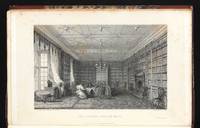
5008Four plates as usual a little foxed. xii 501 pp. 8vo orig. half-morocco & orig. marbled boards joints & spine rubbed spine gilt t.e.g. others uncut. London: Printed for Private Circulation Only 1833. Limited to 100 copies only. This is the second of Miss Currer's library catalogues; the first was issued in an edition of 40 or 50 copies in 1820. "Miss Currer continually added to her collection and found it necessary to have a new 'Catalogue' compiled by Mr. C.J. Stewart. One hundred copies of this handsome volume were printed in 1833 for private circulation. It contains four steel engravings representing the book-rooms and outside of the house; two may be seen in Dibdin's works.The catalogue is admirably arranged after a modification of Hartwell Horne's system of classification and has a good alphabetical index. It is a model catalogue of a private library and is now rare and much sought after. Miss Currer's library.contained many rarities. It was rich in natural science topography antiquities and history. There was a fair collection of Greek and Latin classics.The books were all in choice condition many with fine bindings."-D.N.B. V pp. 340-41. Very good copy. Inscribed on the free front endpaper by Miss Currer to "Cooper Preston Esqr. With Miss Currer's King Regards." Bookplates of John Norcliffe Preston and A.R.A. Hobson. ❧ Gustave Brunet Dictionnaire de Bibliologie Catholique cols. 612-13. De Ricci pp. 141-43. hardcover books
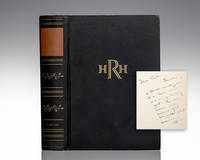
1931148697New York: W. W. Norton & Company Inc 1931. First collected edition of this foundational work in Australian literature. Octavo original publisher's cloth with gilt titles to the spine and gilt author's initials to the front panel. Association copy inscribed by Ernest Hemingway to his cousin on the front free endpaper "Dear Ruth: This one or three really since it is three novels - is or are pretty very good. The same woman wrote Maurice Guest - very good about musicians - EH." The recipient Ruth White Lowry 1884-1974 was Hemingway's cousin and Kansas City native. Hemingway was known to have frequented Bennett Schneider's bookshop in Kansas City where he likely acquired this book for his cousin who he was staying with at the time. In near fine condition. Bookseller's ticket to the rear pastedown of Bennett Schneider Book Seller Kansas City. Henry Handel Richardson the pen name of Ethel Florence Lindesay Richardson is widely regarded as one of Australia's most important early novelists known for her psychologically nuanced and stylistically refined fiction. Educated in both Australia and Europe Richardson drew heavily on her own life experiences to explore themes of identity exile and the tensions between individual aspiration and social expectation. 'The Fortunes of Richard Mahony' is a landmark work in Australian literature notable for its psychological depth and portrayal of colonial life. Published as a trilogy between 1917 and 1929 the novel chronicles the rise and fall of Richard Mahony an English-born doctor whose pursuit of social status and intellectual fulfillment is gradually undone by mental illness and cultural alienation. Drawing on Richardson’s own family history the narrative presents a compelling critique of the colonial experience exposing the tensions between personal ambition and the harsh realities of life in nineteenth-century Australia. W. W. Norton & Company, Inc hardcover
1901138225New York: Croscup & Sterling Company 1901. Handsome set of the Edition de Bibliophile The Edition de Bibliophile set one of 20 limited edition subscription copies only printed on handmade Japanese vellum and published ad hominem. Each volume is signed by the publishers on the limitation page and several of the hand-coloured plates are signed by the colourists. Volume 1 features an original dry-point etching by Jean Paleologue a Romanian poster artist painter and illustrator. A remarkable set. 20 vols octavo 234 x 153 mm. Hand-coloured frontispieces in two states black and white engraved titles hand-coloured plates by various artists in three states with tissue guards printed in red to each vol. Finely bound by Stikeman in contemporary green crushed morocco titles to spines gilt in compartments 3 gilt rose designs inlaid with red morocco raised bands decorated with frieze of tulips in gilt boards elaborately blocked in gilt floral border with red morocco onlays surrounding a central panel of gilt tulips green morocco doublures with author's initials stamped in gilt to a red morocco central panel framed by elaborate gilt tooling white watered silk moiré patterned free endpapers top edges gilt others untrimmed red bookmarker handmade Japanese vellum sheets. Spines sunned to brown or pale green some tips rubbed sides bright and clean internally. A very good set. hardcover
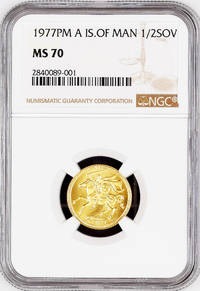
0000007007Pen and Sword Books Ltd. No Binding. As New. New flawless: Isle of Man - Stone Age to Swinging Sixties - and oh yeah: also one 1977 PM Pobjoy Mint Isle of Man 1/2 Gold Sovereign MS 70 Grade. A pristine 2024 example of the best book there is on the Mystical Isle; the finest Mint State half soveriegn from the same inexplicable locale this one as rare as the place itself. Please review all images. 3.99 grams of which 3.6612 are pure gold - IE fineness is 916.7. A Nordic in fact Viking Warrior graces the obverse Brits might call it the reverse and Queen Elizabeth II is on the reverse. This is a genuine rarity even if it weren't in MS-70 "perfect" per grader's terms condition but it is. The two most respected grading / authentication / slabbing companies and most notably so for coins such as this are NGC Numismatic Guaranty Corp. and PCGS Professional Coin Grading Service. As of this listing NGC shows only 6 examples of this coin exist this being one of those that they have graded. PCGS appears to show none at all. No other such graded MS-70 appear anywhere internet or elsewhere - again as of this listing. But it's been that way for a long time. I've seen over the years some MS-68s and MS-69s listed in the range of $900 to $1200. But if you're even here looking - I don't have to tell you the magnitude of the value difference between a 69 and a 70 in the case of rare coins. But there is no true current market information on an MS-70. For now I have to leave this price as it is for now and either increase or decrease it if and when credible new information presents itself. The mystery in this one Just the mystery of the magical Isle of Man itself - which is a "British Crown Dependency" whatever that may be - small unique and full of folklore having arisen so they say from the antics of Buggane Fenodyree the Glashtyn the Moddey Dhoo - and no doubt more once lurked behind those. I personally feel the Tuatha Dé Danann must have started the whole thing. Can't guarantee that though. LSPC-0000007007 <br/> <br/> Pen and Sword Books Ltd unknown
18431177231843. First Edition. RICHARDSON William. The Monastic Ruins of Yorkshire. York: Robert Sunter 1843. Two Volumes. Elephant folio 18 by 24 inches early cloth rebacked and recornered in later dark green morocco all edges gilt. $6500.First edition of this monumental production with two hand-colored title pages a hand-colored dedication leaf 34 hand-colored full-page plates 24 hand-colored half-page plates 22 uncolored full-page plates some tinted and a map.The dissolution of the monasteries by Henry VIII in the 16th century left Yorkshire with a rich collection of monastic ruins captured here in a series of plates by artist William Richardson in a work that rivals the great Holy Land by David Roberts. Locations included here are Whitby Abbey Kirkstall Abbey St. Mary's York Rievaulx and Kirkham Abbeys Fountains Roche Abbey Byland and Newborough Guisborough Mount Grace Selby Abbey Bolton Priory Bridlington Priory Old Malton Priory Joraulx Abbey Sallay Abbey Sawley Abbey Monk Bretton Priory Coverham Abbey Eggleston Abbey Easby Abbey Grey Friars Richmond Howden Kirkham Priory Marrick Nun-Monkton Ellerton and Rosedale Priory. The plates were printed by the lithographic firm of William Day frequently referred to as ""Day and Hague"" because of the fine work of Belgian draughtsman and watercolorist Louis Haghe the foremost lithographer of his time. ""The firm of Day and Haghe raised lithography to perhaps the highest point it ever attained"" Abbey 340. Perhaps not surprisingly this is the same firm that printed Roberts' Holy Land. Issued in two versions one entirely uncolored and the other with many of the plates hand-colored. This copy without the uncolored plate labeled number 49 by Abbey not present or listed in the uncolored copies and often not present but in the plate list in colored copies; in this copy Abbey's plate number 74 ""Howden Tombs"" has been bound in its place. Abbey Life 381. Scattered foxing to some text and plates. An impressive production. hardcover
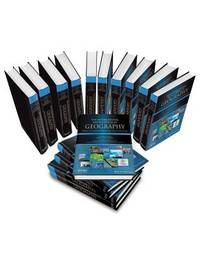
2010CBS-9780444527882Elsevier 2010. New. Elsevier unknown
2010CBS-9780444527882Elsevier 2010. New. Elsevier unknown
1854WRCAM54205London 1854. xi11711 erratapp. plus thirty-three mounted lithographic plates seventeen double- page. Half title bound after the titlepage. Quarto. 20th-century half polished calf and marbled boards spine gilt leather label. Minor scuffing to boards. Modern bookplate on front pastedown light occasional foxing. Very good. The first edition of this zoological publication from the voyage of the Herald with descriptions of fossil bones from Eschscholtz Bay. The first part of this work appeared in 1852; in 1854 it was completed and issued with a new titlepage. The lithographs depict all manner of mammalian fossils including full skeletons of the bighorn and musk-bull and detailed illustrations of their parts with skulls spinal bones and more. Also includes three excellent plates featuring lizards and six of various fish. Rare; not in Hill or ARCTIC BIBLIOGRAPHY. <br> <br> "Sir John Richardson was a distinguished British naturalist and arctic explorer. In 1819 he was appointed surgeon and naturalist to Franklin's first arctic expedition and subsequently to the second. The scientific results of these expeditions he described in contributions to Franklin's NARRATIVES. He also wrote the natural history accounts of several other arctic voyages. The present work is one of these." - Lada-Mocarski. FORBES 2049. LADA-MOCARSKI 139. SABIN 71033. hardcover books
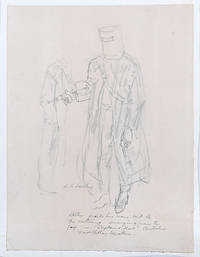
19691724461969. Tell 'em I died game An absorbing collection of accomplished portraits and location sketches by the Australian artist George Crossley 1919-1973 executed during the making of Tony Richardson's Ned Kelly 1970 which "appeared at the beginning of what is considered a renaissance in Australian cinema" and at a moment when Kelly was the cynosure of "related constructions of the Australian past and identity" Basu p. 131. The film starred Mick Jagger as the iconic bushranger and he is pictured in two drawings: "Mick Jagger as 'Ned Kelly' addressing the Jury Braidwood Courthouse 27th Aug '69. Ned Kelly Location Rehearsals" and "Mick Jagger in the courtroom Braidwood Ned Kelly location. Aug '66". Approximately 54 drawings are finely executed close up portraits of cast members extras and crew including Jagger's stuntman Bill Peter caught during breaks from filming each meticulously captioned giving the sitter's identity and the location. A group of half a dozen feature members of the folk band the Wild Colonial Boys some of whom appear in the film and are pictured in performance. Kelly's final gun fight is recorded in an action sequence of looser pencil drawings: "Rehearsals for the Ambush of Kelly" "Kelly fights his way out of the cutting emerging from the fog" and finally "Kelly overcome with loss of blood weakens and collapses". A single pencil drawing depicts Kelly's famous bulletproof armour. Richardson himself makes an appearance in "Kelly's collapse when wounded and identification - by Inspector Nicholson - Glenrowan location. Tony Richardson directing". Crossley was born in Perth and studied at the Melbourne National Gallery School under the renowned portraitist William Dargie. Afterwards he worked as a television artist for the BBC in London. He held exhibitions in Europe the Middle East and Australia. His work is represented in a number of Australian institutions. Ned Kelly was filmed entirely in Australia largely around Braidwood New South Wales. The supporting cast of mainly Australians actors included Frank Thring as the colonial judge Sir Redmond Barry who sentenced Kelly to hang. Thring remains best known for his unforgettable high camp performances in a string of Hollywood blockbusters: Ben-Hur King of Kings and El Cid. Ian McKellen was originally considered for the role of Kelly but the studio wanted a bankable "big personality" and it was offered to Mick Jagger. The film "garnered a lot of attention for the bushranger both at home and abroad as well as causing a fracas for having as lead and director not only non-Australians but Britons Although none of the producers of Kelly products from this period was directly associated with the New Left it is clear that through Kelly they were intervening in related constructions of the Australian past and identity. They situated their past firmly within the structural inequalities necessitated by colonialism at a time when British colonies in Africa and the Caribbean were rapidly gaining independence and affirmed a national identity not only separate from 'Britishness' but in opposition to it" Basu p. 122-25. "Ned Kelly was transformed with the help of the telegraph wire and the early mass media from a regional folk hero into a romanticised media celebrity He has progressed from outlaw to national hero. to international icon. The still-enigmatic slightly saturnine and ever-ambivalent bushranger is the undisputed if not universally admired national symbol of Australia" Seal pp. 99-100. As the Australian Dictionary of Biography concludes "The legend still persists and seemingly has a compelling quality that appeals to something deeply rooted in the character of the 'average' Australian". Together 99 drawings most of them signed by the artist as "G. S. Crossley" the majority executed in black ink on paper some with pencil under drawing and occasional watercolour wash various sizes from 370 x 500 mm to 240 x 310 mm; all laid down on card and with detailed captioning often with a first version jotted down in situ when the drawing were created and a second more formal caption. With a small quantity of research material compiled by a previous owner. Occasional marks but overall in very good condition. Laura Basu Ned Kelly as Memory Dispositif: Media Time Power and the Development of Australian Identities 2012; Graham Seal Outlaw Heroes in Myth and History 2011. unknown
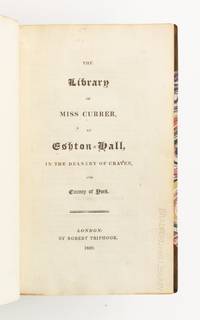
1820ST16983London: Robert Triphook 1820. ONE OF 40 COPIES PRINTED. 235 x 142 mm. 9 1/4 x 5 3/4". iii-xi 1 308 pp. lacking the first of the two title pages at front. <br/> In a very nice replica binding of honey-brown sheepskin over marbled boards raised bands ruled in gilt gilt titling. Front free endpaper INSCRIBED IN INK BY CURRER: With Miss Currer's Compliments"; small ownership perforation of the Bradford Free Library on title page and p. 99; two small ink stamps on p. 59 and 99. Front free endpaper with thinned area where indication of earlier ownership likely appeared. The boards just very lightly scuffed though probably to provide a feeling of authenticity otherwise only trivial imperfections. Apart from the signs of library ownership a very fine copy the text showing virtually no signs of use.<br/> <br/> This is a presentation copy of the first library catalogue of Frances Mary Richardson Currer an Englishwoman described by De Ricci as "England’s earliest female bibliophile" and hailed by Dibdin as "the head of all female collectors in Europe." An only child Currer 1785-1861 inherited considerable assets from both her father's and her mother's families: her relative Dorothy Richardson wrote in 1815 "She is in possession of both the Richardson and Currer estates and inherits all the taste of the former family having collected a very large and valuable library . . . in addition to what were collected by her great grandfather and great-uncle." Dibdin noted that her library at Eshton Hall in North Yorkshire was surpassed only by three collections those of Earl Spencer and the dukes of Devonshire and Buckingham. According to DNB "the library had substantial holdings in natural science topography antiquities and history together with a collection of the classics. There were rarities some early printed books a collection of Bibles and a fine gathering of illustrated books. . . . Dibdin first estimated the number of volumes at 15000 and later 18000. In 1852 Sir J. B. Burke put the number at 20000." With just 40 copies printed this first printing there was a 1933 second edition is very rarely seen on the market. Robert Triphook unknown
1919408155Atlantic City 1919. Softcover. Good. Octavo. Measuring 7" x 9". String-tied decorative paper wrappers. Contains 48 black and white or sepia toned gelatin silver photographs measuring 3.5" x 5.5" with captions. Additionally included is a certificate issued to Richardson and signed by one of Stinson's daredevil pilots attesting to his taking a 33-minute flight with a newspaper article written by Richardson about the flight laid in. The album is good only with considerable edgewear lacking the back cover with near fine photographs.<br /> <br /> A photo album compiled by William H. Richardson a journalist and amateur historian who published a number of monographs about New Jersey. The photographs document Richardson's arrival at the barnstorming event with his friend W.C. Cobb. The photos show the men in flight jackets and leather helmets as well as Eddie Stinson and his pilots and crew. The album features Stinson's seaplanes and ground aircraft and many in-flight scenes and bird's-eye views of Atlantic City. The newspaper article and album label note that Richardson was the first civilian from Jersey City to take aerial photographs.<br /> <br /> Stinson was an early Wright-trained aviator and served as a flight instructor for the U.S. Army during World War I. Following the war he started a barnstorming troupe and during one year earned over $100000 as a stunt pilot. He set a world endurance record for flight in 1921 and eventually founded the Stinson Aircraft Company of Dayton and Detroit which produced a number of very popular aircraft. Stinson accumulated more than 16000 hours of flight time - the most of any pilot in his lifetime - but he died in a 1932 airplane crash at Chicago.<br /> <br /> A very pleasing collection of early aviation stunt pilots and aerial photos of New Jersey. unknown
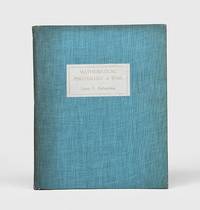
1919162531Oxford: Wm. Hunt 1919. With presentation letter First edition first impression of Richardson's first and pioneering paper on the subject; presentation copy with an autograph letter from the author loosely inserted. The letter is addressed to "Mr Bartlett" probably Frederic Bartlett one of the forerunners of cognitive psychology written on the author's home stationery and dated 20 September 1928. "You may like a copy of 'The Mathematical Psychology of War' if I have not already sent you one. If so you can pass it on. L. F. Richardson". In a postscript Richardson notes that this is his only published work but soon there may be two papers by him in the Journal of General Psychiatry. In the work the mathematician and pacifist Lewis Fry Richardson 1881-1953 developed a mathematical model for describing the change in animosity between two opposing sides during a war and "postulated that the rate of increase of the warlike activity of one nation depended on the current activity of the opposing nation" ODNB. It was published at the author's own expense costing him £35 for 300 copies in total. It contains Bertrand Russell's 20-line contribution "Problem: To Produce in Two Nations a Mutual Will to War" pp. 15-16. "Russell had been impressed with the manuscript which Stanley Unwin had forwarded him although he thought that Richardson's subject required a more extended treatment and that he should 'eliminate dogmatic statements of his metaphysical opinions where they are irrelevant'. But otherwise 'Mr. Richardson's main ideas appear to me true original and important' 29 December 1918. Russell's 'Problem' was enclosed with this letter to Unwin with instructions that it be passed on to the author 'for his amusement'" Rempel & Haslam p. 405. Quarto. Roneo typescript pp. 3 50. Original blue cloth printed paper label to front cover. Slight sunning to spine contents a little toned. A very good copy. Blackwell & Ruja B9. Richard A. Rempel & Beryl Haslam "Appendix I" in their critical edition of Russell's Uncertain Paths to Freedom 2000. hardcover