[ANONYMOUS].Biblio.com
125 résultats
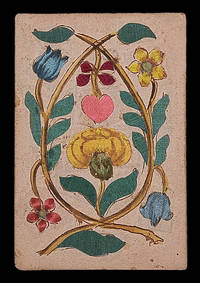
168021834Germany c1680. 93 by 65mm. 3.75 by 2.5 inches. A luxury silk and brocade deck 36 playing cards coloured silk and brocade laid between paper. The Maker There is no information on the present deck of cards about its maker but the nature of the materials used demonstrate that he or she must have been working for some extremely wealthy clients. The Cards The present cards are uniquely luxurious each one being comprised of layers of coloured silk and brocade laid between two sheets of paper. The different layers of fabric give the images added depth which reinforces the sense of meticulous craftsmanship. The janiform eagle which had been a symbol of the German emperors since the fifteenth century points towards a German origin for these cards. Indeed Hargrave records another deck of silk trappola cards from the seventeenth century which appear to have been made in Germany. It has been tentatively suggested that hearts represent France with Louis XIV as King; spades Russia with Peter the Great as Tsar - the jack bears the double headed-eagle of the Russian Empire; clubs the Holy Roman Empire with Leopold I as Emperor - he holds a shield bearing the imperial eagle; and diamonds the Ottoman Empire with - possibly - Mehmed IV as Sultan; the jack holds a falcon: falconry was one of the most popular pastimes in the Ottoman court. unknown
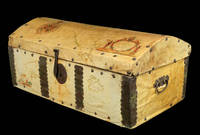
16902196Spain c1690. 320 by 740mm. 12.5 by 29.25 inches. Wooden chest clad in vellum manuscript maps with wrought iron handles rivets lock and clasp. A very unusual piece of cartographic history. It was common for seafarers to have sturdy wooden chests for storage whilst on a voyage but the owner of this chest chose to have it covered it with manuscript maps drawn on vellum possibly by their own hand with the decorative ironwork fitted on top. The lid is covered with a map of North and Central America with the Darien Isthmus labelled to the south and decorated with an elaborate compass rose and title cartouche supported by figures of Native Americans. The map on the front is decorated with a title cartouche showing a sea god. The sides are covered with maps of the East and West Indies decorated with ships. It is remarkable that the maps have survived given the treatment they would have encountered at sea. hardcover
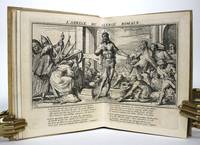
1695017087s.l.: s.n. 1695. 1st Edition. Hardcover. Near Fine/No Jacket. de Hooghe Romeyn; Dusart Cornelius. Small 4to 5.5" x 8". N.d. ca. 1695. S.l. likely printed in Amsterdam Dutch imprint reads "You will find them nowhere but they are sold everywhere in Holland by book and print sellers." Complete in two parts bound in one volume. Tweede Deel title page present lacking in many volumes. Parallel Dutch and French in Part 1 French quatrains and Dutch index in Part 2. Contemporary vellum over boards hand-lettered title to upper spine with spelling error. 4 19 1 104 pp. 25 numbered plates; 7 1 pp. 25 numbered plates. Features Romeyn de Hooghe's two-page frontispiece "L'Abrege du Clerge Romain" depicting Roman clergy torturing Jesus and collecting his blood which has turned to coins while his poor and infirm subjects look on. Contains a total of 50 mezzotint medallion caricature portraits attributed to Cornelius Dusart 1660-1704 by Landwehr. Binding tight but slightly tilted. A few stains to vellum. Light foxing else very clean and well-preserved. Comital bookplate with shelf number to front pastedown likely Belgian or German. Owner inscription of Hecht with their Latin inscription further pencil notations. Inscription of Cottet Oct 66. A rare desirable complete first edition of one of the most famous and remarkable examples of Dutch graphic caricature. The content is a scathing anti-Catholic and anti-monastic satire portraying monks and nuns as brutalized cruel malicious drunken lecherous avaricious and murderous. It was compiled and published by Huguenots during the diaspora and in reaction to the revocation of the Edict of Nantes by Louis XIV in 1685. With the mocking false privilege of Pope Innocent XI d. 1689. Brunet IV 1235; Cohen-de-Ricci 866; Landwehr Romeyn de Hooghe 70; Hollstein. Scarce. s.n. hardcover
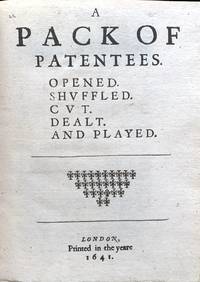
164117940London: n.p. 1641. FIRST EDITION. Type ornament device on title and woodcut headpiece. Polished calf signed “F. Bedford triple gilt fillet round sides spine gilt a.e.g. From the library of Lord Fairfax of Cameron with his armorial bookplate and the Huth bookplate lot 5630 Sotheby’s sale of July 17 1917. First edition of the very rare satire on the granting of monopolies. The anonymous author piles on the criticism of monopolies and patents granted on goods such as coal soap starch leather wine salt tobacco and butter. By the reign of James I patents had become so numerous and unfairly granted that they were considered oppressive and unjust to certain classes of people especially tradesmen and manufacturers. Except for “novel inventions†the King was finally forced to revoke all existing monopolies and declare that henceforth patents were only to be used for “projects of new invention.†This “Statute of monopolies†enacted in 1624 became the foundation for all later developments in patent law in England and elsewhere. It was a fundamental landmark in the transition of Britain’s economy from the feudal to the capitalist.<br /> <br /> Unfortunately James’s successor Charles I continued to abuse the patent system and it was only during the Restoration that the abuse was finally curtailed. The present work written during the reign of Charles I bitterly describes the injustices within certain trades and industries.<br /> <br /> Wing P156; ESTC locates 4 copies in North America Harvard Huntington NYPL McGill. n.p. unknown
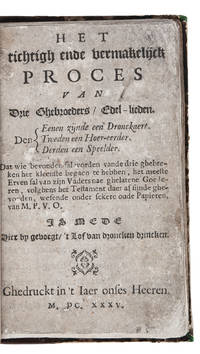
16351616Amsterdam 1635. Small 8vo 14.5 x 9 cm. Jacob Aertsz. Colom Half calf ca. 1830s with the binder's stamp on an endleaf F. DUQUESNE À GAND chemical marbled sides 2 black spine labels marbled endpapers. With 2 decorative initial letters castings made from woodcuts and a decoration made from cast fleurons on the title-page. The main text is set in roman type with long passages in italic and textura. 136 1 1 blank; 30 pp. Second known copy of the third edition 1635 of a rare satirical Dutch adaptation first and second editions 1634 of a moralistic story in Latin by Filippo Beroaldo 1453-1505 possibly intended in this adaptation to satirize the Princes of Orange. The quotations from classical sources are given in Latin each followed by a Dutch verse translation that takes some liberties with the text. Pieter Nootmans active 1627-1635 contributed a verse about the book printed on the back of the title-page. Following the main text is a drinking song by H. Rulant active 1632-1634 with its own part-title which had been published separately in 1632. We have located only one other copy of the present edition in the library of Tresoar in Leeuwarden.The British Library database of bindings includes one binding by this Ghent binder. The title-page is worn and dirty with a small abrasion obliterating the letter S in "Stichtigh" and the upper outside corner of the last leaf has been restored with the loss of a few words of the text of the added drinking song. The binding is good with some cracks in the hinges and minor damage along the edges.l KVK & WorldCat 1 copy; cf. Kruyskamp Jan Mommaert en het "Stichtelyck Proces" in: Het Boek XXX pp. 306-312 1640 ed. unknown
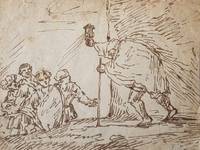
16502105Dutch mid-17th century drawing possibly by Rembrandt pupil Willem Drost. Depicted is Diogenes in robes with his lantern in his left hand and a staff in his right and a group of four figures. Diogenes the Cynic 4th cent. BC renounced material possessions and lived in poverty. He would go out with a lighted lantern in broad daylight to look for an honest man instead he would only find that everyone around him was morally corrupted. He would scare passersby with his lantern causing them to lose their mask and reveal their true intentions.In the present drawing the group of four is clearly scared by the lantern of Diogenes who seems to be towering over them. In fact the artist has placed Diogenes on a higher plane than the passersby an invention that effectively enhances the morality of the scene. This is not found in other contemporary depictions of the same story by artists like Rubens Sandrart Castiglione and Jordaens.The artistdisplays a masterful understanding and application of chiaroscuro. Not only does he use it for the composition he also applies it to benefit the narrative. Light is literally and figuratively at the center of the scene. The artist from the "Rembrandt school" who made most use of stark chiaroscuro in his drawings was Willem Drost 1633-1659. He became a student of Rembrandt around 1650 which corresponds with the dating of the watermark. The style of drawing is also close to drawings attributed to Drost. The facial type of Diogenes in particular the pointy nose corresponds with that found in each of Drost's drawings in the Rijksmuseum. Also the hatchingsmatch those in other works by Drost who made much use of individual lines instead of a continuous zig-zagging stroke and penstrokes of varying thickness to create depth in his compositions Bonny van Sighem 2000.<i>Condition: Number 3 in pencil at the bottom previous attribution to Ferdinand Bol written in pencil on the back. Several small brown spots and a couple minor defects including one on the face of the central figure in the group top edge slightly frayed and creaded. Old repair with tape on the back at the top.Literature: B. van Sighem 'attributed to Willem Drost David Prevents Abishai from Killing Saul Amsterdam c. 1650 - c. 1655' in J. Turner ed. Drawings by Rembrandt and his School in the Rijksmuseum online coll. cat. Amsterdam 2000 Bonny van Sighem 2000; for the watermark cf. Churchill fig. 305; Heawood 305 & 307.</i>
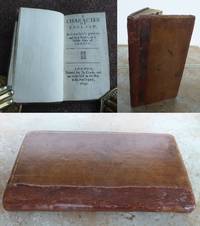
165952785<p>A CHARACTER OF ENGLAND. As it was lately presented in a letter to a noble man of France. SECOND EDITION 1659. The Second edition is one of three printed in the same year. The editions are easily recognised the title page in the first edition has present-ed and a small "s" after London and a different collation the second edition has present-ted and a comma after London the third edition has it printed on title page. 12mo small thin book approximately 120 x 60 mm 5 x 2½ inches pages: 6 1-66 collation A-C12 6 leaves in section "B" have paper fault to lower margins with slight loss of paper no loss to text see attached image and all leaves in this section have pale age-browning ESTC R213652. A PERFECT DESCRIPTION of the PEOPLE and COUNTRY of SCOTLAND London printed for J.S. 1659. Anonymous James Howell or Sir Anthony Weldon see Library Hub Discover. Pages: 2 1-22 last page blank pale age-browning throughout including title page ESTC R204012. Bound together in polished calf covers with old amateur repair to spine marbled endpapers engraved bookplate James Brindley Esq M.A.F. S.A to first pastedown. Spine rubbed corners worn at tips first inner paper hinge cracked a good tight copy. The Noble Man of France finds London to be a city with narrow streets and without fountains or running water. He admires St. Paul's and the Banqueting-house at Whitehall but is disgusted at the meanness of their surroundings. he then returns to complaints about the inconveniences of London and of the 'cloud of sea-coal'. . He has much to say of the national practice of drinking in Ale-houses and of the vile manners of the ladies and being Gaudy. He dislikes English social manners at dances at dinners in Hyde-park and in the Spring Garden. He is very difficult to please." - see full article in Keynes page 61. See Geoffrey Keynes John Evelyn A Study in Bibliophily with a Bibliography of his Writings page 60-67 No. 15 " A True first edition of A Character of England containing 42 leaves and 71 numbered pages is an exceedingly rare book. It was soon reset and reprinted on 36 leaves with 66 numbered pages as our copy listed and this is also very uncommon"; Christies The Evelyn Library Part iv page 87 No.1682 listing a third edition; Sotheby's The Collection of Robert S Pirie Volume I page 217 No. 354 listing the second edition; Bloomsbury Auctions The Cetus Library page 40 lot No.118 this is the same copy as the Pirie copy. MORE IMAGES ATTACHED TO THIS LISTING ALL ZOOMABLE FURTHER IMAGES ON REQUEST. POSTAGE AT COST.</p> London, printed for Jo. Crooke, and are to be sold at the Ship in St. Paul's-yard, 1659. hardcover
1695EBS100342Nuremberg: Johann Zieger 1695. 1st Edition. Hardcover. Good/No Jacket. 17TH CENTURY TREATISE ON METALLURGY AND CHEMISTRY. Anonymous. "Treatise on the assaying of metallic ores. It gives an account of the reagents apparatus furnaces precautions lists of technical terms and methods for analyzing ores in the dry way." Ferguson I 487. - "The manner in which this sampling was carried out and the progress it had already made in the 17th century is best shown by a contemporary assay book which appeared without any indication of the author under the title. The anonymously published work is dedicated to Franz Carl Przehorschowsky Baron of Ovasegowiz in Zbraslawiz and thus suggests a Bohemian practitioner as the author. Independent assay book which the author has compiled "from his own long-term and proven experience". In addition to a general introduction to the art of assaying the necessary equipment individual metals as well as glass and the saltpeter boiling process are presented. The appendix explains the most important chemical terms and sayings. The pretty frontispiece shows a well-stocked chemical laboratory in which chemists and assistants are at work. DETAILS AND CONDITION: Engraved frontis showing assayers laboratory. 12mo 40 523 pp cont. rev. leather very worn and rubbed front cover nearly detached a10 torn repaired w/slight loss of text. Overall in good condition. RARITY: Extremely Rare. USTC lists ten library copies all in Germany. RBH records four copies sold at auction in the last century. PROVENANCE: From the Arthur C. Greenberg History of Chemistry Collection. REFERENCES: Ferchl p. 425. VD17 3:606584F. Darmstädter Probierbüchlein 102. Nuremberg: Johann Zieger hardcover
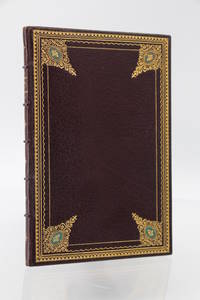
163289048Paris: Mathieu Colombel 1632. Fine. ""The more you stir the mire the worse it stinks"" Mathieu Colombel Paris 1632 11.4 x 16.7 cm Relié First edition only one other copy recorded BnF. Full dark purple morocco binding spine with five raised bands with gilt floral motifs gilt date at foot spine slightly faded covers numerously framed in gilt gilt-tooled corners each adorned with a blue onlaid morocco medallion stamped with a central gilt fleuron marbled endpapers and pastedowns pastedown bookplate of Ernest Stroehlin inner gilt dentelle spine-ends ruled in gilt very light rubbing to corners all edges gilt. A tiny restored lack of paper to the upper part of the title page not affecting the text. Very rare anti-Protestant satire in the form of a dialogue between the renowned Protestant minister Mestrezat and the warden of the Charenton temple where Mestrezat officiated. Undoubtedly one of the most theatrical expressions of the Catholic-Protestant controversy which had then traded weapons of steel for those of paper Pierre de Beloy: ""The time of the Edict of Nantes was marked by interconfessional controversy both oral and written with the aim of defeating the opponent silencing him or ideally converting him leading him from error to truth."" Marianne Carbonnier-Burkard. Techener described this work as a ""witty and spiritual critique"" adding that it is a ""very rare piece unknown to the authors of La France protestante"" Librairie Techener 1888 no. 3903. The Charenton temple where Mestrezat officiated was the place of worship for Parisian Protestants in the 17th century at a time when the practice of the Reformed faith was banned in major cities under the provisions of the Edict of Nantes. The warden of the Charenton temple mockingly referred to in this pamphlet as a mere lamplighter has even been identified as the celebrated Pierre du Moulin the first pastor of the temple who had gained the affectation in 1599 of the land to the Reformed Church of Charenton where a temple was erected Tombeau de la mélancolie p. 737. The anonymous author ridicules both protagonistsJean Mestrezat is portrayed complaining to the warden about having been attacked by ""the wicked little Abbé de Clausone""the fiery polemicist Gabriel Martin Abbé de Clausone had indeed written scathing pamphlets against him. Could this work be by Clausone himself rejoicing in his own writings Regardless retorts abound regarding the heresy of the Reformed faith a ""church order in which a lamplighter the warden holds one of the highest ranks""the same lamplighter who exclaims in these lines: ""I am more learned than all the Councils for I am able to censure them."" Outstanding copy with prestigious provenance beautifully bound in full morocco of this work of which only one other copy is recorded in in institutions. Provenance: Ernest Stroehlin 18441907 Doctor of Theology and Professor of Religious History at the University of Genevawith his engraved bookplate by Champel bearing the motto ""Mente Libera"" and his monogram ""GES"" Gaspard-Ernest Stroehlin on front pastedown. Repertoire of Controversial Works between Catholics and Protestants in France 15981685 no. 2957. Mathieu Colombel hardcover
164919048Paris: Claude Morlot 1649. FIRST EDITION. Crude woodcut on the title of two hands one holding a globe the other a compass. Recently sewn into old wrappers. Old marginal notations. Fresh. First edition a curiously accurate pamphlet of astronomical predictions. By tracking the movements of 48 constellations reconciled with the ages of the earth’s quadrants the anonymous author predicted the French Revolution the expansion of the Turkish empire the Gold Rush and the rise of the “Two Americas†as a global power. He also warns of a comet “with the head of an elephant and the tail of a dragon†destroying Jerusalem as punishment for wars and idolatry.<br /> <br /> This title has been overlooked by the standard bibliographies of the Americas.<br /> <br /> OCLC locates 4 copies in the U.S. BYU Kansas Harvard Newberry.<br /> <br /> Moreau I: 136 no. 430; Dorbon 157. Claude Morlot unknown
168619573Liege but Antwerp: Louis Montfort 1686. FIRST AND ONLY EDITION. Eighteenth-century marbled boards later reinforced spine; old library shelf labels on the spine and pastedown. In good condition. Only edition an ethics guide for angry people. The text begins by describing anger and listing its causes then expounds on its effects for the angry person and society in general. For example one who is angry distances himself from God is prone to foolish and irrational behavior and is unable to love others. The anonymous author then offers advice for ridding oneself of anger: recognize your anger as a burden read the Bible curse the Devil etc. The book concludes with a list of prayers to God and the Saints for controlling and eliminating anger. <br /> <br /> OCLC records no copies outside Europe; STC Netherlands 402258312; not in Barbier. Louis Montfort unknown
16621381629London: s.n. 1662. First Edition. Hardcover. Small Quarto 2 pp. 5 - 134 2. In Good condition. Later three-quarter calf and marbled paper boards with significant wear to leather on spine lacking spine label. Boards are detached. Moderate wear to leather on boards light wear to edges and significant wear and chipping to leather along spine. Text block has moderate plus age toning to speckled edges significant age toning to front and back free end pages along edges moderate age toning to pages throughout interiorly and occasional ink marginalia in a seventeenth century hand. The bottom inch of page 131/132 has been torn away impacting the last four lines of text on both pages. An eight-line ink inscription appearing to be in an 18th century hand appear on the errata page "From the Printer to the Reader." listing errors found in the text. Text complete despite pagination. <br> <br> Shelved in Room G. EH Consignment.<br> <br> References: ESTC R21850; Sabin 98500. Henry Vane 1613-1662 emigrated from England to New England in 1635. A member of the most radical wing of the Puritans he was elected governor of Massachusetts in 1636 but returned to join the Long Parliament in 1637. Vane's stay in Massachusetts was tempestuous and he returned to England in 1637 to become a member of the Long Parliament though his interest in New England continued. After the Restoration he was imprisoned for two years convicted of treason and executed. The present text authored by a partisan in favor of Vane includes the speech Vane intended to give from the scaffold but was barred by the court. The speech argues for parliamentary sovereignty and other radical political ideas that proved influential among American colonists. 1381629. Special Collections. [s.n.] hardcover
1700BTETM0002552Germany: Augusta J. Kopmayer 1700. Hardcover. Good/No Jacket. Imperial octavo 8vo 8 14 × 11 12 in 210 × 292 mm . Various. Please email for Photographs or further information. Good - Half parchment binding old editorial cardboard boards hand-colored signs of wear. Title on the frontispiece engraved in black. Woodcut initials. Numerous plates outside the text. Text written in two columns in Gothic character. Good state of preservation of the work which is not complete. Pp. 118 Published anonymously - Very rare treatise on the events of the time. Beautiful tables with views of cities and buildings. Collation: pp. 118 Please see Photos as part of condition report. 1700 THEATRUM MUNDI. ODER DER WELT SCHAU-PLATZ Vorstellend Verschiedene sonderbahre Begebenheiten Heiliger berühmter Leute wie auch vornehmer Gebürgen Meeren Flüssen Insulen Städten usw. By Anonymous Illustrated By: Various Illustrator Bio: Synopsis: Theatrum Mundi or the Great Theatre of the World is a metaphorical concept developed throughout Western literature and thought evident in theories of the world such as Plato's Allegory of the Cave and a popular idea in the Baroque period among some writers. This metaphysical explanation of the world portrays the world as a theatre evident in Shakespeare's dictum that "all the world's a stage" in which people are characters and their actions form a drama with God as the author specifically for some Christian thinkers. Format: Hardcover Imperial octavo 8vo 8 14 × 11 12 in 210 × 292 mm Note: Binding/size selection follows standard bibliographic conventions and is approximate; exact measurements may vary. Language: German Published By: Augusta J. Kopmayer Germany Condition Report: Dust Jacket: No Jacket Dust Jacket Condition: No Jacket Good - Half parchment binding old editorial cardboard boards hand-colored signs of wear. Title on the frontispiece engraved in black. Woodcut initials. Numerous plates outside the text. Text written in two columns in Gothic character. Good state of preservation of the work which is not complete. Pp. 118 Published anonymously - Very rare treatise on the events of the time. Beautiful tables with views of cities and buildings. Collation: pp. 118 Please see Photos as part of condition report. SKU: BTETM0002552 Shipping Info: Approximate Package Dimensions H: 12.5 L: 30 W: 25 Units: cm W: 2Kg Tracked Shipping Insurance Coverage as per Customer Request Augusta, J. Kopmayer hardcover
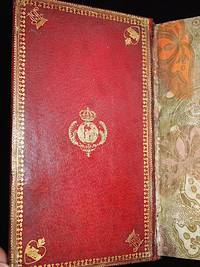
169048360à Paris: Chez Daniel Horthemels 1690. Fine. Chez Daniel Horthemels à Paris 1690 10 x 17 cm relié First edition. A ruled copy. French translation of Latin text on same page. This copy bears unidentified initials. Contemporary lined red morocco spine in compartments with two tools crowned initials BD and a third letter most likely a T' and two hands shaking hands inside a heart the arms of the town of Sées in Normandy; these tools repeated on the corners of the covers with a triple fillet frame. The morocco lining also has these tools in the corners with a personalized central tool consisting of a crowned medallion with an angel facing a kneeling figure preparing to receive the Holy Spirit. Gilt edges. Slightly rubbed along joints. A fine copy in the rarest of conditions. Chez Daniel Horthemels unknown
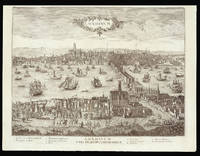
168712426Italy c1687-1730. Image: 395 by 510mm 15.5 by 20 inches. Sheet: 430 by 555mm 17 by 21.75 inches. Copper engraving. A Latin version of Pierre Aveline's view of London. Although the title cartouche has been changed the engraver has not changed the tower of St Paul's Cathedral to its post-Fire state. Although it is intended to represent contemporary eighteenth century London it still shows the Elizabethan theatres in Bankside. Scouloudi records this as a variant of the view published by Antoine Aveline 1691-1743 in the early eighteenth century but she does not record the copy published by his father Pierre Aveline. The present example could therefore be a variant on either the father's or the son's. Scouloudi pp.59-60. unknown
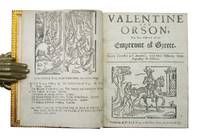
170069536London: Printed by A.M. for E. Tracy at the Three Bibles on London-Bridge 1700. RIVIÈRE & SON. . Valentine and Orson. The Two Sons of the Emperour of Greece. Newly Corrected and Amended; With New Pictures Lively Expressing the History. London: Printed by A.M. for E. Tracy at the Three Bibles on London-Bridge 1700.<br> <br> Full Description:<br> <br> ANONYMOUS. RIVIÈRE & SON binder. Valentine and Orson. The Two Sons of the Emperour of Greece. Newly Corrected and Amended; With New Pictures Lively Expressing the History. London: Printed by A.M. for E. Tracy at the Three Bibles on London-Bridge n.d.c.a. 1700.<br> <br> Early English translation of the French prose romance "Valentin et Orson" the original of which was written between 1475-1489. Small quarto 7 1/8 x 5 9/16 inches; 181 x 141 mm. 1-181 3 table pp. Date is from ESTC. With an initial advertisement leaf and three final contents pages. With an advertisement at foot of Z4. In this edition the text is set in roman letter another edition has the text set in black letter. With a half-page woodcut on title-page a half-page woodcut on advertisement leaf/frontispiece and fourteen additional woodcuts in the text.<br> <br> Bound by Rivière & Son in full red morocco. Spine ruled in blind and lettered in gilt. Gilt dentelles. Board edges doubled ruled in gilt. All edges gilt. Front outer hinge repaired. Endpapers browned around the edges. Neat paper repair to preliminary advertisement leaf with a few letters supplied. Neat paper repair to lower corner of G4 affecting a few letters supplied in facsimile. Two tiny neat repairs in the text on I3 just touching a few letters. paper repair in the lower margin of Y4 touching a few letters. Half-inch closed tear to lower margin of H4 just touching the catchword on the verso. Three previous owner's bookplates to front pastedown including Justin G. Schiller's custom bookplate designed by Maurice Sendak on front pastedown. Overall a very good copy in a handsome binding<br> <br> "'Valentine and Orson' is a medieval French romance that became a popular English chapbook tale. Middle Dutch Low German German and Old Swedish versions suggest that the original verse version is an early-14th-century French text called 'Valentine and Nameless.' It first appeared in French prose with the author listed as Jac. Maillet in 1489 and was translated into English around 1502 by Henry Watson who added many plot details including a helpful dwarf magician and a dragon. Versions vary considerably in content as well as length: from Purfoot on it was stripped of sexual misdemeanors and Catholicism. The tale also appeared in verse and play forms which helped extend its popularity into the 19th century" Elaine Ostry in The Oxford Encyclopedia of Children's Literature.<br> <br> ESTC R34690<br> <br> HBS 69536.<br> <br> $2000. Printed by A.M. for E. Tracy at the Three Bibles, on London-Bridge unknown
1674002378London: Printed by J. C. for Thomas Basset at the George in Fleet Street near Cliffords Inne 1674. First Edition. Very good. First edition; 6 3/4 x 4; pp. 8 1-250; 3/4 polished calf and marbled boards; rebacked; spine in 5 panels with raised bands and gilt decorations; engraved printer's device to title page verso; engraved vignette at beginning of first chapter; thin rubbed line along hinge of title page obscuring the first letter of the title; period brown-ink smudge and a small puncture to upper corner of title page; edges of first few leaves a bit brittle with several small nicks; two bookplates to endpapers - the first that of Colonel Robert Coleman Hall Brock 1861 - 1906 - prominent lawyer financier and scientist; the second that of Thomas Mitchell - possibly Scottish Lieutenant Colonel Sir Thomas Livingstone Mitchell 1792 - 1855 - surveyor and explorer of Southeastern Australia; a third period signature to bottom of last page; overall in very good condition. Called one of the earliest British scholarly histories of Russia written the book's authorship had been attributed to several figures including John Merrick Chief Agent of the English Muskovy Company. In fact the work was written by Sir Roger Manley 1626 - 1688 - soldier translator and author. Despite writing about the Time of Troubles without allegedly ever travelling to Russia Manley still produced a secondary source of great historiographical interest. Loewenson Leo. Sir Roger Manley's History of Muscovy: The Russian Impostor 1674. The Slavonic and East European Review vol. 31 no. 76 1952 pp. 232240. ESTC R22560 Wing M75 Printed by J. C. for Thomas Basset, at the George in Fleet Street, near Cliffords Inne hardcover
168852795<p>London printed and are to be sold by Randal Taylor near Stationers Hall 1688. 1688 Pamphlet: I. Of the longitude. II. The tricks of astrological quacks. III. Of the depth of the sea. IV. Of tobacco. V. Of Europes being too full of people. VI. The various opinions concerning the time of keeping the Sabbath. Small 4to approximately 190 x 135 mm 7½ x 5¼ inches pages: LACKING initial imprimatur leaf 6 1-24 bound in marbled wrappers bookplate of Fox Pointe Collection on first pastedown. Tips of lower corners chipped 1 lower margin slightly chipped not affecting text small old ink spots to 1 page all text legible a few tiny red spots to margin of last page a few margins lightly dusty otherwise a very good copy. In the fifth essay the author urges emigration to America "What Brave Spacious and Fertile Countries has His Majesty in America Not one beggar to be found in all Virginia Maryland New-York New-England nor any of the Neighbouring Plantations". See: A Catalogue of Printed Books in the Wellcome Medical Library Volume 2 page 420 which only has 3 leaves at front instead of 4 probably missing the imprimatur leaf as this copy; Wing Short-Title Catalogue Volume 1 page 412 No. 7678; ESTC R24903. MORE IMAGES ATTACHED TO THIS LISTING ALL ZOOMABLE FURTHER IMAGES ON REQUEST. POSTAGE AT COST.</p> London, printed and are to be sold by Randal Taylor, near Stationers Hall, 1688.
165218460<p>Fair HC. Text in French and Latin. Contemporary full red-brown morocco leather over boards; elaborate gilt-stamped pointille design incorporating multiple frames floral patterns and arabesques on both covers and spine see photos; raised bands on spine; 2 brass clasps at cover fore edges lacking; all edges gilt; swirled comb pattern end papers; all text and plates are copper-plate engravings - verso with scenes of celebration of the mass recto with prayers in Latin and French; 96 engraved plates by Jean Collin Guillaume de Gheyn I. Durant perhaps others. Title page 2 blank pages dedication to Marquis de Chasteu-neuf verso portrait advice to reader verso 2 leaves lacking verso plate nos. 3 - 38 recto plate nos. 2 - 38 Jesus portrait litany Mary portrait litany 19 plates with psalms and scenes from life of David Extraict du Privilege du Roy Sep 20 1652 2 pp in fine hand writing humanist miniscule titled 'Sequentia' and 2 pp titled 'Hymnus'. Covers and spine are bright and clean; rubbing wear at cover fore corners boards just exposed; rubbing wear at top band on spine; slight rubbing at spine ends; scrape on rear cover with ½ inch chip of leather missing; fore edge clasps missing; text block remains firmly bound but last 5 gatherings are just starting; clean interior; 1 interior leaf lacking fore edge - not affecting plates; great clarity in engravings suggests early print run. In modern linen custom archival box with title. 175 x 120 mm.</p> Paris: Chez F[rancois] Mazot hardcover
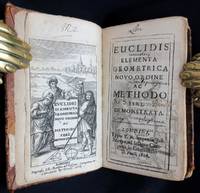
166612956London: Typis T.R. impensis Joh. Martyn. Good with no dust jacket. 1666. First Edition Thus. Leather. viii 136 pp. 12 folding plates. A-F12. A small 12mo measuring 3" x 5" entirely in old calf with new-ish spine. Frontis plate showing 3 ancient scholars along with a modern fellow demonstrating geometrical shapes. This is an odd and scarce little first edition a new method of demonstrating Euclid's elements with an anonymous editor some have identified as Nicolaus Mercator. OCLC 1050145768 identifies Mercator as the editor ESTC R23875 does not. Mercator the German mathematician c1620-1687 did indeed write an extensive introduction to publisher John Martyn's 1678 second edition of this work. According to Malet it is "a simplified reorganized presentation of most of his results the reorganization also involves the axioms and common notions mostly aimed at practically teaching how to solve problems." It covers Books 1-6 and 11-12. A pre-publication 1665 review of the book said "In this compendious and pretty Edition the Anonymous Author pretends to have rendred these Elements more expeditious; by bringing all together into one place what belongs to one and the same subject." English mathematician John Collins wrote ".I met with a Cambridge Scholar who suggested that the small anonymous Jesuit's Euclid printed by Mr. Martyn was now in good request among tutors and their scholars there that they wanted the like for arithmetic and algebra." Beeley BJHS 2019. We haven't been able to determine exactly why this work was known as the "Jesuit's Euclid" except that the Jesuits who taught Euclidean geometry as standard part of the curriculum may have appreciated this condensed no-nonsense version and adopted it for their classrooms. While it may have been popular in the mid-1600s it is now quite scarce with no copies currently for sale and no auction records for this first edition only 3 for the 1678 second edition and those over 50 years ago. ESTC records only 25 copies of the first edition in libraries 14 in the UK and 11 in the US. Condition is good. Original leather boards have some age but are clean and intact new spine done a while ago. Original endpapers appear to have been laid down older cloth strengthening at the gutters. The frontis has a small ink splotch on it's back the title has a ghost impression of the frontis along with at least 2 owner inscriptions one indicating that the book was in the possession of a Benedictin order at some point. The bottom of B12 has a short lack. The folding tables at the rear are out of order and table 1 is labeled table 2 but there are 12 different tables. #10 is separating at the fold. Some small normal toning throughout and signs of use but an intact copy in nice condition of this quite scarce little work. ; Engravings; 12mo 7" - 7½" tall; 136 pages . Typis T.R. impensis Joh. Martyn hardcover
1615117475Parisiis Paris : Apud Rolinum Thierry & Eustachium Foucault 1615. 365x230mm. titre gravÂŽ 3 ff. - 400 pages.- 3 ff. 1 bandeau lettrines partitions de chants liturgique livre en latin reliure plein veau marbrÂŽ de lՎpoque avec ornementations et fleur de Lys dorÂŽs dorrure passÂŽe au dos ˆ six nerfs. Plat encadrements et ornementations dorÂŽs avec au centre un ÂŽcu avec au sommet une chapeau de cardinal et une devise latine inscrite sur un ruban : Non secundun factum non selon lÕapparence. Livre provenant de D. Nicolai Goubile Decani CameracÂŽn. Plat frottÂŽ. CharniÂre craquelÂŽes. IntÂŽrieur propre. Bel exemplaire. 1996 Apud Rolinum Thierry & Eustachium Foucault unknown
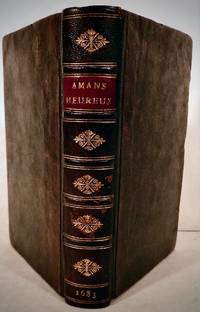
168318928Paris: Chez Claude Barbin 1683. First edition. leather_bound. Contemporary brown calf rebacked in late19th century matching morocco. Near fine. 165 pages 2 A8-L8. 18 x 12 cm. Twenty-eight etched plates including 3 part title plates each part containing eight tales of the "Happy Deceived Unfortunate Lovers"; a precursor to later romantic novels. This copy bound sequentially -- Trompez Malheureux Heureux. Includes a six page catalogue of books in English printed for William Cademan which references this title and its availability in English. Pasted to inside front cover a Parke-Bernet Gallery 1949 announcement of the Frederick M. Hopkins Sale conceivably a provenance for this title. Plates and text clean general title rehinged raised bands spine panels richly gilt red leather spine label printed in gilt. Chez Claude Barbin unknown
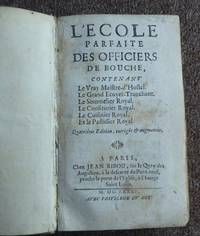
168252894<p>Paris chez Jean Ribou 1682. FOURTH EDITION 1682. Quatrieme Edition corrigee & augmentee. FRENCH TEXT. 12mo approximately 155 x 90 mm 6 x 3½ inches 42 woodcut text illustrations pages: 8 1-480 28 bound in full vellum 3 bookplates of well known cookery book collectors to first pastedown: Westbury Collection Elizabeth David and John Hodgkin. Binding soiled with wear to upper joint and foot of spine still firmly bound no loose pages old ink lettering and date to spine mostly rubbed off pale foxing to title page pale age-browning throughout minor worming to lower outer corners of pages 165-190 and 385-396 not affecting text the worming confirms this as the Westbury copy lot 332 sold by Sotheby's in 1965 3 leaves slightly ragged at lower margins not affecting text occasional tiny nick to outer margins otherwise a good copy. See: Sotheby & Co Catalogue of the Westbury Collection of Cookery Books 1965 page 67 No. 332; Gerard Oberl Les Fastes de Bacchus et de Comus page 72 No. 88; G. Vicaire Bibliographie Gastronomique column 339; William Cagle A Matter of Taste A Bibliographical Catalogue of International Books on Food and Drink page 136 No.180; Katherine Bitting Gastronomic Bibliography page 547; Sotheby & Co. Catalogue of Books on Food and Wine from The Library of Harry Schraemli 1971 page 96 No. 323. MORE IMAGES ATTACHED TO THIS LISTING ALL ZOOMABLE FURTHER IMAGES ON REQUEST. POSTAGE AT COST.</p> Paris, chez Jean Ribou, 1682. hardcover
1651302281Venice: Presso li Guerigli 1651. hardcover. very good. 290 pages all rather fine and clean blue edges. Thick tall 8vo copper engraved illustration on title page engraved decorative chapter initials and tail pieces. Full vellum lightly soiled hand-lettered title on spine. Small ex-libris on inside front cover. Venice: Presso le Guerigli 1651. First Edition. Scarce.<br/> <br/> Presso li Guerigli unknown
16647286Bruxelles: Fopens 1664. Hardcover — Tapa dura. 128x74mm. 5x3". Ratisbona Mathias Kerner pero Bruxelles Fopens 1664. En 12º 128 x 74mm. 8 336 pp. 1 lámina plegada. Encuadernación de finales del siglo dieciocho o principios del diecinueve en tafilete rojo lomera cuajada de adornos dorados cabeza y cortes también dorados. Sátira contra la Liga Católica publicada originalmente en 1593. Dice Palau: "Contribuyó al fracaso de las aspiraciones de Felipe II al trono de Francia en oposición a Enrique de Borbón. No obstante el catolicismo francés se salvó sin duda por la intervención filipista que indujo al axioma "ParÃs bien vale una Misa". Los autores son Pierre Le Roy del Catholicon Gillot Passerat Rapia Florent-Chretien y Pithon". La Liga Católica fue un movimiento polÃtico armado de carácter católico de las guerras de religión de Francia cuyo objetivo era imponer el catolicismo como única religión y eliminar el protestantismo de Francia. Contaba con el apoyo del papa Sixto V los jesuitas la reina Catalina de Médicis y el rey Felipe II de España. Este partido católico se formó con el fin de contraponerse al Edicto de Saint-Germain 1570 y al Edicto de Beaulieu 1576 considerados ambos demasiado favorables a los protestantes. MagnÃfico ejemplar muy bien encuadernado. Fopens hardcover