[ANONYMOUS].Biblio.com
253 087 résultats
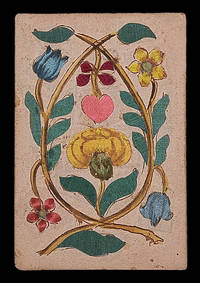
168021834Germany c1680. 93 by 65mm. 3.75 by 2.5 inches. A luxury silk and brocade deck 36 playing cards coloured silk and brocade laid between paper. The Maker There is no information on the present deck of cards about its maker but the nature of the materials used demonstrate that he or she must have been working for some extremely wealthy clients. The Cards The present cards are uniquely luxurious each one being comprised of layers of coloured silk and brocade laid between two sheets of paper. The different layers of fabric give the images added depth which reinforces the sense of meticulous craftsmanship. The janiform eagle which had been a symbol of the German emperors since the fifteenth century points towards a German origin for these cards. Indeed Hargrave records another deck of silk trappola cards from the seventeenth century which appear to have been made in Germany. It has been tentatively suggested that hearts represent France with Louis XIV as King; spades Russia with Peter the Great as Tsar - the jack bears the double headed-eagle of the Russian Empire; clubs the Holy Roman Empire with Leopold I as Emperor - he holds a shield bearing the imperial eagle; and diamonds the Ottoman Empire with - possibly - Mehmed IV as Sultan; the jack holds a falcon: falconry was one of the most popular pastimes in the Ottoman court. unknown
TM 466ELEGANT MANUSCRIPT CONTAINING TWO WORKS OF SPIRITUAL AND MORAL EDIFICATION IN FRENCH TRANSLATION. Illuminated manuscript on parchment in French France after 1482 c. 1490. Dimensions 274 x 175 mm. 70 folios written in a Gothic <i>bâtarde</i> bookhand 18 large initials parti-colored in red and/or blue inserted leaf in first quire with FULL-PAGE HERALDIC COMPOSITION IN GOLD SILVER RED BLUE AND BLACK. BINDING: Bound in modern nineteenth-century blue velvet over wooden boards pink paper pastedowns and endleaves edges gilt. TEXT: Manuscript contains two works that reflect the spirituality of fifteenth-century Carthusians and their quest for the contemplative life. The first text <i>Sept fruits de la tribulation</i> is known in only five extant manuscript and is still unedited. A free French version probably dating from the fifteenth century of either the longer <i>Latin Tractatus de tribulacione</i> or an abridged adaptation of the French <i>Livre de tribulacion</i>. The second text<i> Miroir d'or de l'ame pecheresse</i> is a work of spiritual edification which consists of seven sections: on human misery sin especially lechery penance rejection of the world the vanity of human wishes death and hell and heaven. There is neither a modern critical edition of the second text nor a complete census of the existing manuscripts; the copy here was apparently made from an incunable edition of c. 1490. This manuscript begins with a remarkable added full-page illuminated frontispiece with the coat of arms and motto of Louis de Grolée fl. late fifteenth-early sixteenth century the abbot of Bonnevaux and Saint-Pierre de Vienne. PROVENANCE: Copied in France perhaps northeastern based on script and linguistic characteristics as well as internal evidence. It belonged to Louis de Grolée fl. late fifteenth-early sixteenth century. It then belonged Charles Chardin bibliophile. It was later a part of the collection of Sir Thomas Phillipps 1792-1872 who has been described as the greatest private manuscript collector of all time. CONDITION: Gold slightly rubbed some off-setting from heraldic painted composition to opening text page slight staining in upper margin and into three lines of text ff. 68-69. Overall good condition. Full description and pictures available. TM 466
TM 466ELEGANT MANUSCRIPT CONTAINING TWO WORKS OF SPIRITUAL AND MORAL EDIFICATION IN FRENCH TRANSLATION. Illuminated manuscript on parchment in French France after 1482 c. 1490. Dimensions 274 x 175 mm. 70 folios written in a Gothic <i>bâtarde</i> bookhand 18 large initials parti-colored in red and/or blue inserted leaf in first quire with FULL-PAGE HERALDIC COMPOSITION IN GOLD SILVER RED BLUE AND BLACK. BINDING: Bound in modern nineteenth-century blue velvet over wooden boards pink paper pastedowns and endleaves edges gilt. TEXT: Manuscript contains two works that reflect the spirituality of fifteenth-century Carthusians and their quest for the contemplative life. The first text <i>Sept fruits de la tribulation</i> is known in only five extant manuscript and is still unedited. A free French version probably dating from the fifteenth century of either the longer <i>Latin Tractatus de tribulacione</i> or an abridged adaptation of the French <i>Livre de tribulacion</i>. The second text<i> Miroir d'or de l'ame pecheresse</i> is a work of spiritual edification which consists of seven sections: on human misery sin especially lechery penance rejection of the world the vanity of human wishes death and hell and heaven. There is neither a modern critical edition of the second text nor a complete census of the existing manuscripts; the copy here was apparently made from an incunable edition of c. 1490. This manuscript begins with a remarkable added full-page illuminated frontispiece with the coat of arms and motto of Louis de Grolée fl. late fifteenth-early sixteenth century the abbot of Bonnevaux and Saint-Pierre de Vienne. PROVENANCE: Copied in France perhaps northeastern based on script and linguistic characteristics as well as internal evidence. It belonged to Louis de Grolée fl. late fifteenth-early sixteenth century. It then belonged Charles Chardin bibliophile. It was later a part of the collection of Sir Thomas Phillipps 1792-1872 who has been described as the greatest private manuscript collector of all time. CONDITION: Gold slightly rubbed some off-setting from heraldic painted composition to opening text page slight staining in upper margin and into three lines of text ff. 68-69. Overall good condition. Full description and pictures available. TM 466 books
188615648Arabia 1886. 2435 by 1085mm. 95.75 by 42.75 inches. Lithograph dissected and mounted on linen in black and brown sea in sepia wash minor spotting or staining occasional wear to edges. A rare Arabic map of the Red Sea and Hejaz region. Despite the key role that the Arabian Peninsula and waters had played in Mediterranean trade for centuries European cartographers historically paid surprisingly little attention to the area. The lack of rivers and waterways made Arabia particularly difficult to chart but the exploration of the sixteenth and seventeenth centuries did see a number of new maps being produced. These however were generally littered with errors which were then compounded as later mapmakers drew on the inaccurate work of their predecessors. The eighteenth and nineteenth centuries however saw the rapid expansion of European empires giving rise to a renewed interest in foreign cultures and religions a trend that came to be known as 'Orientalism'. As a result explorers and cartographers began to venture further into the Arabian Peninsula undertaking expeditions to trace the deep-rooted incense trails and pilgrimage routes to the holy cities of Mecca and Medina. Maps began to appear showing the Hajj routes across the peninsula. After annexing Arabia during the sixteenth century the Ottoman Empire exerted various levels of influence; the emergence of Al Saud in the eighteenth century however introduced a rival power. In 1744 the founder of the dynasty Muhammad bin Saud had joined forces with the Wahhabi religious movement and their alliance soon lead to the rapid expansion of their territories and power. Although the first Saudi state was overcome by Mohammed Ali Pasha the Ottoman viceroy of Egypt in 1818 a second state continued to exist in the eastern region of Nejd. Al Saud rule over the Emirate of Nejd was contested throughout the nineteenth century by the Al Rashid dynasty. This map shows the southern portion of the Red Sea bordered on the east by the Arabian peninsula. The majority of the map is taken up by Hejaz the western region of Arabia where the two Holy Cities of Medina and Mecca are located. From 1845 Hejaz was under the direct control of the Ottomans governed by an appointed official known as the Sharif of Mecca. Ottoman influence persisted in the region until the early twentieth century when a popular revolt ousted them from power. In 1825 it was conquered by Ibn Saud who combined the kingdoms of Hejaz and Nejd in 1932 to form Saudi Arabia. Al Saud now controlled almost the entire Arabian peninsula with the exception of Yemen; Ibn Saud's attempts to claim Yemeni land sparked the war of 1934. Interestingly on the present map there is no national boundary drawn between Hejaz and Yemen probably because they were both subsumed under Ottoman control as part of the Egyptian Eyalet. The inset maps offer more detailed views of important cities and ports with two of the urban views depicting specific buildings and walls. Further inland where there were fewer significant settlements general areas are identified while towards the coast numerous towns rivers islands and harbours are labelled. At the bottom of the map the Horn of Africa is partially visible separated from Yemen by the Bab-el-Mandeb strait. We have been unable to trace any other examples of this map in institutions or at auction. unknown
1834000044<p>First volume of two 710 p. in later hard cover binding. the most rare and complete edition edited by Abdurrahman al Safti al Sharqawi. vol.1 contains 536 stories. 26.5 x 18 cm. printed in Bulak 1251 1834-1835.</p> Bulak hardcover
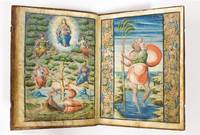
156957498s. l. Grenade Granada: S. n. 1569. Fine. S. n. s. l. Grenade Granada 1569 21.50 x 30.50 cm relié ILLUMINATED MANUSCRIPT ANONYMOUS Regla y Constitutiones de la Cofradia del Sanctissimo Sacramento de la Yglesia de San Christoval de Granada Autograph manuscript with three miniatures no publisher Granada 1569 folio 21.5 x 30.5 cm upper margin: 35 mm bottom margin: 50 mm interior margin: 30 mm exterior margin: 40 mm 31 ff. 16th-century full calf gilt Manuscript on vellum comprising 31 leaves: 50 pages of text ruled and lined and 3 full-page miniatures in colours heightened in gold. The four final leaves were numbered and partly ruled but left empty. Contemporary manuscript ex-libris on front endpaper. In Spanish throughout written in Caroline minuscule on 24 lines the text is very readable and very regular. The manuscript begins with a three-page summary covering the 24 chapters that comprise the Regla y constitutiones de la cofradia del Sanctissimo sacramento de la yglesia de San Christoval de Granada. One illuminated capital in red and blue indents and pagination in red small sketch in black ink to the inner margin. The verso of the final page of the summary has been ruled and lined in red but left blank. There follow the three full-page miniatures. The first shows a Communion scene on the recto of one leaf the second the Tree of Jesse verso of the same leaf and the third Saint Christopher bearing the baby Jesus recto of the following leaf. The verso of the miniature bears a short manuscript text explaining that these rules are those of the confraternity and brotherhood of the Holy Sacrament established in the Church of Saint Christopher of Granada on the 1st of May 1568. This is followed by the prohemio a prologue of two and a half pages in which the confraternity takes an oath; this starts with an imposing illuminated capital in red and blue. The chapters then follow on directly each with a tidy initial. The important terms are heightened in red allowing for quick navigation in the text. A long manuscript annotation to the outer margin of leaf 24. The aforementioned rules take up 23 ruled leaves ruled and lined in red. Leaf 27 bears two manuscript privileges. We have not been able to read the signature on the first dated May 1569 though quite elaborate. The second later one May 1596 is signed by Justino Antolinez de Burgos 1557-1637 at the time the Chaplain Royal charged with the inspection of ecclesiastical lodges. Long contemporary manuscript note to reverse of leaf 24. Contemporary light-brown calf spine in five compartments with gilt fillets and fleurons gilt fillet frame to boards small gilt fleurons to corner and a larger gilt fleuron to centre of covers. One clasp preserved. A few very skilful repairs and regilding practically invisible. This manuscript has three spectacular full-page miniatures in gouache heightened in gold. The first shows the Holy Communion with Christ himself establishing the Eucharist with the words This is my body this is my blood. The Apostles and Jesus with a halo blessing them are seated around a table set with bread and fish. This motif became a major theme of Christian art in the Renaissance as this miniature also shows. The second miniature shows the Tree of Jesse which symbolises the genealogy of Christ traced from Jesse Xese shown as an old man reclining. In keeping with the iconographic tradition a tree protrudes from his side the main branches of which bear some of Jesus's ancestors. Here they are: Zachary Jeremiah David an unidentified king and at the pinnacle Mary holding the Christ child within a mandorla. The third miniature presents a scene with Saint Christopher the patron of the Church in Granada to which the Confraternity of the Holy Sacrament was attached with a child on his shoulders as he was commonly represented. The iconography derives from a passage in the Golden Legend in which St Christopher helps a small b S. n. hardcover
156957498S. n. | s. l. [Grenade] 1569 | 21.50 x 30.50 cm | relié
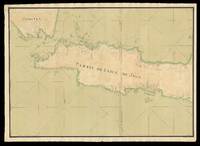
173317524Probably Paris: Dépôt des cartes et plans de la Marine c1733-1739. 530 by 1500mm. 20.75 by 59 inches overall. Manuscript chart pen and black ink and colour wash on two separate sheets of paper watermarked with Strasburg Lily within a shield initials "VDL" beneath and countermark "IV" closest to Churchill 405 dated to 1733 from the mill of Pieter van der Ley son of Gerrit Pieters van der Ley who worked De Wever - the Weaver - and De Bonsem - the Polecat - mills at Koog aan de Zaan Holland from 1674 onwards. The conquest of Jakarta by the Dutch who immediately renamed the port Batavia in 1619 gave the VOC its Asian headquarters from which it commanded a vast trading empire eventually extending from southern Africa to Japan that lasted for nearly two hundred years. By the end of the 1730s the British and French had begun to flex their seafaring muscles in the area and were publishing their own maps. This large-scale and detailed French chart of Java is clear evidence of a hostile interest that is directed at the very the heart of the Dutch empire. It is very similar to Francois Valentyn's large chart 'Nieuwe en zeer naaukeurige kaart van t Eyland Java Major of Groot Java' published in his 'Oud en Nieuw Oost-Indien vervattende een Naaukeurige en Uitvoerige Verhandelinge van Nederlands Mogentheyd in die Gewesten' 1724-1726 based on his own research correspondence and from previously unpublished material secured from the VOC officials. Some of this information must also have been available to the Chatelain family who published their 'Carte de l'Ile de Java: Partie Occidentale Partie Orientale.' 1719 which included details of inland topography not found on this manuscript chart nor on Valentyn's. The Chatelain map is avowedly based on Hadriaan Reland's work which was not published by the Dutch until Johannes van Keulen issued it as 'Insulae Iavae pars Occidentalis edente Hadriano Relando' in 1728. Interestingly this manuscript chart includes soundings that are not expressed on the Chatelains' chart implying some more recent knowledge of the coastline. However it does not reflect VOC knowledge of the southern coastline of Java dating from 1739 when Paulus Paulsz. in the sloop de Valk went on a surveying expedition there. His report and much more detailed chart which "remained the best sea chart of this area until the end of the VOC rule" Schilder page 173 survive. In 1513 Francisco Rodrigues sailed with the "Portuguese expedition from Malacca to find the unknown source of the rich trade in nutmeg mace and other spices. They sailed along the north coast of Java a trip from which Rodrigues prepared the first European map of Java's basic outline only of the north coast from direct observation. The Dutch who followed the Portuguese also ignored the interior in their mapping. In 1619 when the VOC established Batavia present-day Jakarta as a trading entrepot the south coast remained relatively unknown: it did not lie on the route to the valuable Molucca Spice Islands. The interior lands away from Batavia were ignored as long as the Javanese kingdoms remained quiescent; the VOC was intent only on ensuring a profitable return for its investors. Pursuit of these immediate economic goals restricted the exploration and associated topographic cartography of Java for nearly a century. A trivial cartographic misunderstanding reveals much about the stagnant state of mapping in Java at that time. The VOC sent Cornelius Coops by ship in 1698 to update the charts of the south coast; until this time charting was largely restricted to the northern coast where the Dutch ports and trading centres were located. Several schematic manuscript maps of the whole island appeared in Isaak de Graaf's 'Atlas Amsterdam' compiled by the VOC at the end of the seventeenth century but not published until the 1980s chiefly showing unnamed rivers and several VOC strongholds in the island's interior. At the beginning of the eighteenth century further mapping of the interior was conducted in a spasmodic and uncoordinated manner. The maps mostly by anonymous cartographers are in manuscript form and are held by the Netherlands National Archives The Hague. They were prepared internally by the VOC as administrative planning and strategic documents for circulation and use by VOC officials. VOC maps were closely guarded trade secrets; however commercial maps of the whole of Java and the neighbouring island of Madura were becoming readily available in Europe by the second decade of the eighteenth century" Simpson. This anonymous manuscript chart was probably prepared by the Dépôt de la Marine known more formally as the Dépôt des cartes et plans de la Marine the central charting institution of France. The centralization of hydrography in France began in earnest when Jean-Baptiste Colbert became First Minister of France in 1661. Under his watch the first Royal School of Hydrography began operating as did the first survey of France's coasts 1670-1689. The Dépôt itself began as the central deposit of charts for the French Navy. In 1720 the Navy consolidated its collection with those government materials covering the colonies creating a single large repository of navigation. By 1737 the Dépôt was creating its own original charts and from 1750 they participated in scientific expeditions to determine the accurate calculation of longitude. In 1773 the Dépôt received a monopoly over the composition production and distribution of navigational materials solidifying their place as the main producer of geographic knowledge in France. Dépôt-approved charts were distributed to official warehouses in port cities and sold by authorized merchants. The charts were of the highest quality as many of France's premier mapmakers worked at the Dépôt in the eighteenth century including Philippe Bauche Jacques-Nicolas Bellin Rigobert Bonne Jean Nicolas Buache and Charles-François Beautemps-Beaupré. The Dépôt continued to operate until 1886 when it became the Naval Hydrographic Service. In 1971 it changed names again this time to the Naval and Oceanographic Service SHOM. Although its name has changed its purpose is largely the same to provide high quality cartographic and scientific information to the France's Navy and merchant marine. Simpson 'Java Emerging Unfolding Cartographic Views' The National Library Magazine December 2010. Dépôt des cartes et plans de la Marine,
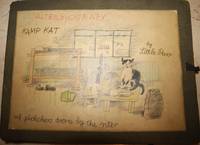
19430072801943. Hardcover. Cloth Box. Very Good. Inimitable and disarming tales that represent the pinnacle of outsider art and folk art with the naive drawings richly full of life as they speak of the daily routine at a British army camp during the Second World War from the point-of-view of a camp mascot cat who excels at mangling English in its creative attempts at phonetic spelling. Folios are oblong 41 by 30 cm each. The first folio contains "The Alterbyografy" a 56 pages long unpaginated with 54 illustrations including the folio cover 28 of which are full page 24 of which are half page. The second folio is entitled "Kamp Karacters" . This is 51 leaves with 92 illustrations including the cover 51 of which are full page 40 a third page generally with the area above entirely blank. Illustrations are rendered with colored pencil and crayon. The first manuscript is a continuous narrative of army life its humdrum rhythms and routines its various inanities its social life sports and other activities etc. while the second part is more character sketches. The second folio is even more visually driven than the autobiography. Another distinction between the two is that the autobiography is done with the leaves oblong while the character studies are applied with the leaves vertical. While one part isn't exactly a sequel to the other the two parts are truly complementary. The two folios are of a rough burlap material with a large title sheet mounted on their front cover. The folios have three flap folds to hold the loose sheets in plus ribbon ties on their right sides. hardcover
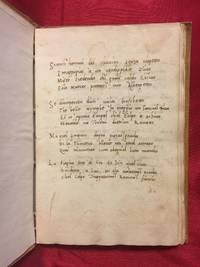
15102973Venice 1510. 8vo. in fours. Collation: A-Q4 COMPLETE. 64 ff. some signatures written in contemporary MS several erroneously neat modern foliation in pencil. Paper size: 155 x 105. Watermarks: Northern Italy ca. 1480-1520 see below. Bound in late 18th century Italian sprinkled ochre boards upper cover with title in MS. Text in Italian and with the titles of several poems in Latin. Several types of Italian humanistic literae cursivae all apparently by the same person see images below numerous corrections throughout. Fascinating Unknown Venetian Manuscript of Unpublished Sonnets and Love Letters ca. 1510.<br/><br/>An important discovery. Unknown manuscripts of unpublished Italian poetry written in Venice during the age of Aldus Manutius are rare in private ownership. The present manuscript contains 100 poetical compositions sic and merits considerable scholarly inquiry: certain sonnets and poems were extensively revised showing authorial development; the handwriting is perfectly clear in some instances modeled after contemporary Italian writing masters; and finally the codex is preserved in remarkably fresh condition and is perfectly suitable for exhibition and intensive study. <br/><br/>The manuscript consists mainly of sonnets in the style of Petrarch several capitoli and strambotti and includes many revisions variants and even cancellations to which two intriguing love letters were added. The name of the author is unknown but his identity may yet be discovered as he left a number of intriguing clues in the text the most obvious one being the family name Colonna famous in Venice and Rome and the names of several of his muses. <br/><br/>Certain sonnets exhibit handwriting reminiscent of Giovanni Antonio Tagliente ca. 1460s - ca. 1528 who worked for the Venetian Chancery and whose "Lo presente libro" Venice 1524 continues to inspire modern-day calligraphers and typographers. We may also reference the work of writing master Ludovico Vicentino degli Arrighi 1475-1527 who seems to have started his career in Venice before becoming a Papal scribe and type designer. <br/><br/>That the MS was written over a long period in some instances interpolated on formerly blank leaves is attested by the changes in handwriting and ink. To illustrate the development of the codex itself we propose an artificial division of four sections: <br/><br/>¶ Section A contains 42 sonnets written in the litera cursiva styles A and B. The neat humanistic handwriting is comparable with that used by contemporary Venetian scribes. If the text had been copied from previous drafts it is clear that the author remained unsatisfied as there are a number of substantive revisions in the text. In the upper margin of eleven sonnets were written the title of the poem - in Latin - at some point in the life of the MS. Two sonnets in this section were cancelled by the author. ¶ Section B contains 32 poems written in the litera cursiva styles C-G. These were presumably written in the same period except for some interpolated sonnets that were written slightly afterwards. ¶ Section C contains 16 poems one of which bears the date 27 Ianuarij 1510 fol. 46v. This section surely contains poems written in a different period including two sonnets fol. 49r-v that were written in the humanistic litera cursiva style A which begins the MS. ¶ Section D contains two Love Letters plus an Addenda of 10 "new" poems and capitoli hastily written. <br/><br/>That the author may have had thoughts on publishing his work is suggested by the "printer's signatures" that were written by him in ink in the lower margins of the first 16 leaves. If such a book was ever printed it has not been located; indeed not even a single poem has been traced see below for a complete Index Poematum. <br/><br/>The fact that the author never signed his work may be due to the private and very personal contents of this Canzoniere. The work was probably begun by the author as a young man and for years it served as a vehicle of consolation for unrequited love. <br/><br/>Faustina Helena Colonna Laura Arianna<br/><br/>In the first sonnet Stanch'ormai dal cacciar senza rispetto fol. 1r the author claims to have met "three beautiful nymphs" during a break from hunting. A possible connection to the Colonna family is first suggested in Sonnet II A una colonna d'alabastro fina 1v in which the poet declares his eternal lover for Faustina "ni altra Dea adorerò ch'a Faustina." The word colonna is found in other compositions throughout the Canzoniere suggesting that at least one of the author's muses was a member of the famous Colonna family. Sonnet XVIII Ardo piango sospiro et a tutt'hore 9v ends with the verse chiedendo sempre a un cor di marmo a una colonna viva "always begging a marble heart a living column" again suggesting by means of a well-crafted literary image the Colonna family. Most importantly the actual name "Helena Colonna" appears as the caption heading to Sonnet LXXXII Da una marmorina Alta colonna 48v. Lady Colonna may be referenced in the first Love Letter 53v in which the author describes her as alta colonna di mia vita "high column of my life". No longer is the Colonna surname obscured behind imagery. <br/><br/>The promise of endless love to Faustina was not kept unless the author cleverly utilized more than one name for the same woman a not-uncommon practice in this particular genre. Two other names appear herein namely Laura and Arianna. That the author may have had changes of heart might be due to the fact that he seems to have written the poems over an extended period of time see images of the handwriting development A-G and is therefore a record of failed love years in the making. The sonnets reflect perpetual desperate longing almost always to the point of death. How could it be otherwise<br/><br/>The Philosopher and His "Poetessa" Muse<br/><br/>In Sonnet LI I' solea ben la penna et l'intelletto 28v the author states quite clearly that the object of his desire was also a poet declaring that a mortal blow has pierced his side because he has lost the paper the ink and each amorous rhyme of his Lady's verse persi la carta l'inchiostro e ogni amoroso detto. The author claims that he is much better at writing about philosophy:<br/><br/>Smaritha quella strada. altro sentiero<br/>Hora mi è scorta mi governa et regge<br/>Qual va fina Avicenna e agli aphorismi<br/>Ove Signor si vostre rime egregge<br/>Non han da me risposta: a dirvi 'l vero<br/>Mi torna meglio scriver Syllogismi.<br/><br/>"The road is lost. A different path is now taking me to Avicenna the philosopher and to Aphorisms where Lady your excellent rhymes have no answer; to tell you the truth I'm better in writing Syllogisms." Thus the identity of the author a "reluctant poet" may be found among contemporary Venetian philosophers. <br/><br/>Index Poematum<br/><br/>Section A litera cursiva styles A and B:<br/><br/>I. Stanch'ormai dal cacciar senza rispetto "Stanch' hormai dal chacciar senza rispetto" fol. 1r<br/>II. A una colonna d'alabastro fina 1v<br/>III. Deponni l'archo la pharetra Amore 2r: textual corrections<br/>IV. Deh! Potess'io canggiar tecco mia sorte 2v: caption title in Latin<br/>V. Non posso più celar la fiamma ardente 3r: caption title in Latin<br/>VI. Era tutto coperto d'adamante 3v: caption title in Latin textual correction<br/>VII. Vedendo de gli fior le Vite corte 4r: caption title in Latin textual correction<br/>VIII. Vaten felice Aventurata Rosa 4v: caption title in Latin<br/>IX. L'esca gli stral et l'amorosa Rete 5r: caption title in Latin<br/>X. Quando sera quel giorno che chi m'have 5v: the entire sonnet cancelled<br/>XI. Dolce m'e 'l giogo et la pregion men grave 6r: caption title in Latin<br/>XII. La singular mia fede che vi porto 6v: entire sonnet cancelled<br/>XIII. Ardo d'Amor et ho la fiama viva 7r: caption title in Latin textual corrections<br/>XIV. Donna gentil fin hor son sta patiente 7v: caption title in Latin<br/>XV. Se mai per tempo alchun mi vedrò sciolto 8r: caption title in Latin<br/>XVI. Amor un dolce viso teso havea 8v: caption title in Latin<br/>XVII. Madonna ogni mio ben da dolci Rai 9r<br/>XVIII. Ardo piango sospiro et a tutt'hore 9v<br/>XIX. Qual vero Pregionier al sacro Tempio 10r<br/>XX. Sono doi animali un de si altera 10v<br/>XXI. Un scoglio d'una Pietra è tanto ardita 11r<br/>XXII. Amor in guisa d'huom che guerra aspetta 11v<br/>XXIII. Il mie Adversario a cui in tutte l'hore 12r<br/>XXIV. Amor nel volto mio ben più di mille 12v<br/>XXV. Sapete che ben solo me nutrisco 13r<br/>XXVI. Una che qui tra noi excider suole 13v<br/>XXVII. Si questo e ver Amor como se dice 14r<br/>XXVIII. Donna gentil mi sento 14v<br/>XXIX. Deh! Perché non vi è noto il mio dolore 15r<br/>XXX. Se gli è pur mio destin ch'amando i' rompa 15v<br/>XXXI. Sempre vidi Iustìa star accorta 16r<br/>XXXII. Come voi ho et d'enverno et d'estate 16v: textual corrections<br/>XXXIII. D'un verdeggiante Lauro un giorno Amore 17r: textual corrections<br/>XXXIV. Gli occhi leggiadri ove ch'alberga Amore 17v: final line verse rewritten in an 18th century hand<br/>XXXV. S'io fusse di sospir Et pianto privo 18r: extensively revised then completely cancelled<br/>XXXVI. Gratie che a pocche donne Amor concede 18v<br/>XXXVII. Occhi miei lassi ho ben mirare Fiso 19r: textual corrections<br/>XXXVIII. Il Pellegrin avintto dal disio 19v: textual corrections<br/>XXXIX. Il Chacciator che nel bosco la Ferra 20r<br/>XL. Smarite piaggie ov'hor piangendo torno 20v<br/>XLI. Mille fiate al di m'assale Amore 21r<br/>XLII. Ogni luocho mi spiace ov'io non trovo 21v<br/><br/>fol. 22r: S'io fusse de sospir et pianto privo: variant of Sonnet XXXV hastily written as a draft<br/>22v-23r: two pages of verse extensively revised and then apparently abandoned<br/>23v: blank<br/><br/>Section B litera cursiva styles C-G<br/><br/>XLIII. Amor Fortuna a sì'nfelice Sorte 24r<br/>Fol. 24v: blank<br/>XLIV. Lasso credendo haver pur qualche pace 25r: textual corrections<br/>XLV. Scoprir non posso l'amorosa fiama 25v<br/>XLVI. Miser vo pur scorgendo a passo: a passo 26r: textual corrections<br/>XLVII. Miser tutto ardo Et piango a tutte l'hore 26v<br/>XLVIII. Io viverei con la Phenice a prova 27r<br/>XLIX. Per la merce dil mio si longo affanno 27v<br/>L. Gli occhi beati intorno han l'esca e'l visco 28r: textual corrections<br/>LI. I' solea ben la penna et l'intelletto 28v<br/>LII. Sotto rara beltà nascosto è l'hamo 29r: textual corrections including one stanza cancelled<br/>LIII. Piango cantando 'n rime il mio lamento 29v: textual corrections<br/>LIV. Qual dolce mana qual esca qual visco 30r: introduction of "Laura"<br/>LV. Quando Madonna con dolci parole 30v<br/>LVI. In fronte meco i' porto l' ben e il male 31r: textual corrections<br/>LVII. Occhi ove ch'Amor sovente tresca 31v: textual corrections LVII and LVIII are written on the same page but in different handwriting styles<br/>LVIII. Che il tempo si consuma ogni fier cosa 31v: textual corrections<br/>LIX. Sol per farmi gustar mana in veneno 32r<br/>LX. Baso ogni giorno mille et mille volte 32v<br/>LXI. N'anti ch'entrasse un'hora me ritrovo 33r<br/>Fols. 33v-34r: blank<br/>LXII. Lauda le ver ch'ogni fidel amante 34v<br/>LXIII. Laura soave che si dolcemente 35r: reintroduction of "Laura"<br/>LXIV. Deh! Vi fusse si noto quanto ch'io ardo 35v<br/>Fol. 36r: blank<br/>LXV. Si come è vagho un vivido colore 36v: a capitolo written for "Arianna" <br/>LXVI. Maraveglia non è si ho mesto il volto 37r<br/>LXVII. Chi non vedrà quanto è mia bella 37v<br/>LXVIII. Dovran per mostrar gran maraviglia 38r<br/>LXIX. Si come è bello un vivido colore 38v: preliminary verses corrected cancelled and apparently abandoned<br/>LXX. Se mai per altra donna i' rompo fede 39r<br/>Fols. 39v-40r: blank<br/>LXXI. Et copre donna quel candido seno 40v: caption heading: "Laura S. C." <br/>LXXII. Amor da cui mai fu troppo lontano 41r<br/>LXXIII. Quella ch'un tempo la ti piacque tanto 41v-42r<br/>LXXIV. S'el primo di che mi piacesti tanto 42r-43r: ending with "Telos" in Greek<br/>Fol. 43v: blank<br/><br/>Section C:<br/><br/>LXXV. Vaga et smarita va Phylosophia 44r<br/>LXXVI. Spirto gentil in cui valor si trova 44v<br/>LXXVII. Occhi che nel mio cor fate il bel nido 45r<br/>LXXVIII. Gli occhi ove scherzar si vede amore 45v: textual corrections<br/>LXXIX. S'el vivo Sol et le doi chiare Stelle 46r: dated 27 January 1510 at Venice "M.E."<br/>LXXX. La meggia notte facea meggio giorno 46v: textual corrections <br/>LXXXI. Gratie da gli occhi uscian sante et si nove 47r: textual corrections <br/>Fols. 47v-48r: blank<br/>LXXXII. Da una marmorina Alta colonna 48v: textual corrections; caption title: "Helena Colonna" <br/>LXXXIII. Istarò sempre come scoglio al onde 49r<br/>LXXXIV. Ogni supplitio dammi ogni martoro 49v <br/>LXXXV. Questo già non pensai superba Altera 50r<br/>LXXXVI. Deh! Pensa un poco a la mia Iniqua sorte 50v <br/>LXXXVII. Da poi che per amar son gionto a morte 51r<br/>LXXXVIII. Non è cosa mortal benchè in fra sphera 51v<br/>LXXXIX. Ben è infelice chi in fra mondo ingrato 52r<br/>XC. Se dil mio amor volevi esser felice 52v: textual corrections<br/><br/>Section D Sigs. O-Q4:<br/><br/>NB: These three gatherings have a waterstain which does not appear in any of the preceding gatherings or individual leaves. <br/><br/>First Letter: Honoranda et singular mia Diva la cui imagime como richo thesoro explicit: Vale o et praesidium et dulce decus meus 53r-54v<br/>Second Letter: Suolsi communemente dire almo mio Sole explicit: Vale. 54v-55v<br/>XCI. Così come un sasso accorto et destro 55r<br/>XCII. Né illegible word d'haver più pena vale 55r<br/>XCIII. A che mostrarmi pace nel aspetto 56v<br/>XCIV. Io son contento poi che m'hai nel Iocho 57r-57v<br/>XCV. Sacro santo mio nome Alma mia stella 58r-59r: caption heading: "Capitolo" / Finis<br/>XCVI. Rotto e carcho d'amor spreciato e l'arco 59r-60v: caption heading: "Capitolo" / Finis<br/>XCVII. Un dolce laccio ha fatto amore 61r-61v: textual corrections; caption heading: "Capitolo" / "Telos" in Greek<br/>Fols. 62r-63r: blank<br/>XCVIII. Mai rosa fu si vagha nel mattino 63v: caption heading: "Strambotti"<br/>XCIX. De' Lumi da begli occhi discendea 63v: caption heading: "Strambotti"<br/>C. Doi occhi da far arder 64r: caption heading: "Sonetto"<br/>Fol. 64r: blank<br/><br/>WATERMARKS: As the book is an octavo the watermarks appear in the upper gutter margins and thus only one half appears at one time; however it has been possible to identify them especially with the aid of the countermarks "angle" and "lettre B". Chapeau: type of Briquet 3456 Venice 1499 and Briquet 3461 Udine 1521. Balance: type of Briquet 2575 Venice 1478 Briquet 2587 Verona et al. 1525. unknown books
8510Monumental manuscrit remontant probablement au XVIIIe siècle et représentant la célèbre Danse macabre de Bâle. Lensemble est constitué de 40 vignettes aquarellées en couleurs encadrées sous verre en cinq panneaux en bois, à raison de huit dessins par panneau. Ils ont été composés sur des feuillets en papier gris clair de 150 x 190 mm, collés sur un support en papier bleu turquoise de 220 x 250 mm. Les panneaux, réalisés par Werner R. Knöll, mesurent quant à eux 93,5 x 57 x 15 cm. L'ensemble est généralement en bon état, mais plusieurs feuillets présentent des déchirures ou portent des traces de restauration ancienne. Conformément aux gravures de Merian, les dessins sont distribués de la manière suivante:Panneau 1: LAvertissement du Prédicateur (Der Prediger), La Mort (Der Tod), La Mort au Pape (Der Tod zum Papst), La Mort à lEmpereur (Der Tod zum Kaiser), La Mort à LImpératrice (Der Tod zur Kaiserin), La Mort au Roi (Der Tod zum König), La Mort à la Reine (Der Tod zur Königin), La Mort au Cardinal (Der Tod zum Cardinal)Panneau 2: La Mort à lEvêque (Der Tod zum Bischoff), La Mort au Duc (Der Tod zum Herzog), La Mort à la Duchesse (Der Tod zur Herzogin), La Mort au Comte (Der Tod zum Grafen), La Mort à l'Abbé (Der Tod zum Abt), La Mort au Chevalier (Der Tod zum Ritter), La Mort au Juriste (Der Tod zum Juristen), La Mort au Conseiller (Der Tod zum Rathsherrn)Panneau 3: La Mort au Chanoine (Der Tod zum Chorheern), La Mort au Médecin (Der Tod zum Doctor), La Mort au Gentilhomme (Der Tod zum Edelmann), La Mort à la Dame (Der Tod zur Edelfrauen), La Mort au Marchand (Der Tod zum Kauffmann), La Mort à lAbbesse (Der Tod zur Äbtissin), La Mort au boiteux (Der Tod zum Krüppel), La Mort à lErmite (Der Tod zum Waldbrüder)Panneau 4: La Mort au Jeune Homme (Der Tod zum Jüngling), La Mort à l'Usurier (Der Tod zum Wucherer), La Mort à la Jeune Fille (Der Tod zur Jungfrauen), La Mort au Musicien (Der Tod zum Rirbepfeiffer), La Mort au Héraut (Der Tod zum Herold), La Mort à l'avoyer (Der Tod zum Schultheiss), La Mort au Bourreau (Der Tod zum Blutvogt), La Mort au Bouffon (Der Tod zum Narren)Panneau 5 : La Mort au Mercier (Der Tod zum Krämer), La Mort à lAveugle (Der Tod zum Blinden), La Mort au Juif (Der Tod zum Juden), La Mort au Païen (Der Tod zum Heyden), La Mort à la Païenne (Der Tod zur Heydin), La Mort au cuisinier (Der Tod zum Koch), La Mort au Paysan (Der Tod zum Bauern), Adam et Eve.
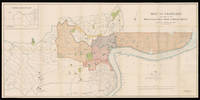
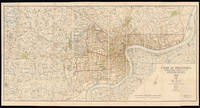
193215013Shanghai: Shanghai Municipal Council 27th October 1932. 860 by 1744mm. 33.75 by 68.75 inches. Coloured lithograph map dissected and laid on linen early ownership stamp of "John Pook & Co." in blank area folding into original cloth portfolio lettered in gilt 'General Map of Shanghai 1933' on spine. Acknowledgement is made of information obtained from the French Municipal Council the Shanghai City Government and the Whangpoo Conservancy Board. The map depicts Shanghai city in 1933 however the date printed on the bottom right corner is 27th October 1932. The round shape of the Old city is still clearly visible as in the Plan of Shanghai printed in 1928 it is labelled the "Chinese City" Similarly immediately to the north east and west is the French Concession and further to the north is the International Settlement. It is printed with a legend which includes: villages and developed property; creek; motor road; path and roads; and important buildings. Compared with the Plan of Shanghai printed in 1928 this map has much more information added most notably is that more villages and developed property are marked and identified using the relevant legend. We are only able to trace one other example of this map that in the British Library Map Collection. BL: Cartographic Items Maps X.3743. Shanghai Municipal Council, hardcover
180018412c1800. 470mm in diameter. Instruments""Planispherum Lunare A unique manuscript lunar astrolabe Ink and polychromy on paper over pine. The instrument comprises a circular base plate and three rotatable cardboard volvelles and a brass radius pointer attached to each other in the centre. A brass ring is attached to the base plate for suspending. All four paper covered discs are finely inscribed in manuscript with various scales and symbols. Content 1. The smallest volvelle bears a scale covering 12 hours on its outer ring. It also shows the ecliptical motion of the Sun the Moon's orbit the line of nodes and the arguments of latitude in other words the distances from the nodes. 2. On the second volvelle a scale covers the years from 1801 to 1825. each year is subdivided in twelve months with the abbreviated name written for each month. 3. The following volvelle carries a series of scales showing a monthly calendar a zodiac calendar with skilfully drawn pictures and the symbols of the signs. Below the zodiac is a scale for the declination of the sun throughout the year set in four sequences of three. 4. On the outside rim of the volvelle is another calendar scale in which the months are unevenly distributed. This scale presumably was to be used in conjunction with the outer scale on the circular base plate. In addition the volvelle holds two brass studs that most probably helped the user turn the disc to the desired position. This latter scale gives the days subdivided in hours. The days are numbered I to XXXI with the number I coinciding with XXVII and 8 hours the sidereal period of the Moon which results in a double numbering from XXVIII to XXXI. Below this scale for days there is a series of dates all confined to the period 1801 to 1825 presumably for solar eclipses. The brass rule or pointer holds a horizontal scale from 5 to 0 LA-southern declination and from 0 to 5 LB-northern declination indicating the latitude of the moon with respect to the ecliptic. The closer to 0 at new moon or full moon the likelier an eclipse is to occur. The rule is engraved with """"Locus Lunae"""". The circular scales serve to set the moon's position and node relative to the sun from which the user can then infer the lunar phase and whether an eclipse will occur at new moon or full moon. Manuscript instruments of this type are rare especially in such good condition as no other exact copy is recorded to date. Similar instruments were produced at the end of the sixteenth century mostly in brass. Sir Robert Dudley 1573-1649 see item 17 had a lunar calculator made by Charles Whitwell c. 1568-1611 a brass disc of 72 cm diameter overall which was the most complex instrument made during the sixteenth century. Inscribed 'Sir Robert Dudley was the inventor of this instrument' its purpose was to calculate the place of the moon over a period of thirty years. It is now in the Museo di Storia della Scienza in Florence Italy. Another similar paper device was printed with detailed instructions in 1786 in Vlissingen Flushing in the Netherlands advertised as a """"Starkundige Maan-Wyzer en Almanach"""" Astronomical Moon Pointer and Almanac by Henricus Schortinghuis. Oxford Dictionary of National Biography; Webster Roderick and Marjorie 'Western Astrolabes' Adler Planetarium & Astronomy Museum 1998; Museo di Storia della Scienza Florence Italy unknown
2024Gyan-9788121258883Gyan Publishing House 2024. In 384 Bindings. Hardcover. New. 22.59 x 28.94 x 1524.27. English Gyan Publishing House hardcover
2024Gyan-9788121258883Gyan Publishing House 2024. In 384 Bindings. Hardcover. New. 22.59 x 28.94 x 1524.27. English Gyan Publishing House hardcover
191315014Shanghai: North-China Daily News & Herald Limited 1st June 1913. 735 by 1510mm. 29 by 59.5 inches. A large English map of Shanghai dissected in 40 4 by 10 sections and mounted on linen folding map. Oriented with north towards the upper right. Top left includes an inset of "plan shewing the rubicon road system". Signed by Engineer and Surveyor. The North-China Daily News was an English-language newspaper in Shanghai China the most influential foreign newspaper of its time. The paper was founded as the weekly North-China Herald and was first published on 3 August 1850. Its founder British auctioneer Henry Shearman died in 1856. North-China Daily News & Herald Limited, unknown
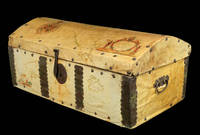
16902196Spain c1690. 320 by 740mm. 12.5 by 29.25 inches. Wooden chest clad in vellum manuscript maps with wrought iron handles rivets lock and clasp. A very unusual piece of cartographic history. It was common for seafarers to have sturdy wooden chests for storage whilst on a voyage but the owner of this chest chose to have it covered it with manuscript maps drawn on vellum possibly by their own hand with the decorative ironwork fitted on top. The lid is covered with a map of North and Central America with the Darien Isthmus labelled to the south and decorated with an elaborate compass rose and title cartouche supported by figures of Native Americans. The map on the front is decorated with a title cartouche showing a sea god. The sides are covered with maps of the East and West Indies decorated with ships. It is remarkable that the maps have survived given the treatment they would have encountered at sea. hardcover
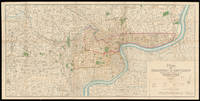
192815011London: Standford's Geog.l Establishment London 21st April 1928. 880 by 1660mm. 34.75 by 65.25 inches. A large coloured lithographed map showing the plan of Shanghai made in 1928. Signed by Commissioner of public works 44 4 by 11 sheets mounted on linen. The map depicts Shanghai city in 1928 with the French Settlements and Shanghai International Settlements hand-coloured in outline in brown and pink. Two lines noted below the title: 1. The Pootung shore is taken from surveys by the Whangpoo Conservancy Board. 2. The French settlement is taken from surveys by the French Municipal Council. The famous Whangpoo Huangpu river in Shanghai is prominently shown from the midpoint of the bottom edge sinuating upwards to the top right corner which divides the settlements to the left and Pootung Pudong to the right. Between the bank of the river and the French settlement are the 'Chinese city' and a district labeled 'Nan Tao' Nan Dao. The "Chinese city" is now called the "Old City" the traditional urban core of Shanghai. Its boundary was formerly defined by a defensive wall. The Old City was the county seat for the old county of Shanghai with the advent of foreign concessions in Shanghai it became just one part of Shanghai's urban core but continued for decades to be the seat of the Chinese authority in Shanghai. It was essentially coterminous with the old Nanshi District - Nan Dao which is now part of Huangpu District. In 1927 in a bid to establish a tangible Chinese authority in Shanghai the Republic of China government established the Special Municipality of Shanghai. The municipal government was moved out of the Old City to near Xujiahui. In 1928 Shanghai City the Old City was reduced to district status under the Special Municipality. In 1930 Shanghai County became a separate parallel administrative unit to the Special Municipality and the county government was moved out to Minhang. This was the end of the Old City's role as the seat of government of Shanghai. From 1928 the Old City was Hunan District; 'Hunan' literally meant 'southern Shanghai'. An exact copy of the map dated to the same day 21st April 1928 was published in Shanghai North-China Daily News and Herald Limited. by permission of the Municipal. It is signed by the same commissioner of public works. We are only aware of a single surviving example that in the Library of Congress Geography and Map Division Washington D.C. Publisher Edward Stanford 1827-1904 rose to prominence during the height of the Victorian age a period defined by technological innovation social upheaval literary excellence and world exploration. In 1853 Stanford became sole proprietor and expanded his shop to 7 and 8 Charing Cross whilst acquiring premises on Trinity Place for a printing works. This solidified Stanford's as the largest and only map maker and seller in London at a time when British colonialism the rise of the railways and the continuing popularity of the Grand Tour. Edward Stanford II took over in 1882 when Stanford's had become the sole agents for Ordnance Survey Maps in England and Wales and in 1887 published Stanford's London Atlas Of Universal Geography dedicated to Queen Victoria on the occasion of her Royal Jubilee and he received his royal warrant as Cartographer to the Queen in 1893. Edward Stanford II died in 1917 and his son Edward Fraser Stanford assumed control of the business in 1917. This map was made in the succeeding period between the wars which saw the company continue to innovate and encourage exploration. Standford's Geog.l Establishment, London, unknown
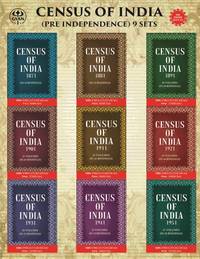
2024BIBHB0334000512024. Hardcover. New. Due to the very old age and scarcity of this book some pages are missing and may be hard to read due to the blurring of the original text. The Title 'Census of India 1871-1951 written/authored/edited by Anonymous' published in the year 2024. The ISBN 9788121258883 is assigned to the Hardcover version of this title. This book has total of pp. 152427 Pages. The publisher of this title is Gyan Publishing House. This Book is in English. The subject of this book is History Census India. Size of the book is 22.59 x 28.94 cms Vol: Volume In 384 Bindings hardcover
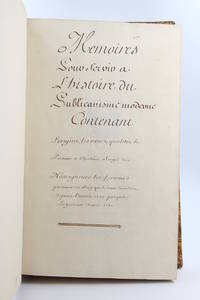
175078168s. l. 1750. Fine. s. l. 1750 23 x 38 cm 2 manuscrits reliés en un volume Manuscript entitled Mémoires pour servir à l'histoire du publicanisme moderne contenant l'origine les noms qualités le portrait et l'histoire abrégée de nosseigneurs les fermiers généraux du Roy qui se sont succédés depuis l'année 1720 jusqu'à la présente année 1750 with Mémoires pour servir à l'histoire du publicanisme ou l'Origine des receveurs généraux des finances du royaume 1750 folio 23 x 38 cm 330 pp 4 p. bl. 8 p. 4 p. bl. 83 pp. contemporary full calf Important and long manuscript composed of two parts written by two different hands retracing in total 160 biographies of the Fermiers Généraux active between 1720 and 1750 lavish and unpopular collectors of indirect taxes in the Ancien Régime. Each of the parts also contains a very useful index. The entries with the exception of 19 of them are all decorated with a coat of arms drawn in pencil painted by hand in colour and sometimes enhanced with gold or silver. Some modern notes some juicy in pencil in the margin of certain leaves. These memoirs have never been the object of a publication and we know of only a few handwritten copies with varying texts. The other examples that we have been able to find including the one digitised by the French National Library contain fewer biographies that ours and are not illustrated. Contemporary binding in full blond marbled calf title pieces in black and red morocco. Joints top of the first board and spine head repaired joints of the first board split but solid scratches on the boards corners damaged. A very beautiful manuscript richly painted retracing the history of the most despised institution of the Ancien Régime. Provenance: library of Count Chandon de Briailles descendent of the founders of the famous house of Champagne then of the Michel de Bry library with its motto Pro captu lectoris with their ex-libris glued to the first endpapers. hardcover
2024Gyan-9788121258876Gyan Publishing House 2024. In 384 Bindings. Paperback. New. 21.59 x 27.94 x 1066.989. English Gyan Publishing House paperback
2024Gyan-9788121258876Gyan Publishing House 2024. In 384 Bindings. Paperback. New. 21.59 x 27.94 x 1066.989. English Gyan Publishing House paperback
21691Grenoble Chez Philippes Charvys 1671 in 16 (14,5x8) 1 volume reliure pleine basane fauve granitée de l'époque, dos à nerfs orné, caissons dorés avec fleurons central, titre, 5 faux-feuillets non chiffrés et 135 pages et 3 faux-feuillets non chiffrés. Garrison-Morton, 6491.9; Krivatsy, 10856. Très rare première édition (First edition). Bel exemplaire (Good copy) ( Photographies sur demande / We can send pictures of this book on simple request )
175078168s. l. 1750 | 23 x 38 cm | 2 manuscrits reliés en un volume
2024Gyan-9788121256711Gyan Publishing House 2024. In 245 Bindings. Hardcover. New. 22.59 x 28.94 x 828.17. English Gyan Publishing House hardcover