Little Purr" [Anonymous soldier]Biblio.com
14 016 résultats
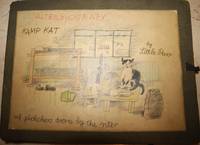
19430072801943. Hardcover. Cloth Box. Very Good. Inimitable and disarming tales that represent the pinnacle of outsider art and folk art with the naive drawings richly full of life as they speak of the daily routine at a British army camp during the Second World War from the point-of-view of a camp mascot cat who excels at mangling English in its creative attempts at phonetic spelling. Folios are oblong 41 by 30 cm each. The first folio contains "The Alterbyografy" a 56 pages long unpaginated with 54 illustrations including the folio cover 28 of which are full page 24 of which are half page. The second folio is entitled "Kamp Karacters" . This is 51 leaves with 92 illustrations including the cover 51 of which are full page 40 a third page generally with the area above entirely blank. Illustrations are rendered with colored pencil and crayon. The first manuscript is a continuous narrative of army life its humdrum rhythms and routines its various inanities its social life sports and other activities etc. while the second part is more character sketches. The second folio is even more visually driven than the autobiography. Another distinction between the two is that the autobiography is done with the leaves oblong while the character studies are applied with the leaves vertical. While one part isn't exactly a sequel to the other the two parts are truly complementary. The two folios are of a rough burlap material with a large title sheet mounted on their front cover. The folios have three flap folds to hold the loose sheets in plus ribbon ties on their right sides. hardcover
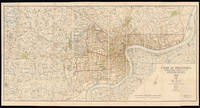
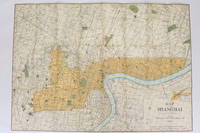
193215013Shanghai: Shanghai Municipal Council 27th October 1932. 860 by 1744mm. 33.75 by 68.75 inches. Coloured lithograph map dissected and laid on linen early ownership stamp of "John Pook & Co." in blank area folding into original cloth portfolio lettered in gilt 'General Map of Shanghai 1933' on spine. Acknowledgement is made of information obtained from the French Municipal Council the Shanghai City Government and the Whangpoo Conservancy Board. The map depicts Shanghai city in 1933 however the date printed on the bottom right corner is 27th October 1932. The round shape of the Old city is still clearly visible as in the Plan of Shanghai printed in 1928 it is labelled the "Chinese City" Similarly immediately to the north east and west is the French Concession and further to the north is the International Settlement. It is printed with a legend which includes: villages and developed property; creek; motor road; path and roads; and important buildings. Compared with the Plan of Shanghai printed in 1928 this map has much more information added most notably is that more villages and developed property are marked and identified using the relevant legend. We are only able to trace one other example of this map that in the British Library Map Collection. BL: Cartographic Items Maps X.3743. Shanghai Municipal Council, hardcover
191315014Shanghai: North-China Daily News & Herald Limited 1st June 1913. 735 by 1510mm. 29 by 59.5 inches. A large English map of Shanghai dissected in 40 4 by 10 sections and mounted on linen folding map. Oriented with north towards the upper right. Top left includes an inset of "plan shewing the rubicon road system". Signed by Engineer and Surveyor. The North-China Daily News was an English-language newspaper in Shanghai China the most influential foreign newspaper of its time. The paper was founded as the weekly North-China Herald and was first published on 3 August 1850. Its founder British auctioneer Henry Shearman died in 1856. North-China Daily News & Herald Limited, unknown
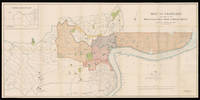
192815011London: Standford's Geog.l Establishment London 21st April 1928. 880 by 1660mm. 34.75 by 65.25 inches. A large coloured lithographed map showing the plan of Shanghai made in 1928. Signed by Commissioner of public works 44 4 by 11 sheets mounted on linen. The map depicts Shanghai city in 1928 with the French Settlements and Shanghai International Settlements hand-coloured in outline in brown and pink. Two lines noted below the title: 1. The Pootung shore is taken from surveys by the Whangpoo Conservancy Board. 2. The French settlement is taken from surveys by the French Municipal Council. The famous Whangpoo Huangpu river in Shanghai is prominently shown from the midpoint of the bottom edge sinuating upwards to the top right corner which divides the settlements to the left and Pootung Pudong to the right. Between the bank of the river and the French settlement are the 'Chinese city' and a district labeled 'Nan Tao' Nan Dao. The "Chinese city" is now called the "Old City" the traditional urban core of Shanghai. Its boundary was formerly defined by a defensive wall. The Old City was the county seat for the old county of Shanghai with the advent of foreign concessions in Shanghai it became just one part of Shanghai's urban core but continued for decades to be the seat of the Chinese authority in Shanghai. It was essentially coterminous with the old Nanshi District - Nan Dao which is now part of Huangpu District. In 1927 in a bid to establish a tangible Chinese authority in Shanghai the Republic of China government established the Special Municipality of Shanghai. The municipal government was moved out of the Old City to near Xujiahui. In 1928 Shanghai City the Old City was reduced to district status under the Special Municipality. In 1930 Shanghai County became a separate parallel administrative unit to the Special Municipality and the county government was moved out to Minhang. This was the end of the Old City's role as the seat of government of Shanghai. From 1928 the Old City was Hunan District; 'Hunan' literally meant 'southern Shanghai'. An exact copy of the map dated to the same day 21st April 1928 was published in Shanghai North-China Daily News and Herald Limited. by permission of the Municipal. It is signed by the same commissioner of public works. We are only aware of a single surviving example that in the Library of Congress Geography and Map Division Washington D.C. Publisher Edward Stanford 1827-1904 rose to prominence during the height of the Victorian age a period defined by technological innovation social upheaval literary excellence and world exploration. In 1853 Stanford became sole proprietor and expanded his shop to 7 and 8 Charing Cross whilst acquiring premises on Trinity Place for a printing works. This solidified Stanford's as the largest and only map maker and seller in London at a time when British colonialism the rise of the railways and the continuing popularity of the Grand Tour. Edward Stanford II took over in 1882 when Stanford's had become the sole agents for Ordnance Survey Maps in England and Wales and in 1887 published Stanford's London Atlas Of Universal Geography dedicated to Queen Victoria on the occasion of her Royal Jubilee and he received his royal warrant as Cartographer to the Queen in 1893. Edward Stanford II died in 1917 and his son Edward Fraser Stanford assumed control of the business in 1917. This map was made in the succeeding period between the wars which saw the company continue to innovate and encourage exploration. Standford's Geog.l Establishment, London, unknown
1920845121920. Fine. 1920 15 x 869 cm autre 12 paintings on silk on a transparent silk band of 840cm mounted on paper and bordered in gold. Each painting 70x14cm. It seems plausible to attribute the work to Miyagawa Shunteï. Wooden scroll on which is wound a long ribbon of 869 cm of paper. The paintings are held essentially by the margins and constitute a long silk band of 840cm. The scroll is nestled in a large green silk fabric. Some worming and stains but superb overall condition. Late production of shunga and ultimate flowering of this creative genre these paintings reveal a new pictorial manner never dared before. Of greater purity and greater preciosity these paintings also reflect in these years another way of apprehending sexuality in which woman is more equal lover. The narrow height and very extended width of the paintings allows extremely tight shots of the couples thus conferring greater immersion for the voyeur and more subtle representation of intimacy. The palette of colors used is very rich ranging from pink to black passing through different shades of green. The scroll participates in the mystery of the progressive unveiling of the paintings. Early 20th-century Shunga are rather rare because the censorship exercised by the authorities was very repressive at this time shunga being considered a stain on Japanese civilization. unknown
1920845121920 | 15 x 869 cm | autre
19405238661940. Near Fine. An original unpublished typescript of a mid-20th Century minstrelsy together with six mimeographed copies of the typescript. The original typescript consists of 12 quarto pages typed in orange on rectos only paginated in ink by hand and a one-page List of Characters. In fine condition. The six mimeographed copies consist of 12 folio sheets 9" x 14" stapled at the topedge onto a cardboard back cover accompanied by two mimeographed copies of the list of characters on separate quarto sheets. The mimeographed copies are lightly toned three or four copies have some slight staining one copy has an owner name in ink and one is lightly annotated near fine or better overall.<br /> <br /> The list of 21 characters includes: The Interlocutor Hambones Tambo Shakespeare of Harlem Seven-Up Jackson Suntan Cootie-Locks Dimwit Muskrat Geo. Washington Jones and others. The single-spaced typescript with about 50-60 lines per page is laced with racist language and stereotypes and includes dialogue musical cues stage directions and narration of the Interlocutor; it ends with one of two poems by Shakespeare of Harlem: “Honey dis am Rufus Tappin’ on yoh window-pane … †and a skit by Seven-Up Jackson: “the only known real live gold-fish swallowing act in history … .â€<br /> <br /> Internal evidence including references to an atomic bomb attack on Tokyo suggests that the play was likely written late in or soon after the Second World War. In 1953 two popular films with similar titles were released: Walt Disney’s Thanksgiving Day Mirthquakes and Merry Mirthquakes featuring a young Liberace as Master of Ceremonies. It is also possible that the character “Shakespeare of Harlem†is an allusion to Langton Hughes whose book of poems “Shakespeare of Harlem†was first published in 1942. An unpublished and unrecorded American minstrelsy well-preserved in near fine condition. The presence of multiple copies inveighs strongly that these scripts were actively used in a group production. unknown
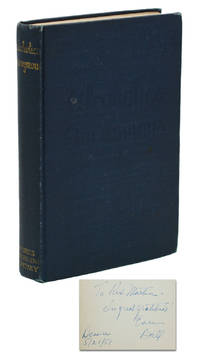
1945140938015New York: Works Publishing Inc 1945. Very Good. Signed by Bill Wilson and inscribed to a former owner on the front free end paper. First edition eighth printing. 400 pp. Bound in publisher's dark blue cloth with title stamped in blind on the front cover and in gilt on the spine; lacking the dust jacket. Very Good. Cloth lightly rubbed at corners and spine ends lightly rubbed and with a few small stains and a small crease to the bottom of the front board. Spine gilt partially rubbed. Previous owner name to front paste down and several notations written in pencil on the front free end paper. Light tidemark to top corner of text block affecting margins in varying degrees throughout. A nice copy of the AA Big Book signed by the co-founder of Alcoholics Anonymous Bill W. Works Publishing, Inc unknown books
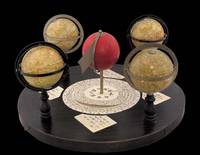
195015336Japan c1950. 280 by 230mm. 11 by 9 inches. Four small globes on turned stands surrounding a red sphere with a directional wind tail attached to a demi-meridian ring all mounted on a central metal pole fitted on a circular wooden base. Two manuscript paper disks overlapping on the wooden base with the top one movable and the bottom attached to the base. Four other manuscripts are attached to the base in between the stands. A unique fortune-telling astronomical instrument made in Edo Japan based on the "Nine-star Ki" ky seikigaku form of divination adapted and refined from traditional Chinese methods by Shinjiro Sonoda 1876-1961 in 1924. "Nine-star Ki" refers to nine-year and nine-month cycles of the Ki/Qi element on Earth which relate to the solar and seasonal cycles. These cycles are believed to have common effects across the planet on mental and physical development and life experiences. The 'stars' of "Nine-Star Ki" are numbers representing those cycles which can be calculated for anyone using their birthdates. This instrument was specifically designed to calculate the numbers of "Nine-Star Ki". Constructed on a circular wooden plate are four small terrestrial globes on turned stands which surround a red sphere mounted on a metal pole at the centre. A bronze signpost attached to the sphere is engraved with three characters " " " " " " "cold" "warm" and "hot" respectively referring to the seasons . Directly beneath the sphere are two circular manuscript charts. The smaller uppermost chart is rotatable bearing the title " " "Fortune-telling Nine astronomical bodies rotating chart". It shows three concentric rings radially divided into sixty sections. The first ring shows a cycle from " " one to " " sixty in anti-clockwise order and there are two characters " " "this year" marked in red above the former indicating the beginning of the cycle. In the second ring every consecutive nine characters represent the Navagraha or "nine celestial bodies of universe" in Hindu astrology. They represent different elements of nature as well as season personality family and direction. These are " " the Sun " " the Moon " " Mars " " Mercury " " Jupiter " " Venus " " Saturn " " Solar Eclipse and " " Lunar Eclipse. The third ring shows the names of Bagua the eight symbols of Taoist cosmology which are " " Heaven " " Earth " " under" "Water" "Mountain" "Wind" "Flame " " Lake. The larger chart beneath is attached to the plate showing two more rings. The first ring is an extension on the Bagua ring it encircles. It shows the sexagenary cycle which is a cycle of sixty terms each corresponding to one year used for reckoning time in China and other parts of East Asia. The outermost ring has thirty divisions each containing a character that represents one of the "Five Phases' " ": " " Wood " " Fire " " Earth " " Metal and " " Water. The system of five phases was used for describing interactions and relationships between phenomena including geomancy and astrology. Rotating the top chart to align the divisions on the five rings would give a combination of numbers and signs. Hence using one's date of birth one could rotate the chart to reveal a set of numbers and figures that signifies one's fortune according to the divination of the "Nine-Star Ki". Surrounding the main chart are four sheets of manuscript text. The top right sheet bears the date " " "May 9th Eleventh year of Bunsei era - 1828" yet this does not appear to be the year of publication since Korea is labelled as " " "Republic of Korea" and China " " "Republic of China" on the terrestrial globes. Given the establishment of the Republic of Korea in 1948 and the Republic of China in 1949 the instrument can be dated to roughly the following decade. This instrument is extremely rare and perhaps unique. We are unable to trace any other examples. unknown
1950019790New York 1950. Minor surface wear ink light at a few points with "Bill" on the dark portion of his suit but still visible. Near Fine. A scarce 8" x 10" Black-and-White Formal Photograph SIGNED by Bill Wilson: "To Martie C--/With affection/and thanks/Bill/NY -- 9/50." <br/><br/> unknown
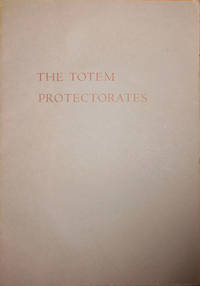
197226416San Francisco: Hermes Free Press 1972. First edition. Paperback. Very Good . Folio. Sewn wrappers. 6 pp. Printed on Bergstrom papers with the text set on Centaur & Cloister types. Rare anonymous collaboration between Allen Ginsberg and Gary Snyder. Subtitled "Being the Assignment of Same to the Honorable Senators Lawmakers of the United States Government toward the Preservation of Life and Spirit in these Lands. This Investiture Proclaimed in Grace Cathedral at the Autumnal Equinox 1971." Published by the Hermes Free Press an offshoot of the Zephyrus Press of San Francisco. Noted on page 175 of Alistair Johnston's "Zephyrus Image: A Bibliography" who notes "10 1/4 x 14 3/4" 12 page book sewn into brown Tweedweave cover "printed on Bergstrom papers at Hermes Free Press in San Francisco Spring 1972" Centaur type in brown on cover. This book assigns specific endangered plants and animals to each U.S. Senator. Originally in printed manila envelope lacking with this copy. One copy was mailed to each U.S. Senator. Rob Rusk writes . The Totem Protectorates appeared in another issue of Place magazine half on the inside front cover and half on the inside back cover - the Neon Rose issue - tho I'm unsure whether it was photocopied or reset". Interestingly neither the Morgan bibliography of Ginsberg or the McNeil bibliography of Snyder makes mention of this independent piece. Only four copies located in O.C.L.C. Although the print run is unstated according again to Johnston the typical Zephyrus Image publications were generally produced in small quantities perhaps 100 to 200 copies. Scarce item. Hermes Free Press paperback books
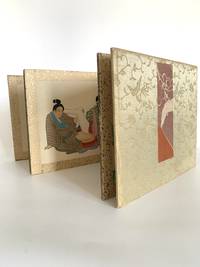
1920734821920. Fine. 1920 16 x 19 cm autre An album containing 14 gouaches on silk including 12 erotic paintings. The first painting on each side of the folding shows a bird and on the other side maple leaves thus masking on each of the first pages the erotic aspect of the collection. Shunga is the generic Japanese term that designates erotic art it literally means Spring Image spring being a euphemism and figure of style expressing sexuality. The term Shunga having been reserved for a long time for prints collections or albums have often been designated by the appellation Pillow Books or notes for the pillow etc. Utamaro: The Song of the Pillow 1788. Japanese accordion album covered with damask silk with flowers and birds in pale gold. Silk band on the first cover serving as a label but mute. Each painting 12.8x16cm is mounted on cardboard. The cardboard folding sections are covered with cream paper speckled with gold. Very fine condition edges rubbed with small lacks to fabric. The paintings respect the canons of Japanese erotic representation: oversized genitals body hair women with white skin and men of flesh color. No decorative element comes to distract the eye from the sexual act only one painting contains a mirror the bodies being most of the time clothed in rich kimonos. These collections were still in the modern era offered to newlyweds particularly to women. The whole is of fine workmanship the 2 introductory paintings the bird and the maple leaves are particularly successful. This type of representation was forbidden in Japan and therefore contains no signature it is however evident that there existed painters whose profession and specialty this was and whom one went to see for private commissions; it is also not forbidden to think that the painter made several on his own initiative and that he offered them for sale as was done with collections of colored photographs at the end of the 19th century. Precious and rare ensemble in superb condition. hardcover
19301715341930. HAENZI Erich. Farbenlehre. 23 Original watercolour plates some with multiple images. Folio 340 x 240 mm. original cloth. N.p.: n.d. ca. 1930. A wonderfully executed manuscript on colour theory by a Swiss commercial artist whose objective was to enhance the work of decorators fashion designers graphic artists and set designers. Divided into ten sections comprising colour and achromatic antagonism colour values light-dark antagonism cold-warm antagonism quality contrast intensity contrast quantity contrast complementary contrast simultaneous contrast and successive contrast. According to the seller the work is by a Swiss commercial artist named Erich Haenzi. hardcover
1928002034Hvidore: s. n. 1928. Softcover. Original silver gelatin photographic postcard of the Empress sitting on a padded bench in her garden holding an umbrella and a bouquet of flowers; 5 x 3 1/4; minor wear to corners and image; a bit of age-toning and a manuscript note in pencil to verso; near fine condition. Signed in ink: "Maria Hvidore" in the lower half of the photo. Possibly one of Maria Feodorovna's last photographs the anonymous note on the back stated: "The Empress sent me this not long before she passed away at Hvidore." Empress Consort of Russia Maria Feodorovna 1847 – 1928 christened Dagmar was the wife of Tsar Alexander III and mother of Emperor Nicholas II of Russia whom she outlived by ten years. The second daughter of King Christian IX of Denmark and Louise of Hesse-Cassel she was bethroted to Tsarevich Nicholas Alexandrovich of Russia but after his death from meningitis in 1865 Maria honored his last wish and married his younger brother the future Alexander III. She converted to Orthodoxy and became Grand Duchess Maria Feodorovna of Russia. With Alexander II's assassination in 1881 she and her husband were crowned Emperor and Empress of Russia. After Alexander III's death in 1894 she became Dowager Empress and her son Nicholas II and his wife Alexandra were crowned the new rulers. The outbreak of the Revolution in 1917 forced her to travel to Crimea where she received the devastating news that her sons daughter-in-law and grandchildren had been murdered. She refused to believe it and declared it a rumor. Although the monarchy would be overthrown she would not leave Russia until 1919 - first to London and eventually to her native Denmark where she would settle in Hvidore a former country house near Copenhagen. Maria died on October 13 1928 at the age of 80 having outlived four of her six children. Hvidore: s. n. paperback
1928002034Hvidore: s. n. 1928. Softcover. Original silver gelatin photographic postcard of the Empress sitting on a padded bench in her garden holding an umbrella and a bouquet of flowers; 5 x 3 1/4; minor wear to corners and image; a bit of age-toning and a manuscript note in pencil to verso; near fine condition. Signed in ink: "Maria Hvidore" in the lower half of the photo. Possibly one of Maria Feodorovna's last photographs the anonymous note on the back stated: "The Empress sent me this not long before she passed away at Hvidore." Empress Consort of Russia Maria Feodorovna 1847 â 1928 christened Dagmar was the wife of Tsar Alexander III and mother of Emperor Nicholas II of Russia whom she outlived by ten years. The second daughter of King Christian IX of Denmark and Louise of Hesse-Cassel she was bethroted to Tsarevich Nicholas Alexandrovich of Russia but after his death from meningitis in 1865 Maria honored his last wish and married his younger brother the future Alexander III. She converted to Orthodoxy and became Grand Duchess Maria Feodorovna of Russia. With Alexander II's assassination in 1881 she and her husband were crowned Emperor and Empress of Russia. After Alexander III's death in 1894 she became Dowager Empress and her son Nicholas II and his wife Alexandra were crowned the new rulers. The outbreak of the Revolution in 1917 forced her to travel to Crimea where she received the devastating news that her sons daughter-in-law and grandchildren had been murdered. She refused to believe it and declared it a rumor. Although the monarchy would be overthrown she would not leave Russia until 1919 - first to London and eventually to her native Denmark where she would settle in Hvidore a former country house near Copenhagen. Maria died on October 13 1928 at the age of 80 having outlived four of her six children. Hvidore: s. n. paperback books
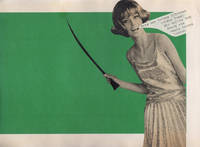
196021470np ca. late 1960s. Hardcover. Very good. Oblong 4to. Boards. Likely commercial scrapbook but possibly ad-hoc. Containing 66pp. plus covers and one fold-out all mounted both recto and verso with color collages consisting mainly of magazine models with occassional textual elements in German many typed. Spine appears persished. But otherwise sound and apparently complete. Very good. Housed in custom Talas archival clamshell box. <br/><br/>An extraordinary and unique handmade artist's book elaborately assembled by an anonymous artist. A kinky but lighthearted celebration of female flagellantism the book appropriates quintessentially 1960s fashion models and recontextualizes them in dozens of original collages so that they are weilding whips switches and various similar tools. Paired with self-referential and irreverant texts as well as black-and-white hand-penned drawings presumably by the assembler of bondage spankings and other S&M-themed scenes the book humorously imagines Mod Girls as doms — a perhaps intentional visual pun. The collages many spanning across page spreads and including one fold-out exhibit a strikingly skillful and stylish retraint suggesting an ambition and audience beyond the merely pruriently personal. An outsider book of rare sophistication and wit: the Swinging Sixties meets Dada. Yeah baby. hardcover books
1920734821920 | 16 x 19 cm | autre
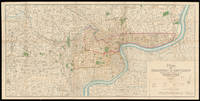
193367432Shanghaï Shanghai: North China Daily NewsHerald limited 1933. Fine. North China Daily News Herald limited Shanghaï Shanghai 1933 100 x 74 cm une feuille rempliée Rare original folding colored map of the city of Shanghai printed on heavy paper and including the street names in English as well as an extensive grid to find locations. It was published under the authority of the Shanghai city council in 1933. A skillfully repaired tear touching the index. There is a variation of this map in existence without the grid or the key of which an example is preserved in the University of Chicago library. We have not otherwise been able to find any other example of this map. This very detailed map still shows the old town under the name «Chinese City.» Each district or foreign concession particularly the French one is marked out and named in a miniaturization on the bottom right of the map these concessions will finally be returned in 1943. Significant places and places of interest are shown as well as the railway lines. Maps of Shanghai before the Battle of Shanghai are rare and sought after. North China Daily NewsHerald limited unknown
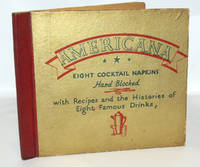
1925TB33810n.p.: n.p circa 1925. First Edition. Good in its original 1/4 red paper and gold jacquard printed covered boards with blue and red text and decorations on the front board. An oblong small octavo of 7 1/2 by 8 3/4 inches with wear to the paper covering all around the edges of the boards. The text is printed on a thin and extremely fragile paper stock which is well tanned with a number of closed tears and minor chips to the margins. All eight cocktail napkins are present and in fine condition in bright colors. 18 pages 17 numbered rectos mounted with illustrated hand-colored cocktail napkins versos with cocktail recipes. Nothing known of author publisher or date or place of publication. However it is rather obvious that this volume was published during the era of Prohibition Jan. 1920 to Dec. 1933 as all of the cocktail recipes call for nonalcoholic beverages. The modified Prohibition ready recipes are for: Manhattan Blue Blazer Deadwood Duck Rip Van Winkle Sleeper Belmont Park Alabama Barbary Coast and New Orleans Drip. The dedication in the book asserts its tongue-in-cheek intent: To Serious Drinkers Everywhere. Of particular interest is the fact that a small 7/8 by 5/16 inch slip of paper with blue and red printing with the word "France" is pasted to the upper fore corner of of the front paste down for each copy that has come to market. The importation laws in the US at the time required all foreign goods to have some indication of where they were coming from. This title was therefore printed in France. The Internet site of Barina Craft in their essay on Barbary Coast Cocktails includes a footnote which reads: "Americana Recipes And The Histories Of Eight Famous Drinks is a rare bartending book not only because of the limited number of copies of its first and only edition but also due to its binding and illustrations. Each of the eight cocktails . were depicted by a hand colored woven fabric cloth cocktail napkin with tassel ends." This rarity is borne out by OCLC reporting only one copy is held by an institution Bowling Green State Univ. n.p hardcover
196043382np 1960. Very good. An extraordinary and unique handmade artist's book elaborately assembled by an anonymous artist. A kinky but lighthearted celebration of female flagellantism the book appropriates quintessentially 1960s fashion models and recontextualizes them in dozens of original collages so that they are weilding whips switches and various similar tools. Paired with self-referential and irreverant texts as well as black-and-white hand-penned drawings presumably by the assembler of bondage spankings and other S&M-themed scenes the book humorously imagines Mod Girls as doms - a perhaps intentional visual pun. The collages many spanning across page spreads and including one fold-out exhibit a strikingly skillful and stylish retraint suggesting an ambition and audience beyond the merely pruriently personal. An outsider book of rare sophistication and wit: the Swinging Sixties meets Dada. Yeah baby. 6.5'' x 9.25''. Likely commercial scrapbook but possibly ad-hoc collages boards. Containing 66pp. plus covers and one fold-out all mounted both recto and verso with color collages consisting mainly of magazine models with occasional textual elements in German many typed. Spine appears perished. But otherwise sound and apparently complete. Very good. Housed in custom Talas archival clamshell box. hardcover
193367432North China Daily News Herald limited | Shanghaï 1933 | 100 x 74 cm | une feuille rempliée
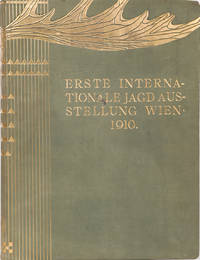
19123979Wien Leipzig: Wilhelm Frick Kais und Kon Hofbandler 1912. First Edition. Hardcover. VG to vg. ein monumentales gedenkbuch. 227 pp. ill. Book produced which showed everything on exhibition at the Vienna sporting exhibition. Hundreds of text ill plus many full page photogravures with tissue guards. A monumental work on European game. Text in German. The binding is gilt stamped suede. 14.5" high 11 inches wide. The front cover has deco gilt vertical rules and pointers to the right side of a stag head the spine has the same rules and the stag skull and the rear board is the same except that it is the left side. Deco end papers. This is a very rare item. Internally near fine. The corners are slightly rolled but the rest of the cover is vg showing that this has been well cared for. See all images. Wilhelm Frick, Kais und Kon Hofbandler hardcover
19190032531919. Cloth. Very Good. Patriotic World War One poem "The Man who Keeps his Head" illuminated with exquisite vignettes. Oblong 24.5 by 31 cm. With eight plates including title page plus painted vignette on final leaf. These vignette watercolors four to eight per page depict the diversity of British experience whether its variety of industry its trades its modes of farming its ships etc. The effect is panoramic and epic a visual equivalent to Noel Coward's sweep in "Cavalcade" say. Framing it all are Art Nouveau devices and ornament very much true to the period. The book was easily of publishable quality and its creation demonstrates that a strain of patriotism and optimism somehow withstood the bitterness and cynicism engendered by the war. Tissue guards with creases and one with tear. Binding bowed. Other light wear. unknown
19190032531919. Cloth. Very Good. Patriotic World War One poem "The Man who Keeps his Head" illuminated with exquisite vignettes. Oblong 24.5 by 31 cm. With eight plates including title page plus painted vignette on final leaf. These vignette watercolors four to eight per page depict the diversity of British experience whether its variety of industry its trades its modes of farming its ships etc. The effect is panoramic and epic a visual equivalent to Noel Coward's sweep in "Cavalcade" say. Framing it all are Art Nouveau devices and ornament very much true to the period. The book was easily of publishable quality and its creation demonstrates that a strain of patriotism and optimism somehow withstood the bitterness and cynicism engendered by the war. Tissue guards with creases and one with tear. Binding bowed. Other light wear. <br/><br/> hardcover books
19011036London: Longmans Green & Co 1901-1902. Limited First Edition. hardcover. Very Good. Large 4tos: 11 5/8" x 8 1/4" 29.5 x 21 cm. <p> <p>First Thus. Printed by Chiswick Press. Bound in publisher's original quarter Holland-backed blue paper boards with blue linen spine and paper title label. One of 315 of which 300 were for sale copies. Printed on fine hand-made W M and floral watermarked paper. Uncut deckled edges. Colophon. A.o.V. 238; A.I.&W. 163; H&FfA./SoC 106; & O.o.H. 293; R.o.t.M. 284; G.t.S. 177; H.o.t.W. 161 & V.S. 113 pp. <p>A full set of the William Morris series comprising eight large quarto books printed at the Chiswick Press with the Golden type designed by Morris for his Kelmscott Press 1901-1902. Chapter headings in red and shoulder notes in red in some volumes. <p>Spare labels tipped in. Loose insert from the press in "Hopes and Fears for Art Sings of Change" that reads: "It has been found advantageous to make one volume instead of two of "Hopes and Fears for Art" and "Signs of Change" and to unite the extra lectures which were originally intended to form a part of volumes vii and viii in volume viiii with the title "Architecture Industry and Wealth" which will complete the series.<p>Paper-covered boards show mild wear to the corners with chips to some edges. Dust soiling to page edges. Spines uniformly faded from blue to brown-grey showing little wear and not unpleasing in appearance. All square and solidly bound. Free from the usual spotting and foxing of books this age excepting a few very light spots to some boards. Offsetting to endpapers of two books still overall very nice copies with internal pages pristine clean white and crisp. No internal markings whatsoever. All in all the books are attractive and very well-preserved. Handsome copies all unopened. Unopened. Condition overall: Very Good. Longmans, Green & Co hardcover