[ANONYMOUS]Biblio.com
237 569 résultats
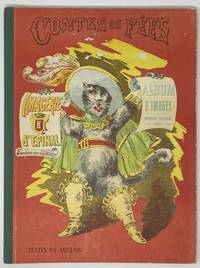
18881464Epinal France: Imagerie D'Epinal 1888. Boards. Very good . HUMOR RACIST CARICATURE. Folio; 56pp; pages numbered 1-60 printed recto only on very thin paper stock lacking pp15 16 17 and 19-SEE NOTE BELOW; red pictorial boards on front rear has green and white patterned boards green cloth shelf-back; "Printed expressly for the Humoristic Publishing Company Kansas City Mo." on the foot of each page; cartoon-style hand-colored lithographed illustrations; light scuffing to boards at edges and bumped corner age-toned paper fragile 3pp with closed tears extending into text: 9&10 from fore-edge and 31 from bottom; very good plus. OCLC only locates two copies in English at Yale and Princeton and two in France in French. Although the cover title is in French the cartoon text is all in English. Published in France by the old and revered Imagerie D'Epinal founded by the Jean-Charles Pellerin family in 1796 and continuing today it was printed for the Humoristic Publishing Company in Kansas City Missouri. Famous stories and tales many moralistic are included in comic strip form one story to a page. Included are: William Tell Little Tom Thumb Little Red Riding Hood and Cinderella.<br /> <br /> Fifty-six hand-colored cartoons printed one side only. Overstreet states that "All copies known only have 50 of the 60 known of these broadsheets." And "All known copies were collected with sheets 15-20 23 24 47 and 48 missing." In this volume pages 15 16 17 and 19 only are lacking. Overstreet 366. Imagerie D'Epinal unknown
1727BB0614London: Printed for J. Roberts in Warwick-Lane; J. Stagg in Westminster Hall; and D. Browne without Temple-Bar 1727. Quarter-bound Leather. Near Fine. Third Edition with price 2s. 6d below imprint in square brackets. Full of fascinating information relating to the etiquette and procedure of royal ceremonies. Small 4to 210 x 155mm: 80pp with large folding copper-engraved frontispiece "Procession of Kings and Queens with over 150 robed figures" measuring a full 440 mm x 350 mm a second folding engraving "The Manner of the Champions performing the Ceremony of ye Challenge" and 12 woodcuts in the text depicting various ceremonial objects including crowns maces scepters and coronation rings. Bound in early possibly contemporary quarter sheep with marbled boards red morocco lettering piece gilt all edges marbled. Bookplate of Buddle Atkinson to front paste-down. A sturdy unsophisticated copy frontispiece slightly spotted along folds sporadic light soiling and browning binding rubbed along spine and corners but an excellent example of a scarce book. ESTC Citation No. T113877. Lowndes 526. Bindley pt. vi 1039. Not in Halkett & Laing. Buddle Atkinson's bookplate appears in Hugo's Catalogue of Thomas Bewick's works but it is in fact engraved on steel not wood and came from the workshop of Mark Lambert one of Bewick's pupils. The plate was designed and engraved by George F. Robinson who joined Lambert's workshop in 1841 and who in the course of 50 years became chief engraver and director of all art works carried out by the firm. The plate was produced when Atkinson b.1841 was a young child perhaps for putting in books that had been owned by his father John Buddle so it likely dates from 1845-1850. N. B. With few exceptions always identified we only stock books in exceptional condition carefully preserved in archival removable polypropylene sleeves. All orders are packaged with care and posted promptly. Satisfaction guaranteed. Printed for J. Roberts, in Warwick-Lane; J. Stagg, in Westminster Hall; and D. Browne, without Temple-Bar unknown
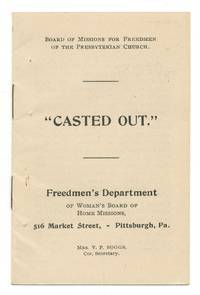
1910550603Pittsburgh: Freedmen's Department of Woman's Board of Home Missions 516 Market Street 1910. Softcover. Very Good. First edition. 24mo. 11pp. Stapled white printed self-wrappers. Few sewn marks along spine where once bound with other publications else a very good copy. Freedmen's Department of Woman's Board of Home Missions, 516 Market Street unknown
180018412c1800. 470mm in diameter. Instruments""Planispherum Lunare A unique manuscript lunar astrolabe Ink and polychromy on paper over pine. The instrument comprises a circular base plate and three rotatable cardboard volvelles and a brass radius pointer attached to each other in the centre. A brass ring is attached to the base plate for suspending. All four paper covered discs are finely inscribed in manuscript with various scales and symbols. Content 1. The smallest volvelle bears a scale covering 12 hours on its outer ring. It also shows the ecliptical motion of the Sun the Moon's orbit the line of nodes and the arguments of latitude in other words the distances from the nodes. 2. On the second volvelle a scale covers the years from 1801 to 1825. each year is subdivided in twelve months with the abbreviated name written for each month. 3. The following volvelle carries a series of scales showing a monthly calendar a zodiac calendar with skilfully drawn pictures and the symbols of the signs. Below the zodiac is a scale for the declination of the sun throughout the year set in four sequences of three. 4. On the outside rim of the volvelle is another calendar scale in which the months are unevenly distributed. This scale presumably was to be used in conjunction with the outer scale on the circular base plate. In addition the volvelle holds two brass studs that most probably helped the user turn the disc to the desired position. This latter scale gives the days subdivided in hours. The days are numbered I to XXXI with the number I coinciding with XXVII and 8 hours the sidereal period of the Moon which results in a double numbering from XXVIII to XXXI. Below this scale for days there is a series of dates all confined to the period 1801 to 1825 presumably for solar eclipses. The brass rule or pointer holds a horizontal scale from 5 to 0 LA-southern declination and from 0 to 5 LB-northern declination indicating the latitude of the moon with respect to the ecliptic. The closer to 0 at new moon or full moon the likelier an eclipse is to occur. The rule is engraved with """"Locus Lunae"""". The circular scales serve to set the moon's position and node relative to the sun from which the user can then infer the lunar phase and whether an eclipse will occur at new moon or full moon. Manuscript instruments of this type are rare especially in such good condition as no other exact copy is recorded to date. Similar instruments were produced at the end of the sixteenth century mostly in brass. Sir Robert Dudley 1573-1649 see item 17 had a lunar calculator made by Charles Whitwell c. 1568-1611 a brass disc of 72 cm diameter overall which was the most complex instrument made during the sixteenth century. Inscribed 'Sir Robert Dudley was the inventor of this instrument' its purpose was to calculate the place of the moon over a period of thirty years. It is now in the Museo di Storia della Scienza in Florence Italy. Another similar paper device was printed with detailed instructions in 1786 in Vlissingen Flushing in the Netherlands advertised as a """"Starkundige Maan-Wyzer en Almanach"""" Astronomical Moon Pointer and Almanac by Henricus Schortinghuis. Oxford Dictionary of National Biography; Webster Roderick and Marjorie 'Western Astrolabes' Adler Planetarium & Astronomy Museum 1998; Museo di Storia della Scienza Florence Italy unknown
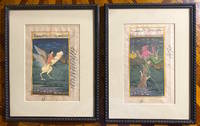
19203217n.d. 19th or 20th century. Two illuminations on thin India paper some vertical creasing professionally matted and framed. Ad 1 priapus: 300 x 250 mm frame size 198 x 140 mm visible 147 x 93 mm size of illumination. Ad 2 she-devil: 306 x 231 mm frame size 205 x 140 mm visible 150 x 83 mm size of illumination. Sold as a pair. TWO WEIRD EROTIC INDIAN ILLUMINATIONS THE LIKES OF WHICH WE HAVE NEVER BEFORE ENCOUNTERED AND ARE UNLIKELY TO ENCOUNTER AGAIN. <br /> <br /> Popular in Roman decorative art the winged priapus is uncommon in Indian iconography. Our illumination is of particularly high quality and depicts a beautiful Indian woman riding a reined priapus perhas twice her size. The priapus is depicted with avain feet and giant wings. The environment is like a strange dream: in the foreground a grey pool with pink flowers; behind are dark green hills with eerie trees and vegetation. In the sky at sunset are what appear to be rain clouds touched in white. We have been unable to transcribe the text but there is writing on the verso. <br /> <br /> The second illumination depicts a grotesque she-devil with fangs horns and a long tongue naked save for pearls around her wrists ankles and biceps. Above her waist her speckled skin is light purple and below dark green. The monster clutches to a strange tree on which four priapus grow and with it engages in sexual relations. She reaches toward a basket of several other priapus which are positioned on an upper branch. As with the accompanying illumination in the foreground we find a watery pool and pink flowers and dark green hills studded by surreal trees. The setting is at twilight. <br /> <br /> HIGHLY CURIOUS AND MUST BE SEEN TO BE FULLY APPRECIATED. unknown
180517799Augsburg: Bürglen 1805. 185 by 144mm. 7.25 by 5.75 inches. Prints""J. J. Scheuchzerus Johann Jakob Scheuchzer Engraved portrait. Johann Jakob Scheuchzer 1672-1733 published 34 original works and numerous articles on the subjects of history science and travel; his subscribers included some of the most notable names of the day such as Isaac Newton and Hans Sloane. After extensive journeys throughout his native Switzerland he published a four sheet map of the country in 1712 the same year that a civil war toppled the Old Swiss Confederacy and ended Catholic hegemony. Until the end of the eighteenth century Scheuchzer's map was the most accurate cartographical representation of Switzerland in existence. Additionally Scheuchzer was appointed senior town physician in Zurich in 1733 and for this reason his portrait was included in George Wihelm Zapf's 'Abbildungen berühmter & besonders' a collection of 180 portraits of famous physicians. Bürglen, unknown
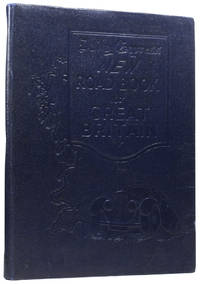
53012London: The Daily Express no date c.1937. Early Road Map EARLY EDITION. Quarto 28 x 21 pp.128. A gazetteer with eight loose map cards with the original wrap-around band stating 'Important First - turn to page two!'. Publisher's navy leatherette boards with titles blind to upper board. Light outer rubbing with some browning to gazetteer. A near fine example likely never used. London: The Daily Express, no date [c.1937] unknown
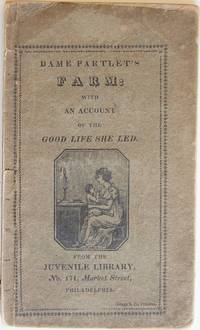
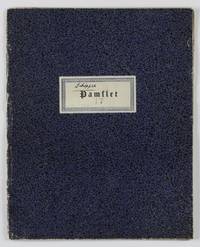
14142Philadelphia: Published and for Sale by Johnson and Warner No. 147 Market Street and at their Bookstore in Richmond Virginia and Lexington Kentucky 1810. . 59 1pp. 12mo. Woodcut illustrations some signed "A" Alexander Anderson in the block; variable spotting especially at the beginning. Original printed stiff gray wrappers; stitching partly defective with a pirce of the backstrip missing but intact. Second American edition not so stated first published in London by John Harris in 1804 and by Johnson in Philadelphia in 1806; a manuscript note in a copy of the London edition says the book "was written by Dr. James Hodson." The illustrations are particularly fine though not printed on especially good paper. Dame Partlet is said to have been a very near relation to that renowned person Goody Two Shoes so well known to every good child who would rather read in pretty books than waste their time in idle play. . . . Welch American Children’s Books. . . Prior to 1821 253.2 this copy Welch’s "reissue" with the publisher’s address on the cover given as 171 Market Street. Pomeroy Alexander Anderson 190b. Philadelphia: Published and for Sale by Johnson and Warner, No. 147, Market Street, and at their Bookstore in Richmond, Virginia unknown
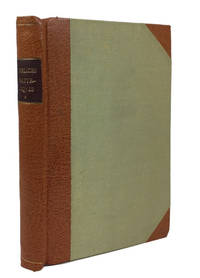
191674751Paris: Henri d'Arthez 1916. Hardcover. Very Good. xvi 160p. Rebound in recent 1/4 leather. 17cm. French text. Copy No. 194 of 475 copies "sur papier verge d'Arches" out of an edition of 500 numbered copies. Henri d'Arthez hardcover
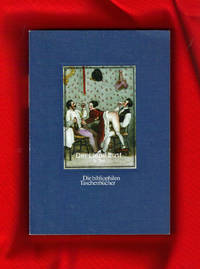
1983000193Dortmund: Die Bilbiophilen Taschenbucher 1983. Pictorial Wraps. Fine. 16mo - over 5¾" - 6¾" tall. Dortmund: Die BibliophilenTaschenbucher 1983. IN GERMAN AND FRENCH. Erotica. 16mo. 6.5" x 4.75". Blue wraps with illustration pastedown on front cover. Unpaginated. Minute edgewear else fine. A collection of full color erotica taken from 19th century French miniature lithographs showing "libertines" of that era engaged in all sorts of.sports. Though vintage in nature these are all a little too HC for presenting scans here the cover image which see being pretty much the only one suitable for that. Although the book was produced in Germany being installment #149 in Die Bibliophilen Taschenbucher's aggregation of similar offerings and has a bit of text in German the lithographs reproduced all have short French captions - my personal favorite being "L'asperge a la sauce blanche" "Asparagus with white sauce". In fact quite collectible both because it is an assortment of the miniature erotica that Parisian street artists and lithographers produced for extra income - selling these to the leisure-elite gentlemen of Paris around 1840 - and because it is a fine example of one of a prodigious array of such titles produced by DBT several pages at the end are devoted to the cataloging these. In far better condition than one is likely to find another. L85 <br/> <br/> Die Bilbiophilen Taschenbucher paperback
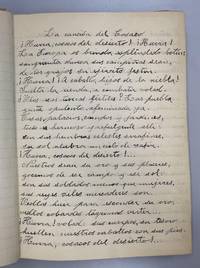
1935315Mexico City: publisher unknown 1935. <p dir="ltr">6.5" x 9" pp. 382 270 pages contain handwritten entries black and tan boards with red appliqués stamped "Copiador" = "Copier". This is a Spanish language diary entry containing a compilation of poems written in verse and belonging to various authors. Diary journal is dated Jan. 2 1935. Approximately 4 leaves are removed in the middle of the text block. All likely transcribed poems not original to the diary's author. </p> . [publisher unknown] unknown
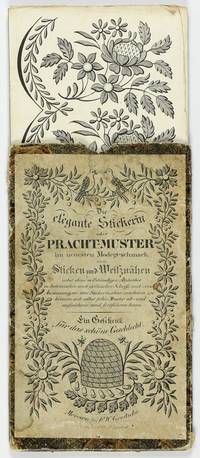
63376Meissen F. W. Goedsche no date but circa 1820. 8vo. 4 pp. instruction leaf; 13 leaves with floral patterns four double-sized. In original marbled paper covered slipcase 22.2 x 13.2 cm with mounted pictorial title leaf. = A charming "Biedermeier" style pattern book being a guide in decorating clothes. An ephemeral publication intended to be used; as the leaves would become damaged in the process it is very rare indeed to see it in this near pristine state. Only the leaves with letters are wanting. Board edges a bit rubbed otherwise in a very good clean condition. hardcover
181027615Prague 1810. Other. In excellent condition. 210 by 201mm 8¼ by 8 inches. 210 by 201mm 8¼ by 8 inches. Copper engraving uncolored as published. unknown
31733Wien Commission des Cosmographischen Büreau 1814. Small 8vo 17.5 x 10.0 cm. 164 pp.; one engraved plate. Contemporary marbled wrappers. = A very rare work by an unknown author. The work offers a systematic account of minerals. The plate shows crystal-forms. A long quote by Pliny is printed on the title page verso. The name "Dr. J. Rehmann" possibly the Austrian Viennese - later Russian medical doctor Joseph von Rehmann 1779-1831 inscribed in an old hand on the front wrapper verso; a with a weak old stamp on the title page verso. We know of one other copy in the Österreichische Nationalbiblothek Austrian national library. Neither in Sinkankas nor in Ward and Carozzi. unknown
1919193New York: George Harvey Publishing Company 1919. Octavo original decorated limp cloth covers 146 pp. Localised adhesion affects two leaves with some loss of text a few spots and marginal stains throughout covers rubbed a good copy. A rare relic from the First World War not recorded in Dornbush 'Unit Histories of the United States Air Forces'. George Harvey Publishing Company unknown
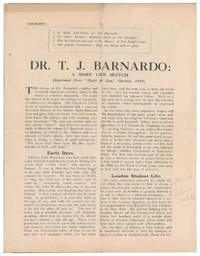
57241London: Dr. Barnardo's Homes 1919. Children's Welfare EARLY ARTICLE. Octavo pamphlet 24 x 18cm pp.12. No covers as issued stapled twice. Folded both horizontally and vertically. Fairly lightly handled with just a few marks out outer leaves. Very good. A short article on the life and work of philanthropist and children's home founder Dr. Barnardo reprinted in order to raise funds for the charity's fiftieth anniversary which had fallen in 1916 at the most crucial moment in the Great War. As the advertisement states "We ask for a sum that would have been used up in the Great War in just about 40 minutes: and we are going to use it not for organised Waste and Destruction but for the grandest and most productive industry in the world-the saving and upbuilding of young lives. London: Dr. Barnardo's Homes, 1919 unknown
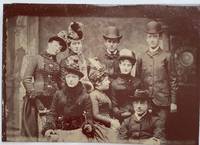
1269No place identified: No photographer identified No date c. late 19th c. No binding photograph. Very good . TINTYPE PHOTOGRAPH MELAINOTYPE FERROTYPE. 3 ½" x 5"; image is clear; japanned verso; light scratching to surface; very good plus. A tintype or ferrotype photograph of five young women and three young men most likely taken during the 1890s based on the clothing style. Three men two in Bowler or derby style hats and suits buttoned high. First introduced in England in the 1840s and considered formal wear the Bowler was worn by working classes by the late 19th century. The women are dressed in suits with short jackets a style that emerged in the late 1880s and went on to be a men's wear craze during the 1890s and well into the 1910s. Each person's outfit suggests the wealth of the upper class. Other types of photography had been developed and perfected by the late 19th century but the tintype remained a sturdy inexpensive and quickly developed alternative. No photographer identified unknown
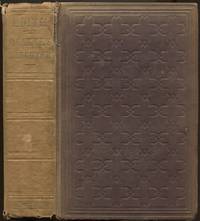
1856622256New York: Published by Mason Brothers 1856. Hardcover. Very Good. First edition. Octavo. 407pp. Publisher's faded brown cloth stamped in gilt and blind. Foxing on pages spine sunned with tears and chips on spine ends corners bumped about very good copy. Wright II 836. Novel set in Boston. Published by Mason Brothers hardcover
1856515577New York: Published by Mason Brothers 1856. Hardcover. Fine. First edition. Octavo. 407pp. Publisher's red cloth stamped in gilt and blind. Very slight wear to cloth else a fine bright copy. Wright II 836. Novel set in Boston. Published by Mason Brothers hardcover
74163No place no date 1608. Small 4to 18.0 x 14.6 cm. Engraved title page; five pp. 19th-century marbled wrappers. = A very rare pamphlet in which the anonymous author questions a truce between the Netherlands and Spain. "The Twelve Years' Truce was the name given to the cessation of hostilities between the Habsburg rulers of Spain and the Southern Netherlands and the Dutch Republic as agreed in Antwerp on 9 April 1609 coinciding with the Royal Decree of Expulsion of the Moriscos. It was a watershed in the Eighty Years' War marking the point from which the independence of the United Provinces received formal recognition by outside powers. For Spain the truce was seen as a humiliating defeat as they were forced to make several sacrifices but they scarcely got anything in return" Wikipedia. The engraving shows the Dutch and Spanish engaged in some kind of ritual battle on a beach with shells along the tide line and dunes in the background. According to Tiele the truce was: "een van de aardigst geschrevene blaauwboekjes tegen den vrede" one of the most pleasantly written pamphlets against peace. Paper trimmed to plate edges some light mostly marginal staining small chip to last leaf lower outer corner otherwise very good. Knuttel 1466; Muller 1254b; Tiele 676. unknown
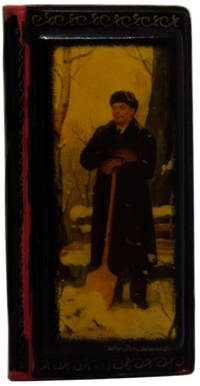
52671no date circa 1980's. A simple Cyrillic address book in a red plastic binding 14 x 7cm but uniquely decorated in black over the top with an enamelled image of Lenin leaning on a shovel in a snowy park. Fine and unused inside; some cracking and chipping of the enamel to edges and joints. Minor crazing to the image. no date [circa 1980's] unknown
78684Paris Panckoucke 1786-1789. 4to 26.0 x 20.5 cm. 447 pp. 445; ii; 16 engraved plates of which 14 double-sized 1-3; 1-11; 1-2. Contemporary full mottled calf. Spine with burgundy morocco label with gilt lines and title. Speckled edges. = A rare part - in particular regarding the plates - of the Ultimate Encyclopaedia and the largest of all great Encyclopaedias and the most important work published during the French Enlightement. This section - complete in itself - published anonymously which for the Encyclopédie is exceptional see Schmitt. Provenance: small stamp "de Prony" in the lower margin of the title page. Armorial stamp on front pastedown surrounded with extensive scribblings in pencil and a few more lines on the rear free endpaper verso. Boards worn at edges; spine ends and fore edges more abraded. Damp-staining to the top outer quarter of the plates diminishing away from the rear board and text leaves unaffected. Schmitt S. 2018 Inventaire des livraisons des auteurs et du contenu de lEncyclopédie méthodique 1782-1832. hardcover
78685Paris Panckoucke 1786. 4to 25.6 x 20.1 cm. 445 pp. Contemporary quarter calf over marbled boards. Spine with gilt lines and burgundy morocco label with gilt title. Marbled edges. = A seldom seen complete text part of the Ultimate Encyclopaedia and the largest of all great Encyclopaedias and the most important work published during the French Enlightement. This section published anonymously which for the Encyclopédie is exceptional see Schmitt. This is the text only. A later atlas with sixteen plates is not present as usual. Schmitt S. 2018 Inventaire des livraisons des auteurs et du contenu de lEncyclopédie méthodique 1782-1832. hardcover
1970513763Brooklyn: Corlay Publishers 1970. Softcover. Fine. First edition. 12mo. 78pp. Stapled printed brown wrappers. A fine copy. An anonymous interpretation of African-American theology. Uncommon. OCLC lists a single copy NYPL. Corlay Publishers unknown
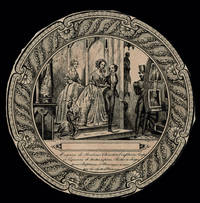
17949Paris nineteenth century. diamter 160mm 6.25 inches. Prints""Magasin de Bonbons Chocolats Confitures Sirops C is for Chocolatier Engraved trade card. The present print appears to be not a trade card but a product label similar in design and shape to many of those found on food products in nineteenth century France. There is a blank rectangle where the contents of the package could be written by hand and beneath this is a sentence clarifying that the goods come from a """"sweet chocolate jam syrup and liqueur shop"""" trans. It also advertises that they can provide such delights for celebrations including baptisms and marriage. Indeed the image at the centre of the print appears to show a newly married couple leaving the church both elaborately dressed and attended by a small boy and bridesmaid. The whole label is surrounded by a decorative floral frame. unknown