HUGO VictorABAA

747 résultats
245008Boston: Dana Estes. hardcover. very good. 24 volumes. Black & white illustrations with tissue guards. Small 8vo 3/4 tan calf ornately gilt spines with green leather spine labels marbled boards t.e.g. Boston: Dana Estes & Co. N.d. ca. 1910. Very Good .<br/><br/> Illustrated Cabinet Edition.<br/><br/> Dana Estes unknown books
188019331Paris: J. Hetzel and A. Quatin 1880. Edition limited to 100 sets only 46 vols. tall 8vo 3/4 red crushed levant by Gruel t.e.g. very minor scuffing several joints with small cracks one volume L'Homme Qui Rit with front joint badly cracked and rear cover loose; otherwise generally a fine bright set of the best edition of one of France's greatest writers. With the bookplates in each volume of Whitelaw Reid the American journalist and diplomat see DAB. <br/><br/> J. Hetzel [and] A. Quatin unknown books
1862160731001Brussels: A. Lacroix Verboeckhoven & Ce 1862. First Edition. Hardcover. Very Good. First Edition. Very Good. Ten volumes bound in five. Half sheepskin binding gilt stamping to spine marbled end sheets; boards rubbed and edge worn. Title page to volume 8 lacking. Foxing to pages and wear commensurate with age. The first two volumes of the Brussels edition were published several days before the Paris edition giving it distinction as the first edition; the remaining volumes were published May 15 1862. A. Lacroix, Verboeckhoven & Ce hardcover books
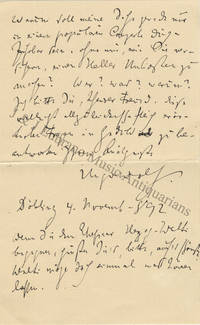
253123 pp. of a bifolium. 8vo 175 x 110 mm. Dated Döbling now part of Vienna November 4 1892. In black ink. In German with translation. <br/><br/>Wolf asks Sternfeld who is not named in the letter but may be identified by circumstantial evidence about the "popular concerts" series in Berlin which Sternfeld had suggested as a venue for showcasing Wolf's music. He doubts whether the setting of these concerts was suited to the purpose:<br/><br/>"Would you please most esteemed Sir be so kind as to reveal to me the character of the so-called popular concerts in Berlin. Are your popular concerts such at which the audience is eating drinking and smoking Of course such concerts would prohibit the performance of vocal music and when you proposed a popular concert to me you intended to perform my instrumental works only. In such a case a popular concert would not serve me well because as you know my specialty is vocal music. However should it be otherwise and should the said concerts also include vocal music then I would of course prefer such a popular concert to one at the Singakademie if only to save money. It also would appear that these popular concerts are held in the hall of the Philharmonic which should not be underestimated."<br/><br/>Creased at horizontal fold; short split to lower portion of central fold. "Wolf intensified the expressive vocabulary of the lied by means of extended tonality and post-Wagnerian declamation while retaining the defining elements of the song tradition he had inherited from Schubert and Schumann. Profoundly responsive to poetry he incorporated detailed readings of his chosen poems in the compositional decisions he made about every aspect of song: harmonic nuances tonal form melodic design vocal declamation pianistic texture the relationship of voice to piano etc. Seeking an art 'written with blood' he went below the surface of poetry - even where his musical purposes were inevitably distinct from the poet's - in order to recreate it in music of remarkable intensity written as he once proclaimed for epicures not amateurs." Eric Sams and Susan Youens in Grove Music Online.<br/><br/>Richard Sternfeld 1858-1924 was a prominent arts administrator in Berlin at the time. A board member of the Wagner-Verein he organized several performances of Wolf's works. <br/><br/>The Berlin concert Wolf was planning at the time finally took place on January 8 1894 - but not as a "popular" concert. Siegfried Ochs director of the Philharmonischer Chor conducted some of Wolf's choral-orchestral works. unknown books
1968260881968. Black and white photograph from the late 1960s of the Warren Court mounted to board signed by each member. The justices are John Marshall Harlan Hugo Black Earl Warren William O. Douglas William J. Brennan Jr. Potter Stewart Abe Fortas Potter Stewart Byron R. White and Thurgood Marshall. Light wear and crease to the bottom left corner. Matted and framed. The entire piece measures 15.5 inches by 18.5 inches. Rare and desirable. The Warren Court is best known for its landmark decisions which outlawed segregation in public schools and transformed many areas of American law especially regarding the rights of the accused ending public school-sponsored prayers and requiring "one man-one vote" rules of apportionment of election districts. He made the Supreme Court a power center on a more even basis with Congress and the Presidency especially through four landmark decisions: Brown v. Board of Education 1954 Gideon v. Wainwright 1963 Reynolds v. Sims 1964 and Miranda v. Arizona 1966. unknown books
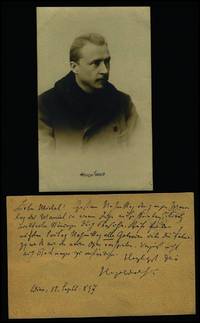
10889Used; Like New/Used; Like New. Autograph letter 1 page to Michael Haberlandt. Vienna 15 September 1897. The letter reports that Wolf has yesterday afternoon completed the monologue to Manuel despite the disturbance of numerous visits and reads in part: "Gestern Nachmittag den ganzen Monolog des Manuel in einem Zuge aufgeschrieben trotz vielfacher Storungen durch Besuche. Rufe fur den nachsten Sontag Nachmittag alle Getreuen unter die Fahne. Ich werde aus der neuen Oper vorspielen." 14 x 9 cm and in fine condition. Sold together with a vintage postcard photograph of the composer. <br><br><br />The Austrian folklorist and Indologist Michael Haberlandt 1860 - 1940 was an important supporter of Hugo Wolf and was one of the founders of the Hugo Wolf Society. <br><br><br />The Austrian composer died tragically young of syphilis while committed to an asylum for the insane and autograph material is uncommon. At the end of July 1897 Wolf had begun feverishly working on his opera "Manuel Venegas" and "despite interruptions the opera's opening began to take shape as Wolf's swings from manic gaiety to irascibility became more pronounced. In mid-September his boast that he had been appointed director of the Vienna Court Opera and had sacked the current director Gustav Mahler signaled the onset of madness. Inviting his friends to hear his new opera and congratulate him on September 20 he played through the 50 completed pages of vocal score blissful raving and wholly insane as his friends clustered around him in stunned misery -- a scene famously adapted by Thomas Mann in his novel Doktor Faustus 1947. Wolf's polished fragment introduces characters and motifs without reaching the great dramatic moments that had tempted him though the opening Spring Chorus is one of the freshest most evocative and inspired in his entire oeuvre." Adrian Corleonis All Music unknown books
1894283788Philadelphia: Barrie & Jenkins 1894. hardcover. 41 volumes small 8vo 3/4 blue morocco marbled boards gilt spine with fleur de lys design top edges gilt. Philadelphia: Barrie & Jenkins 1894. Limited Edition. Edition Definitive. Near Fine.<br/><br/> Number 128 of 1000 sets.<br/><br/> Barrie & Jenkins unknown books
18874511Chicago: A. C. McClurg & Co 1887. Two Volumes: Expanded into Extra-Illustrated volumes see below. Superbly bound by the Monastery Hill Bindery unsigned but documented per below and through descent provenance in full maroon crushed morocco with rectilinear design motif shields stylized bird etc on both covers wide inner dentelles with elaborate gilt ruling. The book has been personally assembled by Ernst Hertzberg the original founder and principal first binder of the firm in 1902 of the Monastery Hill Binder. From "Exhibit of Bookbinding" St. Louis Ringer & Hertzberg 1904 this important documentation explaining the incredible origination of this extra-illustrated volume: "This work was especially gotten up by Ernst Hertzberg for the Universal Exposition of 1904 to show the art of Bookbinding in this line in America. Provenance: Through descent through Hertzberg family and Monastery Hill Bindery. Extra-Illustrated with "many Copper and Steel Plates Etchings and Photogravures extended into two volumes" printed on title-page which has been adapted by Hertzberg to contain additional information. As well printed in red at bottom of title page: "This was especially gotten up for the Louisiana Purchase Exhibition St. Louis 1904 to show the Art of Bookbinding in America by Ernst Hertsberg 110 Randolf St. Chicago. Spines slightly worn at margins a nicely preserved set of important historical reference. <br/><br/> A. C. McClurg & Co unknown books
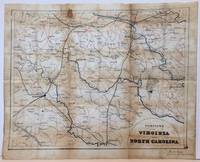
186563086In the field North Carolina 1865. Detailed manuscript map of a large portion of eastern North Carolina. Pen-and-ink manuscript map on glazed cotton of a large portion of the eastern North Carolina theater in the spring of 1865 17 3/4 x 22 inches from just east of Williamston and Murfreesboro on the east to just west of Chalk Level on the Cape Fear and West Point on the west and from just south of Goldsboro on the south to the North Carolina-Virginia state line on the north despite the title no land area of Virginia is included. The cartographer has shown the area in rich detail the rivers especially the Meherrin Roanoke Tar Neuse and Cape Fear creeks streams and swamps in blue ink and watercolor railroads and primary roadways in bold black ink place names swamps and other features in thin black ink and the intricate pattern of local roads are given in red ink; virtually all of the cities towns crossroads settlements railroads waterways railroad stops river crossings etc. are identified. No troop positions are given. The map is signed by Deprezin in the lower right corner as given above; we have been unable to locate any other maps prepared by Deprezin. An excellent manuscript map of east-central North Carolina near the close of the Civil War. Some browning one small old stain several ink smudges but very good. Pen-and-ink and watercolor on glazed cotton folded. Deprezin apparently served in the 119th New York Infantry throughout the Civil War mustering out with the unit in New York in June 1865 at the time one of seven captains in the regiment. With the 119th Deprezin served first in Virginia defending Washington and in the Chancellorsville and Gettysburg campaigns; detached to the Army of the Cumberland the unit served in the Chattanooga and Knoxville campaigns in late 1863 the Atlanta campaign and the March to the Sea in 1864 and the campaign in the Carolinas through May 1865 participating in the battle at Bentonville and the occupations of Goldsboro and Raleigh. The unit was on hand for Johnston's surrender to Sherman at the Bennett Farm near present day Durham which is located on the map. Deprezin was mustered into the unit as a 23-year old sergeant in 1862 wounded at Chancellorsville and then promoted to lieutenant; he was promoted to captain in July 1864. 9844. <br/><br/> unknown books
1872VH004Paris: Michel Lévy Frères 1872 First edition. Presentation copy signed and inscribed by Hugo on the half-title to close friend and fellow writer Ernest d'Hervilly: A mon cher et charmant/ poëte d'Hervilly / Victor Hugo." Finely bound in three-quarter blue crushed morocco over black and blue marbled boards spine lettered in gilt four raised bands speckled edges gray marbled endpapers original gray printed front wrapper bound in at front. Spine lightly faded mild rubbing and slight wear to the extremities front wrapper with some light staining; internally very clean with a few scattered spots else near fine. . Signed by Author. First Edition. Hard Cover. Near Fine. Paris: Michel Lévy Frères hardcover books
189288108Philadelphia: W.H. Campion & Co 1892. Finely bound national edition set of the novels of Victor Hugo. Quarto 14 volumes bound in three quarters morocco over marbled boards gilt titles and tooling to the spine raised gilt bands top edge gilt marbled endpapers. One of 1000 copies privately printer for a limited subscriber list. This is set number 205 which has been subscribed for by Mr. William P. Bonbright Colorado Springs Co. with his bookplate to the front panel of each volume. Each volume is profusely illustrated with engravings with tissue guards and a table of contents at rear. In near fine condition. An exceptional example. Victor Hugo was a French poet novelist and dramatist of the Romantic movement. He is considered one of the greatest and best-known French writers. His best-known works are the novels Les Miserables 1862 and Notre-Dame de Paris 1831 known in English as The Hunchback of Notre-Dame. He produced more than 4000 drawings and also earned respect as a campaigner for social causes such as the abolition of capital punishment. W.H. Campion & Co hardcover books
1915239530Philadelphia: Barrie 1915. hardcover. fine. 10 volumes 8vo handsomely rebound in 3/4 brown morocco over marbled boards; gilt-ruled and lettered spine with raised bands. all edges gilt. Philadelphia: Barrie 1893.<br/><br/> Part of the Complete and Unabridged Novels. Edition de Bibliophile limited to 250 sets on Japanese vellum. Containing 519 etchings in two printings one in black and one in bistre and 75 double page etchings in black all on Japanese vellum.<br/><br/> Barrie unknown books
1892108436Boston: Estes & Lauriat 1892. Limited edition one of 500 copies of the Holland Paper edition. Octavo 30 volumes bound in contemporary three quarters morocco gilt titles and tooling to the spine top edge gilt frontispiece to each volume numerous plates. In near fine condition. Victor Marie Hugo was a French poet novelist and dramatist of the Romantic movement. He is considered one of the greatest and best known French writers. In France Hugo's literary fame comes first from his poetry but also rests upon his novels and his dramatic achievements. Among many volumes of poetry Les Contemplations and La Légende des siècles stand particularly high in critical esteem. Outside France his best-known works are the acclaimed novels Les Misérables 1862 and Notre-Dame de Paris 1831. Estes & Lauriat unknown books
1926249499New York: Ernest Gee 1926. Large Paper One of 28 unnumbered copies. Engraved portrait by Gordon Ross titlepage engraving. vi 24 2 pp. 1 vols. 8vo 9.25 x 6.25 inches. Green paper boards white cloth spine paper label on front cover. Ross Gordon. Large Paper One of 28 unnumbered copies. Engraved portrait by Gordon Ross titlepage engraving. vi 24 2 pp. 1 vols. 8vo 9.25 x 6.25 inches. INSCRIBED LARGE PAPER. The original edition of this book was so rare that Mr. Gee the great sporting bookseller reprinted it for his friends.<br/>Frazier writes: "the book and its design paper binding and style are so obviously Derrydale in spirit and influence that one only to put it side by side with Connett's AMERICAN TROUT STREAMS by Henry Ingraham produced the following year to see how this book and the books of the Press came together. The question would be whether Ernest Gee had more influence on Connett in 1926 or whether Connett had more influence on Gee in this important year when together they formed the group that formed the press." Siegel clearly felt this was not a Derrydale because in the early days of the Press Connett used J.N. Johnston for the printing of the Press books and no connection can be established with August Becker who printed this work. <br/>In Ernest Gee's catalogue No. 10 printed around 1928 he lists this title in two areas. In one instance he states "A small privately printed edition." and in the other mention he declares "Edition limited to 330 copies" with no mention of a Deluxe state.<br/><br/>Inscribed on the front flyleaf "Mrs. Jackson A. Dykman/ With the best wishes from/ Ernest R. Gee/ New York. Dec 1926." Siegel p. 182; Frazier M-6-D; Biscotti Six Centuries of Foxhunting pp. 176-8 Ernest Gee unknown books
1925108026Boston: The Stratford Company 1925. First edition of "arguably the first major work of American science fiction" The Economist. Octavo original cloth. Signed by the author on the front free endpaper "With the compliments of the author H Gernsback 1925." Near fine in a very good dust jacket. Bookplate on the front pastedown. "In 1908 Gernsberg established 'Modern Electrics' a radio catalog that rapidly became a monthly magazine; one of its editorials was instrumental in establishing the Wireless Act of 1912. In April 1911 'Modern Electrics' began serializing Gernsback's Ralph 124C 41 written to exemplify his contention that fiction could serve to teach science. Thoroughly deficient as fiction the story nevertheless predicts radar microfilm and microfiche tape recorders television wireless transmission of power planet hormones and weather control" American National Biography. The Stratford Company hardcover books
1834140940930Philadelphia: Carey Lea and Blanchard 1834. First American Edition. Near Fine. First American edition. Two volumes bound in publisher's original dram boards over blue cloth spine; title labels perished. Binding worn corners softened and contents foxed old tidemarks to bottom corner of several early pages. Chip to edge of first blank in Volume II. Lower third of rear free endpaper lacking in Volume I and rear blank near-completely missing from the second volume. Housed in a custom cloth chemise case. Carey, Lea and Blanchard unknown books
1926251066n.p.: Privately Printed for Ernest R. Gee at the Press of August Becker Brooklyn 1926. Large Paper. One of 28 copies on Large Paper. Frontispiece portrait by Gordon Ross. Title-page vignette of a foxhound. vi 24 2 pp. 1 vols. 8vo. Original cloth-backed boards printed paper label on front cover. An immaculate copy in its original glassine dust jacket spine of which is partially gone. Bookplate. In custom quarter crimson and cloth slipcase with leather label on upper cover. Large Paper. One of 28 copies on Large Paper. Frontispiece portrait by Gordon Ross. Title-page vignette of a foxhound. vi 24 2 pp. 1 vols. 8vo. ONE OF 28 COPIES. Inscribed by Gee "To Mr. Wilson S. Mills / with the compliments of / Ernest R. Gee / New York / April 1945." <br/>While there is disagreement as to whether this volume is one of the Derrydale Press works Frazier states: "But the book and its design paper binding and style are so obviously Derrydale in spirit and influence that one has only to put itside by side with Connett's American Trout Streams.produced the same year 1926 or Connett's own Magic Hours produced the following year to see how this book and the books of the Press came together. The only question would be whether Ernest Gee had more influence on Connett in 1926 or whether Connett had more influence on Gee in this important year when together they formed the group that formed the press." Frazier<br/><br/>In Ernest Gee's catalogue No. 10 printed around 1928 he lists this title in two areas. In one instance he states "A small privately printed edition." and in the other mention he declares "Edition limited to 330 copies" with no mention of a Deluxe state. Frazier M-6-D; Siegel p. 182 note; Biscotti Six Centuries of Foxhunting pp. 176-8 Privately Printed for Ernest R. Gee [at the Press of August Becker, Brooklyn] unknown books
19004885Berlin: Verlage der Insel bei Schuster & Loffler 1900. First edition. First edition. Original publisher's full stiff vellum binding with gilt lettering on spine stunning full color endpapers designed by Vogeler in green and red and highlighted in gold. Richly illustrated by Heinrich Vogeler with the celebrated double-spread illustrated title page and frontispiece in Jugendstil/Art Nouveau featuring vivid colors including green red blue brown and highlighted in gold. Illustrated half title and initials. Printed in only 200 numbered copies of which this is Nr. 145. Printed on handmade thick paper with watermark of the Insel Verlag. Printed in red and black throughout with elaborate artistic layout on Alfred Walter HeymelÃs commission by Otto von Holten. In publisherÃs vellum with the inner edges stamped in repeating gilt design. A remarkable copy one of the nicest we have seen of this incomparable classic with the stiff vellum boards nearly perfect with no warping whatsoever. Small wear to edge of front panel a few brown stains to endpapers. Copious notes in pencil about the edition and old auction records on the verso of the front endpaper. Old presentation inscription on first blank leave. Inside clean and bright and overall in fine condition. One of the most beautiful early publications of Insel with illustrations by Heinrich Vogeler. VogelerÃs title page for "Der Kaiser" HofmannstahlÃs lyrical one act play is considered the peak of German Art Nouveau and also one of his masterpieces. In a superb green fine wove cloth clamshell case with quarter contrasting dark green crushed leather spine gilt ruling and stippling and lettering on spine and lined in lighter green felt by Sean E. Richards. Verlage der Insel bei Schuster & Loffler unknown books
6928Portfolio of original photographs mainly from 210 x 300 mm. to 240 x 330 mm. depicting artillery field guns howitzers cannons ammunition wagons etc. produced by Friedrich Krupp. 53 mounted photographs some partly faded on 51 stiff boards 640 x 480 mm. all boards signed "Photogr. Atelier des Krupp'schen Etablissements." Large oblong folio 645 x 500 mm. orig. red cloth folder a little rubbed & soiled with title printed in gilt on cover metal protectors at corners. Essen: dated 1869-76. A very rare portfolio issued by the Krupp Steel Works with 53 original albumen photographs. A sort of trade catalogue showing the different cannons other weapons and military equipment manufactured by Krupp it was created for clients who were considering purchasing these products for their government or army. This album comes from the family collection of Otto von Bismarck chancellor and unifier of Germany and was presented to him by Krupp presentation slip laid-in. Alfred Krupp proved to be exceptionally progressive in his use of the art of photography. Employing this medium he persuasively presented the complexity of his huge enterprise to a wide public. The photographs were made to impress his far-flung clientele of "States Governors and Khans." Krupp had his publicity team assemble portfolios of relevant photographs depicting the tools of war and sent them to possible clients. This set is such an example: a miscellany of images selected to demonstrate to Bismarck the wide range of products manufactured by Krupp. "In 1861 one of the most remarkable figures in German industrial history Alfred Krupp commissioned his far relative Hugo van Werden 1836-1911 to learn photography in a studio in Hannover then well-known for its qualities in depicting industrial products. After a short apprenticeship van Werden set up the Krupp photographic and lithographic institute which from then on had to deliver all visual materials used for documentation press releases and public relations for Krupp's steel company. As early as 1862 on the occasion of the London World Fair Krupp was able to show and deliver large quantities of photographs of all his products and the company gained fame for the use of the new medium in advertising."-Rolf Sachsse in Encyclopedia of 19th-Century Photography p. 584. In fine condition although some of the photographs are inevitably slightly faded. 48 of the boards are numbered: 1 4 6 8 11 12 14.D.R. 16.M. 18.R 20 23 25 26 28 30 30A 30B 32 32A 33 34 35 36 38 39 40 41 42 43 45 46 47 48 48B 49A 51 54 54A 55 57 58 59 59A 60 61 62 63 and 64. Three are unnumbered. hardcover books
1862122855Bruxelles: Lacroix Verboeckhoven & Ce 1862. Rare first printing of this classic work of literature published in Brussels on the 30th or 31st March 1862. Octavos 10 volumes bound into 5 bound in contemporary full morocco gilt titles and tooling to the spine all edges gilt marbled endpapers. From the library of painter George Cooke with his bookplate to the front pastedown of each volume. Cooke was a painter who specialized in portrait and landscape paintings and was one of the South's best known painters of the mid nineteenth century. In very good condition. A nice example with noted provenance. Victor Hugo's "great novel has been hailed as a masterpiece of popular literature an epic poem in prose about God humanity and Hugo. Hugo hoped that Les Miserables would be one of if not the 'principal summits' of his body of works. Despite its length complexity and occasionally unbelievable plot and characterization it remains a masterpiece of popular literature. It anticipates Balzac in its realism but in its flights of imagination and lyricism its theme of redemption and its melding of myth and history it is uniquely Hugo" Dolbow 149 214. Charles E. Wilbour was hired by the Carleton Publishing Company to translate Hugo's grand masterpiece and he did so very quickly allowing the first American edition to be published within months of its French release. The intense advertising campaign waged by Carleton resulted in massive sales for Les Miserables solidifying Hugo's epic in second place behind only Uncle Tom's Cabin in pre-Civil War American book sales. Lacroix, Verboeckhoven & Ce unknown books
1831307333Paris: Charles Gosselin 1831. First edition third issue. Title vignettes by Tony Johannot. viii 404; iv 536 pp. 2 vols. 8vo. Bound to style in the early 20th-century in red half morocco and embossed paper over boards smooth spines stamped in gilt and blind to cathedral design t.e.g. the rest uncut by René Aussourd signed in gilt at foot of spine and on front free endpaper. Slight rubbing to extremities expert paper repair to lower outside corner of vol. I half-title and repairs to a few other paper faults throughout. In a custom gilt-ruled full brown morocco slipcase and chemise by R. Patron. Johannot Tony. First edition third issue. Title vignettes by Tony Johannot. viii 404; iv 536 pp. 2 vols. 8vo. First edition third issue of Hugo's first great success as a novelist The Hunchback of Notre-Dame in a fine retrospective binding by René Aussourd. Though styled the "Troisème Édition" on the title-page this is in fact the third issue of the first edition. The entire edition consisted of four separate issues of 275 copies each with each issue designated as a separate edition on the title-page. <br/><br/>Notre-Dame de Paris is more commonly known in English as The Hunchback of Notre-Dame the title under which the first English translation by Frederic Shoberl appeared in 1833. Set in 15th-century Paris the novel introduces a memorable cast of Romantic characters; some such as the hunchback Quasimodo and the gypsy girl Esmérald have so permeated our culture that they've reached the status of archetypes. Hugo hoped that his novel would reverse the sad neglect of Gothic architecture in his country much of which had fallen into ruin or been brutally altered. Indeed Hugo created a depiction of Notre-Dame "so erudite and familiar that it caused a revolution in architectural taste. The success of this darkly moving novel was immediate establishing Hugo as the premier historical novelist of his time" Oxford Companion to Literature in French.<br/><br/>In a fine retrospective French romantic binding by René Aussourd recalling the work of Simier or Thouvenin. Aussourd studied under his uncle Charles Meunier and was first gilder at Chambolle-Duru before starting his own business in 1912 Devauchelle III p. 243. Carteret I p. 402 Charles Gosselin unknown books
5946Six albumen prints from wet collodion negatives each 430 x 430 mm. each mounted on stiff card stock panels each panel measuring 620 x 430 mm. joined together with the orig. linen with the lithographed title at foot of the two middle panels. Preserved in the orig. green cloth-backed board portfolio ties gone. Essen: F. Krupp ca. 1872-73. A magnificent and rare photographic panorama of the Krupp Steel Works in Essen consisting of six albumen prints each mounted on paper board panels measuring altogether 430 x 2480 mm. The industrial steel manufacturer Friedrich Krupp AG was the largest company in Europe at the beginning of the 20th century. One of the most powerful business dynasties in Europe for 400 years Krupp flourished as the premier weapons manufacturer of Germany. From the Thirty Years' War until the end of the Second World War they produced everything from guns and cannons battleships U-boats tanks and hundreds of other products. "In 1861 one of the most remarkable figures in German industrial history Alfred Krupp commissioned his far relative Hugo van Werden 1836-1911 to learn photography in a studio in Hannover then well-known for its qualities in depicting industrial products. After a short apprenticeship van Werden set up the Krupp photographic and lithographic institute which from then on had to deliver all visual materials used for documentation press releases and public relations for Krupp's steel company. As early as 1862 on the occasion of the London World Fair Krupp was able to show and deliver large quantities of photographs of all his products and the company gained fame for the use of the new medium in advertising.On top of the Krupp stand at the World Fair in London in 1862 there was a large photograph showing the Essen company site. Made of 12 images it correlated to a recent fashion among manufacturers: showing a bird-like view of their establishment."-Rolf Sachsse in Encyclopedia of 19th-Century Photography p. 584. In the century prior to the advent of photography panoramic painting reached a pinnacle of development in which whole buildings were constructed to house 360 degree panoramas and even incorporated lighting effects and moving elements. Indeed the career of one of the inventors of photography Daguerre began in the production of popular panoramas and dioramas. Shortly after the invention of photography the desire to show overviews of cities and landscapes prompted photographers to create panoramas. The development of panoramic cameras was a logical extension of the 19th-century enthusiasm for panorama. Because of the high cost of materials and the technical difficulty of properly exposing the plates Daguerreotype panoramas especially those pieced together from several plates are rare. After the advent of wet-plate collodion process photographers would take anywhere from two to a dozen of the ensuing albumen prints and piece them together to form a panoramic image. This photographic process was technically easier and far less expensive. The history of photography and the modern manufacturing of steel have been interwoven since both came into being in the mid-19th century. Photography of steel mills began about the same time that modern steel making became possible through invention of the Bessemer converter furnace in 1855. Photographers have actively engaged this topic ever since. Photographing the steel industry has always presented technical as well as aesthetic challenges but no challenge was more daunting than that of access. Mere fascination with industrial architecture the dramatic processes of transforming raw iron ore to finished steel or the many tasks performed by steel workers did not entitle a photographer to take pictures of mills. The pioneering German industrialist Alfred Krupp hired Hugo van Werden as the company's first full- time photographer. As an employee van Werden had unlimited access to take photographs of the factory. The stunning nature of van Werden's early photographs interpreted Krupp's business vision. Van Werden's task was to document Krupp's rapidly expanding company; he began to make periodic panoramas of the Kruppsche Gußstahlfabrik in Essen in 1861. These panoramas started modestly and ended up being monumental. Krupp's intensive advertising work for his company as well as the company's presence in commercial and world exhibitions was important in the success and economic expansion of the company. Krupp used the new medium photography for the self-presentation and documentation of his emerging company. In addition to a historical department which was founded in 1861 Krupp set up an atelier for photographers. Not only the individual products but also the company as a whole were documented by means of the photographic image. Our 180 degree panoramic view of the cast steel factory was taken by van Werden at the request of Krupp from a tower of the cannon workshop. Krupp himself gave the order to photograph the factory on a Sunday because "the work days carry too much smoke steam and restlessness." The elevated viewpoint provides an overview of the extent of the factory which transitions into the landscape on the horizon. The panoramic view over the roofs of the factory buildings along the chimneys to the landscape gives the impression of a self-contained world. From the tower one looks westward over the works to the surroundings of Essen. The arranged scenery - the factory buildings still partly under construction the workers and steam locomotives the railway bicycles and other steel goods transported throughout the plant - give the impression of remarkable economic activity. In fine and fresh condition. From the library of Otto von Bismarck no doubt presented to him by the firm. ❧ Tenfelde Pictures of Krupp: Photography and History in the Industrial Age 2005. hardcover books