227 résultats
1837100463(Paris, Victor Magen, 1837), in-8, paginé 330 à 409, Demi-toile brune postérieure, Deuxième édition en librairie de cette nouvelle, précédemment publiée dans la Revue de Paris (1830). Elle est extraite du Dodecaton ou le Livre des Douze, recueil romantique paru à Bruxelles en 1836 (Wahlen) puis à Paris (Magen) en 1837. Reliure modeste. Carteret I, 219. [Exposition 1983] Stendhal et l'Europe, Paris, BNF, p. 10. Vicaire III, 280-281. Couverture rigide
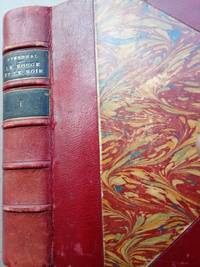
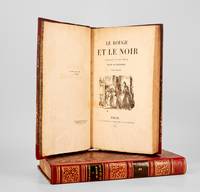
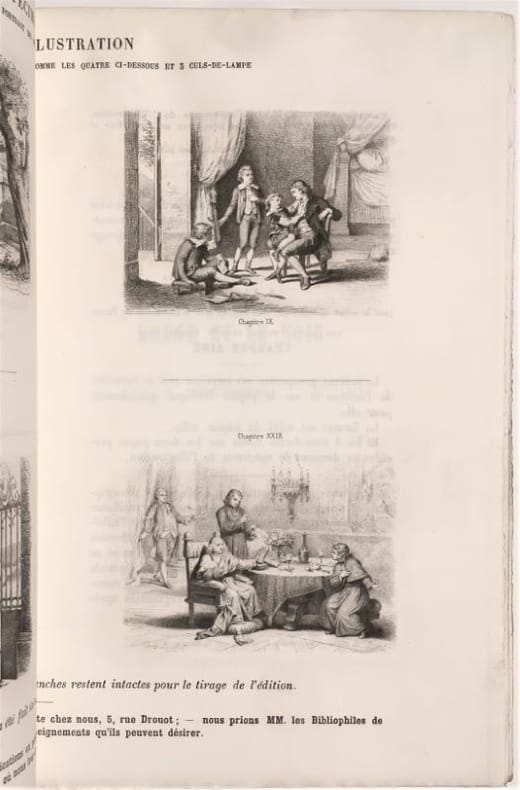
1884977Q20Paris : Librairie L. Conquet 1884 . Leather. Very Good Indeed. 10" by 7". H. Dubochet . A beautiful Ramage-bound limited edition copy of Stendhal's popular psychological novel Le Rouge et le Noir with illustrations from H. Dubouchet. Limited edition of 500 copies. One of the first 150 copies to be printed on Japanese paper. This is No. 73. Elegantly bound by Ramage in full turquoise morocco with gilt tooling and dentelles. With the original wraps bound in. Complete in three volumes. First published in 1830 'Le Rouge et le Noir' or 'The Red and the Black' tells the story of a provincial young man attempting to rise socially escaping his modest upbringing through hard work talent and deception. Written in the original French by Marie-Henri Beyle a French author best known under his pseudonym Stendhal. Beyle received wide acclaim for this novel alongside 'La Chartreuse de Parme' and is particularly praised for his pioneering use of realism in his writings. With a preface by Leon Chapron.Illustrated with eighty engravings by H. Dubouchet containing a portrait 76 vignettes and 3 page adornments. Vignettes are duplicated with each in-text illustration having a corresponding full-page plate with a tissue guard. Bound in full morocco by Ramage. Externally lovely with light rubbing to the extremities slight fading to the spines and the odd light mark. Internally firmly bound. Pages are bright and clean. Bookseller label to front paste down. Very Good Indeed Librairie L. Conquet hardcover

1886253251Paris: Lemerre 1886. Halbleder. Lemerre unknown
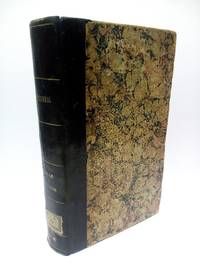
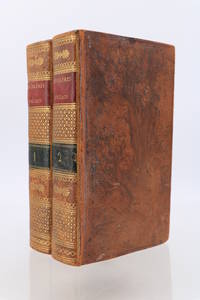
183187102Paris: A. Levavasseur 1831. Fine. A rare copy with no foxing A. Levavasseur Paris 1831 13.10 x 20.80 cm 2 volumes reliés First edition ""very rare and extremely sought-after"" Clouzot one of 750 copies on laid paper with title vignettes engraved by Henri Porret after Henry Monnier. Skilful restoration of a tear at the foot of a page with slight damage to a letter. A rare copy with no foxing. Green half calf binding smooth spines with arabesques stamped in gilt black title labels and volume labels; marbled paper boards spine boards and endpapers speckled edges later bindings in the Romantic style. Stendhal began writing 'Le Rouge et le Noir' under the Restoration and completed it just four months after the July Revolution of 1830. The seminal novel was published in the last weeks of 1830. All critics immediately praised the novel's exceptional qualities although even its most enthusiastic supporters were shocked by the hero's harsh judgment of society and Jacobinism. A handsome first-edition copy of this great classic of French literature. A. Levavasseur hardcover
183188395Paris Paris: A. Levavasseur 1831. Fine. First edition in contemporary binding of one of the rarest and most sought-after Romantic novels A. Levavasseur Paris Paris 1831 14 x 22 cm 2 volumes reliés First edition untrimmed with wide margins very rare and highly sought-after see Clouzot. Some occasional foxing. Illustrated on the title pages of both volumes with two engraved vignettes by Porrêt. This copy contains the publishers notice leaf in the first volume and the authors note leaf in the second volume. Contemporary red half calf over marbled boards calf corners spines ruled in gilt with double gilt panels decorated with typographic gilt tooling black calf title and volume labels some minor rubbing to joints marbled endpapers and pastedowns lower corners a bit worn bookplate pasted on the front pastedown of volume one contemporary bindings. A very rare and desirable copy entirely untrimmed and preserved in a handsome contemporary binding an even rarer feature. As noted by Clouzot: Contemporary bindings are most often rather plain; one should not be overly particular regarding their quality. A. Levavasseur hardcover
1886064334Paris: Lemerre 1886. Stendhal Oeuvres; 2 Bände; LV 408 430 S.; mit 1 Stahlstichfrontispiz je 1 Titelvignette u. Kapitelbordüren; unikater Handeinband in weinrotem Ganzleder aus der Buchbinderwerkstatt Rönsberg Langenberg/Wuppertal rundum Rotschnitt. Leder. Sehr gut. 157 cm. Handeinband. Lemerre Hardcover
1846435822ª. Ed.- Paris: Publie par J. Hetzel Imp. Centrale de Napoleon Chaix et Cie. 1846.- 2 h. 468 p.; 8º 18 x 113 cm; Media Piel época.- Oeuvres de Stendhal. La encuadernación algo rozada pero restaurada quedando en bastante buen estado. LITERATURA Y ESTUDIOS LITERARIOS EXTRANJEROS DE LOS SIGLOS XVI-XXI Livre en français Publie par J. Hetzel (Imp. Centrale de Napoleon Chaix et Cie.) hardcover
1831500377468A. Levavasseur Libraire Palais Royal 1831 1831.
183187102A. Levavasseur | Paris 1831 | 13.10 x 20.80 cm | 2 volumes reliés
183188395A. Levavasseur | Paris 1831 | 14 x 22 cm | 2 volumes reliés
18841581884 Paris, Conquet, 1884 ; 3 vol. in-8 de [2] ff., xxiv-324 pp. ; [2] ff., 338 pp., 1 f. bl. ; [2] ff., 374 pp., [6] ff. (dont 3 cartons), demi-maroquin à long grain prune, à coins, filet doré, dos à nerfs plats ornés, têtes dorées, non rognés, couvertures et dos (V. Kraft).
18311979Paris: A. Levavasseur 1831. First edition. Fine. A Fine copy of Stendhal's masterpiece and one of the major literary works of 19th century France. A lovely copy entirely untrimmed pages 181 x 140 mm with the original wrappers bound in to each volume including the spine panels. Elegantly bound by Edouard Pagnant of Paris 1852-1916 in green half-morocco over marbled boards spine with gilt titles and decorated columns marbled end papers. Internal contents clean and fresh quite rare and desirable with the original printed wrappers. Upper wrapper and titles with vignettes of Henry Monnier engraved by Porret. Volume one vignette shows Julien Sorel appearing to Madame de Renal near a confessional; volume two shows Mathilde de La Mole holding the head of Julien Sorel.<br/><br/>Stendhal's surprisingly modern bildungsroman about the rise and fall of the romantic Julian Sorel who attempts to climb the rungs of French society and surpass the expectations of his modest rural upbringing. The novel is not only an exploration of Julian's own psychological and spiritual struggles but also a satire of the clergy and French society in general. "The Red and The Black like much of Stendhal's work was not appreciated in his own day. It was only after Stendhal's death that critics began to realize what a revolutionary stylist he was. He's currently credited as one of the fathers of psychological realism due to the space he devotes to his characters' inner lives. "Stendhal's mind was of the first order. he wrote his two novels which so few people have read in a spirit of fearless liberty" Joseph Conrad. Fine. A. Levavasseur unknown books
18621192491862 A Paris, Michel Lévy Frères, Libraires-éditeurs - 1862 - Troisième édition, notée "Seule édition complètes, entièrement revue et corrigée" - In-12, demi basane camel; 4 nerfs, auteur, titre et fleurons dorés au dos - 503 pages
18543991854 À Paris, chez Michel Lévy Frères, 1854.
181491120Paris: Chez H. NicolleDe l'Imprimerie de C.-F. Patris 1814. Fine. Anonymous work attributed to Anna Maria Porter which inspired Stendhal's masterpiece ""La Chartreuse de Parme"" Chez H. Nicolle De l'Imprimerie de C.-F. Patris Paris 1814 10.2 x 17.4 cm Relié First edition of the French translation by Élisabeth de Bon gathering in 2 volumes the 4 parts of this anonymous English novel originally printed in 1809 which according to André Marc in his Dictionnaire des romans anciens et modernes of 1819 is the work of Anna Maria Porter younger sister of the novelist Jane Porter. The Porter sisters contemporaries of Jane Austen and famous before the Brontës were close to the Scottish poet Walter Scott. Contemporary full brown tree sheep smooth spines divided into compartments richly gilt in decorative rolls of laurels annulets and lozenges two compartments with a lozenge network formed by interlacing fillets with fleurons at the corners red and green morocco lettering-piece and numbering-piece blind-tooled fillet border to boards gilt fillet to turn-ins edges sprinkled red marbled endpapers in pebbled pattern. Some light surface wear and minor offsetting to boards corners slightly worn. On volume 1 a charming error in the decorative roll at foot of spine corrected by the binder. On volume 2 small piece of leather at the edge of the numbering-piece slightly detaching. Scattered foxing and faint marginal damp-staining to upper margins. In volume 3 two minor marginal repairs to half-title and p. 8. Several period textual corrections in brown ink and pencil: volume 1 p. 131 volume 2 p. 90 and volume 3 p. 21. In the early nineteenth century English novels were widely translated into French. According to the critic signing as ""E."" in the Journal de l'Empire Les Frères Anglais is a success and according to another reviewer writing for the Gazette de France the French translation as much as the original text deserves praise: ""We have already had the opportunity in this Gazette to praise the translator. English novels are much vaunted but the choice is vast; some prove mediocre and even detestable. This one does honour to the good sense of Madame Elisabeth de B. The situations are lively and varied the characters well drawn; the work pleases and holds one's attention from beginning to end."" Gazette de France December 4 1814 ""What astonishes readers who cannot transport themselves into the society whose customs are depicted and who insist on judging everything by the habits of their own circle is the liberty of young English ladies. If their novels offer a faithful picture of their manners and habits these young women converse familiarly in tête-à-tête with their suitors; they write to them even give them their portraits; they tell their parents without ceremony that their heart is engaged. Never would a French demoiselle make such a frank avowal; at most she allows her secret to be guessed."" Journal de l'Empire May 10 1815 our own translation Two women of letters were behind this literary success: Élisabeth de Bon a translator renowned in her lifetime also a novelist short-story writer and co-proprietor of the periodical the Mercure de France and a mysterious authoress. The name of Anna Maria Porter absent from the title-page would be revealed by the bookseller André Marc as that of the author in 1819. Precocious and prolific Anna Maria began writing and publishing books during adolescence nearly a decade before her elder sister Jane. In 1807 she published The Hungarian Brothers and in 1809 she is thought to have written The English Brothers. These two works with their near-identical titles like false twins are the starting point according to Richard Bolster for the attribution of the latter novel to Anna Maria Porter. It was precisely the same translator Élisabeth de Bon who undertook the translation of the third edition of The Hungarian Brothers in 1818 and in 1815 that of another of the author's works The Recluse of Norway. The En Chez H. NicolleDe l'Imprimerie de C.-F. Patris hardcover
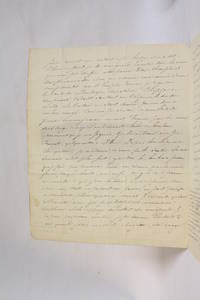
1808689671808. Fine. 26 mars 1808 20 x 24.80 cm 3 pages 1/2 sur un double feuillet Long autograph letter by Stendhal addressed to his sister Pauline written in fine handwriting with black ink. Address of Stendhal's father where his sister resides in Grenoble with the stamp ""n°51 Grande Armée."" Red wax seal bearing Stendhal's coat of arms. Several original folds inherent to postal delivery. A paper loss due to the unsealing of the letter has been skillfully restored. Published in his Correspondance ed. Henri Martineau Paris Le Divan 1933 vol. 3 no. 262 A pp. 26-29. A very beautiful letter filled with romantic passion blending childhood nostalgia with sentimental tales and foreshadowing The Red and the Black. This letter is part of the correspondence between twenty-five years old Henri Beyle and his sister Pauline three years his junior. This epistolary relationship which quickly took the form of a ""journal"" as Pauline's responses were rare. It is deemed a crucial milestone in the intellectual development of the future Stendhal: ""Here are my dreams my dear friend; I am almost ashamed of them; but after all you are the only person in the world to whom I dare confess them."" In this letter which attests to the strong bond between brother and sister Stendhal then in Germany expresses his deep nostalgia: ""I revisited in my memory all the time we spent together: how I did not love you in our childhood; how I once hit you at Claix in the kitchen. I hid in the little book cabinet; my father came back a moment later furious and said to me: 'Wicked child! I would eat you!' Then all the woes inflicted upon us by poor Aunt Séraphie; our walks along those paths surrounded by stagnant water towards Saint-Joseph."" These regrets about the past are accompanied by a typically Stendhalian melancholy: ""Alas! That delightful happiness I once imagined I glimpsed it once at Frascati and a few other times in Milan. Since then it has not returned; I marvel at my inability to feel it. The mere memory of it is more powerful than all the present joys I can procure."" This evocation of the Italy he longs for is intertwined with memories of the women he loved: ""I told you that while in Frascati at a charming fireworks display at the moment of the explosion Adèle leaned on my shoulder for an instant; I cannot express how happy I was. For two years whenever I was overwhelmed with sorrow this image gave me courage and made me forget all my troubles. I had long forgotten it; I tried to recall it today. Against my will I see Adèle as she is; but as I am now there is no longer the slightest joy in this memory."" This lengthy account of Adèle Rebuffet his cousin with whom he had a profound romantic relationship before forming a closer bond with her mother reflects Stendhal's sentimentality. He also mentions another of his great passions Angelina Pietragrua the ideal Italian woman and embodiment of his Milanese memories: ""Madame Pietragrua is different: her memory is linked to that of the Italian language; whenever something pleases me in a role for a woman in a work I involuntarily put it into her mouth."" This ""role for a woman"" that Stendhal refers to echoes the central theme of this letter the work Il Matrimonio segreto by composer Cimarosa: ""Do you sometimes play the Matrimonio Its the passage Cara sposa at the beginning between Carolina and Paolino. . But play the Matrimonio for my sake especially Signor deh permettette and the finale Io rival de mia sorella."" This opera by Cimarosa remained a constant throughout the writer's life and work. In his Memoirs of an Egotist 1832 he explains: ""In Milan in 1820 I wanted to have this written on my tomb . I wanted a marble tablet in the shape of a playing card: ""Errico Beyle - Milanese - Visse scrisse amò - Quest'anima adorava Cimarosa Mozart e Shakspeare - Morì di anni. il . 18."" ""Henri Beyle - Milanese - He lived wrote loved - This soul adored Cimarosa Mozar unknown
1892134884Paris: Calmann-Levy 1892. 1st edition. Nice copy. small octavo. 3/4 cloth iii 335pp. FRENCH TEXT. Burgundy cloth over marbled boards Calmann-Levy hardcover
1892RO80070644CALMANN LEVY. 2ème édition. 1892. In-12. Broché. Etat passable, 2ème plat abîmé, Manque en coiffe de pied, Intérieur acceptable. 335 pages. Manque important sur le 2nd plat. Dos et charnières fendus.. . . . Classification Dewey : 840.08-XIX ème siècle
1892119657Calmann-Lévy, 1892, in-12, iii-335 pp, broché, non coupé, bon état. Edition originale
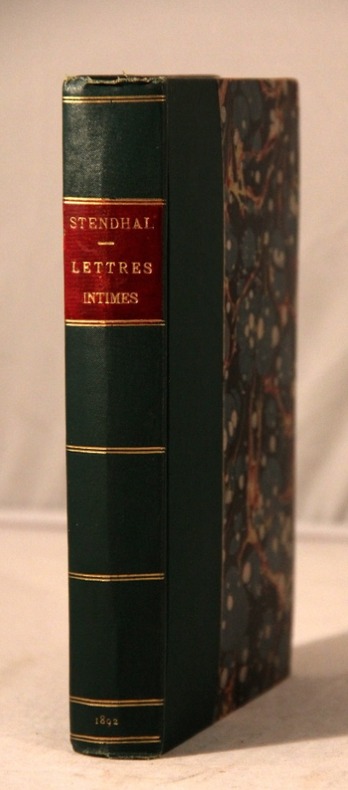
18923721Paris, Calmann-Lévy, 1892. 1 vol. in-8 de III-335 p. Demi-percaline verte, dos lisse orné de filets dorés, pièce de titre maroquin bordeaux. Coiffes et bords un peu frottés.
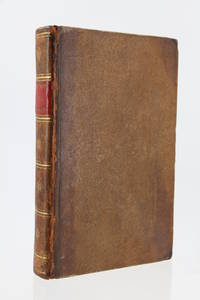
181478167Paris: De l'Imprimerie de P. Didot l'aîné 1814. Fine. De l'Imprimerie de P. Didot l'aîné Paris 1814 12.50 x 20.50 cm relié De l'Imprimerie de P. Didot l'Aîné Paris 1814 125 x 205 cm bound in calf First edition of Stendhal's very first book published under the pseudonym of Louis-Alexandre-César Bombet. Contemporary binding in half brown calf spine decorated with gilt fillets and tooling as well as a red morocco title piece. Very rare according to Clouzot De l'Imprimerie de P. Didot l'aîné unknown
181478167De l'Imprimerie de P. Didot l'aîné | Paris 1814 | 12.50 x 20.50 cm | relié
181418974Suivies d'une vie de Mozart, et de considérations sur Métastase et l'état présent de la musique en France et en Italie. Par Louis-Alexandre-César Bombet.Edition originale rare du premier livre de Stendhal.Paris, de l'imprimerie de P. Didot l'ainé - 1814 - 468 pp.Belle reliure demi veau postérieure. Dos lisse orné d'une harpe dorée, avec auteur, et titre dorés. Tête dorée. Signet. Quelques rousseurs. Très bon état. Format in-8°(20x13).À son retour à Milan en 1814, Angela, sa maitresse, veut mettre un terme définitif à leur relation. Il hésite à se brûler la cervelle. Finalement, il termine vies de Haydn, Mozart et Métastase dont le titre complet de la 1ère édition est "Lettres écrites de Vienne en Autriche, sur le célèbre compositeur J. Haydn", qui sera publié en janvier 1815 sous le nom de Bombet. Il est rapidement accusé de plagiat par le musicologue italien Giuseppe Carpani, auteur d’un essai sur Haydn.
185346404504Paris, Didier, 1853 ; petit in-12, demi-basane fauve, dos lisse, filets à froid, tranches jaspées. (Reliure de l’époque.) 126 pp.Première édition de petit format, recherchée en raison de la rareté de l’édition originale in-8 publiée par Dumont en 1839.Vicaire I, 460 - Carteret II 360 - Ce volume est un des 21 titres parus dans la collection Diamant de l’éditeur Eugène Didier (entre 1852 et 1856) Carteret I p. 177.
1891R160112041CALMANN LEVY. 1891. In-12. Broché. Etat passable, Plats abîmés, Dos abîmé, Intérieur frais. 362 + 368 pages. Bandes adhésives sur les plats au niveau du dos du tome 1. Déchirures sur les bords des plats. Cahier détaché. Manque en tête du dos.. . . . Classification Dewey : 840-Littératures des langues romanes. Littérature française