1783-1842, StendhalBiblio.com

1 297 résultats
1024469050.Ghardcover. Good. Access codes and supplements are not guaranteed with used items. May be an ex-library book. hardcover
1246975831.Gpaperback. Good. Access codes and supplements are not guaranteed with used items. May be an ex-library book. paperback
0243064497.Gpaperback. Good. Access codes and supplements are not guaranteed with used items. May be an ex-library book. paperback
0332714713.Ghardcover. Good. Access codes and supplements are not guaranteed with used items. May be an ex-library book. hardcover
1892134884Paris: Calmann-Levy 1892. 1st edition. Nice copy. small octavo. 3/4 cloth iii 335pp. FRENCH TEXT. Burgundy cloth over marbled boards Calmann-Levy hardcover
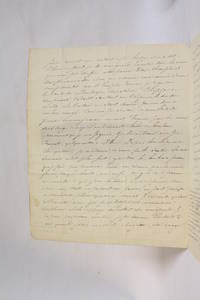
1808689671808. Fine. 26 mars 1808 20 x 24.80 cm 3 pages 1/2 sur un double feuillet Long autograph letter by Stendhal addressed to his sister Pauline written in fine handwriting with black ink. Address of Stendhal's father where his sister resides in Grenoble with the stamp ""n°51 Grande Armée."" Red wax seal bearing Stendhal's coat of arms. Several original folds inherent to postal delivery. A paper loss due to the unsealing of the letter has been skillfully restored. Published in his Correspondance ed. Henri Martineau Paris Le Divan 1933 vol. 3 no. 262 A pp. 26-29. A very beautiful letter filled with romantic passion blending childhood nostalgia with sentimental tales and foreshadowing The Red and the Black. This letter is part of the correspondence between twenty-five years old Henri Beyle and his sister Pauline three years his junior. This epistolary relationship which quickly took the form of a ""journal"" as Pauline's responses were rare. It is deemed a crucial milestone in the intellectual development of the future Stendhal: ""Here are my dreams my dear friend; I am almost ashamed of them; but after all you are the only person in the world to whom I dare confess them."" In this letter which attests to the strong bond between brother and sister Stendhal then in Germany expresses his deep nostalgia: ""I revisited in my memory all the time we spent together: how I did not love you in our childhood; how I once hit you at Claix in the kitchen. I hid in the little book cabinet; my father came back a moment later furious and said to me: 'Wicked child! I would eat you!' Then all the woes inflicted upon us by poor Aunt Séraphie; our walks along those paths surrounded by stagnant water towards Saint-Joseph."" These regrets about the past are accompanied by a typically Stendhalian melancholy: ""Alas! That delightful happiness I once imagined I glimpsed it once at Frascati and a few other times in Milan. Since then it has not returned; I marvel at my inability to feel it. The mere memory of it is more powerful than all the present joys I can procure."" This evocation of the Italy he longs for is intertwined with memories of the women he loved: ""I told you that while in Frascati at a charming fireworks display at the moment of the explosion Adèle leaned on my shoulder for an instant; I cannot express how happy I was. For two years whenever I was overwhelmed with sorrow this image gave me courage and made me forget all my troubles. I had long forgotten it; I tried to recall it today. Against my will I see Adèle as she is; but as I am now there is no longer the slightest joy in this memory."" This lengthy account of Adèle Rebuffet his cousin with whom he had a profound romantic relationship before forming a closer bond with her mother reflects Stendhal's sentimentality. He also mentions another of his great passions Angelina Pietragrua the ideal Italian woman and embodiment of his Milanese memories: ""Madame Pietragrua is different: her memory is linked to that of the Italian language; whenever something pleases me in a role for a woman in a work I involuntarily put it into her mouth."" This ""role for a woman"" that Stendhal refers to echoes the central theme of this letter the work Il Matrimonio segreto by composer Cimarosa: ""Do you sometimes play the Matrimonio Its the passage Cara sposa at the beginning between Carolina and Paolino. . But play the Matrimonio for my sake especially Signor deh permettette and the finale Io rival de mia sorella."" This opera by Cimarosa remained a constant throughout the writer's life and work. In his Memoirs of an Egotist 1832 he explains: ""In Milan in 1820 I wanted to have this written on my tomb . I wanted a marble tablet in the shape of a playing card: ""Errico Beyle - Milanese - Visse scrisse amò - Quest'anima adorava Cimarosa Mozart e Shakspeare - Morì di anni. il . 18."" ""Henri Beyle - Milanese - He lived wrote loved - This soul adored Cimarosa Mozar unknown
0484404687.Ghardcover. Good. Access codes and supplements are not guaranteed with used items. May be an ex-library book. hardcover
0243048807.Gpaperback. Good. Access codes and supplements are not guaranteed with used items. May be an ex-library book. paperback
1722920718.Gpaperback. Good. Access codes and supplements are not guaranteed with used items. May be an ex-library book. paperback
2366595182.Gpaperback. Good. Access codes and supplements are not guaranteed with used items. May be an ex-library book. paperback
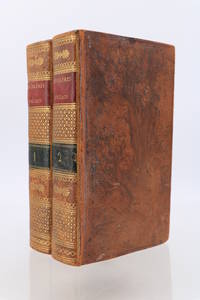
181491120Paris: Chez H. NicolleDe l'Imprimerie de C.-F. Patris 1814. Fine. Anonymous work attributed to Anna Maria Porter which inspired Stendhal's masterpiece ""La Chartreuse de Parme"" Chez H. Nicolle De l'Imprimerie de C.-F. Patris Paris 1814 10.2 x 17.4 cm Relié First edition of the French translation by Élisabeth de Bon gathering in 2 volumes the 4 parts of this anonymous English novel originally printed in 1809 which according to André Marc in his Dictionnaire des romans anciens et modernes of 1819 is the work of Anna Maria Porter younger sister of the novelist Jane Porter. The Porter sisters contemporaries of Jane Austen and famous before the Brontës were close to the Scottish poet Walter Scott. Contemporary full brown tree sheep smooth spines divided into compartments richly gilt in decorative rolls of laurels annulets and lozenges two compartments with a lozenge network formed by interlacing fillets with fleurons at the corners red and green morocco lettering-piece and numbering-piece blind-tooled fillet border to boards gilt fillet to turn-ins edges sprinkled red marbled endpapers in pebbled pattern. Some light surface wear and minor offsetting to boards corners slightly worn. On volume 1 a charming error in the decorative roll at foot of spine corrected by the binder. On volume 2 small piece of leather at the edge of the numbering-piece slightly detaching. Scattered foxing and faint marginal damp-staining to upper margins. In volume 3 two minor marginal repairs to half-title and p. 8. Several period textual corrections in brown ink and pencil: volume 1 p. 131 volume 2 p. 90 and volume 3 p. 21. In the early nineteenth century English novels were widely translated into French. According to the critic signing as ""E."" in the Journal de l'Empire Les Frères Anglais is a success and according to another reviewer writing for the Gazette de France the French translation as much as the original text deserves praise: ""We have already had the opportunity in this Gazette to praise the translator. English novels are much vaunted but the choice is vast; some prove mediocre and even detestable. This one does honour to the good sense of Madame Elisabeth de B. The situations are lively and varied the characters well drawn; the work pleases and holds one's attention from beginning to end."" Gazette de France December 4 1814 ""What astonishes readers who cannot transport themselves into the society whose customs are depicted and who insist on judging everything by the habits of their own circle is the liberty of young English ladies. If their novels offer a faithful picture of their manners and habits these young women converse familiarly in tête-à-tête with their suitors; they write to them even give them their portraits; they tell their parents without ceremony that their heart is engaged. Never would a French demoiselle make such a frank avowal; at most she allows her secret to be guessed."" Journal de l'Empire May 10 1815 our own translation Two women of letters were behind this literary success: Élisabeth de Bon a translator renowned in her lifetime also a novelist short-story writer and co-proprietor of the periodical the Mercure de France and a mysterious authoress. The name of Anna Maria Porter absent from the title-page would be revealed by the bookseller André Marc as that of the author in 1819. Precocious and prolific Anna Maria began writing and publishing books during adolescence nearly a decade before her elder sister Jane. In 1807 she published The Hungarian Brothers and in 1809 she is thought to have written The English Brothers. These two works with their near-identical titles like false twins are the starting point according to Richard Bolster for the attribution of the latter novel to Anna Maria Porter. It was precisely the same translator Élisabeth de Bon who undertook the translation of the third edition of The Hungarian Brothers in 1818 and in 1815 that of another of the author's works The Recluse of Norway. The En Chez H. NicolleDe l'Imprimerie de C.-F. Patris hardcover
2090317973.Gpaperback. Good. Access codes and supplements are not guaranteed with used items. May be an ex-library book. paperback
3387002289.Gpaperback. Good. Access codes and supplements are not guaranteed with used items. May be an ex-library book. paperback
3387002297.Ghardcover. Good. Access codes and supplements are not guaranteed with used items. May be an ex-library book. hardcover
3563263426.Ghardcover. Good. Access codes and supplements are not guaranteed with used items. May be an ex-library book. hardcover
3388044074.Gpaperback. Good. Access codes and supplements are not guaranteed with used items. May be an ex-library book. paperback
3368302280.Gpaperback. Good. Access codes and supplements are not guaranteed with used items. May be an ex-library book. paperback
3368302299.Ghardcover. Good. Access codes and supplements are not guaranteed with used items. May be an ex-library book. hardcover
1946300022294EDITIONS DU MOUSTIE 1946. 1946. EDITIONS DU MOUSTIE unknown
1273860977.Gpaperback. Good. Access codes and supplements are not guaranteed with used items. May be an ex-library book. paperback
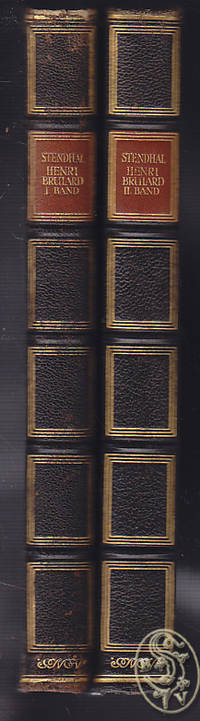
2176-12Mchn. Müller 1923. 2 Bde. 8°. 214 1; 247 S. OHLdr. Mit Rückengoldpräg. - Gesammelte Werke Bd. 1 u. 2. Kat. 25 Jahre G. Müller S. 196 Mchn., Müller (1923). unknown
0353788120.Ghardcover. Good. Access codes and supplements are not guaranteed with used items. May be an ex-library book. hardcover
1016433557.Ghardcover. Good. Access codes and supplements are not guaranteed with used items. May be an ex-library book. hardcover
1016437900.Gpaperback. Good. Access codes and supplements are not guaranteed with used items. May be an ex-library book. paperback
1020101946.Ghardcover. Good. Access codes and supplements are not guaranteed with used items. May be an ex-library book. hardcover