KAFKA, FranzBiblio.com

1 557 résultats
1915175616Leipzig: Kurt Wolff Verlag 1915. The insect itself must not be illustrated by a drawing. It cannot be shown at all not even from a distance First edition first printing first issue a superbly well-preserved copy of the case-bound issue complete with the original dust jacket which rarely survives. The first of Kafka's masterpieces Metamorphosis narrates the tale of a man who wakes up to find himself transformed into an "ungeheuren Ungeziefer" usually translated as a "monstrous insect". The Expressionist jacket illustration by Ottomar Starke 1886-1962 does not represent the insect; after learning that Starke would illustrate the dust jacket Kafka wrote to the publisher: "The insect itself must not be illustrated by a drawing. It cannot be shown at all not even from a distance" 25 October 1915. The novel met with unimpressive sales on publication and after a year or so the numerous unsold copies were stamped on the title pages with the official stamp of the German censors. This copy is a first issue without the censor stamp. It is one of two variant states with the spine and front cover lettered in serif type no established priority. There was also an issue in wrappers which repeats Starke's jacket illustration published simultaneously. Octavo. Original quarter japon spine and front lettered in black blue laid paper boards top edge blue. With dust jacket illustrated by Ottomar Stark. Housed in a black quarter morocco solander box by the Chelsea bindery. Boards slightly bowing minimal rubbing to extremities a couple of minute marginal tears to first few leaves; jacket just lightly toned tiny marks and nicks to top edge flaps without price as issued: notwithstanding a fine copy in like dust jacket. hardcover
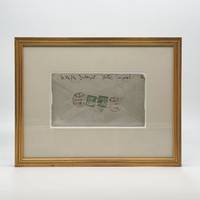
1917371699Budapest 1917. 1 vols. 4-1/8 x 7-1/8 inches. Matted in double glazed frame. Fine. 1 vols. 4-1/8 x 7-1/8 inches. Envelope sent Express from Budapest to Rudolf Fuchs by author Franz Kafka who was writing from the Hotel Imperial Budapest. Signed in the third person Dr. Kafka on the back flap. <br /> <br /> Rudolf Fuchs 1890-1942 poet and social critic was a member of Kafka's literary circle in Prague.<br /> He knew Kafka since 1912. In an article in Zeitschrift für Germanistik scholar Ilse Seehase discusses three wartime communications from Kafka to Fuchs. The second of these dated 14 July 1917 was "probably" written in Budapest and looked ahead to a meeting in Vienna Seehase p. 179. This autograph envelope postmarked 14 July confirms that Kafka was indeed in Budapest when he wrote Fuchs: he had just become engaged for the second time to Felice Bauer. On 16 July 1917 Kafka held a conversation with Otto Groß Anton Kuh and Rudolf Fuchs at a café in Vienna. In August of that year Kafka was diagnosed with the tuberculosis that would later kill him. <br /> Fuchs published an early obituary of Kafka on 4 June 1924. Fuchs described the effect of his writing: "He perceived as no other the romance of the quotidian and the poetry of familiar things. The effect of just one of his short observations is magical. As in a dream a dense realistic dream. All that he puts into words is so vital and yet an experience one hasn't seen before and even his simple phrasing has the grace of utter strangeness."<br /> Fuchs escaped the Nazis to London where he composed his Erinnerungen an Franz Kafka. A posthumous collection Ein wissender Soldat. Gedichte und Schriften aus dem Nachlass von Rudolf Fuchs was published there in 1943.<br /> Kafka autograph material is rare. Cf. Ilse Seehase Drei Mitteilungen Kafkas und ihr Umfeld pp. 178-83 in: Zeitschrift für Germanistik 8:2 1987 unknown
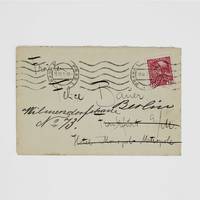
1913374043Prague 1913. Addressed in Kafka's hand to his fiancée "Fraulein Felice Bauer Frankfurt 9/M Hotel Monopol-Metropole" signed on the reverse with his return address "Abs. Dr. F. Kafka Prag Poric 7." Bauer's address has been struck through and corrected in another hand. 1 vols. 4 x 6 inches. Fine. Addressed in Kafka's hand to his fiancée "Fraulein Felice Bauer Frankfurt 9/M Hotel Monopol-Metropole" signed on the reverse with his return address "Abs. Dr. F. Kafka Prag Poric 7." Bauer's address has been struck through and corrected in another hand. 1 vols. 4 x 6 inches. Kafka met Felice Bauer in August 1912 at a dinner hosted by his friend Max Brod and he soon began to send her nearly daily letters until their split at the end of 1917 during which period he wrote "The Judgment" dedicated to her "The Man Who Disappeared" and "The Metamorphosis". Bauer saved nearly 500 letters from Kafka which she sold to a publisher in 1955 and they were collected and published as Letters to Felice. Their romance was lived mostly through correspondence and Kafka often expressed his impatience if she did not write as frequently as he did. They met occasionally and were twice engaged. Around the time of this letter they had recently met for only the second time. Likely it's the letter that is dated the 18th of April in which he writes of his inability to keep himself from writing to her and his desire to focus on his fiction:<br /> <br /> "Don't I bother you with my letters Felice I'm sure I bother you it cannot be otherwise. Of necessity you are wrapped up in business matters; the exhibition may be decisive for your firm for a whole year-and then I come along with unconnected irrelevant things but mainly with my despair."<br /> <br /> Kafka would propose marriage to Bauer in July for the first time but they never married. As most of Kafka's works were published only posthumously and little of his correspondence survives any autograph material by him is rare. Cf. Ilse Seehase Drei Mitteilungen Kafkas und ihr Umfeld pp. 178-83 in: Zeitschrift für Germanistik 8:2 1987 unknown
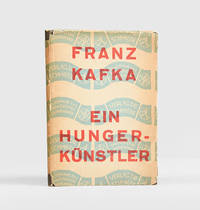
1924188798Berlin: Verlag die Schmiede 1924. His parting literary endeavour First edition boards issue in the dust jacket. Kafka worked on his final story collection during his last days. "When he finished the proofs - working on them must have been a tremendous psychological effort and a shattering intellectual reencounter with himself - tears rolled down his cheeks for a long time" cited in Unseld p. 273. Also issued in cloth the collection comprises the title story along with "Ersted Lied" "Eine kleine Frau" and "Josefine die Sängerin oder Das Volk der Mäuse". The cover art is by the influential German-American book artist George Salter 1897-1967. Among his other cover designs were Kafka's Der Prozess 1925 William Faulkner's Absalom Absalom! 1936 and Ayn Rand's Atlas Shrugged 1957. Loosely inserted is the publisher's promotional bookmark for their Novels of the 20th Century series. Octavo. Text in German. Original patterned boards blue paper label lettered in red on spine and front cover top edge blue. With dust jacket by George Salter. Ends and corners rubbed splash marks to top edge contents clean; jacket slightly chipped with loss to ends of unlettered spine discreet repairs to folds toning and faint damp stains issued without printed price: a very good copy in like jacket. Joachim Unseld Franz Kafka: A Writer's Life 1994. hardcover
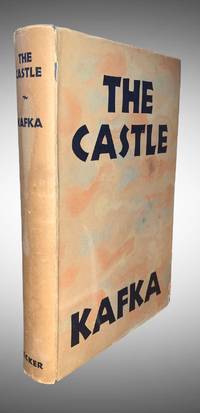
19302396First Edition in English; A Near Fine book in a Very Good or better dust jacket. An outstanding copy of this UK Edition the first translation of a Kafka novel into English preceding both "The Trial" and "The Metamorphosis"; very scarce in this condition particularly with the Original intact dust jacket. Housed in a beautiful custom quarter leather clamshell box. This copy is in near fine condition with a square tight binding bright blue boards with sharp gold lettering and pages free of any markings with mild age-toning; the book does show minor rubbing to the board edges moderate sunning to the spine and light soiling to the exterior text block. Housed in a crisp and bright very good or better original dust jacket that shows mild rubbing and chipping to the ends edges and corners a light dampstain to the spine and a small closed tear at the spine fold near the head of the spine. Overall a sharp and presentable copy of a book rarely seen in this condition; an important addition to the Kafka collection or the 20th century literature collection. Not remaindered not price clipped not ex-library; in a fresh Mylar protective cover and will be shipped carefully wrapped in a sturdy box.<br /><br />This work was unfinished before Kafka's death in 1925; Kafka had requested that all his papers and unfinished works be burned upon his death however novelist Max Brod also executor of Kafka's will chose to have them published some years later to preserve Kafka's work. Martin Secker hardcover
192432166Berlin: Die Schmiede 1924. First edition. Publisher's brown striped boards printed cover and spine labels design by Georg Salter. A fine copy in the rare and fragile dust jacket with only minimal wear. Published shortly after Kafka's death in June 1924 it is the last book for which he corrected proofs. Dietz 66. Die Schmiede unknown
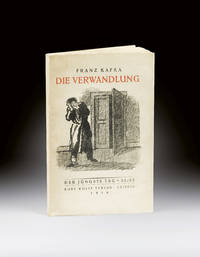
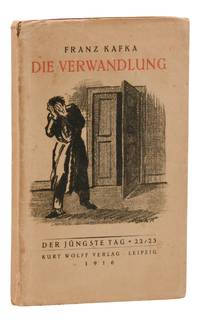
1915127<p><i>"One of the masterpieces of the literature of the 20th century"</i> Claude David.</p><p>First edition of Kafka's masterpiece the preferred issue in illustrated wrappers.</p><p><b>First edition the preferred issue in illustrated wrappers of one of masterpieces of world literature.</b></p><p>The text had first been published in the magazine Die Weissen Blatter.</p><p>One of the very few books that were published as Kafka was still alive.</p><p>Only 800 copies were printed of which only 400 were sold. The rest of the edition was sold again with the mention of the second edition.</p><p>With the famous illustration by Ottomar Starke on the front wrapper. Kafka was adamant that the illustration not depict a bug writing in a letter to the publishing house: "The insect itself must not be illustrated by a drawing. It cannot be shown at all not even from a distance."</p><p>One of the most famous books of the literature of the 20th century.</p><p>"On the evening of November 17 1912 a young employee of the Workmen's Accident Insurance Agency in Prague sat down to work on a 'troubling little story' that had occurred to him 'in bed' the previous night. After spending the first part of the day in the office he returned to the apartment he shared with his parents and sisters had lunch napped took a walk and then did a series of strengthening and stretching calisthenics. This was his daily ritual before settling in for the evening - and often far into the night - to what he considered his true life a life dedicated to writing. Then whether acting on a long-meditated plan or following an obscure sudden intuition he set down the words of the first hammerlike sentence of what would become his most famous story and one of the defining works of modern imaginative fiction The Metamorphosis or more simply 'The Transformation': 'When Gregor Samsa woke one morning from troubled dreams he found himself transformed right there in his bed into some sort of monstrous insect.' Ever since readers have been mesmerized amused puzzled irritated and unsettled by Gregor's life-changing transformation" Mark M. Anderson ed. The Metamorphosis.</p><p><b>A beautiful copy preserved in its original wrappers as issued.</b></p> Kurt Wolff Verlag paperback
192632165Munich: Kurt Wolff 1926. First edition. 8vo pp. vi 504. Original blue cloth some mild fading internally fine and fresh with the rare original dust jacket edges and folds minimally restored slightly chipped at the ends of the spine the jacket carries a quote from Hermann Hesse calling Kafka "König der Deutschen Sprache Kurt Wolff unknown
1915140947640Leipzig: Kurt Wolff Verlag 1915. First edition. Very Good/Very Good. First edition first printing. 73 1 5 ads 1 pp. The preferred issue bound in publisher's red wrappers with beige printed dust jacket illustrated by the German Expressionist Ottomar Starke. Very Good with lean to binding small tear at crown and creasing to spine and edges. Light toning and slight discoloration to cover label removed with residue on front red wrapper. Foxing to textblock edges and margins of contents light toning throughout with small closed tear to inner margin of p. 10 not affecting text. <p>One of the only books published in Kafka's short lifetime an initial flop that scarcely sold more than 400 out of 800 copies on first printing. "This 'exceptionally repulsive story' is the most sustained work of fiction published during Kafka's lifetime and the one with which his name is most profoundly associated in the common conscious. In his critical hierarchy of the great prose works of the Twentieth Century Vladimir Nabokov rates Die Verwandlung second behind only James Joyce's Ulysses a work that is twenty or more times its length." The Breon Mitchell Collection of the Works of Franz Kafka p. 7; Flores p.4. Kurt Wolff Verlag unknown
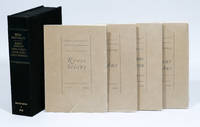
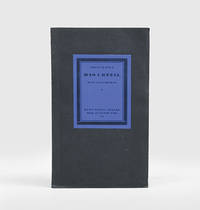
19392727Paris: GLM 1939. FIRST EDITION Deluxe issue. Original wrappers. Fine. EXCEEDINGLY RARE DELUXE SET OF AVANTE-GARDE WORKS BY FOUR LITERARY MASTERS. Each copy one of only 15 deluxe issues. Includes the deluxe issue of Duchamp's important collection of aphorisms "Rrose Sélavy". This extraordinary and complete collection collectively "Biens Nouveaux" of works by Marcel Duchamp Lewis Carroll Franz Kafka and Gisèle Prassinos demonstrates the significance of absurdism magical realism and surrealism across Europe in the 1930s and 40s. Published in April 1939 by Guy Lévis-Mano one of the most creative French printers of the twentieth century this complete series includes Marcel Duchamp's Rrose Sélavy Lewis Carroll's La Canne du Destin Franz Kafka's Le Chasseur Gracchus and Gisele Prassinos's Sondue. Each copy is one of only 15 of the deluxe issue printed on high-quality Vieux Japon. <br /> <br /> This original edition of Marcel Duchamp's book of aphorisms Rrose Sélavy is numbered two out of only fifteen copies on Vieux Japon. Duchamp's female alter ego Rrose Sélavy was an artist muse and creative experiment that brought to life his symbolic use of language. Her name as pronounced in French sounds like "Eros c'est la vie" meaning "The passion of love sex such is life." The playful puns and witty satire in this text provide clever commentary on society and the art world offering the reader a glimpse into the mind of a revolutionary artist who believed in the joy to live and roam free in thought.<br /> <br /> Lewis Carroll's La Canne du Destin The Cane of Destiny is numbered thirteen out of only fifteen copies on Vieux Japon. Published posthumously in 1939 translator André Bay believed it was written in 1848 when Carroll was only 16. La Canne du Destin features two barons a magician and a man named Blowski who dies and is transformed into mashed potatoes !. It is notable for its fantastical storytelling and whimsical wordplay a style which predated and foreshadowed Carroll's most famous work Alice's Adventure in Wonderland. His writing inspired the work of surrealists like Duchamp and Prassinos.<br /> <br /> Le Chasseur Gracchus English: The Gracchus Hunter; German: Der Jäger Gracchus numbered seven out of fifteen copies on Vieux Japon was translated by Henri Parisot in 1939 and is one of the earliest Franz Kafka's stories published in French. A six-page story written in 1917 it was found posthumously among Kafka's papers. The tale is about the long-dead Hunter Gracchus who is destined to wander aimlessly and eternally at sea unable to find peace. The surrealist dreamlike imagery of the story explores themes of loneliness alienation and the human condition. This work represents a model for Kafka's later writing and a Kafkaesque dilemma "two worlds that cannot make themselves understood by one another." Emrich<br /> <br /> Sondue Sounded by Gisèle Prassinos is numbered two out of fifteen copies on Vieux Japon. A French artist and writer she was discovered by André Breton in 1934 who declared "the tone of Gisèle Prassinos is unique: all the poets are jealous of it." When she was just fourteen her first book La Sauterelle Arthritique The Arthritic Grasshopper was published. For many her personification of animals in this story was reminiscent of Carroll's Alice's Adventures in Wonderland. Hailed as a prodigy by the surrealists Sondue a novella-length narrative was published when she was just 19 and considered macabre humor. Prassinos used automatic writing sometimes referred to as free writing a common surrealist technique. This was the last story she published before the start of World War II. She would not publish any writing again until 1958. <br /> <br /> This "Biens Nouveaux" collection was beautifully printed on Vieux Japon known for its velvety texture and substantial weight and only used by Guy Lévis Mano for premium projects. René Char French poet and member of the French resistance explained "When the passion to give life to a collection.unites with.the art of printing it brings us admirable successes and restores the object to its lasting plenitude. Guy Lévis Mano is the only one today who satisfies this haughty concern. He devoted his faith his competence his generosity and his enthusiasm to it." Char 745 <br /> <br /> 1. Marcel Duchamp. Rrose Sélavy. Paris G.L.M. 1939. First Edition. Small quarto 165 x 115 mm original wrappers; glassine. Small closed tear to glassine at front base otherwise fine. One of 15 original copies on Vieux Japon this one number 2. <br /> <br /> 2. Lewis Carroll. La Canne du Destin The Cane of Destiny. Paris G.L.M. 1939. <br /> Small quarto 165 x 115 mm original wrappers; glassine. Fine condition. One of 15 original copies on Vieux Japon this one number 13. <br /> <br /> 3. Franz Kafka. Le Chasseur Gracchus The Gracchus Hunter. Paris G.L.M. 1939. <br /> Small quarto 165 x 115 mm original wrappers; glassine. Fine condition. One of 15 original copies on Vieux Japon this one number 7.<br /> <br /> 4. Gisèle Prassinos. Sondue Sounded . Paris G.L.M. 1939. First edition. Small quarto 165 x 115 mm original wrappers; glassine. Fine condition. One of 15 original copies on Vieux Japon this one number 2. <br /> <br /> References:<br /> <br /> André Breton. Translated by Richard Seaver and Helen R. Lane. Manifestos of Surrealism. University of Michigan Press 1969.<br /> <br /> René Char. In the Poet's Studio. Gallimard "Quarto" collection 1956.<br /> <br /> The Editors of Encyclopaedia Britannica. "Franz Kafka." Encyclopedia Britannica December 2 2022.<br /> <br /> Wilhelm Emrich. Translated by Sheema Z. Buehne. Franz Kafka. Frederick Ungar Publisher 1961.<br /> <br /> Alexander Hawkins. "Meet Rrose Sélavy: Marcel Duchamp's Female Alter Ego." AnOther Magazine. December 1 2015.<br /> <br /> Gisèle Prassinos. Translated by Ellen Nations. Surrealist Texts. Black Scat Books 2014.<br /> <br /> Rachel Rivenc and Kendra Roth eds. Living Matter: The Preservation of Biological Materials in Contemporary Art. Getty Conservation Institute 2022. GLM unknown
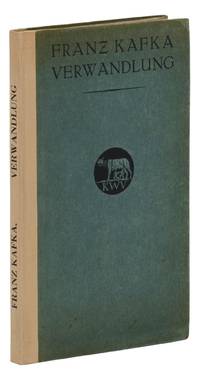
1915140948517Leipzig: Kurt Wolff Verlag 1915. First Edition. Near Fine. First edition first printing case-bound issue. Text in German. Bound in publisher's blue paper-covered boards stamped in black; spine sympathetically replaced. Near Fine boards are lightly toned and soiled with wear at corners slight foxing to endsheets. The first book appearance of Kafka's The Metamorphosis issued simultaneously in wraps and boards a landmark of 20th century literature. Flores p. 20; Dietz 26. Kurt Wolff Verlag unknown
1930140948911New York: Alfred A. Knopf 1930. First American Edition. Near Fine/Near Fine. First American edition first printing. xi 1 340 pp. Bound in publisher's dove grey cloth stamped in black black topstain. Near Fine with light toning and foxing to cloth and textblock edges slight bumping to corners. Binding square and firm. In a superlative Near Fine price-clipped dust jacket with sunning to spine panel and extremities and light wear and rubbing; colors bright. Kafka's final and unfinished philosophical novel posthumously published by his executor Max Brod who refused to honor his friend's request that the manuscript be burned. Alfred A. Knopf unknown
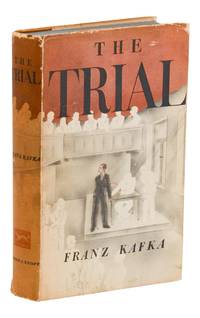
1937140948920New York: Alfred A. Knopf 1937. First American Edition. Near Fine/Near Fine. First American edition stated first printing. Bound in publisher's rust-colored cloth over semi-flexible boards with stamped in blue and black blue topstain. Near Fine with lean to binding light foxing to text block edges offsetting to endsheets. In a Near Fine unclipped dust jacket with moderate toning to spine light wear to the extremities and light soiling with a few small light stains. A sharp copy in the scarce dust jacket. <p>Kafka's darkest work a posthumously published novel about a man arrested on undefined charges with no hope of redemption or acquittal. Adapted into the 1962 film of the same name directed by Orson Welles starring a young Anthony Perkins as Josef K. Alfred A. Knopf unknown
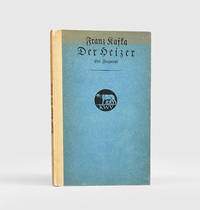
1913191336Leipzig: Kurt Wolff 1913. The story born from his abandoned initial novel First edition of The Stoker the only part of his first novel published during Kafka's lifetime. Believing that "of the entire book only the first chapter stems from an inner truth" Letters p. 218 the author abandoned the novel and issued its introduction here as a separate story. The complete work was edited posthumously by Max Brod as Amerika 1927. Inspired by Dickens the story is unusually optimistic for the period in which Kafka also wrote The Metamorphosis and The Judgment. Octavo. Frontispiece illustrating New York harbour. Text in German. Original japon-backed blue boards spine and front cover lettered in black publisher's device on front cover top edge blue. Pencilled ownership inscription on front free endpaper. Spine and head of front cover toned couple of marks to binding spot of wear to one corner. A very good copy. Franz Kafka Letters to Felice 1973. hardcover
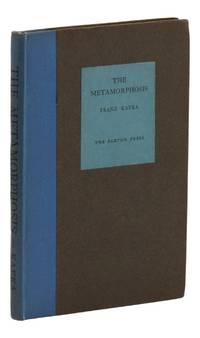
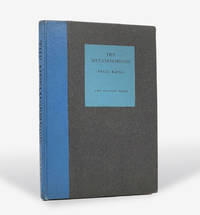
1937189715London: The Parton Press 1937. With the glassine jacket First edition in English of Kafka's famous story in which the protagonist finds himself transformed into an "ungeheuren Ungeziefer" translated here as "some monstrous kind of vermin". Lloyd's translation went quickly out of print in Britain selling similarly poorly to the original publication in German Die Verwandlung 1915. The public's unfamiliarity with the strange world of the Kafkaesque proved a difficult obstacle for the author and his early translators to overcome. In the same year as this publication Willa and Edwin Muir produced the first English translation of The Trial following their version of The Castle 1930 which had been financially unsuccessful. Lloyd's Metamorphosis briefly reappeared when the Vanguard Press published it in America in 1946 before vanishing into the shadow of the Muir translation. It was Lloyd who gave the work its enduring name in English. The Muirs initially used the title "The Transformation" and later reverted back to Lloyd's "The Metamorphosis". Octavo. Original blue quarter cloth spine lettered in black brown board sides with blue paper label on front lettered in black. With original glassine jacket and contemporary bookseller's acetate. Contemporary ownership inscription of literary critic Boris Ford 1917-1998. Spine cocked extremities a little rubbed and bumped; chips to glassine: a very good copy. Flores p. 20. Valentine Cunningham British Writers of the Thirties 1993. hardcover
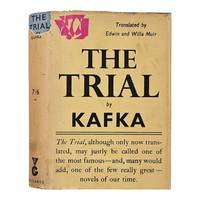
1937262 - 867 - 633<p><em>First printing in the English language in the exceptionally rare dust jacket</em></p><p><strong>Publisher and Year: </strong>London: Victor Gollancz Ltd. 1937</p><p><strong>Edition:</strong> First British edition first printing. Translated by Edwin and Willa Muir this was the novel's first introduction to the English-speaking world. This first British edition preceded the American edition New York: Knopf 1937 by a little more than three months June versus October respectively. Gollancz managed to sell only about a thousand copies of The Trial and therefore decided never to produce another of Kafka's works. The American publisher evidently fared much better with those first printing copies appearing much more frequently on the market today and with subsequent reprints by the same publishing house all the way through the 1950s. The British jacket is exceptionally scarce; we can trace just five appearances of copies in jacket at auction.</p><p><strong>Condition and Description: </strong>Octavo blue cloth lettered in black 285 pp. A sharp copy of the book with clean cloth and tight binding. Mild fading to the spine and edges. Some spotting to the edges of the text block. No writing or underlining. Clean pages with only very occasional and minor imperfections including some modest foxing to the preliminary leaves representative examples shown. The original dust jacket is chipped toned stained and has closed tears repaired on the verso with archival tape as shown in the final four pictures.</p><p><em>"…without having done anything wrong he was arrested one fine morning."</em></p><p><strong>References:</strong></p><p>1. The Yorkshire Post 23 June 1937. The British edition of The Trial listed with a publication date of 28 June</p><p>2. The New York Times 30 Sep 1937. The American edition of The Trial listed with a publication date of 18 October</p><p>Inventory ID: 262 - 867 - 633</p> Victor Gollancz Ltd. hardcover
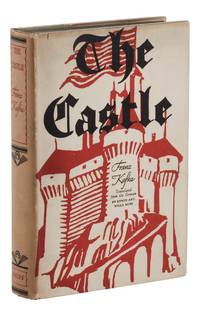
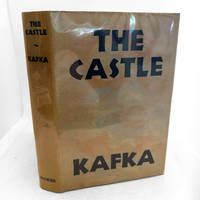
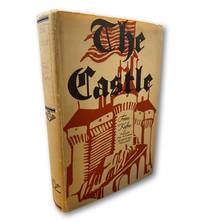
193088212London: Martin Secker 1930. First edition. Hardcover. 1930 First edition in English. 8vo. Original blue cloth lettered in gilt. Dust-jacket priced 7s6d. This stands as the first English translation of any of Kafka's works appearing some seven years before English editions of either <em>The Trial</em> or <em>The Metamorphosis</em> which makes it considerably the rarer book.<br /><br /><em>The Castle</em> was first published in German in 1926. It is the longest and last of Franz Kafka's novels 1883-1924 begun in the final two years of his life and left unfinished at his death. The novel works a quiet transformation on the medieval grail narrative substituting the quest for the grail with its protagonist's dreamlike struggle against a remote and impenetrable bureaucracy - the kind Kafka had encountered at first hand in the unsettled years following the collapse of the Habsburg monarchy. What Kafka intended the novel to mean has never been satisfactorily resolved; this first English edition inclines toward the text's religious symbolism with the repeated and frustrated attempts to reach the castle read by some critics as an allegory of the search for salvation rather than emphasising the partially autobiographical strand that led Kafka to begin the book in the first person.<br /><br />The translation is made from the first German edition incorporating the posthumous revisions of Kafka's friend and literary executor Max Brod who prepared the manuscript for publication.<br /><br />The book was banned in Germany between 1933 and 1945 under the National Socialist regime. Slight sunning to cloth spine ends corresponding to previous loss to jacket; dust-jacket with superb professional restoration to head and foot of spine and fore-corner tips spine slightly dulled but otherwise bright. Very good Martin Secker hardcover
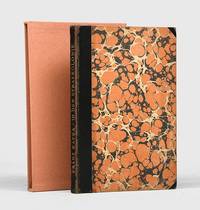
1919149938Leipzig: Kurt Wolff 1919. In the deluxe binding First edition first impression in the deluxe binding. One of 1000 copies of Kafka's short story set in an unnamed penal colony which he wrote in October 1914. The "relatively long time span between composition and first publication is due in part to Kafka's dissatisfaction with the original conclusion of the story" however "Kafka revised the end of the text in November 1918" Gray et al. p. 134. In November 1916 Kafka presented a version of the text "at a public reading - something to which Kafka rarely agreed - at the Goltz Gallery in Munich" ibid. p. 134. The work was first translated into English by Eugene Jolas in 1941; published in the Partisan Review as In the Penal Colony. Octavo. Text in German. Printed in blue and black. Contemporary dark brown half roan spine lettered in gilt marbled boards cream endpapers white silk page marker top edge gilt others uncut. Housed in a custom slipcase. Light wear to extremities the binding otherwise sound internally clean and fresh; a very good copy. Dietz 50. Richard T. Gray et al. A Franz Kafka Encyclopedia Greenwood Press 2005. hardcover
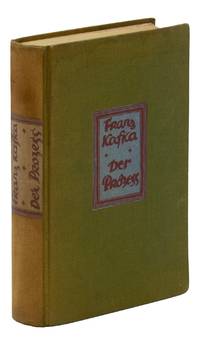
1925140948670Berlin: Verlag Die Schmiede 1925. First Edition. Very Good. First edition first printing with text in the original German. Bound in publisher's green cloth with paper title labels lettered in dark maroon at spine and front board. Very Good with lean to binding fading spine light dampstain to cloth at top edges. Foxing and light offseting at endsheets with woodcut mounted by former owner at front free endpaper and light pencil sketch at rear endpaper. The scarce German language edition of Kafka's never completed work--a posthumously published novel about a man arrested on undefined charges with no hope of redemption or acquittal. Flores p. 6. Verlag Die Schmiede unknown
1937140948644London: The Parton Press 1937. First English Edition. Near Fine. First English language edition first printing. vi 74 pp. Bound in publisher's charcoal-colored paper boards over blue cloth spine lettered in black and blue printed title label to upper board. Near Fine with lean to binding slight toning to spine light wear. Former owner's name on front free endpaper small spot of abrasion to top edge of front gutter. A nicer than commonly found copy of Kafka's masterpiece translated by English folklorist and key figure of the post-WWII British folk music revival A. L. Lloyd. Lloyd's translation swiftly went out of print amidst abysmal sales much like the first German edition Die Verwandlung. Flores p. 20. The Parton Press unknown
198423499New York: At the Wild Carrot Letterpress for the Limited Editions Club 1984. Unique Inscribed copy of this Limited Edition of 1500 hand-numbered copies signed by the artist José Luis Cuevas. THIS COPY WITH ADDITIONAL INSCRIPTION AND ORIGINAL PEN AND INK DRAWING BY THE ARTIST. With etchings on tissue-guarded plates and drawings by José Luis Cuevas created specifically for this publication. Large 8vo hand-cased at the Gray Parrot bindery in quarter gray-brown calf over textured paper-covered boards the spine lettered in gilt within a blank embossed frame in the original slipcase. xii 61 1. Internally a pristine copy the binding also fine but for a light touch of sun and one small abrasion to the calf of the spine the slipcase still very nice with only minor age evidence. UNIQUE INSCRIBED COPY WITH AN ORIGINAL DRAWING BY JOSÉ LUIS CUEVAS. The famous Mexican Surrealist has inscribed this copy “La Vida de un hobre . with a bold signature and a very large pen and ink drawing filling much of the front blank page. The book itself is a fine production printed on mold-made paper specially produced for this edition by Cartiere Enrico Magnani. It was designed by Ben Shiff set in American Monotype and the etchings were printed at the Water Street Press. In all Kafka’s surreal fable is given a very contemporary and highly artistic twist making this one of the most original and striking productions for the club for quite some time. At the Wild Carrot Letterpress for the Limited Editions Club hardcover
1916191218Leipzig: Kurt Wolff 1916. This is the only way to write. with such complete opening of body and soul First edition in book form of The Judgement one of the author's best stories in his own estimation. Kafka recalled of the piece written in a single night in 1912 "the story evolved as a true birth covered with filth and slime". It was printed in Max Brod's periodical Arkadia: Ein Jahrbuch für Dichtkunst in 1913. Octavo pp. 32. Text in German. Original black wrappers wire-stitched as issued blue paper label on front wrapper printed in black. Light creases to wrappers near-fine. unknown
193721211731937. London: The Favil Press for The Parton Press. 1937 8vo. Publisher's blue buckram-backed boards with black paper sides blue printed label to upper board; pp. vi 1 blank 74; twentieth-century collector's bookplate to front pastedown; a very good copy.First complete English translation of Kafka's Die Verwandlung The Metamorphosis printed by the publisher of Dylan Thomas's first book and translated by the influential folklorist Bert Lloyd. The translator the London-born folk singer ethnomusicologist and broadcaster Albert Lancaster Lloyd also known as Bert Lloyd 1908-1982 is perhaps best remembered for his instrumental role in popularising British folk music in the 1950s and 1960s; in 1959 he was the co-editor of The Penguin Book of English Folk Songs with Ralph Vaughan Williams. At the age of sixteen he went to Australia to work as a shepherd and farmhand returning to England in the early 1930s where he worked briefly at the Foyles Foreign Books Department spent a great deal of time in the British Museum's reading room befriended Dylan Thomas and Jack Lindsay joined the Communist Party and produced a translation of poems by Lorca. It is perhaps through Thomas that he became connected with David Archer of the Parton Press and bookshop in Red Lion Square in London; the Parton Press had published in collaboration with the Sunday Referee Dylan Thomas's first book 18 Poems 1934 here advertised on the half-title verso. Nabokov owned a copy of the present translation the 1946 Vanguard Press edition his copy now at the New York Public Library featuring copious drawings annotations and amendments to Lloyd's translation which he annotated in preparation for his lectures on Die Verwandlung at Cornell. Hemmerle p. 22. hardcover
1930212379Alfred A. Knopf 1930. First English translation edition first printing. Publisher's grey cloth stamped in black and blue top edge stain grey. The final pages have been left unopened awaiting their first ever reader. Bookplate of book collector R.J. Dickinson very faint foxing and fading to boards internally bright clean and tight. Near fine in near fine price-clipped and very lightly edge worn dust jacket with slight darkening to extremities and toned spine in mylar cover. An especially nice copy of this philosophical classic. Translated by Edwin and Willa Muir. With an introduction by Edwin Muir this is the first English translation of The Castle published simultaneously with the British edition Flores 15. <br /> <br /> Published posthumously in 1926 The Castle was never actually finished by Kafka. Despite having directed his good friend Max Brod to destroy all of his unpublished works upon his death The Castle found its way to the printers and onward as one of the most important and humanizing existential works of the twentieth century. Alfred A. Knopf unknown
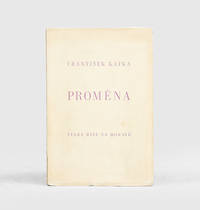
1929188167Stara Rise: Josef Florian 1929. The insect itself must not be illustrated by a drawing. It cannot be shown at all not even from a distance First edition in Czech the first illustrated edition and the first translation of Metamorphosis into any language. This is an out of series copy on white paper from a total edition of 600 copies. This was published in three issues: 50 "A" copies on Holland 150 "B" copies on buff paper and 400 "C" copies on white paper as here. The German artist Otto Coester 1902-1990 was a member of a close circle of Kafka's admirers and may have known Kafka personally. Some scholars have therefore posited that he "had some inside knowledge of Kafka's vision" and the scholar Richard Lawson regarded Coester's illustrations of the insect as the most authentic Gallagher p. 134. During his lifetime Kafka was anxious to never see the insect depicted. He wrote to his publisher upon learning that his Die Verwandlung 1915 was to have an illustrated dust jacket "the insect itself must not be illustrated by a drawing. It cannot be shown at all not even from a distance" 25 October 1915. A separate portfolio edition was published the same year in an edition of 120 copies with different illustrations. The book edition was published as the 99th volume in Dobrého Díla in July 1929. Octavo. Illustrations in the text by Otto Coester. Original wrappers spine and front lettered in purple. Rubbed short split to lower front spine contents clean. A very good copy. David Gallagher Metamorphosis: Transformations of the Body and the Influence of Ovid's Metamorphoses on Germanic Literature of the Nineteenth and Twentieth Centuries 2009. unknown