HUXLEY, Thomas HenryBiblio.com
205 résultats
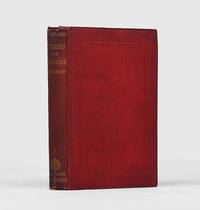
1873167597London: Macmillan and Co. 1873. Presented to one of Huxley's close friends at the Royal Society First edition presentation copy inscribed on the half-title: "John Evans esq from his friend T. H. Huxley". Huxley collaborated with Sir John Evans 1823-1908 the eminent archaeologist in the administration of several learned societies in London most notably the Royal Society. In 1873 Huxley was the society's biological secretary and would later serve as its president while Evans who was elected a fellow in 1864 would serve as its treasurer from 1878 to 1898. The two men were personal friends and corresponded on a wide range of subjects. Alongside his profession as a paper manufacturer Evans is credited with pioneering a more scientific approach to British archaeology. Two years after Huxley's Critiques was published Evans wrote a paper which applied Darwinian natural selection to the archaeological study of ancient British coins. The essays and addresses in this collection attest to Huxley's wide range of interests: education "The School Boards: What they can do and what they may do"; geology "On the Formation of Coal"; and Darwinian evolution "Palaeontology and the Doctrine of Evolution Darwin's Critics" among much else. Evans's attractive bookplate depicting a variety of antiquities and bearing the motto "I desire to deserve" is on the front pastedown. Octavo. Leaf of publisher's advertisements at rear. Original red pebbled cloth spine lettered ruled and with publisher's device in gilt covers with concentric panels in blind dark blue coated endpapers. Light bumping and wear to extremities light finger soiling to covers cosmetic split to front inner hinge moderate foxing to endpapers edges and initial leaves: a very good copy. hardcover
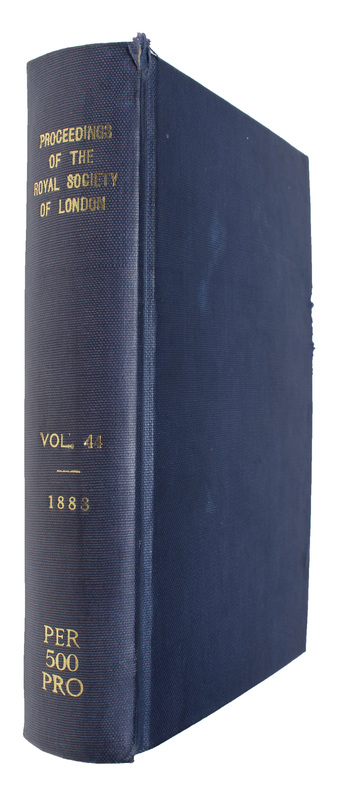
188857931London, Harrison and Sons, 1888. 8vo. In later full blue cloth with gilt lettering to spine. In ""Proceedings of the Royal Society of London"", vol. XLIV. Entire volume offered. Soiling to extremities, endges of front board torn and upper front hindge with small tear. Library label pasted on to front free end-paper. Vague blindstamp to title-page of volume. Internally fine and clean. [Darwin's orbituary""] I-XXV pp. [Entire volume: viii, 464, XXXV, (1) pp.].
188857931London Harrison and Sons 1888. 8vo. In later full blue cloth with gilt lettering to spine. In "Proceedings of the Royal Society of London" vol. XLIV. Entire volume offered. Soiling to extremities endges of front board torn and upper front hindge with small tear. Library label pasted on to front free end-paper. Vague blindstamp to title-page of volume. Internally fine and clean. Darwin's orbituary; I-XXV pp. Entire volume: viii 464 XXXV 1 pp. <br/><br/><em>First appearance of Huxley's famous obituary of Darwin. "While Huxley was composing this and other expositions of technical education in the late 1880s he was also writing an obituary notice on Darwin for the Proceedings of the Royal Society. Though he undertook this piece in 1883 he did not complete it until five years later. In letters to Foster and Hooker in early 1888 Huxley remarked that he was still rereading Origin of Species trying to separate the "substance" of the theory from its "accidents" with the aim of warding off a generation of "hostile comments and would-be improvements.". Even though he had written at least a half-dozen abstracts of the work and was reading it he said "for the nth time" he was "getting along slowly" and finding it "one of the most difficult books to exhaust that ever was written." At this juncture in his life it seemed that Huxley had difficulty concluding what he had always concluded previously about Darwin's theory: that its points of central importance were the facts of variation the Malthusian principle of overpopulation and its consequence universal struggle. As Huxley finally came around to saying once again the obituary article it was immaterial how organisms differed from each other or why." White Thomas Huxley: Making the 'Man of Science P. 152Darwin-Online A344. </em> hardcover
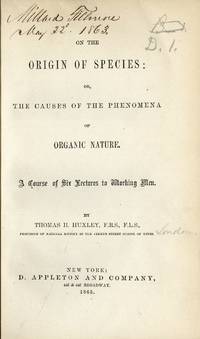
186332820395<p>Original cloth paper spine label chipped. Very good. Cloth case</p><p>FIRST AMERICAN EDITION. <b>From the library of Millard Fillmore 13th president of the United States 1850-1853 with his signatures dated May 22 1863</b> on the title and on the front pastedown.</p><p>Huxley "Darwin's bulldog" was the leading defender and promoter of Darwinism in the years following the publication of <i>On the Origin of Species</i> in 1859.<br /><br />In this popular work Huxley attempts to "disencumber the subject of its difficulties simplify its statements relieve it of technicalities and bring it so distinctly within the horizon of ordinary apprehension that persons of common sense may judge for themselves. … Such is the character of the present volume" preface.</p><p>This volume reflects the wide dissemination of Darwin's ideas in the 1860s.</p><br /> Appleton hardcover
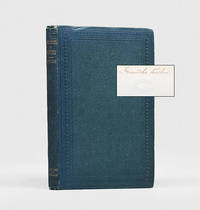
1863181331London: Williams and Norgate 1863. Exploring human evolution some seven years before Darwin's Descent of Man First edition first issue presentation copy inscribed in a secretarial hand "from the author" on the half-title. Evidence is Huxley's key work deliberately written for a non-specialist audience and among his most influential contributions to the theory of human evolution being the first to bring together anatomical and embryonic evidence. In the Origin of Species Darwin carefully avoided the implications of his theory for humanity but Huxley boldly brought them to the fore. In the early 1860s Richard Owen had asserted that human and ape brains were fundamentally different and that the hippocampus minor was exclusively found in humans. In Evidence Huxley uses extensive dissectional evidence to disprove this emphasizing the human-ape commonality and relying on Darwinian evolution for his theoretical underpinnings. The work was also among the first to publicize the discovery of Neanderthal man. The first issue prints the frontispiece on the verso of the second leaf forming an integral part of the preliminaries and the "Advertisement to the Reader" appears on the recto of the fourth. Octavo pp. viii 159 1 8. Wood-engraved frontispiece extensive illustrations in the text. With 8 pp. of publisher's advertisements dated February 1863 at rear. Original green pebble-grain cloth spine lettered in gilt and ruled in blind covers panelled in blind brownish-red endpapers with printed advertisements. Near-contemporary blue ink ownership stamp of chemist and publisher John Balcomb 1841-1918 of Cheltenham to half-title. Infrequent pencil sidelining to contents. Light bumping wear and toning head of front joint starting infrequent minor foxing to otherwise fresh contents: a very good copy. Cushing H554; Garrison-Morton 165; Heirs of Hippocrates 1033; Norman 1132; Osler 1605; Waller 10853. hardcover