691 résultats
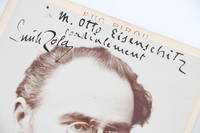
189087793Eugène Pirou | Paris s.d. (ca 1890) | 10.70 x 15.50 cm | une feuille
189946858Paris Charpentier et Fasquelle 1899-1903 6 vol. relié 6 vol. in-8, demi-maroquin rouge à coins, dos à nerfs, têtes dorées, couvertures et dos conservés, non rognés (Durvand), 345-405, 329-338 et 381-367 pp. Édition originale du dernier cycle romanesque de Zola. Interrompue par la mort accidentelle de l'auteur en 1902 - la quatrième et dernière partie, Justice, étant restée à l'état d'ébauche, cette oeuvre est demeurée largement méconnue. Après les "Rougon-Macquart", analyse de la société sous le Second Empire, après les "Trois Villes", procès du catholicisme, Zola nous livre ses évangiles pour construire une société meilleure : une nécessaire natalité, le sauvetage de l'humanité laborieuse, l'instruction et la laïcité. L'ensemble, d'un optimisme qui peut sembler forcé, se lit comme un testament idéologique et rêveur. Zola confie : « Tout cela est bien utopique, mais que voulez-vous ? Voici quarante ans que je dissèque, il faut permettre à mes vieux jours de rêver un peu » (lettre à Octave Mirbeau). Chaque volume est l'un des exemplaires de tête numérotés sur Japon Impérial (50 pour le premier, 30 pour les suivants). Série complète, dans une très belle reliure signée de l'époque.
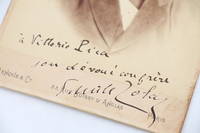
188087792Paris: Benque & Cie 1880. Fine. Benque & Cie Paris s.d. ca 1880 10.50 x 16.50 cm une feuille Original dedicated photograph representing Emile Zola facing forward head slightly turned to the right. Vintage silver gelatin print. The photograph is mounted on cardboard. On verso studio stamp of Benque & Cie. Worming to verso of the photograph. Small stain in lower left margin of the photograph and a clear fingerprint stain in lower right margin. Autograph inscription signed by Emile Zola to the art critic and great friend of the Goncourt brothers Vittorio Pica. Art critic of Neapolitan origin Vittorio Pica took an early interest in French naturalist and symbolist movements: ""Curious about all avant-garde movements he first concerned himself with the naturalists - he maintained regular contact with Maupassant Huysmans and Zola - then he became interested in the symbolists particularly Mallarmé and Verlaine to whom he devoted studies of admirable accuracy"" Petralia Bibliographie de Rimbaud en Italie cit. p. 37. Contributor to the most prestigious national and international reviews of modernist tendency he was one of the first founders of the Venice Biennale of which he would be secretary general from 1920 to 1926. Benque & Cie unknown
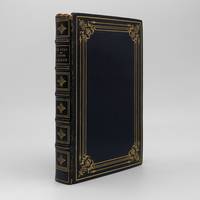
1864374820Paris: J. Hetzel et A. Lacroix 1864. First edition of the author's first book. 4 320 pp. 1 vols. 8vo. Full blue morocco gilt marbled endpapers t.e.g. by Taffin with the original yellow printed wrappers bound in. Very good head rubbed slight toning to a few leaves. With loosely inserted calling card of the author. First edition of the author's first book. 4 320 pp. 1 vols. 8vo. Zola's first book INSCRIBED on the half-title to the distinguished literary critic and author Jules Levallois 1829 - 1903: "à M. Jules Levallois "temoignage du devouement et de la sympathie de l'auteur a testimony of the author's devotion and sympathy Emile Zola." Zola was 24 years old when Contes à Ninon was published.<br /> <br /> The calling card ca. 1890 is engraved "Emile Zola / rue de Bruxelles 21 bis" and inscribed in pen by Zola "Avec mes remerciements et l'expression de ma sympathie with my thanks and the expression of my sympathy." Carteret II p. 488 J. Hetzel et A. Lacroix unknown
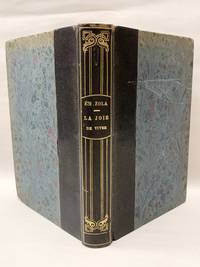
188436519Paris: G. Charpentier et Cle Editeurs 1884. First Edition. Octavo. 447pp A very good copy in black morocco spine and marbled boards gilt titled and original yellow printed wraps bound in.Tiny chip to the foredge of the front fly leaf. Inscribed by Zola to his close friend and mentor Edmund de Goncourt "Edmond de Goncourt Mon ami Enile Zola" Goncourt has additionally written a 3 line note and signed it. Zola wrote The Joy of Living after the deaths of his mother Edmond Duranty and Gustave Flaubert plunging him into a deep depression. Zola was attracted to the Goncourt brothers because of their realism in literature. The Prix Goncourt is the most prestigious award in France for literature. Bookplate of the wife of an Atlanta businessman who mingled with the French Literati 1930s-60s. <br /> <br /> <br/><br/> G. Charpentier et Cle Editeurs paperback
186452158Paris: J. Hetzel & A. Lacroix 1864. Fine. J. Hetzel & A. Lacroix Paris 1864 11 x 18 cm relié The first edition of the author's first book. Contemporary half red shagreen over marbled paper boards spine in five compartments with gilt fillets and triple gilt frames marbled endpapers and pastedowns collector's blindstamp to head of one endpaper speckled edges. Handsome rare autograph inscription to this text from Emile Zola to a monsieur Boucher. Faint dampstain to the first 70 pages a little light foxing. There are very few inscribed copies of this text. J. Hetzel & A. Lacroix hardcover
188384971Reliure demi-maroquin grenat à coins. Dos à nerfs. Date dorée au talon. Tête dorée. Couvertures conservées. Non rogné. Fine reliure signée Semet & Plumelle.
189491151Charpentier | Paris 1894 | 12.8 x 18.9 cm | Relié
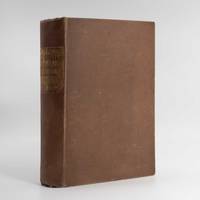
188521222981885. London: Vizetelly & Co. 1885. 8vo. Original brown cloth with paper label to spine floral endpapers; pp. 464 20 publisher's catalogue; marks to boards a little bumped to extremities label a little chipped and rubbed very good.First English edition translated and published by Vizetelly not long before he was imprisoned for publishing Zola and other ""demoralising"" works. This novel is considered to be Zola's great contribution to literature. A rallying cry for social justice in its portrayal of the brutal lives of miners it is both a landmark of realist literature and a powerful political statement. hardcover
189087793Paris: Eugène Pirou 1890. Fine. Eugène Pirou Paris s.d. ca 1890 10.70 x 15.50 cm une feuille Original inscribed photograph portrait of Emile Zola. Original albumen paper print on cardboard bearing the stamps of the Eugène Pirou studio rue Royale Paris. Signed and inscribed by Emile Zola to Otto Eisenschitz: ""à M. Otto Eisenschitz / cordialement / Emile Zola"". Otto Eisenschitz a leading arts and culture journalist on numerous Viennese periodicals playwright and director of the Josefstadt theater was the author of numerous plays and novels. His translation work from Italian gave preference to contemporary naturalist authors such as Roberto Bracco Guglielmo Ferrero Antonio Fogazzaro Marco Praga and Giovanni Verga. He lost his life in the Theresienstadt ghetto-concentration camp in 1942. Eugène Pirou unknown
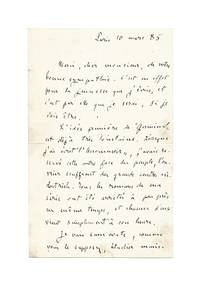
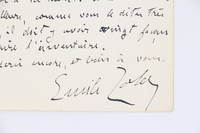
1885Zola14<p><strong>ZOLA Émile 1840-1902</strong></p><p>Autograph letter signed " Emile Zola " to Joseph Canqueteau<br />Paris 10th March 1885 2 p. in-8°<br />Small tears on folds some browning see scans</p><p><strong>An important letter written juste a week after the release of <em>Germinal</em> and drawing up a panorama of some of the most emblematic works of the <em>Rougon-Macquart</em> saga</strong></p><p><strong><u>From the</u></strong><u> <strong>B. & R. Broca</strong> <strong>collection</strong></u></p><p><em>" Merci cher monsieur de votre bonne sympathie. <strong>C'est en effet pour la jeunesse que j'écris et c'est par elle que je serai si je dois être. </strong></em><br /><strong><em>L'idée première de "Germinal" est déjà très lointaine. Lorsque j'ai écrit "l'Assommoir" j'avais réservé cette autre face du peuple l'ouvrier souffrant des grands centres industriels.</em></strong><em> Tous les romans de ma série ont été arrêtés à peu près en même temps et chacun d'eux vient simplement à son heure. </em><br /><strong><em>Je vais sans doute comme vous le supposez étudier maintenant le monde des artistes en reprenant mon Claude Lantier</em></strong> <em>L'Œuvre</em><em>. Mais le roman militaire celui où je compte mettre Sedan</em> <em>La Débâcle</em><em> est loin encore car il ne viendra guère que dans six ou sept ans : il est l'avant dernier de la série. </em><br /><em>Bien cordialement à vous<br />Emile Zola "</em></p><p>We know that even before writing the first of the twenty novels in his series Zola had drawn up as early as 1868 a family tree of his characters then a chronology of his novels. Initially planned in ten volumes the writer revised his ambitions upwards. There will be a total of twenty novels written between 1870 and 1893. This letter thus allows us to take the measure of the almost millimetric organization that the writer imposes on himself to the point of predicting with some precision "in six or seven years" the release of <em>La</em> <em>Débacle</em>. The penultimate volume of the series was indeed published in 1892.</p><p>A bohemian artist already present in <em>Le Ventre de Paris</em> but whose role is only minor Claude Lantier older brother of Etienne the hero of <em>Germinal</em> becomes the main protagonist in <em>L'Oeuvre</em>. A cursed painter whose features recall those of Paul Cézanne his fate is disastrous like that of his mother Gervaise Macquart in<em> L'Assommoir</em>. This fourteenth novel in the series was published by Charpentier the following year in 1886.</p><p>We know the letter that Joseph Canqueteau about to give a lecture on Les Rougon-Macquart addressed to Zola to ask him for some information who was right in his predictions: "We are here a meeting of young people who like you I assure you and know how to defend you on occasion. You have youth on your side dear master and that is a hard addition. We greatly appreciate the honor you have bestowed upon us by accepting the title of honorary member of our young conference. What a powerful book <em>Germinal</em> is! … I should be obliged to you dear master to tell me exactly at what time you had the idea of this vast social study Won't military life and artistic life be the subject of two future works ".</p><p><u>Provenance:</u><br />Collection B. & R. Broca</p><p><u>Bibliography:<br /></u><em>Correspondance</em> t. V éd. du CNRS p. 241-242 n°185</p>
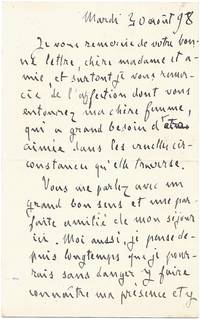
1898ZolaDreyfusAffair1<p><strong>AFFAIRE DREYFUS ZOLA Émile 1840-1902</strong></p><p>Autograph letter signed " Z " to Alice Mirbeau<br />N.p Addlestone Tuesday 30th August 1898 4 p. in-8° on laid paper<br />Central fold reinforced with Japan paper light browning lower margin stain on second folio see scans</p><p><strong>Letter from exile testifying to the writer's unwavering commitment to the Dreyfus affair</strong></p><p><em>" Je vous remercie de votre bonne lettre chère madame et amie et surtout je vous remercie de l'affection dont vous entourez ma chère femme qui a grand besoin d'être aimée dans les cruelles circonstances qu'elle traverse.<br />Vous me parlez avec un grand bon sens et une parfaite amitié de mon séjour ici. Moi aussi je pense depuis longtemps que je pourrais sans danger y faire connaître ma présence et y prendre une attitude que je saurais rendre utile et <strong>digne. Mais il y a aussi l'autre parti celui de rentrer en France et d'y faire mon devoir jusqu'au bout. Je ne puis donc encore me prononcer j'attends l'avis de nos amis et j'attends aussi les évènements</strong>. De toutes façons d'ailleurs je ne puis guère rentrer avant la fin d'octobre car je désire que la chambre soit réunie et qu'on ait liquidé toutes les autres affaires pendantes.<br />Vous me touchez infiniment en m'offrant vos services dévoués ici et même à Paris. Ici le mieux est que je vive encore ignoré travaillant en paix dans une solitude dont personne le connaît le chemin. Mon travail que j'ai repris régulièrement m'est un grand repos. À Paris certes si j'avais besoin de vous je serais fort heureux de me confier à votre dévouement et à votre discrétion.<br /><strong>Les infamies s'entassent cela devait être. C'est avec un serrement douloureux de cœur que je songe à la pure victime</strong></em> <strong><em>qu'ils vont encore condamner ; et cela ne me donne qu'une passion celle du sacrifice la volonté de m'immoler moi-même.<br /></em></strong><em>Embrassez bien tendrement votre cher mari. Je sais tout ce qu'il fait pour vous et j'en suis profondément ému.<br />Merci encore chère madame et amie et mille bonnes affections.<br />Z "</em></p><p>Convicted definitively on appeal on July 18 1898 by the Versailles court Zola left France to return to England. His open letter "J'accuse…!" published in <em>L'Aurore</em> on January 13 1898 earned the writer a fine of 3000 francs and 1 year of imprisonment. Committed body and soul to the defense of Captain Dreyfus Zola was forced into exile by Clemenceau and Labori and at the same time into silence. Kept away from the Parisian furnace prey to all the passions surrounding the affair Zola sometimes lets glimpse from England like this letter a share of frustration at no longer being at the center of the chessboard.<br />Regarding the support he received from his close friends the writer could count on that of Octave Mirbeau a Dreyfusard from the very beginning. The latter whose role has long been underestimated was one of the most influential defenders of Captain Dreyfus and Zola. After taking a public stand for the first time in an article in the Journal of 28 November 1897 two days after Zola's first article it was Mirbeau who in July 1898 paid out of his own pocket the entire fine to which Zola was sentenced on appeal in Versailles. Two weeks after Zola's conviction he wrote in L'Aurore on 2 August 1898:<br />" Will not professors philosophers scholars writers artists all those in whom truth resides from all parts of France finally free their souls from the terrible weight that oppresses them Faced with these daily challenges to their genius their humanity their spirit of justice their courage will they not finally understand that they have a great duty… that of defending the heritage of ideas of science of glorious discoveries of beauty with which they have enriched the country of which they are the guardians… "</p><p>We know the letter of support that Alice Mirbeau committed to her husband sent to Zola on August 24 and to which the writer replied above: " Despite the pain I feel in knowing how much you suffer from your isolation I persist in believing that you must find the strength to wait and that at no cost should the end be hastened. Certainly prison where all those who love you could come and embrace you would be sweeter for you and for your friends but you must not abandon everything especially now that there is a new victim on the eve of being so harshly struck. … I am very happy that you have resumed your work it will console you a little because you must persist … If I can do you any pleasure soften your captivity a little by a few steps for anything that you would like to be done use me I beg you I put my tenderness at your service and I will be happy to use myself to be agreeable to you…"</p><p>At the time he wrote this letter Zola did not yet know it but the affair was about to change on this August 30. After having completed the Dreyfus file with a piece that he himself had forged Commander Henry confessed after his forgery was discovered by Captain Cuignet military attaché to Minister Cavaignac. Taken immediately to detention at Mont Valérien Henry committed suicide the next day in his cell his throat slit with a razor. Already imprisoned at La Santé in July 1898 Picquart was again imprisoned at Cherche-Midi prison on September 22 proving Zola's prediction right.</p><p><u>Provenance:<br /></u>Collection particulière</p><p><u>Bibliography:<br /></u><em>Correspondance</em> éd. Maurice et Denise Leblond Bernouard 1929 t. II p. 811<br /><em>Correspondance</em> t. IX éd. du CNRS p. 285-286 n°186</p>
188744694Paris, Charpentier, 1887. In-12 de (4)-519 pp., demi-maroquin chocolat à coins, dos orné à nerfs, non rogné, couverture conservée (reliure de l'époque).
188279111Médan 1882. Fine. Médan 1er décembre 1882 13.60 x 21.40 cm 2 pages sur un double feuillet - enveloppe jointe Autograph letter signed by Emile Zola - apparently unpublished - written in black ink on a double sheet and addressed to Léon Carbonnaux department head at Bon Marché. Folds inherent to mailing. Envelope included. Only two letters from Léon Carbonnaux to Emile Zola are known: they can be consulted in the digitized preparatory file for Au bonheur des dames made available online by the Bibliothèque nationale de France. However we know from this same file which contains a long section entitled ""Notes Carbonnaux"" that this department head at Bon Marché provided Zola with a significant amount of information particularly about employee customs their remuneration and especially inventory techniques. The two men probably met when Emile Zola eager for information about the workings of department stores conducted field research in February and March 1882. Very important unpublished letter shedding new light on the pre-original publication of Au bonheur des dames. In his biography of Emile Zola Henri Mitterrand writes: ""Even before the novel was completed Zola gave an extract to Panurge in November; and on November 23 1882 Gil Blas announced its imminent publication in its columns."" Our letter discussing precisely this alleged pre-publication in Panurge attests that it was simply a joke and thus contradicts Henri Mitterrand: ""But your letter surprises and saddens me somewhat. How could you have been taken in by Panurge's stupid joke Did you not notice that the entire issue is a 'farce' Not one of the articles is authentic they are parodies and very poorly done ones at that."" Indeed reading the said extract cannot fool the assiduous reader of Zola despite the introduction that the journalists wrote: ""After Nana and Pot-Bouille those epics of elegant vice and bourgeois vice M. Emile Zola wanted to create one of honesty: Au bonheur des Dames which will appear shortly is a reassuring painting of innocence and virtue; the greatest success is assured for this new work whose characters move in the setting of a large novelty store; Parisian high commerce will not long await its observer and painter. We thank Emile Zola for having kindly cut out especially for Panurge a few pages from his still unpublished work and we are proud to give the public first an extract from this work of such high morality and such powerful interest."" Panurge no. 4 of October 22 1882 The sentences of this false Zolian text are exaggeratedly long and Panurge took the liberty of endowing the novel with a male main character Denis Mouret an amalgam of Denise the true heroine of the book to appear and Octave Mouret. One can think that it is a text composed from elements of Pot-Bouille the previous volume of Rougon Macquart where Octave - future owner of Bonheur des Dames - exercised the function of clerk before his meteoric social rise: ""For already more than two months he had been attached to the 'silks and furs' department; he arrived in the morning at seven o'clock to return home his day finished only at nine o'clock in the evening when all of Paris buzzed strangely with a feverish animation of pleasure and enjoyment and on his way back he followed gawking the great crowded boulevards where blazed the cafés full of girls and where on the asphalt at theater doors the crowd jostled with here and there in the vague rumor of trampling and pressing the roguish intonation of the cries of program vendors and ticket sellers."" Panurge In his letter of November 30 1882 Léon Carbonnaux - reading the extract from Panurge - had reproached Zola for his errors: ""Nowhere except at the Fabriques de France near Les Halles does one arrive at 7 a.m. It's at the earliest 7:30 but more often 8 a.m. and even then. There is no silk and fur counter at the Louvre. . It is so easy for you to be accurate that errors of this kind especially if t unknown
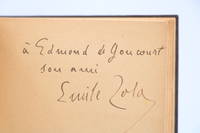
189491151Paris: Charpentier 1894. Fine. Charpentier Paris 1894 12.8 x 18.9 cm Relié First edition on ordinary paper. Bradel binding in chocolate-brown half shagreen smooth spine date gilt at the tail contemporary leather boards japonisants embossed and polychrome decorated with gilded and colorful floral motifs marbled paper endpapers and pastedowns original wrappers and restored spine preserved later binding. Exceptional presentation copy signed by Emile Zola: ""à Edmond de Goncourt son ami Emile Zola."" Below the presentation inscription a manuscript gift inscription by Edmond de Goncourt: ""Edmond de Goncourt à Pauline Zeller."" Goncourt had the privilege of hearing Zola speak on several occasions about his rediscovery of the miraculous city that inspired this very popular novel: ""Here he broke off to tell us that he had been to Lourdes where he had been impressed and amazed by that world of hallucinated believers and that there was something worthwhile to be written about that revival of faith which in his opinion was responsible for the mysticism to be found at the moment in literature and elsewhere."" Goncourt Journal 16 March 1892. ""I arrived at Lourdes in pouring rain and stopped at a hotel where all the good rooms were already taken. And I was in such a bad mood that I felt like leaving the next morning. But I went out for a while and the sight of all those sick people those poor wretches those dying children carried up to the statue those men and women lying prostrate in prayer. the sight of that city of faith born of the hallucinations of that little girl of fourteen the sight of that grotto those processions those stampeding crowds of peasants from Brittany and Anjou.'"" ibid. 26 July 1892. Despite the stylistic disagreements that set them apart Edmond nonetheless had the book he received from Zola bound in one of his famous Japanese-style bindings notoriously fragile at the joints this example has been expertly reinforced with half shagreen. These superb kami-kawa embossed leathers sometimes referred to as the cartonnages des Goncourt for having been introduced by the brothers into the world of Parisian bibliophiles are also the fruit of a fascinating and almost devotional encounter of the Goncourts with Japanese art. The copy was later presented by Edmond to the woman who had nearly become Madame Edmond de Goncourt: Pauline Zeller a cousin of Count Tolstoy whom he had met in the salon of Princess Mathilde. A compelling parallel may be drawn between the tale of two chaste destinies in Lourdes Pierre Froment and Elise Rouquet and that of young Pauline whose diary and account of her first love Edmond obtained in order to write his final novel Chérie. Charpentier hardcover
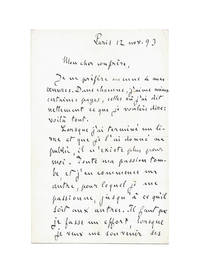
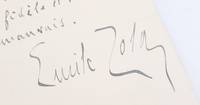
1893ZOLA3<p><strong>ZOLA Emile 1840-1902</strong></p><p>Autograph letter signed " Emile Zola " to a colleague Paris 12th November 1893 1 p. 1/2 in-8 Usual fold marks some tiny spots</p><p><strong>A very moving letter almost entirely unpublished written at the end of the <em>Rougon-Macquart</em> saga – Zola explains that he no longer owns his books once published and evokes with a superb metaphor what they represent years later. The writer expresses with relevance and sensitivity the distance he feels from his books once all published. This letter offers a more general reflection on the author's relationship to his work.</strong></p><p><em>" Mon cher confrère <strong>Je ne préfère aucune de mes œuvres</strong>. Dans chacune j'aime mieux certaines pages celles où j'ai dit nettement ce que je voulais dire : voilà tout. <strong>Lorsque j'ai terminé un livre et que je l'ai donné au public il n'existe plus pour moi. Toute ma passion tombe</strong> et j'en commence un autre pour lequel je me passionne jusqu'à ce qu'il soit aux autres. Il faut que je fasse un effort lorsque je veux me souvenir des romans hélas ! trop nombreux que j'ai écrits. <strong>Ce sont comme des tombes de parents et d'amis autrefois bien chers sur lesquelles il me serait trop triste d'aller m'attendrir</strong>. Cordialement à vous. Emile Zola "</em></p><p>The Rougon-Macquart saga came to an end with the publication by Charpentier of <em>Docteur Pascal</em> in the spring of 1893. Among the most famous of the saga are <em>Germinal</em> <em>Nana</em> and <em>L'Assommoir</em>. A total of twenty novels were written and published between 1870 and 1893.</p><p>Zola is probably responding here to a fellow journalist wishing to make an article on the whole saga and what it represents in the eyes of the novelist.</p><p>A summary of the letter and the quotation of a sentence are published in Volume VIII of the correspondence from an extract from the catalogue: <em>"They are like graves of relatives and friends …" – </em>This comparison illustrates the sadness that emanates from the moving statement and what Zola's works represent for Zola himself. Personification of books or metonymy designating the characters to whom the author gave life the "<em>tombs</em>" of course refer to death.</p><p><u>References:</u> Extr. cat. libr. Charavay n° 6599 Corr. t. VIII Presses de l'Université de Montréal / Editions du CNRS 1991</p>
188043456Sous étui bordé. Reliure postérieure plein chagrin bordeaux. Dos à nerfs orné à froid. Toutes tranches dorées. Dentelle intérieure. Couverture et dos conservés. Reliure signée DEVAUCHELLE.
189080793Reliure moderne plein chagrin rouge janséniste. Tête dorée. Non rogné. Couverture et dos en simili-parchemin.
189087244Sous étui bordé. Reliure postérieure plein maroquin bleu nuit. Dos lisse avec date au talon. Couverture conservée. Reliure signée DEVAUCHELLE.
187789251877 ÉDITION ORIGINALE rare et très recherchée. À Paris, G. Charpentier Éditeur, 1877. 1 volume, in-12° (12 x 17.5 cm), III + [1bl] + 569 + [1bl] pages. Achevé dimprimer à Corbeil, Typographie et Stéréotypie de Crété, 1876. Reliure en demi-percaline à grand coins bleu roi, dos lisse avec pièce de titre en maroquin vert et lettres dorés, date et une décoration florale. Beau papier-marbré sur les contre-plats, deuxième et troisième de couverture. Ouvrage enrichi dune rare dédicace autographe de lauteur à Léon Gambetta (1838-1882), important homme dÉtat français de la Troisième République. Deux petites taches de rousseur sur la page de titre et le faux-titre, une petite tache de huile de lampe en bas des pages 300-330, autrement ouvrage en très bon état.
18988675015 décembre 1898 | 13.50 x 20.50 cm | quatre pages sur un bifeuillet
189886837[Weybridge] 19 août 1898 | 13.50 x 20.50 cm | quatre pages sur un bifeuillet
188785004Reliure demi-maroquin carmin à coins. Dos lisse à décor d?encadrement de filets et de fleurons, date dorée au talon. Tête dorée. Exemplaire à grands témoins. Ex-libris sur contreplat. Infimes frottements d?usage. Reliure signée Pouillet.
189886837Weybridge 1898. Fine. In the midst of universal cowardice you wouldn't believe how moved I am to feel a few faithful people around me Weybridge 19 août 1898 13.50 x 20.50 cm quatre pages sur un bifeuillet Autograph letter signed by Emile Zola to Octave Mirbeau dated August 19 1898. Four pages in black ink on a bifolium written to Octave Mirbeau. Usual trace of horizontal fold. Published in Zola's uvres complètes t. XLIX ed. F. Bernouard 1927 p. 808. Exceptional testament of friendship and self-sacrifice from Emile Zola in exile after being sentenced to the maximum penalty for writing ""J'accuse!"" the most famous article proclaming Captain Dreyfus's innocence. After his historic article in L'Aurore Zola was sentenced a first time by a jury on February 23 1898 to one year's imprisonment and a fine of three thousand francs. The verdict was overturned and the case was referred back to the Versailles court of justice which upheld only three of the eight hundred lines in ""J'accuse!"" as a charge. Unwilling to accept such a stifling of the proceedings Zola's defense decided to default and the conviction was upheld. After his eventful exit from the courthouse Clémenceau and his lawyer Labori advised him to leave the country before the judgment could become enforceable. Zola left on the last train that evening with only a shirt hastily rolled up in newspaper as luggage. A month after his departure the writer writes this superb reply to a letter from his loyal supporter Octave Mirbeau who had written to him a few days earlier: ""We think only of you; there isn't a minute of our existence that you don't fill entirely"" August 14 1898. Settled in the London suburb of Weybridge he angrily receives the ""echoes of Paris"" and is enraged to see Esterhazy the true culprit of the Dreyfus Affair once again cleared - this time by civil courts. ""My dear friend Thank you for your kind letter . In the midst of universal cowardice you wouldn't believe how moved I am to feel a few faithful people around me. My existence here has become possible since I've been able to get back to work. Work has always comforted me saved me. But my poor hands are still trembling with a shiver that cannot end. You wouldn't believe the outrage I feel at the echoes from France that reach me. In the evening when daylight falls I think it's the end of the world. You think I should go back and make myself a prisoner without returning to Versailles. That would be too good to have the peace of prison and I don't think it's possible. I didn't set out to go back like that; our attitude would be neither logical nor beautiful. Rather I think I'm in indefinite exile unless I run the abominable risk of a new trial. Besides we won't be able to make up our minds until October. And by then who knows Although I'm counting on a miracle in which I have little faith. So let us be brave my friend and let our work be done! If I can keep working things won't be too bad yet. . I shake your hand my good friend the faithful and rare friend of bad days"". Poignant manuscript confession from Zola forced into exile. Death would strike him in the midst of his glory days without him ever knowing the outcome of the affair he had devoted so many years of struggle. unknown