Emile ZolaBiblio.com
250 résultats
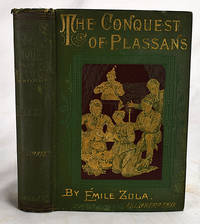
18872602020002Vizetelly & Co. London 1887. First Edition. Hardcover. Good. First English edition of La Conquete de Plassans. Bound in publisher's green pictorial cloth. Hardcover. Good binding and cover. Minor shelf wear. Several pages detached including frontis. viii 356 pages. Catalogue at rear for Sept. 1886 1st issue. 8 engravings. Vizetelly & Co., London hardcover
1892040674London: Chatto & Windus 1892. 1st English Edition. Hardcover. Very Good/No Dust Jacket. Octavo. pp XIV 534 32.1st printing. Head of spine shows wear. Prior owner bookplate to FPD. Chatto & Windus hardcover
1897040682London: Chatto & Windus 1897. 1st English Edition. Hardcover. Good/No Dust Jacket. Octavo. pp X. 410 32. 1st printing. Prior owner nameplate to FPD. Tiny mark to upper board. Internally fine. Chatto & Windus hardcover
1896BUL91067Chatto & Windus London 1896. Book. Good. Hardcover. 2nd Edition. The revised and expurgated English edition. 8vo. 314pp xxxii publisher's advertisements. Decorated cloth lettered in gold at the spine. Patterned endpapers. A nice crisp if slightly dusty copy. The third volume of Zola's celebrated 'Les Rougon-Macquart' series. It was originally translated into English in 1888 by publisher Henry Vizetelly who was imprisoned for obscene libel the same year for his translation of Zola's 'The Soil'. This revised and expurgated version was subsequently produced by Vizetelly's son and for years remained the most widely available English translation. Chatto & Windus, London Hardcover
1898040681London: Chatto & Windus 1898. 1st English Edition. Hardcover. Good/No Dust Jacket. Octavo. pp XII 347 32. 1st printing. Prior owner nameplate to FPD. Spine sunned wear to head of spine. Internally fine. Chatto & Windus hardcover
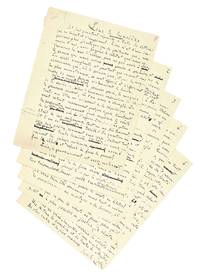
1898Zol1<p><strong>DREYFUS AFFAIR ZOLA Emile 1840-1902</strong></p><p>Unpublished autograph manuscript signed " <em>Emile Zola</em> "<br />Grosvenor Hotel London 19 July 1898 5 pages in-4 on ligned paper<br />Fold marks small hole at the folding junction on 5th folio without affecting the text<br /><br /></p><p><strong><u>Unpublished manuscript on the Dreyfus Affair</u></strong><br /><strong>Written six months after his open letter "J'accuse…!" and directly in its continuity this momentous manuscript testifies to the writer's tireless commitment to the cause of Captain Alfred Dreyfus</strong></p><p><em><br />" La vérité aveuglante est pourtant que ce sont nos adversaires qui dès le premier jour et pas les moyens les plus monstrueux se sont efforcés et s'efforcent encore de nous fermer violemment la bouche. </em>… <strong><em>De toute ma lettre au président de la République </em></strong>" J'accuse…! "<em> <strong>on avait extrait savamment quelques lignes limitant les poursuite uniquement pour empêcher la vérité de se faire jour sur l'affaire Dreyfus</strong>. Le plan était de me condamner tout en me bâillonnant. et l'on se souvient du terrible : 'La question ne sera pas posée' revenant sans cesse sabrant tout éteignant toute lumière.</em> …<strong><em> Enterrer l'affaire tout l'ardent désir est là</em></strong><em> il n'y a rien d'autre au fond de l'effroyable campagne qu'on mène contre nous </em>…<em> nous n'avons d'autre idée que de la faire vivre jusqu'à ce que la vérité et la justice triomphent </em>…<em> Les choses vont trop bien l'abcès mûrit nous avons tout intérêt à attendre qu'il crève. <strong>Comment ! Esterhazy est sous les verrous et l'on s'imagine que nous ne sommes pas curieux de savoir avant toute chose quelle partie de vérité va éclater! Je veux bien être condamné mais tout de même la complaisance au martyre a des bornes</strong></em> …<em> On aura beau jusque-là travestir nos actes prodiguer les mensonges et les ignobles injures nos amis savent que <strong>nous resterons les soldats impassibles du vrai incapables d'une reculade capables de tous les sacrifices</strong> et de toutes les attentes les plus rudes et les plus anxieuses. Emile Zola "</em></p><p><br />"Pour la Lumière" is an unpublished article by Émile Zola written in July 1898 six months after "J'accuse…!" in the midst of the Dreyfus affair. This is the only article on the Affair that Zola wrote during his exile. Intended to appear on the front page of <em>L'Aurore</em> it was never published as it was most likely censored by Georges Clemenceau who was editor of the newspaper. The latter used the present manuscript to publish "Pour la Preuve" on the front page of <em>L'Aurore</em> of July 20 1898. When reading both texts "Pour la Preuve" appears much more watered down than "Pour la Lumière" and largely expurgated in places. All the power of "Zolien" prose thus disappears in the guise of a bland and tasteless article.</p><p>The manuscript dates from the very beginning of the writer's London exile. On July 18 1898 Zola's conviction following the publication of "J'accuse…!" on January 13 of the same year was confirmed by the court of Versailles. On the orders of Georges Clemenceau and his lawyer Fernand Labori Zola left the France for London the same day even before the end of the trial.<br />The circumstances surrounding the writing of "Pour la lumière" are fairly well known from various sources: Zola's correspondence the diary that the writer kept during his exile published later under the title of "Pages d'exil" and a note that Bernard Lazare left on these events. The five pages of the article were written during the end of the day on July 19 1898 in a small room on the top floor of the Grosvenor Hotel in which the writer felt imprisoned: "the window was barred by the openwork frieze that crowns the whole immense building: a foretaste of the prison" he reported in his "Pages d'exil".<br />"Pour la Lumière" was to offer an answer to all those who accused the writer of fleeing justice while retrospective of his trial since his "coup d'éclat" of January 13 tipping point in the Dreyfus affair.</p><p>The manuscript which has remained unpublished to this day opens for Zola an exile that will last almost a year. No text of him concerning the Affair was published until June 1899 marking his return to his homeland.</p>
1886000593London: VIZETELLY & CO. Good with no dust jacket. 1886. Half-Leather. Set of three 3 matching illustrated editions with fine bindings assumed originally from a larger set. Book One - Nana 1887 a 'new edition' translated without abridgment from the 127th French edition. Book Two - His Masterpiece 1887 a 'new edition' with a portrait of the author etched by Bocourt. Book 3 - Germinal 1886 translated without abridgment from the 60th French edition and illustrated with sixteen page engravings from designs by J. Ferat. Ox-blood half leather with 5-band spine with gilt title treatment. Marbelized end papers. Overall in very good shape save for some moderate dingage and rubbing and splitting at the front covers and the upper spines. Nana the worst rating good overall. Super shelf presence and three of Zola's best reads of the Rougon-Macquart series.; 12mo - over 6¾" - 7¾" tall; LITERATURE DRAMA PROSE FRENCH FRANCE ZOLA EMILE ZOLA NATURALISM NATURAL . VIZETELLY & CO. hardcover
1889046694Paris: E. Plon Nourrit etc. 1889. First Edition. Hardcover Half Leather. Near Fine Condition. Jean-Francois Raffaelli. Half green morocco over marbled boards spine a bit sunned original wrappers bound in. Black and white and hand colored illustrations throughout and 10 heliogravure by Raffaelli - number 29 of 40 on Japan and with an additional folding etching a version of the frontis signed in pencil by Raffaelli tipped in before the frontis. A lovely production. Size: Quarto 4to. Illustrator: Jean-Francois Raffaelli. Quantity Available: 1. Shipped Weight: Under 1 kilo. Category: Literature & Literary; Inventory No: 046694. E. Plon, Nourrit etc. hardcover books
1889046694Paris: E. Plon Nourrit etc. 1889. First Edition. Hardcover Half Leather. Near Fine Condition. Jean-Francois Raffaelli. Half green morocco over marbled boards spine a bit sunned original wrappers bound in. Black and white and hand colored illustrations throughout and 10 heliogravure by Raffaelli - number 29 of 40 on Japan and with an additional folding etching a version of the frontis signed in pencil by Raffaelli tipped in before the frontis. A lovely production. Size: Quarto 4to. Illustrator: Jean-Francois Raffaelli. Quantity Available: 1. Shipped Weight: Under 1 kilo. Category: Literature & Literary; Inventory No: 046694. E. Plon, Nourrit etc. hardcover
18893986Green cloth with gilt particulars to spine. A nice clean copy without previous owners' names or other markings. ; 4to; vii i 162 i pages; All shipments through USPS insured Priority Mail. E. Plon, Nourrit et Cie. hardcover
1889252812Edition du Figaro E. Plon Nourrit et C 1889. Hardcover Seide Zustand: Mit Beschädigungen mit einem Namenszug aus 1940 im Vorsatz. Rücken Ecken Kanten stark zerfranst. Die Bindung ist nicht beeinträchtigt. Edition du Figaro, E. Plon, Nourrit et C, hardcover
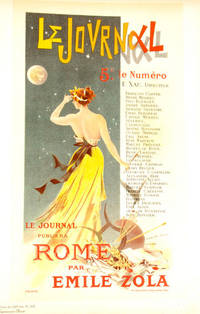
189913736Paris: L'Imprimerie Chaix 1899. First edition. Print. Fine. A young woman dressed in the classical style looks at the moon with her back to the viewer. Image size varies on paper 11 1/4 x 15 1/2" with the blind stamp in the lower right corner. <br /> <br /> Maitres de l'Affiche Masters of the Poster was an outstanding publication publishing in a small format the best of poster art from the Belle Epoque. They are lithographs printed by Imprimerie Chaix in Paris between 1895-1900. L'Imprimerie Chaix unknown
189874340Paris: Imprimerie Champenoispour CH. MassonH. Piazza 1898. Fine. Imprimerie Champenois pour CH. Masson H. Piazza Paris Février 1898 31 x 27 cm une feuille et une serpente Rare original colour lithograph executed by Albert-Émile Artigue for L'Estampe Moderne series no. 10 published in February 1898. One of 50 deluxe proofs printed on Japon with wide margins artist's signature within the stone publisher's blindstamp depicting a child's profile in the lower margin numbered stamp of the deluxe issue on the verso; the print is preceded by a captioned tissue guard with the artist's name the title and an excerpt from the work; with additional plain tissue guard. Lithograph inspired by an excerpt from Emile Zola's novel La Faute de l'abbé Mouret reproduced on the tissue guard of the print. A magnificent French monthly publication issued between May 1897 and April 1899 L'Estampe Moderne comprises original chromolithographs which unlike other periodicals such as Les Maîtres de l'Affiche and as specified on the tissue guards were created expressly for the journal by each artist. In all 100 prints were published encompassing the major artistic movements of the late 19th century: Symbolism Art Nouveau the Pre-Raphaelites Orientalism and the Belle Époque. Each issue of four plates was printed in 2000 copies sold at 3.50 francs and 100 on Japon paper offered at 10 francs. Henri Piazza also planned an exclusive printing of the utmost luxury: 50 copies on Japon with wide margins and 50 in black on China paper at the considerable price of 30 francs. This large-format print is superbly printed on the most prestigious of papers: Japon. Thick silky satin-finished and pearly it elevates each sheet into a work of art in its own right. Its exceptional capacity for ink absorption and affinity with colour make it the ideal medium for these splendid lithographs. The interest of French collectors in artistic posters intensified at the beginning of the 1890s. Octave Uzanne to describe this craze coined the term affichomanie. The poster originally popular and pasted up on the streets of the capital then became an art object its ephemeral support transformed into something precious and destined for preservation. Piazza resolved to remove the poster from its advertising purpose and elevate it to the rank of a work of art in its own right on a par with the deluxe illustrated book. In this way he assembled a prestigious collection of entirely original works by the most prominent European artists of the time: Georges de Feure Eugène Grasset Henri Detouche Emile Berchmans Louis Rhead Gaston de Latenay Lucien Lévy-Dhurmer Gustave-Max Stevens Charles Doudelet Hans Christiansen Henri Fantin-Latour Steinlen Ibels Engels Willette Henri Meunier Evenepoël Bellery-Desfontaines Charles Léandre etc. A handsome copy. Imprimerie Champenoispour CH. MassonH. Piazza unknown
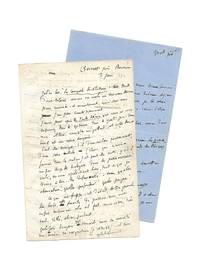
1874Flo16<p><strong>ZOLA FLAUBERT Gustave 1821-1880</strong></p><p>Autograph letter signed " Gve Flaubert " to Émile Zola<br />N.p.n.d Croisset 26th May 1874 1 p. in-8° on blue laid paper<br />Tear on fold old trace of previous mounting</p><p>And</p><p>Autograph letter signed " Gve Flaubert " to Émile Zola<br />Croisset près Rouen 3rd June Croisset 3 juin 1874 4 pp. in-8° on laid paper<br />Three words underlines by Alexandrine Zola old trace of previous mounting</p><p><strong>Set of two letters on <em>La Conquête de Plassans</em> forming undoubtedly Flaubert's most detailed critique of a novel by his friend Zola</strong></p><p>First letter</p><p><em>" Mardi soir.</em><br /><strong><em>C'est très fort ! mon brave homme ! Je l'ai lu tout d'une haleine & j'en suis étourdi.</em></strong><br /><em>Dans 8 jours je le relirai lentement ! p</em>ou<em>r voir si j'ai raison d'être enthousiasmé.</em><br /><em>J'ai reçu un g</em>ran<em>d choc comme d'une machine électrique.</em><br /><em>Vous ne serez pas poursuivi. <strong>La poésie vous sauvera</strong>. Mais je comprends les terreurs du jeune Charpentier.</em><br /><em>à dimanche une longue bavette sur votre truculent bouquin.</em><br /><em>tout à vous</em><br /><em>Gve Flaubert</em><br /><em>Je trouve Barbané très médiocre de fond & de forme" quoi qu'on dise ". Celui-là par exemple je ne le relirai pas. Je le sais. "</em></p><p>Second letter</p><p><em>" <strong>Je l'ai lue " La Conquête de Plassans " lue tout d'une haleine comme on avale un bon verre de vin puis ruminée – & maintenant mon cher ami j'en peux causer sciemment.</strong></em><br /><strong><em>J'avais peur après Le Ventre de Paris que vous ne vous enfonciez dans le système dans le parti pris. Mais non ! Allons vous êtes un gaillard ! et votre dernier livre est un crâne bouquin !</em></strong><br /><em>Peut-être manque-t-il d'un milieu proéminent d'une scène centrale chose qui n'arrive jamais dans la nature et peut-être aussi y a-t-il un peu trop de dialogues dans les parties accessoires ! Voilà en vous épluchant bien tout ce que je trouve à dire – de défavorable – mais quelle observation ! quelle profondeur ! quelle poigne !</em><br /><em>Ce qui me frappe c'est d'abord le ton général du livre la cette férocité de passion sous une surface bonhomme. Cela est fort mon vieux très fort râblé & bien portant.</em><br /><strong><em>Quel joli bourgeois que ce Mouret avec sa curiosité son avarice sa résignation p. 183-184 et son aplatissement ! L'abbé Faujas est sinistre et grand – un vrai directeur ! Comme il manie bien la femme comme il s'empare bien habilement de celle-là en la prenant par la charité puis en la brutalisant !</em></strong><br /><em>Quant à elle Marthe je ne saurais vous dire combien elle me semble réussie & l'art que je trouve au développement de son caractère ou plutôt de sa maladie. J'ai parti surtout remarqué les pages 194 215 et 227 261 264 267. – <strong>Son état hystérique son aveu final p. 350 & sq. est une merveille. Comme le ménage se dissout bien ! Comme elle se détache de tout et en même temps son moi son fond. Il y a là une science de dissolution profonde.</strong></em><br /><em>J'oublie de vous parler des Trouche – qui sont adorables comme canailles – & de l'abbé Bourette</em> Bourrette<em> exquis avec sa peur & sa sensibilité.<br />La vie de province les jardins qui se regardent le ménage Paloque les Rastoil & les parties de raquette parfait parfait.<br /><strong>Vous avez des détails excellents des phrases des mots qui sont des bonheurs</strong> page 17 " … la tonsure comme une cicatrice " 181 " j'aimerais mieux qu'il allât voir les femmes " 89 " Mouret avait bourré le poêle " etc.<br />Et le Cercle de la jeunesse ! Voilà une invention vraie.<br />J'ai noté en marge bien d'autres endroits.<br />– Les détails physiques qu'Olympe donne sur son frère – la fraise<br />– La mère de l'abbé prête à devenir sa maquerelle 152 – et son coffre ! 338.<br />– <strong>L'âpreté du prêtre qui repousse les mouchoirs de sa pauvre amante parce que cela sent " une odeur de femme "</strong>.<br />– " Au fond des sacristies le nom de Mr Delangre… " et toute la phrase qui est un bijou.<br /><strong>Mais ce qui écrase tout – ce qui couronne l'œuvre c'est la fin !</strong> Je ne connais rien de plus empoignant que ce dénouement. La visite de Marthe chez son oncle – le retour de Mouret & l'inspection qu'il fait de sa maison ! La peur vous prend comme à la lecture d'un conte fantastique & vous arrivez à cet effet-là par l'excès de la réalité par l'intensité du vrai ! Le lecteur sent que la tête lui tourne comme à Mouret lui-même.<br />L'insensibilité des bourgeois qui contemplent l'incendie assis sur des fauteuils est charmante. & vous finissez par un trait sublime : l'apparition de la soutane de l'abbé Serge au chevet de sa mère mourante comme une consolation ou comme un châtiment !<br />Une chicane cependant. Le lecteur qui n'a pas de mémoire ne sait pas quel instinct pousse à agir comme ils font Me Rougon et l'oncle Macquart. Deux paragraphes d'explications eussent été suffisants. N'importe ça y est et je vous remercie du plaisir que<br />vous m'avez fait.<br />Dormez sur vos deux oreilles c'est une œuvre<br /><strong>Mettez de côté p</strong></em>ou<strong><em>r moi toutes les bêtises qu'elle inspirera. Ce genre de documents m'intéresse.</em></strong><em><br />Je vous serre la main très fort & suis<br />vous n'en doutez pas<br />vôtre<br />Gve Flaubert "</em></p><p>The fourth volume of <em>Rougon-Maquart</em> <em>La Conquête de Plassans</em> was published in the spring of 1874 by Charpentier and tells the story of Father Faujas a Bonapartist priest ready to do anything to reconquer the city of Plassans fallen into the hands of the legitimists royalists. In this violent attack on the clergy Zola depicts a Church complicit in political power manipulative using the naive piety of the faithful especially women through practices where faith is in fact only a veil masking other ambitions.</p><p>Flaubert first emits a brief hot reaction after a first reading having left him "dizzy". He says he is "shocked" and rightly so because he will a week later give himself to a criticism this time without reservation going so far as to quote passages on the recently published novel of his friend Zola.<br />It should be noted that it is not without some apprehension that Flaubert undertakes the reading of this fourth volume of <em>Rougon-Macquart</em> having succeeded the much maligned <em>Ventre de Paris</em>. He does not hide it this last novel had displeased him because according to him being too deeply in the naturalist doctrine the "system the bias" through the small Parisian people.<br /><em>La Conquête de Plassans</em> offers a different romantic formula.<br />We also notice that Flaubert revels in the way the bourgeoisie is portrayed the same provincial bourgeoisie he himself had mocked in his previous works : <em>Madame Bovary</em> and <em>L'Éducation sentimentale</em>.<br />Finally emphasizing the Abbot's hold on the Mouret couple and more particularly on Marthe whose decline will sink into madness Flaubert appreciates with what scientific precision and coldness Zola describes the ravages of the imbalance that strikes the two characters.</p><p><u>Bibliography:</u><br />Gustave Flaubert <em>Correspondance</em> éd. Jean Bruneau Pléiade t. IV p. 801 first letter<br />Gustave Flaubert <em>Correspondance</em> éd. Jean Bruneau Pléiade t. IV pp. 805-806 second letter<br />Flaubert <em>Correspondance</em> éd. René Descharmes Le Centenaire t. III pp. 541-543 second letter</p><p><u>Provenance:</u><br />Émile Zola's personal collection<br />Then Alexandrine Zola by descent<br />Then famille Le Blond-Zola by descent</p>
186782102Paris:: E. Dentu 1867. First edition. handsome later half morocco and marbled sides t.e.g.; elaborately gilt spine. Some extremely light marginal foxing to the margins of the text; original etching of Olympia and the portrait fine; binding fine. . 8vo. Accompagnee d'un portrait d'Ed. Manet par Bracquemond et d'une eau-forte d'Ed. Manet d'apres Olympia. E. Dentu, unknown
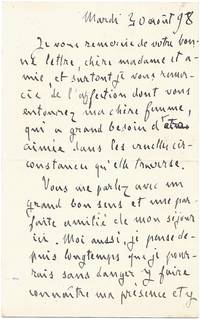
1898ZolaDreyfusAffair1<p><strong>AFFAIRE DREYFUS ZOLA Émile 1840-1902</strong></p><p>Autograph letter signed " Z " to Alice Mirbeau<br />N.p Addlestone Tuesday 30th August 1898 4 p. in-8° on laid paper<br />Central fold reinforced with Japan paper light browning lower margin stain on second folio see scans</p><p><strong>Letter from exile testifying to the writer's unwavering commitment to the Dreyfus affair</strong></p><p><em>" Je vous remercie de votre bonne lettre chère madame et amie et surtout je vous remercie de l'affection dont vous entourez ma chère femme qui a grand besoin d'être aimée dans les cruelles circonstances qu'elle traverse.<br />Vous me parlez avec un grand bon sens et une parfaite amitié de mon séjour ici. Moi aussi je pense depuis longtemps que je pourrais sans danger y faire connaître ma présence et y prendre une attitude que je saurais rendre utile et <strong>digne. Mais il y a aussi l'autre parti celui de rentrer en France et d'y faire mon devoir jusqu'au bout. Je ne puis donc encore me prononcer j'attends l'avis de nos amis et j'attends aussi les évènements</strong>. De toutes façons d'ailleurs je ne puis guère rentrer avant la fin d'octobre car je désire que la chambre soit réunie et qu'on ait liquidé toutes les autres affaires pendantes.<br />Vous me touchez infiniment en m'offrant vos services dévoués ici et même à Paris. Ici le mieux est que je vive encore ignoré travaillant en paix dans une solitude dont personne le connaît le chemin. Mon travail que j'ai repris régulièrement m'est un grand repos. À Paris certes si j'avais besoin de vous je serais fort heureux de me confier à votre dévouement et à votre discrétion.<br /><strong>Les infamies s'entassent cela devait être. C'est avec un serrement douloureux de cœur que je songe à la pure victime</strong></em> <strong><em>qu'ils vont encore condamner ; et cela ne me donne qu'une passion celle du sacrifice la volonté de m'immoler moi-même.<br /></em></strong><em>Embrassez bien tendrement votre cher mari. Je sais tout ce qu'il fait pour vous et j'en suis profondément ému.<br />Merci encore chère madame et amie et mille bonnes affections.<br />Z "</em></p><p>Convicted definitively on appeal on July 18 1898 by the Versailles court Zola left France to return to England. His open letter "J'accuse…!" published in <em>L'Aurore</em> on January 13 1898 earned the writer a fine of 3000 francs and 1 year of imprisonment. Committed body and soul to the defense of Captain Dreyfus Zola was forced into exile by Clemenceau and Labori and at the same time into silence. Kept away from the Parisian furnace prey to all the passions surrounding the affair Zola sometimes lets glimpse from England like this letter a share of frustration at no longer being at the center of the chessboard.<br />Regarding the support he received from his close friends the writer could count on that of Octave Mirbeau a Dreyfusard from the very beginning. The latter whose role has long been underestimated was one of the most influential defenders of Captain Dreyfus and Zola. After taking a public stand for the first time in an article in the Journal of 28 November 1897 two days after Zola's first article it was Mirbeau who in July 1898 paid out of his own pocket the entire fine to which Zola was sentenced on appeal in Versailles. Two weeks after Zola's conviction he wrote in L'Aurore on 2 August 1898:<br />" Will not professors philosophers scholars writers artists all those in whom truth resides from all parts of France finally free their souls from the terrible weight that oppresses them Faced with these daily challenges to their genius their humanity their spirit of justice their courage will they not finally understand that they have a great duty… that of defending the heritage of ideas of science of glorious discoveries of beauty with which they have enriched the country of which they are the guardians… "</p><p>We know the letter of support that Alice Mirbeau committed to her husband sent to Zola on August 24 and to which the writer replied above: " Despite the pain I feel in knowing how much you suffer from your isolation I persist in believing that you must find the strength to wait and that at no cost should the end be hastened. Certainly prison where all those who love you could come and embrace you would be sweeter for you and for your friends but you must not abandon everything especially now that there is a new victim on the eve of being so harshly struck. … I am very happy that you have resumed your work it will console you a little because you must persist … If I can do you any pleasure soften your captivity a little by a few steps for anything that you would like to be done use me I beg you I put my tenderness at your service and I will be happy to use myself to be agreeable to you…"</p><p>At the time he wrote this letter Zola did not yet know it but the affair was about to change on this August 30. After having completed the Dreyfus file with a piece that he himself had forged Commander Henry confessed after his forgery was discovered by Captain Cuignet military attaché to Minister Cavaignac. Taken immediately to detention at Mont Valérien Henry committed suicide the next day in his cell his throat slit with a razor. Already imprisoned at La Santé in July 1898 Picquart was again imprisoned at Cherche-Midi prison on September 22 proving Zola's prediction right.</p><p><u>Provenance:<br /></u>Collection particulière</p><p><u>Bibliography:<br /></u><em>Correspondance</em> éd. Maurice et Denise Leblond Bernouard 1929 t. II p. 811<br /><em>Correspondance</em> t. IX éd. du CNRS p. 285-286 n°186</p>
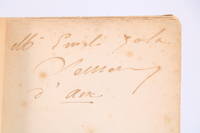
187590869Paris: Ernest Leroux 1875. Fine. Ernest Leroux Paris 1875 1879 12.2 x 11.8 cm Broché Second edition the dedication to Pierre Laffitte is dated 1879. A study of madness from a positivist perspective based on the work of Auguste Comte. The dedicatee Pierre Laffitte was the editor of the review ""Le Positivisme"". Spine cracked with small losses occasional foxing and a horizontal crease at the foot of the upper cover small marginal tears on the cover firts cover reattached. With a fine signed presentation inscription from Emile François Eugène Sémérie to Émile Zola on the half-title: ""A Mr. Émile Zola. Sémérie d'Aix"" the final word underlined. The close connections between positivism and naturalism the literary doctrine developed in the 1860s1880s are well known: positivist philosophy the observation of reality and the primacy of experience influenced naturalist writers in their concern to depict reality with strict objectivity. Zola made an essential contribution to the movement with his study ""Roman expérimental"" 1880. Ernest Leroux unknown
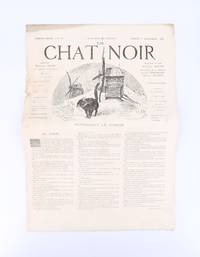
188788816Paris: Au cabaret Le Chat noir 1887. Fine. Au cabaret Le Chat noir Paris 3 septembre 1887 31 x 45 cm en feuillets First edition one of the rare copies printed on laid paper. This four-page issue features a comic strip by Louis-Christian known as Döes: ""La bonne galette"". Includes literary contributions by Francisque Sarcey on ""La Terre"" by Emile Zola Charles Cros ""Psaume CCCCXXXIV"" Alfred Béjot ""Épitre à Allais"" Georges Auriol ""Malabar"" among others. One tear with loss and some light staining to the margins of the covers. Le Chat Noir was a weekly review founded by Rodolphe Salis and Emile Goudeau published from 1882 to 1897 intended to promote the famous cabaret of the same name and to serve as its chronicle. It featured the texts recited during performances and constitutes an important literary and artistic record of late 19th-century bohemian life and the unique vibrancy of Paris during that era. Au cabaret Le Chat noir unknown
189621947Paris & Bruxelles Brussels: SeghersA. Manceaux 1896. Fine. Seghers A. Manceaux Paris & Bruxelles Brussels 1896 16.50 x 25.50 cm broché First edition of which no deluxe copies are mentioned. Spine split one joint cracked at head and foot otherwise a rare and handsome copy. SeghersA. Manceaux unknown
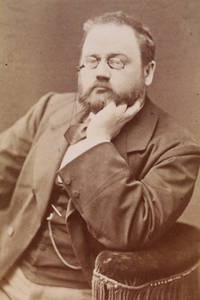
187072935Paris: Ernest Ladrey 1870. Fine. Ernest Ladrey Paris 1870 6.50 x 10.50 cm une photographie Very rare original albumen photograph in carte-de-visite format mounted on yellow cardboard with red border. Manuscript annotation on verso. The address at Passage des Princes on the back of the photograph indicates that the photograph was taken before 1875. Handsome copy of this photograph of the writer with his lorgnette and beard. Ernest Ladrey unknown
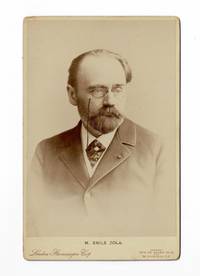
190073358Londres London: London Stereoscopic Company 1900. Fine. London Stereoscopic Company Londres London 1900 10.70 x 16.60 cm une photographie au format carte cabinet Handsome original photographic portrait of Emile Zola in cabinet card format period print on albumen paper mounted on cardboard from the London Stereoscopic Company and taken by an unidentified photographer. The writer poses there rosette of the Legion of Honor at his buttonhole. Condemned for defamation after the publication of his famous ""J'Accuse!"" on the front page of L'Aurore and to escape prison Zola secretly fled to London on July 18 1898. On July 26 1898 the Legion of Honor was withdrawn from him. A snub to this France that did not understand him this ""rosette"" photograph was most likely taken after his removal from the order of the Legion of Honor. Exceptional state of conservation. London Stereoscopic Company unknown
189822226Paris: La Revue Blanche 1898. Fine. La Revue Blanche Paris 1er Mars 1898 17.50 x 26 cm broché First edition presented under double cream wrappers one of the rare copies on Holland paper from a very small print run whose number is not specified the only deluxe copies. Contributions by G. Kahn J. de Mitty J.P. Jacobsen on the plague in Bergamo tribute from the Revue Blanche to Emile Zola for the condemnation he faced in the verdict of February 23 1898 regarding the Dreyfus affair. Minor marginal worming without consequence to the covers of the double wrappers handsome copy. Rare. La Revue Blanche unknown
188720546Paris: Extrait de La Revue des deux mondes 1887. Fine. Extrait de La Revue des deux mondes Paris 1887 15.50 x 25 cm agrafé First edition. Plain paper cover. Rare. Extrait de La Revue des deux mondes unknown
190014035Paris: Imp. A. Eyméoud 1900. Fine. Imp. A. Eyméoud Paris s. d. circa 1900 11 x 16.50 cm agrafé First edition. Three small marginal lacks to the slightly faded front cover handsome interior condition. Rare. Imp. A. Eyméoud unknown
190016528Paris: Imp. A. Eyméoud 1900. Fine. Imp. A. Eyméoud Paris s. d. circa 1900 11 x 17 cm agrafé First edition. A good copy. Imp. A. Eyméoud unknown