Wilde, OscarBiblio.com

303 résultats
1899140940300London: Leonard Smithers and Co 1899. Signed Limited First Edition. Near Fine. Signed limited first edition. xii 152 pp. Bound in publisher's original pale lavender cloth with gilt spine lettering and decorations by Charles Shannon. Copy number 82 of 100 large paper copies signed by Oscar Wilde with a flourish. Near Fine with subtle sunning several barely discernible spots to cloth short bubble to rear cloth. Typical offsetting to endpapers and a 5" tear to the rear endpaper. Contents bright and fresh. A beautiful copy.<br /> <br /> <p>Wilde's masterpiece which opened to wide acclaim at the St. James's Theatre London on February 14 1895. It was withdrawn after 86 performances following his arrest and imprisonment on charges of gross indecency as a consequence of his failed libel suit against Lord Queensbury the father of Wilde's homosexual lover Lord Alfred Douglas. He was outed as gay a disgrace in Victorian society and the play was not published in any form until the present edition following his release from prison. It has been hailed as an exemplary farce called by poet W.H. Auden "a pure verbal opera. Leonard Smithers and Co unknown
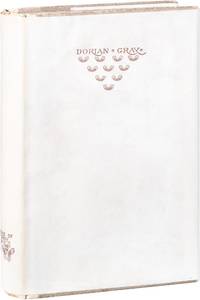
1891260London: Ward Lock & Co 1891. First Edition. First printing without Bowden's name added to the title page imprint the Preface with Wilde's name at the end in larger bolder type and with "nd" for "and" beginning the eighth line from the bottom on page 208. The error was corrected for the second printing which included the 250 signed copies of the limited edition—copies that in addition to being the second issue are literally the second printing. This trade edition is not only earlier than the limited but when it has its dust jacket many times rarer. Original white vellum parchment-backed boards former owner's neat name to endpaper spine slightly faded from light not dust else near fine in the rare dust jacket with small tears and chips to the spine tips and corners neatly repaired a bit short an irregularity with nineteenth-century hand-trimmed jackets but a charismatic jacket still—integral clean and one to be owned with pride. An unequivocal Victorian classic as great a short novel as has ever been written and copies in dustjacket must have been dumped in the Bermuda Triangle because they never show up at auction or in the trade. Full morocco case. Wilde was from that atypical minority of great men those who do not remind us of anyone else. He wrote the best comedies since Shakespeare mastered paradox and was the reigning wit of the 1890s but he became a victim when society forgot that the mouse should never be a juror at the cat’s trial. Dorian Gray was his only novel and why not When you write one like this one is sufficient. It’s undeniably a modern Gothic and a self-evident Victorian classic unique in the delicacy of its grim and melancholy metaphor and it continues to maintain it’s appeal even in our 21st century. Ward Lock & Co unknown
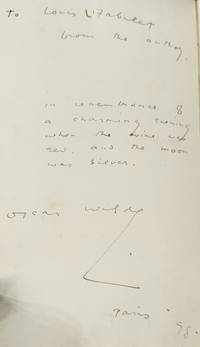
18986<p><strong>Oscar Wilde</strong></p><p><strong>The Ballad of Reading Goal by C.3.3.</strong></p><p><em>Leonard Smithers Royal Arcade London W. 1898.</em></p><p>Original white quarter cloth spine lettered in gilt yellow cloth sides.</p><p>Inscribed in ink on the back of the half-title:</p><p><em>To Louis Fabulet</em></p><p><em>from the author</em></p><p><em>in remembrance of</em></p><p><em>a charming evening</em></p><p><em>when the wine was </em></p><p><em>red and the moon</em></p><p><em>was silver</em></p><p><em>Oscar Wilde</em></p><p><em>Paris</em></p><p><em>98</em></p><p>Autograph note from Louis Fabulet:<em><br /><br />"This book: "The Ballad of Reading Jail" was given to me by Oscar Wilde in June 1898 a few days after the dinner that after his release from prison in England I persuaded my friend the poet Edouard Ducôté then director of the magazine "L'Ermitage" to offer in his honor.<br />Hugues Rebell André Gide Henri Ghéon René Boylesve and I were the guests.<br />Louis Fabulet.<br /><br /></em>Attached is the business card bearing the name under which Oscar Wilde then lived in Paris. The address in pencil: <em>"Hôtel d'Alsace rue des Beaux-Arts is in his handwriting.<br /></em></p><p>"<em>Melmoth" is the man "who sold his soul for eternal youth."</em></p><p>Louis Fabulet 1862-1933 was one of the main translators from English to French in his time notably of the works of Kipling and Thoreau. It is said that it was Oscar Wilde who introduced him to <em>The Jungle Book.</em></p><p>This inscription exceptionally long and colorful which is almost akin to a brief poem refers to the dinner that Louis Fabulet speaks of in his note.</p><p>Wilde had arrived in Paris in March and the French literati were keen to pay him public homage with this banquet which he presided over.</p><p>The inscription makes a nice reference to the event with perhaps a reminiscence of the <em>Ballad</em> itself where we read in the second verse: <em>"For blood and wine are red"</em> .</p><p>Mounted in the copy is Wilde's rare card in the name of Sebastian Melmoth. The aged ruined writer abandoned by almost everyone hid himself under the name of the hero of Robert Mathurin's novel <em>Melmoth the Wanderer.</em></p><p>The card does not have an address. Wilde in fact lived at the Hôtel d'Alsace in Saint-Germain des Prés a shabby establishment at the time <em>"it's so dirty so totally depressing and hopeless"</em> he wrote. He wrote down the address of his hand in pencil. It was there that he died two years later. The hotel took the name "L'Hôtel" in 1963 and became a rather chic place.</p><p>These combined elements: the poetic inscription which evokes a happy moment and the moving card which evokes his misery make this copy one of the most precious there is.</p> Leonard Smithers