Wilde OscarBiblio.com
5 936 résultats
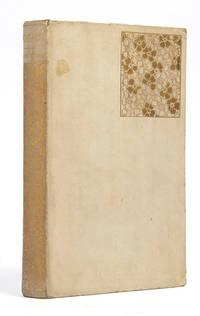
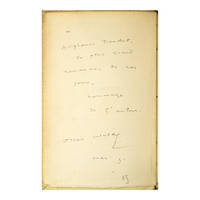
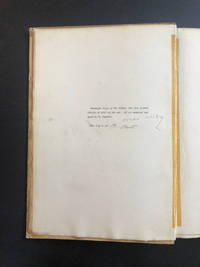
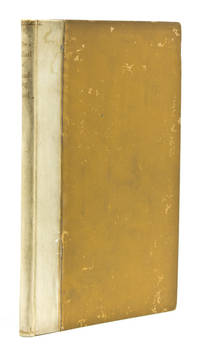
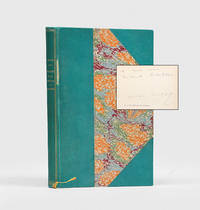
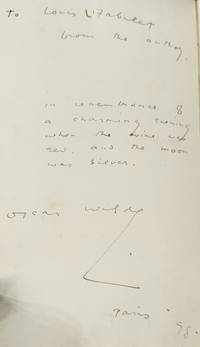
18986<p><strong>Oscar Wilde</strong></p><p><strong>The Ballad of Reading Goal by C.3.3.</strong></p><p><em>Leonard Smithers Royal Arcade London W. 1898.</em></p><p>Original white quarter cloth spine lettered in gilt yellow cloth sides.</p><p>Inscribed in ink on the back of the half-title:</p><p><em>To Louis Fabulet</em></p><p><em>from the author</em></p><p><em>in remembrance of</em></p><p><em>a charming evening</em></p><p><em>when the wine was </em></p><p><em>red and the moon</em></p><p><em>was silver</em></p><p><em>Oscar Wilde</em></p><p><em>Paris</em></p><p><em>98</em></p><p>Autograph note from Louis Fabulet:<em><br /><br />"This book: "The Ballad of Reading Jail" was given to me by Oscar Wilde in June 1898 a few days after the dinner that after his release from prison in England I persuaded my friend the poet Edouard Ducôté then director of the magazine "L'Ermitage" to offer in his honor.<br />Hugues Rebell André Gide Henri Ghéon René Boylesve and I were the guests.<br />Louis Fabulet.<br /><br /></em>Attached is the business card bearing the name under which Oscar Wilde then lived in Paris. The address in pencil: <em>"Hôtel d'Alsace rue des Beaux-Arts is in his handwriting.<br /></em></p><p>"<em>Melmoth" is the man "who sold his soul for eternal youth."</em></p><p>Louis Fabulet 1862-1933 was one of the main translators from English to French in his time notably of the works of Kipling and Thoreau. It is said that it was Oscar Wilde who introduced him to <em>The Jungle Book.</em></p><p>This inscription exceptionally long and colorful which is almost akin to a brief poem refers to the dinner that Louis Fabulet speaks of in his note.</p><p>Wilde had arrived in Paris in March and the French literati were keen to pay him public homage with this banquet which he presided over.</p><p>The inscription makes a nice reference to the event with perhaps a reminiscence of the <em>Ballad</em> itself where we read in the second verse: <em>"For blood and wine are red"</em> .</p><p>Mounted in the copy is Wilde's rare card in the name of Sebastian Melmoth. The aged ruined writer abandoned by almost everyone hid himself under the name of the hero of Robert Mathurin's novel <em>Melmoth the Wanderer.</em></p><p>The card does not have an address. Wilde in fact lived at the Hôtel d'Alsace in Saint-Germain des Prés a shabby establishment at the time <em>"it's so dirty so totally depressing and hopeless"</em> he wrote. He wrote down the address of his hand in pencil. It was there that he died two years later. The hotel took the name "L'Hôtel" in 1963 and became a rather chic place.</p><p>These combined elements: the poetic inscription which evokes a happy moment and the moving card which evokes his misery make this copy one of the most precious there is.</p> Leonard Smithers
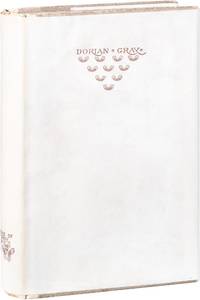
1891260London: Ward Lock & Co 1891. First Edition. First printing without Bowden's name added to the title page imprint the Preface with Wilde's name at the end in larger bolder type and with "nd" for "and" beginning the eighth line from the bottom on page 208. The error was corrected for the second printing which included the 250 signed copies of the limited edition—copies that in addition to being the second issue are literally the second printing. This trade edition is not only earlier than the limited but when it has its dust jacket many times rarer. Original white vellum parchment-backed boards former owner's neat name to endpaper spine slightly faded from light not dust else near fine in the rare dust jacket with small tears and chips to the spine tips and corners neatly repaired a bit short an irregularity with nineteenth-century hand-trimmed jackets but a charismatic jacket still—integral clean and one to be owned with pride. An unequivocal Victorian classic as great a short novel as has ever been written and copies in dustjacket must have been dumped in the Bermuda Triangle because they never show up at auction or in the trade. Full morocco case. Wilde was from that atypical minority of great men those who do not remind us of anyone else. He wrote the best comedies since Shakespeare mastered paradox and was the reigning wit of the 1890s but he became a victim when society forgot that the mouse should never be a juror at the cat’s trial. Dorian Gray was his only novel and why not When you write one like this one is sufficient. It’s undeniably a modern Gothic and a self-evident Victorian classic unique in the delicacy of its grim and melancholy metaphor and it continues to maintain it’s appeal even in our 21st century. Ward Lock & Co unknown
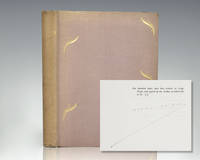
1899140940300London: Leonard Smithers and Co 1899. Signed Limited First Edition. Near Fine. Signed limited first edition. xii 152 pp. Bound in publisher's original pale lavender cloth with gilt spine lettering and decorations by Charles Shannon. Copy number 82 of 100 large paper copies signed by Oscar Wilde with a flourish. Near Fine with subtle sunning several barely discernible spots to cloth short bubble to rear cloth. Typical offsetting to endpapers and a 5" tear to the rear endpaper. Contents bright and fresh. A beautiful copy.<br /> <br /> <p>Wilde's masterpiece which opened to wide acclaim at the St. James's Theatre London on February 14 1895. It was withdrawn after 86 performances following his arrest and imprisonment on charges of gross indecency as a consequence of his failed libel suit against Lord Queensbury the father of Wilde's homosexual lover Lord Alfred Douglas. He was outed as gay a disgrace in Victorian society and the play was not published in any form until the present edition following his release from prison. It has been hailed as an exemplary farce called by poet W.H. Auden "a pure verbal opera. Leonard Smithers and Co unknown
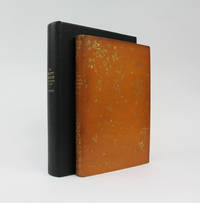
18832London: David Nutt. 1888. First edition first printing. First edition first printing. Signed Limited Edition. Small 4to. Stunning contemporary orange morocco by Zaehnsdorf titles and ivy leaf tooling in gilt to the spine upper board with titles in gilt upper and lower boards decorated with acorns and oak ivy sycamore and willow leaves in gilt. The inner dentelles are decorated with ivy leaves in gilt the binder's name stamp in gilt at the front and exhibition stamp in gilt at the rear. Top edge gilt others untrimmed. Retaining the original upper wrapper. Illustrated title page in red with black vignette printed title page in red and black. Illustrated with a frontispiece and two further plates by Walter Crane each in two states and 12 head and tailpieces by Jacomb Hood. A beautiful near fine copy. Imperceptible repair to the upper joint minor toning to the leather. The contents with light offsetting to the endpapers and a faint mark to the margin of one page are otherwise clean and bright throughout. Housed in a recent full black morocco felt lined solander case titles in gilt to the spine and grey cloth slipcase. Limited to 75 large paper copies of which this is hand numbered 36 and signed by Oscar Wilde and the publisher David Nutt on the limitation page. A superb example of the rare first edition preceding the trade edition of 1000 copies issued later the same year in an exceptional contemporary exhibition quality autumnal foliate binding. The Happy Prince is Oscar Wilde's first and best known collection of children's stories including "The Selfish Giant" "The Nightingale and the Rose" "The Devoted Friend" and "The Remarkable Rocket". Wilde's "Reputation as an author dated from the publication of The Happy Prince and Other Tales in London in May 1888. The Athenaeum compared him to Hans Christian Andersen and Pater wrote to say that 'The Selfish Giant' was 'perfect in its kind' and the whole book written in 'pure English' - a wonderful compliment" Ellmann Richard: Oscar Wilde p. 282. Mason 314. Provenance: Charles Mills Lord Hillingdon 1830 - 1898; Sotheby's sale of 1932 lot 454; purchased by book dealer and co-founder of the Society for Theatre Research Ifan Kyrle Fletcher with his neat pencil note recording the sale on the front pastedown; Helen Hambro née Boyson 1936 - 2004. Further details and images for any of the items listed are available on request. Lucius Books welcomes direct contact with our customers. London: David Nutt. 1888 hardcover
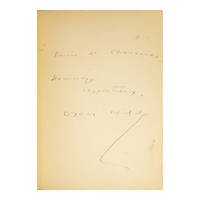
1893#16<p>Oscar Wilde Salomé. Drame en un acte. Paris Librairie de l'Art indépendant; London Elkin Mathews and John Lane 1893. Square 12mo 196 × 145 mm. 2 blank leaves 84 numbered pages the first 8 unnumbered: half-title title dedication to Pierre Louÿs list of characters; text beginning on p. 9 and 2 unnumbered leaves 1 leaf with the colophon dated 6 February 1893 and 1 blank leaf. Modern binding. Half black morocco with small corner pieces bluish paper sides smooth spine title in gilt untrimmed top edge with matte gilt doublures and endleaves of the same paper. Original violet wrappers and spine the upper cover printed in silver lettering preserved. Excellent condition. A few small spots; upper edges of the boards slightly faded; wrappers somewhat sunned. First edition. This celebrated play was written directly in French by Wilde between 1891 and 1892; first performed in 1896 its text was revised at the author's request by Marcel Schwob Stuart Merrill and Pierre Louÿs. The first English edition appeared the following year. Limited edition of 600 copies with no special issue on large paper. The second blank leaf bears the following autograph inscription signed in black ink: "<em>À Puvis de Chavannes / </em><em>Hommage respectueux / </em><em>Oscar Wilde</em>" To Pierre Puvis de Chavannes respectful homage Oscar Wilde. The celebrated painter and muralist Pierre Puvis de Chavannes 1824–1898 like Oscar Wilde 1854–1900 lived in the cult of Beauty. Renowned for his compositions of noble and hieratic character influenced both by Greco-Roman classicism and by Symbolism his work exerted a profound fascination on late nineteenth-century painters and sculptors particularly Edgar Degas Paul Gauguin Aristide Maillol and Maurice Denis. The aesthetic connection between Oscar Wilde and Puvis de Chavannes is to be sought precisely around Salomé since the artist had painted in 1869 a Beheading of Saint John the Baptist that may well have inspired the author. Moreover it is known that when Aubrey Beardsley—who would illustrate the English version of the play in 1894—came to Paris in 1893 he was strongly encouraged by the French painter who introduced him as "a young English artist who produces astonishing things." The inscription in Salomé is therefore particularly significant and of greater import than a simple tribute. A very fine provenance for this celebrated drama written directly in French by Oscar Wilde.</p> Librairie de l’Art indépendant
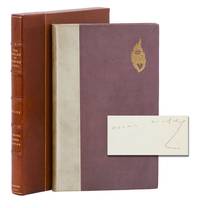
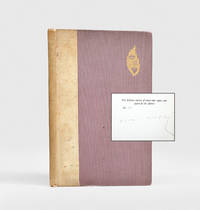
1898140948944London: Leonard Smithers 1898. Signed Limited Issue. Near Fine. Third edition limited issue #69 of 99 copies signed by Oscar Wilde in black ink on the limitation page. 31 pp. printed on rectos only. Bound in publisher's purple cloth over and white spine cloth stamped in gilt; gilt floral ornament to front board after the famed British artist Charles Ricketts. Housed in a custom quarter morocco slipcase. <p>Near Fine with slight lean to binding light soilingto boards. Bookplate of business man Chauncey Lawrence Williams at front pastedown along with an inscription from the former owner and giftee below dated March 8 1934. Williams was publishing partner of W. Irving Way of Way and Williams who published L. Frank Baum's first literary venture Mother Goose in Prose 1897 Additionally he commissioned a 28-year-old Frank Lloyd Wright to build his home in River Forest Illinois. Williams' funeral service program is laid-in at front offsetting from previously laid-in papers at front endsheets with remnants of former auction record at front free endpaper. <p>Wilde's poignant poem a reflective narrative calling for prison reform and critique of Victorian-era justice systems. Written in exile and printed anonymously under his identification number "C. 3. 3." issued to him at Reading prison during his two year imprisonment for gross indecency with his lover Lord Alfred Douglas.The scarcest and most desirable edition of the author's widely lauded and instantly successful protest poem which serves as a deeply personal lament and a powerful testament to his time in prison. Mason 374. Leonard Smithers unknown
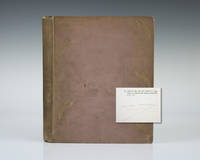
118405London David Bogue 1882. . Fourth edition inscribed presentation copy; single leaf of publisher's ads at rear bookplate of Waldo Story free endpapers tanned light spotting to the title and blanks and occasionally to the contents; publisher's parchment boards blocked in gilt binding rubbed with some wear at the tips and a few spots and marks including a 1cm mark on the upper board spine rolled very good condition; 234pp.<br /> Fourth edition of Wilde's first poetry collection a presentation copy inscribed from the author to Ada Maud Story née Broadwood wife of his friend the sculptor Thomas Waldo Story: 'To Mrs. Waldo Story from her friend Oscar Wilde. Paris May 9th '83'. Additionally inscribed 'Rien n'est vrai que le Beau' on the title and with her husband's bookplate.<br /><br />Thomas Waldo Story 1854-1915 was born in Rome the son of American Neoclassical sculptor William Wetmore Story. He was educated at Eton and Oxford before returning to Italy and joining his father's practice. The Storys cultivated an impressive clientele including the Marlboroughs and Astors for whom they developed large-scale decorative schemes and Thomas Waldo is best known for the monumental two-colour marble sculpture Fountain of Love at Cliveden. In addition to Neoclassicism he was inspired by the Aesthetic movement espoused by friends such as Wilde who wrote to him in 1883 that Whistler 'spoke of your art with more enthusiasm than I ever heard him speak of any modern work' Whistler Catalogue Raisonné University of Glasgow. <br /><br />The present copy was inscribed in Paris in May 1883 following the Story's April marriage and a year prior to Wilde's own marriage. Upon becoming engaged Wilde wrote to Thomas Waldo 'Well we are to be married in April as you were and then go to Paris and perhaps to Romewhat do you think Will Rome be nice in May I mean will you and Mrs Waldo be there and the Pope and the Peruginos Her name is Constance and she is quite young very grave and mystical. quite perfect except that she does not think Jimmy the only painter that ever really existed: she would like to bring Titian or somebody in by the back door: however she knows I am the greatest poet so in literature she is all right: and I have explained to her that you are the greatest sculptor: art instruction cannot go further'.<br /> London, David Bogue, 1882. hardcover
1882#8<p>Oscar Wilde<br />Poems. Fourth Edition.<br />London David Bogue 1882.<br /><br />Octavo. ix pp. 1 blank leaf 234 pp. 2 pp. publisher's catalogue and 1 blank leaf.<br /><br />Publisher's binding. Full white vellum Bradel binding both covers decorated with a symmetrical gilt and blind-stamped floral panel spine likewise adorned with a large gilt floral panel title in gilt lettering top edge gilt untrimmed.<br /><br />Fourth edition.<br /><br />Copy enriched with an autograph inscription signed on the verso of the half-title:<br />"To Alphonse Daudet the greatest novelist of our time homage from the author. Oscar Wilde May 3 83."<br /><br />An exceptional inscription to "the greatest novelist of our time."<br /><br />Having only just returned from New York Oscar Wilde spent the period from February to mid-May in Paris. It was there that he made the acquaintance of Alphonse Daudet whom he met both at his home his wife hosted a celebrated salon and at the residence of the painter Giuseppe de Nittis.<br /><br />Robert Harborough Sherard who was a friend of both Daudet and Wilde testified to the genuine esteem the English writer held for the French novelist.<br /><br />Although their aesthetics may at first appear far apart certain parallels can nevertheless be drawn between their works. Thus it has been written of L'Homme au cerveau d'or one of the tales from Lettres de mon moulin that "one might readily believe it to be the work of an Edgar Allan Poe or an Oscar Wilde."<br /><br />Yet Alphonse Daudet like the vast majority of French writers did not distinguish himself by his courage and even went further: in 1895 after Wilde's sentence to two years' hard labour he refused to sign a petition by Hugues Rebell calling for a reduction of his sentence accompanying his refusal with the remark: "As a father I can only express my horror and indignation."<br /><br />Let us recall that this exemplary family man confided to Gustave Flaubert during a dinner: "To experience pleasure against my own flesh I require the flesh of two women one whom I handle and the other who attends to the backside of the one I am fondling" Journal of Edmond de Goncourt 5 May 1876.<br /><br />This inscription by Oscar Wilde certainly dates from a period when he was seeking to ingratiate himself with the French intellectual milieu yet he was nonetheless fully aware of Alphonse Daudet's great talent and sincere in this fine dedication.</p> David Bogue
1882#9<p>Oscar Wilde<br />Poems. Fourth Edition.<br />London David Bogue 1882.<br /><br />Octavo. ix pp. 1 blank leaf 234 pp. 2 pp. publisher's catalogue and 1 blank leaf.<br /><br />Publisher's binding. Full white vellum Bradel binding both covers decorated with a symmetrical gilt and blind-stamped floral panel spine likewise adorned with a large gilt floral panel title in gilt lettering top edge gilt untrimmed.<br /><br />Fourth edition.<br /><br />Copy enriched with an autograph inscription signed on the verso of the half-title:<br />"To Alphonse Daudet the greatest novelist of our time homage from the author. Oscar Wilde May 3 83."<br /><br />An exceptional inscription to "the greatest novelist of our time."<br /><br />Having only just returned from New York Oscar Wilde spent the period from February to mid-May in Paris. It was there that he made the acquaintance of Alphonse Daudet whom he met both at his home his wife hosted a celebrated salon and at the residence of the painter Giuseppe de Nittis.<br /><br />Robert Harborough Sherard who was a friend of both Daudet and Wilde testified to the genuine esteem the English writer held for the French novelist.<br /><br />Although their aesthetics may at first appear far apart certain parallels can nevertheless be drawn between their works. Thus it has been written of L'Homme au cerveau d'or one of the tales from Lettres de mon moulin that "one might readily believe it to be the work of an Edgar Allan Poe or an Oscar Wilde."<br /><br />Yet Alphonse Daudet like the vast majority of French writers did not distinguish himself by his courage and even went further: in 1895 after Wilde's sentence to two years' hard labour he refused to sign a petition by Hugues Rebell calling for a reduction of his sentence accompanying his refusal with the remark: "As a father I can only express my horror and indignation."<br /><br />Let us recall that this exemplary family man confided to Gustave Flaubert during a dinner: "To experience pleasure against my own flesh I require the flesh of two women one whom I handle and the other who attends to the backside of the one I am fondling" Journal of Edmond de Goncourt 5 May 1876.<br /><br />This inscription by Oscar Wilde certainly dates from a period when he was seeking to ingratiate himself with the French intellectual milieu yet he was nonetheless fully aware of Alphonse Daudet's great talent and sincere in this fine dedication.</p> David Bogue
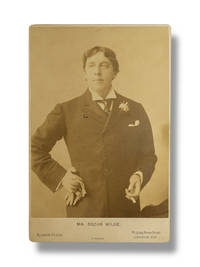
1894#15<p>Oscar Wilde<br />Salome. A Tragedy in One Act: Translated from the French of Oscar Wilde; Pictured by Aubrey Beardsley.<br />Salomé une tragédie en un acte traduite du français illustrée par Aubrey Beardsley.<br />London Elkin Mathews & John Lane; Boston Copeland & Day 1894.<br /><br />Small quarto. 5 unnumbered leaves half-title engraved title dedication to Alfred Douglas list of characters engraved list of illustrations 67 pp. and 16 pp. of publisher's advertisements. 10 engraved plates printed on Japan paper and one historiated tailpiece.<br /><br />A precious copy from the library of Jules Claretie accompanied by an autograph letter and a superb original photograph of Oscar Wilde.<br /><br />Contemporary binding signed by Gruel. Full olive morocco covers framed with a quadruple blind fillet spine with five raised bands extending onto the covers inner dentelles with gilt fillets gilt edges at the head edges ruled.<br /><br />First English edition printed in 500 copies.<br /><br />Copy enriched with:<br />– An original photograph of Oscar Wilde 145 × 105 mm by Alfred Ellis albumen print of the period.<br />– A press clipping announcing Wilde's death and another reporting on his funeral.<br />– An autograph letter signed by Oscar Wilde to Jules Claretie dated "The Cottage Goring-on-Thames" 1894 4 pages 12mo in black ink on a folded vellum paper bifolium.<br /><br />Translation of the letter originally in French:<br />"Dear Monsieur Claretie<br />Pray allow me the pleasure of asking you to accept a copy of my play Salomé and permit me to assure you how highly I value the privilege of meeting the artistic director of the most artistic theatre in the world.<br />I have retired to the country to reflect upon a new play but before the season ends I hope to return to London and to have the opportunity of seeing you again.<br />The only hope I see for our English drama lies in the establishment of a theatre like the French Theatre. I hope we may find a director possessing as much sympathy for art as yourself.<br />Pray accept this expression of my respect and admiration.<br />Oscar Wilde."<br /><br />One year after its first appearance in French the English version of Salome was published. The dedication reads: "To my friend Lord Alfred Bruce Douglas the translator of my play." In fact the translation gave rise to a dispute between Wilde and his young protégé whose command of French was rather limited. Wilde redid the entire work and refused to allow Douglas's name to appear on the title page. Douglas saw between this dedication and the absence of his name on the title page "the difference between a tribute of admiration from an artist and a tradesman's receipt."<br /><br />The book is one of the masterpieces of the English illustrated book featuring the striking compositions of Aubrey Beardsley 1872–1898 who also designed two magnificent historiated borders for the title page and the list of illustrations as well as the final tailpiece. These stylized and sinuous drawings show the artist at the height of his powers playing with bold areas of deep black ink contrasted with untouched white spaces and sophisticated decorative elements inspired equally by Renaissance ornament and the then-fashionable Japanese style. For Salome the young artist created the archetype of the poisonous woman typical of Symbolism surrounded by grotesque and perverse secondary figures. Wilde paid tribute to him declaring that Beardsley was "the only artist who knew what the dance of Salome was and who could see that invisible dance."<br /><br />This copy belonged to the novelist playwright and critic Jules Claretie 1840–1913 who from 1885 until his death served as administrator of the Comédie-Française which Wilde here does not hesitate to call "the most artistic theatre in the world." Claretie introduced contemporary authors such as Henry Bataille and Octave Mirbeau into its repertoire.<br /><br />This was a bold undertaking and Wilde here pays tribute to it: "The only hope I see for our English drama lies in the establishment of a theatre like the French Theatre."<br /><br />The very fine portrait of Oscar Wilde mounted at the beginning of this copy was taken in 1892 by the London photographer Alfred Ellis 1854–1930. The writer is captured as he truly was at the height of his career: impeccably dressed posing in a high-buttoned double-breasted jacket flower in his buttonhole white pocket square a cigarette in his left hand and his gloves in his right the latter resting on his hip.</p> Elkin Mathews & John Lane
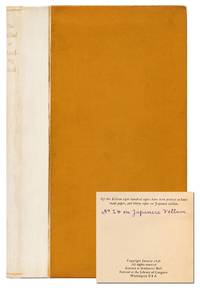
18987848London: Leonard Smithers 1898. First edition. Fine. One of thirty copies printed on Japanese vellum paper this being copy twenty-four. Published under the pseudonym "C.3.3." Wilde's cell number while he was at Reading Gaol in an attempt to separate Wilde's then-notorious name from the publication. A lovely Fine copy.<br /> <br /> Wilde's long poem "The Ballad of Reading Gaol" published just two years before his death draws on the experience of being imprisoned at Reading after his conviction for gross indecency in 1895. Wilde had famously faced a highly publicized trial that ended with a sentence of two years hard labor which he served at Pentonville Prison Wandsworth and finally at Reading. The poem was directly inspired by Charles Thomas Woolridge a fellow inmate who was executed at Reading after being convicted of murdering his wife. The crime was metaphorized by Wilde in his poem which contains one his most famous lines: "Yet each man kills the thing he loves."<br /> <br /> In the last three years of his life which he spent in exile in Naples and then in Paris Wilde continued to edit and publish his plays - the first editions of An Ideal Husband and The Importance of Being Earnest were published during this period - but he wrote very little having "lost the joy of writing" Ellman Oscar Wilde. "The Ballad of Reading Gaol" then was the last new literary work of Wilde's career and perhaps his most haunting. He concludes his poem with the elegiac stanza: "And all men kill the thing they love / By all let this be heard / Some do it with a bitter look / Some with a flattering word / The coward does it with a kiss / The brave man with a sword." Fine. Leonard Smithers unknown
1888PB-0034<p>Signed first edition of Oscar Wilde's incredibly scarce "The Happy Prince and Other Tales." David Nutt publisher. Ballantyne Press. Quarto handmade paper. Original boards in Japanese vellum. Limited edition number 14 of 75 signed by both Oscar Wilde and publisher David Nutt. Publication date: 1888. Stunning illustrations: front cover design in red ink by Jacob Hood as well as head and tailpiece vignettes. Plates by Walter Crane. No dust jacket as issued.</p><p>Published before well before Wilde's incarceration and trial and before his best known works such as "The Portrait of Dorian Gray" and "The Importance of Being Earnest". The fairy tales written for his children originally include "The Happy Prince" "The Nightingale and the Rose" "The Selfish Giant" "The Devoted Friend" and "The Remarkable Rocket."</p><p>Evidence of previous tape repair on spine exterior and front and rear boards with chipping and loss on spine. Interior tape repair on inner hinge and evidence of what appears to be a hastily removed book plate on front pastedown. Light soot or dirt smudging on portion of title page. Interior pages are good. This volume is scarce in any condition but remains an excellent candidate for rebinding or external repairs and is priced accordingly. More photos available on request.</p> David Nutt hardcover
1898259158London 1898. First edition ONE OF 30 COPIES on Japanese vellum. 1 vols. 8vo. Cinnamon-colored cloth vellum spine. Covers show slight insect damage and minor soiling spine a bit soiled otherwise a very good copy in a quarter blue morocco slipcase with chemise and with the bookplate and signature of actress LENA ASHWELL 1872-1957 on the front pastedown. First edition ONE OF 30 COPIES on Japanese vellum. 1 vols. 8vo. First edition of Wilde's legendary poem written while he was imprisoned in its rarest state - being one of only 30 copies printed on Japanese vellum.<br /> <br /> This copy comes from the distinguished library of the actress Lena Ashwell 1872-1957 who as a young actress toured in Wilde's Lady Windermere's Fan in 1891 later becoming actor-manager of the Savoy Theatre. Ashwell was particularly troubled by the news of Wilde's arrest and wrote later: ". the atmosphere of London was horrible and cruel. His plays were so very brilliant and I had seen this when I was in Lady Windermere's so I felt that he was a friend and in desperate trouble." Later during WWI she is known to have pioneered the organization of entertainments on a large scale for the British troops in France Leask Margaret Lena Ashwell: Actress Patriot Pioneer 2012.<br /> <br /> An excellent association copy of an essential Wilde rarity. Mason 372 unknown
1898188708London: Leonard Smithers 1898. For he who lives more lives than one / More deaths than one must die Signed limited edition number 74 of 99 copies signed by the author. Wilde styled this the "author's edition" and in a letter to his publisher of 28 February 1898 he insisted on the purple binding with a new gilt remarque by Ricketts. Produced at Wilde's request it was the third edition overall appearing two months after the first. Octavo. Original cream quarter linen spine lettered in gilt purple cloth sides flower and leaf design on front cover after remarque by Charles Ricketts edges untrimmed. Ownership inscriptions to prelims of Florence Vanda Cunliffe Thomas 1873-1936 Red House Bicester dated March and April 1898 following publication in March. Spine toned binding a little marked surface scratch on front cover light edge wear intermittent foxing but bright overall. A very good copy. Mason 374. hardcover
189996121London: Leonard Smithers and Co 1899. First signed limited edition of Wilde's classic comedic stage play. Octavo original lavender publisher's cloth with gilt titles to the spine and gilt flourishes to the spine and front panel. One of 100 large paper copies signed by Oscar Wilde this is number 85. In near fine condition with a touch of toning. Housed in a custom half morocco slipcase. A superior example. Wilde’s play premiered in January 1895 to an audience that included the Prince of Wales and was an immediate success. Together with The Importance of Being Earnest An Ideal Husband is often considered Wilde's dramatic masterpiece. After Earnest it is his most popularly produced play. It has been adapted to film several times first in 1935 most recently in 1999 starring Julianne Moore Minnie Driver Cate Blanchett and Rupert Everett. Leonard Smithers and Co hardcover
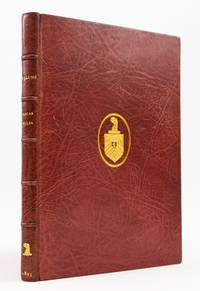
1893ST20128Paris and London: Librairie de l'Art Indépendant; Elkin Mathews et John Lane 1893. FIRST EDITION. ONE OF 600 COPIES 500 of which were for sale. 243 x 150 mm. 8 x 5 5/8". 84 pp. 1 leaf. <br/> Pleasing red very coarse-grained morocco by Sangorski & Sutcliffe stamp-signed in gilt on rear turn-in covers with gilt coat of arms surrounded by a gilt oval raised bands gilt lettering gilt-ruled turn-ins top edge gilt others untrimmed. With the original purple wrappers bound in. Housed in a deluxe suede-lined modern red morocco case by Antonio Perez-Noriega covers with elaborate twining wood onlays. A PRESENTATION COPY FROM WILDE TO ADOLPHE RETTÉ WITH WILDE'S INSCRIPTION AND SIGNATURE ON THE FRONT FLYLEAF. Mason 348. See also: Mikhail "Oscar Wilde: Interviews and Recollections" pp. 190-91. Spine faintly sunned covers with a few small bumps and dents perhaps original with the skin or intentionally made by the binder one or two negligible finger smudges but a fine clean copy with just insignificant imperfections.<br/> <br/> This is a very special presentation copy of Wilde's most controversial play inscribed to one of three writers the author invited to edit the original French script. In the Gospel of Luke Herodias the haughty wife of Antipas tetrarch of Galilee is so incensed by the preaching of John the Baptist against her sins that she determines to be revenged. She persuades her daughter Salomé to ask Antipas the girl's stepfather for John's head as the reward for her seductive dancing. Wilde's fertile imagination converts this story into a tale of juvenile infatuation scorned and turned into demented hate. Written and first published in French "Salomé" was to have been staged in London with Sarah Bernhardt in the title role but this was prevented by the Lord Chamberlain the theater censor. Thus the play was first performed in 1896 in Paris with Bernhardt in the title role but without Wilde in attendance since he was confined at the time in Reading Gaol. It was not performed in London until 1905 in a private performance and the censor's ban was not lifted until 1932. Adolphe Retté 1863-1930 was a French poet essayist and literary figure who initially was celebrated for his decadent and symbolist poetry but later experienced a profound spiritual awakening that led him to renounce his earlier works and embrace Catholicism. He was one of three French-speaking poets along with Stuart Merrill and Pierre Louÿs Wilde solicited to look over the original script and correct any overt anglicisms. Retté who had met Wilde in Paris wrote about his involvement with "Salomé" in his memoir where he describes his admiration for the work: "Not only were Wilde's ideas subtle and delightful but he knew how to enhance them seeming to caress each word with his irresistible way of speaking." Retté marveled at Wilde's "talent as a conversationalist or rather as a monopolizer of the conversation and the wonderful way he would set forth the philosophy of 'hedonism.'" Wilde presentation copies are not exceptionally rare in general but we could find few such copies of this important first edition and none any more important as this one. Librairie de l'Art Indépendant; Elkin Mathews et John Lane unknown
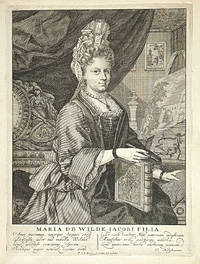
1700103081<p>Amsterdam Maria de Wilde 1700. 4to. 1 1 blank 11 1 blank pp. and 60 numbered engraved plates. = engraved title-page an engraved vignette depicting "virtute" signed "A. Schoonebeek fec." 1 large folding plate showing the interior of "Museum Wildianum" a full-page engraved portrait of Maria de Wilde signed "P. v.d. Berge ad vivum del. et fecit." decorated initials in the text and 60 numbered engraved plates by Maria de Wilde. Contemporary blind-stamped vellum sewn on 4 supports and laced through the joints with the manuscript title and author at the head of the spine red and blue sprinkled edges. With the green and white bookplate of "Collectie Buijnsters-Smets" on the inside of the front board and with the black and white bookplate of "A. Pitlo. Plus est en vous" on the verso of the now loose front paste-down. The binding is slightly browned and the paste-downs have come loose revealing the sowing supports. Internally fine and clean. Overall in very good condition.</p><p>First and only edition of an attractive display of the statues of the Museum Wildeanum once housed on the Keizersgracht in Amsterdam. The Dutch tax collector Jacob de Wilde 1645-1721 began the collection containing gems coins scientific instruments and statues. "This attractive account of a Dutch cabinet of the late seventeenth century is as much a eulogy of Maria de Wilde's gifts as an engraver as of her father's museum" Grinke. The 60 plates by Maria de Wilde 1682-1729 show the ancient Egyptian Greek and Roman statues in the museum including Egyptian figures of Isis Horus etc. some of which are now believed to be Renaissance copies of antique originals. The 6 text leaves include a brief introduction and several laudatory poems directed at Maria de Wilde and her engravings. The collection drew some important visitors including the Russian tsar Peter the Great in 1697. His visit is illustrated on the engraved folding plate where he can be identified by the double-headed eagle at his feet an element of the Russian coat of arms sitting in the museum at a table accompanied by Jacob. After De Wilde's death the collection probably dispersed. The tsar acquired part of it for his "Kunstkamera" the first museum in Russia which was completed in 1727. A catalogue of the gems and coins of the museum was published in 1703 entitled Gemmae selectae antiquae e museo Jacobi de Wilde.<br />From the library of the Dutch professor of civil and notarial law Adriaan Pitlo 1901-1987 and from the collection of Dutch book historian and professor of Dutch literature linguistics and book history Piet J. Buijnsters 1933-2022 and his wife the art historian Leontine M.A. Buijnsters-Smets 1937-2021. A beautiful copy of an art historical work showing a late 17th-century Dutch cabinet with a notable provenance. c.f. Grinke 61; Murray I p. 38 & III p. 272; STCN 842380264; Tavernier Russia and the Low Countries: an international bibliography 3178.</p> Maria de Wilde
189916085London: Leonard Smithers and Co 1899. First edition signed limited edition. Octavo original lavender publisher's cloth. One of 100 large paper copies signed by Oscar Wilde. In very good condition with some light rubbing and darkening to the extremities. Housed in a custom half morocco clamshell box. Wilde’s play premiered in January 1895 to an audience that included the Prince of Wales and was an immediate success. Together with The Importance of Being Earnest An Ideal Husband is often considered Wilde's dramatic masterpiece. After Earnest it is his most popularly produced play. It has been adapted to film several times first in 1935 most recently in 1999 starring Julianne Moore Minnie Driver Cate Blanchett and Rupert Everett. Mason 385. Leonard Smithers and Co hardcover
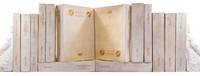
61214London: Methuen & Co. & Paris: Charles Carrington The Picture of Dorian Gray 1908. FIRST COLLECTED EDITION OF THE WORKS OF OSCAR WILDE. LIMITED EDITION ONE OF 80 SETS ON JAPANESE VELLUM. 14 volumes. Demy 8vo. 20.5 x 15 cm. Publisher's original limp vellum bindings gilt titles and tooling to the spine upper covers with designs by Charles Ricketts yap edges top edges gilt. Ex libris William Forbes Morgan with his bookplate to front pastedowns. Some trivial soiling to vellum Salome with a light splash of red to upper cover contents exceptionally clean and fresh overall an excellent bright set. A fine set of this first collected edition in its most desirable format on Japanese vellum. "The text is taken in most instances from the last editions issued under the superintendence of the author. In some cases the volumes contain additional matter which had not previously been reprinted while some of the volumes contain matter here published for the first time. Some of the volumes contain matter which owing to the exigencies of copyright and other difficulties is not included in any other edition" Mason. Complete sets in the original binding and in such excellent condition seldom appear on the market. "The first collected edition of Wilde's works was issued in 1908 with 14 volumes 13 with the imprint of Methuen & Co. and one The Picture of Dorian Gray with the imprint of Charles C arrington Paris. The text is taken in most instances from the last editions issued under the superintendence of the author. In some cases the volumes contain additional material which had not previously been r0eprinted while some of the volumes contain matter here published for the first time… Some of the volumes contain matter which is not included in any other edition" Mason 459. This set collects such classics as Lady Windermere's Fan The Happy Prince Salome and The Importance of Being Earnest as well as numerous essays and poems. This edition was edited by Robert Ross Wilde's long-time intimate friend and literary executor. Mason 421 424 426 428 430 432 434 436 438 440 442 444 446 and 448 London: Methuen & Co. & Paris: Charles Carrington [The Picture of Dorian Gray], 1908. hardcover
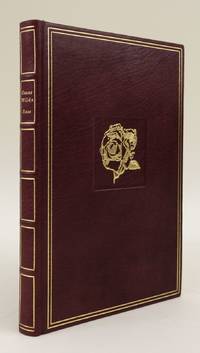
1982ST16482Bayreuth: Printed by Chr. Scheufele Offizin Stuttgart for Bear Press 1982. No. 1 OF 10 COPIES ON VELLUM plus a "special" edition of 25 copies and 185 copies on Kochi Japanese paper. 223 x 148 mm. 8 7/8 x 5 3/4". 50 pp. 2 leaves.Translated and with an afterword by Wolfram Benda. <br/> Publisher's fine burgundy morocco by Erwin Lehr upper cover with gilt rose in recessed square flat spine with gilt titling turn-ins with gilt fillet frame pale yellow silk pastedowns. In the original burgundy suede slipcase. With three large initials in burnished gold and four signed and numbered original etchings by Peter Klitsch. Printed in red and black. Signed in the colophon by the artist the binder and the publisher/translator. In mint condition.<br/> <br/> This is the splendid deluxe version of a finely crafted private press edition of Wilde's fairy tales "The Nightingale and the Rose" "The Happy Prince" and "The Selfish Giant." It is the third work issued by the Bear Press founded in 1979 by literary scholar Wolfram Benda and still in operation. According to the firm's website "at a time when the craftsmanship and ethos of the artisan in bookmaking have been damaged by ever-increasing industrialization and neglect . . . The Bear Press . . . tries to achieve the highest possible degree of technical and artistic perfection in its printed works." The font used to print the text and the artist chosen to illustrate each work are carefully selected to express "the individual author's personality and intention." Even the discriminating aesthete Wilde 1854-1900 would be pleased with the choices here especially for the luxurious vellum printing: the type is set in refined Walbaum Antiqua and shown off with special effect by the creamy leaves; the etchings by Austrian artist Peter Klitsch b. 1934 are meticulous detailed and reminiscent of the work of Wilde's friend Aubrey Beardsley; and the binding is the epitome of tasteful restraint flawlessly executed with premium materials. <br /> <br /> The three tales here first appeared in 1888 and are bittersweet in their themes of love and self-sacrifice. His stories for children were one of Wilde's early successes and DNB notes "Their permanent place in child affections refutes the vulgarism that Wilde's literary reputation arose from his legal notoriety. In all cases the fairy tales are on the child's side celebrating the courage and generosity of the poor and vulnerable while their satire mocks the kind of pomposity and hypocrisy children can recognize." We have been able to trace just two other copies of the vellum printing at auction in ABPC and RBH. [Printed by Chr. Scheufele Offizin, Stuttgart, for] Bear Press unknown
1898181391Paris: Société du Mercure de France 1898. Inscribed to a literary batailleur First edition in French number 1 of 12 copies on Holland paper inscribed by the author on the justification de tirage page: "a mon ami Robert Scheffer Oscar Wilde". Signed or inscribed copies of this edition are rare: we trace only two others in auction records. A French poet and short story writer Scheffer 1864-1926 is best remembered for his "contes rapides" or "quick tales" and for his combative style both as a literary critic and as a duellist. He took Wilde to the Folies Bergère on 10 May 1898 and presented him with a copy of his poetry collection La Chanson de Néos affectionately inscribed to the "grand poète". In 1909 Scheffer edited the short-lived gay magazine Akademos. Wilde wrote The Ballad of Reading Gaol while exiled in France and originally published the work in Britain earlier the same year under the pseudonym "C.3.3." the number of his cell. He took a particular interest in this edition discussing the format type binding and other details with his translator Henry-David Davray 1873-1944. Wilde was intimately involved in the translation and Davray remembered how "Every word was weighed every term was discussed every sentence was read reread scanned with all possible intonations". Provenance: Samuel Pozzi 1846-1918 the French surgeon and pioneer gynecologist and subject of a portrait by John Singer Sargent with his bookplate. Octavo 183 x 121 mm. Text printed in French and English. Contemporary three-quarter green waxed paper spine lettered and ruled in gilt marbled sides and endpapers top edge red others untrimmed original wrappers bound in red and yellow silk bookmarker. Superficial split and small abrasion to front joint contents toned but clean. A very good copy. Not in Mason. unknown
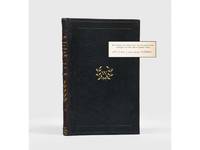
1898181423London: Leonard Smithers 1898. The rare deluxe issue elegantly bound First edition number 17 of 30 copies printed on japon presented here in a restrained contemporary morocco binding. The limitation is handwritten in purple ink by Leonard Smithers. A further 800 copies on handmade paper were published simultaneously. Wilde wrote the poem while exiled in France and published it under the pseudonym "C.3.3." after his cell in Reading Gaol the third cell on the third landing of Gallery C. The first edition sold out rapidly and a second edition was issued within weeks. Octavo 220 x 145 mm. Contemporary purple morocco spine lettered and decorated with leaf tools in gilt "W" monogram enclosed in laurel wreath to front cover in gilt blind rules to covers turn-ins gilt original vellum spine bound in at rear. Housed in a purple flat-back cloth box by the Chelsea Bindery. Book label of J. O. Edwards to front free endpaper. Joints repaired a handsome copy. Mason 372. hardcover
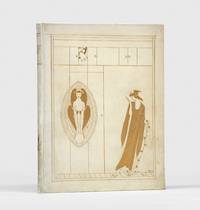
1894151353London: Elkin Mathews and John Lane 1894. In the original vellum decorated by Charles Ricketts First edition one of 200 unnumbered copies. Wilde's poem together with Charles Ricketts's art nouveau illustrations was described by W. E. Henley Wilde's harshest critic as "about as fin-de-Siecle a business as you ever saw" Frankel p. 155. Wilde first met Ricketts in 1889 and in the two years that followed the artist designed either parts or the entirety of several of Wilde's works. Now celebrated for his book illustration and design Ricketts is also noted for his theatre designs and costumes and he contributed to the first English production of Wilde's Salomé in 1906. James G. Nelson records that alongside the 200 copies published in the limited edition a further 103 copies were printed though most of these were left unbound. Small quarto. Title page design one half-page illustration and eight full-page illustrations by Charles Ricketts. Original full vellum pictorial decorations by Ricketts to spine and covers in gilt all edges untrimmed printed throughout in black green and red. Ownership signature to front free endpaper and ownership inscription to preliminary blank. Vellum lightly soiled as usual and some occasional internal foxing; a fresh and very good copy with bright gilt to the covers. Nicholas Frankel Oscar Wilde's Decorated Books 2003; Mason 361; James G. Nelson A Checklist of Early Bodley Head Books: 1889-1894. hardcover
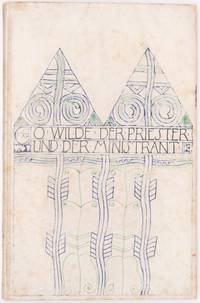
19061843Düsseldorf: Schmitz & Olbertz 1906. First German edition. Numbered one of 600 copies. In unique custom made hand-painted vellum binding by Lajos Kozma. Title on spine in gilt lettering. Upper edge gilt. Paste paper endpapers. Kozma’s signet on front flyleaf’s verso and another signet supposedly of the owner: “CHW†on the additional flyleaf drawn by Kozma in black ink. Binding with slight discolorations and light stains. Inside some light and scattered foxing. Overall in fine condition. First German edition. Numbered one of 600 copies. In unique custom made hand-painted vellum binding by Lajos Kozma. Title on spine in gilt lettering. Upper edge gilt. Paste paper endpapers. Kozma’s signet on front flyleaf’s verso and another signet supposedly of the owner: “CHW†on the additional flyleaf drawn by Kozma in black ink. 44 4 p. <p><br /> The first German edition of The Priest and the Acolyte in Lajos Kozma’s Unique Hand-Painted Art Nouveau binding.<br /> <p><p><br /> Lajos Ludwig Kozma 1884–1948 was one of the chief Hungarian architects and interior designers of the first half of the 20th century he is also known for his graphic designs and book illustrations and binding designs. His early works were created in Art Nouveau style but later through Art Deco he found his way to International Modernism.<br /> <p><p><br /> The scandalous story of The Priest and the Acolyte here in A. W. Hiller’s translation is attributed to Oscar Wilde however its real author was John Francis Bloxam 1873–1928 an English Uranian author and churchman. The novel appeared first in The Chameleon Vol. I No. 1 December 1894.<br /> <p>. Schmitz & Olbertz unknown
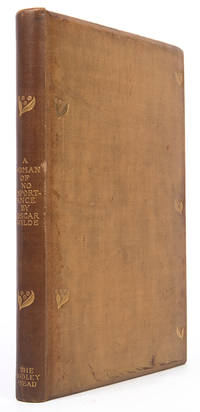
119720London John Lane 1894. . First edition one of 50 large paper copies; 4to; printed on hand-made paper contemporary ownership inscription to limitation endpapers browned; publisher's straw coloured buckram with gilt decorations by Charles Ricketts gilt lettering to spine spine browned a couple of trivial marks to covers else very good plus; housed in custom purple cloth chemise and matching quarter morocco slip-case.<br /> One of only 50 large paper copies. This play contains some of Wilde's most famous epigrams.<br /><br />First performed in April 1893 prior to being published in book form A Woman of No Importance addresses many social issues with Wilde's wit and dark humour. The run of the play was cut short as a result of Wilde's arrest and prosecution. The scandal dampened enthusiasm for Wilde's work until after his death in 1900 when interest in his work began to revive.<br /> Mason 402. London, John Lane, 1894. hardcover