WillyLivre Rare Book
2 649 résultats
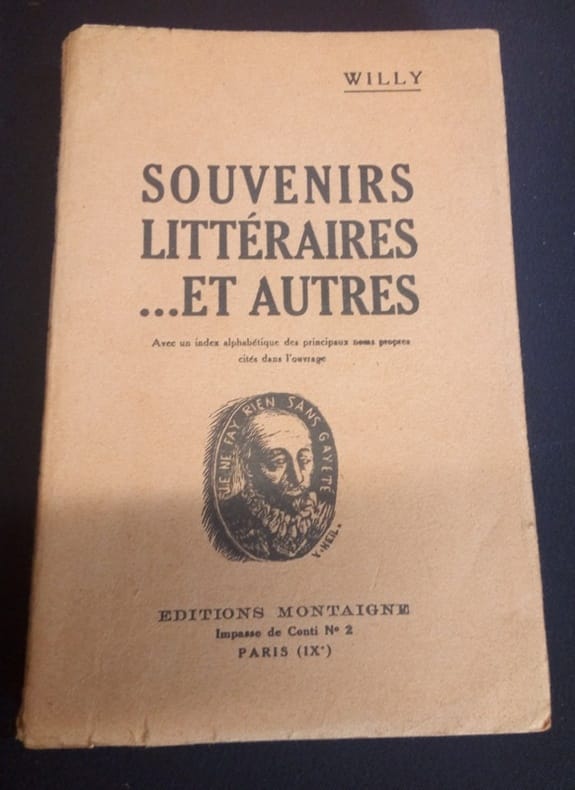
1925100AgParis Montaigne 1925 In8 - broché - 141 pages + index aphabétique des noms propres - papier jauni
1925100AgParis Montaigne 1925 In8 - broché - 141 pages + index aphabétique des noms propres - papier jauni
192518611925 Paris Editions Montaigne 1925 Un volume in°12 broché 146 pages A22
1926xt538Albin Michel Le Roman-Succès Agrafé 1926 In-4 (17,7 x 25 cm), agrafé sous couverture, sans date, 122 pages, illustrations en noir et blanc de A. Supparo ; rousseurs au premier plat en queue, par ailleurs bon état général. Livraison a domicile (La Poste) ou en Mondial Relay sur simple demande.
1931300025514A. Michel 1931 319 pages 1931. 319 pages.
1999C98701Leuven, Peeters 1999 334pp. rijkelijk geïllustreerd, 31cm., geïll. omslag, goede staat, catalogus van gelijknamige tentoonstelling, C98701
196926551969 broché (paperback) in-octavo, dos et première de couverture ornés d'une illustration photographique en couleurs (spine and front cover illustrated in colour), illustrations hors-texte - les cartes (maps) sont de Willy Rousseau et Fils, 352 pages, 1969 à Paris Marabout Université,
1995241220BBBuer, Heimatverein, (1995). Gr.-8°. 249 S. Ill. OPbd. - Gutes Expl.
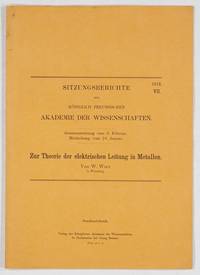
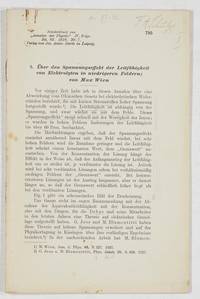
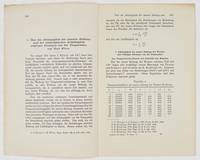
1913113891913. S.ber. Akad. Wiss. Berl. 1913. - Berlin Verlag der Königlichen Akademie der Wissenschaften / In Commission bei Georg Reimer 1913 Gr.-8° pp.184-200 5 Fig. orig. Broschur. First Edition! "Die Ergebnisse der Strahlungstheorie und die neuere Theorie der spezifischen Wärme haben den Nachweis geliefert daß die Elektronentheorie der Metalle auf eine wesentlich neue Grundlage gestellt werden muß. Man kann nicht mehr die Annahme aufrechterhalten daß die Elektronen in einem Metall wie freie Gasmoleküle herumfliegen und daß ihre mittlere lebendige Kraft der absoluten Temperatur des Metalls proportional ist. Solche Elektronen müssen vielmehr wie Lorentz gezeigt hat eine Wärmestrahlung erzeugen die dem Rayleigh-JEANSschen Gesetz folgt das sich bekanntlich mit der Erfahrung nicht in Übereinstimmung bringen läßt. Man würde nach diesem Gesetz für kürzere Wellenlängen eine viel größere Strahlung erhalten müssen als sie erfahrungsmäßig vorhanden ist. Ebenso zeigt die Theorie der spezifischen Wärme welche die Wärmebewegung in festen Körpern als Schwingungen der Moleküle um feste Zentren auffaßt und diese nach der PLANCKSchen Formel statistisch verteilt durch ihre Übereinstimmung mit den Beobachtungen daß die Elektronen nicht an der Wärmeenergie merklich beteiligt sein können." WienWien Wilhelm Carl Werner Otto Fritz Franz Wien 1864-1928 physicist who in 1893 used theories about heat and electromagnetism to deduce Wien's displacement law which calculates the emission of a blackbody at any temperature from the emission at any one reference temperature. He also formulated an expression for the black-body radiation which is correct in the photon-gas limit. His arguments were based on the notion of adiabatic invariance and were instrumental for the formulation of quantum mechanics. Wien received the 1911 Nobel Prize for his work on heat radiation. unknown
1928680891928. Ann. Phys. 4. Folge 85/7. - Leipzig Verlag von Johann Ambrosius Barth 1928 8° pp.795-811 5 Fig. orig. Broschur. Rare Offprint! Wilhelm Wien 1865-1928 "grew up in the east Prussian town of Rastenburg today Ketrzyn Lithuania. He then studied at the prominent universities of Heidelberg and Göttingen before he eventually completed his doctorate in Berlin. In 1900 he succeeded W.C. Röntgen 1901 Physics Laureate as a professor in Würzburg. Wien's research concerned how various metals radiate heat and he received the Nobel Prize for the law of black-body radiation now known as Wien-Planck's law. It was drawn up jointly with Max Planck Physics 1918 and many felt that they should have shared in the award." "When a completely dark body is heated it emits visible light and other electromagnetic radiation. The spectrum of the radiation is entirely dependent on the temperature of the body and not its composition. In 1893 Wilhelm Wien formulated his displacement law which indicates at which wavelength the radiation is most intense at a certain temperature. He subsequently also formulated a law indicating how the radiation spectrum varies as temperature changes. However this does not apply to long wavelengths and in 1900 Max Planck formulated a law that conforms better." Wilhelm Wien - Facts. NobelPrize/org The Nobel Prize in Physics 1911 unknown
1925680881925. Ann. Phys. 4. Folge 77. - Leipzig Verlag von Johann Ambrosius Barth 1925 8° pp.560-586 7 Fig. orig. Broschur. First Edition! Wilhelm Wien 1865-1928 "grew up in the east Prussian town of Rastenburg today Ketrzyn Lithuania. He then studied at the prominent universities of Heidelberg and Göttingen before he eventually completed his doctorate in Berlin. In 1900 he succeeded W.C. Röntgen 1901 Physics Laureate as a professor in Würzburg. Wien's research concerned how various metals radiate heat and he received the Nobel Prize for the law of black-body radiation now known as Wien-Planck's law. It was drawn up jointly with Max Planck Physics 1918 and many felt that they should have shared in the award." "When a completely dark body is heated it emits visible light and other electromagnetic radiation. The spectrum of the radiation is entirely dependent on the temperature of the body and not its composition. In 1893 Wilhelm Wien formulated his displacement law which indicates at which wavelength the radiation is most intense at a certain temperature. He subsequently also formulated a law indicating how the radiation spectrum varies as temperature changes. However this does not apply to long wavelengths and in 1900 Max Planck formulated a law that conforms better." Wilhelm Wien - Facts. NobelPrize/org The Nobel Prize in Physics 1911 unknown
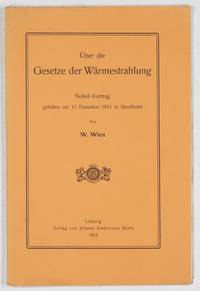
1912113881912. Leipzig Verlag von Johannes Ambrosius Barth 1912 Gr.-8° 21 3 pp. orig. Broschur; unbeschnittenes Expl. First Edition! Wilhelm Wien 1865-1928 "grew up in the east Prussian town of Rastenburg today Ketrzyn Lithuania. He then studied at the prominent universities of Heidelberg and Göttingen before he eventually completed his doctorate in Berlin. In 1900 he succeeded W.C. Röntgen 1901 Physics Laureate as a professor in Würzburg. Wien's research concerned how various metals radiate heat and he received the Nobel Prize for the law of black-body radiation now known as Wien-Planck's law. It was drawn up jointly with Max Planck Physics 1918 and many felt that they should have shared in the award." "When a completely dark body is heated it emits visible light and other electromagnetic radiation. The spectrum of the radiation is entirely dependent on the temperature of the body and not its composition. In 1893 Wilhelm Wien formulated his displacement law which indicates at which wavelength the radiation is most intense at a certain temperature. He subsequently also formulated a law indicating how the radiation spectrum varies as temperature changes. However this does not apply to long wavelengths and in 1900 Max Planck formulated a law that conforms better." Wilhelm Wien - Facts. NobelPrize/org The Nobel Prize in Physics 1911 unknown
1905376731905. Verh. Ges. Naturf. Ärzte 77.Vers. Meran 1905. - 12/1 Bd. - Leipzig F.C.W. Vogel 1905 8° 3 308; X 223 pp. Halbleinenband der Zeit. unknown
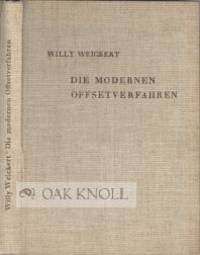
19364298Berlin: Deutscher Drucker 1936. cloth. 8vo. cloth. 96 pages and 42 full-page color plates. A guide to the process of book illustration in color. The plates demonstrate the process of color separation by showing an illustration in full color followed by a number of plates in the hues that make up the final print. Deutscher Drucker unknown books
1991Q-0943173477Roberts Rinehart 1991-03-01. Paperback. New. New. In shrink wrap. Looks like an interesting title! Roberts Rinehart paperback
1996Q-0943173949Roberts Rinehart 1996-01-01. Paperback. New. In shrink wrap. Looks like an interesting title! Roberts Rinehart paperback
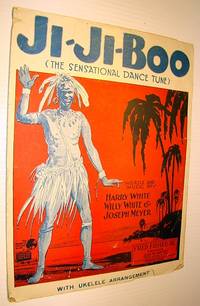
1922848G0702USA: Fred Fisher Inc. 1922. Sheet music. Fair. Paperback. First Edition. 4to - over 9¾" - 12" tall. 6 pages. Nice cover art. Above-average but not excessive wear. Fred Fisher Inc. Paperback
1930305023Selbstverlag 1930. Softcover Heft Zustand: Keine Beschädigungen zwei Stempelungen - ansonsten keine Eintragungen. Rücken Ecken Kanten sind berieben/bestoßen. Selbstverlag, paperback
1953250824001Viking 1953. Hardcover. Very Good/acceptable . book is vg dust jacket is inserted the dj is all there but needs repair Viking hardcover
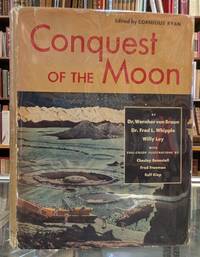
1953115809Viking 1953. Hardcover. Very good/Good. Chesley Bonstell; Fred Freeman; Rolf Klep. With illustrations by Chesley Bonestell; Fred Freeman and Rolf Klep. Shelfworn. Jacket fragile with chipped edges and a two inch tear on the top edge. Viking hardcover
1953ZB1329054Gnome Press 1953. Price HAS BEEN REDUCED by 10% until Monday June 29 SALE item first edition first printing; 144 pp. original yellow cloth hardcover some spotting to the covers previous owner's information inked to the bottom margin of the front paste down a few inked numbers to the bottom margin of the rear paste down else very good in a slightly edge-worn dust jacket. - If you are reading this this item is actually physically in our stock and ready for shipment once ordered. We are not bookjackers. Buyer is responsible for any additional duties taxes or fees required by recipient's country. Photos available upon request. Gnome Press hardcover
19313985Bielefeld 1931. Ein Bergwelt-Zauber aus Hoch-Rhätiens Sonenstadt. 2. Aufl. 8°. Samt-Ebd. Raetica unknown
19318401Bielefeld 1931. Ein Bergwelt-Zauber aus Hoch-Rhätiens Sonnenstadt. Erzählung. 2. Aufl. Kl.-8°. Ln. / kt. Raetica unknown
193121696Bielefeld 1931. EA Elbracht & Co. 8°. Samt-Ebd. Raetica unknown
197213168Stuttgart, Seewald, 1972. 214 S. Kartoniert