10 088 résultats
003195Edinburgh: Alexander Donaldson Sept 16 1768. Soft cover. Very Good. Edinburgh: Alexander Donaldson Sept 16 1768. Large quarto. 8pp. Disbound. <br/> <br/> Edinburgh: Alexander Donaldson, Sept 16, 1768. paperback
1333303378.Gpaperback. Good. Access codes and supplements are not guaranteed with used items. May be an ex-library book. paperback
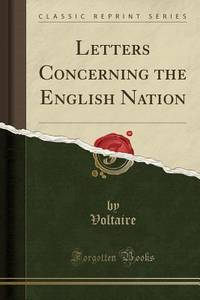
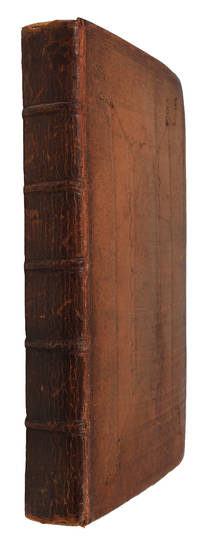
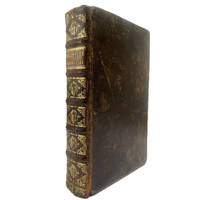
173361360London 1733. 8vo. Bound in a lovely contemporary English Cambridge-style full calf binding with a plain spine with five raised bands. Spine a bit cracked vertically and with minor loss to capitals. Corners a bit bumped and adges of boards a bit worn. Binding overall nice and tight. Small damp stain at the lower blank corner of the first few leaves otherwise a very good clean copy on thick crisp paper. 16 -including preface contents advertisements 253 1 18 -Index pp. <br/><br/><em>The important actual first edition of this highly celebrated key work of the Enlightenment in which the anecdote of how Newton discovered gravity the story about Newton and the falling apple appeared for the first time together with the description of the difference between the physical world view of the English and the French the "plenum" and the "vacuum". This seminal work in which Voltaire famously depicts British philosophy science society and culture in comparison to French can be viewed as the Enlightenment equivalent to Tocqueville's "Democracy in America". This series of essays which is based on Voltaire's experiences when living in England was actually written by Voltaire mostly in English which he mastered to perfection. It has often been presumed that the first edition of the work was that published in French in 1734 but actually the present English edition constitutes the actual first appearance of the work as well as the version that is closest to Voltaire's intention as the French language version is the re-written one and the English version the original. Curiously almost all modern English versions are translations into English of the French edition instead of the original English version making this edition of the utmost importance.After the original English edition of 1733 two French editions soon followed the first in 1734. Unlike the British the French resented the book and already in 1734 the French Parliament issued an order for the author's arrest and condemned the work causing the impact of it in France to be delayed. The book was burned for being "dangerous to religion and civil order". At the same time the work became a bestseller in Britain and as much as 14 editions of the work were published in the eighteenth century. "Inspired by Voltaire's two-year stay in England 1726-8 this is one of the key works of the Enlightenment. Exactly contemporary with Gulliver's Travels and The Beggar's Opera Voltaire's controversial pronouncements on politics philosophy religion and literature have placed the Letters among the great Augustan satires. Voltaire wrote most of the book in English in which he was fluent and witty and it fast became a bestseller in Britain. He re-wrote it in French as the Lettres philosophiques and current editions in English translate his French." Nicholas Cronk Introduction to the Oxford's Classics edition from 1999.The great French philosopher Voltaire was greatly impressed by the philosophical and scientific achievements of the English especially those of Newton Locke and Bacon. As a disseminator of scientific knowledge Voltaire came to play a great rôle in the popularization of Newtonian science and its discoveries the present work being a prime example. Although the work was condemned by the French authorities it still came to play a great rôle in the spreading of Newtonian ideas in France. The present work generally came to play a dominant rôle in Enlightenment accounts of the history of science and philosophy. The work focuses on British science and thought and uses the accounts of these to emphasize what is lacking in French society and French thought. The work is generally very critical towards the French "ancient régime" and when Voltaire here discusses the emergence of empiricism it is viewed as an English tradition that stands in opposition to the French rationalist tradition with Descartes as the prime example. This view is taken over by the following Enlightenment historians of science and philosophy e.g. d'Alembert see for instance his "Preliminary Discourse" of 1751. Some of the most influential passages of the work are probably those on Bacon who Voltaire sees as the founder of modern experimental science Newton and Descartes. Letters XIV on Descartes and Newton XV on attraction and XVI on Newton's Optics from 1704 are among the most influential essays of the work. In XVI Voltaire reflects upon Newton's "Optics" and the way that he rejected Descartes' theory and set out his own account of the properties of light. In XV he presents the first account of Newton and the falling apple: "As he was walking one Day in his Garden and saw some Fruits fall from a Tree he fell into profound Meditation on that Gravity the Cause of which had so long been sought but in vain by all the Philosophers whilst the Vulgar think there is nothing mysterious in it. He said to himself that from what height soever in our Hemisphere those Bodies might descend their Fall wou'd certainly be in the Progression discover'd by Galileo; and the Spaces they run thro' would be as the Square of the Times. Why may not this Power which causes heavy Bodies to descend and is the fame without any sensible Diminution at the remotest Distance from the Center of the Earth or on the Summits of the highest Mountains; Why said Sir Isaac may not this Power extend as high as the Moon." pp. 127-28.But perhaps the most famous passage in the volume is the opening of Letter XIV: "A Frenchman who arrives in London will find Philosophy like every Thing else very much chang'd there. He had left the World a "plenum" and he now finds it a "vacuum". At Paris the Universe is seen compos'd of Vortices of subtile Matter; but nothing like it is seen in London. In France 'tis the Pressure of the Moon that causes the Tides; but in England 'tis the Sea that gravitates towards the Moon; so that when you think that the Moon should make it Flood with us those Gentlemen fancy it should be Ebb which very unluckily cannot be prov'd." pp. 109-10. </em> hardcover
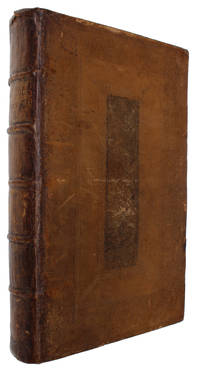
173360085London C. Davis and A. Lyon 1733. 8vo. Lovely contemporary full Cambridge-style binding with five raised bands to spine and blindstamped ornamental borders to boards. . Double gilt line-borders to boards. All edges of boards with gilt borders. Gilt title to spine. Hinges neatly and professionally re-inforced. Internally very nice clean and fresh. A lovely crisp and large copy with good margins printed on heavy fine paper. 16 -including preface contents advertisements 253 1 18 -Index pp. <br/><br/><em>The important actual first edition of this highly celebrated key work of the Enlightenment in which the anecdote of how Newton discovered gravity the story about Newton and the falling apple appeared for the first time together with the description of the difference between the physical world view of the English and the French the "plenum" and the "vacuum". This seminal work in which Voltaire famously depicts British philosophy science society and culture in comparison to French can be viewed as the Enlightenment equivalent to Tocqueville's "Democracy in America". This series of essays which is based on Voltaire's experiences when living in England was actually written by Voltaire mostly in English which he mastered to perfection. It has often been presumed that the first edition of the work was that published in French in 1734 but actually the present English edition constitutes the actual first appearance of the work as well as the version that is closest to Voltaire's intention as the French language version is the re-written one and the English version the original. Curiously almost all modern English versions are translations into English of the French edition instead of the original English version making this edition of the utmost importance.After the original English edition of 1733 two French editions soon followed the first in 1734. Unlike the British the French resented the book and already in 1734 the French Parliament issued an order for the author's arrest and condemned the work causing the impact of it in France to be delayed. The book was burned for being "dangerous to religion and civil order". At the same time the work became a bestseller in Britain and as much as 14 editions of the work were published in the eighteenth century. "Inspired by Voltaire's two-year stay in England 1726-8 this is one of the key works of the Enlightenment. Exactly contemporary with Gulliver's Travels and The Beggar's Opera Voltaire's controversial pronouncements on politics philosophy religion and literature have placed the Letters among the great Augustan satires. Voltaire wrote most of the book in English in which he was fluent and witty and it fast became a bestseller in Britain. He re-wrote it in French as the Lettres philosophiques and current editions in English translate his French." Nicholas Cronk Introduction to the Oxford's Classics edition from 1999.The great French philosopher Voltaire was greatly impressed by the philosophical and scientific achievements of the English especially those of Newton Locke and Bacon. As a disseminator of scientific knowledge Voltaire came to play a great rôle in the popularization of Newtonian science and its discoveries the present work being a prime example. Although the work was condemned by the French authorities it still came to play a great rôle in the spreading of Newtonian ideas in France. The present work generally came to play a dominant rôle in Enlightenment accounts of the history of science and philosophy. The work focuses on British science and thought and uses the accounts of these to emphasize what is lacking in French society and French thought. The work is generally very critical towards the French "ancient régime" and when Voltaire here discusses the emergence of empiricism it is viewed as an English tradition that stands in opposition to the French rationalist tradition with Descartes as the prime example. This view is taken over by the following Enlightenment historians of science and philosophy e.g. d'Alembert see for instance his "Preliminary Discourse" of 1751. Some of the most influential passages of the work are probably those on Bacon who Voltaire sees as the founder of modern experimental science Newton and Descartes. Letters XIV on Descartes and Newton XV on attraction and XVI on Newton's Optics from 1704 are among the most influential essays of the work. In XVI Voltaire reflects upon Newton's "Optics" and the way that he rejected Descartes' theory and set out his own account of the properties of light. In XV he presents the first account of Newton and the falling apple: "As he was walking one Day in his Garden and saw some Fruits fall from a Tree he fell into profound Meditation on that Gravity the Cause of which had so long been sought but in vain by all the Philosophers whilst the Vulgar think there is nothing mysterious in it. He said to himself that from what height soever in our Hemisphere those Bodies might descend their Fall wou'd certainly be in the Progression discover'd by Galileo; and the Spaces they run thro' would be as the Square of the Times. Why may not this Power which causes heavy Bodies to descend and is the fame without any sensible Diminution at the remotest Distance from the Center of the Earth or on the Summits of the highest Mountains; Why said Sir Isaac may not this Power extend as high as the Moon." pp. 127-28.But perhaps the most famous passage in the volume is the opening of Letter XIV: "A Frenchman who arrives in London will find Philosophy like every Thing else very much chang'd there. He had left the World a "plenum" and he now finds it a "vacuum". At Paris the Universe is seen compos'd of Vortices of subtile Matter; but nothing like it is seen in London. In France 'tis the Pressure of the Moon that causes the Tides; but in England 'tis the Sea that gravitates towards the Moon; so that when you think that the Moon should make it Flood with us those Gentlemen fancy it should be Ebb which very unluckily cannot be prov'd." pp. 109-10. </em> hardcover
1347308806.Ghardcover. Good. Access codes and supplements are not guaranteed with used items. May be an ex-library book. hardcover
1980Q-014044386XPenguin 1980-07-31. Paperback. New. New. In shrink wrap. Looks like an interesting title! Penguin paperback
1334969191.Gpaperback. Good. Access codes and supplements are not guaranteed with used items. May be an ex-library book. paperback
338500618X.Gpaperback. Good. Access codes and supplements are not guaranteed with used items. May be an ex-library book. paperback
1334819297.Gpaperback. Good. Access codes and supplements are not guaranteed with used items. May be an ex-library book. paperback
1925elala168Paris: René Kieffer 1925. 1925. 8vo. pp. numerous text illus. with pochoir hand-colouring. contemporary half morocco original coloured pictorial wrs. bound in. First Edition Illustrated by Joseph Hémard Limited to 500 copies this one of 480 on vélin de cuve. One of the few of Voltaires works to deal with a distinctly economic subject. Directed against the Physiocrats and specifically Mercier De La Rivières Ordre naturel et essentiel des sociétés the witty and sarcastic tale takes its title from Merciers statement that in an organized state according to the physiocratic doctrine an average sum of forty crowns should suffice for the existence of each citizen. Voltaire singles out for special ridicule the proposed impot unique or single tax on land. The story revolves around the owner of a small estate yielding an annual net income of forty crowns who is alarmed at the promulgation of several edicts "by a few gentlemen who having some leisure have undertaken to govern the kingdom from their firesides". According to them the government "being by divine- and birth-right co-proprietor of his land he at least owes it one-half of his income" and that "as all wealth proceeds from land land is to bear the whole burden of taxation." Carteret IV 406. 1st Edition. Paris: René Kieffer, 1925. unknown
1768RMP785<p>>8º. 8 317 p. 7 p. Belisaire; 89 p. L'Homme aux Quarante Écus cuatro planchas grabadas. Piel de becerro de época con cinco nervios en relieve y lomo ricamente dorado con tejuelo de cuero rojo. Tableros y capiteles con algo de desgaste. Ex libris pegado sobre la guarda frontal.</p><ol><li>></li></ol><p><strong>Belisaire: </strong>Leipsic Lebrecht Crusius 1768. Jean-François Marmontel fue un escritor y dramaturgo francés. Obtuvo un gran éxito con las novelas <em>Bélisaire</em> 1767 y <em>Les Incas ou la destruction de l´Empire du Perou</em> 1777con acerbas críticas de la conquista española. La presente edición aumentada con <em>"L´Hereusse Famille"</em> ><strong>"<em>L'Homme aux Quarante Écus":</em></strong> Londres sin dato de impresor 1768. <em>El hombre de las cuarenta coronas</em> es la única obra en la que se ocupa Voltaire con el tema de economía. Fue creado como una fábula en respuesta a las políticas económicas del escuela fisiocrática: "El industrial rico podía sonreír al respaldar la doctrina de que no debería ser obligado a pagar el impuesto porque no añadía nada a la riqueza ya que creían que sólo la tierra podía producir un excedente. Esta anomalía inspiró a Voltaire a escribir esta animada sátira; en él el rico financiero quien escapa a los impuestos se burla del pobre granjero que paga impuestos por ambos aunque sus ingresos sólo sean de cuarenta coronas. "A pesar de la actitud satírica de Voltaire hacia los industriales ricos defendió el bien económico. En <em>"Le Mondain"</em> 1736 y <em>"La Défense du Mondain" </em>1737 propuso una filosofía de vida personal deseable y como medio para asegurar prosperidad nacional." Este ejemplar publicado el mismo año que la edición original de Ginebra. La obra fue lo suficientemente controvertida como para que el Parlamento lo condenara y ordenara su quema en 1768.</p> hardcover
169287Montreal: CIDIHCA nd. New. DVD 52 min. Haitian Creole. Documentary film on musical and cultural exchanges from Palestine to the Caribbean to the United States. Traces the path of a musical revolutionary who championed Latin jazz. Covers the years 1942-1959 in the career of this extraordinary musician. CIDIHCA unknown
3814552Short description: In Russian. Voltaire Eduard Alexandrovich. Materials for the consolidated list of periodicals on ethnography anthropology folklore and archaeology in Petrograd libraries. Petrograd: type. V.D. Smirnov 1914. The image is provided for reference only. It may reflect condition of one of the available copies or only help in identifying the edition. Please feel free to contact us for a detailed description of the copies available. SKU3814552 unknown
198195056Berkeley: Arif Press 1981. Hardcover. Fine. Translated by P. H. Hanssen. Slim small octavo. Cloth with applied paper label. Fine. One of 150 copies. Arif Press hardcover
2038A Londres Fictitious imprint. BN gives place of publication as Amsterdam. Bengesco gives place of publication as Paris.: Pour la compagnie 1747. Hardcover. Very Good. Octavo. iv 172pp. 2 A8-K8 L6. With the half-title. Title-page in red-and-black. Engraved title vignette. Paper boards. Bengesco 1420; BN CCXIV 2973; Cioranescu 64349. From the library of the Fideicommis Bodenstein with their stamp on the title-page. The first published edition of a work by Voltaire which later appeared under the title Zadig ou La destinée. <br/> <br/> A Londres [Fictitious imprint. BN gives place of publication as Amsterdam. Bengesco gives place of publication as Paris.]: Pour hardcover
133438990X.Gpaperback. Good. Access codes and supplements are not guaranteed with used items. May be an ex-library book. paperback
0140389024.Gmass_market. Good. Access codes and supplements are not guaranteed with used items. May be an ex-library book. unknown
2002Q-0140446869Penguin Classics 2002-08-27. Paperback. New. New. In shrink wrap. Looks like an interesting title! Penguin Classics paperback
192322200Paris: Rene Kieffer 1923. leather_bound. Orig. full two-toned brown leather covers decorated in blind backstrip lettered in gilt marbled endpapers. Teg. Fine. 54 pages. 24 x 19 cm. Limited edition copy 95 of 500 on velin la forme with 45 vignettes in pochoir by Joseph Hemard. An exquisite copy bound by Kieffer with his label on verso of front cover paste-down. Hémard’s lasting fame however lies in his book illustrations – always with a distinctly French character usually comic and often mildly erotic. He was probably the most prolific book illustrator in the first half of the twentieth century in France. Rene Kieffer unknown
20159782701193069-2025BELIN EDUCATION 2015. Paperback. New. <p><strong>Author:</strong> Voltaire Faure Elsa</p><p><strong>Publisher:</strong> BELIN EDUCATION</p><p><strong>Binding:</strong> Paperback</p><p><strong>ISBN:</strong> 9782701193069</p><p><strong>Release Date:</strong> 2015</p><p><strong>Number Of Pages:</strong> 96</p><p><strong>Details:</strong> Micromégas . Micromégas un géant de l'étoile Sirius décide de partir explorer l'univers. Un nain rencontré sur Saturne l'accompagne dans ce voyage initiatique. Tous deux arrivent sur Terre où ils font la connaissance d'êtres étranges et minuscules à leurs yeux : les humains. A travers le regard faussement naïf de ces deux personnages Voltaire compose un conte philosophique plein d'humour et nous livre une leçon de tolérance toujours d'actualité. ¤ Le texte intégral de l'oeuvre. accompagné de notes de bas de page. ¤ Huit fiches pour faire le tour de l'oeuvre. Voltaire en 20 datesL'oeuvre dans son contexteLa structure de l'oeuvreLes grands thèmes de l'oeuvreLes formes de l'argumentationLe conte philosophiqueLe siècle des LumièresCitations¤ Pour préparer l'oral du Bac. Des lectures analytiques au fil de l'oeuvre. ¤ Pour préparer l'écrit du Bac. Un sujet complet. ¤ Deux groupements de textes. Voyage et découverte de l'autre au XVIIIième siècleL'homme le savoir et le progrès</p> BELIN EDUCATION paperback
59106Eds Le Triptyque 1946 In-4 28 cm 60pp. illustr. hors-texte bandeaux et culs de lampe Nb-0328 unknown
1332563619.Gpaperback. Good. Access codes and supplements are not guaranteed with used items. May be an ex-library book. paperback
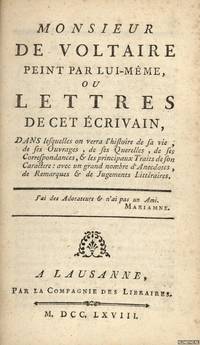
176800293190Lausanne : Compagnie des Libraires 1768. Hardcover. Good. Contemporary gilt half calf with moroccan letterpiece.; Name on endpaper. Lausanne : Compagnie des Libraires hardcover
178467131Londres: chez Robinson No 25 Pater-Noster-Row 1784. First British edition 8vo pp. 2 ii 208; vignette title page; original blue paper wrappers; edges curled small cracks at spine ends; all else very good. Unpublished during the author's lifetime these Memoires are generally seen as an outright attack on Frederick of Prussia after Voltaire had suffered humiliation on Frederick's orders in Frankfurt. chez Robinson, No 25, Pater-Noster-Row unknown