882 résultats
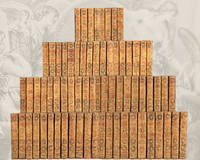
178488246Imprimerie de la Société Littéraire-Typographique | s. l. [Kehl] 1784-1789 | 14 x 21.7 cm | 70 vol. reliés
17992091202133206278A Paris De L'imprimerie de Crapelet 1799. Soft Cover. Fine. Number of books: 2 books in total A Paris, De L'imprimerie de Crapelet paperback
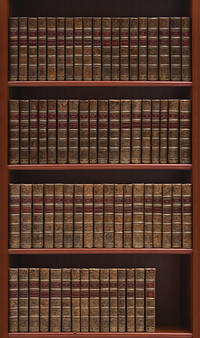
178488246s. l. Kehl: Imprimerie de la Société Littéraire-Typographique 1784. Fine. « Divine Voltaire ora pro nobis ! » Exceptional copy on large paper and contemporary binding Imprimerie de la Société Littéraire-Typographique s. l. Kehl 1784-1789 14 x 21.7 cm 70 vol. reliés The Kehl edition the most renowned edition of Voltaire's works illustrated and published on deluxe paper. It was printed on five different types of paper and only the deluxe editions such as ours on laid paper feature engravings. These are naturally the most sought-after and rarest copies. Binding in full painted sheep decorated with a honeycomb motif smooth spine tooled with gilt fleurons fillets and compartments light beige calf lettering and volume pieces gilt chain-roll border on covers marbled endpapers gilt roll on edges all edges marbled contemporary binding. Two volumes nos. 50 and 70 with slight variations in gilt tools on the spines and with orange morocco lettering pieces edges and covers treated somewhat differently. General condition of the 70 volumes: bindings with light rubbing to corners gilt a little dulled occasional foxing a few wormholes and old restorations not affecting the text. 28 volumes vols. 4 5 8 10 11 13 16 17 19 20 24 27 28 33 34 35 36 37 43 48 61 62 63 65 66 67 68 70 with cracked joints at the ends and 20 volumes vols. 8 11 12 14 16 18 33 34 37 42 46 49 53 56 57 60 65 66 68 70 with damaged caps. Two editions were published at the same time. Our copy belongs to the prestigious in-8 edition on large paper published in 70 volumes the other edition being in-12 format in 92 volumes. It is richly illustrated with 125 etched plates: - There are 17 portraits including 3 of Voltaire: a frontispiece portrait by N. de Largillière engraved by P. Alex. Tardieu; one drawn from Houdon's bust by Moreau le Jeune and engraved by P. Alex. Tardieu; and one allegorical portrait by Louis Croutelle after Moreau le Jeune belonging to the second series of illustrations of Voltaire's works executed by Moreau for the publisher Renouard. The 14 other portraits include an allegorical frontispiece of Frédéric-Guillaume Prince of Prussia depicted in profile in a medallion by Dambrun after Moreau le Jeune; a portrait of Henry IV by Pourbus engraved by Tardieu; one of Charles VII engraved after the original in the King's Cabinet by Mavieri; another of Agnès Sorel drawn by Moreau the Younger after the original in the King's Cabinet and engraved by Mavieri; one of Joan of Arc engraved by Beisson; followed by the Count of Dunois engraved after the original in the King's Cabinet by J. B. Fosseyeux; one of Louis XIV drawn by Moreau Le Jeune after C. Le Brun engraved by J. B. Fosseyeux; one of Charles XII engraved by P. Alex. Tardieu after the original in the King's Cabinet; one of Pierre I engraved by P. G. Langlois after a painting by L. Caravaque; one of Madame du Châtelet after Marie Anne Loir and engraved by P. G. Langlois; one of the Count of Argental after J. Defraine and engraved by J. B. Fosseyeux; one of Frédéric II of Prussia painted from life by Van Loo and engraved by P. G. Langlois; one of Catherine II of Russia engraved by J. B. Fosseyeux; and one of d'Alembert after De La Tour engraved by N. F. Maviez. - 93 engravings by Moreau le Jeune including 44 figures for le Théâtre engraved by Lingée Simonet de Launay Trière Halbou Duclos Romanet Dambrun de Longueil Delignon Le Mire Le Veau 10 for la Henriade engraved by Masquelier Delignon Dambrun Patas Gutemberg Helman Simonet Duclos Romanet 21 for la Pucelle engraved by Simonet Dambrun Halbou Baquoy Trière Delignon de Longueil Croutelle and Duclos 4 for the Contes in verse engraved by Langlois Duclos Delignon and Le Veau and 14 for the Romans engraved by Trière Duclos de Longueil Dambrun Baquoy Delignon Simonet Langlois and Halbou. - 14 scientific plates in volume 31 illustrating the experiments of Newton Descartes and Leibniz. - 1 battle Imprimerie de la Société Littéraire-Typographique unknown
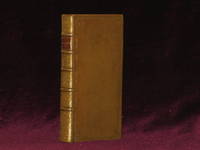
175908228Geneva: Gabriel Cramer 1759. First Edition. Full Leather. Fine. The third of the first four editions according to Bengesco 1436 and the fourth edition according to Wade see Voltaire and Candide 1959 p. 201 dated 1759 with 299 pages clandestinely printed and published by Cramer in Geneva and preceeding the other 16 different editions published throughout Europe in 1759. The present copy conforms to Bengesco 1436 in every respect which is "page by page line for line like the first edition" except for the "que ce ce fut" error on page 103 an error which was introduced by Cramer into the early printings then doubtless not "fixed" as it was correct in the first place. Note that the fleurons agree exactly with Bengesco 1436 as follows: p. 134 is a basket of fruits; p. 228 shows two horns 'a plenty; the fleuron at p. 115 is repeated on pages 179 and 193; fleuron on page 213 is signed N. C. and is repeated on page 279; page 277 is paginated 177. The present copy also agrees with Wade see Voltaire and Candide 1959 p. 201 in every respect including that page 17 is numbered 15. Both the above references to Bengesco and Wade show signatures A-N3 meaning they are bound without the Table of Chapters; the present copy like 7 of the 10 known copies of the first edition shows signatures A-N6 without the final leaves N7 a blank and without N8 instructions to the binder concerning the cancellation of two pairs of leaves B4 B9 and D6 D7. In addition to the above let us state the textual points in the present copy: page 31 B4 an unnecessary paragraph break was eliminated. The words "mais il y a une raison." do NOT start a new paragraph; page 41 B9 several short sentences about the Lisbon earthquake were rewritten as "car dit-il tout ceci est."; page 84 D6 D7 reads "Nos filles se trouverent."; page 103 reads "que ce fut." as explained above was correct to begin with then discovered by Cramer and was not "fixed"; page 125 reads "mais ils se leverent precisement."; page 242 the paragraph beginning "Candide etait afflige."; has been removed by Voltaire while the book was being printed as it was critical of German poets. Pages 121 - 168 signatures F and G are a larger type than the rest of the book. In summation the present copy agrees with the first edition except that the "que ce ce fut." error was discovered and not inserted and the fleurons differ but are by Cramer who printed the first four editions. This a wide margined copy is larger than other copies we have seen at 165 mm x 95 mm; beautifully bound in late 19th Century full tan leather with raised bands and gilt decoration on spine with a brown leather lettering piece marbled end papers all edges gilt; printed on laid paper. The text is remarkably clean and bright; a fine copy. PMM204. <br/><br/> Gabriel Cramer hardcover books
1784191724Kehl: De L'imprimerie de la Société Littéraire-Typographique 1784-89. Canonizing Voltaire an enterprise on the eve of Revolution The first complete collection known as the "Kehl" edition for the small German town in which it was printed to avoid French censorship. After his death the Société Littéraire Typographique was founded there dedicated to the monumental effort of disseminating Voltaire's work through a definitive and typographically magnificent edition. The group of Enlightenment intellectuals ready to champion the author were led by Pierre-Augustin Caron de Beaumarchais who financed the operation and the Marquis de Condorcet who acted as chief editor. For the first time Voltaire's correspondence was published and commentary and a biography by Cordorcet was added. For the type Beaumarchais bought John Baskerville's apparatus from his widow. This coupled with the unprecedented price he paid for the rights the paper mills he purchased and the cost of setting up in Kehl bankrupted Beaumarchais. Nevertheless he concluded "Europe will be satisfied". Octavo 70 vols 213 x 134 mm. Portrait frontispiece engraved plates. Contemporary mottled calf signed by François Gaudreau at foot of spines red morocco labels double gilt fillet to compartments and boards marbled endpapers varicolour bookmarkers. Superficial splits and worming to joints still very firm occasional wear contents largely clean. A very good set. hardcover
1759752Genève Geneva: Cramer 1759. First Edition. 3 vols. in one 12mo 164 x 100mm pp. 2 291 1; 133 1 35 1. First printing of the great 18th century philosophical narrative with all the points correct. Including the 3 usual cancels the right title page ornament repeated pages 193 and 266 the misprints of “que ce ce fut†page 103 line 4 and “précisément†page 125 line 4 the correction removing a paragraph break page 31 the rewritten lines about the Lisbon earthquake page 41 etc. Contemporary full calf red calf label rebacked with the original spine saved and laid down recornered marbled endpapers gilt rubbed inner paper hinges strengthened old ink signatures on the endpaper and front blank tiny signature on the title page one tissue strengthened tear at the bottom of A2 touching the last 3 lines of text without any loss otherwise internally quite nice clean and very good. Bound without N7 a blank and N8 a notice to the binder as is usual agreeing in all respects to what you would have received if you had purchased a copy in sheets on publication day then bought the sequels and then handed them over to the most local Swiss bindery. Ref: PMM 204. There were 18 editions of Candide in 1759. It took 221 years for a clear and convincing bibliography to first sort them out and then got accepted and once accepted our real 1st edition was confirmed as rare. In the last 15 years however that bibliographical data has been more widely circulated and several 1st editions that weren’t on the original 22–copy census have come into market. It is still scarce more so in a contemporary binding.<br /> <br /> Candide bides as the epitomic philosophical fable of the French Enlightenment and the genotype of irony without exaggeration and though it’s laced with more salt than the postwar streets of Carthage it repeatedly tolls a reminder that light hearts live long. Most importantly Candide remains remarkably relevant when examined through contemporary frameworks functioning as an incisive proto-postcolonial text that anticipates modern discourse on global inequality systems of oppression and the limitations of Enlightenment rationality. The novel's scathing portrayal of slavery conquest and religious persecution resonates with intersectional analyses that recognize how power structures interlock across racial gender and economic dimensions. The savage irony throughout the text dismantles not just philosophical optimism but also European exceptionalism exposing the hypocrisy of colonial enterprises and religious institutions alike. The narrative's episodic structure—with its global movements between Europe South America and the Ottoman Empire—invites discussions of transnationalism and diasporic experience while Candide's concluding retreat to cultivate his garden has been reinterpreted by ecocritical scholars as both an acknowledgment of environmental interdependence and a potentially problematic withdrawal from systems-level political engagement.<br /> <br /> “Do you believe†said Candide “that men have always massacred each other as they do to-day that they have always been liars cheats traitors ingrates brigands idiots thieves scoundrels gluttons drunkards misers envious ambitious bloody–minded calumniators debauchees fanatics hypocrites and fools†“Do you believe†said Martin “that hawks have always eaten pigeons when they have found them†<br /> –Voltaire Candide. Cramer unknown
17512605210193Chez Briasson David Le Breton Durand A Paris; Amsterdam 1751 - 1777 1751. First Edition. Hardcover. Very Good. 0x0x0. The Organization of Enlightenment Thought: The Revolution in Ideas. A first edition of this foundational encyclopedia of 18th century knowledge. A massive thirty-five volume set. Large folios volumes 39.5 x 25 cm. Bound in 18th-century French calf. Spines gilt with raised bands. One volume non-uniformly bound in light calf. <br> The set includes: Encyclopedie Paris: 1751-57 & Neuchatel 1765. 17 volumes; Recueil de planches. Paris: 1762-72. 11 volumes 1 2 part I 2 Part II 3 5 6 7 8 9 10 11; Supplement a l'Encyclopedie. Paris & Amsterdam: 1776-77. 5 volumes including the Suite de recueil de planches; Table Analytique. Paris: 1780. <br> Profusely illustrated with engraved plates. <br> Diderot's famous Encyclopedie was initially a modest translation of Chambers's Cyclopaedia. It grew as a project into a massive project which attempted to collect human knowledge from a rationalistic perspective instead of by nature or theology. In organizing knowledge from a position where human reason was paramount the supremacy of the Church was imperiled. As a result the Encyclopedie was widely controversial and placed on the Index Librorum Prohibitorum by the Catholic Church. In discussing fundamental philosophical issues such as on political authority and natural rights articles in the Encyclopedie shifted the basis of governmental authority from the divine right of Kings to radical concepts popular consent was the basis of legitimacy and the ideals of a social contract. The work was banned by the King of France. It spread the foundational ideas of the French Revolution and enlightenment thinkers. "No encyclopaedia perhaps has been of such political importance or has occupied so conspicuous a place in the civil and literary history of its century. It sought not only to give information but to guide opinion." "It was a war machine; as it progressed its attacks on both the church and still more on despotic government as well as Christianity itself became bolder and more undistinguished and it was met with persecution and opposition unparalleled in the the history of encyclopedias." - Encyclopedia Britannica 11th ed p. 1483. "A monument in the history of European thought; the acme of the age of reason; a prime motive force in undermining the ancien regime and in heralding the French Revolution" Printing in the Mind of Man 200. Refs: Grolier/Horblit 25b; Norman 637; PMM 200. <br> Includes: 17 v. : ill. ; 41 cm. supplement 4 volumes plates 11 volumes plates supplement 1 volume. Table Analytique 1 volume. This is an oversized or heavy book which requires additional postage for international delivery outside the US. Chez Briasson, David, Le Breton, Durand, A Paris; Amsterdam (1751 - 1777) hardcover