VOLTAIRE, (FMA de). F M ABiblio.com
878 résultats
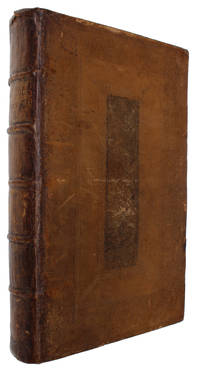
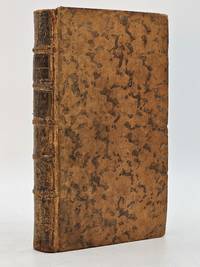
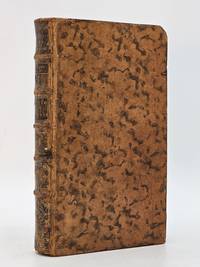
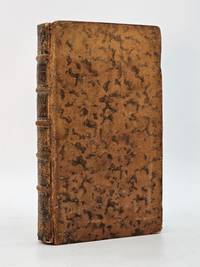
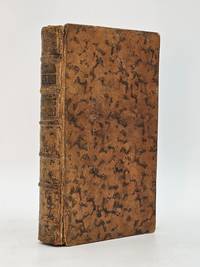
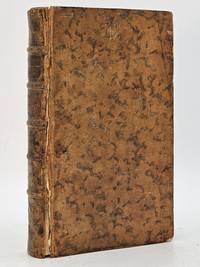
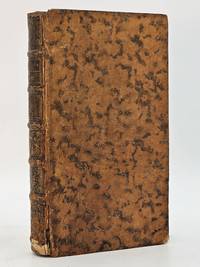
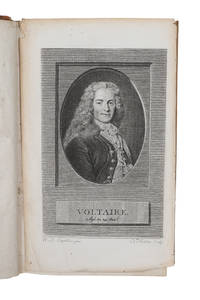
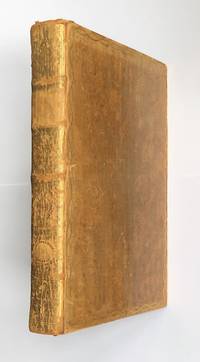
173361360London 1733. 8vo. Bound in a lovely contemporary English Cambridge-style full calf binding with a plain spine with five raised bands. Spine a bit cracked vertically and with minor loss to capitals. Corners a bit bumped and adges of boards a bit worn. Binding overall nice and tight. Small damp stain at the lower blank corner of the first few leaves otherwise a very good clean copy on thick crisp paper. 16 -including preface contents advertisements 253 1 18 -Index pp. <br/><br/><em>The important actual first edition of this highly celebrated key work of the Enlightenment in which the anecdote of how Newton discovered gravity the story about Newton and the falling apple appeared for the first time together with the description of the difference between the physical world view of the English and the French the "plenum" and the "vacuum". This seminal work in which Voltaire famously depicts British philosophy science society and culture in comparison to French can be viewed as the Enlightenment equivalent to Tocqueville's "Democracy in America". This series of essays which is based on Voltaire's experiences when living in England was actually written by Voltaire mostly in English which he mastered to perfection. It has often been presumed that the first edition of the work was that published in French in 1734 but actually the present English edition constitutes the actual first appearance of the work as well as the version that is closest to Voltaire's intention as the French language version is the re-written one and the English version the original. Curiously almost all modern English versions are translations into English of the French edition instead of the original English version making this edition of the utmost importance.After the original English edition of 1733 two French editions soon followed the first in 1734. Unlike the British the French resented the book and already in 1734 the French Parliament issued an order for the author's arrest and condemned the work causing the impact of it in France to be delayed. The book was burned for being "dangerous to religion and civil order". At the same time the work became a bestseller in Britain and as much as 14 editions of the work were published in the eighteenth century. "Inspired by Voltaire's two-year stay in England 1726-8 this is one of the key works of the Enlightenment. Exactly contemporary with Gulliver's Travels and The Beggar's Opera Voltaire's controversial pronouncements on politics philosophy religion and literature have placed the Letters among the great Augustan satires. Voltaire wrote most of the book in English in which he was fluent and witty and it fast became a bestseller in Britain. He re-wrote it in French as the Lettres philosophiques and current editions in English translate his French." Nicholas Cronk Introduction to the Oxford's Classics edition from 1999.The great French philosopher Voltaire was greatly impressed by the philosophical and scientific achievements of the English especially those of Newton Locke and Bacon. As a disseminator of scientific knowledge Voltaire came to play a great rôle in the popularization of Newtonian science and its discoveries the present work being a prime example. Although the work was condemned by the French authorities it still came to play a great rôle in the spreading of Newtonian ideas in France. The present work generally came to play a dominant rôle in Enlightenment accounts of the history of science and philosophy. The work focuses on British science and thought and uses the accounts of these to emphasize what is lacking in French society and French thought. The work is generally very critical towards the French "ancient régime" and when Voltaire here discusses the emergence of empiricism it is viewed as an English tradition that stands in opposition to the French rationalist tradition with Descartes as the prime example. This view is taken over by the following Enlightenment historians of science and philosophy e.g. d'Alembert see for instance his "Preliminary Discourse" of 1751. Some of the most influential passages of the work are probably those on Bacon who Voltaire sees as the founder of modern experimental science Newton and Descartes. Letters XIV on Descartes and Newton XV on attraction and XVI on Newton's Optics from 1704 are among the most influential essays of the work. In XVI Voltaire reflects upon Newton's "Optics" and the way that he rejected Descartes' theory and set out his own account of the properties of light. In XV he presents the first account of Newton and the falling apple: "As he was walking one Day in his Garden and saw some Fruits fall from a Tree he fell into profound Meditation on that Gravity the Cause of which had so long been sought but in vain by all the Philosophers whilst the Vulgar think there is nothing mysterious in it. He said to himself that from what height soever in our Hemisphere those Bodies might descend their Fall wou'd certainly be in the Progression discover'd by Galileo; and the Spaces they run thro' would be as the Square of the Times. Why may not this Power which causes heavy Bodies to descend and is the fame without any sensible Diminution at the remotest Distance from the Center of the Earth or on the Summits of the highest Mountains; Why said Sir Isaac may not this Power extend as high as the Moon." pp. 127-28.But perhaps the most famous passage in the volume is the opening of Letter XIV: "A Frenchman who arrives in London will find Philosophy like every Thing else very much chang'd there. He had left the World a "plenum" and he now finds it a "vacuum". At Paris the Universe is seen compos'd of Vortices of subtile Matter; but nothing like it is seen in London. In France 'tis the Pressure of the Moon that causes the Tides; but in England 'tis the Sea that gravitates towards the Moon; so that when you think that the Moon should make it Flood with us those Gentlemen fancy it should be Ebb which very unluckily cannot be prov'd." pp. 109-10. </em> hardcover
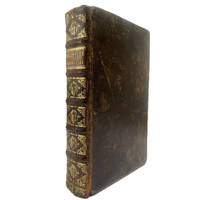
173360085London C. Davis and A. Lyon 1733. 8vo. Lovely contemporary full Cambridge-style binding with five raised bands to spine and blindstamped ornamental borders to boards. . Double gilt line-borders to boards. All edges of boards with gilt borders. Gilt title to spine. Hinges neatly and professionally re-inforced. Internally very nice clean and fresh. A lovely crisp and large copy with good margins printed on heavy fine paper. 16 -including preface contents advertisements 253 1 18 -Index pp. <br/><br/><em>The important actual first edition of this highly celebrated key work of the Enlightenment in which the anecdote of how Newton discovered gravity the story about Newton and the falling apple appeared for the first time together with the description of the difference between the physical world view of the English and the French the "plenum" and the "vacuum". This seminal work in which Voltaire famously depicts British philosophy science society and culture in comparison to French can be viewed as the Enlightenment equivalent to Tocqueville's "Democracy in America". This series of essays which is based on Voltaire's experiences when living in England was actually written by Voltaire mostly in English which he mastered to perfection. It has often been presumed that the first edition of the work was that published in French in 1734 but actually the present English edition constitutes the actual first appearance of the work as well as the version that is closest to Voltaire's intention as the French language version is the re-written one and the English version the original. Curiously almost all modern English versions are translations into English of the French edition instead of the original English version making this edition of the utmost importance.After the original English edition of 1733 two French editions soon followed the first in 1734. Unlike the British the French resented the book and already in 1734 the French Parliament issued an order for the author's arrest and condemned the work causing the impact of it in France to be delayed. The book was burned for being "dangerous to religion and civil order". At the same time the work became a bestseller in Britain and as much as 14 editions of the work were published in the eighteenth century. "Inspired by Voltaire's two-year stay in England 1726-8 this is one of the key works of the Enlightenment. Exactly contemporary with Gulliver's Travels and The Beggar's Opera Voltaire's controversial pronouncements on politics philosophy religion and literature have placed the Letters among the great Augustan satires. Voltaire wrote most of the book in English in which he was fluent and witty and it fast became a bestseller in Britain. He re-wrote it in French as the Lettres philosophiques and current editions in English translate his French." Nicholas Cronk Introduction to the Oxford's Classics edition from 1999.The great French philosopher Voltaire was greatly impressed by the philosophical and scientific achievements of the English especially those of Newton Locke and Bacon. As a disseminator of scientific knowledge Voltaire came to play a great rôle in the popularization of Newtonian science and its discoveries the present work being a prime example. Although the work was condemned by the French authorities it still came to play a great rôle in the spreading of Newtonian ideas in France. The present work generally came to play a dominant rôle in Enlightenment accounts of the history of science and philosophy. The work focuses on British science and thought and uses the accounts of these to emphasize what is lacking in French society and French thought. The work is generally very critical towards the French "ancient régime" and when Voltaire here discusses the emergence of empiricism it is viewed as an English tradition that stands in opposition to the French rationalist tradition with Descartes as the prime example. This view is taken over by the following Enlightenment historians of science and philosophy e.g. d'Alembert see for instance his "Preliminary Discourse" of 1751. Some of the most influential passages of the work are probably those on Bacon who Voltaire sees as the founder of modern experimental science Newton and Descartes. Letters XIV on Descartes and Newton XV on attraction and XVI on Newton's Optics from 1704 are among the most influential essays of the work. In XVI Voltaire reflects upon Newton's "Optics" and the way that he rejected Descartes' theory and set out his own account of the properties of light. In XV he presents the first account of Newton and the falling apple: "As he was walking one Day in his Garden and saw some Fruits fall from a Tree he fell into profound Meditation on that Gravity the Cause of which had so long been sought but in vain by all the Philosophers whilst the Vulgar think there is nothing mysterious in it. He said to himself that from what height soever in our Hemisphere those Bodies might descend their Fall wou'd certainly be in the Progression discover'd by Galileo; and the Spaces they run thro' would be as the Square of the Times. Why may not this Power which causes heavy Bodies to descend and is the fame without any sensible Diminution at the remotest Distance from the Center of the Earth or on the Summits of the highest Mountains; Why said Sir Isaac may not this Power extend as high as the Moon." pp. 127-28.But perhaps the most famous passage in the volume is the opening of Letter XIV: "A Frenchman who arrives in London will find Philosophy like every Thing else very much chang'd there. He had left the World a "plenum" and he now finds it a "vacuum". At Paris the Universe is seen compos'd of Vortices of subtile Matter; but nothing like it is seen in London. In France 'tis the Pressure of the Moon that causes the Tides; but in England 'tis the Sea that gravitates towards the Moon; so that when you think that the Moon should make it Flood with us those Gentlemen fancy it should be Ebb which very unluckily cannot be prov'd." pp. 109-10. </em> hardcover
1768RMP785<p>>8º. 8 317 p. 7 p. Belisaire; 89 p. L'Homme aux Quarante Écus cuatro planchas grabadas. Piel de becerro de época con cinco nervios en relieve y lomo ricamente dorado con tejuelo de cuero rojo. Tableros y capiteles con algo de desgaste. Ex libris pegado sobre la guarda frontal.</p><ol><li>></li></ol><p><strong>Belisaire: </strong>Leipsic Lebrecht Crusius 1768. Jean-François Marmontel fue un escritor y dramaturgo francés. Obtuvo un gran éxito con las novelas <em>Bélisaire</em> 1767 y <em>Les Incas ou la destruction de l´Empire du Perou</em> 1777con acerbas críticas de la conquista española. La presente edición aumentada con <em>"L´Hereusse Famille"</em> ><strong>"<em>L'Homme aux Quarante Écus":</em></strong> Londres sin dato de impresor 1768. <em>El hombre de las cuarenta coronas</em> es la única obra en la que se ocupa Voltaire con el tema de economía. Fue creado como una fábula en respuesta a las políticas económicas del escuela fisiocrática: "El industrial rico podía sonreír al respaldar la doctrina de que no debería ser obligado a pagar el impuesto porque no añadía nada a la riqueza ya que creían que sólo la tierra podía producir un excedente. Esta anomalía inspiró a Voltaire a escribir esta animada sátira; en él el rico financiero quien escapa a los impuestos se burla del pobre granjero que paga impuestos por ambos aunque sus ingresos sólo sean de cuarenta coronas. "A pesar de la actitud satírica de Voltaire hacia los industriales ricos defendió el bien económico. En <em>"Le Mondain"</em> 1736 y <em>"La Défense du Mondain" </em>1737 propuso una filosofía de vida personal deseable y como medio para asegurar prosperidad nacional." Este ejemplar publicado el mismo año que la edición original de Ginebra. La obra fue lo suficientemente controvertida como para que el Parlamento lo condenara y ordenara su quema en 1768.</p> hardcover
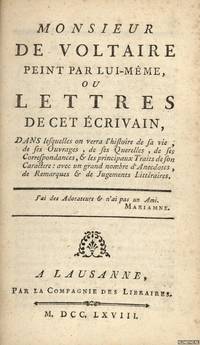
176800293190Lausanne : Compagnie des Libraires 1768. Hardcover. Good. Contemporary gilt half calf with moroccan letterpiece.; Name on endpaper. Lausanne : Compagnie des Libraires hardcover
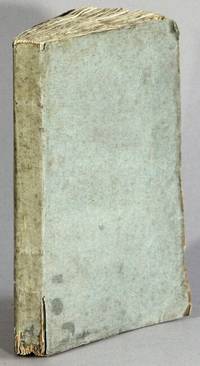
178467131Londres: chez Robinson No 25 Pater-Noster-Row 1784. First British edition 8vo pp. 2 ii 208; vignette title page; original blue paper wrappers; edges curled small cracks at spine ends; all else very good. Unpublished during the author's lifetime these Memoires are generally seen as an outright attack on Frederick of Prussia after Voltaire had suffered humiliation on Frederick's orders in Frankfurt. chez Robinson, No 25, Pater-Noster-Row unknown
1770028261765 - 1770 s.l. sans éditeur 1770. Cramer - Genève - 20 x 12 cm - 2376pgs - 388 pgs - 430 pgs - 366 pgs - 364 pgs - XXIIles pages 3-312 pgs 1et 2 n'existent pas - 404 pgs - plein basane dos à 5 nerfs - fleurons estampées en or dans les caissonstomaisons rouges avec une partie du titre estampée en or - traces d'usage aux dosaux coiffes et aux coins mais très acceptable nom à l'intérieur des plats suppérieurs pour le premier vol.: texte en manuscrit en face du faux titre 18ième- en tout des ex. très acceptables - Bengesco 2212 - Barbier III 532 - les parties 1-3 probablement imprimés en 1766 mais la date sur la page de titre est 1765 le supplément dans la 3ième partie est intégré dans le texte <br/> <br/> 1765 - 1770 s.l. sans éditeur unknown
1775044596Genève et Paris: Cramer et Bardin 1775. Edition encadrée" Complete set of all 40 volumes with the engraved frontispieces where issued all pages printed within the wood-engraved frames octavo format. Uniformly bound in mottled calf with gilt spine trim and lettering; some leather chipping mostly at the head of some spines. all edges marbled. Contents: t. 1 La Henriade divers autres poëmes et toutes les piéces relatives à l'épopée. t. 2-10 Ouvrages dramatiques précédés et suivis de toutes les piéce qui leur sont relatifs. t. 11 La Pucelle d'Orléans poëme suivie du Temple de Gout &c. t. 12-13 Mélanges de poësies &c. t. 14-17 Essai sur les moeurs et l'esprit des nations; et sur les principaux faits de l'histoire depuis Charlemagne jusqu'à Louis XIII. t. 18-20 Siècle de Louis XIV auquel on a joint un précis du siècle de Louis XV et un autre morceau d'histoire. t. 21 Histoire de Charles XII roi de Suède avec les pièces qui y sont relatives. t. 22 Histoire de l'Empire de Russie sous Pierre le Grand divisée en deux parties. t. 23-24 Annales de l'Empire depuis Charlemagne fragmens sur quelques revolutions dans l'Inde fragmens sur l'histoire générale et divers autres morceaux historiques. t. 25-30 Questions sur l'Encyclopédie par des amateurs. t. 31-32 Romans philosophiques élémens de Newton précédés et suivis de divers morceaux intéressans. t. 33-37 Mélanges de littérature d'histoire et de philosophie. t. 38-40 Piéces détachées attribuées à divers hommes célèbres. Cramer et Bardin unknown
1785355899De l'imprimerie de la Societe Litteraire-Typographique. 1785. Contemporary mottled calf raised bands gilt spine decorations marbled edges marbled endpapers. Good plus moderate wear to covers spine decorations faded contents clean and tight. 8vo. 20.8x12.3 cm. French text. Volume 20 only. weight: 1.2 lb. De l'imprimerie de la Societe Litteraire-Typographique. hardcover
1785355892De l'imprimerie de la Societe Litteraire-Typographique. 1785. Contemporary mottled calf raised bands gilt spine decorations marbled edges marbled endpapers. Good plus moderate wear to covers spine decorations faded contents clean and tight. 8vo. 20.8x12.3 cm. French text. Volume 46 only. weight: 1.3 lb. De l'imprimerie de la Societe Litteraire-Typographique. hardcover
1785355900De l'imprimerie de la Societe Litteraire-Typographique. 1785. Contemporary mottled calf raised bands gilt spine decorations marbled edges marbled endpapers. Good plus moderate wear to covers spine decorations faded contents clean and tight. 8vo. 20.8x12.3 cm. French text. Volume 21 only. weight: 1.2 lb. De l'imprimerie de la Societe Litteraire-Typographique. hardcover
1785355890De l'imprimerie de la Societe Litteraire-Typographique. 1785. Contemporary mottled calf raised bands gilt spine decorations marbled edges marbled endpapers. Good plus moderate wear to covers spine decorations faded front joint weakcontents clean and tight. 8vo. 20.8x12.3 cm. French text. Volume 43 only. weight: 1.2 lb. De l'imprimerie de la Societe Litteraire-Typographique. hardcover
1785355891De l'imprimerie de la Societe Litteraire-Typographique. 1785. Contemporary mottled calf raised bands gilt spine decorations marbled edges marbled endpapers. Good moderate wear to covers spine decorations faded front board detached contents clean and tight. 8vo. 20.8x12.3 cm. French text. Volume 41 only. weight: 1.2 lb. De l'imprimerie de la Societe Litteraire-Typographique. hardcover
1785355894De l'imprimerie de la Societe Litteraire-Typographique. 1785. Contemporary mottled calf raised bands gilt spine decorations marbled edges marbled endpapers. Good plus moderate wear to covers spine decorations faded spine heel chipped contents clean and tight. 8vo. 20.8x12.3 cm. French text. Volume 22 only. weight: 1.4 lb. De l'imprimerie de la Societe Litteraire-Typographique. hardcover
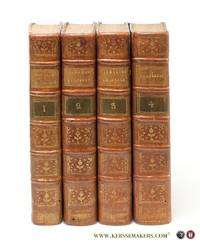
178961987No place L’Imprimerie De La Société Littéraire-Typographique 1785-89. 8vo. Uniformly bound in 90 contemporary full sprinkled calf bindings with five raised bands and gilt lettering and ornamentation to spines. Ex-libris Karl Henrik Koch Danish author and philosopher pasted on to pasted down front end-papers. Bindings with wear of which 35 have considerable wear with loss of leather and boards party detached. Internally with light marginal browning but generally nice and clean. With 2 portraits in vol. 1 and 16 and 14 engraved plates in vol. 39. Wanting vol. 57 and 87. <br/><br/><em>This edition of the Voltaire's Complete Works notably includes the bulk of Voltaire’s previously unpublished correspondence. The Société littéraire typographique was a publishing house founded by Beaumarchais and Condorcet in order to publish a new complete edition of Voltaire's works. Based in Kehl in Baden to escape censorship it operated from 1780 to 1790 they aimed at creating a monumental posthumous edition seven years after Voltaire’s death. To achieve this Beaumarchais purchased the printing types of the great English typographer John Baskerville from his widow and acquired paper mills and presses including three paper mills in the Vosges. Graesse VII 390.Brunet V 1354.Bibliographie Voltairienne p. 101. </em> hardcover
177616734Geneva Switzerland 1776. Leather Bound. Fair/No Dust Jacket Issued. 16mo - over 5¾ - 6¾" tall. French text. 'Philosophical Thoughts of M. de Voltaire Drawn from his Works; in Verse and Prose . To Which We Have Added Mixtures of Literature by the Same Author to Serve as a Supplement to the Different Editions of His Works'. 387193pp. Brown leather boards with five raised bands and two morocco title plates to spine. The leather is heavily worn to edges and corners are turned. The spine is original but the boards look to have been replaced though are near contemporary. There is 0.75cm loss to the head of the spine and uneven minor loss to the foot. Title plates are heavily rubbed and now illegible. All page edges have been dyed red. Marbled end papers. Formerly held in a public library with stamp to fixed end paper and remains of label to first free end paper. Extensive contemporary hand-written notes to blank end papers and some to title page. Text-block is sound and pages in good crisp condition. red page edges. Texte français. « Pensées philosophiques de M. de Voltaire tirées de ses ouvrages ; en vers et en prose . auxquels nous avons ajouté des mélanges de littérature du même auteur pour servir de supplément aux différentes éditions de ses ouvres ». 387193pp. Plats de cuir brun à cinq nerfs et deux plaques de titre en maroquin au dos. Le cuir est très usé sur les bords et les coins sont tournés. Le dos est d'origine mais les planches semblent avoir été remplacées bien qu'elles soient presque contemporaines. Il y a une perte de 075 cm à la tête de la colonne vertébrale et une perte mineure inégale au pied. Les plaques de titre sont fortement frottées et maintenant illisibles. Tous les bords de la page ont été teints en rouge. Gardes marbrées. Anciennement conservé dans une bibliothèque publique avec cachet à garde fixe et reste d'étiquette à première garde libre. De nombreuses notes manuscrites contemporaines sur les pages de garde vierges et certaines sur la page de titre. Le bloc de texte est sain et les pages sont en bon état. . hardcover
176353707Paris etc.: various publ. 1763-1788. 38 parts in 4 vols. 8vo 20x13 cm. Contemporary half leather spines gilt with ribbons; with red and green morocco title-labels; marbled covers. Titles with title-vignette; woodcut headpieces. - 1 NN Voltaire. Le dépositaire. Lausanne Grasset 1772. 84 pp. Barbier I882. First edition. - 2 Monsieur D M Voltaire. Les Guebres ou la Tolérance. Genève Grasset 1769. 48 pp. brown spots. One of the 1769 editions but without 'Préface' and 'Épitre' but with mention Genève. Not mentioned in Quérard I964. - 3 Voltaire. Les lois déminos ou Astérie. Genève se trouve à Toulon 1763. 60 pp. - 4 Voltaire. Irène. 1783. 34 pp. - 5 Voltaire. Brutus. Marseille chez Mossy 1774. 52 pp. - 6 Hume trad. Voltaire. Le caffé ou l'Écossaise. Nouv. éd. Ruault 1777. 50 pp. - 7 Sedaine. Le philosophe sans le savoir. Avignon 1772. 54 pp. - 8 M.D.B. Nadir ou Thomas Kouli-Kan. Alex. & Ant. Jombert 1780. 60 pp. - 9 l'abbé Le Blanc. Aben-Saïd empereur des Mogols first ed. 1736. Prault fils 1737 1787. 60 pp. - 10 Dorat. Adelaide de Hongrie. Monory1774 à la date de l'originale. 62 pp. - 11 Marmontel. Venceslas 1759. La Haye se vend à Marseille Mossy 1777. 56 pp. - 12 NN Mme de Graffigny. Cénie. 1750. Mossy1776. 60 pp. - 13 Scarron. Dom Japhet d'Arménie. 1653. Mossy 1776. 68 pp. - 14 Destouches. Le tambour nocturne. Nouv. éd. Didot l'Ainé. 66 pp. - 15 idem. Le philosophe marié. Didot l'Ainé 1778. 82 pp. - 16 Idem. L'homme singulier. Ruault 1778. 86ii pp. - 17 idem. Le glorieux. 1732. Delalain 1781. 104 pp. - 18 Montfleury père et fils. La fille capitaine. Nouv. éd. Compagnie Librairies Associés 1771. 66 pp. - 19 NN Dorat. Le célibataire. 1775. Didot l'Ainé 1778. 72 pp. - 20 Gresset. Le méchant. Didot Ainé 1778. 78iipp. -21 De Chamfort. Mustapha et Zéangir. 1776. Didot l'Ainé 1778. 54 pp. 22-24: Publisher: Avignon L. Chambeau 1773-74: 22 Diderot le fils naturel 54 pp. 23 Nivelle de la Chaussée. La gouvernante. 24 De Campistron. Le jaloux désabusé. 56 pp. - 25-29: Publisher: Paris Duchesne: 25 A. Collalto. Les trois jumeaux Venitiens 1773 en quatre actes. 1777. 26 De la Noue. La coquette corrigée. 1756. 1774. 27 NN Nivelle de la Chaussée. Le préjugé à la mode. 1776. 64 pp. 28 Poisson. Le Mercure gallant. 1776. 60 pp. 29 Delaunay. Le complaisant. 1732. Nouv. éd. 1776. - 30-38: 'Nouv. éditions' published by Ruault 1777-84: 30-31 Boursault. Esope à la cour & Esope à la ville ou les fables d'Ésope. 1780-86. 68 & 92 pp. 32 Rochon de Chabannes. Les amans généreux. 52 pp. 33 De Boissy. Les dehors trompeurs. 72 pp. 34 A. Montfleury. La femme juge et partie. 56 pp. 35-36 Colardeau. Astarbé & Caliste 1760. 1777. 44 & 46 pp. 37 De la Harpe. Jeanne de Naples.46ii pp. 38 Le Mierre. Guillaume Tell. 36 pp. -- Nice spotless convoluut. various publ. hardcover
1775000712Geneva: Geneva: Cramer et Bardin 1775. Full leather. Very Good. Octavo volume two only; 448 ipp. In contemporary full speckled calf extremities lightly worn spine rubbed gilt roll to board margins spine gilt spine labels missing original marbled endpapers light spotting to opening and closing leaves closing errata leaf present a clean complete odd volume example produced within Voltaire's lifetime of this attractive edition with each page set within an ornamental frame. Geneva: (Cramer et Bardin) hardcover
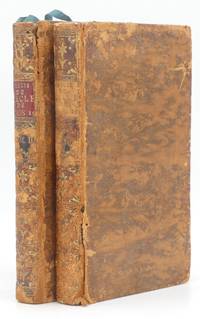
1771A5BROWN20101771. Hardbacks full-calf gilt title and decoration to spines but lacking 3 of 4 spine labels. 16.5cm x 10.5cm. 2 volume set. Text in French. Pp. 260 4; 218 2. Decorative ornaments and head and tail-pieces. Nouvelle edition 1771. Bindings slightly rubbed and worn with small perforations to spine. Some foxing/age-discolouration to contents. A decent set. a5. Hard Cover. Good. Hardcover
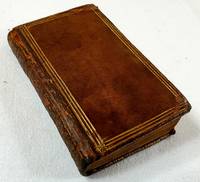
1773044671Geneve Geneva Switzerland: N.P. 1773. In French. Petite book about 4.5 inches tall full brown cale with covers bordered in gilt spine lettered and decorated in gilt all edges gilt blue endpapers. Some expected cover wear including surface chipping to the foings and spine archivally stabilized joints good text block sound bottom margin of title page torn away below the date pages clean no names or other markings. . Hard Cover. Good. 32mo - over 4" - 5" tall. N.P. Hardcover
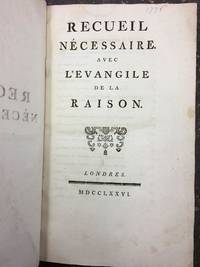
17761316353Londres 1776. Hardcover. Octavo 280 pages; VG; bound in quarter red calf gilt lettering and tooling to paneled spine marbled boards marbled endpapers; half-title present verso of sfep has two early math equations; wide margins; scarce; shelved case 10. The imprint is false; probably printed in the Netherlands. Contrary to the title this edition does not contain "L'evangile de la raison" but does include "Dialogue du douteur & de l'adorateur". Signature marks include "Tome I" but no Vol. 2 is recorded; <br /> <br> <br /> <br> <br /> Preceeded by a second false imprint printed in Amsterdam by M. M. Rey in 1768;<br /> <br> <br /> <br> <br /> ESTC Citation No. N12875. 1316353. Shelved Dupont Bookstore. hardcover
180076774Paris: Chez Colnet 1800 AN VIII. Chez Colnet unknown
1774012891London: Printed for G. Kearsly 1774. First edition thus. Leather. Very Good. 12mo - over 6¾ - 7¾" tall. Text in English. A Very Good copy. 12mo. vi 222 2 pp. Bound in full calf with title on a red morocco label on the spine. The front joint is cracking but holding. Text and end papers clean. Very Good. Printed for G. Kearsly unknown
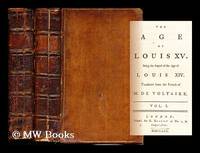
1770282472London: printed for G. Kersly 1770. First Edition. Hardcover. Worn set bound in full aniline calf with a leather gilt-blocked label to the spine. Some wear and tear to the spine and panel edges as with age. Physical description; two volumes. Subjects; Louis XV. French History. M. De Voltaire. London: printed for G. Kersly hardcover
1752018552R. Dodsley 1752. Hardcover. Very Good. Tight clean copy in full leather. Size: 8vo - over 7¾" - 9¾" tall R. Dodsley hardcover
176158239London: Printed for J. Newbery R. Baldwin Etc 1761. Paper covered boards and spine rubbed and bumped spine heavily chipped and cracked with some loss to paper covering gutters cracked sporadic foxing pages clean and bright. Hard. Fair. 12mo. Printed for J. Newbery, R. Baldwin, Etc Hardcover