577 résultats
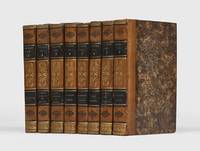
1821160633Paris: Bossange Frères 1821. With autograph material by the author First complete collected works. Bound into this set are five letters by Volney including one dated only a week before his death addressed to his friend Colonel Pierre Jacotin the head geographer responsible for all mapping operations during Bonaparte's Egyptian campaign. The letters underscore Volney's keen engagement with the contemporary discourse surrounding the geography of the Arabian Peninsula Egypt and the Levant. Jacotin met Volney in Corsica in the 1790s while working as a cadastral mapper. His conversations with Volney - who had travelled extensively to Egypt and Syria - eventually inspired him to pursue a career in Egypt where he was later assigned as military cartographer to the Napoleonic expedition. Jacotin's account of the cartographic survey work conducted in the area later formed the basis of the monumental Description de l'Égypte. Bound in at the beginning of the first volume are three letters sent by Volney to Jacotin from Paris respectively dated 20 March 11 April and 17 April 1820 Volney died on 25 April. A fourth letter at the end of vol. IV is dated 24 October. In the first letter Volney apologises for not having been able to receive Jacotin who had come to visit him the day before due to a bad fever. In the others Volney asks Jacotin for help and advice with preparing the plates specifically the maps for an English edition of his Ruines which "a bookseller" had asked him permission to publish; he also points out misspellings appearing in earlier states of the plates for example correcting toponyms in the Arabian Peninsula. No details are given concerning the edition in question. The first translation of the Ruins appeared in 1792 and was followed by numerous others. Further manuscript pages in Volney's hand are tipped into the first volume with a note gifting them to Jacotin. These contain an extract from an anonymous article published on 1 July 1819 in The Monthly Magazine London with the title "Account of Newly-Discovered Antiquities in Arabia Petraea Derived from the Personal Inspection of a Recent British Traveler". The traveller was William John Bankes 1786-1855 and the article is concerned with the projected publication of his voyage. Bankes travelled from Jerusalem to Wadi Musa passing through Kerak Castle Mount Hor and Petra; he describes the ancient Roman ruins that he saw during the trip and recounts sojourning with the Bedouin transcribing a Bedouin love song. Volney translates part of the article into French and adds his own comments and questions. A philosopher and orientalist Volney 1757-1820 wrote extensively on history religion politics and linguistics. His major works include Voyage en Syrie et en Egypte published in 1787 which had a profound impact on the Western view of the region and inspired Napoleon to undertake his invasion of Egypt in 1798 and Les Ruines 1791 a philosophical treatise on the history of social political and religious institutions and the rise and fall of empires. According to the distinguished American historian Ussama Makdisi holder of the Arab-American Educational Foundation Chair of Arab Studies at Rice University Volney's Voyage en Égypte et en Syrie "was simply the first of the great works of modern travel writing and description. Volney was a man of the Enlightenment. His work was suffused with its vocabulary and his humanism motivated him to travel to Asia to better understand the nature of 'despotism' under which his native France laboured" Makdisi p. 17. 8 vols octavo 204 x 123 mm. With 40 engraved plates many folding including portrait of author tables and maps. Contemporary quarter calf smooth spines divided by gilt fillets gilt and black ornaments in compartments black calf labels marbled boards endpapers and sides black silk bookmarkers. Embossed library stamp lettered "Ct Perret Havre" on front free endpaper of vol. I perhaps Auguste Perret 1874-1954 French architect active in Le Havre. Extremities rubbed couple of small chips short superficial splits at foot of front joints of vols. V and VIII remaining firm patches of stripping to leather of vols II and III occasional light foxing to contents faint damp stain to lower margin of final leaves and folding plates of first 5 vols otherwise generally bright and clean. A very good set. Ussama Makdisi The Culture of Sectarianism: Community History and Violence in Nineteenth-Century Ottoman Lebanon 2000. hardcover
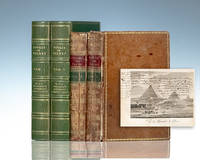
1799146536A Paris: Chez Dugour et Durand Libraires Rue et Hotel Serpente 1799. Volney's important work on Egypt and Syria from the library in exile of Napoleon Bonaparte with his annotations and corrections throughout several made as he was dictating details from the Egyptian Campaign for his own Memoirs. This copy may also have accompanied him during his Egyptian Campaigns; it is known that Napoleon brought along a copy of Volney's book to Egypt and it served as the standard reference source for the members of the campaign. Octavo two volumes bound in full contemporary French sprinkled calf with gilt tooling to the spine morocco spine labels lettered in gilt gilt scrolling to the front and rear panels with 3 engraved folding maps and 5 folding plates. First published in 1787 this important travel account by the renowned French historian orientalist philosopher and politician Constantin Francois de Chasseboeuf comte de Volney 1757-1820 is considered the best exposition of Egypt from Ottoman Syria in the late eighteenth century. It served as a basis for later Egyptian expeditions and many scientists as well as Bonaparte himself took this work with them on their expeditions. His candid descriptions did not romanticize Egypt's history or its contemporary social and political conditions but discussed the ills that plagued the country and explored the military weakness of the Ottoman Empire. Based on his observations Volney discouraged a conquest of Egypt and while he supported his friend Bonaparte politically he declined the invitation to accompany Napoleon's expedition in person. It is known that Napoleon brought along a copy of Volney's book to Egypt and it served as the standard reference source for the members of the campaign. The French campaign in Egypt and Syria 1798--1801 was a Napoleonic campaign in the Ottoman territories of Egypt and Syria executed by Bonaparte. Napoleon proclaimed to "defend French trade interests" and to establish "scientific enterprise" in the region. Despite early victories and an initially successful expedition into Syria Napoleon and his Armee d'Orient were eventually defeated and forced to withdraw especially after suffering the defeat of the supporting French fleet by the British Royal Navy at the Battle of the Nile. However on a scientific front the expedition was a success that led to the discovery of the Rosetta Stone creating the field of Egyptology. This important copy contains numerous annotations in ink and pencil in Bonaparte's hand mostly concerning measurements and other calculations including a heavily annotated folding plate of the pyramids "Vue de Pyramides de Djize" in Vol. I. The first volume contains ink annotations on pages 188 232 272 273 277-79 281 plate at page 229 cited above and map "Carte de la Syrie" at p. 288 outlines drawn in red pencil. The second volume contains mostly pencil annotations on pages 223 225 227 229 272 ink and pencil and 333. These corrections were made by Napoleon as he was dictating details from the Egyptian Campaign for his own Memoirs see provenance below. After Napoleon's death on St. Helena a large portion of his last library was divided by the executors among heirs and friends. The remainder was removed from St. Helena by order of the British Government and sold to the important French bookseller in London Martin Bossange. The lots that failed to sell almost half were quickly consigned by Bossange to Sotheby's and sold on 23 July 1823. The lengthy catalogue entry for the present lot in the Sotheby's catalogue reads: "This Work is one of the most interesting books that has occurred for sale for many years. Most persons are aware that Napoleon wrote very little but dictated to his favorite Generals Bertrand Montholon and Count Las Casas. The Egyptian Campaign which forms a part of two volumes just published of his Memoirs have been dictated from these volumes: he has taken notice of the most trifling error in the book; hence the many CORRECTIONS BY HIM. The Plate at page 229 vol. i is entirely covered with his hand writing. This unique Book forms an historical document which will be looked at with a mixture of pleasure and pain by the admirers of so great a man." Provenance: Napoleon I each title-page with circular hand-stamp in brown ink from Napoleon's library at Longwood House on St. Helena; and with his numerous ink annotations to plates and text in both volumes; Sir James Lewis Knight-Bruce bookplates; and with a note from his grandson regarding this copy: "These two volumes of 'Volnay's Voyages' which belonged to Napoleon the first were understood to have accompanied him during his Egyptian Campaigns and contain many notes in his the Emperor's handwriting. My grandfather the late Lord Justice Sir James Lewis Knight-Bruce of Roehampton Priory purchased these books presumably about 1821-2 when they were sent to England from St. Helena for sale. They being in Napoleon's possession there until his death in 1821." In very good condition with splitting to the spine and joints small section of leather torn from the upper cover of Vol. II; some wear to extremities. Occasional pale spotting internally final blank leaves 30/8 of both volumes removed presumably at the time of binding. First map in Vol. I with small marginal tear repaired near gutter margin second and third maps each with 2-inch tear repaired at gutter a few other plates with small marginal tears or reinforcements. Housed in a custom full crushed levant morocco clamshell box by Riviere & Son. Third edition revised and corrected. An exceptional piece of history with fascinating provenance. Chez Dugour et Durand, Libraires, Rue et Hotel Serpente hardcover