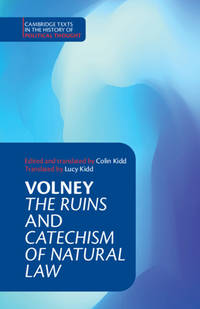
Volney: ‘The Ruins' and ‘Catechism of Natural Law'
2024x-1108717268Cambridge University Press 2024. Paperback. New. 249 pages. 8.50x5.50x0.57 inches. Cambridge University Press paperback
Revaluation Books · Royaume-Uni43,33 £GB≈ 49,47 €
765 résultats
1852604181852. Notiz. Geb. Nat. Heilk. 4 441445. - Anatomie und Physiologie 1.Bd. No. 4546. - Frorieps Tagsberichte. - Weimar Januar 1852 8° pp.321-336 2 Rückenbroschuren. Erstdruck! "1852 zeigen der deutsche Physiologe Julius Ludwig Budge 1811-1888 und der englische Neurophysiologe Augustus Volney Waller 1816-1870 dass die für die Pupille bestimmten Fasern des Sympathikus ihren Ursprung im Rückenmark haben. Wenn man die vorderen Wurzeln der Nervenpaare durchschneidet die aus dem Centrum ciliospinale hervortreten - also aus der Wurzel der zwei oder drei ersten dorsalen Spinalnervenpaare - so sieht man an der Pupille sogleich die für die durchtrennung des Halssympathikusstrangs charakteristische Verengung." Albert Mudry : Johann Friedrich Horner 1831-1886 und das okulopupilläre Syndrom. Schweiz Med Forum 2014;1434: pp.605-607 "In 1851 Waller abandoned his practice to devote himself entirely to research and moved to Bonn Germany. During his 5 years in Bonn Waller turned to his second major focus in neurophysiology the autonomic nervous system. In collaboration with Julius Ludwig Budge Waller studied the pupillary action and nerve supply to the iris. Their important observations were reported in 1851 and 1852 in the Comptes Rendus published by the French Academy of Sciences. With carefully executed experiments Budge and Waller showed the influence of the cervical portion of the sympathetic nerve in dilatation of the pupil. Using the Wallerian method to trace the dilator fibers they followed the fibers in the sectioned sympathetic trunk to the first and second thoracic segments of the cord. If this region was stimulated in an intact animal there was pupillary dilatation; if the cervical sympathetic nerve was sectioned pupillary dilatation was abolished. Budge and Waller named the area controlling the dilatation of the pupils the ''ciliospinal center.'' Their work on the ciliospinal center won Budge and Waller the 1852 Monthyon Prize awarded by the French Academy of Sciences. They went on to demonstrate the action of the cervical sympathetic nerves on vasoconstriction." Venita Jay: Augustus Volney Waller. Arch Pathol Lab Med 126/9 2002: pp: 1018-1019. unknown
2024x-1108717268Cambridge University Press 2024. Paperback. New. 249 pages. 8.50x5.50x0.57 inches. Cambridge University Press paperback
2024x-1108493106Cambridge University Press 2024. Hardcover. New. 249 pages. 8.50x5.50x0.63 inches. Cambridge University Press hardcover
47113268-nnew. unknown
47113268like new. unknown
A9781108493109Hardback. New. A fresh modern translation of a major French Revolutionary text whose arguments for popular sovereignty are couched in the form of an Oriental dream-tale. This is a forgotten bestseller in the history of political thought which was translated by Thomas Jefferson and hugely influenced radical poets from Shelley to Whitman. hardcover
2024SKU0604400Cambridge University Press 2024-02-15. paperback. Good. 5x0x8. Textbook May Have Highlights Notes and/or Underlining BOOK ONLY-NO ACCESS CODE NO CD Ships with Tracking Cambridge University Press paperback
2024SKU0651907Cambridge University Press 2024-02-15. paperback. New. 5x0x8. New Textbook Ships with Tracking Cambridge University Press paperback
1108493106.Ghardcover. Good. Access codes and supplements are not guaranteed with used items. May be an ex-library book. hardcover
1108717268.Gpaperback. Good. Access codes and supplements are not guaranteed with used items. May be an ex-library book. paperback
ria9781108493109_inpHardcover. New. New Book; Fast Shipping from UK; Not signed; Not First Edition; N/A hardcover
34217Turnhout , Brepols, 1999 Paperback, 172 p., 170 x 240 mm. ISBN 9788886609203.
1924264069Girard Kansas: Haldeman-Julius Company 1924. Pamphlet. 64p. light blue stapled wraps 3.5x5 inches frontispiece portrait of Volney wraps lightly toned along edges large chip at top edge of rear wraps pages evenly toned pp9-16 trimmed too tight in outer margin with some loss of text else good condition. Little Blue Book No. 564. Haldeman-Julius Company unknown books
1528252535.Ghardcover. Good. Access codes and supplements are not guaranteed with used items. May be an ex-library book. hardcover
1333853831.Gpaperback. Good. Access codes and supplements are not guaranteed with used items. May be an ex-library book. paperback
0266303463.Ghardcover. Good. Access codes and supplements are not guaranteed with used items. May be an ex-library book. hardcover
45460681like new. unknown
1015593186.Ghardcover. Good. Access codes and supplements are not guaranteed with used items. May be an ex-library book. hardcover
1950mon0003239638Truth Seeker Company 1950T. hardcover. Good. . No jacket but minimal wear to the cover. Pages are tanning. Truth Seeker Company hardcover
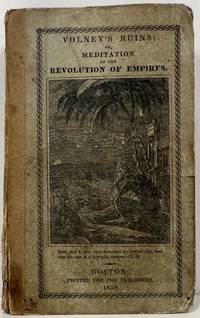
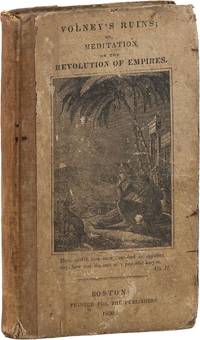
183567296Printed in the USA: Charles Gaylord 1835. 1835 edition. Cloth and paper over boards. As described. Hardcover cloth tan over paper illustrated over boards. 12mo. 216 pp. Illustrated with a b/w engraved frontispiece. No edition marks. Remnants of a paper label on the spine. Faded partially legible inscription on the front flyleaf. Ownership signature P. S. Van Wagner Hamilton 1844 R. R. on the front flyleaf and title page. Small enclosed tear on the back flyleaf. Text block is age browned around the edges and mildly foxed throughout. Binding is strong and square. Spine and boards are soiled rubbed and worn. Edges of the boards are frayed in sections. Small enclosed tear on the fore edge of the front board. Crack in the bottom of the front hinge. Bumped corners. Despite its appearance this copy's bindings are still strong and its pages legible. Charles Gaylord unknown
183588767Boston: Charles Gaylord 1835. Early US Edition. Twelvemo. 17cm. Publisher's original linen spine lacking paper title label over decorated publisher's paper covered boards. 216pp. Strong and solid scuffed to the corners with the paper worn allowing the board to show through rubbed and a little battered in places with some light cosmetic fraying to the spine ends and a general unform wear that is oddly not unappealinig; internally foxed in a pale similarly uniform fashion with some truly eccentric oak gall ink inscriptions to the preliminary blanks stating that the book was part of the library of the Transylvania Whig Society of Kentucky and presented by a visiting Englishman the inscriptions seem to serve as a kind of lending record denoting that the book was especially approved of by Kathleen O'Pinkerly who seems to have borrowed it twice; the page block is worn and a little stained but solid and eminently handleable and the rear flyleaf blank is covered with small neat pencil annotations with a corner of the blank torn away. Cosmetically unappealing perhaps but aesthetically rather charming and undeniably a survivor. A very good copy by dint of completeness eccentricity and stubbornness.<br /> <br /> An early US reprint the US first was issued in New York in 1828 by Dixon and Sickles and it is likely there is a Gaylord edition from 1833 with all US imprints being pretty thin on the ground especially with illustrated publisher's boards. This is in addition an uncredited Jefferson-Barlow translation translated with the approval and co-operation of the author by none other than Thomas Jefferson who managed the first 20 chapters or so before distracting himself with political fripperies whereupon it was subsequently completed by Joel Barlow. Of the various translations the Jefferson-Barlow is considered superior by dint of Volney's close relationship with Jefferson their common views and sympathies and frankly the fact that it renders the whole piece rather more poetically than might be found elsewhere. <br /> <br /> Controversial and madly popular it's far more a work of radical philosophy than anything else; like Jefferson Volney was a committed Deist and a firm believer in the separation of church and state for reasons clearly expressed by him through Jefferson in this work. Even more radically for the time he was a propogator of the "Christ Myth" which suggested that there was little or no evidence for the actual existence of Christ as a historical personage and that He was far more likely to be an inspiring assemblage. As might be expected such views were polarizing engendering either inspired revolutionary support or cries of heresy and treason depending upon the reader. The upshot of this and a number of other controversies was that Volney in common with the Founding Fathers not being a man known for keeping his mouth shut was ejected from the United States on more or less invented charges of espionage and his philosophical musings on the ashes of Empires and the sad destiny of mankind somewhat discredited. This had little effect upon the historical importance of Volney's "Ruins" however and it was for example widely embraced by the Romantics and their followers with Shelley having a virtual addiction to its evocative embracing of decay and his wife Mary for reasons of her own making it the text from which Frankentein's monster learned what he could about the nature of mankind and developed a rather stereotypically male interest in the Roman Empire. An unusual edition of an influential and incendiary work. Charles Gaylord unknown
3337173314.Gpaperback. Good. Access codes and supplements are not guaranteed with used items. May be an ex-library book. paperback
185316954Philadelphia: F. W. Thomas 1853. Dritte Stereotyp Ausgabe. Hardcover. fair. Sm. 8vo. 220pp. Blind-stamped brown cloth with gold decorated spine. Small plate with "27" handwritten near head of spine. Chipping to head and tail of spine. Wear to edges. Staining and rubbing to boards. Sporadic foxing throughout. Bookplate of school-district on inside of front board and name of the same handwritten on title-page. Ex libris.Text in Gothic script. Binding in fair interior in good condition. Rare. F. W. Thomas hardcover
0243057822.Gpaperback. Good. Access codes and supplements are not guaranteed with used items. May be an ex-library book. paperback