336 résultats
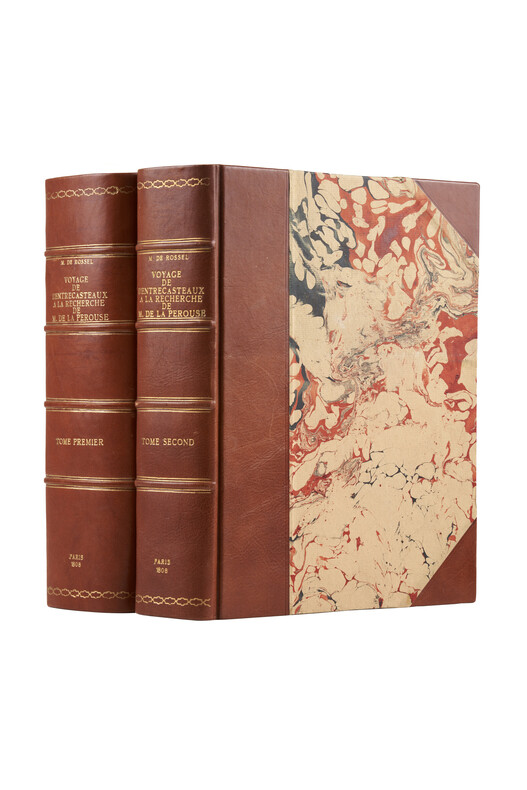
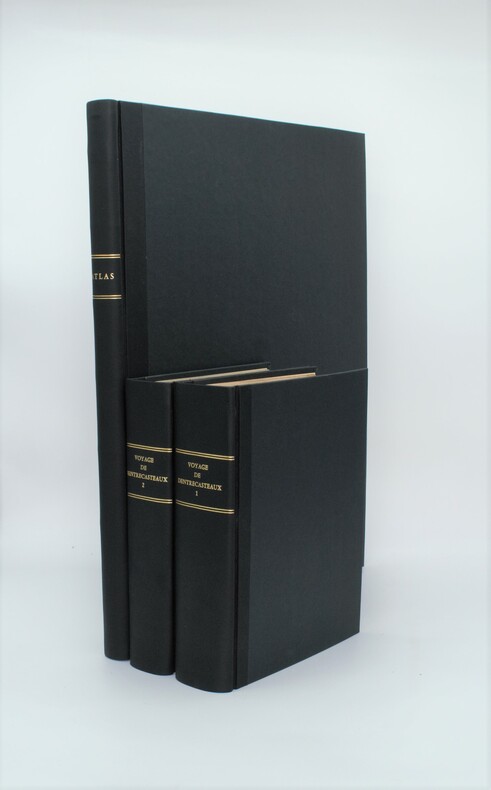
1807PHO-1A Paris, Dépôt général des Cartes et Plans de la Marine et des Colonies, 1807 et De L’Imprimerie Impériale, 1808 RARE ENSEMBLE COMPLET en 3 volumes TEXTE ; 2 forts vol. in-4° ; (2)-LVI-704 pp.-32 pl. h.-t. repliées in-fine (I-XXXII)/(2)-VIII-692 pp.-1 pl. h.-t. Repliée sur papier bleuté , relié demi cuir , dos lisse avec titre et tomaison , tranches mouchetées , mouillure angulaire sur 7 planches, petites rousseurs sur les planches . ATLAS ; 1 volume grand in-folio (560x445) ,page de titre-1 fnch. (Table )-39 cartes et vues h.-t. , dont 29 à double page ,dressées par l'ingénieur hydrographe C. F. Beautemps Beaupré et gravées sur cuivre par E. Collin , relié demi cuir , dos lisse ,cachets répétés , petites rousseurs .
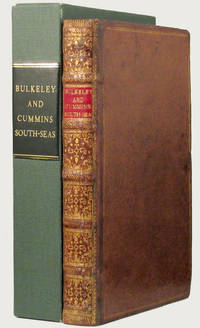
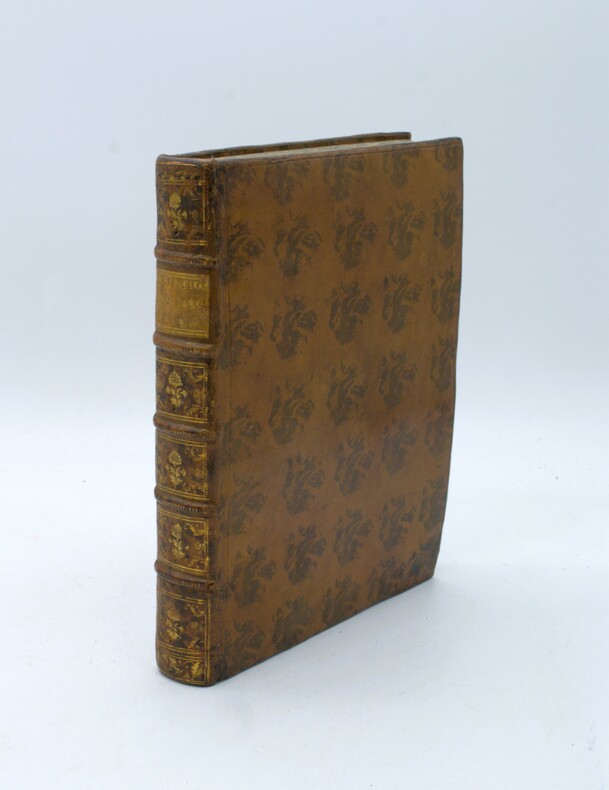
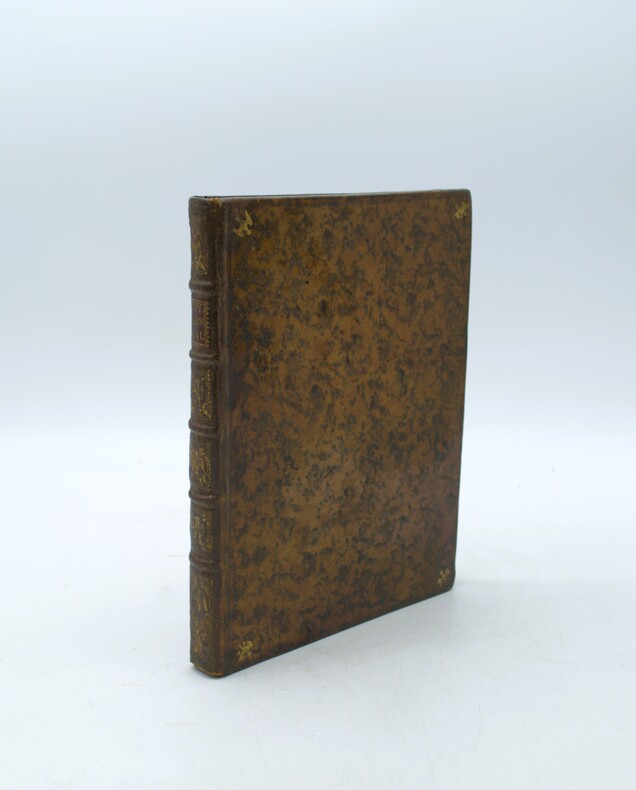
174331681London: Printed for Jacob Robinson 1743. First edition the first of the two issues of 1743 being the issue printed by Robinson with the author's names stated. With a number of attractive woodcut headpieces and initials. 8vo 190 x 120 mm especially well bound in very handsome contemporary full polished brown calf the boards framed with double-ruled gilt edges hatched in blind the spine finely gilt decorated with elaborate detailed tooling in five compartments between wide gilt ruled and hatched raised bands a sixth compartment with red morocco label ruled and lettered in gilt additional gilt at the tips and along the joints. With the engraved bookplate of Lord de Saumarez an admiral of the British Royal Navy notable for his victory at the Second Battle of Algeciras. Saumarez is one of the true historical figures to appear in C. S. Forester's Hornblower novels being celebrated in two of the novels. Saumarez's fictional alter-ego also plays a role in two of the Aubrey-Maturin novels by Patrick O'Brian. Now housed in a handsome green cloth clamshell box with morocco label gilt. xx 220 pp. A very handsome and well preserved copy the text clean crisp and unpressed the handsome binding solid and sturdy with a some expert and accomplished restoration along the joints and a bit of touching up to the corners. In all a fine copy with excellent Naval provenance. RARE AND TRUE FIRST EDITION FIRST ISSUE WITH FINE MARITIME PROVENANCE OF ONE OF THE PRINCIPAL ACCOUNTS OF THE LOSS OF H.M.S. WAGER; ONE OF THE MOST COMPELLING NAVAL ACCOUNTS OF THE EIGHTEENTH CENTURY.<br> This narrative is the exciting mutineers' side of the story of the loss of the Wager to inhospitable climate on one of the world's most remote and dangerous coastlines beyond the Straits of Magellan. When Commodore Anson set out for the Pacific in 1740 to attack the Spanish ships on the Chilean coast he took eight ships with him. The Wager was effectively a transport ship carrying stores and a force of marines; as the squadron rounded Cape Horn in fearsome weather she was unable to keep up with the rest of them and with her gear wrecked by the storm was driven ashore on the Patagonian coast. This tale of mutiny hardship and tenacity that ensued was told by the survivors especially John Bulkeley leader of those who repudiated the captain's authority. Bulkeley the ship's carpenter and Cummins led their small group of survivors until their landing at Rio de Janeiro and finally England concluding a voyage that had lasted almost two years. Another narrative was published by John Byron then a midshipman who remained with Captain Cheap. Of Cheap's group only three members Cheap Byron and one other eventually reached home but by a different overland route.<br> This voyage was the basis for Patrick O'Brian's historical work 'The Unknown Shore' written before he embarked on the Jack Aubrey/Stephen Maturin novels. Printed for Jacob Robinson hardcover
5794<p>Textile 81.5 x 70.5 cm Fabric images printed from copperplate with maroon body color printed by woodblock. Occasional very minor toning otherwise very well preserved with printing clear and color still fresh.<br /></p><p>Highly attractive and unusual mid-19th-century printed textile illustrating an archetypal story of the ideal French mariner a fisherman's son named Jacques who left home as a boy to sail to the Antilles with the merchant marines met with many adventures on the high seas shipwreck pitched battle on deck encounters with natives and years later returned home to raise his children to follow his example of maritime heroism.</p><p>Such printed handkerchiefs a specialty of Rouen most notably associated with the shop of the engraver/printer Narcisse-Alexandre Buquet 1825-94 formed a category of popular imagery in which a textile was printed with an engraved plate and sometimes as here enriched with woodblock color. The ephemeral "<i>mouchoir illustré rouennais</i>" depicted a broad range of scenes taken from daily life contemporary domestic and foreign politics and even served as practical technical reminders for servicemen known as "<i>mouchoirs d'instruction militaire</i>". These highly perishable items are all today very rare with many examples known only from archival proofs printed on paper see Bassargette for an introduction to the <i>mouchoir illustré rouennais</i>.</p><p>The present handkerchief is particularly lively illustrating the life of the seaman Jacques in 9 rather romantic scenes each of which is provided with an extensive caption. The story seems to harken back to a nostalgia for French maritime exploits during the Napoleonic Wars and while some details seem drawn from history and popular periodical literature the tale was apparently invented specifically for this piece. The scenes read from left to right can be summarized as follows: 1 Jacques the eldest son of a fisherman's widow in order to support his family signs on with the merchant ship Sainte-Adelaïde sailing for the Antilles. 2 In the Gulf of Mexico the ship is caught in a storm and springs a leak. The crew promises to make a pilgrimage to Our Lady of Mercy if they are saved. Jacques plunges into the hold and plugs the leak. 3 In port the crew fulfill their pilgrimage vow. Sailors place an <i>ex voto</i> of a ship on the church altar. 4 Jacques signs on with the battleship <i>Hercules</i> where he is bullied by the "old sea wolf" named Lartigot but he eventually wins the admiration of the crew. 5 A heavily armed enemy vessel attacks the <i>Hercules</i>. Grappling irons are thrown the bugle blows the enemy vessel is boarded and Jacques hatchet in hand saves the surrounded Lartigot. 6 Now in the Pacific the <i>Hercules</i> anchors at the Navigator Islands Samoa. A party goes ashore in search of water and encounters natives eager to trade. The lieutenant is injured in a melee but Jacques saves him. 7. The <i>Hercules</i> sails for France and back home Jacques is decorated for his bravery is promoted marries Lartigot's beautiful daughter and settles down in St. Malo. 8 One day a ship founders off the coast of St. Malo. Jacques hears the alarm and rope tied around his waist he swims into the sea and saves eight sailors. 9 Jacques is given the nickname "<i>Va-de-bon-coeur</i>" in recognition of his eager courageousness is appointed head of the coast guard and is given a seaside house where he raises his children to follow in his footsteps.</p><p>E. Bassargette "Une imagerie éducative: Le mouchoir illustré rouennais" <i>Histoire de l'education</i> vol. 30 1986 pp. 61-66.</p> [Rouen?], [s.n.], [c. 1850s].
003235Mornay, 1932
1808PHO-1626Paris, Imprimerie impériale, 1808. 2 grands et forts volumes in-4 (32x24), lvi, 704 p., 33 pl. ; viii, 692 p., relié demi basane et coins moderne, dos avec auteur, titre, tomaison, lieu et date, exlibris en page de garde, non rogné, tome 2 non coupé, petite mouillure au tome 2, petites rousseurs aux illustrations du tome 1. Exemplaire sur papier bleuté, complet de son illustration mais sans son atlas de cartes
Abundant black and white illustrations and reproductions of photos. Features: Two Men's Madness - six lives and a fine ship, the Frank N. Thayer, are lost through the unaccountable frenzy of two Indians; In Wildest Ireland - A.W. Cutler describes and photographs "unspoilt" regions of the Emerald Isle - with many fascinating photos; The Guardian of the Line - the ordeal undergone by a humble railway-crossing keeper's wife in Lithuania on the Russian Front; In Search of the Unknown Land - The tragic story of the Stefansson Arctic Exploration Expedition, twelve-page article including many photos; The Tales of Golab Khan - some amusing stories of Indian life; The Airman's Escape - two British aviators raid a Bulgarian town, then one is shot down and must be rescued by his companion; From Job To Job Around the World - part VI - Two American wanderers make there way through the Holy Land to Constantinople - with photos; The Trouble at Crib No. 2 - a tug-boat fireman recounts an exciting story of a winter rescue on the Great Lakes; Australia's Water Miracle - article and photos describe how the Government of New South Wales has created a miracle of irrigation; The Story of Count Seilern - A Tragedy of the Hapsburgs; Alpine Acrobats - A vivid account, illustrated by some very remarkable photographs, of the first ascent of the needle-like "Cigar Rock" in the Italian Alps; Lovely one-page illustrated ad by Canada Steamship Lines promotes their Niagara to the Sea all-water route; and more. pp. 4 [ads], [3], 290-385, 7-32 [ads]. Unmarked with moderate wear. Soiling to back cover. Covers beginning to loosen, otherwise a sound vintage copy of this exceptional issue.. Book
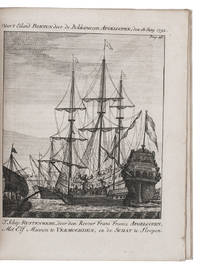
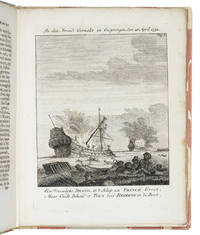
1752E51BW3BBNOWBAmsterdam 1752. 4to. Bernardus Mourik Disbound. With 2 etched plates. Further with publisher's woodcut BM cypher monogram on the title page a woodcut tailpiece and 2 woodcut decorated initials. 2 37 1 pp. The first edition of a compelling account of two fatal voyages of the French East Indiaman Le Prince and the VOC ship Rustenwerk. Le Prince commanded by Captain Morin left the port of Lorient on 19 February 1752 sailing for Pondicherry. The voyage passed quietly until fire was discovered in the ship. It spread fast and the ship exploded when the fire reached the gunpowder magazine leaving only 10 survivors. The second account relates the seizure of the ship Rustenwerk a 650-ton Dutch East Indiaman. Moored off Ternate it was taken by the pirate Frans Fransz on 28 June 1751 and some 12 passengers including the Captain were killed. The survivors reached Batavia by way of Makassar and sailed for Holland. The VOC eventually managed to retake the ship but Frans Fransz escaped with the valuable cargo. The account includes a list of 210 VOC ships lost in the period 1688-1752 through disasters mutiny piracy etc.In good condition.l Landwehr & V.d. Krogt 437; STCN 4 copies; Tiele Bibl. 1238. unknown
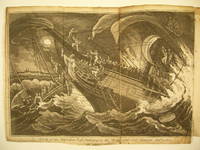
1752L73F2JRXUYKAAmsterdam: Bernardus Mourik 1752. Boards covered with modern pink decorated paper which are also used as paste-downs and endpapers with a dark brown morocco spine label. 4to. With 2 etched plates the publisher's woodcut BM cypher monogram on the title page a woodcut tailpiece and 2 woodcut decorated initials. Second and rare edition of an account of two fatal voyages with two ships. The first voyage was made with the French East Indiaman Le Prince and was commanded by Captain Morin. On 19 February 1752 this ship left the port of Lorient sailing for Pondicherry. However initially the voyage went well on 26 April 1752 there was a fire in Le Prince. It spread fast and it also reached the gunpowder magazine. Therefore the ship exploded as the engraving shows and only 10 persons survived.The second account concerns the seizure of the Dutch ship Rustenwerk an East Indiaman of 650-ton. On 28 June 1752 this ship was taken by the pirate Frans Fransz after mooring of Ternate. He and his companions killed 12 people on board which is depicted in the engraving. The survivors of this violent seizure by Frans Fransz reached Batavia and they sailed to Holland. Although the VOC succeeded in retaking the ship Frans Fransz. Already escaped with the valuable cargo. A more historical addition to this report is the list it includes of 210 VOC ships lost in the period 1688-1752 through disasters mutiny and piracy. These two ships are cruel examples of how East Indiamen could be defeated by fate. After this first edition Mourik also published a second also undated edition with the same plates. Spine slightly discoloured otherwise in very good condition.l Landwehr & V.d. Krogt 437; STCN 1 copy; Tiele Bibl. 1238; Worldcat 7 or 9 copies. Bernardus Mourik, hardcover
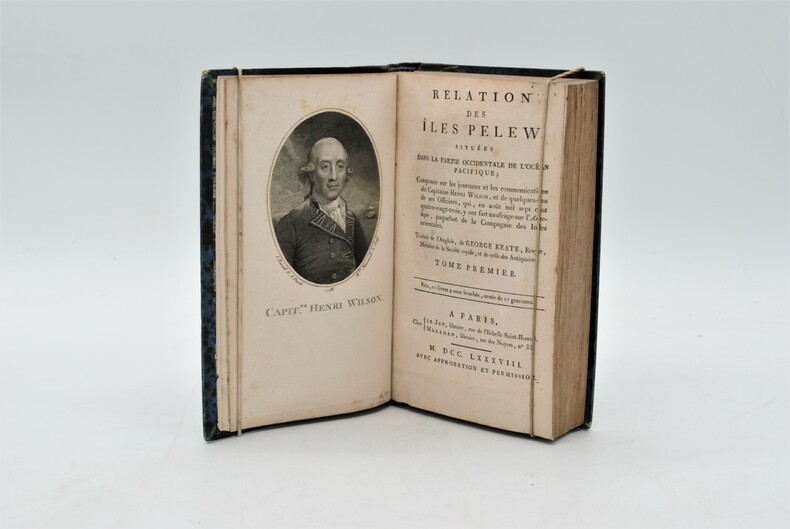
1788PHO-1658Paris, Le Jay & Maradan, 1788, in-4, relié plein veau moucheté époque, dos à nerfs avec pièce de titre, XIV-(1)-384 pp., illustré d’un frontispice ,1 gde carte h.-t. et 14 pl. h.-t., petit travail de ver en marge sur 3 feuillets.
First edition, [4],viii,257,[1]pp., with half-title and engraved frontispiece, cont. half calf, marbled paper boards, hinges slightly cracked, head and foot of spine worn with some light worming to raised bands, marbled paper on lower board peeling, but overall internally a clean and bright copy. Of the first work Hill notes "This account of John Byron's circumnavigation is usually ascribed to midshipman Charles Clerke, who later sailed on all three of Captain Cook's voyages...". Of the second work, Byron was midshipeman aboard the Wager when it was wrecked off the Chilean coast, and he provides a vivid account of the privations endured by the survivors. The author's grandson Lord Byron drew upon the Narrative as a source for his epic poem 'Don Juan'. Hill, 311 & 232.
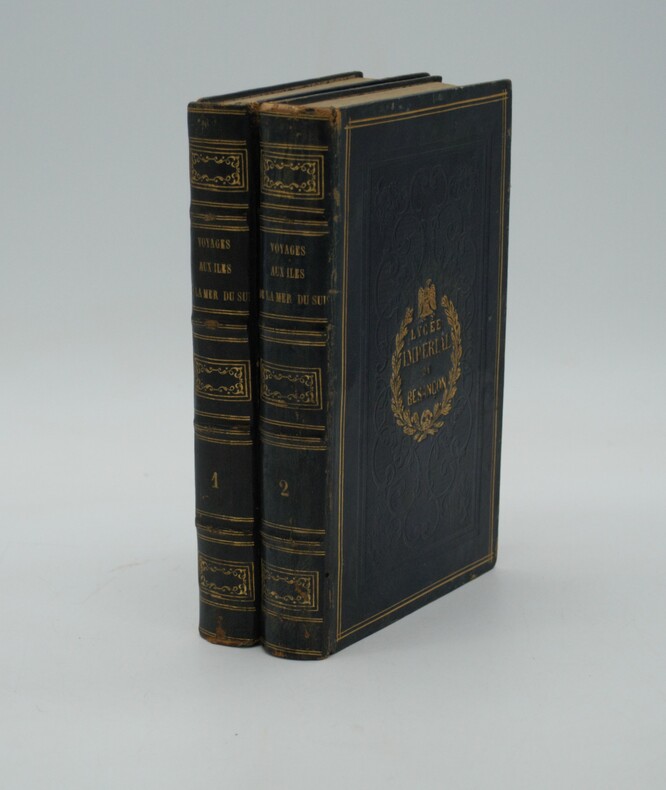
1830PHO-1024Paris, Pillet aîné, 1830. 2 volumes in-8 (210x130), LX-294-1ff , 2ff-361pp-1ff , relié pleine basane bleue, double filet doré, plaque de rinceaux à froid, supralibris doré au centre du premier plat, dos orné avec titre et tomaison , coupes décorées, tranches mouchetées (Reliure de l'époque).L'ouvrage est orné de deux frontispices et d'une carte lithographiés en noir, tous trois dépliants. Exemplaire du Lycée impérial de Besançon, avec supralibris doré apposé sous le Second Empire. Manque la planche de pirogue. Dos légèrement passés, deux coiffes usées, quelques frottements, Hill, n°481 ,Sabin, n°20176 ,Chadenat, n°561.
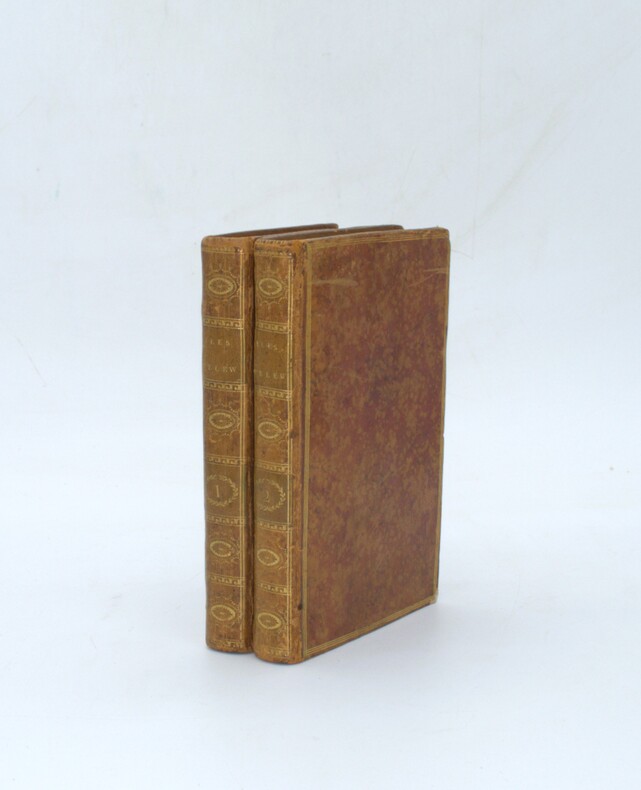
5750Paris, Le Jay et Maradan, 1788. 2 vol. in-8 de [4]-282p. + [4]-274-[6] pages, demi-veau brun, dos lisses ornés de filets dorés, pièces de titre et tomaison beiges, salissure en marge des p. 28/29; excepté de minimes défauts, l'exemplaire est en parfaite condition. Ex-libris H. Tronchin.
1750PHO-538Les deux ouvrages reliés en un vol. in-4(245x200) Demi veau, dos à 5 nerfs orné avec pièce-de-titre , tranches rouges. (Reliure moderne). Ouvrage orné de vignettes et de 32(sur 34) cartes et planches gravés dont des cartes dépliantes. [1 f blanc], XXIV-363 pp / [2 ff n. ch], XVI-185 - xivpp (table des matières), [1 f blanc]. Exemplaire en bel état intérieur carte et texte.
1830PHO-1108Paris, Pillet aîné, 1830. 2 volumes in-8 (210x130), LX-294-1ff , 2ff-361pp-1ff , brochage éditeur , L'ouvrage est orné de deux frontispices dépliants , la planche de pirogue qui manque souvent et la carte de manniloco , petits défauts à la reliure , petites rousseurs mais bel exemplaire avec en fin du tome 2 le catalogue de Pillet avec l’annonce de la parution du voyage de Freyssinet Hill, n°481 ,Sabin, n°20176 ,Chadenat, n°561.
11636François PYRARD de LAVAL contenant sa navigation aux Indes Orientales, aux Moluques, & au Brésil. Première partie. Un volume in 12 plein cuir fauve raciné à nerfs, pièce de titre chagrin rouge, filets et caissons dorés. X (Epistre-table des chapitres- Extrait du privilège du Roy) 738 pages. Sans la page de titre. REMY DALLIN –Samuel THIBOUST 1615(?). Un petit raccommodage à la coiffe supérieure .première page poussiéreuse. Sinon Bon exemplairepour être jugé comme espion à Lisbonne. Les tempêtes détournent sa route sur San Salvador de Bahia, au Brésil, puis le mènent, en Galice d’où il rejoint la Rochelle le 5 février 1611. Premier récit français sur les Indes.
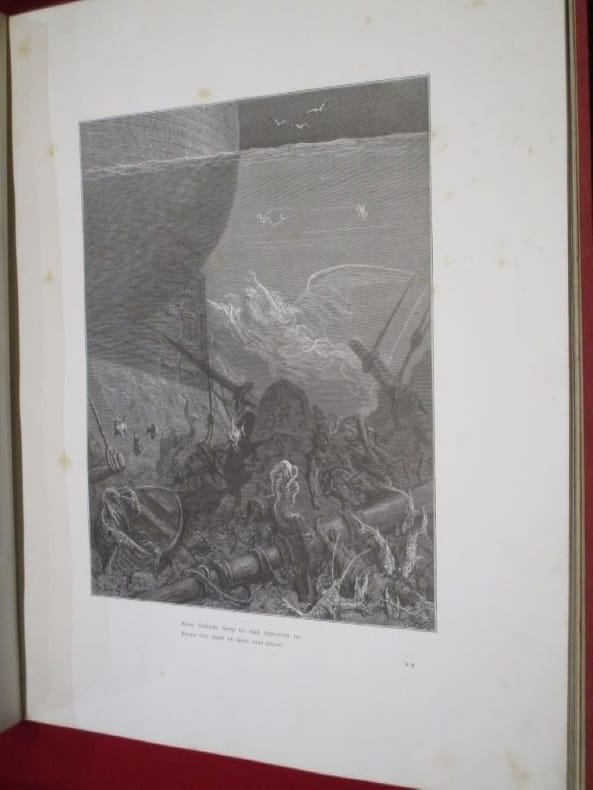
18761152691876 in folio percaline London, Doré Gallery - Hamilton, Adams & C°, 1876, 1 volume grand in-folio, (2) ff. (faux-titre, titre), frontispice, 12 pages, 38 planches. Complet des illustrations de Gustave Doré. Pleine percaline rouge de l'éditeur, titres et mention "offert par le XIXme siècle à ses abonnés" sur le plat supérieur, gardes bleues, feuillets montés sur onglets. Exemplaire solide, état général correct mais percaline usée (taches, coins émoussés, toile du mors inférieur fendue, déchirure sur le dos), présence de rousseurs en grande partie sur les pages de texte et en marge des planches.
Very Good Turkish, Ottoman (1500-1928) Paperback. Cr. 8vo. (20 x 14 cm). In Ottoman script. 439 p. First Edition, thus. This first Turkish translation of Robinson Crusoe made by Sükrü Kaya is produced while the translator was in exile in Malta. With the help of Michael Seidel's argument, for instance, Kaya's translation might be regarded not only as a translation made in the circumstances of exile but also as a translation of what Seidel calls an "exile narrative". This might be the only reason why Kaya decided to translate this novel. It is highly probable that he was feeling depressed and lonely; therefore, he chose to translate the story of a lonely man like himself. Indeed, Kaya declares in the translator's preface to Robinson Crusoe that the activity of translation to an extent made him forget the pain of captivity [= Tercüme mesguliyeti bana esaretin acilarini kismen unutturuyordu]. The first Turkish translation of this novel was made by Ahmed Lutfî and published by Takvimhâne-i Âmire as early as 1864. It was an abridged translation, and an unabridged translation was not made until 1919 when Sükrü Kaya was in exile in Malta. This unabridged translation made by Kaya was published by Tanin Printing House in Istanbul in 1923, and it belonged to -The Collection of Immortal Works- [Ölmez Eserler Külliyati]. Daniel Defoe's Robinson Crusoe (1719) has been attracting the attention of many critics and scholars both in the West and in Turkey for years. Robinson Crusoe was originally written in English, and published on April 25, 1719, and its title was in fact quite long. Robinson Crusoe is among the novels which are argued to be the first English novel. The book has obtained worldwide fame, and there are hundreds of translations and adaptations. Probably due to the success of the first novel, Defoe wrote the second book which is entitled The Further Adventures of Robinson Crusoe. (Sources: THE SHAPING ROLE OF RETRANSLATIONS IN TURKEY: THE CASE OF ROBINSON CRUSOE, Asli Emekçi.; OSMANLICADA ROBENSON, Ayse Banu Karadag). Sükrü Kaya, (1883-1959), was a Turkish civil servant and politician, who served as a government minister, Minister of Interior and Minister of Foreign affairs in several governments. (Wikipedia). First Unabridged Ottoman Turkish Edition. Özege 17028.; TBTK 8228. Only one institutional copy located in OCLC: 949585991 (Bogaziçi University Library).
AQ29403Woolcock General & Commercial Printer Single leaf quarto broadside sheet. Printed within decoratie black borders with a woodcut of a steamship at head. Dated in manuscript 'Septem. 1881' beneath drop-head title An apparently unrecorded broadside ballad consisting of six eight-line stanzas and composed to fit the Air "Sailor's Grave" lamenting the loss of the Royal Mail Steamship Teuton which grounded and sank en route to Algoa Bay from Table Bay both South Africa on August 30th 1881. Flipping on its vertical axis caused complications with the lifeboats resulting in just 27 of the 242 souls on board- which included emigrants to South Africa from Great Britain and local businessmen embarking on local journeys- surviving the tragedy. . Dimensions 190 x 250mm. Woolcock, General & Commercial Printer unknown
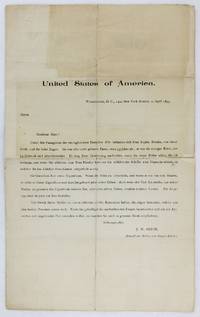
18952672Washington DC: April 2 1895. Good. 4pp. on a single folded sheet with two small photographs tipped in. In German. Quarto. Old folds some separation along central horizontal fold small chip to first leaf minor soiling. One photograph chipped. A sad document detailing the plight of a mother and son who perished in the sinking of the German transatlantic ocean liner Elbe on January 30 1895. The document seeks to detail exactly the times of death of the mother and son in order to determine whether the heirs of the mother or son have title to the property belonging to the family. Translated into English a portion of the opening reads: "She left some property here in Germany. If her son survived her if by a minute he inherited that property and it now belongs to his heirs; but if death overtook him before his mother the property never belonged to him or now to his heirs but to other people. The matter is now before the court."<br /> <br /> The Elbe collided with a Scottish ship called the Crathie in the North Sea on January 30 1895 while on the way from Bremen to New York City; the Elbe was a very popular ship amongst immigrants from Central and Eastern Europe looking to make their way to the United States. The two victims detailed in the present document were a German-American immigrant mother and son who had previously settled in Indianapolis and then moved to Washington D.C. Sophie and Eugene Rhodes. At the time of their deaths Eugene was a student at Heidelberg University in Germany. The present document opens with a typed notice from the counsel to the family detailing their presence on the Elbe and asking for details of their deaths. This is followed by photographs of both Sophie and Eugene tipped to the second page then two pages of questions attempting to locate the missing travelers. Brief answers to the questions were supplied in ink by Ernst Linkmeyer assistant engineer on the Elbe and one of only twenty survivors of the wreck. The survivors of the wreck of the Elbe included just four passengers and sixteen crew members who crowded onto the only rescue boat that survived the collision. The death toll of the wreck of the Elbe totaled 334 including Sophie and Eugene Rhodes. April 2 unknown
1756PHO-2159Lyon, chez les Frères Duplain, 1756. In-4° (25,5x19,5cm), 1f.-xvi-185 pp.- xiv pp. (table des matières), veau marbré époque, dos à nerfs orné de lions et oiseaux avec pièce de titre grenat, lions et oiseaux aux coins des plats, tranches rouges, doubles filets aux coupes, très légères rousseurs, coiffe sup. arasée, mouillure très claire, manque la page de titre Illustré d’une vignette gravée sur cuivre en tête du texte, d’après Delamonce.
1830PHO-1714Paris, Pillet l’Ainé, 1830. 2 volumes in-8 (210x130), LX-294-1ff , 2ff-361pp-1ff , brochage éditeur , L'ouvrage est orné de deux frontispices dépliants, la planche de pirogue qui manque souvent et la carte de Manniloco, défauts à la reliure, couverture tome 1 avec taches et déchirure sans manque, manque au titre tome 2, rousseurs éparses. Hill, n°481, Sabin, n°20176, Chadenat, n°561.
1793PHO-2402Paris, Maradan, 1793. 2 volumes in-8 (20 x 12,5 cm), 2ff.-280pp. & 2ff.-272pp., veau porphyre, dos lisse orné avec titre et tomaison, triples filets aux plats, tranches jaspées. Petits frottements, 2 coins usés, 1 cahier bruni, déchirure au pli de la grande carte.
Generously illustrated with black and white photos and illustrations. Features: The Devil-Stones - A strange story of West African "fetish" and its uncanny powers among the superstition-ridden natives; Too Many Bears - Experiences of a camp cook in Yosemite National Park, where bears are as plentiful as berries, and astonishingly bold - with great photos; Through the Guadalupe Wilderness - Photo-illustrated account by Carl B. Livingston of his exploratory trip into the Guadalupe Mountains of New Mexico, perhaps the most inaccessible and least-known region in the United States; The Last Voyage of the "Joan" - W.E. Sinclair and a partner attempt to cross the Atlantic from England to Newfoundland - until disaster strikes in mid-ocean; To Lhasa in Disguise - Part I - After two years of preparation living in a Himalayan cave, Alexandra David-Neel sets out to become the first white woman to enter Lhasa, the mysterious Forbidden City of Tibet - with photos; The Mare's Nest - an amusing photo-illustrated story from an Australian back-blocks medical practice; Two Girls on the Frontier - Part II - Two city-bred sisters continue their homesteading adventures in South Dakota; Eskimo Magic - E.W. Hawkes, who has spent considerable time among the Eskimos of the Bering Strait, recounts several uncanny instances of "native magic"; His Highness The White Elephant - Photo-illustrated article on this animal which is held in the utmost veneration in Siam; In Quest of Gold - Part III - Final part of the adventure faced by two young Americans seeking buried gold who were forced to turn back by the Savage Yaqui Indians; The Robbery At the Mine - Sundry exciting happenings at a gold mine in West Australia where the author worked; His Last Break - An unsuccessful prison escape attempt in South Africa; The Worm That Turned - A tale from Calcutta where a European official did not recognize one of his staff. 84 pages plus 12 pages of nostalgic ads. Unmarked with moderate wear. A quality copy of this fascinating vintage issue. Book
#[33227]London Thomas Tegg 1809. Sm.8vo. Modern boards. With folding aquatint plate depicting the 'wreck of the Hindostan East -Indiaman on the Wedge Sand near Margate January 11-1809' mounted. 28 pp. Extracted from the collection Mariner's marvelous Magazine or wonders of the ocean containing narratives of the most noted shipwrecks and disasters at sea. - The East Indiaman of the East India Company Hindostan sailed from Gravesend for India January 2 1803 passed the Nore and anchored in the Queen's Channel off the Wedge Sand. There a terrible storm struck her and she drove on the sandbank and broke up. A small boat of Margate rescued 129 out of 143 on the Hindostan; the dead were drowned or frozen. The ship was carrying a good deal of specie much of which was saved from the wreck Huntress p.53. - Rare popular edition. Huntress 153C. hardcover
1788PHO-1087Chez Le Jay et Maradan, A Paris 1788, 2 volumes reliés en un , in 8 , (4) 282pp. et (4) 274pp. (3),, relié demi cuir , dos lisse avec titre illustré d’un portrait de Wilson en frontispice, une grande carte dépliante , 15 planches hors texte, petites rousseurs , léger frottements .