34 268 résultats
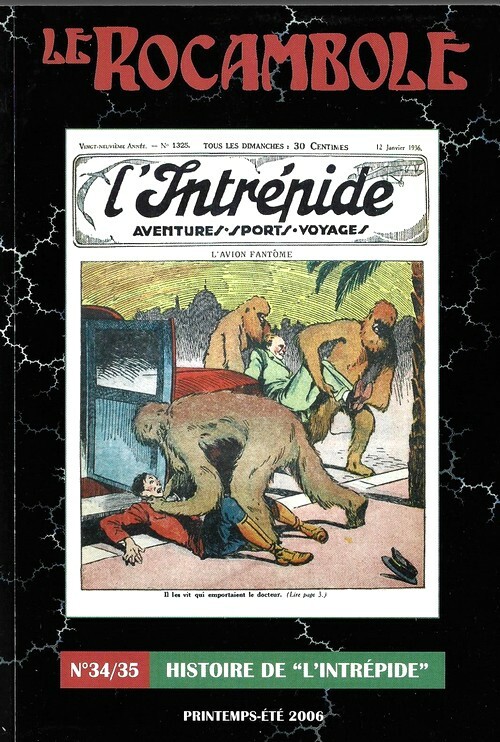
192030933Bulletin des Amis du Roman Populaire / Revue Le Rocambole n° 34/35 de 2006. Fort in-8 broché de 352 pages au format 14 x 20 cm. Couverture illustrée. Illustrations. Bibliographie du Journal l'Intrépide. Livre en état correct avec haut du dos et coin supérieur droit du 4ème plat tassés. Edition originale.
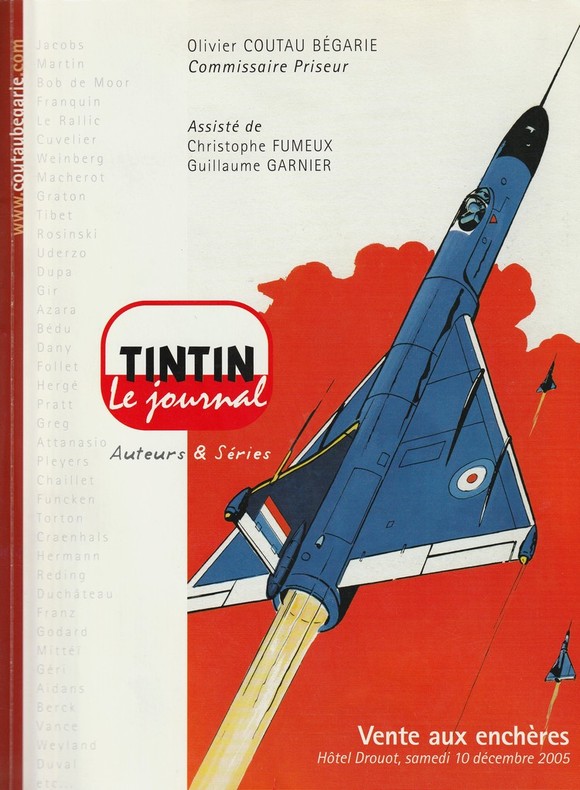
200527472Me Olivier Cautau Bégarie, assisté de Christophe Fumeux et Guillaume Garnier / Hôtel Drouot 2005. Catalogue in-8 broché de 56 pages au format 22 x 29,5 cm. Couverture illustrée par Albert Weinberg. Vente du samedi 10 décembre 2005, consacrée au Journal Tintin et à ses auteurs et séries. Au total 396 lots décrits avec de très nombreuses reproductions ( Livres de Hergé, Edgar Pierre Jacobs, Tibet, Paul Cuvelier, Dany, Jacques Martin, etc. Reproductions de couvertures d'albums, planches, dessins originaux, lithographies, sérigraphies, tirages spéciaux, plaques émaillées, cartes postales, etc. Petits frottis aux coins et aux mors . Dos carré muet. Intérieur frais. Superbe état général. Rare édition originale.
3155Editions de Jusaine à Florennes, 1999. Grand In-8 broché, couverture imprimée, 59 pages, illustrations de Kathleen de Fays. Tirage limité à 190 exemplaires numérotés.
2076chaque numéro d' environ 15 pages. très illustrés in texte. nombreuses publicités. couvertures hebdomadaires en couleurs. illustrateurs ( Benjamin Rabier ; Haye ; Paul d' Espagnat ; Th. Barn ; J. Testevuide ; Luc Leguey ; Valverane ; Mauryce Motet ; Ymer ; Parfait état intérieur. défauts d'usage à la reliure. complet pour l' année 1913.
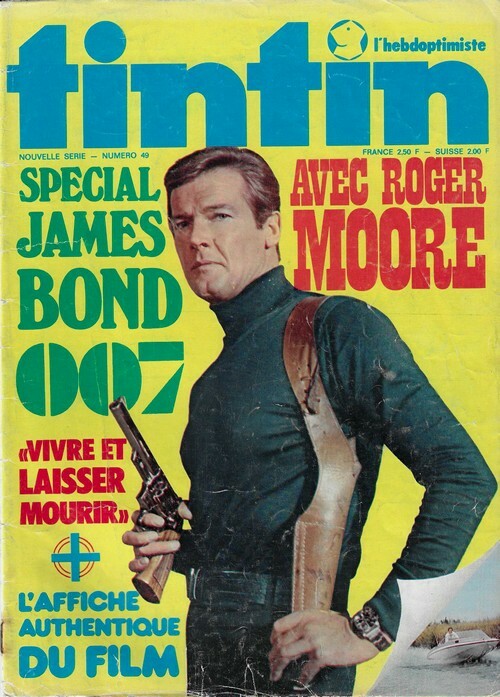
31958Journal Tintin, nouvelle série n° 49 de 1973. In-8 agrafé de 66 pages au format 29 x 21 cm. Couverture avec photographie de Roger Moore dans le rôle de James Bond. Plats avec petits frottis aux coins. Intérieur frais. Contient 5 pages avec photographies consacrées au film de Guy Hamilton, sorti en 1973, dont la page centrale ( détachée ) faisant office de poster, ) avec photographie de Roger Moore. Le film de James Bond 007, " Vivre & laisser mourir " avait dans les rôles principaux : Roger Moore, Yaphet Kotto, Jane Seymour. A noter la chanson du générique " Live and Let Die ", paroles de Linda McCartney sur musique de Paul McCartney, interprétée par Paul McCartney et les Wings. Malheureusment il manque l'affiche du film. On trouve aussi des BD de Dupa, Martial, Gordon Bess, André-Paul Duchâteau et Tibet ( Enigme avec solution de Ric Hochet ), Turk, De Groot, Michel Greg, Will Eisner ( aventure complète du Spirit en couleurs ). Edition originale en assez bel état général.
M12539Couverture rigide Amsterdam , 1784 , in 12 , plein veau , dos lisse , 130pp Reliure en bon état si ce n' est un manque de cuir sur un coin , un léger manque de cuir sur la pièce de titre ainsi qu' une coiffe émoussée. Langue: Français
18632021757Berlin GE: Verlag von A. Haack 1863. First Edition. Hardcover. Good. Folio 368 pages lacks spine with nos. 2-48 not collated with any faults. <br/><br/>Extensively illustrated with articles stories and more for the home. Verlag von A. Haack hardcover
Prefazione del Tradutore - Lo stampatore di Londra, a chi Leger? - Allo Stampatore del Libro intitolato PAMELA, ovvero LA VIRTU' PREMIATA - Al mio degnissimo Amico, lo Stampatore di PAMELA - 1 14,5x9 cm., legatura editoriale muta, incisione in frontespizio, pp. (22), 320, non refilate, prima edizione italiana, dalla prima inglese del 1740, testatine, capilettera e finalini; dorso sciupato, margini prime e ultime pagine un po' fragili, con evidenti segni d'uso e tempo, piccoli strappi margini esterni alle p. 187 e 244, alcuni tagli di misura minore, alcuni leggeri allentamenti interno dorso, 2 fiorellini secchi p. 108 e 161, discreto esemplare. .....Questa Operetta ? scritta con quell'aria di verit?, e con quell'amabile semplicit?, che s'incontrano molto di rado nelle Opere ordinate ad istruire, e dilettare; e per verit? ella tocca il cuore, e persuade la mente..? impossibile leggerla senza interessarvisi dovero, e senza rimanerne commosso. Ella contiene mille buone lezioni; ella insegna una morale pura, ella mette la virt? nel suo pi? bel lume, e ne rende grata la pratica....diverr? soggetto d'imitazione a tutte le Dame giovani della Gran Bretagna...
4696JAPAN. Diary. January 14 1950 to late 1954. Various places Philadelphia Japan Fort Meade. A lengthy diary of an American officer Lieutenant Louis T. Holtz who was stationed in Japan during the Korean War. It was written on dozens of sheets of loose-leaf notebook pages and it contains many black and white photographs with captions as well as newspaper and magazine cutouts and brochures from places he visited. The diary begins on January 14 1950 in Philadelphia and he discuses seeing shows and such but notes that All in all this constituted a very enjoyable ten days of leave prior to going overseas. Sometimes I wish I could stay at home and live a normal routine life like everyone else. Other times I find myself eager to goAlmost two years ago who could forecast a war in Korea and the manner in which it would rip everyones life to shreds He writes on January 2 1951 from Kurume Japan: perhaps 10 years from now it the diary will be of interest if any of our civilization remains in 1961I collapsed 28 June and spent 3 weeks in the hospital with excessive fatigueI am the Officer-in-charge of the Kurume Office with an area of jurisdiction of approximately 1000 square miles. In April 1951 he mentions I am very busy in my position as OIC Officer In Charge. Its a full 7-day-a-week jobThe Korean mess has everyone guessing as to eh future of the Far Eastbeing the senior official in an area of jurisdiction of nearly 10000 square miles with dozens of mayors and police chiefs constantly catching my every word as official. The next couple dozen pages contain black and white photographs of protests in Japan and Holtzs commentary about the images including When people get hurt propaganda fills the air. The winner: the Kremlin always! Demonstrations take planning and people. You can always be sure the plans were framed in red and the spectators sprinkled liberally with dye-hard communist stooges Demonstrations & rallies are usually fantastically well organized. And as often as not they can be unbelievably orderly and But orderly or violent you can always be sure there is a professional communist keeping the sheep in line or arousing them to maximum fury. In September 1951 Holtz writes from Sapporro life in the Armed Services has been a miserable one because of one bad experience after anotherKurume was one of the most pleasant and enjoyable assignments I ever held. The 45th was without doubt the most bitter and least enjoyable. I gave up so much for so little. Holtz was in Californias Camp Stoneman in November 1951: with all the hundreds of officers here not particularly anxious to go overseas and with several actually fighting the assignment I was amazed to find that someone eager to return is sidetracked so abruptly. He was back in Japan by December and then wrote a lengthy entry entitled The Korean Story starting with Combat precautions make it mandatory that no diaries or personal papers be kept where they may fall into enemy hands and he spends the next seven pages describing his experiences in the Korean War. Holtz wrote in part: Things had not gone well at all with Trubotas unit prior to August 1951. After my arrival working results proved very satisfactoryThree other officers has also joined up in the interim between leaving Sapporo and going to KoreaWhen oriented in Tokyo they were told that the 45th Detachment would remain in Sapporo and they had already alerted their families to start to prepare to join them overseasI had to fight Trubota in order to be able to fight the enemy. In one occasion I was reprimanded for going to a forward observation post and not being personally available to answer the telephone at my CP and the section finishes with a photograph of the USS Marine Lynx the ship that brought him home. The diary continues with his being stationed at Marylands Fort Meade. There are photographs of the mansion he occupied in Kyushu Japanese women at the beach his fellow soldiers after a bowling tournament etc. There are Samples of United Nations propaganda leaflets dropped on North Korean positions early in the Korean conflict that show Truman and MacArthur a December 7 1950 letter signed by the mayor of Kurume City Japan. The condition is fine to very fine. unknown
73937Sitka Alaska Territory: Alaskan Publishing Company 600. First edition. Newspaper dated January 30 1886. Folio. 4 pp. Typical folds with some areas of separation that have been repaired with Scotch tape including central horizontal fold of front page. Remarkably nice condition. No copies at auction according to RBH.Very early Alaska Territorial newspaper with news regarding the territory and advertisements for local businesses printed just 19 years after the Territory was purchased from Russia. The Alaskan a Sitka newspaper published from 1885-1907 was an important voice for Alaska. The newspaper was managed by a Miss Cassia Patton. She was a fierce proponent of sending Native American children to "white schools." Patton first came to Sitka in 1889. She taught school then owned the Alaskan newspaper . She was supported in all this by her brother-in-law Governor Brady. Alaskan Publishing Company unknown
181931400Sydney: Wireless Press 1918-19. Very Good. lge. octavo. cloth binding 770pp. b/w pls. col. ills. diags. maps index Australasian Monthly Journal for the Navy & Mercantile Marine Aviation Radio-telegraphy & Telephony. Vol. 1 No. 1 to Vol. 1 No. 12. Copiously illustrated inc. photos of decorated Australian Sailors & Flyers. Also many fine photos of Australian Ships & AFC aircraft. Very Scarce Wireless Press hardcover
In unico tomo rilegati più numeri del periodico illustrato in b.n. n.t., in lingua francese. I numeri presenti sono : 1) Le diner, 2) Les icebergs, 3) Les bédouins, 4) Le sapin, 5) Nijni-Novgorod, 6) Les cynocéphales, 7) La promenade du boeuf gras, 8) L'orgue de barbarie, 9) La mosquèe de cordoue, 10) Druides et druidesses, 11) Le bouleau, 12) Constantinople, 13) Les fourmilier, 14) La table, 15) La conciergerie, 16) Les finlandais, 17) La tulipe, 18) Fribourg, 19) Le rossignol, 20) L'orfèvrerie, 21) Le panthèon, 22) Les nubiens, 23) Le framboisier, 24) Alger, 25) Le chardonneret, 27) Le capitole, 28) Les aissaouas, 29) Le pecher, 30) Berne, 31) Le peche aux bains de mer, 32) Le simoun, 33) Le vatican, 34) La perle, 35) Le hindous.
Riso/Annex. I quaderni di Riso è una rivista periodica del Museo d'Arte Contemporanea della Sicilia. Documenta le attività istituzionali del museo, che nel 2008 sono raccolte nel Progetto 5venti, incentrato sulla promozione e la valorizzazione attraverso azioni sperimentali del sistema d'arte contemporanea della Sicilia. Primo numero è dedicato a Gibellina. Volume riccamente ill. con imm. in b.n. e a col. n.t. e f.t (49c).
In unico tomo rilegate diverse serie nel seguente ordine: prima, terza, quarta, quinta, sesta, settima, ottava, seconda, ciascuna di circa 24 pag. contenenti inni e canti con spartiti musicali. Di grande interesse per documentare gli usi nel ventennio in ambito musicale e valido repertorio di inni e canti giovanili.
Collezione completa in edizione originale. CON DEDICA Trascurabili minimi difetti al piatto posteriore del primo fascicolo; secondo fascicolo con firma e data autografe, sempre al posteriore: «Benedetta Marinetti -– 24». Eccezionale insieme. I due volumetti uscirono come allegati alla rivista settimanale di Umberto Notari «Gli Avvenimenti», rispettivamente con il numero 114 (28 nov. - 5 dic. 1915) e con il numero II,15 (2-9 aprile 1916): stampati su carta povera, contengono i primi exploit teatrali dei futuristi, preceduti dal «Manifesto del teatro futurista sintetico» stampato al primo fascicolo. Gli stessi contenuti si ritrovano nei due volumetti dedicati al «Teatro futurista sintetico» della collana «Biblioteca teatrale» dell’Istituto Editoriale Italiano. Claudia Salaris parla di «ristampe in edizione economica», mentre in realtà non sembra poter essere chiarito chi precede cosa, nella confusione tipica delle edizioni Notari: di certo è più probabile una quasi contemporaneità, tra fascicoli/allegati e volumetti, se non addirittura una precedenza della presente edizione allegata al settimanale. -- Il vero pregio dei due fascicoli, tuttavia, risiede nelle meravigliose copertine d’artista, affidate ai due pesi massimi della pittura futurista: Carlo Carrà e Umberto Boccioni, che concedono i clichés di due opere assolutamente coeve; molto felice, quindi, la scelta di stampare a due colori, nei toni dell’azzurro-violetto per Carrà e azzurro-grigio per Boccioni. -- Al primo volume le sintesi teatrali di Marinetti, Settimelli, Bruno Corra, Remo Chiti, Arnaldo Corradini, Balilla Pratella, Paolo Buzzi, Francesco Cangiullo, Boccioni, Corrado Govoni, Luciano Folgore, Decio Cinti, sono precedute dal «Manifesto del teatro futurista sintetico». Più ampio il “parterre” di autori nel secondo volume, dove sono pubblicati Marinetti, Settimelli, Bruno Corra, Remo Chiti, Balilla Pratella, Paolo Buzzi, Francesco Cangiullo, Boccioni, Luciano Folgore, Mario Carli, Giacomo Balla, Guglielmo Jannelli, Mario De Leone, Ulric Quinterio, Armando Cavalli, Oscar Mara, Depero, Auro D'Alba, Trilluci, Cantarelli, Rebecchi, Diobelli, Nannetti. Salaris, Riviste futuriste, pp. 662-7 2 voll.
19291826<p>BOOKSELLER JOURNAL Newsboy & Newsgirl. A Monthly Paper for all the Boys & Girls of W H Smith & Son. London 1929-1955. </p><p>Uncommon publication created for the children and teenagers employed by the UK news vendors W H Smith best known for their chain of railway station airport port hospital and motorway service station shops selling books stationery magazines newspapers entertainment products and confectionery. Articles include internal news of the company features by various staff and extracts from similar news agencies issued in the USA Australia and Europe also Boys Scout news with special coverage of the blitz during World War II comprising:</p><p>Volumes 3 issues 1 - 36 January 1928 thru December 1930; afterwards renamed JUNIOR STAFF JOURNAL Volumes 5 issues 1 - 36 January 1934 thru December 1936; volume 6 issues 1 - 12 January - December 1937; volume 7 8 each 12 issues January 1938 thru December 1939 volume 9 ten issues January thru October 1940; volume 10 two issues November December 1940; Volumes 11 thru 13 each twelve issues January 1941 thru December 1943; volumes 14 thru 16 each twelve issues January 1944 thru December 1946. </p><p>Also Including TALKING SHOP <em>A Business Magazine for the Staff of W H Smith & Sons Ltd</em> January 1948 thru December 1955. Altogether 288 issues bound into eleven cloth bindings not matching. </p> W H Smith & Son, hardcover
12 pages. "Not to be Published - the information given in this publication is not to be communicated, either directly, to the Press or to any person not holding an official position in His Majesty's Forces." - from front cover. Reprinted in Canada September, 1943. Contents: Sicily Battle Diary - article with map; Hoping This Finds You - The Soldier and his Mail; Index to issue Nos. 27-52 of this publication. Unmarked with light wear. A quality copy. Book
187472902Bakersfield: Joe K. Acklin July 9 1874. First edition. Bifolio 4 pp.; 21 1/2 x 14 1/2 inches. A very good copy.Information and ads for early Kern County. Joe K. Acklin unknown
5300CARIBBEAN TRAVEL JOURNAL. Diary. 101 pages. The Caribbean. c. 1908-9. The handwritten journal belonging to C. B. Benson of Hudson New York. The diary recounts Bensons experience on an organized cruise group visit to Caribbean locations such as St. Thomas Puerto Rico Kingston Jamaica Caracas Venezuela Panama City Panama Port of Spain Trinidad and Martinique. Benson records his experiences in each location including his impressions of the town the locals sights he visited and local travel. He visited forts a school churches a mill a sugar plantation and Carnival celebrations. Benson took his tour during the era of colonial rule the attitudes of which infuse both his experiences and observations. Based on his mention of an earthquake in Kingston Jamaica taking place a year or two before he travelled in 1908 or 1909. St. Thomas where we arrived about 6 A.M. mid morning Jan 26 is one of the Virgin group and we found her framed and frescoed in the principal churches. Columbus in 1493 gave the group of 100 islands rocks andwhich comprise the group. St. Thomas is 13 miles in length and 3 miles in width at its broadest. And I guess we walked the length of it speaking broadly and in the abstract at this distance.The heat of the tropical sun also takes its toll and blurs our ideas of time and distance somewhat. The town of Charlotte Amelia contains 13000 inhabitants merchants and black babies and they are all dressed in their Sunday best to receive us properly.Thursday morning at 8 we went ashore at Porto sic Rico.Returning thro the village streets we stopped at the market place and noticed the display of fruits in baskets a couple of men seated on low stools with blacks in front of them.a native womanwas entertaining us in the middle of the road with a dance.When passing the island of Haiti.Do you know why we do not stop at the Island of Haiti No There are cannibals there there are so many fat people aboard you would lose your wife At St Thomas the American council held open house and received some of us who dared to invade this solitude.An hours railroad ride which was made interesting by stops at every littleand station where the bare legged boy with the oil gun in hand squirted oilbearings sic of the cars and engine. As it was before the 17 miles came to an end the rear axle of the parlor car so called because it had leather covered reclining seats caught fire. But when this happened we were nearly at the end of our journey and we were not delayed much. At the sugar plantation where we detrained we found we had some distance to walk downto the sugar mill. As there was no path and the sticky wet ground to soil made worse by the heavy rain of the night before.A sugar mill is never a clean place.The process is somewhat intricate but way he likened to the process of brewing.The cane piled up in the yard is boiled in a number of vats then is run off with barrels and in a black and solid state in shipped to the Refineries at New York. The fiber of the cane is then hardened and dried and is fed to the furnaces to boilcane. After return to the town San Juan we visited the shops. Walked out to the fort at the entrance of the harbor. The town is excellently policed and paved in the principal streets with telegram blocks.As this day was Thursday we concluded that every day was wash day for the native women and girls who for want of other diversions spend most of their time in this form of dissipation. Even the balconies of the main public street filled with traffic of street cars carriages and drays had their fill of wash some of which are found laying in the street having been carried down by the wind. No one had appropriated it as yet; and we did not add it to our collection of souvenirs. At the officers quarters I applied for a permit of the officer of the day to enter the fort San Cristobal the fort commanding the entrance to the harbor.The fort was like most forts. The high tower gave a commanding view of the town and harbor. Then we visited the Governors Palace. In the Reception Room hanging on opposite sides facing each other are life sized oil paintings of McKinley & Cleveland. In the garden were some large palms tropical ferns a fountain &.Jan 29. early in the morning we were at Kingston in Jamaica. The channel is narrow and tortuous but well Taking a local pilot we soonopposite itof three vessels one of which was the Princess Louise that was caught in the hurricane here three years ago andthe larger of the three vessels was trying to pick up the light from the light house which had been blown down. This destruction of the hurricane.After driving about a mile thru the city the destruction to the buildings & pavements made by the earthquake here a year or two ago half of the city seems to be in ruins and no attempt has been made apparently to rebuild & restore the city. Thousands of lives were lost here at that time which did immense damage to the fruits. Most of the uninhabitable part of the island belongs to the United Fruit Company a Boston Corporation who ships immense quantities of bananas from Port Antonio. Owing to recent destruction by fire of Hotel Litchfield our stop at the port of San Antonio and stay of night at the Hotel was omitted. An excursion across the island by train to Mandeville was arranged in its place.The town of Colon in its principle streets are paved with brick and appear clean. We noticed many buzzards. The air was clear and there was a delightful cool breeze blowing.We stopped at all of the stations going to Panama and noted the wonderful impressions made by the Sanitary Commission. The well ventilated and screened houses. The plan for disposal of garbage the open drainage the cleared landsBut of course the facts are here bug and drain all working to the mutual exclusion of some ideas to the American white employers. Therefore after a few months they must have a reaction in the States toand detach themselves from all absorbing facts. The fighting for life againstfires. Most things arebetween the white employers and the black employees. So we find the White Bar and the Black Bar The White Employees The Silver White Employees &c as signs on the cars intended to carry workmen back and forth from the works.Caracas the capital of Venezuela is about 3000 ft up but the sun in the middle of the day we found very hot.Plaza Bolivar was decorated with rows of colored electric lights. They are preparing for the Carnival season which ushers in Lent in Catholic countries. The market place had counters for dry goods highly colored handkerchiefs etc. Another section was devoted to fruits vegetables etc. We noticed some very large apricots. Mr. Bolivar apparently has done a great deal for his native town. He has given his name while the people furnished the funds for the largest parks a street and the coinage of the plutocrats.The Spaniard theHildago -in his easy subjugation of thepleasure loving tropical savage has replaced the native of simple taste and left in his place the mongrel half-breed with all the vices of the conqueror and none of the virtues of theIndian savage. The diary is in very good condition. It is mostly written in pencil but is quite legible. hardcover
66451aafParis, Bourgogne & Martinet, 1833- 1902, in-4to, richement illustré de gravures sur bois, qqs rousseurs par ci par là, demi-toile / demi-cuir / demi- parchemin (reliures de bibl.) Le tout en bon état
97801aafParis, Bureaux d’Abonnement et de Vente, 1853 -1857, in-4to, 2 ff. + 412 p., ill. / 2 ff. + 412 p., ill. / 2 ff. + 412 p., ill. / 2 ff. + 412 p., ill. / 2 ff. + 412 p., ill., reliures en demi-toiles, couv. orig montée sur le plat devant. Bon état.
6252EDWARD ALLEN GOODWIN unknown-1862. Goodwin was the Sergeant in Company K of the 23rd Regular Massachusetts Volunteers. This is the diary of Edward A. Goodwin Co. K 23rd Regt. M. of. M. This diary is THE AMERICAN UNION DIARY FOR 1862 an annual published diary accessible and likely provided to Union soldiers during the Civil War. After a few pages that include a calendar and interest tables the diary provides space for each day of the year 1862. Goodwin wrote entries every day from January 1st to April 7th and none thereafter. At the time Goodwin was serving in the 23rd Massachusetts Infantry Regiment which was a part of the Coast Division under General Ambrose Burnside. Entries are handwritten in either pencil or black ink. Notable entries include: aFriday 7: Naval engagementplace lasting from noon till sunset. Troops were landedin the afternoon and evening. Bivouacked on Roanoke Island in the rain. b Saturday 8: Captured a rebel battery in a swamp. Took 3000 rebel provisions and the whole island wasSergt. Howard hurt his foot. W.S. Clark missing. Both entries describe the Battle of Roanoke Island fought February 7th and 8th 1862. Part of General Ambrose Burnsides expedition to capture key ports in the Outer Banks the battle first saw Union gunboats first firing on Confederate forts under the command of Henry Wise until Burnsides soldiers could land ashore unopposed. and the forts on shore engaged in a gun battle with occasional contributions from the Mosquito Fleet. The next day the Union soldiers successfully flanked the Confederate artillery and infantry defenders on both sides forcing a retreat into the Confederate forts. The forts were then individually taken with the Union suffering only 264 casualties and capturing 2500 Confederate defenders. c Friday 14: Fought the battle of New Bern. Took over 100 pieces of artillery ammunitioncamp equipment &c. I arrived at night in the tents of the enemy. This entry describes the Battle of New Bern fought on March 14th 1862. After first advancing up the Trent River General Burnside had his soldiers exploit the weakened center of the line of the defending Confederates under Lawrence O'B. Branch. This allowed the Union Navy to shell Fort Thompson forcing its abandonment and shortly thereafter the city of New Bern too. 90 Union soldiers were killed and 64 Confederates were killed and 413 were captured. d Monday 31: Sick all day. Took horses.e Monday 7: Saw Amoat the hospital. DeceasedRain in the afternoon. These two entries foreshadow Goodwins ultimate fate including his last entry on April 7th 1862. Goodwin would pass away in New Bern on April 16th. Having survived two major battles unscathed at least according to his diary Goodwin most likely succumbed to disease. It is estimated that 2/3 of Civil War soldiers who died during the war died of disease not in battle. His body was ultimately returned to Massachusetts and is buried in Mansfield. The pages of the journal are in good condition but the exterior of black leather is frayed and partially torn. It should be handled very delicately but its value as a lens into the mindset of a Civil War soldier is immense. hardcover
187476538Virginia City: The Chronicle Printing Company 1874-5. Two issues. No. 49 is dated December 4 1874. No. 113 is dated February 20 1875. Folio 15 1/2 x 22 inches. 4 pp. each. Some minor edge chipping and #49 with a couple of short tears to center fold. Overall in very nice condition.These were issued at the very peak of heyday of the Comstock Lode. The Big Bonanza of 1873 made it a very important place and added ffour more Robber Barons to the ranks. At the end of 1874 and the start of 1875 Virginia City Nevada was experiencing both the height of its mining boom and a growing realization that its golden days were starting to fade. At its height Virginia City was a thriving metropolis of 25000 residents. The Republican Daily Territorial Enterprise where Mark Twain started his career and the Democratic Virginia Evening Chronicle were integral to the city. In October of 1875 a serious fire burned most of the town to ashes and although residents rebuilt the really lucrative perios of mining there ended in about 1880. By 1890 there were only about 8500 people still living there and by 1900 that figure shrank to about 2500. The Chronicle Printing Company unknown
pp. ix, 259, (8) [Appendix], 12 [Publisher's catalogue]. Illustrated half title, Frontis and six worn plates by Abraham John Mason. Early manuscript ownership of New Jersey businessman and industrialist, Edwin J.C. Atterbury on title page. Early penciled name of Seba Smith on the frontis. Seba Smith (1792-1868) was an American humorist, jounalist, and writer. He was one of the first writers to use American vernacular in humor. His series with the New England character Major Jack Downing was popular after its start in 1830. Smith's dry satirical humor influenced other humorists, including Artemus Ward and Finley Peter Dunne (Mr. Dooley). Foxed. Some plates and pages loose. 165 mm. Original green very worn muslin cloth binding. Lacks spine. Front board detached. Worn printed paper label of the D. McKercher's Circulating Library pasted on front board. Binding needs to be resewn. S&S/AI 24106. Sabin 84170. Wright I, 834. Hamilton 1012. Second edition. Hardbound. Poor. VERY SCARCE. AI BX 7
86229hardcover. Vol. VI No. 1-Vol. VII No. 25. April 5 1905-December 15 1907. 4to modern buckram; ex-lib. Habana 1905-1907.<br/> <br/> unknown