4 788 résultats
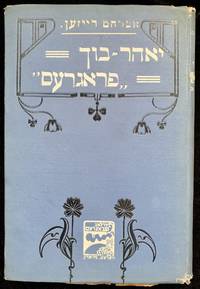
190443110Varsha Warsaw: Ferlag "Progress 1904. First edition. Original illustrated printed boards 8vo 162 32 pages plus 7 unnumbered leaves of plates with illustrations. 22 cm. In Yiddish. Title translates as “Yearbook ‘Progress’: A Journal for Literature Science and Criticism.â€<br> “Abraham Reisen was a Yiddish poet short-story writer playwright and editor…While he was still a teenager his talent was recognized by Shalom Aleichem and I.L. Peretz who arranged for the publication of his earliest poems. After some years in Minsk Warsaw Krakow and Berlin he settled permanently in New York in 1914. Influenced by Heinrich Heine whom he translated into Yiddish he was one of the first Yiddish poets to make use of folksong material. His poetry though mostly written in conventional quatrains is suffused by a refined sensibility that adumbrates the writing of Di Yunge.†Jewish Virtual Library<br> â€In 1900 Yakov Lidski founded "Progress" publishing house. Its name clearly communicated its goal. This publishing company considered to be the first to deal with modern Yiddish literature published a series of original and translated popular science books along with translated European literature and original Yiddish literature. The first editor of the publishing house was poet Avrom Reyzen.†Wikipedia. <br> SUBJECTS: Yiddish literature. Jews -- Poland -- Periodicals. OCLC: 21651882<br> Wear to spine some page separation toning and markings. About Good Condition. YID-46-28-GGLEX-’cc. Varsha [Warsaw]: Ferlag "Progress unknown
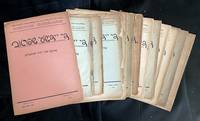
193042139Kiev: Katedr far Yidisher Kultur ba der Ukr. Visnshaftl. Akademye Filologishe Sektsye 1930. Paper Wrappers. 1st edition. Original printed publisher’s color paper wrappers 4to large ca 72-116 columns ca 36-58 pages per issue. 28 cm. In Yiddish. Title translates roughly as “The Yiddish Language.†Succeeded in 1931 by “Afn shprakhfront.â€Di Yidishe Shprakh was a “Yiddish linguistic journal published in Kiev from 1927 to 1930. A bimonthly journal Di yidishe shprakh The Yiddish Language was published by the cooperative publishing house Kultur-lige and was the main philological publication of the Kiev Yiddish academic center. Its editor was the veteran Yiddishist Nokhem Shtif a founder of YIVO who had returned to Kiev from Germany in 1926. The journal’s inaugural issue March–April 1927 was published under the auspices of the Central Yiddish Bureau of the Ukrainian Commissariat for Education. With the next issue Di yidishe shprakh was an organ of the Chair and from July to October 1929 it was an organ of the Institute for Jewish later Proletarian Jewish Culture at the Ukrainian Academy of Sciences. Initially defined as a 'journal for practical Yiddish linguistics' from May to June 1927 it appeared as simply a 'journal for Yiddish linguistics. 'Shtif distinguished three language registers: the vernacular of the old generation partly represented in the works of Sholem Aleichem and predecessors; the highbrow language of modern writers such as Dovid Bergelson; and the contemporary 'culture language' most notably of the press. Although Shtif sought to target speakers of the mass 'culture language' the journal’s circulation hovered around 500 copies read mainly by Yiddish teachers.Apart from Shtif who published articles on various language-planning problems the most active contributors to Di yidishe shprakh were Ber Slutski Ayzik Zaretski Elye Falkovitsh Lipe Reznik and Shimen Dobin. In early 1929 Moscow literary critic Aron Gurshteyn criticized the journal for its purist approach to language planning. In the July–October 1929 issue Shtif published his article 'Di sotsyale diferentsiatsye in yidish' The Social Differentiation in Yiddish heralding an intensification of Soviet linguists’ anti-Hebraist campaign. That issue of Di yidishe shprakh adopted completely reformed Soviet spelling omitting for example final consonant letters.Although the last—twenty-fifth—issue of the journal was dated November–December 1930 it included materials from the First All-Union Yiddish Language Conference convened in Kiev from 8 to 13 February 1931 that issue is present here. Published under the imprint of the Central Publishing House this issue also signaled the demise of the remaining vestiges of the Kiev Kultur-lige. Yoysef Liberberg’s article 'Far parteyishkayt in der yidisher visnshaft-arbet' For a Party Approach to Yiddish Linguistics marked a full break with YIVO scholars particularly with YIVO director Max Weinreich whom Liberberg ridiculed for presenting Yiddish as an emanation of the Ashkenazic Jews’ soul. The Yiddish Language Conference decided to change the name of the journal. Between 1931 and 1939 it appeared sporadically under the title Afn shprakhfront On the Language Front reflecting its new more aggressive and politically charged approach' Gennady Estraikh in YIVO Encyclopedia of Jews in Eastern Europe 2010. For more see David Shneer “Yiddish and the Creation of Soviet Jewish Culture 1918–1930†Cambridge and New York 2004. SUBJECTS: Yiddish language -- Periodicals. Title also listed on covers in Russian “Ievreis'ka Mova†and German “Jiddische Sprachâ€. OCLC: 22840298. Most holdings in OCLC appear to be fragmentary. Covers are browning and fragile as expected but are otherwise very well preserved with very little edgewear. Internal text pages are also toning but remain relatively strong as pulp paper. Very important journal scarce in this degree of completeness Note that Estraikh suggests a circulation of only 500!. B YID-43-5-E. Kiev: Katedr far Yidisher Kultur ba der Ukr. Visnshaftl. Akademye, Filologishe Sektsye unknown
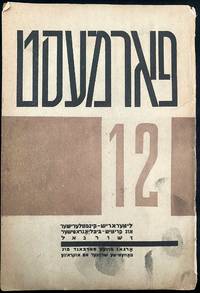
193543308Kharkov: Ukrmelukhenatsmindfarlag 1935. First edition. Original illustrated paper wrappers 8vo 156 pages.Includes illustrations. 21-23 cm. In Yiddish. Title translates roughly as “Challenge: A Literary Artistic and Critical Bibliographical Journal.â€<br> At the time the only Yiddish literary periodical in Ukraine.<br> Farmest 1933–1937 was a monthly Yiddish literary magazine published in Kharkhiv Ukraine by the Ukrainian Committee for Soviet Writers.<br> “Edited by the poet Itsik Fefer 1900–1952 it was continued in Sovetishe literatur: Literarish-kinstlerisher un kritish-bibliografisher zhurnal Soviet Literature: Literary-Artistic and Critical-Bibliographical Journal; 1938–1941.<br> In 1927 Fefer was a founding member of the Jewish Section of the All-Ukrainian Union of Proletarian Writers and from 1928 one of the editors of its Kharkov-based journal Prolit Proletarian Literature. He also coedited the nonproletarian Kharkov journal Di royte velt The Red World from 1929. From 1933 to 1937 he edited the Kiev periodical Farmest Challenge; known as Sovetishe literatur Soviet Literature between 1938 and 1941 which replaced Prolit and Di royte velt and was thereafter the only Yiddish literary periodical in Ukraine.†YIVO. Avrom Gontar was also involved in the collective and editorial committee. <br> The editor Itsik Fefer 1900–1952 “began writing poems in 1918 and in 1922 joined Vidervuks New Growth in Kiev a group of young Yiddish literati whose mentor was Dovid Hofshteyn. That same year the appearance of Fefer’s small collection Shpener Splinters established him as a rising literary star. His poetry amalgamated the Kultur-lige poets’ revolutionary romanticism with the propagandist objectives of the workers’ movement.<br> Fefer was known for his literary credo of proste reyd simple speech a concept he formulated in 1922. In the early 1920s poetry particularly avant-garde poetry swamped the literary pages of Soviet Yiddish periodicals. This phenomenon worried editors and critics who were wary of the fact that Yiddish readers usually could not identify with this style of literature. All Yiddish readers by contrast could understand Fefer’s proste reyd.<br> In 1927 Fefer was a founding member of the Jewish Section of the All-Ukrainian Union of Proletarian Writers and from 1928 one of the editors of its Kharkov-based journal Prolit Proletarian Literature. He also coedited the nonproletarian Kharkov journal Di royte velt The Red World from 1929†Gennady Estraikh.<br> For more see: Gennady Estraikh “The Kharkiv Yiddish Literary World 1920s–Mid-1930s†East European Jewish Affairs 32.2 2002: 70–88; Chone Shmeruk “Yiddish Literature in the U.S.S.R.†in The Jews in Soviet Russia since 1917 ed. Lionel Kochan pp. 242–280 London and New York 1970.<br> SUBJECTS: Yiddish literature -- Ukraine -- Periodicals. Yiddish literature. OCLC: 35051038.<br> Pages toning as expected some sunning and stains to cover Good Condition. BYID-46-2A-LGG-’excc. Kharkov: Ukrmelukhenatsmindfarlag unknown
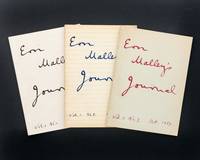
1952118558Heidelberg: The Editors 1952. First Edition. Paperback. Heidelberg The Editors 1952 and 1953. Octavo three issues 48 53 and 48 pages with 2 full-page illustrations by Jean Langley in the first number and 2 pages of facsimile manuscript poetry by Joy Hester plus a plate in each number in the third one it reproduces 12 Charles Blackman paintings from his exhibition at the Bray Gallery in Melbourne in May of the previous year. A subscription form is loosely inserted in the third number. Wrappers with the titles in facsimile holograph on the front cover; the second number shows mild signs of use; overall an excellent run. 'Six years ago Ern Malley lived and died in Australia. Child of the unintended creative act of two other Australian poets he became overnight the most significant figure in the current literary scene. Alike as poet and as a symbol of creative living . Who can doubt that he did in fact live. And now we hope his spirit will live on in the pages of this Journal' introduction to the first number. The lengthy editorial in the third number indicates their hope is a little forlorn 'we cannot congratulate either our contributors our readers or ourselves' and it concludes with a half-page explanation - clearly called for - of 'Who was Ern Malley'. It was another thirteen months before Volume 1 Number 4 appeared; Volume 2 Numbers 1 and 2 followed at six-monthly intervals before the journal ceased publication for want of subscribers. 3 items. The Editors paperback
199421401AB1994. Sigmaringen Thorbecke Verlag 1994. Gr.-8°. 694 Seiten. Hardcover / Originaler Ganzleinenband mit illustriertem Original-Umschlag in Brodart. Bis auf ein Eselsohr ist der Band in tadellosem neuwertigem Zustand. Kein Besitzervermerk! Keine Anstreichungen! Kein Mängelexemplar! Umschlag mit minimalen Gebrauchsspuren ansonsten ebenfalls in sehr gutem Zustand. Der Teutsche Merkur wurde von 1773 bis 1789 von Christoph Martin Wieland als Literaturzeitschrift und Rezensionsorgan in Weimar herausgegeben. Vorbild war nicht nur für den Titel der Mercure de France aber mit Einschränkungen. Wieland schreibt: "Uebrigens soll und kan der deutsche Merkur weder was die Ausführung noch was die Anzahl und Beschaffenheit der Artikel betrift völlig nach dem Französischen gemodelt werden. Selbst die wesentliche Verschiedenheit der Nationalverfassung läßt dies nicht zu. Wir haben keine Hauptstadt welche die allgemeine Akademie der Virtuosen der Nation und gleichsam die Gesetzgeberin des Geschmacks wäre. Wir haben kein feststehendes National-Theater; unsre besten Schauspieler so wie unsre besten Schriftsteller Dichter und Künstler sind durch alle Kreise des deutschen Reiches zerstreut und größtentheils der Vortheile eines nähern Umgangs und einer vertraulichen Mittheilung ihrer Einsichten Urtheile Entwürfe u. s. w. beraubt welche zur Vollkommenheit ihrer Werke so viel beytragen würde." Offenbar war es Wielands Ziel die genannten Nachteile der deutschen Kulturlandschaft durch Schaffung eines publizistischen Bindeglieds ausgleichen zu helfen und die Bildung eines literarischen National-Geschmacks durch Rezensionen zu fördern. Dementsprechend übten er und die Mitarbeiter eine ausgebreitete kritische Tätigkeit aus die sich lange Zeit hindurch auf fast alles erstreckte was für die literarische Welt von Bedeutung war. Darüber hinaus erschienen in der Zeitschrift zahlreiche dichterische Arbeiten Wielands im Erstdruck. Eine solche Publikation die September 1773 erschienenen Briefe über Alceste gaben Goethe und Herder Ärgernis und veranlassten Goethe zum Verfassen der Farce Götter Helden und Wieland. Wieland reagierte auf diesen Angriff mit heiterer Milde. Wikipedia hardcover
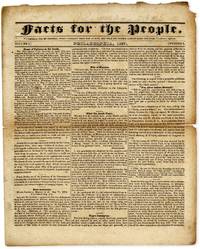
183788394Philadelphia: Anti-slavery Society of the City and County of Philadelphia; printed by Merrihew & Gunn 1837. Single quarto issue 29cm x 23cm; ca. 11-1/2" x 9-1/4". Bifolium 4pp pages numbered 9-12. Issued monthly. Old horizontal fold at center as issued; small loss at upper margin away from printed area brief separations at folds without loss to text; complete and Good. <br /> <br /> Single issue of this very scarce presumably short-lived abolitionist newspaper published by Benjamin S. Jones under the auspices of the Anti-slavery Society of the City & County of Philadelphia. This copy with dated 1864 pencil ownership markings of "J.E. Jones" this possibly being the publisher's spouse the reformer abolitionist and suffragist Jane Elizabeth Jones née Hitchcock; 1816-1896. The paper's contents are devoted almost entirely to exposure of the injustices of the southern slave system with excerpts from Southern papers quoted and sharply rebuked by Jones' editorial comments. This issue also includes a brief notice of the progress of the recently-founded city of Houston Texas which now contained ".about 3000 people two hundred buildings four hotels thirteen retail stores and one wholesale establishment." The extracts quoted in this issue are generally dated from March April and May of 1837 leading us to suggest a May-June date for this issue.<br /> <br /> It is unclear how many issues of Facts for the People appeared. The only recorded example for a physical copy is at AAS which holds two unspecified issues with the annotation "sparse holdings." Not in LCP Afro-Americana. Not in Blockson. Anti-slavery Society of the City and County of Philadelphia; printed by Merrihew & Gunn unknown
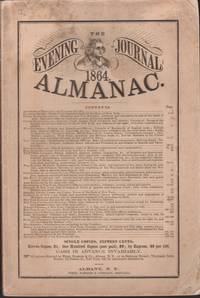
186432462Albany New York: Albany Evening Journal 1864. First Edition. Wraps. Good. Stitched wraps. 144 pages. Tan paper wraps with illustrated title top of the outer wrap. Contents printed on the front cover. Full page advertisement for the Albany Evening Journal printed on the back. Toning and light edge wear to the covers. Some corner creases to the pages. Much content on the Civil War. Almanac lists organization of the War Department and Navy Department; includes news of captured blockade runners; captures and losses in the Army; New York State volunteers; Rebel Government; and next to last on the bottom of the contents are two pages of Abraham Lincoln's Amnesty Proclamation. Albany Evening Journal unknown
18451160505.23Philadelphia: Lea and Blanchard 1845 1846. Hardcover. Good. 8vo hardcover no dj. Binds together the 12 monthly issues for each of 1845 and 1846: 24 issues total. Good condition. Quarter leather over brown cloth boards gilt spine lettering. Moderate interior foxing contents otherwise clean no markings binding & hinges firm. Reconditioned leather supple & smooth with pea-sized scuff spot at front edge of spine; gilt title lettering bright. 98 & 118 pp. incl's Index for each volume. Philadelphia: Lea and Blanchard hardcover
23561Undated c.1905. Typewritten draft of circular letter with corrections appealing for support for Griffith’s Sinn Féin newspaper and giving details concerning its foundation. Typescript 3pp 4to good condition. Author and recipient not stated. Undated but from the context written in 1906. It begins We desire to bring under your notice the following facts respecting the "Sinn Fein" daily newspaper’ and says that Griffith and the directors stated that ‘a sum of £8000 was required for the purpose’ but that the sum of £3300 only was subscribed in answer to the appeal. The Board decided to proceed with the establishment of the paper notwithstanding that the amount was so far short of that required. The paper commenced its tenth week on 1st corrected in manuscript from ‘2nd.’ November. The entire plant – exclusive of linotypes which are always hired is the property of the Company. The plant – in addition to the Linotupes sic includes a Victory machine which fortunately was acquired for a very small sum a fine stereo plant and type. The result is that the Company have now got a nice compact plant for the purposes required. . There are in England a large number of Irishmen of means who are interested in Ireland and who are anxious to do all in their power to financial support sic the new movements. To them it will be apparent that the principal support of the new movement will be a daily paper and who if the fats sic are brought before them would readily provide the monetary help required. It proposes a ‘Meeting in support of "Sinn Fein" paper’ and requesting that the reader subscribe directly ‘owing to the size of London’. From the Papers of Robert and Sylvia Lynd. Undated [c.1905]. unknown
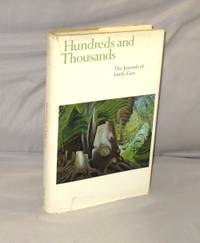
196629144Toronto:: Clarke Irwin 1966. First Printing of the First Canadian Edition. A Near Fine copy with previous owner name on flyleaf in a Near Fine dust jacket with modest edgewear. Emily Carr’s journals from 1927 to 1941 portray the happy productive period when she was able to resume painting after dismal years of raising dogs and renting out rooms to pay the bills. These revealing entries convey her passionate connection with nature her struggle to find her voice as a writer and her vision and philosophy as a painter. Clarke Irwin, unknown
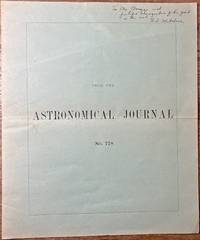
192034817Albany New York: Leander McCormick Observatory University of Virginia 1920. Reprint. Wraps. Good. Green printed stapled wraps. Approx. 11.75" x 10". 8 pages. Folded in the middle. Light creases and toning to the covers. Inscribed and signed by the author on the front cover. <br /> <br /> From wikipedia: Samuel Alfred Mitchell April 29 1874 – February 22 1960 was a Canadian-American astronomer who studied solar eclipses and set up a program to use photographic techniques to determine the distance to stars at McCormick Observatory where he served as the director. Leander McCormick Observatory, University of Virginia unknown
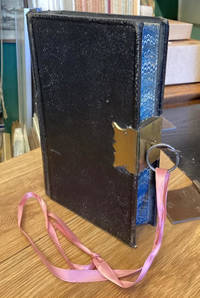
189072121unknown: unknown n.d. circa 1890. 8vo. Unpaginated. Black full morocco with a working brass key-locked clasp. All edges and endpapers marbled. With a contemporary pink ribbon attached to the key. Leaves are ruled and blank. Edgewear and rubbing to boards alongside some chipping to the leather at the spine. Some damage to the endpapers from the nails fastening the lock to the binding. Occasional marks and foxing to the leaves. No date but likely a late Victorian to early Edwardian binding. . Very Good. Full Morocco. 1890. [unknown] [n.d.] circa 1890 unknown
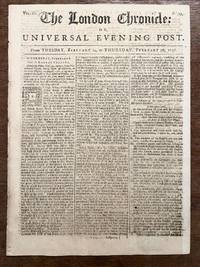
PR121614The London Chronicle or Universal Evening Post on laid paper 285 x 205 mm. unknown
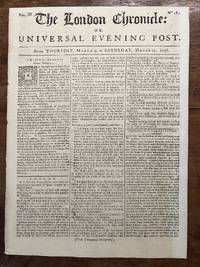
PR121618The London Chronicle or Universal Evening Post on laid paper 285 x 205 mm. unknown
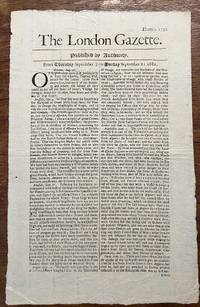
PR121617Antique newspaper on laid paper 290 x 180 mm. unknown
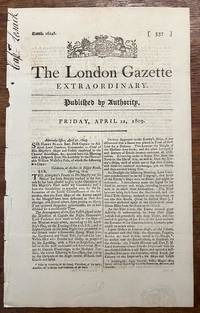
PR121616Antique newspaper on laid paper 300 x 185 mm. unknown
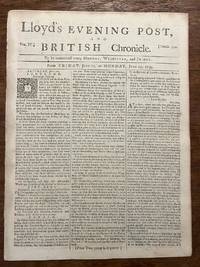
PR121615Lloyd's evening post and British chronicle on laid paper 275 x 200 mm. unknown
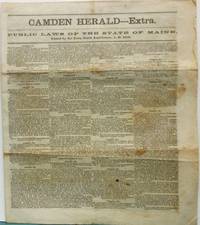
187026Camden Maine: Dunton Brothers 1870. Wraps. Very good. 8pp; two horizontal folds; some spotting and chipping of edges; very good. The Camden Herald newspaper is a mid-coast Maine Knox County paper founded in 1869. This Extra reports on the Legislature includes legislation passed relating to: attorneys banks cemeteries coroners fishing highways industry lime insane hospitals insurance judgements land licenses liquor manufacturing pensions of soldiers and seamen railroads salaries schools tax collection and wildlife preservation. Dunton Brothers unknown
1897149789Edinburgh: W & R Chambers 1897. Nice copy. octavo. disbound 16pp. Inc. an article ÔThe ÔMountain MysteryÕ of New South WalesÕ reporting on the trial & execution of ÔÕthe notorious Frank ButlerÕÕ. Also a fascinating article ÔThe Tourist in the Land of the TsarÕ about travelling in Imperial Russia W & R Chambers unknown
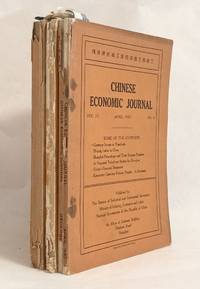
193010366Shanghai: Bureau of Industrial and Commercial Information Republic of China 1930. First Edition. Printed wrappers. Good. 8vo. Pp. average 200. Illustrated Vol I No. 1 with black & white photographs of jade artifacts; Vol I No. 3 with black & white photographs of Peking carts; Vol I No. 5 with several fold out charts; Vol VI No. 4 with black & white photographs of different currencies and all vols a map of China inside rear cover. Also included is "The Soybean Oil of China and its Manifold Uses" by A. A. Horvath 8vo pp. 57 bound in stapled paper wrappers with minor rubbing to edges. Articles cover a variety of industrial and agricultural and related subjects including population growth soybeans Big Horned Cattle currencies banking in China timber resources the business practices of Shanghai pawnbrokers salt and jade. Bureau of Industrial and Commercial Information, Republic of China unknown
18612786np: np 1861. First edition. Original leather covers. Good. A REMARKABLY EXTENSIVE ARCHIVE OF A UNION SOLIDER INCLUDING DIARIES FROM 1861-1865 SPANNING HIS ENTIRE CIVIL WAR CAREER.<br /> <br /> THE SOLDIER CHARLES E. SMITH PARTICIPATED IN SOME OF THE MOST CRITICAL CAMPAIGNS OF THE WAR INCLUDING THE SEIGE OF VICKSBURG THE FALL OF ATLANTA AND SHERMAN'S MARCH TO THE SEA. Background:<br /> <br /> Charles E. Smith 1836-1905 was born in Berlin Township Ohio. He worked as a farmer and country schoolteacher in Alum Creek Delaware County Ohio. He enlisted in the 32nd Ohio Volunteer Infantry at the age of 25 on September 3 1861 and mustered in September 7 1861. He was promoted to the rank of corporal in Company I of the regiment on January 30 1864. He was slightly wounded on July 29 1864 during the Atlanta Campaign. He mustered out of the service on July 20 1865 at Louisville Kentucky.<br /> <br /> The 32nd Ohio Infantry was organized at Mansfield Ohio on August 20-September 7 1861 and mustered in for three years' service under the command of Colonel Thomas H. Ford. The regiment was involved in several important engagements and operations during the Civil War including the Battle of Greenbrier River the Battle of McDowell the Battle of Harpers Ferry the Battle of Champion Hill the Siege of Vicksburg the Atlanta Campaign the Battle of Jonesborough Sherman's March to the Sea the Carolinas Campaign and the Battle of Bentonville. The 32nd Ohio Infantry mustered out of service at Louisville Kentucky on July 20 1865.<br /> <br /> The Collection:<br /> <br /> The collection consists of 26 dairies dating from 1859 to 1866. Except for four volumes covering a period from 1856 to April 1861 and one covering the period September 18 1865 to December 5 1866 the remaining dairies 21 volumes span his entire Civil War career in the 32nd Ohio Volunteer Infantry covering the period September 3 1861 the date of his enlistment to the date of his mustering out of the service on July 20 1865. The diaries of various sizes average approximately 100 pages with few blank pages.<br /> <br /> His daily entries in his Civil War diaries many of which are detailed consist of descriptions of the weather diet geographical locations his devotion to the Union camp activities military news and description of engagements. He also included several drawings in the diaries some in color. He described his day of enlistment of September 3:<br /> <br /> "Enlisted at Lewis Center between 8 and 9 oclock in Captain Dyre's company of 3 years volunteers. I bid good bye to all my folks and started having resolved to assist in sustaining the Government. But the feelings which came over me when I left home friends and all that seemed dear to me I cannot describe."<br /> <br /> The new enlistees moved to Camp Dennison and Smith records the daily activities in camp as his company prepared for their first movement. From Camp Dennison the 32nd Ohio was ordered to western Virginia present-day West Virginia to assist in driving Confederate forces out of the region. On October 3 1861 the 32nd Ohio participated in the inconclusive Battle of Greenbrier River. Smith records in his diary beginning on September 29 through October 3:<br /> <br /> "In the evening we received orders to march to make an attack on Greenbrier about 12 miles distant. Our company numbered 86 men. Our regiment probably numbered 900 men present and able to perform duty. The 32nd. Went in advance and cleared out the road and took one prisoner. Our regiment stopped at the cross roads within four miles of Greenbrier and stopped. We expected there that the battle commenced. but they Confederate troops did not come and we. crept into the thick laurel bushes to lay till morning. When I awoke it was daylight and other regiments were passing. The artillery was hurrying along as fast as possible each gun was drawn by six horses and about nine oclock the canons began to roar. It was kept up till two oclock on both sides when our communication failed and our men withdrew from the field without losing any guns. The canons roared very loud and the sound rolled over the Mountains and valleys and made everything ring once more. Our loss was including those that were killed on the field and those that died of wounds after the battle about 12 men. We took 13 prisoners." <br /> <br /> Smith describes an engagement with Confederate forces around Beverly Virginia on December 18 1861:<br /> <br /> "The rebels came out and met our forces and a bloody fight ensued. The 32nd fought bravely and drove the enemy back. The 25th were in the advance and were cut up dreadfully. They fell back and the 32nd stood their ground and fought them like tigers. Our men made two or three gallant charges and drove them out of their entrenchments and were forced out themselves. Our boys could not drive them out again and after a desperate and bloody struggle our troops retreated. having lost about one hundred men."<br /> <br /> After spending the winter in Beverly Virginia the 32nd Ohio participated in the Shenandoah Campaign of 1862 where they engaged Stonewall Jackson's Confederate force at the Battle of McDowell Virginia on May 8 and were defeated. On that day Smith recorded the following:<br /> <br /> "We formed into line and gave three cheers to the cavalry and were waiting to welcome the infantry when a dispatch came for us to report immediately at headquarters armed and equipped. We went forthwith and formed into line of battle on an open field. The rebels came down on the hills & tried to pick a spot to plant a gun and our boys threw shell amongst and drove them out. The rebels gathered on a mountain at the right of town about 4000 men. Our boys did not find out what they were at or where they were till late in the afternoon. Two regiments went up the mountain and the ball was opened. The battle lasted till after 8 oclock at night when our boys withdrew bringing the wounded and mostly all the dead from the field. The fight lasted about 4 hours."<br /> <br /> The 32nd Ohio retreated to Franklin Virginia where they joined General John C. Fremont's command. Fremont followed the Confederates into the valley and engaged a Confederate force at Cross Keys Virginia on June 8 1862 but Smith's company did not participate in the action. The 32nd Ohio move on to Winchester Virginia where they performed garrison duty for the remainder of the summer.<br /> <br /> In September 1862 the 32nd Ohio was dispatched to Harper's Ferry. The regiment again faced Stonewall Jackson participating in the Battle of Harper's Ferry September 12-15 1862. In this engagement Jackson captured the town and nearly twelve thousand Union soldiers including the 32nd Ohio subsequently paroling them after confiscating their supplies. In his entry for September 15 Smith describes the last day of the battle:<br /> <br /> "At sunrise the ball opened with a heavy cannonade from both sides. Our men were nearly out of ammunition for artillery and the enemy was mowing down our ranks. The shells and shot came down like hail all around and amongst us and many of our officers and soldiers were mortally wounded. Our artillerists run out of ammunition and there was no other way for us to do than surrender or be slaughtered on the field. At about 8 oclock the stripes and stars were hauled down and the white flag waved as a signal for surrender. The rebel cavalry and officers were soon riding through our camp. They hoisted the bars and stars where an hour before our glorious old star spangled banner floated proudly in the breeze. O how my heart beat and my bosom heaved to see that corrupt flag raised in defiance over us."<br /> <br /> The surrender of the 32nd Ohio resulted in a revolt in the ranks of the enlisted men against the regiment's officers which Smith later discusses in a January 15 1863 entry in his diary stating: "we were obliged to surrender 11500 men to the Rebels General A.P. Hill. It was the opinion of nearly all of our men that Colonel Miles of Baltimore betrayed us into the hands of the Rebels. It was said that he got 15 cents per head for us. Our Col Thomas H. Ford was examined by a committee and dismissed from the service for blame that was unjustly laid against him for the evacuation of the Maryland Heights. Since we were paroled a hard feeling was created between the officers of the regiment." Smith and his regiment eventually rejoined General Ulysses Grant's Army of the Tennessee in Memphis on January 25 1863. The regiment was involved in Grant's Siege of Vicksburg beginning in April 1863.<br /> <br /> A pivotal engagement in Grant's Vicksburg Campaign was the Battle of Champion Hill which occurred on May 16 resulting in a Union victory. Smith's entry for that day records the fighting:<br /> <br /> "A battle had begun on the left the firing seemed to be from large guns and the line seemed to be several miles long. We halted to await orders. Soon they came & we went forward & laid behind a ridge where we could see the fighting. The scene was grand but terrible. The heavy fighting was on the left & center at first. Our brigade charged on a rebel battery and took it & hauled it off. The 32nd did a noble part charging on the hills & ravines and out the battery driving the enemy before them killing a large number."<br /> <br /> The siege of Vicksburg ended on July 4 1863 when the Confederate forces surrendered and the Union troops under Grant including the 32nd Ohio entered the city. Smith recorded the events of July 3 and 4 in his diary. On July 3 he wrote: "This is the 46th day of the Siege. The rebels have sustained at this place and nobly and bravely have they defended it but General Grant has been too much for them." The next day's entry detailed the surrender. "At nine oclock it was announced that Vicksburg was surrendered. What a thrill of joy ran through every heart. The boys all seem lively and jubilant over the success which has crowned our arms. At half past ten oclock the rebels march out of their forts and rifle pits. and form in line outside their works and stuck arms."<br /> <br /> After Vicksburg the 32nd Ohio joined an expedition to Monroe Louisiana and then participated in General James McPherson's expedition to Brownsville Mississippi. In addition to his daily entries Smith also drew a number of pencil and ink sketches that reflected what he described in on a particular day such as sketching images that depicted the sleeping arrangements in the soldiers' tents maps of terrains and a two-page spread showing the capture of a Confederate battery in Mississippi. He also wrote down poems whether written by him or others. For example on January 31 1864 he added a six-stanza poem possibly written by him entitled "Evening Thoughts" to that day's entry. A partial transcription reads: "I'm weary and I'm lonely//As I'm sitting in my tent//And I'll take my leaden pencil//And give you my feelings sent// O would this war be over//And these bloody strivings cease//And our country now distracted//Return with lasting peace."<br /> <br /> In February 3 to March 6 1864 the 32nd Ohio was involved in General William T. Sherman's Meridian Expedition which resulted in the capture of Meridian Mississippi. On March 3 Smith recorded a diary entry that detailed the destruction rendered by the campaign:<br /> <br /> "I cannot fully give the amount of damage done to the Southern Confederacy while on this Expedition but the result foots up about as follows. About 200 miles of railroad running east & west was destroyed. About 60 miles of the Mobile and Ohio railroad was destroyed and about 40 miles of the Central Mississippi road destroyed. There were about 25 Locomotives and a considerable number of cars together with Confederate railroad houses machine shops and foundries manufacturing establishments of arms ammunition. A large amount of cotton was burned."<br /> <br /> On June 10 1864 the 32nd Ohio joined Sherman's Atlanta Campaign. In the campaign the 32nd fought in the Battles of Kennesaw Mountain Atlanta Ezra Church and Jonesborough. The campaign ended on September 2 1864 when Union forces occupied Atlanta. Smith's diary entry for June 27 mentions the engagement at Kennesaw Mountain:<br /> <br /> "We were aroused at early dawn. and then ordered to pile our knapsacks and be ready to move. A battery had been brought up and was shelling the Rebels lively for a while. Our division having formed a line of battle came to a right shoulder shift arms and then we advanced in line through the woods toward the enemy. The skirmishers engaged the enemy who replied by volleys of musketry which whizzed overhead and sounded hideous. The rebels brought several batteries down and opened upon us. Moved up a little higher and laid down again and the rebels opened with shot and shell which came whizzing overhead. Some of them sung like an old spinning wheel under the control of a northern farmer's wife. Our loss in this engagement was considerable. We fell back learning that the rebels were massing their force to right and formed a new line of battle in front of our new breastworks and behind the skirmishers. Skirmishing was kept up lively along the lines and many had hair breadth escapes. We made our demonstration to draw as much rebel force away from the right as possible."<br /> <br /> His diary entry for September 3 1864 reported the good news concerning the fall of Atlanta:<br /> <br /> "Atlanta was evacuated yesterday morning at daylight the rebels having blown up large magazines of ammunition destroyed government stores and eighty carloads of ammunition. The Twentieth Corps under General Slocum marched into and took possession of the city of Atlanta an eleven oclock. We have last caused the rebels to evacuate what they called the 'Gate City' or 'Key' to the southern Confederacy and that without a very general battle. The rebels have made many boasting speeches and declared that they would fight for Atlanta till the last man woman and child was sacrificed before they would give it up. Where is their vain boasting where are their prophesies"<br /> <br /> The capture of Atlanta had a major impact on the presidential election of 1864 and helped President Lincoln's chances for reelection enormously. On election day November 8 the 32nd Ohio voted in the field. Smith's diary entry for the day reads "This being election day the polls were opened and we voted for President. Abe Lincoln carried the day."<br /> <br /> In mid-November 1864 the 32nd Ohio participated in General Sherman's "March to the Sea." The command engaged in no noteworthy battles or skirmishes until reaching Savannah Georgia. On December 10 1864 the regiment was among the lead Northern units that drove the Confederate garrison into the confines of city. Upon the Union Army's capture of Savannah on December 21 1864 the 32nd entered and encamped in the city.<br /> <br /> Within a week of the fall of Richmond the capital city of the Confederacy the news of President Lincoln's assassination and death on April 15 spread slowly to the soldiers in the south including the 32nd Ohio. On Monday April 17 Smith recorded in his diary:<br /> <br /> "An order said to have come from Secretary Stanton to General Howard was announced to the soldiers. That President Lincoln Secretary Seward and son were assassinated and that the President was killed. Whether this be true or not it caused sadness in many hearts and was believed to be reliable."<br /> <br /> The next day's entry was in response to the confirmation that Lincoln was dead:<br /> <br /> "News of the death of our President Abraham Lincoln causes a gloom over our minds. We feel that in losing him we have lost one of the best men our nation ever produced. In losing him we lose a wise and intelligent statesman a great and good counsellor a lover of freedom and humanity and the deliverer of our nation from the curse of slavery."<br /> <br /> In addition to the dairies there are several documents and papers relating to Smith and his family including the following: 1 An autograph manuscript entitled "The Vicksburg Campaign from Millikens Bend Louisiana. From March to July 4th 1863" 81 pages one side only in a bound copy book cover missing 8.5" x 11.5" n.p.; n.d.<br /> <br /> 2 An autograph manuscript entitled "The Siege of Vicksburg Continued" 34 pages one side only in a bound copybook 6.75" x 8.25 n.p.; n.d.<br /> <br /> 3 Autograph manuscript signed entitled "Diary of Events Transpiring between the United States and Spain over Cuban affairs." 117 pages in bound copy book 5.75" x 9" n.p.; circa 1901.<br /> <br /> 4 Autograph manuscript signed entitled "Closing Scenes of the Rebellion. An Original Poem" Six pages one side only in bound copybook 8" x 10" n.p.; May 30 1895. Poem was recited on Decoration Day at Cheshire Ohio on May 30 1895.<br /> <br /> 5 An autograph manuscript entitled "The Great Three Days Battle of Gettysburg Fought July 1 2d & 3d 1863. The Greatest and Most Decisive Conflict of the Great Struggle for American Independence" 28 pages one side only in bound copy book missing front cover 8" x 10" n.p.' n.d.<br /> <br /> 6 Autograph manuscript part 2 of number 4 above 27 pages one side only in bound copy book 8" x 10" n.p.; n.d.<br /> <br /> 7 Autograph manuscript entitled "Original Poem Written for the 49th anniversary of the birth of Mrs. Louisa Rolson Smith" Five pages one side only 8" x 10" n.p.; June 22 1895.<br /> <br /> 8 Autograph manuscript signed entitled "Incidents in the war of the rebellion from 1861 to 1865. Poetical Effusions from the pen of Charles E. Smith late of Co. F. 32d Ohio veteran volunteer Infantry" 68 pages one side only in bound copybook missing front and back cover 8.5" x 11.75" n.p.; n.d.<br /> <br /> 9 Photograph of Charles E. Smith 3.5" x 4.75 oval albumin print mounted on board n.p; circa 1894. <br /> <br /> 10 CDV of George Smith brother of Charles E. Smith 2.5' x 4" T.Beach photographer Delaware Ohio; circa 1860s. <br /> <br /> 11 Medal with badge for 32nd National Encampment GAR Cincinnati 1898.<br /> <br /> 12 Photograph of residence of Charles E. Smith West Berlin Ohio an 9.25" x 7.5 albumen print on a 10.25" x 8.5" mount Acme View Company McAlisterville Pennsylvania; 1894. <br /> <br /> 13 A Confederate envelope "captured on the battle field of Raymond Miss. May 12 1863 by C. E. Smith. <br /> <br /> 14 Discharge of Charles E. Smith from the service one page 6" x 8.5" Columbus Ohio; July 28 1865.<br /> <br /> 15 Two pencil sketches by Smith of "A residence near camp of 20th Ohio sketched by C. E. Smith Dec 3d 1863" on front and "A scene in co. D. 20th O.V.I. Thursday evening Nov 26th 1863. A Thanksgiving oyster supper. Sketch by C. E. Smith Nov 27th 1863." <br /> <br /> 16 A pencil sketch of the "View of The Court House at Vicksburg. Drawn by C.E. Smith Nov 4th 1863."<br /> <br /> 17 Pencil sketch of the Rock House inside the Confederate fortifications at Vicksburg "Sketched by C.E. Smith Nov 2d 1863." On verso is sketch by Smith of the city vault in Vicksburg November 2 1863.<br /> <br /> 18 Photocopy of will of Charles E. Smith Two pages West Berlin Ohio; December 18 1901. <br /> <br /> Condition: The 26 diaries all have leather covers over boards which in most cases are worn but intact. The front cover of volume #9 has separated. Most have flaps. Overall the dairies are in good condition. The other items in the collection are overall good; numbers #1 and #7 manuscripts are brittle and fragile. Foxing and toning to letters along with creasing and light tearing at edges. Wear and staining to the exterior of diaries.<br /> <br /> Note: The text of the collection has been published as "A View From the Ranks: The Civil War Diaries of Corporal Charles Smith" in a very limited printing by the Delaware County Historical Society 1999. A copy of the book is included with the collection. <br /> <br /> A REMARKABLE UNBROKEN RUN OF DIARIES OFFERING A HIGHLY LITERATE FIRST-HAND ACCOUNT OF THE CIVIL WAR EXPERIENCE THROUGH THE EYES OF A UNION SOLDIER. np unknown
186136009New York 1861. Elephant folio 15-3/4" x 22". 8pp. Caption title as issued printed in six columns. Disbound light wear and several short closed tears at outer margins Very Good. <br /> <br /> A Civil War illustration of wishful thinking: "Your correspondent has this moment - half-past five o'clock P.M. - received a special despatch from a reliable source dated Louisville Kentucky Sept. 5 couched in the following language which confirms the announcement of the death of Jeff. Davis first made in this correspondence on Tuesday last:- 'Positive advices received here this morning on Davis' death.' A special messenger from Fortress Monroe who arrived here to-day announces that flags have been flying at half-mast along the rebel lines for several days and information was received at the fortress that it was in consequence of the death of Jeff Davis."<br /> A source from Richmond stated that Davis had a serious illness and "little hope was entertained of his recovery." This is then followed by a biographical sketch of the provisional Vice President Alexander H. Stephens under the heading "THE NEW PRESIDENT OF THE SOUTHERN CONFEDERACY." Much other war news is printed. unknown
18629136New York. Good with no dust jacket. 1862. First Edition. Hardcover. Large 5 1/2" tear in first leaf without loss of text. Small tears to margins. Folded horizontally in half. ; 8 page newspaper. Page dimensions: 22" x 16". Headlines include: Flight of the Rebels from Nashville; A Stand to be made at Murfreesboro' Columbus Randolph and Memphis; The Streets of Memphis Barricaded with Cotton. "Martial Law Declared in West Tennessee" - "Gen. Grant has declared martial law over West Tennessee with the understanding that when a sufficient number of citizens of the state return to their allegiance and show a desire to maintain law and order over the territory all military restrictions shall be withdrawn." ; Folio . hardcover
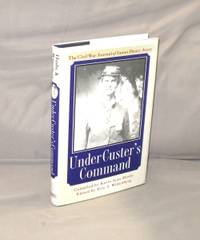
200028798Washington DC:: Brassey's 2000. First Printing of the First US Edition. A Fine tight copy in a Fine unclipped dust jacket. George Armstrong Custer’s fabled Fifth Regiment fought with great distinction throughout the war and suffered the third highest total of men killed in the entire Union cavalry. A twenty-four-year-old farmer and new father from Hopkins Michigan named James Henry Avery was one of Custer’s feared “Wolverines.” Besides eloquently describing his personal experiences Sergeant Avery’s wartime journals and postwar reminiscences provide uniquely detailed descriptions of Civil War cavalry movements and the only known account that addresses the escape of elements of the Fifth Michigan Cavalry on the first day of the Battle of Trevilian Station. Brassey's, unknown
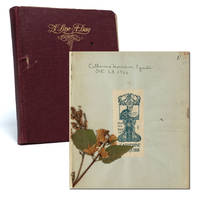
19116011US Germany 1911. Red cloth over card with gilt to front board. All edges stained read. Measuring 200 x 170mm and containing 186 handwritten pages across five years. Dried flowers and theatre program loosely inserted at front. Ownership signature and bookplate of Catherine Harrison Squibb to front pastedown and endpaper with signature of the same to rear endpaper. A research rich and densely written diary the present would be useful in fields including but not limited to intergenerational wealth and its relationship to emotional abuse women's education and educational travel early 20th century reading habits modern friendship courtship and romance and women's increased mobility and travel.<br /> <br /> The second daughter of Charles Fellow Squibb himself the second son of pharmaceutical boss Dr. E. R. Squibb Catherine Harrison Squibb was raised in economic privilege. Her earliest years were spent in the Brooklyn townhouse built for her parents by her grandfather while her teen years were split between her father's historic estate of Welwood and her boarding school in Dresden. At Welwood Charles always considered as "the lesser son" according to his E.R.'s journals followed in his father's controlling footsteps by "purchasing polo ponies setting about learning to jump" and "insisting his children do the same.to maintain the lifestyle of the landed gentry" Belcher. This is confirmed in the opening entry of the diary October 25 1906 near Catherine's 16th birthday where she reports "I rode side-saddle with Rosalie in the morning.rode again in the afternoon ist richerverlobt! er est 62 --- alt!!" The numerous rides do not seem to entirely please Catherine as she hides her frustration in the German parenthetical roughly "he is engaged to be a judge! he is 62 years old!!". Three days later on her birthday she spends her time significantly differently clowning with her brother and aunt and "playing tennis in the afternoon." This becomes something of a tradition as her birthday entries report several times "played tennis all afternoon" She also notes her time in French and German lessons -- with German becoming more frequent during and after her time at school in Dresden especially when she wants to obfuscate her thoughts from unwanted readers. <br /> <br /> If this diary is any indication music and reading travel and school became refuges for Catherine. And she claimed as much time as she could to find independence and develop herself outside of Charles' strict rules. Her reading preferences reflect this desire to immerse herself in Jane Austen's world of social visits and balls where family conflict is eventually smoothed by a woman's exit to a loving partner and home of her own. "Good day!" she writes on April 29 1908 "Stayed in bed all day. I finished Pride & Prejudice and began Emma." This is contrast against her reaction to Charlotte Bronte's work on May 1 of the same year: "Cold & windy. We came in on the 9.30. Aunts at Welwood.had music lesson.I began Jane Eyre. Dismal book!" Her tone and word choice reflect the most happiness in these circumstances whereas riding is reported like a duty -- she may report what time of day and what horse but no expressions of joy accompany them. <br /> <br /> While the diary concludes in 1911 when Catherine is 21 we know that she would return to Europe from 1917-1919 as a nurse in WWI watching her own country battle her beloved Germany. Within the time her father had sold his birthright in Squibb and with "his extravagant lifestyle eating through his money quickly.he was forced to sell Welwood.not long thereafter he went to France" and never returned to the US Belcher. In 1920 she would marry veteran and shoe manufacturing foreman Raymond Pratt moving with him to Pasadena California and becoming a civic leader.<br /> <br /> Much deeper work can be done on Catherine's lives and relationships especially considering the current cultural trends of novels films and series depicting both the glamour and the emotional squalor of the 1%. unknown