4 788 résultats
1931KC15863Utrecht Netherlands 1931. Paperback. Very Good. April 1931 47pp. 7.25 x 9.75. This progressive Catholic cultural and literary journal was published between 19251941 and partly responsible for introducing modernist aesthetics to Netherlands alongside well-known avant-garde journals such as De Stijl and International Review i 10. Cover design and photomontage by Piet Worm 1909-1996. Very good with light soiling to the white covers with chips and small tears with tape repair to the spine mostly to the 1" split at the head of the spine. Binding tights with light wear throughout. <br />DUTCH LITERARY JOURNAL <br /> <br/><br/> paperback
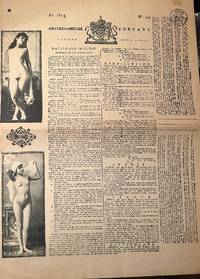
PR121572<div>A facsimile reproduction of the newspaper Amsterdamsche courant for Friday April 21 1815 in the margins of which photographs of nude women taken later in the 19th century have been reproduced. Original publisher J. Van Bonga. Only one other copy known in Yale library. 44 x 62 cm folded to 44 x 31 cm.</div><div></div><div></div> unknown
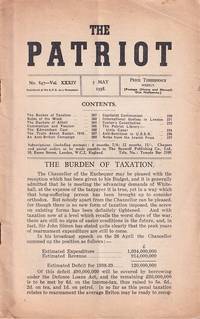
1938222733London.: The Patriot. 5 May1938. 358-380pp. 24 x 15cm. Leaves somewhat friable wrappers little marked and damp stained though overall a good copy of this scarce publication. A notoriously proto-fascist publication its roots in hardline Toryism with several of its more notable authors also affiliating with the British Union of Fascists. Reeking of antisemitism of the most insidious kind virtually every article has an explicit or implicit connection to a hypothesised far-extending Jewish conspiracy. <br> <br>This particular issue covers such topics as: the national budget shortfall; the evils of cinema; the arrival of Jewish refugees in Britain; the unwelcome conflation of fascism and communism in popular discourse; a denunciation of Katharine Stewart-Murray the Duchess of Atholl; a diatribe against Ireland and Éamon de Valera; and objections to Ceylon potentially demanding self-rule in the future. <br> <br>This ragtag assembly of articles is ultimately topped off with an ominous prediction of the imminent fall of the Soviet Union - itself a product of a "Jewish revolution launched according to the Jewish gospel of Karl Marx". The author declares that "a terrible settling of accounts is being prepared. and Israel will bitterly regret Nicholas II". . The Patriot. unknown
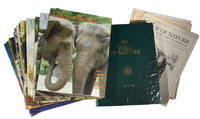
1982155951Bogor.: Green Indonesia Foundation. 1982- 1989. A broken run of 43 issues of the English language Indonesian journal Voice of Nature. Issues included: <br>Number V/15 1982; <br>Numbers 21 23 and 24 1984. Original wrappers printed in black and white. <br>Numbers 25 January 1985 - Number 39 March 1986 bound in dark green cloth binding with original colour wrappers bound in <br>No 45 January 1987 - Vol 53 December 1987. Lacks January July September October November and December. <br>Vol 54 January 1988 - Vol 65 December 1988. Lacks October 1988. <br>Vol 66 January 1989 - Vol 72 July 1989. Lacks August to December. The foundation journal for the Indonesian Conservation Movement. . Green Indonesia Foundation. hardcover
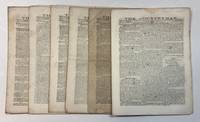
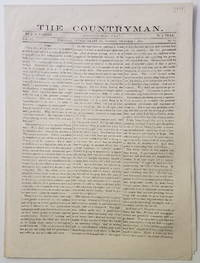
186241734Turnwold Putnam County Ga. 1862. Each issue a folio sheet folded to 8 pp. Each page 9-1/4" x12." Each number printed in three columns per page. No. 12 with a persistent corner chip and occasional small loss. Light foxing. Very Good. EACH ISSUE $250 OR THE ENTIRE RUN FOR $1000<br /> <br /> Crandall does not record Numbers 4 and 5; but AAS which says The Countryman was "suspended intermittently" evidently owns them. Its first printing was March 18 1862. The articles cover an array of subjects including of course much on the War: <br /> This interesting Confederate weekly was printed at Turnwold Turner's Putnam County plantation probably the only wartime newspaper so printed. "Joel Chandler Harris was an apprentice for Joseph Addison Turner. In 1862 Turner decided to produce a newspaper from his home at Turnwold Plantation. In fact in a more-than-semi-autobiographical book Harris wrote called On the Plantation he explains that the printing office for The Countryman was established 'in an outhouse.'. . . As was the typical arrangement for the time Harris worked for Turner in exchange for clothing and boarding at the Turnwold Plantation for the four plus years he apprenticed there. As a printer's devil Harris was responsible for setting and inking the type for the paper on the hand-press individually placing the letters so they were spaced appropriately for printing" "Joel Chandler Harris and The Wren's Nest" December 3 2020 Blog site of American Writers Museum accessed May 01 2026. <br /> Crandall 5152. Not in Parrish & Willingham. unknown
186241733Turnwold Putnam County Ga. 1862. Each issue a folio sheet folded to 8 pp. Each page 9-1/4" x12." Each number printed in three columns per page. No. 1 is browned. Very Good.<br /> <br /> Crandall does not record Numbers 4 and 5; but AAS which says The Countryman was "suspended intermittently" evidently owns them. Its first printing was March 18 1862. With the opening issue of this volume III Turner trumpets the "remarkable" success of The Countryman which has received a "universal acclaim of approbation" and has been financially successful. The articles cover an array of subjects including of course much on the War: Why the Hessians Enlist; the "worst provincialisms of the Yankees;" John Adams; observations on the War; the printing of The Countryman; poetry "The Old Plantation"; advertisements; President and leaders of the Confederate States; Iron; "Teaching Negroes to Read." <br /> This interesting Confederate weekly was printed at Turnwold Turner's Putnam County plantation probably the only wartime newspaper so printed. "Joel Chandler Harris was an apprentice for Joseph Addison Turner. In 1862 Turner decided to produce a newspaper from his home at Turnwold Plantation. In fact in a more-than-semi-autobiographical book Harris wrote called On the Plantation he explains that the printing office for The Countryman was established 'in an outhouse.'. . . As was the typical arrangement for the time Harris worked for Turner in exchange for clothing and boarding at the Turnwold Plantation for the four plus years he apprenticed there. As a printer's devil Harris was responsible for setting and inking the type for the paper on the hand-press individually placing the letters so they were spaced appropriately for printing" "Joel Chandler Harris and The Wren's Nest" December 3 2020 Blog site of American Writers Museum accessed May 01 2026. <br /> Crandall 5152. Not in Parrish & Willingham. Lomazow 687. unknown
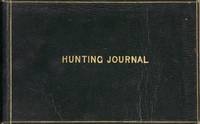
191831750United Kingdom 1918. Full leather. Very good. Oblong soft black leather journal. 8" x 5". Gilt lettered title "Hunting Journal" stamped on the front cover. Reddish marbled end papers and edges. Gilt lined borders on the covers. Front cover has a light creased area. <br /> <br /> Dates for the entries commence "Oct. 1st 1917" and end 13.1.20 January 13th 1920. Journal consists of 30 pages of hand written entries sectioned in printed columns with headings: "Date" "Hounds" Meet: Distance to it.; Horses; Wind & Weather; Scent; Coverts Drawn; Killed; and To Ground and Remarks. Remainder of journal after January 13 1920 unused. No removed pages. <br /> <br /> Name of g. F. D. Wade R.F.A. written on the front blank end paper. Inscription on the verso of the right front flyleaf reads: "The sport of Kings & the limage of war with none of its guilt & only twenty five per cent of the danger. From Handley Cross By R. S. Surtees sp." Journal covers hunts before the end of World War I November 11 1918. Under the remarks section are several listed names of people with Military ranks including Maj. Evans Maj. Beevor sp. Maj. Covy Maj. Atkinson Capt. Cox Capt. Holman and many other names are listed with some difficult to transcribe. unknown
12251<p><b><i>The Countryman</i></b> is the only newspaper known to have been published on a Southern plantation. J.A. Turner was the owner of the Turnwold plantation and editor of the newspaper. This issue features a full-page editorial titled "God Bless Our Southern Women!" which extolled their virtues during wartime. Also of interest is a full page devoted to "Teaching Negroes to Read." The author of the piece was quite clear in his views of educating slaves: "Negroes are incapable of education and it will be a waste of our time and resources to attempt to confer it upon them…"</p><p>Joel Chandler Harris author of the Uncle Remus Brer Rabbit and Brer Fox stories was employed as a printer's apprentice at Turnwold from 1862 at which time he was 16 years old to 1866. Indeed it was during his employment at Turnwold that he heard the stories told by slaves which served as the basis for his later successful literary efforts. This issue of <b><i>The Countryman</i></b> contains a brief item about a recipe for making black writing ink signed "J.C. Harris." </p><p>This issue of the paper comes from the personal collection of Joel Chandler Harris handed down to his youngest daughter Mildred Harris Camp then to her granddaughter from whom it was purchased by a prominent newspaper dealer and then by me. ICN 7579.</p><br /><br />
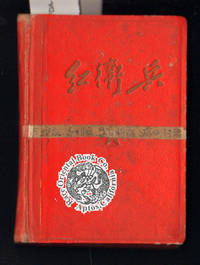
34021401Beijing 1967. Red board coverscloth spine4 color photos of Mao & Mao with Lin Biao no pagination ca. 250p. with penned text on lined paper very clean 9.3 x 13.2 cm.lower edges/corners/spine a bit rubbed else excellent example.RARE . . . A VERY RARE ORIGINAL PENNED DIARY & NOTEBOOK . . . BY A HONG WEI BING CHINESE RED GUARD . . . BAREFOOT DOCTOR . This "Hong Wei Bing" "Red Guard" note book was published in Beijing July 1967. It was a popular item with the "Red Guards" during the "Wenhua Da Geming" "Cultural Revolution". We have a few of these please inquire. . The book was published with a red cloth spine over boards and has 100 pages which = 200 pages/sides in all. . THE SUBJECT OF THIS DIARY: This diary was made a person who appears to be a "Barefoot Doctor" assigned to a rural location the last entry is May 16 1969 per the penned name & date on the last page. . The diary contains medical treatment exceptionally useful during the chaotic "Cultural Revolution" when "Red Guards" engaged in fights and confrontations of accused landlords moneylenders capitalists and ordinary Chinese who objected to being man-handled. The "Red Guards" were often injured or involved in fist-fights and other confrontations which caused them injury. . This diary/notebook was made to teach its author how to treat injured fellow "Red Guards." . It was also an early form of "Barefoot Doctors." That is to say amateur medical providers who treated 'ad-hoc' injuries as well as useful to those young "Red Guards" who went into the countryside to treat peasants who had no access to any medical parishioners. . SUBJECT: CONTINUED: . Sea navigation depends on the helmsman and our great helmsman is Chairman Mao. We must hold high the great banner of Mao Zedong Thought and carry the Great Proletarian Cultural Revolution through to the end. Turn socialist China into an iron-clad country of the proletariat and fulfill the glorious historical mission entrusted to us by the Chinese people and the people of the world. . The great leader Chairman Mao and his close comrade-in-arms Comrade Lin Biao stood side by side on the Tiananmen Rostrum watching the mighty parade. Chairman Mao happily said to Comrade Lin Biao "This movement is very large-scale it has indeed mobilized the masses and it has indeed had a great effect on the ideological revolutionization of the people of the whole country." . The millions of people at the General Assembly of Disabled Peoples expressed their determination in the Under the leadership of the great leader Chairman Mao carry the Great Proletarian Cultural Revolution to the end. . . . The content of this notebook is all medical and we believe it belonged to a "Barefoot Doctor" who was assigned to some distant province and outback where he practiced medicine in the deep rural area. It contains a wealth of medical knowledge and treatment concepts. . COLOR PHOTOS OF MAO & LIN BIAO: This book originally issued blank came with 4 1966 color photos of: a. Chairman Mao with Hong Wei Bing Red Guard red arm band on his life arm. This was more than likely the August 8th or 16th mass Beijing Tiananmen rally where the Red Guards were officially greeted and sanctioned by Mao. . b. The "Great Helmsman" shows Mao again at Tiananmen where he greeted the throngs he holds a cigarette and waves. . c. Another profile of Mao and Lin Biao as they greet the throngs in an early August 1966 mass rally at Tiananmen Square. . d. A color photo of the Tiananmen Square mass rally of the millions. The hold a banner advocating the Cultural Revolution."Man Sui" "Long Live the Cultural Revolution." . Each color photo has a caption indicating the historic setting. . Color photos are posted to our website. . CONDITION: . The book is bound in the original publisher's red cloth spine over red boards which has a front cover title reading: HONG WEI BING" "RED GUARDS. This was originally a blank book later filled-in by a young Red Guard. . The book is firmly bound solid with a tiny bit of usual wear to the head/tail of spine with usual minor rubbing to the edges & corners The contents are firm solid the diary was written in fountain pen ink with a few sketches here and there. An excellent example & seldom found primary resource. . . unknown
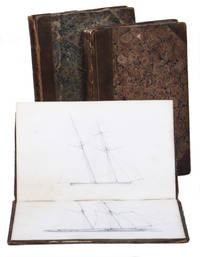
1822ABC_49460Aboard the Winchelsea written and drawn at sea 1822. Contemporary half gold-tooled brown calf marbled paper sides each volume with a different marbled paper the journal volume with marbled endpapers. 8vo. The two sketchbooks contain a total of ca. 100 pages of sketches of ships done in pencil including 1 page containing signal flags in colour. 3 volumes. With: Two sketchbooks with pencil drawings of ships. A neatly-written and illustrated sea journal kept by James Dudman the second mate on board the East India Company's ship Winchelsea during a 1822-23 voyage to India. Launched in 1803 the Winchelsea was already a veteran East Indiaman this being her ninth voyage - she made a total of eleven voyages for the EIC before she was broken up in 1834. On the present voyage commanded by Captain William Adamson she carried 592 people including the 17th and 44th Regiments of Foot and detachments of the King's and EIC's soldiers and a number of women and children. The sea journal volume is accompanied by two additional volumes by Dudman containing pencil sketches of unidentified masted sailing vessels.The Winchelsea's journey from its departure at Blackwall Dock on April 24 1822 to its arrival in Bengal and eventual return to England via St. Helena and The Downs on May 24 1823 reflects the extensive maritime routes integral to British imperial dominance. The ship's role in transporting personnel and cargo exemplifies the strength of the EIC's logistical network sustaining Britain's colonial and economic interests in India. The journal with its careful record-keeping offers an intimate glimpse into the daily operations experiences and extraordinary events encountered by the second mate aboard an East Indiaman during Britain's height of imperial expansion.The journal written in Dudman's beautiful scribe-like handwriting opens with an entry dated 24 April 1822 at Blackwall Dock where the voyage started "bound for Bengal." The next few pages contain a detailed listing of the people on board beginning with the ship's company of 122 men with names followed by the troops on board: "List of a detachment of His Majesty's Troops belonging to the 44th Regt. of Foot on board the Honable. Company's Ship Wincelsea for Bengal" comprising name and rank of 367 men followed by the names of 42 women on board as well as the name and age of 57 children on board including 3 who died at sea plus 4 additional passengers.At Saugur meaning Sagar Island they took on board further passengers duly noted in an additional "List of H.M. 17th Regiment of Foot with the Women and Children accompanying them. Embarked on board the Honble. Company's ship Winchelsea at Saugur New Anchorage for England."Beyond the usual records of position winds weather and other ships Dudman includes interesting notes on unusual occurrences. Perhaps the most fascinating event was recorded on February 10 1823: a major earthquake off the coast of India experienced by the Winchelsea: "At 10 minutes past 1 PM every one on board was greatly alarmed at the singular feel of the ship which was in a violent trembling motion as if the ship was grazing over a rocky shoal and a loud rumbling noise similar to the roll.g! of a Bull quickly along the deck this very singular seuration lasted certainly not less than a minute those below ran on deck to enquire the cause and those below the poop below to ask the same question. I was in the round house at the time when it comen'd. The noise appeared to me as coming along the quarter deck and instantly over the poop the sea was smooth and the day clear. I looked out at the stern windows but saw no appearance of any shoal which I certainly would have done had such existed. The water being very clear and the ship not going more than 2 knots I cannot account for this very singular phenomenon in any other way than its being the shock of an Earthquake".The voyage journal of the Winchelsea during its 1822-23 journey to Bengal provides valuable insight into the maritime operations of the EIC its commercial and colonial reach and the strategic importance of British trade with India in the early 19th century. As a veteran East Indiaman the Winchelsea was part of the vast trading network that connected Britain with the Indian subcontinent transporting soldiers goods and passengers under the auspices of the EIC which functioned as both a commercial enterprise and a colonial governing force.The journal volume contains the typographic book plate of Mr. Jas. Dudman on the front pastedown and a manuscript inscription in ink on the first flyleaf by Lumsden Dudman who was married to Mary Anne Shirreff "Joseph H. Shirreff from L.S. Dudman Xmas 1892" one of the sketchbooks contains a manuscript inventory list in Greek of goods for sale on the first flyleaf and one of the sketchbooks with ownership signature "L: Dudman / Sept. 27 1836" likely Rev. Lumsden S. Dudman perhaps a brother of James Dudman. Some general wear to the leather spines and corners of the boards of the volumes occasionally foxed but overall internally clean. Overall in good condition. unknown
1924106857<p>Newspaper small folio color comics 12 pp. A little aging and browning slight foxing; otherwise very good plus. Includes four pages of color comics. Some of the comics include a Felix the cat type character.</p>
1971024204Istanbul: Jamanak Nesriyat Limited Sti. Matbaasi 1971. Soft cover. Very Good. 8vo - over 7¾ - 9¾" tall. Paperback. Pbo. Roy. 8vo. 24 x 16.5 cm. B/w ills. In Armenian. 119 p. Yushamatean Yobelear Yerazhshtapet Nikoghos Tatareani 1921-1971. <br/> <br/> Jamanak Nesriyat Limited Sti. Matbaasi paperback
1718159896Tokyo: Asahi shinbun. Showa 17. January 181942. 4 page broadsheet newspaper folded evenly browned. Maps black and white photographic illustrations very good copy. 54 x 41cm. Main headline: "Closing in on Singapore Vanguard: Rear-guard of Defeated British Army Cut Off; Battle of Annihilation in Johor". Other headlines include: "Occupation of Strategic Territory of Batu Anam; Australian 8th Division Crushed" followed by an account of fighting between Japanese and Australian forces in Malaya; "Main Enemy Position Cut Off: Battle of Annihilation on the Bataan Peninsula Heats Up"; "Steady Advance by Road: Imperial Army's Fierce Attack on West Coast" followed by account of Japanese advances in Malaya with map; "British Cabinet Restructured"; "US Said to Be Sending Troops to Northern Ireland". Front page has photos of Japanese soldiers standing in front of the monument to Jose Rizal in Manila and of a column of Japanese soldiers advancing by bicycle along a road on the Bataan Peninsula. Articles on the inside pages include discussions of plans to increase production of shipping to meet war needs and of a meeting of Latin American countries to discuss the world situation. Several articles on the back page emphasise material and spiritual preparations being made in Japan for a "long war". The back page also includes an interesting article criticizing US and British propaganda and "misreporting" of the war situation. All text in Japanese. . Asahi shinbun. unknown
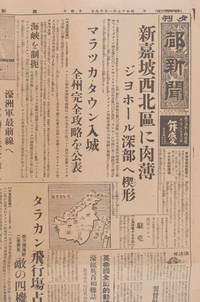
1572159803東京. Tokyo.: 都新聞社.Miyako shinbunsha. 昭和十七 1942. Double sided newsheet browned with a few small holes folded. Good copy. 54 x 40.2cm. WWII Japanese newspaper one sheet printed double side issued by Miyako Shinbunsha on January 18th 1942. Front page features latest military news including Japanese army's advances in Johore State and capture of Malacca town to the northwest of Singapore on January 15th. These is also a report on the capture of Tarakan airfield and on bombing raids launched against Rabaul. It also shows two maps one of Borneo and one of the war zone of southern Malaya Singapore and northern Sumatra. One article highlights the fact that Australian newspapers including Sydney's Daily Mirror have been critical of the failures of British Military strategy in Southeast Asia. Another entitled "Australian Army to the Front Line" describes the deployment of Australian forces to Southeast Asia to oppose Japan's southward advance. <br> <br>There is also an article on page 2 about marriages of Japanese military settlers in Manchuria. Not all of the reports are war related - the newsheet includes reports of sumo results and advertisments for patent medicines. Occasional closed tears at edges and trifle losses otherwise in good condition. Text in Japanese. . 都新聞社.[Miyako shinbunsha]. unknown
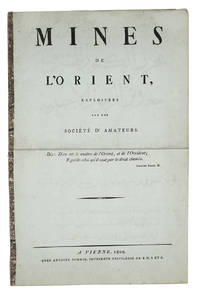
1809ABC_45177Vienna 1809. Folio. Antoine Schmid Folded strengthened with a decorated paper strip. 10 pp. Rare prospectus for a series of volumes to be issued periodically with contributions on a variety of subjects concerning Islamic studies and the Middle East in the broadest sense under the title Mines dOrient Fundgruben des Orients; Fontes rerum Orientalium; Sources for Oriental studies. The founders of this first professional journal were Count Wenceslaus Rzewuski and Baron Joseph Freiherr von Hammer-Purgstall who would also act as editor. Count Wenceslaus Waclaw Seweryn Rzewuski 1784-1831 was a Polish explorer poet orientalist and horse expert. Baron Joseph Freiherr von Hammer-Purgstall 1774-1856 was an Austrian orientalist and historian. Hammer-Purgstall published numerous texts and translations of Arabic Persian and Turkish authors.Both considered Vienna the ideal transfer point between West and East and invited all orientalists of Europe to contribute in French German English Italian Spanish or Latin. Six volumes of the journal were published between 1809 and 1818 by Antoine Schmid in Vienna.Corners a little frayed otherwise in good condition.l WorldCat 2 copies. unknown
CORV-BBP-13532Thomas Avery & Sons Ltd. Australia. Paperback. Good. Good. Softbound 8vo. No. 135 September 1925. Supplementary Tongan Vocabulary by E.E. Collocott The Umu-Ti: Ceremonial Fire Walking by JL Young and Notes on Incised Designs Seen in a Cave Near Waverly by TW Downes. 195-275pp. B/w photos & illus. > Language: English > Size: 8vo > Media/Binding: Soft cover Thomas Avery & Sons, Ltd., Australia paperback
CORV-BBP-13529Thomas Avery & Sons Ltd. Australia. Paperback. Good. Good. Softbound 8vo. No. 134 June 1925. 100-187pp. Legends of Samoa by O.F. Nelson The Evolution of Maori Clothing by Te Rangi Hiroa and The Moa in Maori Tradition by John White among others. Laid into this copy is the 8pp pamphlet The Polyesian Society: Its Genesis Objects and Achievements by Elsdon Best. B/w photos & illus. > Language: English > Size: 8vo > Media/Binding: Soft cover Thomas Avery & Sons, Ltd., Australia paperback
CORV-BBP-17947J.P.S. Sydney. Paperback. Good. Good Softbound 8vo. No. 148. Articles include Samoan Head-shaping by Andrew Thomson and The Story of Tawhaki by Henare Potae of Uawa. pp359-460. > Language: English > Size: 8vo > Media/Binding: Soft cover J.P.S., Sydney paperback
CORV-BBP-17949J.P.S. New Plymouth NZ. Loose Leaf. Very Good. Uncut pages. Very good. Unbound 8vo. pp355-371. > Language: English > Size: 8vo > Media/Binding: Unbound J.P.S., New Plymouth, NZ unknown
CORV-BBP-17938J.P.S. Sydney. Paperback. Good. Good Softbound 8vo. No. 137. Articles include The Oracle House in Polynesia by E. S. Craighill Handy. xx 72pp. B/w illustrations. > Language: English > Size: 8vo > Media/Binding: Soft cover J.P.S., Sydney paperback
CORV-BBP-17942J.P.S. Sydney. Paperback. Good. Good Softbound 8vo. No. 143. Articles include Raumahora and Takarangi - A legend of the Taranaki tribes and Hau and Wairaka - The adventures of Kupe and his relatives collected by Elsdon Best. pp207-302. B/w photos. > Language: English > Size: 8vo > Media/Binding: Soft cover J.P.S., Sydney paperback
CORV-BBP-17940J.P.S. Sydney. Paperback. Good. Good Softbound 8vo. No. 139. Articles include The Value of Tradition in Polynesian Research by Te Rangi Hiroa P. H. Buck and Dolmens in Espiritu Santo by H. D. Skinner. pp181-265. B/w photos illus. > Language: English > Size: 8vo > Media/Binding: Soft cover J.P.S., Sydney paperback
CORV-BBP-17944J.P.S. Sydney. Paperback. Good. Good Softbound 8vo. No. 145. Articles include Fish-poisoning in Rarotonga Hora by Te Rangi Hiroa P. H. Buck. 112pp. B/w photos illus. > Language: English > Size: 8vo > Media/Binding: Soft cover J.P.S., Sydney paperback
CORV-BBP-17950J.P.S. New Plymouth NZ. Loose Leaf. Very Good. Uncut pages. Very good. Unbound 8vo. pp403-420. > Language: English > Size: 8vo > Media/Binding: Unbound J.P.S., New Plymouth, NZ unknown
CORV-BBP-17948J.P.S. New Plymouth NZ. Loose Leaf. Good. Good. Unbound 8vo. pp390-398. > Language: English > Size: 8vo > Media/Binding: Unbound J.P.S., New Plymouth, NZ unknown