239 résultats
1888330521888. FRANK LESLIE'S ILLUSTRATED NEWSPAPER. SEA GIRT 1888: NATIONAL GUARD ENCAMPMENT. A 15.5-inch by 10.5-inch page from the newspaper the September 1 1888 issue featuring an engraving of the encampment of the Second Brigade State National Guard at Sea Girt. The image occupies the 9-inch by 11-inch lower half of the page and depicts a review of troops by Major-General Plume on August 23 1888. There is also a smaller 4-inch by 4.5-inch insert depicting a rifle competition for the Governor's Prize. The upper portion of the page shows several politicians. $75.00. <br/><br/> unknown books
186723291867. TOMS RIVER. FRANK LESLIE'S ILLUSTRATED NEWSPAPER. "TOMS RIVER: CRANBERRY BOGS NEW JERSEY." A 11-inch by 16-inch hand-colored page from the November 23 1867 issue of "Frank Leslie's Illustrated Newspaper." The scenes depicts scores of workers particularly young women gathering cranberry's in wicker baskets. $85.00. <br/><br/> unknown books
196519162New York 1965. First edition. Loose Sheets. Very Good. Large single sheet folded twice to form a booklet. The fifth issue of this Fluxus inspired newspaper edited by George Maciunas with a page given over to George Brecht. Printed on heavy brown paper stock. Illustrated. Measures 22 x17. Includes a full-page advertisement for the Perpetual Fluxfest. George Brecht Alison Knowles Robert Watts Eric Andersen Ben Vautier Chieko Shiomi and others contribute. Paper a bit worn with age. A fragile item in very good condition. <br/><br/> unknown books
1981WRCLIT61012Chouduno Italy 1981. Whole number one. 12mo. Decorated wrappers. Illustrated. Fine. Edited and published by Gaspari Walter. An intended quarterly with multi-lingual contributions including Bataille Corman Samperi et al. unknown books
1864694531864. A Curious 1864 Case Involving Murder and Insanity Editors of the Journal of Mental Science. Insanity and Crime: A Medico-Legal Commentary on the Case of George Victor Townley. London: John Churchill and Sons 1864. 47 1 pp. Octavo 8-3/4" x 5-1/2". Stab-stitched pamphlet with untrimmed edges bound into recent cloth printed paper title labels to front board and spine endpapers added. Moderate toning to text faint vertical crease through center small inkspots to a few leaves. $500. Only edition. In this unusual trial Townley was found sane and guilty of the murder of his fiancee but insane afterwards and thus incapable of execution. The discussion of this case in the interesting pamphlets examines among other related topics partial impulsive and "moral" insanity. OCLC locates 13 copies in North America 1 in a law library U.S. Supreme Court. unknown books
3751DS. 4pgs. 7 ½†x 12â€. December 1875. Somerset County New Jersey. A contract for the sale of a Somerset County New Jersey newspaper signed “C J Wilson†“D. W. Wilson†and “V.D. Honeymanâ€. The contract sates in part: “In consideration of one dollar to us in hand paid and for the further consideration to be made as hereafter specified we Charles J .Wilson editor and publisher of the ‘Somerset Gazette’ a newspaper printed and published in Somerville Somerset County New Jersey and David W. Wilson who has an interest therein do agree to sell and convey and do hereby sell convey transfer and assign unto a van Daren Honeyman of the same place all our right title interest ownership and possession of in and to said newspaper and its appurtenances with all its appliances machinery tools and materials presses type cases forms stencils frames inks and stock of paper on hand being everything whatsoever which is now in the office occupied by said ‘Somerset Gazette’…â€. The selling price was $3250.00 which was to be paid in three installments over a period of ten months. All three men signed the bottom of the document. It is in very good condition with several fold lines. unknown books
1737WRCAM55322Philadelphia: Andrew Bradford 1737. 4pp. illustrated with two woodcuts in the masthead and four maritime woodcuts in the text. Folio printed on a single folded sheet. Minor foxing and edge wear marginal stabholes along central vertical fold two short repaired horizontal tears. Very good. A rare issue of the first newspaper printed in Philadelphia and in fact the first American newspaper to appear outside Boston. THE AMERICAN WEEKLY MERCURY was founded by the pioneering Philadelphia printer Andrew Bradford in 1719. As would be expected this issue contains news from both Great Britain and the colonies. The first page contains a Parliamentary dispatch regarding the production of iron in the American colonies "where it is capable of being produced in every respect equal in Goodness to the best Iron from Sweden." and a report of a shipwreck off the coast of Bristol. Also included is shipping news from Boston and Philadelphia along with almost twenty advertisements containing information on ships for hire runaway servants trade services debt notices real estate offerings and more. <br> <br> Most notable among the advertisements are three relating to slaves. The first advertises for sale "A Likely young Negro Man about Seventeen that has been in the Country some Years and had the Small Pox." The second seeks return of a runaway "Servant Man named Patrick Burk a Saddler by Trade.of small stature brown Complexion short black Hair mark'd with the Small Pox." The last advertisement in the paper touts for sale "Very good Houshold sic Goods of all sorts: Also divers young Negro Boys and Girls all Born here." <br> <br> Andrew Bradford was the fourth printer in Philadelphia and the son of William Bradford the first printer there and in New York. The younger Bradford became Philadelphia's sole printer when he returned there in 1713 and remained so until Samuel Keimer arrived in 1723. He immediately obtained the lucrative contract to print the colony's laws and produced the first collected volume in 1714. He also published works on his own account including almanacs religious works broadsides the second edition of CONDUCTOR GENERALIS and the present newspaper. Bradford published the MERCURY from December 1719 until his death in 1742 though it was continued by others until 1749. <br> <br> Issues of THE AMERICAN WEEKLY MERCURY or any early 18th-century American newspaper rarely appear at auction or in the market. Andrew Bradford unknown books
1931KC15863Utrecht Netherlands 1931. Paperback. Very Good. April 1931 47pp. 7.25 x 9.75. This progressive Catholic cultural and literary journal was published between 19251941 and partly responsible for introducing modernist aesthetics to Netherlands alongside well-known avant-garde journals such as De Stijl and International Review i 10. Cover design and photomontage by Piet Worm 1909-1996. Very good with light soiling to the white covers with chips and small tears with tape repair to the spine mostly to the 1" split at the head of the spine. Binding tights with light wear throughout. DUTCH LITERARY JOURNAL <br/><br/> paperback books
193938801Amsterdam 1939. paperback. very good. Orgaan van de Maatschappij tot Bewordering der Bouwkunst Bond van Nederlandsche Architecten B.N.A. en het Genootschap Architectura et Amicitia. 60ste Jaargang. No. 1 - 52. 7 Jan. - 30 Dec. 1939. Illustrated. 52 vols. thin folio printed wrappers; some pp. stuck together else fine. Amsterdam 1939.<br/><br/> One year run of this technical journal edited by H. G. J. Schelling B. T. Boeyinga et al.<br/><br/> unknown books
02972612mo 361 pages of manuscript entries plus 16 pages of memoranda and cash accounts at rear pocket diary bound in original dark blue leather wallet style binding some minor wear to binding few old tape repairs to wallet flap entries in a good clear legible hand. The entries are dated January 1st through December 31st 1865. Accompanied by mid-twentieth century typescript transcription compiled by a Michener family descendant. Manuscript diary of Philip Fie Michener a carpenter and resident of Duncannon Pennsylvania. Michener was born July 30 1821 and died July 22 1889. The entries record the daily activities of Michener the work he was engaged in news of the Civil War the death of Abraham Lincoln and his experiences on a trip west across Iowa to Sioux City Iowa and into Nebraska Territory looking at various properties with a view to purchasing a homestead in that Territory. Michener was a correspondent of Rev. Samuel Aughey 1832-1912 a Lutheran minister and natural scientist and former Pennsylvanian and who had been in Nebraska since 1864 who acting in the role of promoter and booster seems to have induced a number of residents of Duncannon to Dakota Nebraska Territory to seek homesteads. Aughey was appointed in 1871 by the regents of the University of Nebraska to a chair of natural history at the new university. The only scientist on a faculty of five Aughey acquired the title of “Honorary State Geologist.” He was possibly the best known member of the university faculty during the 1870’s Aughey became a well-known Nebraska booster. He promoted the richness of the state’s soils the idea of increasing precipitation by cultivating more acres and the prospects for coal fuel in that state with few trees. Sample Quotations: Sunday January 1 1865. “Sunday the weather fine and clear at Sunday School at 1 o’clock. School opened by P. F. Michener Sup’t and closed by Father Sylvanus Green with a few appropriate remarks we did get the news of the death of M. B. P. Stewart who was seriously wounded and died from the effects on the 27th of November 1864.” Monday January 2 1865. “… received from A. G. White twelve dollars for making sleigh and one dollar & half from A. Miller for repairing sausage cutter John McLain is very sick and he is at John Jones no person is allowed to go into see him save the family …” Monday January 9 1865. “This morning the coldest this winter. This evening somewhat warmer… Received a letter from Rev. Samuel Aughey from Dakota Nebraska Territory he gives much information about the country…” Wednesday January 25 1865. “This morning clear and very cold and has been all day and this is going to be a very cold night. The boys have a fine time sliding down the hills on their sleds. I was told today that the Smithsonian Institute at Washington has been partly destroyed by fire very lately which did contain many things that can never be replaced Such as paintings and so forth which is a great loss to the country.” Wednesday February 1 1865. “This morning cloudy and not so cold as it has been the sleighing is first rate yet. 18 years today since I did commence business. Chickens are crowing and it is but 9 o’clock. This evening is cloudy. I did today send my application with some certificates and a partition to Provost Marshall General for to try and get back my commutation and also a letter to the Hon. Jas. Bailey member of congress. Slavery is forever done with in the United States.” Wednesday February 22 1865. “This morning clear and pretty cold about 9 o’clock … There is a ball up at Bloomfield. I think it would be better for them here and hereafter if they would turn it into a prayer meeting and ask God to have mercy on their souls. Received the Governor’s message from Nebraska Territory I suppose sent by Bro. Aughey. Some very good things in it.”write for fuller description unknown books
19253070Richmond VA 1925. One year diary bound by Fidelity and Deposit Company of Richmond. Comprised of 271 pages handwritten by Beatrice E. Smither a young woman working in a law firm five years after the 19th Amendment's passage. The majority of passages are written in longhand with scattered shorthand throughout. Beatrice's daily diary reveals an incredibly active life and gives a strong sense of the kind of independence that women of her generation were experiencing.<br/><br/>Employed in Richmond Virginia at the law firm of Williams and Mullen founded 1909 and still operating Beatrice Smithers is the embodiment of a flapper. Throughout the year of 1925 she reports daily on her work at the law firm where she frequently stays til 6:00 or later on meetings of her multiple church and civic clubs and on her romances with two men Cy and George who rival for her affection. She even reports on political events such as board local and presidential elections in which she participates. The diary is clearly a safe space for her where she can sort out ideas and emotions. <br/><br/>"Quite busy at work today" she reports on January 5 "Lunch at noon with Mae Burton - at night trying to work up some plan for Junior Council Meeting - Cy talks to me early - does not bring me home from work - John D. calls me up and wants me to attend a meeting of the Sunday Night Club." In entries like these we get a sense of the busy rhythm of Beatrice's days. In others we get a sense of her ability to manage and lead groups and how seriously she takes community engagement. "Leave office at 5:25 to ride up.to Public Library & look over same & I take out our membership card to get a book for my Sunday leading exercise -- Mae brings me home & I work for awhile on preparing to lead Sunday morning exercises" she reports on January 22. We also get regular glimpses into Beatrice's private life and her family. "Dear Diary" she writes on February 18 "As if we are not all worried enough to kill us with father's craziness drunk nearly all the day since he got back from Westbrook I had to turn my ankle while walking." The next day "Father home - who is again as usual drunk with liquor and not himself." The addiction issues in her family drive Beatrice to pursue financial independence -- and to think seriously about her choice of a mate as she debates between Cy "so dear and devilish" and George "so sweet and faithful"; she even despairs "I wonder if I am a traitor to my own self loving two men at the same time" and "I wish I could die!.Everything is a mess." There are even entries that cryptically suggest she had a pregnancy scare or was using the rhythm method to avoid it: "Menstruation begins" October 8 and "Menstruation ends" Oct 14 the only two such in the whole book. In the course of the year she ultimately breaks with Cy gets engaged to stable and supportive George and decides to continue working.<br/><br/>A densely packed manuscript with research potential including but not limited to women's employment history gender studies post-suffrage literature the history of reading the history of social and civic clubs in America the history of tourism paleography family addiction and mental illness and sexuality. unknown books
86229hardcover. Vol. VI No. 1-Vol. VII No. 25. April 5 1905-December 15 1907. 4to modern buckram; ex-lib. Habana 1905-1907.<br/><br/> unknown books
1990103481Newark DE: Library University of Delaware 1990. Softbound. VG. Spiral plastic bound. 192 pp. no illustrations. A mighty reference. Library, University of Delaware paperback books
2009CNJL1180Monmouthshire: The Old Stile Press 2009. Limited Edition. No binding. Fine. Lemaire Angela. No. 3 of 25 copies for sale folio size 52 pp. The story begins: "I was present during the Great Plague of 1665 It took away my life" he said. Per the artist this work originally produced by her in 1967 is "about a man who is killed by the plague in London in 1665; I have brought him to life again so that he can tell his story." The story unfolds as a series of nine eerily wonderful etchings by Angela Lemaire which were inspired by the sufferings of the plague victims. Each enclosed in a separate leaf and introduced with a quotation from scripture also dealing with suffering with each plate numbered and signed by her. Ms. Lemaire's Afterword tells the story of her inspiration for the work and the essay by Anthony Dyson discusses the making and proofing of the plates which is a story worthy on its own merits. <br/><br/>___DESCRIPTION: Unbound folio sheets each with letterpress printing on the first and last pages inserted between the plates the images from zinc plates with each plate signed and numbered by the artist in pencil. The eight intaglio plates images 2 through 9 are each tissue-guarded; Image 1 and the original Title page are both woodcuts. Folio size the signatures being just under 15" tall the work is unpaginated containing 52 pages excluding cuts and images; type Baskerville paper Somerset soft white satin; limited edition of 25 copies for sale plus 3 NFS this no. 3 signed by the artist on the colophon page. The unsewn sections are held loosely in a folded portfolio of smokey blue Roma paper handmade by Fabriano in Italy which is then laid into a clamshell box covered with blue cloth paper label on the front with olive green lettering lined with aubergine velvet. <br/><br/>___CONDITION: Signatures are fine; clean straight with no folds or edgewear. All tissue guards over the zinc etchings present. The portfolio is fine as is the clamshell box. <br/><br/>___POSTAGE: International customers please note that due to the size of this work additional postage may apply please inquire for details. <br/><br/>___Swan's Fine Books is pleased to be a member of the ABAA ILAB and IOBA and we stand behind every book we sell. Please contact us with any questions we are here to help. The Old Stile Press unknown books
1819SS321-001Various: Various 1918-1955. Hardcover. Very Good. For an itemized list of the items in this lot please inquire. Condition Very Good to Good. The Courier-Journal newspaper began publication in Louisville Kentucky in 1868 - the last run of the Courier-Journal newspaper was Sunday February 28 2021; the Courier-Journal Job Printing Company printing facilities closed for good on March 4th 2021. The material offered here is dated 1918 through circa 1955 and includes technical material used by apprentices and compositors working in the composition and press rooms of the Courier-Journal Job Printing Co. Included are 6 volumes of the Typographic Technical Series For Apprentices Part VI Nos. 32-40 out of series Chicago IL: Published by the Committee on Education United Typothetae of America 1918. All copies with the bookplate "Property of Courier-Journal Job Printing Co. For EMPLOYES' sic Use Only Return to Superintendent's Office" in a handsome Art Nouveau design on the front paste-down. This educational material demonstrates that the Courier-Journal Job Printing Company was unionized at least from the beginning of the twentieth-century and highlights the power and influence of typographers who were among the most educated economically mobile wage laborers in the United States and who were represented in every major urban center in the newspaper industry; the typographic unions won a 48-hour work week in 1897 and a standard wage scale throughout the newspaper industry; as an example of the power of the typographers unions in the 1930s the International Typographical Union introduced the 40-hour work week across the industry which spread to other unions and has sinse been codified across the labor sector by federal legislation; the typographers occupied an important if ambiguous place in the development of American labor history in as much as American labor was never successful in uniting all laborers together in one force but tended organize within industries. This grouping tends to focus on the tools of the trade including type specimens and catalogs of process inks issued in the 1920s and 1930s; Courier-Journal typographers left notes to themselves in these catalogs indicating material they felt needed representation in the Courier-Journal Job Printing Company's shops. Something of an outlier in this grouping is an accordion-fold volume of photographs of printing equipment available for use in the 1950s by the competing print shop The Standard Printing Company Incorporated of Louisville Kentucky. Most likely a salesman's dummy to show potential clients that The Standard Printing Company had the latest printing equipment and the most prestigious customers this undated circa 1955 without imprint accordion-fold photo-archive of printing equipment shows the most modern print shop of the 1950s. The earliest book printed by the Courier-Journal Job Printing Company was issued in 1884. An interesting article by Chris Kenning in the Louisville Courier Journal March 11 2021 gave some valuable insights into the history of the newspaper the Courier-Journal Job Printing Company and the challenges to the newspaper business and printing in general in the United States with the advent of desktop computers and the rise of the internet. While the Kenning article did not touch much on the time period 1918-1955 there are still interesting stories to tell about the printing industry in America the place of printing in the American labor movement and printing technology in the first half of the twentieth century that can be told using the materials offered here as visual aids. With the sale of the Courier-Journal to the Gannett Co. Inc in 1986 the road to the shut down of the Courier-Journal Job Printing Company was opened. Now the Courier-Journal newspaper will be printed in Indianapolis IN. The current print circulation of the paper is now under 60000 while the Courier Journal's digital journalism garners 4.5 million monthly visitors to their website. Media consolidation has been made possible with the internet's ability to distribute news on a minute-by-minute basis making regional newspapers printed on paper a redundancy. The Cincinnati Enquirer the Lexington Herald-Leader the Bowling Green Daily News are all regional newspapers that will no longer be produced locally after having been produced in Louisville by the presses of the Courier-Journal. This consolidation of the newspaper industry means the loss of 102 Louisville jobs including printing press operators mailroom and transportation jobs that have been lost to the relocation of the press work to Indianapolis. Various hardcover books
186337167Natchez Miss. 1863. Elephant Folio broadsheet 18" x 24." Each page printed in seven columns on dark blue-green "necessity paper." Old folds minor wear Very Good plus.<br/><br/> The Natchez Weekly Courier begun in 1848 ceased publication in 1870 when it merged with the Natchez Weekly Democrat. The Courier's publisher was William R. Adams. <br/> Printed on green "necessity paper" its War content is unusually rich. The middle of the first page prints and discusses "Butler's Order" of 15 May 1862 commenting on "the unparalleled order of Gen. Butler subjecting the women of New Orleans to insults and outrage by the soldiery under his command. The order will shock every person of the least refinement of decency." His "Proclamation" orders that "when any female shall by word gesture or movement insult or show contempt for any officer or soldier of the United States SHE SHALL BE REGARDED AND HELD LIABLE TO BE TREATED AS A WOMAN OF THE TOWN PLYING HER AVOCATION" capital letters in italics in original. A nine-stanza poem immortalizes Butler's abomination.<br/> Additional war news includes a long story on "The Fall of New Orleans" T.J. Jackson's progress in the Valley of Virginia "Stonewall Jackson is within twenty-five miles of the capitol." The roll of officers and privates of the Bingaman Rangers of Adams County Natchez is printed; military activities in Richmond Savannah Williamsport Jackson again with the support of "10000 Marylanders". Distressing news that "Jere. Clemens late Major-General of the Alabama militia has turned traitor. We can hardly believe that Jere would be guilty of such monstrous baseness. unknown books
177320539Baltimore: William Goddard Publisher 1773. Facsimile reprint. Abt VG some edgwear/horizontal fold-line in center/short horizontal tear to left edge 1" above fold-line with split in first leaf along horizontal fold. 1 sheet folded; 4 pp. Text in 3 columns. Wood-cut head-piece at mast-head. Folio. 43.2 cm x 26.5 cm. <br/><br/>This newspaper had the distinction of being the first published in Baltimore and continued in various guises until December 30 1794. Pg 4 of this issue has a George Washington advertisement seeking subscribers to lease land on the Ohio and Great Kanhawa. William Goddard, Publisher unknown books
1861333Cleveland: G. F. Lewis Publisher 1861. Single Issue. Broadside. 440 x 300 mm. 17 1/4/ x 11 1/2 inches. Printed in four columns. Folded some minor separation at folds edges folded and chipped some discoloration from tape at top margin otherwise good and sound. Old Soldier's Advocate was published from 1858 through Reconstruction when it ceased publication in 1878. As the title suggests its' cause was the enlisted man the veteran and war widows and orphans. Many of its articles include information about pressuring government to insure pensions and benefits to military families. This issue includes a description of General Fremont's removal from Command by President Lincoln a synopsis of his address to his troops reports from the field on Fremont's removal report about various Union troop movements in the West the resignation of General Winfield Scott a column on payments to war widows and heirs and a military pension report. One notice reads: "Apocryphal Report: Gen Beauregard is reported to have resigned his command of the rebels. Guess not." The editor Col. G. F. Lewis was the owner of the Bank of Cleveland as well as editor of the Old Soldier's Advocate and a woodcut illustration of the Bank appears in the fourth column. OCLC list a number of scattered issues of Old Soldier's Advocate in Americana collection around the country but this issue is not cited on any of the library catalogues we visited. A look online at Newspaper.com shows that many of the article which appear in Old Soldier's Advocate were picked up by other paper especially in the Midwest although runs of the newspaper are not cited. 333. G. F. Lewis Publisher unknown books
1865018675Clarion PA: Clarion Extra 1865. Book. Very good- condition. Unbound. First Edition. Quarto 4to. Issued the day President Lincoln died as he succumbed to the assassin's bullet. A one-sheet publication no place of publication listed but thought to be Clarion PA issued in haste as it has numerous typographical errors. Folded into fourths moderately foxed with one corner torn off affecting a few letters of text. It reads: CLARION EXTRA. FROM WASHINGTON. Pres. Lincoln Assassinated! Sec. Seward Assassinated! Seward's Son Dangerously Wounded! THE NATION MOURNS. Curiously the final line of text reads: The latest despatch states that Booth the supposed assassin has been captured. - Ed. Measures 5.5 inches width by 12.75 inches height. . Clarion Extra Paperback books
1863WRCAM48378ASt. Louis: Wiebusch und Sohn 1863. Four volumes bound in one. 2208; 200 of 208; 4208 lacks pp.137-144; 2200pp. Vol. 17 lacks issue 26. Vol. 18 lacks issue 18. Folio. Half morocco and marbled boards. Spine and corners heavily worn front cover detached. Titlepage of first volume torn; second and third leaves heavily torn with some minor loss. Light to moderate foxing and wear. Else good. Lutheran German-language newspaper founded in 1844 by Carl Ferdinand Wilhelm Walther 1811- 87. The paper and its founder were key components in introducing the idea of an umbrella church for Lutherans in America and the Midwest founding in 1847 the German Evangelical Lutheran Synod of Missouri Ohio and Other States. In the 1840s and '50s Germans were the largest immigrant group in America settling heavily in the Midwest. Wiebusch und Sohn hardcover books
1862278075Philadelphia 1862. unbound. very good. 8pp. Elephant Folio front page has some small tears across the folded middle with a small loss of text several small tears in center margin of the whole newspaper very small hole to text of last page most pages with crease or fold lines. Philadelphia 1862.<br/><br/> On the front page in the first one and half columns on the left and concluding in two full columns on the last page is an article on the February 5 1862 United States Senate vote to expel Senator Jesse Bright of Indiana who was the most senior Democrat in the Senate. On March 1 1861 Senator Bright wrote a letter of introduction for Thomas B. Lincoln a Texas arms dealer. The letter was addressed to Jefferson Davis. In July 1861 Lincoln was captured with the letter by Union troops as he attempted to enter the Confederacy. Senator Bright was accused of being a traitor because of the letter. The proceedings of the Senate and impressions of the vote by Senators are included in the article. Senator Bright was expelled by a vote of 32 to 14. The yeas and nays votes with each Senator listed are on the front page. Jesse Bright was the fourth Senator from a Union state to be expelled during the Civil War.<br/><br/> unknown books
186136009New York 1861. Elephant folio 15-3/4" x 22". 8pp. Caption title as issued printed in six columns. Disbound light wear and several short closed tears at outer margins Very Good. <br/><br/> A Civil War illustration of wishful thinking: "Your correspondent has this moment - half-past five o'clock P.M. - received a special despatch from a reliable source dated Louisville Kentucky Sept. 5 couched in the following language which confirms the announcement of the death of Jeff. Davis first made in this correspondence on Tuesday last:- 'Positive advices received here this morning on Davis' death.' A special messenger from Fortress Monroe who arrived here to-day announces that flags have been flying at half-mast along the rebel lines for several days and information was received at the fortress that it was in consequence of the death of Jeff Davis."<br/> A source from Richmond stated that Davis had a serious illness and "little hope was entertained of his recovery." This is then followed by a biographical sketch of the provisional Vice President Alexander H. Stephens under the heading "THE NEW PRESIDENT OF THE SOUTHERN CONFEDERACY." Much other war news is printed. unknown books
5678Vintage newspaper printed during the Civil War. The New York Times December 13 1864 issue New York NY. The entire front page of this historic war-dated paper has stories of the War including "The War in Tennessee." In part: ".Seventy-four shots were fired at it doing however no damage.Our troops attacked and routed the enemy. The Federal loss was four killed and forty wounded. The enemy's loss is unknown." Slight wear and light foxing. Overall in excellent condition. unknown books
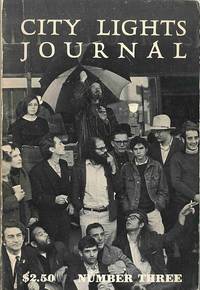
1966WRCLIT70552San Francisco: City Lights Books 1966. Whole number three of four in this iteration. Pictorial wrappers. Ink gift inscription on title usual slight rubbing else very good. Edited and published by Lawrence Ferlinghetti with associate editors. The third number of this irregular anthology/periodical highlighting authors associated with the imprint as well as a wide range of native and international writers many of them early in their careers. Herein appear Beck Garson Ginsberg Plymell McClure Olson Guest Ferlinghetti McCord Shattuck Pelieu et al. According to Cook the first printing consisted of 6000 copies and an undifferentiated second printing of 5000 copies was produced in 1967. COOK 57. City Lights Books unknown books
1966WRCLIT70387San Francisco: City Lights Books 1966. Whole number three of four in this iteration. Pictorial wrappers. Slight dust smudging to lower wrapper but very good or better. Edited and published by Lawrence Ferlinghetti with associate editors. The third number of this irregular anthology/periodical highlighting authors associated with the imprint as well as a wide range of native and international writers many of them early in their careers. Herein appear Beck Garson Ginsberg Plymell McClure Olson Guest Ferlinghetti McCord Shattuck Pelieu et al. According to Cook the first printing consisted of 6000 copies and an undifferentiated second printing of 5000 copies was produced in 1967. COOK 57. City Lights Books unknown books